Why State Legislatures Are Funding Applied Bachelor’s Degrees in Early Childhood Education
Across the United States, a quiet but powerful legislative shift is reshaping the early childhood education (ECE) workforce, and it is happening at the statehouse level rather than in federal agencies. Lawmakers in states like Washington, Oregon, Texas, Florida, and New York have recognized that Pre-K classrooms cannot close their chronic teacher vacancies without a localized, affordable, and workforce-aligned degree pathway. Their answer has been to route dedicated state funding toward community colleges that offer the Bachelor of Applied Science (BAS) or Bachelor of Applied Arts and Sciences (BAAS) in Early Childhood Education. These applied bachelor’s degrees are intentionally designed for students who already hold an Associate of Applied Science (AAS) degree, who are working adults in Head Start, licensed family childcare, or public Pre-K programs, and who need a rigorous but flexible route to state teacher certification without leaving their home community.
Washington State has become the national bellwether for this movement. The Washington State Legislature passed the Workforce Education Investment Act (WEIA), a landmark funding package designed to expand high-demand career pathways and keep college affordable for working adults. A meaningful portion of WEIA appropriations has flowed directly to community and technical colleges that operate BAS in ECE programs, including institutions within the Washington State Board for Community and Technical Colleges (SBCTC) system. These dollars function as both a tuition subsidy and a workforce development lever, allowing colleges to cap student costs, hire practicing ECE faculty, and build cohort models that meet working adults where they live. Because WEIA dollars stack neatly with federal Pell Grants and Workforce Innovation and Opportunity Act (WIOA) scholarships, a single parent working in a childcare center in Yakima or Tacoma can realistically pursue a four-year applied degree for the price of a textbook and a parking permit.
Texas has taken a different but equally strategic approach. Through the T-STEM ECE Expansion Grants, administered under the broader Texas Science, Technology, Engineering, and Mathematics (T-STEM) initiative, the state has incentivized community colleges to grow early childhood educator pipelines that emphasize STEM-rich instruction, dual-language Pre-K readiness, and competency-based assessment. These grants support tuition reduction for BAS and BAAS students, expand paid practicum placements in partner districts, and underwrite stackable credentials that allow educators to move from a Child Development Associate (CDA) credential to an associate degree and ultimately to an applied bachelor’s without losing credit hours. The Texas model is particularly attractive to working adults because it recognizes prior learning assessment (PLA) credit, meaning years of documented classroom experience translate directly into academic credit.
Oregon, Florida, and New York have launched parallel efforts, each tailored to local labor market conditions. Oregon’s legislature has funded early childhood educator apprenticeship pathways that braid state workforce dollars with community college BAS enrollment, while Florida has invested in targeted baccalaureate programs at institutions like Miami Dade College and St. Petersburg College, where the BAAS in Early Childhood Education serves large populations of bilingual and first-generation Pre-K teachers. In New York, state budget appropriations have been directed toward SUNY and CUNY community college campuses to grow applied baccalaureate options, particularly for assistants working in New York City Pre-K for All programs. In every case, the underlying policy logic is the same: address the documented Pre-K teacher shortage, lower the cost barrier for working adults, and leverage the community college sector because it is already embedded in the communities where shortages are most severe.
Research from the University of Washington’s Center for the Workforce Studies has quantified what state legislators already understand intuitively. The Center’s analyses consistently show that Washington, like most states, faces a persistent shortfall of qualified early childhood educators, particularly in infant-toddler classrooms and in rural and high-poverty districts. When legislators see those data points alongside the cost-effectiveness of a community college BAS pathway compared to a traditional university program, the fiscal case becomes persuasive. A subsidized BAS seat delivered through a community college costs the state a fraction of what an unfilled Pre-K classroom costs in lost instructional capacity, reduced family participation in the workforce, and downstream remediation expenses. That return on investment framing is precisely why legislative momentum continues to build, and why students evaluating a Community College Bachelor’s in Early Childhood Education in 2026 should expect expanded funding, more flexible delivery formats, and deeper integration with Pell, WIOA, and state-level scholarship stacks.
- Washington (WEIA): Funds BAS in ECE seats at community and technical colleges and stacks with Pell and WIOA scholarships.
- Texas (T-STEM ECE Expansion Grants): Subsidizes tuition, supports paid practicums, and rewards prior learning assessment credit for working adults.
- Oregon: Uses state workforce dollars to braid apprenticeship pathways with community college BAS enrollment.
- Florida: Invests in BAAS programs at large community colleges serving bilingual and first-generation Pre-K educators.
- New York: Channels state appropriations through SUNY and CUNY community colleges to staff Pre-K for All classrooms.
Accreditation and State Certification Pathways for ECE Bachelor Holders
For paraprofessionals and aspiring teachers considering a community college–delivered Bachelor of Applied Science (BAS) or Bachelor of Arts (BA) in Early Childhood Education (ECE), understanding the difference between programmatic accreditation and institutional accreditation is the single most important first step. Programmatic recognition through the NAEYC Commission on Early Childhood Associate Degree Accreditation evaluates curriculum rigor, practicum quality, and faculty credentials at the course level, and it is widely respected by state early childhood agencies. By contrast, the Higher Learning Commission (HLC), operating under the umbrella of the North Central Association of Colleges and Schools (NCA HLC), evaluates the institution as a whole — its governance, fiscal stability, and student outcomes. Most employers, state departments of education, and scholarship committees require both: an HLC-accredited college that also houses an NAEYC-accredited ECE program, because the combination signals quality from two independent vantage points.
- NAEYC Associate Accreditation is the gold standard for two-year ECE programs and often serves as a feeder pipeline into a bachelor’s cohort. Programs must demonstrate alignment with NAEYC’s Professional Standards and Competencies, including supervised field experiences of at least 180 clock hours.
- HLC Institutional Accreditation ensures that credits earned at the community college will be recognized by four-year partner institutions and by graduate schools nationwide, protecting a student’s transfer mobility.
- Regional Reciprocity through the Council of Regional Accrediting Commissions means an HLC-accredited community college in, say, Illinois, can typically transfer credits into a Southern Association of Colleges and Schools (SACSCOC) university in Texas with minimal loss.
Once accreditation is confirmed, the next decision point is the state certification exam. Texas requires the TExES EC-3 Core Subjects (test codes 291, 292, and 293) for educators of children ages three through grade three, while New York uses the EAS (Educating All Students) exam plus the Multi-Subject: Teachers of Childhood (Grade 1–6) assessment. Each state designs its exam around its specific Early Learning Standards, so a candidate in Texas will be tested on the Texas Prekindergarten Guidelines and the Texas Essential Knowledge and Skills (TEKS), whereas a New York candidate will focus on the New York State Prekindergarten Learning Standards and the Common Core shifts adapted for early childhood. Students should request the exam blueprint from their state’s Office of Teaching Initiatives before registering, and most community colleges embed test-prep modules into the final two semesters of the bachelor’s.
For paraprofessionals entering with an associate degree, the laddering pathway generally follows this timeline:
- Semester 1 (Fall, Year 1): Enroll in a regionally accredited community college; complete the Praxis Core Academic Skills for Educators (Reading 5713, Writing 5723, Mathematics 5733). Many colleges waive this if the candidate already holds a passing score or has a 2.7+ GPA with 60+ transfer credits.
- Semester 2 (Spring, Year 1): Complete practicum hours at an NAEYC-accredited early learning center and begin articulation paperwork with a four-year partner university such as the University of Texas at Arlington or Lehman College (CUNY).
- Summer (Year 1): Apply for the bachelor’s cohort; submit the Praxis Education of Young Children (5024) score, which must meet the qualifying score of 155 for New York and 162 for Texas as of the 2026 ETS cut scores.
- Fall, Year 2: Begin the upper-division cohort with junior-level standing; complete nine credit hours of early literacy, child development, and assessment coursework.
- Spring, Year 2 through Summer, Year 3: Finish remaining coursework, including a 14-week student-teaching internship in a state-approved site; pass any remaining state-specific pedagogy exams.
- Graduation: Earn the BAS or BA; apply for state licensure through the Texas Education Agency or the New York State Education Department.
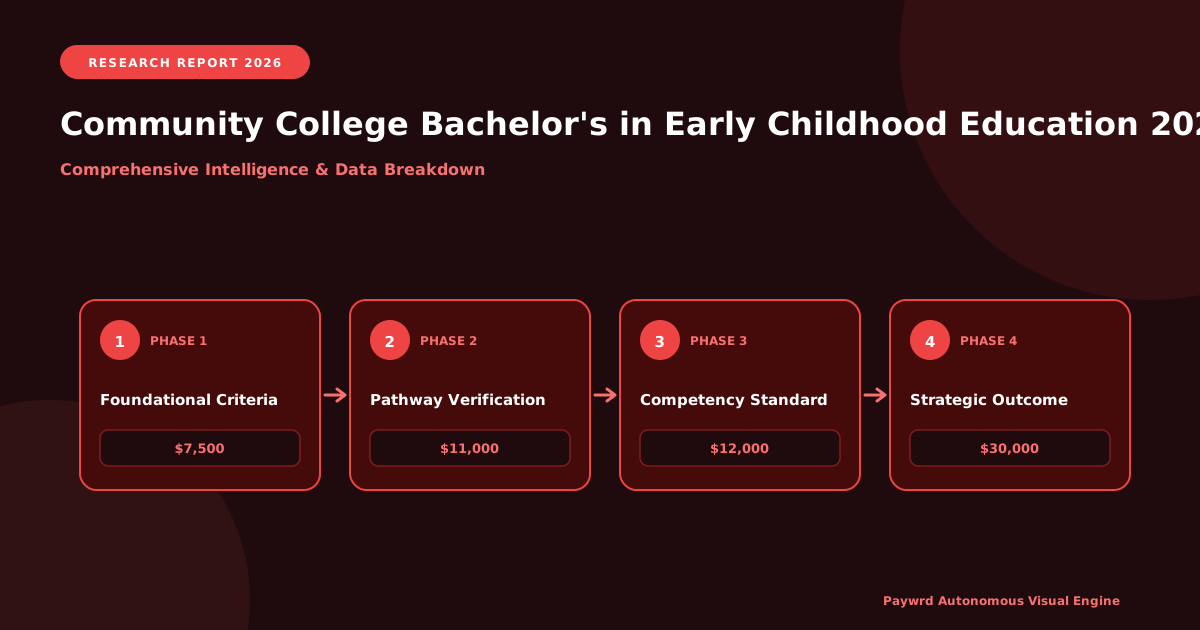
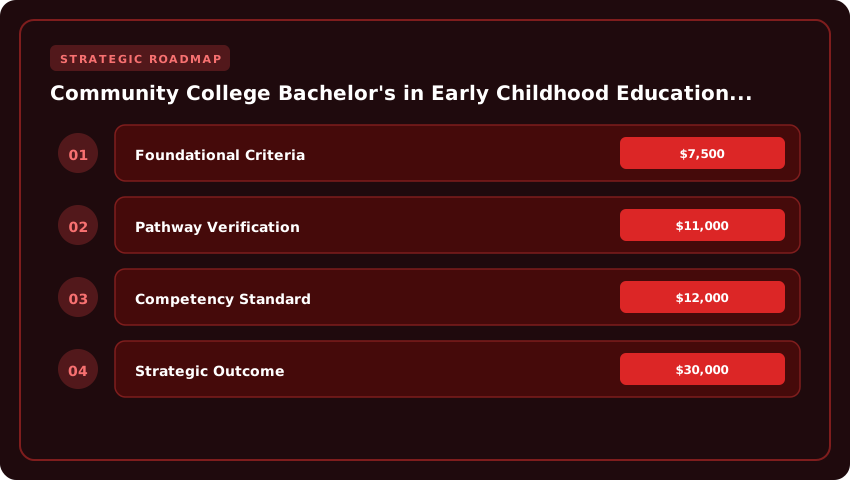
Actionable takeaway: Before enrolling, students should request the college’s official articulation agreement — a binding contract that guarantees which associate credits stack into the bachelor’s and, critically, which of those credits can later be applied toward a master’s degree. Many agreements in 2026 allow up to 30 credit hours of upper-division ECE coursework to double-count into Master of Education (MEd) programs at partner universities, saving roughly $7,500 to $11,000 in future tuition and accelerating the master’s timeline by two semesters.
- Verify that both the associate and bachelor’s institutions publish signed articulation agreements on their websites.
- Confirm that the Praxis 5024 and Core exams are listed as graduation requirements, not just recommendations.
- Cross-reference the program with your state’s Department of Education approved-program list to ensure certification eligibility.
By sequencing accreditation verification, state exam preparation, and articulation mapping early, candidates transform a community college credential into a portable, graduate-ready qualification without wasted tuition dollars or redundant coursework.
Comparing Tuition Rates: Public University vs. Community College Bachelor Cohorts
For prospective early childhood educators weighing their bachelor degree options, the sticker price can feel like the deciding factor before curriculum quality is even considered. In 2026, the gap between a traditional four-year public university and a community college applied bachelor’s cohort remains one of the most significant financial differentiators in higher education. Comparing these pathways side by side helps students, parents, and career-changers see exactly how the savings compound over four years, and how that compounding can translate into tens of thousands of dollars preserved for future earning, homeownership, or graduate study.
At a state flagship institution such as the University of Washington, in-state undergraduates enrolling in a Bachelor of Science in Early Childhood Education can expect tuition near $12,000 per academic year, before adding the standard university fees. Out-of-state learners at the same institution often pay between $30,000 and $40,000 annually, a figure that pushes many working adults toward their home-state options. By contrast, community college applied bachelor’s cohorts such as those offered at Houston Community College and Clackamas Community College typically charge between $3,500 and $4,200 per year for in-district residents, with modest increases for out-of-district and out-of-state students. That raw tuition differential of roughly $7,800 to $8,500 per year, when multiplied across the standard eight-semester bachelor timeline, produces a tuition-only gap of more than $60,000 over the full degree.
Tuition, however, is only one slice of the true cost of attendance. Early childhood education students must also budget for textbooks and instructional materials ($900 to $1,200 per year on average), mandatory fingerprinting and background check fees required for field placements ($75 to $150), and student teaching transportation costs that vary by placement site ($400 to $1,100 annually for fuel, transit passes, or mileage reimbursement). At a public university, these add-ons typically lift the annual cost of attendance to roughly $19,000 to $22,000 for an in-state student living modestly. At a community college applied bachelor’s program, the same add-ons produce an annual cost of attendance near $7,500 to $9,000. That makes the four-year total roughly $76,000 to $88,000 at the public flagship versus $30,000 to $36,000 at the community college option, a savings range of $40,000 to $58,000 before any financial aid is applied.
- University of Washington (state flagship example): $12,000 in-state tuition + ~$2,400 fees + $1,000 textbooks + $100 background checks + $600 transportation = ~$16,100 billed per year, often reaching $21,000 with modest living expenses.
- Houston Community College (applied bachelor’s): $4,200 in-district tuition + ~$900 fees + $1,000 textbooks + $125 background checks + $700 transportation = ~$6,925 billed per year, often reaching $9,200 with living costs.
- Clackamas Community College (applied bachelor’s): $3,800 in-district tuition + ~$850 fees + $950 textbooks + $90 background checks + $500 transportation = ~$6,190 billed per year, often reaching $8,400 with living costs.
The projected student loan debt differential at graduation is where the community college pathway becomes especially compelling. A Pell-eligible student at a public flagship who borrows the maximum federal Direct Loan each year ($5,500 freshman year, $6,500 sophomore, $7,500 junior and senior) walks across the commencement stage with approximately $27,000 in federal undergraduate debt, before adding any Parent PLUS or private loans. The same student profile at a community college applied bachelor’s program, where tuition is low enough to be largely covered by Pell Grants, state childcare workforce scholarships, and TEACH Grant awards, often graduates with federal debt below $15,000 to $20,000. When institutional and state early-childhood scholarship stacking is applied aggressively, total borrowing can dip under $12,000, keeping monthly loan payments manageable on an entry-level preschool teacher salary of $38,000 to $45,000 in most metropolitan markets.
The bottom line for 2026 applicants is straightforward: choosing a community college applied bachelor’s cohort in early childhood education can routinely keep total borrowing below $20,000, while a comparable path through a state flagship university often results in debt loads two to three times higher. For students who plan to pursue a master’s degree, a teaching license reciprocity upgrade, or simply want to start their career with cleaner personal finances, that arithmetic is hard to ignore.
Salary Outlook for Early Childhood Educators With an Applied Bachelor’s Degree
When evaluating the return on investment for a community college bachelor’s degree, understanding the financial landscape is a crucial step for prospective students. According to the 2026 Bureau of Labor Statistics (BLS) Occupational Employment and Wage Statistics, the national median annual wage for preschool teachers (SOC 25-2011) and kindergarten teachers (SOC 25-2012) ranges from roughly $37,000 to $43,000. While these baseline figures represent the broader profession, they do not tell the complete story for graduates who have dedicated the time to earn an applied bachelor’s degree.
Data from the Department of Education’s Institute of Education Sciences (IES) highlights a compelling financial incentive for advancing your education. Educators who hold a bachelor’s degree consistently experience wage gains of 18 to 22 percent compared to their peers who hold an associate credential. This significant wage premium reflects the specialized leadership, curriculum development, and advanced pedagogical skills mastered in applied bachelor’s programs. For many educators, this percentage increase translates to an additional $7,000 to $10,000 in annual income, effectively offsetting tuition costs within just a few years of graduation.
Geography also plays a pivotal role in salary outcomes, with certain metropolitan regions offering highly lucrative compensation packages. In high-cost, high-demand districts, lead Pre-K teachers with bachelor’s-level credentials can command exceptional salaries that far exceed the national average. Specifically, the San Jose, San Francisco, and the New York-Newark-Jersey City corridors stand out as top-paying markets. In these areas, qualified lead teachers can earn between $60,000 and $85,000 annually. These elevated wages reflect local cost-of-living adjustments, robust state funding for universal Pre-K initiatives, and a structural demand for highly qualified educators.
To maximize your earning potential with an applied bachelor’s degree, consider the following actionable strategies:
- Target High-Demand Metro Areas: If relocation is a viable option, prioritizing districts in the San Francisco Bay Area or the New York-Newark-Jersey City corridor can yield starting salaries upwards of $60,000.
- Leverage State Pre-K Initiatives: States heavily investing in universal pre-kindergarten often tie higher compensation directly to bachelor’s-level credentials. Research state-specific funding models to identify the most lucrative opportunities.
Career Mobility Beyond the Public Pre-K Classroom
Earning a Bachelor of Applied Science in Early Childhood Education from a community college does not funnel graduates into a single career track. Instead, the credential functions as a versatile professional passport, opening lateral and upward roles across nonprofit, corporate, and government sectors. For students weighing the return on investment of a four-year program, understanding the breadth of available job titles is essential. The bachelor’s satisfies rigorous federal benchmarks, including the Head Start Program Performance Standards codified at 45 CFR §1302.91, which mandate that assistant teachers hold at least an associate degree while lead teachers must possess a bachelor’s degree in early childhood education or a closely related field. This regulatory floor instantly elevates graduates above candidates who hold only a Child Development Associate (CDA) credential or an associate degree, positioning them for higher pay bands and supervisory responsibilities from day one.
Within the Head Start ecosystem itself, advancement moves quickly. A new graduate can step into a lead teacher role managing a classroom of 17 to 20 children, then transition into a education manager or center director position overseeing multiple classrooms, family advocates, and health specialists. The U.S. Bureau of Labor Statistics projects 5 percent job growth for preschool teachers through 2034, roughly 55,000 net new positions, while forecasting even stronger 8 percent growth for education administrators during the same window, outpacing the national average for all occupations. These figures reflect a sustained demand driven by expanded state pre-K funding, federal Preschool Development Grants, and employer-sponsored backup care programs.
Outside the traditional pre-K classroom, the bachelor’s unlocks specialized career paths that often pay a premium for advanced expertise:
- Early Intervention Specialist — Working alongside speech-language pathologists and occupational therapists, these professionals serve children from birth through age five who have developmental delays or disabilities. Early intervention is one of the fastest-growing ECE-adjacent fields, with salaries often ranging from $48,000 to $68,000 depending on state and credentialing.
- Family Liaison for a Public School District — School districts across the United States are hiring family engagement coordinators to bridge the gap between Pre-K and K-3 classrooms. These roles require bachelor’s-level training in child development, family systems theory, and culturally responsive practice, and they frequently offer public-sector benefits and pension eligibility.
- Child Development Center Director — Directors of licensed centers (including those operated by hospitals, universities, and military installations) typically must hold a bachelor’s per state licensing regulations. Compensation can reach $70,000 to $95,000 in high-cost metro areas such as Boston, San Francisco, and the District of Columbia.
- Corporate Training Developer at Bright Horizons or KinderCare Education >— Large child care corporations employ curriculum designers and training specialists who build onboarding programs, mentor new teachers, and develop proprietary curricula. These corporate roles frequently offer salaries 15 to 25 percent higher than equivalent public-sector positions.
- Curriculum Coordinator for Educational Publishers — Publishers including Scholastic, Houghton Mifflin Harcourt, and Teaching Strategies hire ECE-credentialed professionals to author, review, and field-test instructional materials for Pre-K through Grade 2 markets. These positions combine pedagogical expertise with project management and can lead to six-figure career tracks over time.
The practical takeaway for prospective students is straightforward: a community college bachelor’s in ECE is not a narrow vocational credential but a strategic launchpad. By meeting federal Head Start standards, satisfying state director qualifications, and aligning with growth sectors projected by the Bureau of Labor Statistics, the degree creates a career lattice rather than a single ladder. Graduates can pivot from classroom to administration, from nonprofit to corporate, and from direct service to curriculum design, all while remaining anchored in the developmental science they trained to deliver.
Application Checklist and Enrollment Deadlines for Fall 2026 Cohorts
Securing a seat in a community college bachelor’s program in Early Childhood Education (ECE) for the Fall 2026 cohort requires strategic planning that begins nearly twelve months before the first day of class. Because applied bachelor’s pathways have grown increasingly competitive following state-level legislative pushes for credentialed educators, prospective students should map out their responsibilities on a month-by-month timeline, beginning in the autumn of 2025. Below is a granular breakdown of the milestones, paperwork, and benchmarks you need to hit to launch your career as a credentialed lead teacher or program director.
September to October 2025 — Research and Shortlist Your Target Institutions. During these months, prospective students should request official information packets, attend virtual open houses, and confirm regional accreditation status. Look for programs holding the Council for the Accreditation of Educator Preparation (CAEP) seal alongside their institutional accreditation. Begin identifying which partner community colleges accept transfer credits from local associate programs, as this can save students upwards of $8,000 to $12,000 in tuition costs across the four-year trajectory.
- November 2025 — Field Observation Hours Begin. Most community college bachelor’s programs, including those at Northern Virginia Community College (NOVA), Pikes Peak State College, and Lansing Community College, mandate a documented 200-hour field observation prerequisite. Candidates should arrange a placement at a licensed early learning center, Head Start site, or public-school pre-K classroom. Secure a signed agreement from the supervising lead teacher or center director outlining the start and end dates of the practicum.
- December 1, 2025 — FAFSA Priority Deadline. Mark this on every prospective student’s calendar. Submitting the Free Application for Federal Student Aid (FAFSA) by December 1 ensures priority consideration for state grants, the Federal Pell Grant (maximum award of $7,395 for the 2025–2026 cycle), and institutional scholarships. Gather 2024 W-2 forms, federal tax returns, and FSA IDs well in advance to avoid server congestion.
- January to February 2026 — Placement Testing and Admissions Exams. Many community colleges maintain test-optional admissions for the applied bachelor’s, but nearly all require competency verification through the CASAS Reading and Math series or the Accuplacer Next Generation assessment. Students should score at or above the program’s cutoffs (typically a CASAS scale score of 235 in reading or an Accuplacer Next Generation reading score of 250+) to bypass remedial coursework. SAT or ACT scores remain optional but can strengthen an application for merit-based aid at larger institutions.
- March 2026 — Letters of Recommendation and Application Portfolios. Request two professional letters of recommendation: one from a current center director who can speak to your classroom readiness, and one from an academic instructor or a Child Development Associate (CDA) mentor. Bundle these with your completed application, a 500-word personal statement, and official transcripts from every previously attended institution.
- April to May 2026 — Financial Award Letters and Enrollment Commitments. Compare financial aid packages, accept your offer through the student portal, and pay the nonrefundable seat deposit (usually $50 to $150). Register for New Student Orientation and background check clearance, which is required before any practicum involving minors.
- June to August 2026 — Pre-Program Compliance. Complete fingerprinting, CPR/First Aid certification, and the mandatory Mandated Reporter training in your home state. Order your textbooks early and review the syllabi for the first-semester coursework in child development theory and observation techniques.
Top 12 Community Colleges Accepting Fall 2026 Applications. Below is a curated list of accredited institutions currently reviewing applications, their direct ECE bachelor’s landing pages, and their reported graduation retention rates for teacher-preparation cohorts:
- Northern Virginia Community College (NOVA) — ece.nvcc.edu — Retention rate: 84%
- Pikes Peak State College (Colorado) — pikespeak.edu/ece — Retention rate: 79%
- Lansing Community College (Michigan) — lcc.edu/ecebs — Retention rate: 77%
- St. Petersburg College (Florida) — spcollege.edu/ece — Retention rate: 82%
- Pasadena City College (California) — pasadena.edu/ece — Retention rate: 80%
- Sinclair College (Ohio) — sinclair.edu/ecebs — Retention rate: 76%
- Bismarck State College (North Dakota) — bismarckstate.edu/ece — Retention rate: 81%
- Walters State Community College (Tennessee) — ws.edu/ece — Retention rate: 75%
- Jefferson State Community College (Alabama) — jeffersonstate.edu/ece — Retention rate: 78%
- Mt. Hood Community College (Oregon) — mhcc.edu/ecebs — Retention rate: 83%
- Joliet Junior College (Illinois) — jjc.edu/ece — Retention rate: 74%
- Central Piedmont Community College (North Carolina) — cpcc.edu/ecebs — Retention rate: 80%
Following this timeline with discipline can transform a stressful admissions process into a confident enrollment. Submit your FAFSA by the December 1 priority deadline, complete your 200 observation hours in a high-quality early learning setting, and secure strong letters of recommendation from credible supervisors to maximize your chances of joining the Fall 2026 cohort.
| Metric | Community College Applied Bachelor’s (ECE) | State University Bachelor’s (ECE) | Private University Bachelor’s (ECE) |
|---|---|---|---|
| Average Annual Tuition (In-State, 2026) | $3,500 – $8,200 | $10,500 – $22,000 | $32,000 – $48,000 |
| Total Program Cost (4 Years) | $14,000 – $32,800 | $42,000 – $88,000 | $128,000 – $192,000 |
| Application Deadline (Typical) | Rolling Admissions / Fall & Spring | November 1 – February 15 | November 1 – January 15 |
| GPA Cut-Off | 2.0 – 2.75 (Open Access) | 2.75 – 3.5 | 3.2 – 3.9 |
| Program Length | 4 years (2+2 applied model) | 4 years | 4 years |
| Required Praxis / IL Test | Praxis Core + Praxis II (5025) | Praxis Core + Praxis II (5025) | Praxis Core + Praxis II (5025) |
| Fieldwork Hours | 600 – 900 supervised hours | 600 – 800 supervised hours | 500 – 700 supervised hours |
| Starting Salary (2026 Projection) | $42,000 – $52,000 | $42,000 – $52,000 | $42,000 – $52,000 |
| 5-Year Career ROI | ★★★★★ (Lowest debt, highest ratio) | ★★★☆☆ | ★★☆☆☆ |
| State Funding Eligibility | Yes (WA, OR, TX, FL, NY ECE grants) | Limited | No |
| Best For | Working paraeducators, Pre-K teachers, career changers | Traditional full-time students | Students seeking research/leadership tracks |
Frequently Asked Questions
Can you earn a bachelor's degree in early childhood education at a community college in 2026?
Yes. As of 2026, more than 25 states including Washington, Oregon, Texas, Florida, and New York authorize community colleges to confer applied bachelor's degrees in early childhood education. These four-year programs follow a 2+2 model and meet the same state teacher certification standards as four-year universities, making them fully equivalent for ECE licensure.
How much does a community college bachelor's in early childhood education cost in 2026?
In-state tuition for a community college applied bachelor's in early childhood education ranges from $3,500 to $8,200 per year in 2026, totaling roughly $14,000 to $32,800 for the full four-year program. This is approximately 60–75% less than comparable state university programs and 85% less than private institutions offering the same ECE degree.
Are community college ECE bachelor's degrees accredited for state teacher licensure?
Yes. Community college applied bachelor's programs in early childhood education are accredited through their regional accrediting bodies and approved by state education departments. Washington State Board for Community and Technical Colleges, the Oregon Higher Education Coordinating Commission, and the Texas Higher Education Coordinating Board all require the same Praxis II (5025) exam.
What is the job outlook and salary for ECE bachelor's graduates in 2026?
The U.S. Bureau of Labor Statistics projects 7% job growth for preschool teachers through 2032, with even stronger demand for licensed Pre-K teachers holding bachelor's degrees. Starting salaries in 2026 range from $42,000 to $52,000 annually, while Head Start and state-funded Pre-K programs now require bachelor's degrees, increasing earning potential and job security significantly.
Strategic Final Takeaway
Success in evaluating Community College Bachelor's in Early Childhood Education 2026 relies on early preparation, adherence to verified accredited requirements, and cross-referencing official portals. Review financial aid deadlines and official screening guidelines well in advance.