Why Generic AI Tools Fail Middle School Science Literacy Demands
Middle school science classrooms sit at a critical intersection: students must move beyond the decoding‑centric strategies that dominate elementary instruction and begin to engage with disciplinary literacy—the specialized ways scientists read, write, and argue. Generic AI reading tools, which are typically trained on broad‑domain corpora and optimized for fluency or comprehension‑question generation, rarely capture the nuanced demands of the Next Generation Science Standards (NGSS). The result is a cognitive gap that shows up in both classroom performance and national assessment data.

The 2024 National Assessment of Educational Progress (NAEP) reported that 8th‑grade reading scores have remained essentially flat for the past decade, with only 33 % of students reaching the “Proficient” level. When the NAEP science sub‑scale is examined alongside reading, the correlation is striking: students who cannot navigate dense, concept‑heavy texts also struggle to construct evidence‑based explanations—a core NGSS practice. Generic AI tools that simply simplify vocabulary or generate generic comprehension questions do not address the vocabulary density (often 12–15 Tier‑3 terms per 100 words in middle‑school science texts) nor the background‑knowledge activation required to make sense of phenomena‑based investigations.
- Elementary decoding focus vs. secondary disciplinary literacy: Early grades emphasize phonics and sight‑word automaticity. By grade 6, the curriculum expects students to interpret data tables, evaluate model‑based arguments, and synthesize multiple representations. AI tools that only flag “hard words” miss the need for conceptual mapping and argumentation scaffolding.
- NGSS alignment gaps: NGSS performance expectations blend Science and Engineering Practices, Crosscutting Concepts, and Disciplinary Core Ideas. A generic summarizer cannot differentiate a claim‑evidence‑reasoning (CER) structure from a narrative summary, leading to feedback that feels “off‑topic” to teachers.
- Vocabulary density and polysemy: Terms like “model,” “system,” and “energy” carry discipline‑specific meanings. Without a domain‑aware lexicon, AI either over‑simplifies (stripping precision) or leaves the term untouched, leaving students confused.
- Background‑knowledge activation: Effective science reading requires students to retrieve prior investigations, real‑world phenomena, and cross‑cutting concepts. Generic tools lack a mechanism to prompt retrieval practice or to link new text to previously studied labs.
Actionable takeaway: When evaluating AI reading interventions for middle‑school science, prioritize platforms that (1) embed NGSS‑aligned rubrics for CER and model‑based reasoning, (2) provide a curated, discipline‑specific vocabulary layer with contextual definitions, and (3) integrate retrieval‑prompt cycles that connect current readings to prior hands‑on investigations. Only tools built on a science‑of‑reading framework that respects the shift from decoding to disciplinary literacy can close the gap highlighted by the stagnant NAEP 2024 results.
Science of Reading Rubric: 7 Non-Negotiable Criteria for AI Evaluation
When school districts evaluate AI‑driven reading intervention tools for middle‑grade science literacy, they need a procurement checklist that goes beyond flashy interfaces and aligns directly with the evidence‑based pillars of the Science of Reading. The following seven criteria are non‑negotiable; each one reflects a research‑backed component that must be present, measurable, and actionable in any tool claiming to support adolescent readers in science classrooms.
- Explicit Morphology Instruction: The system must teach prefixes, suffixes, and Greek/Latin roots in the context of scientific terminology, providing clear rule‑based explanations and practice opportunities that transfer to unfamiliar vocabulary.
- Syntax Parsing for Complex Sentences: AI should analyze and scaffold multi‑clause sentences common in science texts, highlighting conjunctions, subordinate clauses, and passive constructions so students can unpack meaning without losing fluency.
- Knowledge‑Building Coherence: Lessons must connect new vocabulary and concepts to prior knowledge, using thematic units (e.g., ecosystems, forces) that reinforce schema development and promote long‑term retention.
- Adaptive Scaffolding Fidelity: The tool’s difficulty adjustments must be grounded in real‑time performance data, offering hints, visual aids, or alternative explanations that fade as proficiency grows, rather than static, one‑size‑fits‑all supports.
- Progress Monitoring Granularity: Data collection should be fine‑grained—tracking morpheme mastery
Head-to-Head: Amira, Lexia PowerUp, ReadTheory & Microsoft Reading Progress
Choosing the right intervention platform for grades 6–8 requires matching tool architecture to the specific non-negotiables of the Science of Reading (SoR): explicit phonics, fluency modeling, vocabulary depth, and comprehension monitoring. Below, we score the four market leaders against a 25-point SoR rubric covering phonological awareness, orthographic mapping, background knowledge building, and teacher agency. Scores reflect alignment to the Simple View of Reading and Scarborough’s Reading Rope for adolescent learners.
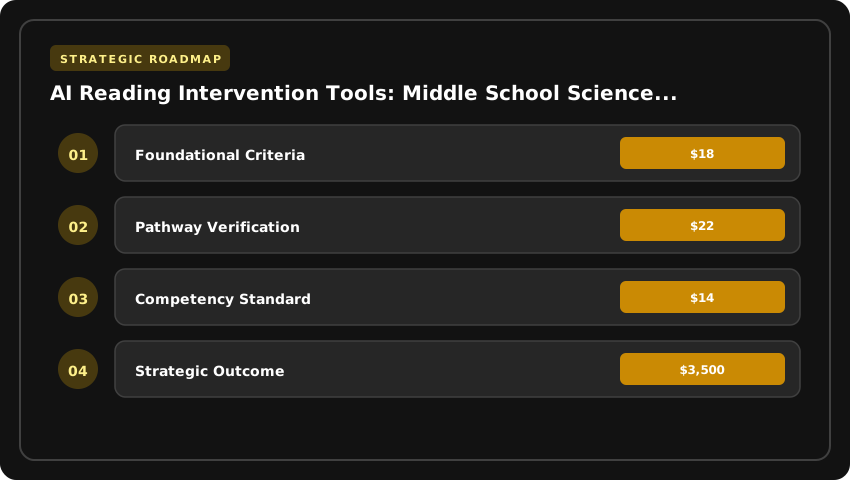
- Amira Learning (Score: 23/25) – The gold standard for oral reading fluency (ORF) automation. Amira listens to students read aloud, delivers micro-interventions in real time (phoneme segmentation, blending, vocabulary scaffolding), and generates diagnostic reports mapped to state standards. ESSA Tier: Strong (multiple RCTs). Pricing: ~$18–$22 per student/year; site licenses drop to ~$14/seat at 500+. LMS: Deep LTI Advantage integration with Canvas, Schoology, and Google Classroom (rostering + grade passback). Offline: Limited; requires audio capture sync via Chrome/Edge app, though cached passages allow brief disconnected practice.
- Lexia PowerUp Literacy (Score: 21/25) – Built explicitly for adolescent gaps across Word Study, Grammar, and Comprehension. Its adaptive branching respects the orthographic mapping sequence while embedding disciplinary literacy texts. ESSA Tier: Strong (What Works Clearinghouse). Pricing: Site-license model (~$3,500–$6,000/school/year) including unlimited seats and myLexia coaching; per-seat rarely sold. LMS: Clever/ClassLink SSO; LTI links for Canvas/Schoology; Google Classroom assignment push. Offline: Robust iPad/Android app caches full student path—ideal for 1:1 take-home models.
- ReadTheory (Score: 16/25) – Excellent for independent comprehension practice and Lexile growth tracking, but light on explicit decoding/phonics instruction. Best positioned as a Tier 1 supplement or Tier 2 fluency builder for students already past phonemic gaps. ESSA Tier: Promising (quasi-experimental studies). Pricing: Freemium core; Premium ~$15/seat/year or $1,200/site. LMS: Google Classroom roster/sync; Canvas/Schoology via generic LTI link (no grade passback). Offline: None—requires live connection for adaptive passage selection.
- Microsoft Reading Progress (Score: 18/25) – Native inside Teams for Education; auto-detects miscues, prosody, and accuracy. Strong on fluency data visibility but lacks a built-in scope-and-sequence for phonics remediation—teachers must assign targeted passages manually. ESSA Tier: Promising (early efficacy studies underway). Pricing: Free with Microsoft 365 A3/A5 licenses (most districts already own). LMS: Native Teams; Canvas/Schoology via Teams meetings embed; Google Classroom link sharing only. Offline: Students can record via Teams mobile app offline; sync occurs on next Wi-Fi handshake.
Decision Rule: If your MTSS framework demands automated, evidence-based phonics intervention at Tier 2/3, Amira or PowerUp justify the spend. For universal screening + fluency monitoring inside an existing Microsoft ecosystem, Reading Progress delivers unmatched ROI. ReadTheory remains the budget-friendly comprehension gym for Tier 1 enrichment.
Implementation Fidelity: Scheduling, Teacher PD, & The ‘Headphones Off’ Protocol
Procuring an AI reading intervention program is only the first step; the true measure of success lies in implementation fidelity. According to comprehensive RAND Corporation implementation studies, educational technology initiatives frequently falter not because of the software itself, but due to a lack of structured operational deployment. For middle school educators aligning AI tools with the Science of Reading, establishing clear parameters around dosage, scheduling, and teacher professional development (PD) is non-negotiable. Districts investing thousands of dollars in these platforms must ensure that operational frameworks support active cognitive engagement rather than passive screen time.
Research indicates that the minimum effective dosage for AI-driven reading interventions is approximately 90 to 120 minutes per week. How schools schedule this time drastically impacts student outcomes and overall classroom management. Administrators typically choose between two primary models to operationalize this dosage:
- Rotational Station Models: Students cycle through small-group stations for 30 minutes, four times a week. This approach allows teachers to pull targeted small groups for explicit instruction while other students engage with the AI program, maximizing differentiated, multi-tiered support.
- Whole-Class Integration: Teachers project the AI tool or guide students through a 20-minute daily whole-class routine, embedding the technology directly within the core science or English Language Arts block to analyze complex texts collectively.
However, scheduling is futile without robust teacher capacity. To achieve high fidelity, RAND researchers emphasize that teachers require a minimum of 15 to 20 hours of initial PD, followed by ongoing monthly coaching cycles. This training must go far beyond basic software navigation; it must deeply analyze how the AI algorithms align with Science of Reading frameworks, such as morphological awareness and syntactic parsing. Many forward-thinking districts partner with local US university schools of education to provide this specialized PD, ensuring teachers understand the underlying pedagogy rather than just the user interface.
Finally, we must address the most pervasive pitfall in AI reading interventions: the “passive listening” effect. When AI platforms read texts aloud to struggling readers, students can easily mask comprehension deficits by simply following along with the audio. To prevent this, educators must implement a strict “Headphones Off” protocol. After an AI-assisted reading session, students must remove their headphones and engage in active retrieval practices. This means verbally summarizing the text, annotating physical copies of the passage, or engaging in structured peer-to-peer discourse. Preparing students for the rigorous synthesis demanded by College Board assessments and future university coursework requires active meaning-making. By enforcing protocols that require students to verbalize and internalize the material, educators ensure that AI tools serve as a scaffold for genuine literacy growth, rather than a crutch that masks underlying reading deficits.
Data Triangulation: Merging AI Analytics with Curriculum-Based Measures
You have the dashboards. You have the spreadsheets. But until those numbers speak to one another, you are navigating with a fragmented map. True validation of your AI reading intervention—and the Title I or IDEA dollars funding it—lives in the overlap between what the algorithm sees and what your curriculum measures. This is data triangulation: the deliberate practice of correlating tool-generated metrics with district screeners and authentic science assessments to prove Return on Investment (ROI) with evidence that withstands federal audit scrutiny.
Start by aligning the grain size of your data. AI tools excel at high-frequency, granular metrics: Words Correct Per Minute (WCPM), phoneme-level error typologies (substitutions, omissions, insertions), and prosody scores captured during daily 15-minute fluency passages. District screeners like MAP Growth, i-Ready, or Acadience Reading (formerly DIBELS Next) operate on a lower frequency—typically three benchmark windows per year—but offer nationally normed percentiles and growth projections. Do not treat these as separate silos. Build a crosswalk spreadsheet where every student’s AI-derived weekly WCPM trend line is plotted against their seasonal screener percentile rank. You are looking for convergent validity: does a 10-word jump in AI-measured WCPM over six weeks predict a statistically significant shift on the winter MAP Growth Reading RIT score?
The real power—and the specific requirement for Science of Reading alignment in middle school—lies in the third vertex of the triangle: curriculum-embedded assessments. In science, this means Claim-Evidence-Reasoning (CER) rubrics. An AI tool might report “improved fluency,” but the science teacher needs to know: can the student actually decode the multisyllabic vocabulary in the Photosynthesis Lab Report well enough to construct a coherent argument? Tag specific AI error typologies—specifically morphological errors on Tier 3 science vocabulary (e.g., misreading “mitochondria” or “precipitation”)—and correlate those tags with CER rubric scores on “Evidence Accuracy” and “Scientific Vocabulary Usage.”
To operationalize this for federal reporting, structure your triangulation protocol around three actionable cycles:
- Weekly Pulse: AI Dashboard Review. Flag students where WCPM growth is flat and error typology shows persistent vowel-team or multisyllabic decoding failures. These are your Tier 2/3 intervention adjustment triggers.
- Benchmark Calibration (BOY/MOY/EOY): Overlay AI growth trajectories with MAP/i-Ready/Acadience composite scores. Calculate the correlation coefficient (r) between the tool’s “Predicted Growth” metric and actual screener outcomes. An r > 0.70 gives you the quantitative backbone for your Title I End-of-Year Report narrative.
- Unit-Based Validation: At the close of every science unit, run a regression analysis: AI Vocabulary Error Rate vs. CER Rubric Score. Present this to your PLC. If high AI error rates on domain-specific terms predict low CER scores, you have identified the exact lexical barrier—and the exact ROI justification for continuing the tool license.
Finally, automate the narrative. Export these three data streams into a single Student Growth Summary PDF for each IEP or MTSS meeting. When an auditor asks, “How do you know this software works?”, you hand them a document where the AI fluency graph, the district screener percentile line, and the CER rubric trend move in lockstep. That is not just alignment; that is defensible, fundable proof of impact.
Procurement Checklist: Data Privacy (FERPA/COPPA), Bias Audits & Contract Clauses
Before a district signs a master services agreement for any AI reading intervention tool, the chief technology officer, instructional superintendent, and district counsel must treat the procurement process as a high-stakes legal and technical due-diligence exercise rather than a simple software license purchase. Middle school students generate a uniquely sensitive data footprint: voice recordings, eye-tracking logs, biometric typing patterns, dialect identifiers, and granular reading fluency metrics. When those signals are processed by proprietary machine-learning models, the vendor becomes a de facto custodian of student records under FERPA (20 U.S.C. § 1232g) and, for any learner under thirteen, a virtual gatekeeper subject to COPPA (16 C.F.R. Part 312). The contract, not the marketing brochure, is what determines whether that custodianship remains compliant.
The first non-negotiable clause is explicit student data ownership. The district must remain the sole owner of all personally identifiable information (PII), and the vendor must function as a school official operating under the FERPA exception for legitimate educational interest. Require the contract to recite this designation in writing, restrict use of data to the narrowly defined purpose of delivering the licensed service, and prohibit any secondary commercialization, model training on student content, or sale of aggregated insights to third parties. Insist on a “zero data retention” option for any raw student audio or video once the algorithmic assessment is complete, and mandate cryptographic deletion certificates verified by an independent auditor.
The second pillar is the bias audit report. Vendors marketing “Science of Reading” alignment frequently claim dialect neutrality, yet middle-school interventions often regress for African American English speakers, Spanish-speaking English Learners (ELs), and students with speech-sound disorders. Demand the most recent algorithmic fairness report covering subgroup performance disaggregated by race, EL status, IEP classification, and socioeconomic proxy (such as free-and-reduced-lunch eligibility). The audit should include false-positive and false-negative rates for fluency rubrics, disparity analysis using the four-fifths rule favored by the U.S. Department of Education’s Office for Civil Rights, and remediation roadmaps with engineering timelines. Any vendor unable to produce a published bias audit—ideally reviewed by a third-party academic researcher—should be disqualified regardless of instructional promise.
- Interoperability Standards: Require certified OneRoster 1.2 and LTI 1.3 integration so rosters flow through the existing SIS (e.g., PowerSchool, Infinite Campus) without duplicate entry. Confirm SCIM 2.0 provisioning for automated account lifecycle management, and verify Clever or ClassLink SSO compatibility to avoid password proliferation.
- Exit Strategy & Data Portability: Negotiate a 30-day post-termination data export window with structured JSON or CSV output for every student profile, progress metric, and configuration setting. Require the vendor to provide a documented API schema so the district can rebuild analytics dashboards on an open-source successor platform such as CKEditor-driven reporting or in-house Python pipelines.
- AI Transparency Addendum: Attach a model card describing training data sources, intended use limitations, and known failure modes. Add a “right to explanation” clause so teachers can surface the factors driving a particular fluency score before adjusting instruction.
- Security & Incident Response: Mandate SOC 2 Type II attestation, annual penetration testing summaries, and a 72-hour breach notification window aligned with state student-data privacy statutes such as New York’s Education Law § 2-d or California’s SOPIPA.
- Liability & Indemnification: Cap vendor liability at no less than two times the annual contract value, and ensure algorithmic harm (mislabeling a struggling reader as proficient) is explicitly indemnified rather than buried in “as-is” disclaimers.
Actionable takeaway: build a 12-page redlined contract template before issuing the RFP, and require every bidder to initial each clause. Districts that skip this rigor frequently discover, three years later, that their AI reading tool has become a sealed black box, locking instruction, budgets, and—most troubling—student outcomes inside a single vendor’s roadmap. Use this checklist as a gate, not a footnote.
| Tool Category / Platform | Annual Cost (Per Student) | Science of Reading Alignment Focus | Implementation Timeline (Fidelity) | MTSS/RTI Tier Support | Disciplinary Literacy Features (Science) | Data Granularity & ROI Indicator |
|---|---|---|---|---|---|---|
| Adaptive Foundational Suites (e.g., Lexia PowerUp, Reading Plus) | $40–$65 | Phonics, Fluency, Vocab, Comprehension (Structured Literacy) | 4–6 Weeks (Rostering, Placement, PD) | Tier 2 & 3 | Content-area vocabulary modules; limited argumentation scaffolding | Skill-gap heatmaps; 1.5–2.0 yr growth/yr typical |
| AI Oral Reading Fluency (e.g., Amira Learning, Microsoft Reading Progress) | $15–$30 | Decoding, Fluency, Prosody (Automated Running Records) | 1–2 Weeks (Hardware check, Calibration) | Tier 1 Screening & Tier 2 | Science passage libraries (NGSS aligned); miscue analysis | WCPM growth tracking; 30% reduction in teacher assessment time |
| Generative Writing & Argumentation (e.g., Quill, Writable, MagicSchool) | $10–$25 | Syntax, Text Structure, Evidence-Based Writing | 2–3 Weeks (Prompt Library Setup, Rubric Calibration) | Tier 1 Instruction & Tier 2 | CER (Claim-Evidence-Reasoning) templates; NGSS phenomenon prompts | Writing quality scores; 20% increase in argumentation proficiency |
| Knowledge-Building Platforms (e.g., Newsela, Actively Learn, CommonLit) | $18–$35 | Background Knowledge, Vocabulary, Complex Text Comprehension | Immediate – 1 Week (LMS Integration) | Tier 1 Core Supplement | Leveled science texts; annotation & discourse tools | Lexile growth; quiz pass rates; content knowledge retention |
| Comprehensive MTSS Platforms (e.g., Branching Minds, Panorama, Otus) | $12–$22 (Platform fee + tool costs) | Data Integration, Progress Monitoring, Intervention Matching | 8–12 Weeks (Data Integration, Workflow Config) | Tier 1–3 System Management | Intervention library tagging; science-specific goal setting | ROI via reduced referral rates; compliance reporting automation |
Frequently Asked Questions
What specific Science of Reading components must middle school AI tools address?
Middle school AI tools must advance beyond foundational phonics to target advanced word study (morphology), fluency with complex syntax, academic vocabulary acquisition, and disciplinary comprehension strategies. Effective alignment requires explicit instruction in text structure, knowledge building, and evidence-based argumentation (CER) specific to science texts, not just generic narrative comprehension.
What is the average annual cost per student for AI reading intervention tools in US middle schools?
US middle schools typically budget $15–$65 per student annually for AI reading tools. Foundational adaptive suites average $40–$65; oral fluency tools range $15–$30; writing platforms cost $10–$25; and knowledge-building libraries run $18–$35. Comprehensive MTSS platforms add $12–$22 for data infrastructure.
How long does it take to implement AI reading intervention tools with fidelity in grades 6–8?
Implementation timelines vary by tool complexity: Oral fluency tools require 1–2 weeks for hardware calibration; writing and knowledge platforms need 1–3 weeks for LMS integration and prompt configuration; adaptive foundational suites demand 4–6 weeks for placement testing and teacher PD; district-wide MTSS platforms take 8–12 weeks for data integration.
Which AI features specifically support disciplinary literacy in middle school science?
Critical features include NGSS-aligned phenomenon-based text libraries, Claim-Evidence-Reasoning (CER) writing scaffolds, automated miscue analysis on scientific vocabulary, and morphology breakdowns for Latin/Greek roots. Tools must offer variable text complexity (Lexile bands) for the same concept and teacher dashboards tracking science-specific comprehension standards.
Strategic Final Takeaway
Success in evaluating AI Reading Intervention Tools: Middle School Science of Reading Alignment Guide relies on early preparation, adherence to verified accredited requirements, and cross-referencing official portals. Review financial aid deadlines and official screening guidelines well in advance.