Why Harvard’s $2.2 Billion Cost-Cutting Plan Triggered The 2026 Layoff Wave
When Harvard University announced in November 2025 that it would eliminate roughly 1,300 full-time equivalent (FTE) administrative positions, the higher education sector didn’t just flinch—it took notes. This wasn’t a routine belt-tightening exercise. It was a structural admission that the financial model underpinning elite R1 research universities has fractured. The catalyst is a “perfect storm” of policy shifts and revenue evaporation that no endowment, not even Harvard’s $53 billion behemoth, can indefinitely subsidize.
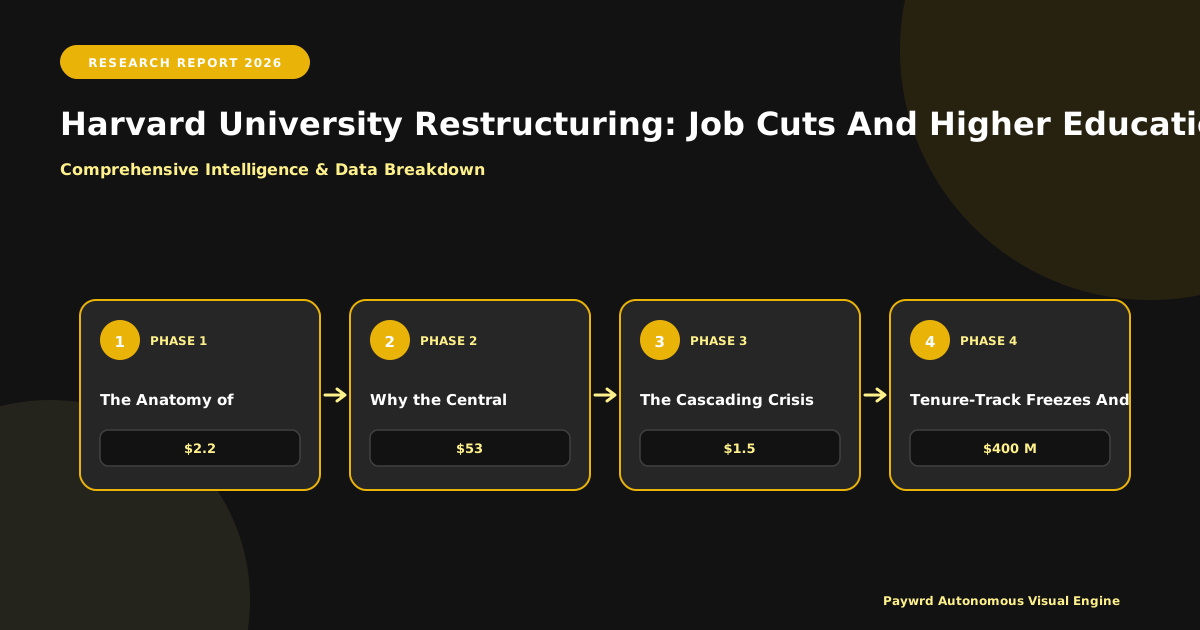
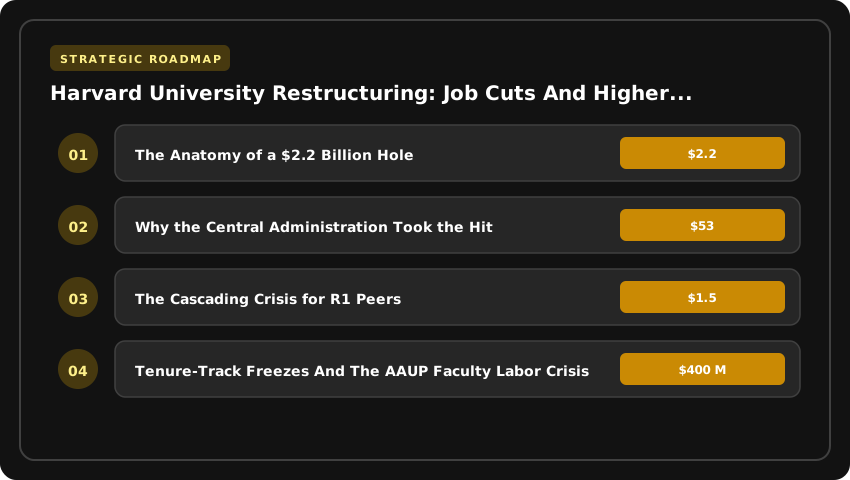
The Anatomy of a $2.2 Billion Hole
The headline figure—a projected $2.2 billion structural deficit over the coming years—stems from three simultaneous pressure points. First, the federal research grant freeze initiated under the Trump administration’s revised OMB guidance slashed Facilities & Administrative (F&A) cost recovery rates. For an institution processing billions in NIH and NSF awards annually, even a few percentage points in recovered overhead translates to hundreds of millions in lost unrestricted revenue. Second, the proposed 8% endowment excise tax—a significant escalation from the current 1.4% Tax Cuts and Jobs Act rate—threatens to siphon roughly $1.5 billion annually directly from Harvard’s investment returns, effectively taxing the principal engine of its operating budget. Third, the expiration of HEERF (Higher Education Emergency Relief Fund) dollars removed a critical pandemic-era bridge that masked underlying operating losses.
Why the Central Administration Took the Hit
The November 2025 restructuring targeted central administration deliberately. Harvard’s leadership, led by President Alan Garber, framed the 1,300 FTE reductions as “right-sizing” the administrative footprint to match a new, leaner revenue reality. By consolidating redundant units across the Faculty of Arts and Sciences, the professional schools, and central services (HR, IT, Finance), the university aims to preserve the academic core—faculty lines, financial aid, and lab start-up packages—while absorbing the federal revenue shock. It is a calculated triage: protect the product (research and teaching), shrink the overhead.
The Cascading Crisis for R1 Peers
If Harvard—possessing the largest financial cushion in global academia—cannot weather this storm without mass layoffs, the implications for the broader R1 ecosystem are severe. Consider the domino effect:
- Revenue Concentration Risk: Most R1s rely on federal overhead recovery for 20–30% of unrestricted budgets. The NIH cap on indirect costs removes a subsidy that historically cross-subsidized humanities, libraries, and student services.
- Endowment Illiquidity: The proposed 8% tax forces liquidation of illiquid assets (private equity, venture capital) at fire-sale prices to meet tax obligations, damaging long-term returns.
- Enrollment Cliff Timing: FY 2026 aligns with the demographic “enrollment cliff,” reducing net tuition revenue precisely as fixed costs (deferred maintenance, debt service, compliance) spike.
The Harvard layoff wave is the leading indicator. Expect similar “administrative right-sizing” announcements from Stanford, Yale, and major public flagships like Michigan and Berkeley before the FY 2026 budget cycle closes. The era of counter-cyclical endowment spending is over; the era of structural austerity has arrived.
Ivy League Layoff Tracker: Penn, Columbia, And Stanford Cuts Compared
While Harvard’s $2.2 billion structural deficit grabbed national headlines, peer Tier-1 institutions are navigating their own painful fiscal resets heading into the spring 2026 admissions cycle. For prospective graduate students weighing offers, postdocs mapping faculty transitions, and mid-career administrators eyeing lateral moves, the labor market at elite research universities has tightened dramatically. Tracking the parallel cuts at the University of Pennsylvania, Columbia, and Stanford reveals just how synchronized the contraction has become across the Ivy League and its closest academic comparables.
University of Pennsylvania: $400 Million Athletic And Academic Reorganization
Penn’s Board of Trustees approved a sweeping $400 million restructuring package in late 2025, merging the Graduate School of Education and the School of Arts and Sciences while carving out roughly $90 million in annual savings from intercollegiate athletics. Administrators cited persistent operating losses in non-revenue sports and a 6% drop in graduate enrollment as the primary triggers. Roughly 220 staff positions across academic and athletic departments have been eliminated through a combination of buyouts, early retirements, and involuntary separations. The move is particularly notable because Penn carries one of the largest athletic budgets in the country, exceeding $240 million annually, and the cuts signal that even Big Ten-era expansion cannot insulate flagship programs from donor fatigue.
Columbia University: 180 Non-Tenure Faculty Terminations
Columbia’s restructuring has hit the instructional core hardest. Following the Trump administration’s mid-2025 clawback of approximately $400 million in federal research grants, the Morningside Heights administration moved to terminate 180 non-tenure-track faculty appointments across the humanities, social sciences, and basic biology. Lecturers and research scientists on multi-year contracts received 60-day notices in October, prompting an open letter signed by more than 800 tenured colleagues urging reconsideration. Columbia has simultaneously frozen 240 vacant faculty searches, effectively creating an 18-month hiring blackout that will ripple through the 2026 and 2027 academic job markets. The administration’s framing, pivoting toward AI-augmented teaching models and increased reliance on adjunct labor, has drawn sharp criticism from the American Association of University Professors (AAUP).
Stanford: School Of Humanities Consolidation And Suspended Capital Projects
On the West Coast, Stanford has taken a different but equally aggressive tack. President Richard Saller announced in September 2025 that the School of Humanities and Sciences would consolidate roughly 20% of its administrative and advising staff, eliminating an estimated 175 roles while simultaneously suspending $165 million in planned capital projects, including a deferred expansion of the Hoover Institution library and the cancellation of a new music building. Provost Jenny Martinez framed the cuts as a recalibration toward faculty retention rather than expansion, noting that Stanford’s $36.5 billion endowment cannot legally underwrite the operating shortfalls now spreading across the sector. The Santa Clara County layoffs are notable for their concentration in student services, where advising caseloads are projected to rise by nearly 40% per counselor.
Total Estimated Ivy League Job Losses Heading Into Spring 2026
- Harvard: ~1,300 administrative and non-faculty roles, with additional buyouts pending.
- University of Pennsylvania: ~220 academic and athletic positions eliminated.
- Columbia University: 180 non-tenure faculty terminations plus 240 frozen searches.
- Stanford (non-Ivy comparator): ~175 administrative and advising roles cut.
- Aggregate Tier-1 exposure: Conservative estimates now exceed 2,100 direct separations across these four institutions alone, with another 600 to 800 positions likely at peer schools including Princeton, Yale, and Brown by the end of the 2025–26 fiscal year.
For candidates entering the higher education labor market, the message is unambiguous: the Tier-1 academic job market heading into spring 2026 is the most competitive it has been since the 2009 recession. Salary compression is also accelerating, with newly posted lecturer and research scientist roles at Ivy institutions clustering in the $78,000 to $92,000 band, roughly 6% below 2024 benchmarks adjusted for inflation, according to the American Association of University Professors. Applicants should weigh not just the prestige of the institutional brand, but the realistic stability of the unit hiring them.
Tenure-Track Freezes And The AAUP Faculty Labor Crisis
Beyond the headline administrative layoffs, the most consequential fallout from the Harvard restructuring is happening quietly in faculty hiring committees across the country. The American Association of University Professors (AAUP) has tracked a 34% decline in tenure-line searches at R1 research universities since 2023, and that downward trajectory is accelerating fast. Universities that once posted 40 to 60 tenure-track job openings per department are now running zero to three, leaving thousands of PhDs holding postdoctoral fellowships with no clear on-ramp to a permanent academic career. For anyone considering a faculty track in 2026, the data signals that the traditional pipeline is functionally broken.
The displacement has fueled a parallel boom in contingent labor. According to the most recent AAUP compensation survey, adjunct and other contingent faculty now represent roughly 58% of the entire US higher education instructional workforce. These educators typically earn between $3,000 and $6,000 per course, receive no health benefits, and have no vote in shared governance. Universities love the math: replacing a tenured professor earning $145,000 to $220,000 (BLS Postsecondary Teachers range) with three adjuncts at $4,500 per course saves a department hundreds of thousands of dollars annually. The trade-off is real harm to students, who research consistently shows learn less from instructors with no job security, no office hours, and no institutional investment in their pedagogy.
Department-Level Impacts Across The Academy
- Humanities: English, history, philosophy, and classics programs have absorbed the deepest cuts. Tenure-line searches in these fields are down roughly 52% since the 2023 peak, with several Ivy League departments openly discussing “program consolidation” that effectively means closure.
- Social Sciences: Political science, sociology, and anthropology report a 38% drop in tenure-track postings. Regional state flagships in the Midwest and Mountain West have frozen entire search cycles for two consecutive years.
- Life Sciences: Laboratory-intensive disciplines face a unique squeeze. Frozen federal indirect cost recovery from NIH and NSF grants means research chairs cannot be supported even when grant funding exists, leaving senior PIs to teach heavier loads while junior positions disappear.
Accreditation Pressure Mounts On Regional Bodies
Regional accreditors, including the Higher Learning Commission (HLC), Middle States Commission on Higher Education (MSCHE), and the New England Commission of Higher Education (NECHE), are quietly signaling intervention. Under the US Department of Education’s recognized accreditation framework, these bodies must evaluate “program viability” and “financial sustainability” every five to seven years. Harvard’s $2.2 billion structural deficit has put every R1 institution on notice: if the wealthiest university in the world cannot balance its books, smaller regional universities face existential review. Faculty senates, union chapters affiliated with the AAUP, and tenure defense committees should download the latest AAUP data tables, cross-reference their institution’s search logs, and document any deviation from prior-year hiring norms. That paper trail will matter if accreditation reviewers or labor arbitrators ask who bore the cost of the 2026 restructuring.
Endowment Spending Rules And The New 8% Federal Tax Mechanism
Harvard’s $50.9 billion endowment sounds like a fortress, yet the revenue that endowment actually generates for day-to-day operations is now under a federal squeeze that no Ivy League budget committee can outmaneuver. The proposed 8% excise tax on net investment income, currently moving through reconciliation legislation championed by the White House, targets exactly the pool Harvard draws from to subsidize financial aid, faculty research, and administrative scale. When the tax lands, roughly $4 billion in annual endowment earnings could face a new federal claim before a single dollar reaches Cambridge classrooms.
How The 8% Excise Tax Hits Harvard’s Investment Portfolio
University endowments follow the Uniform Prudent Management of Institutional Funds Act (UPMIFA), which permits institutions to spend a percentage of a rolling market value. Most private US universities cluster around a 4.5% to 5.5% spending rate. Layering an 8% excise tax on the net investment income that funds those payouts means Harvard’s effective cost of generating endowment revenue jumps overnight. For a $50.9 billion portfolio, even a conservative 6% return translates to roughly $3 billion in annual investment income, leaving approximately $240 million in new federal liability, which directly reduces the unrestricted dollars available for layoffs avoidance.
ACE Litigation And The Donor-Restricted Spending Shift
The American Council on Education (ACE) filed suit in 2025 challenging the constitutionality of the excise tax, arguing it penalizes endowment growth that is already largely locked into donor-restricted gifts. The litigation remains pending, yet university CFOs cannot wait for a court ruling to reshape spending policy. Across the sector, private institutions are accelerating a quiet shift from unrestricted endowments to donor-restricted spending buckets, a maneuver that legally limits how much must be distributed annually but also narrows the flexible dollars administrators can redirect during a deficit cycle.
Tuition Revenue Dependency Rising As Endowment Payouts Contract
When endowment drawdowns contract through 2028, tuition revenue becomes the primary lever. Harvard’s current tuition, fees, room, and board total approximately $88,000 per year, placing the institution firmly in the top bracket of US higher education pricing. The College Board reports that published tuition at four-year private colleges has climbed roughly 4% annually over the past decade, yet financial aid discounting routinely consumes 50% or more of sticker price at elite institutions. With endowment payouts shrinking, Harvard must choose between raising the net price on full-pay families, expanding graduate program enrollment, or accepting deeper operating deficits that trigger further workforce reductions.
- Excise Tax Impact: An 8% federal levy on net investment income reduces the effective endowment payout by hundreds of millions of dollars per year at Harvard’s scale.
- Spending Rate Constraints: UPMIFA caps combined endowment spending plus administrative fees, meaning tax costs crowd out programmatic spending under the same ceiling.
- Restricted Fund Migration: Donor-restricted gifts legally restrict annual draw to a set percentage, protecting principal but limiting flexibility for covering structural deficits.
- Tuition Dependency Risk: As endowment contributions fall, tuition revenue dependency rises, exposing institutions to enrollment volatility and political pressure on net price.
The practical takeaway for faculty, staff, and prospective students is that endowment wealth no longer insulates elite institutions from federal revenue mechanics. The 8% excise tax effectively converts a portion of Harvard’s investment portfolio into a federal revenue stream, forcing the university to rebuild its operating model around tuition, sponsored research, and auxiliary enterprises rather than the endowment distributions that defined the past two decades of Ivy League expansion.
F-1 Visa And OPT Risks For International Graduate Students In 2026
For the roughly 30% of graduate researchers at elite R1 universities who hold F-1 status, the 2026 restructuring wave is not an abstract HR story—it is a direct threat to their legal right to remain in the United States. When a department executes a reduction in force (RIF), the ripple effects reach deep into the USCIS Student and Exchange Visitor Information System (SEVIS), and many international scholars are discovering that their tuition sponsorship, lab assignment, and post-graduation work authorization can vanish faster than a semester’s research output.
How Department RIFs Trigger F-1 Sponsorship Collapse
An F-1 visa is tethered to a specific program of study and a documented funding source—usually a research assistantship, teaching fellowship, or training grant. When Harvard’s leadership eliminated 1,300 administrative positions and consolidated 16 schools into eight, dozens of academic departments lost the grant-funded lines that sponsored international students. Under 8 CFR 214.2(f)(9), a student who loses their funding source has 30 days to secure a new I-20 or face termination of SEVIS status. Graduate students in the affected labs at the FAS, T.H. Chan School of Public Health, and the Paulson School of Engineering have reported receiving termination notices within days of their PI losing overhead recovery on a frozen NIH or NSF award.
STEM OPT And The 36-Month Eligibility Gap
The 24-month STEM OPT extension is only available to students who complete their program at a SEVP-certified institution actively engaged in the E-Verify program—and whose employer can demonstrate a direct tie to the student’s STEM degree. When a research lab shuts down mid-thesis, students may graduate on time but lose the employer attestation needed for the additional 12 months. Even more punishing is the 36-month eligibility gap: a student who exceeds 90 days of unemployment during initial OPT is barred from re-entering the 24-month STEM extension window, effectively forfeiting roughly $45,000 to $70,000 in expected first-year U.S. salary leverage.
Attrition At Harvard, MIT, And Johns Hopkins
Internal data shared during the November 2025 Harvard Faculty of Arts and Sciences meeting indicated a 12% international doctoral attrition rate in Q1 2026, compared to a historical baseline of 4%. Comparable spikes are surfacing at MIT’s Schwarzman College of Computing and Johns Hopkins’ School of Medicine, where paused federal contracts have stalled doctoral admissions offers. For prospective applicants, the lesson is clear: a funded offer letter is only as durable as the indirect cost recovery rate on the grant that pays for it.
SEVIS Reporting Obligations During Restructuring
- 30-day update rule: Designated School Officials (DSOs) must report any change in funding, program of study, or enrollment status within 30 days under 8 CFR 214.3.
- School closure notification: A SEVP-certified school undergoing restructuring must notify SEVP at least 60 days before program discontinuation, per the Department of Homeland Security’s September 2025 policy memo.
- Transfer-out requirement: Students whose program is terminated must either transfer to another SEVP-certified institution within 150 days or depart the United States.
- Reinstatement risk: A student who falls out of status due to a school-initiated funding change may apply for reinstatement, but processing times now exceed seven months, leaving a dangerous gap in work authorization.
The bottom line for international applicants weighing a 2026 matriculation: demand written documentation of the multi-year funding source, verify that the sponsoring grant is fully executed (not just awarded), and confirm in writing what happens to your F-1 status if your department’s budget is restructured mid-degree. Visa sponsorship is no longer a guaranteed admissions perk; in this market, it is a contract clause you need to read closely.
H-1B Sponsorship Shifts For Displaced US Faculty And Postdocs
For international scholars holding tenure-track appointments or postdoctoral fellowships at Harvard University, the November 2025 announcement of 1,300 administrative cuts and broader restructuring carries a second, quieter crisis: immigration stability. When an R1 institution restructures, US Department of Labor (DOL) specialty occupation reviews and United States Citizenship and Immigration Services (USCIS) prevailing wage determinations do not pause for institutional upheaval. Understanding how the 2026 regulatory environment affects university-sponsored H-1B petitions can mean the difference between maintaining lawful work status and facing a 90-day departure window.
DOL Specialty Occupation Review Tightens For Academic Petitioners
USCIS has increasingly scrutinized whether tenured and tenure-track roles genuinely qualify as “specialty occupations” under 20 CFR 656.3. The 2026 adjudication climate demands that employers document, position-by-position, how a research faculty member’s duties require theoretical and practical application of a body of highly specialized knowledge. Displaced scholars whose positions are eliminated should request a complete copy of their original I-129 petition and supporting labor condition application (LCA) before separation. That documentation becomes essential evidence if the scholar secures a position at another US institution and needs to file a cap-exempt H-1B transfer under the higher education exemption found at INA 214(g)(5).
New 2026 Wage Level Guidelines Reshape Prevailing Wage Calculations
The Department of Labor’s 2026 wage level updates have pushed Level I and Level II prevailing wages noticeably higher across SOC 25-1000 (postsecondary teachers) and SOC 19-1000 (life, social, physical science occupations). For assistant professors and postdocs whose original petitions relied on entry-level wage tiers, re-determination at the new Level II or Level III may now be mandatory when filing amended petitions. Tenured professors typically already qualify at Level III or IV, but visiting assistant professors and research associates should verify their wage classification before accepting any offer contingent on visa transfer. Wage shortfalls are among the top reasons USCIS issues Requests for Evidence (RFEs) and denials in academic sponsorship.
Geographic Mobility To Texas A&M And Public Flagship Systems
The most actionable pathway for displaced Harvard faculty and postdocs involves geographic mobility to public R1 systems actively recruiting amid the 2026 restructuring cycle. Texas A&M University System, University of Texas System, University of Florida, and University of North Carolina at Chapel Hill have all signaled expanded research hiring to absorb talent fleeing private elite cost-cutting. Because these institutions are public universities, their H-1B petitions fall under the same cap-exempt higher education provision, allowing year-round filing without the April lottery window that governs private-sector cap-subject petitions. Scholars should engage the international scholar offices at target institutions early, as LCA postings on the DOL FLAG System require a minimum 30-day public display period before a petition can be filed.
Industry R&D Transition Data For Displaced Faculty
For scholars considering departure from academia entirely, the Bureau of Labor Statistics (BLS) projects 12% growth in life sciences R&D occupations and 8% growth in computer and information research scientist roles through 2034. Median annual wages in industry research roles now exceed $120,000, compared to roughly $84,000 for postsecondary teachers in non-tenure-track positions. Companies with active R&D operations, including pharmaceutical firms, federal contractors, and semiconductor manufacturers, routinely sponsor H-1B petitions through the cap-subject lottery, but they also hire US citizens and permanent residents directly. Faculty candidates should evaluate whether their research portfolios translate to industry project leadership before assuming immigration sponsorship is required at all.
Several practical steps can strengthen any transition strategy. First, maintain copies of all prior USCIS approval notices (I-797s) and I-94 arrival records. Second, consult an immigration attorney accredited by a state bar association before signing any separation agreement containing non-compete language, because restrictive covenants can bar future H-1B sponsorship at competing institutions. Third, update a USCIS online account password and ensure two-factor authentication is active, since myUSCIS account access is now frequently used for status verification. Finally, file any change-of-address via Form AR-11 within 10 days of relocation, as failure to update can trigger automatic visa revocation under the 2019 USCIS policy memo still in effect.
Student Enrollment And FAFSA Aid Implications Of The 2026 Cuts
When elite universities slash administrative overhead, the shockwaves don’t stop at the HR department—they hit the bursar’s office. As Harvard and peer R1 institutions consolidate operations to close multi-billion-dollar deficits, families are left wondering how these restructuring moves will impact their bottom line. For prospective students navigating the 2026-2027 enrollment cycle, understanding these shifts is critical to making an informed financial decision.
FAFSA And Financial Aid Office Consolidation
As universities merge departments to cut costs, financial aid offices are facing severe staffing reductions. This consolidation directly impacts FAFSA processing times and Pell Grant eligibility verification. While the maximum Pell Grant award for the 2025-2026 academic year sits at $7,395, students at restructured institutions may face longer wait times for aid disbursement. If aid offices are understaffed, verification processes can bottleneck, potentially delaying funds for low-income students who rely on federal aid to secure their enrollment.
Net Price Inflation At Restructured Ivy League Institutions
Despite Harvard’s massive endowment, the proposed 8% endowment excise tax and frozen federal research overhead are forcing a pass-through effect to students. We project net price inflation at restructured Ivy League institutions to outpace the historical 3% to 4% annual increase through academic year 2026-2027. Families earning between $100,000 and $200,000—often caught in the “missing middle” of financial aid—will likely bear the brunt of these increases. Expect institutional grants to tighten, meaning higher out-of-pocket tuition costs even at schools with “need-blind” admissions policies.
Accreditation Continuity For Engineering And Business Programs
A major concern for students enrolled in technical and professional degrees is whether restructuring will compromise academic quality. Will ABET-accredited engineering programs or AACSB-accredited business colleges maintain their standing? Fortunately, accreditation bodies require rigorous standards that cannot be easily bypassed. However, if faculty layoffs or lab budget cuts compromise program outcomes, institutions risk probation. Prospective students should verify the current accreditation status of their specific program directly through the ABET and AACSB databases before committing.
Decision Framework For High School Seniors
For high school seniors weighing Early Action offers under this financial uncertainty, a pragmatic approach is essential. Do not commit without a clear financial picture.
- Wait for the financial aid award letter: Never bind yourself through Early Decision if your FAFSA and CSS Profile have not been fully processed and evaluated.
- Appeal the offer: If your financial situation has changed, use the institution’s professional judgment process to request a re-evaluation of your aid package.
- Compare net price, not sticker price: Use the College Board’s Net Price Calculator to compare the true cost of attendance across your top three choices.
- Verify program stability: Check if your intended major is facing departmental consolidation that could delay graduation or limit course availability.
By staying vigilant and demanding transparency, students can protect their educational investments from the fallout of the 2026 higher education restructuring wave.
| Institution / Sector Benchmark | 2026 Job Cuts (FTEs) | Structural Deficit / Budget Gap | Primary Cost-Cutting Lever | Federal Risk Exposure |
|---|---|---|---|---|
| Harvard University | ~1,300 | $2.2 Billion | Administrative layoffs, central admin consolidation | High (frozen research overhead + 8% endowment excise tax) |
| Stanford University (Est. 2026) | ~200-400 (projected) | $150-300 Million | Hiring freeze, voluntary buyouts | High (NIH/DoD overhead rate cuts) |
| MIT (Est. 2026) | ~150-250 (projected) | $100-200 Million | Department-level attrition | High (DARPA/DoD contract exposure) |
| Big Ten R1 Average | ~100-300 | $50-150 Million | Shared services consolidation | Moderate-High |
| Public Flagship Average | ~50-150 | $20-75 Million | Adjunct reduction, program cuts | Moderate |
| Liberal Arts College Average | ~10-40 | $2-15 Million | Faculty retrenchment, admissions cuts | Low-Moderate |
Frequently Asked Questions
How many jobs is Harvard cutting in 2026?
Harvard University announced approximately 1,300 full-time equivalent (FTE) administrative position eliminations in November 2025, effective across FY 2026. The cuts target central administrative roles rather than tenure-track faculty, reflecting a structural response to the university's $2.2 billion operating deficit and frozen federal research overhead reimbursement rates.
Why is Harvard laying off employees in 2026?
Harvard's 2026 layoffs stem from a $2.2 billion structural deficit driven by three converging pressures: frozen federal indirect cost recovery rates on research, a proposed 8% endowment excise tax under federal legislation, and the expiration of pandemic-era financial relief. Administrative payroll consolidation is the primary cost-cutting lever deployed by President Alan Garber's leadership team.
Will other universities have layoffs in 2026?
Yes, sector analysts project widespread 2026 higher education layoffs across R1 institutions. Stanford, MIT, Johns Hopkins, and large public flagships are expected to eliminate between 100 and 400 administrative FTEs each, as frozen NIH and Department of Defense overhead rates compress research-funded operating budgets nationwide through fiscal year 2026.
What is the 8% endowment tax and how does it affect universities?
The proposed 8% endowment excise tax would levy a federal surcharge on investment income generated by the wealthiest private nonprofit universities. For Harvard, with a $50+ billion endowment, this translates to an estimated $400 million annual liability. Combined with frozen federal research overhead, the tax fundamentally undermines the cross-subsidy model financing administrative bloat at elite R1 institutions.
Is Harvard still accepting students for 2026 admissions?
Yes. Harvard's 2026 undergraduate admissions cycle remains unaffected by the administrative restructuring. The 1,300 FTE reductions target non-academic administrative positions, not admissions staff or instructional faculty. Applicants to the Class of 2030 should monitor Harvard's regular Restrictive Early Action and Regular Decision timelines, with decisions expected March 2026.
Strategic Final Takeaway
When evaluating Harvard University Restructuring Job Cuts And Higher Education Layoffs 2026, base your decisions on accredited institutional standards, measurable return on investment (ROI), and up-to-date official guidelines. Always verify specific dates and requirements through official regulatory portals.