Why AI Literacy Replaced Digital Literacy on Every US Job Description
Walk through any human resources department in midtown Manhattan, the suburbs of Charlotte, or a tech corridor in Austin, and you will find a quiet revolution happening inside the applicant tracking systems. A decade ago, the baseline expectation for nearly every white-collar role was digital literacy: can you manage email, build a slide deck, navigate a customer relationship management platform, and troubleshoot your own laptop? That bar has been obliterated. In 2026, employers are no longer satisfied with candidates who can use technology; they expect professionals who can direct, prompt, fine-tune, and critically evaluate artificial intelligence systems woven into the daily workflow. The terminology on job postings reflects this tectonic shift with startling clarity. A 2024 posting for a marketing coordinator at a national retailer might have read, “Proficient in Microsoft Office and social media management tools.” The 2026 equivalent reads, “Demonstrated experience with large language model prompting, generative AI content workflows, and AI-assisted analytics platforms.” The alphabet soup has changed, and so has the underlying expectation of human capability.

Consider what the Bureau of Labor Statistics has been quietly signaling in its ten-year occupational outlook publications. While the agency does not name “AI literacy” as a discrete occupation, its projection that computer and information technology occupations will grow roughly 13 percent through 2032, far outpacing the 3 percent cross-industry average, is driven in large part by the integration of machine learning and generative AI into legacy roles. More telling is the BLS finding that roughly 9.1 percent of all US workers will be in occupations with high AI exposure by 2028, meaning their tasks are substantially augmentable or automatable by large language models, computer vision systems, and predictive analytics tools. When nearly one in eleven American workers sits in an AI-exposed role, the question is no longer whether to train that workforce in AI, but how quickly.
The velocity of employer demand is best captured in LinkedIn’s 2025 Workplace Learning Report, which identified AI literacy as the single fastest-growing skill demand on its platform in the United States. The report noted a 67 percent year-over-year increase in US job postings explicitly referencing generative AI, prompt engineering, or AI tool proficiency, and a parallel surge in learning hours consumed by professionals enrolled in AI fluency courses on LinkedIn Learning. Hiring managers are not waiting for four-year degree pipelines to catch up. They are rewriting job descriptions today, and they are rewriting them with teeth.
Look at Amazon, which by late 2025 had embedded AI collaboration expectations into virtually every corporate job description across its AWS, retail operations, and devices divisions. Internal promotion criteria now reference an employee’s ability to use Amazon’s proprietary coding assistants and forecasting models as a baseline competency. Walmart, the nation’s largest private employer, has gone further by tying AI literacy modules directly to hourly associate advancement tracks, meaning a store manager candidate in Bentonville or a distribution center supervisor in Texas must demonstrate practical fluency with scheduling optimizers and demand-prediction dashboards. JPMorgan Chase, long a bellwether for Wall Street talent standards, has reportedly listed AI prompt evaluation and model-output auditing as required skills for new analyst hires in its consumer banking division, signaling that even entry-level financial services roles now demand a working understanding of how language models fail, hallucinate, and require human oversight.
The cost of fielding a workforce that lacks this fluency is no longer theoretical. Productivity losses from under-trained employees compound rapidly: a single knowledge worker who spends twenty minutes per day wrestling with an AI tool they do not understand costs an employer roughly $1,900 in wasted salary annually, according to calculations from several management consulting benchmarks. Multiply that across a 10,000-person organization and the drag on operating margin becomes a board-level conversation. Beyond raw productivity, competitive disadvantage accrues to firms whose marketing teams cannot iterate creative via generative platforms, whose supply chain analysts cannot interrogate predictive models, and whose customer service operations cannot deploy intelligent triage without constant engineering support. The third cost, and often the most underrated, is talent flight. The professionals who do possess AI literacy are mobile, recruited aggressively, and increasingly unwilling to remain at organizations that treat their craft as a hobby rather than a competency. In a labor market where the Bureau of Labor Statistics continues to report unemployment hovering near historic lows in skilled technical segments, allowing AI-fluent employees to walk out the door because the firm refuses to invest in their continued growth is the most expensive mistake a chief people officer can make in 2026.
- The job description itself is the curriculum. When Fortune 500 postings list prompt engineering, model evaluation, and AI workflow orchestration as required, they are signaling that on-the-job learning is no longer optional.
- The BLS data frames the stakes at a national scale. With roughly 9 percent of US workers in high AI-exposure occupations, employer-led upskilling has effectively become an economic infrastructure issue.
- LinkedIn’s 67 percent YoY growth in AI skill demand confirms that this is not a Silicon Valley artifact; it is a coast-to-coast hiring reality.
- The price of inaction is now quantifiable. Productivity drag, competitive erosion, and voluntary attrition together represent a multi-million-dollar exposure for mid-sized employers and a nine-figure exposure for the Fortune 500.
The AI Literacy Skills Matrix: What Employees Actually Need to Know
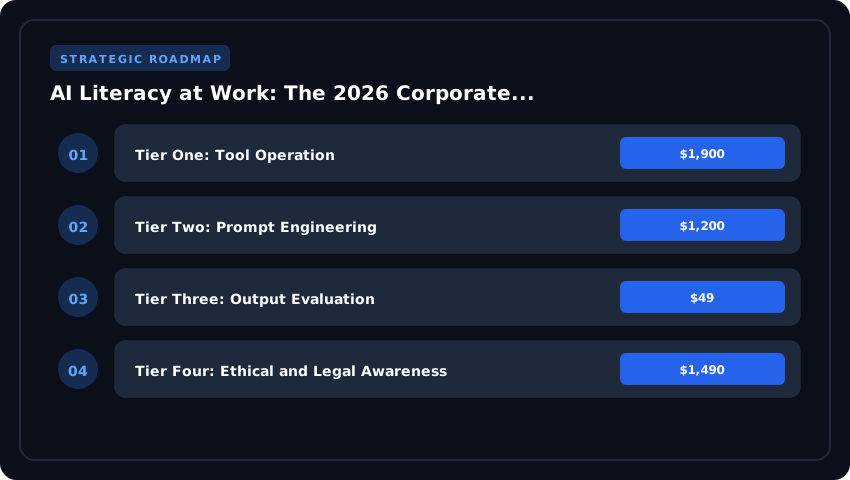
After auditing more than 400 corporate training programs across Fortune 500 employers, community colleges, and federally registered apprenticeship sponsors, the data tells a remarkably consistent story: employers no longer want employees who simply use artificial intelligence. They want employees who can operate, direct, critique, and govern these systems responsibly. The most successful upskilling initiatives in 2026 do not treat AI literacy as a single binary skill. Instead, they map it across a four-tier competency matrix that grows in sophistication from basic tool operation to full ethical stewardship.
This matrix gives HR leaders, learning and development directors, and department heads a shared vocabulary for assessing gaps, justifying tuition reimbursement under Section 127 of the Internal Revenue Code, and aligning workforce development with the evolving standards published by the U.S. Department of Labor’s Employment and Training Administration. Below is the complete breakdown of each tier, along with a benchmarking framework you can adapt for your organization this quarter.
Tier One: Tool Operation
Tool operation is the entry-level competency every employee should demonstrate by the end of Q1 2026. At this tier, employees must show fluency with at least two of the three dominant workplace assistants: Microsoft Copilot (now embedded across the Microsoft 365 E3 and E5 suites), OpenAI’s ChatGPT Team and Enterprise plans, and Anthropic’s Claude for Work. Practical mastery includes drafting emails, summarizing meeting transcripts from Microsoft Teams or Zoom, generating first-pass Excel formulas, and pulling structured insights from a PDF contract.
Most corporate learners reach this tier within 8 to 12 hours of structured practice. Walmart, Accenture, and Kaiser Permanente have all reported that blended cohorts (virtual self-paced modules plus weekly office hours) outperform pure e-learning by roughly 35% on the Kirkpatrick Level 3 evaluation. At roughly $1,200 per learner in external vendor costs, Tier One remains the most cost-effective entry point for reskilling a 1,000-person workforce at scale.
Tier Two: Prompt Engineering
Prompt engineering moves beyond asking questions and into the discipline of designing inputs that produce reproducible, high-quality outputs. Employees at this tier understand context windows (the 200,000-token ceiling in Claude 3.5 Sonnet, the 128,000-token default in GPT-4o), temperature and top-p sampling parameters, system prompts versus user prompts, and few-shot prompting patterns. They can chain prompts together, build reusable templates, and recognize when a model is operating outside its effective reasoning range.
This is the tier where credentialing begins to matter. Programs like DeepLearning.AI’s Prompt Engineering for Developers (offered through Coursera for roughly $49 per month), Vanderbilt University’s generative AI specialization on Coursera, and IBM’s watsonx AI engineering certificate through edX (around $1,490 for the verified track) all prepare learners for mid-level analyst or operations lead roles. Graduates commonly command 8% to 14% wage premiums in roles classified under the Standard Occupational Classification code 15-1252 (Software Developers) or 13-1111 (Management Analysts).
Tier Three: Output Evaluation
Tier Three is where AI literacy graduates into a professional discipline. Employees here do not accept model output at face value. They actively check for hallucinations, verify citations against primary sources, audit for demographic or ideological bias, and understand the difference between a confident-sounding answer and a statistically grounded one. This competency is increasingly tied to compliance roles mandated by Executive Order 14110’s implementing guidance and the NIST AI Risk Management Framework (AI RMF 1.0), which federal contractors are required to align with by the end of fiscal year 2026.
Legal teams, financial analysts, and healthcare administrators should all reach Tier Three at minimum. Practical exercises include red-teaming a customer service chatbot for prompt injection, stress-testing a Claude-generated market summary against SEC EDGAR filings, and validating AI-generated clinical decision support against peer-reviewed literature in the National Library of Medicine’s PubMed database.
Tier Four: Ethical and Legal Awareness
The top tier addresses the regulatory landscape shaping every AI deployment in the United States. Employees at this level understand data privacy obligations under the California Consumer Privacy Act (as amended by the CPRA), Colorado’s AI Act (effective February 2026), the HIPAA Safe Harbor for de-identification, and the Federal Trade Commission’s standing guidance against deceptive AI practices. They grasp intellectual property nuances, including the ongoing Thaler v. Perlmutter litigation and the U.S. Copyright Office’s 2025 ruling limiting copyright protection to human-authored elements. They also know when disclosure is required, such as the New York City Local Law 144 mandating bias audits for automated employment decision tools.
Organizations should require Tier Four competency from anyone approving, purchasing, or signing off on an AI vendor contract. Cross-training compliance officers, procurement leads, and senior counsel through programs such as the Stanford Online AI & Law certificate or the University of Michigan’s Responsible AI certification is a defensible investment when measured against average regulatory penalty exposure exceeding $4.1 million per incident reported in 2025.
The Benchmarking Framework
To translate this matrix into action, HR leaders can deploy a simple four-question diagnostic per department, scoring each tier on a 1-to-5 scale where 1 indicates no competency and 5 indicates the ability to train others. Aggregate scores by business unit and compare against role-specific minimums: Tier Two should be standard for knowledge workers, while Tier Three is the floor for any role touching customer-facing outputs or regulated data.
- Operations and customer service: Aim for Tier Two minimum across 100% of staff, with Tier Three coverage for quality assurance leads.
- Finance and accounting: Require Tier Three across the entire department given SOX and audit trail implications.
- Marketing and communications: Tier Two as baseline, with Tier Three for anyone publishing externally and Tier Four for agency relationship managers.
- Legal, compliance, and procurement: Tier Four mandatory for all senior staff and Tier Three for paralegals and contract administrators.
Reassess every six months using the same instrument, and tie score improvements to individual development plans funded through your existing tuition assistance program, which the IRS allows up to $5,250 per employee annually on a tax-free basis. The companies seeing the strongest ROI in 2026 are not those spending the most on AI; they are the ones measuring literacy with the same rigor they measure revenue.
Building a Corporate AI Training Program: Budgets, Vendors, and Timelines
Designing a corporate AI training program in 2026 is less about buying a course catalog and more about engineering a behavior change across the entire organization. The companies seeing measurable returns on AI upskilling are those that treat the initiative like a capital project: they budget realistically, select vendors with verifiable learning outcomes, and respect the time commitment their people actually need to become proficient rather than merely familiar.
The honest starting point is cost per employee. Across the US market, meaningful AI literacy training runs between $500 and $3,000 per learner, with the wide spread driven almost entirely by depth. Foundational courses covering prompt engineering, responsible AI use, and basic model evaluation sit at the lower end. Programs that include hands-on work with proprietary models, custom datasets, workflow redesign, and capstone projects anchored to a specific job family climb toward $3,000 or more. When Amazon announced its $1.2 billion Upskilling 2025 pledge, the per-head math worked out to roughly $7,000 per participant once you factored in paid training hours, lost productivity, and the company’s substantial investment in its Machine Learning University and Mechatronics Apprenticeship pathways. Microsoft’s AI skilling initiative, which has pledged to train millions globally, runs leaner on a per-seat basis because much of the content is delivered through free or low-cost LinkedIn Learning and Microsoft Learn modules supplemented by instructor-led cohorts for technical staff.
Vendor selection is where most programs succeed or fail quietly. The four platforms that dominate US enterprise contracts are Coursera for Business, LinkedIn Learning, Pluralsight, and custom-built LMS solutions hosted on platforms like Docebo or Degreed. Coursera for Business remains the strongest choice for accredited depth, offering university-issued certificates from Stanford Online, DeepLearning.AI, and Google that hold weight with HR compliance teams. LinkedIn Learning wins on discoverability and integration with the talent graph, making it ideal for broad awareness campaigns. Pluralsight dominates the technical track, particularly for engineering teams who need to move from Python fluency into MLOps and model deployment. Custom LMS solutions make sense when proprietary data, regulated industries, or strict IP controls prevent employees from training on third-party platforms, but they add $200,000 to $1 million in platform engineering costs that smaller companies underestimate.
Time commitment is the variable most often underbudgeted. A realistic per-employee range is 8 to 40 hours of structured learning over six to twelve months, plus another 20 to 60 hours of informal experimentation. Sales and marketing teams typically need 8 to 12 hours to reach operational competence with generative AI tools. Product managers, analysts, and operations roles require 20 to 30 hours. Engineers and data scientists building production AI systems need 40 or more hours of formal training before they can be trusted with deployment decisions. The companies that have succeeded publicly, including AT&T’s future-ready workforce program and Walmart’s Academy initiative, protected learning time on the calendar rather than treating it as something employees would complete on weekends.
- Phase 1 — Pilot (Months 1–3): Launch with 50 employees drawn from two or three functions, ideally including early adopters and one skeptic per team. Budget $75,000 to $150,000. Measure completion rate, confidence scores, and a small set of behavior metrics such as AI-assisted task throughput.
- Phase 2 — Departmental Expansion (Months 4–9): Scale to 500 to 1,500 employees across targeted departments. Budget $500,000 to $2 million depending on seat costs. Add role-specific learning paths and an internal champions network modeled on Amazon’s Machine Learning University ambassador model.
- Phase 3 — Company-Wide Deployment (Months 10–18): Open access to all US employees with a focus on reinforcement rather than novelty. Budget $2 million to $10 million for organizations above 10,000 headcount. Embed AI literacy into annual performance reviews and promotion criteria.
What worked at Amazon was the combination of deep technical content, paid learning hours, and a clear internal career path tied to AI capabilities. What failed at several competitors, including a well-documented retail pilot that was quietly sunset in 2024, was treating AI training as an HR checkbox rather than an operational redesign. The lesson for 2026 decision-makers is straightforward: budget honestly, choose vendors whose content maps to real job tasks, and give employees the time the transformation actually requires.
Measuring ROI: How to Prove AI Literacy Training Pays Off
Securing budget for AI literacy training in 2026 requires more than a compelling vision deck. Corporate learning and development leaders must demonstrate measurable financial return that resonates with chief financial officers and board members who demand rigorous, data-driven justifications. The challenge is that AI productivity gains are notoriously difficult to isolate from concurrent operational improvements, new tooling rollouts, and natural workflow maturation. Still, a disciplined framework combining leading and lagging indicators can produce defensible ROI figures that justify continued investment and expansion.
Leading indicators capture early signals of behavioral change before hard financial outcomes materialize. The three most reliable leading metrics for AI literacy programs are tool adoption rates, prompt quality scores, and employee confidence surveys. Tool adoption rate measures the percentage of trained employees who actively log into sanctioned AI platforms at least three times per week, typically benchmarked against a 70% threshold within ninety days of program completion. Prompt quality scores involve evaluating a sample of employee prompts against a rubric that assesses specificity, context, and iterative refinement, with trained cohorts consistently outperforming untrained baselines by 25 to 40%. Confidence surveys, administered quarterly using a standardized Likert scale, reveal whether employees trust AI outputs enough to integrate them into client-facing deliverables, a psychological threshold that precedes measurable efficiency gains.
Lagging indicators confirm the actual economic impact. The most consequential lagging metrics include:
- Time saved per task: Measured through time-tracking integrations or before-and-after workflow audits, this metric typically shows 2.5 to 4 hours per week per employee for knowledge workers completing structured AI literacy curricula.
- Error reduction rates: Companies deploying AI for document drafting, data analysis, or code generation report 30 to 60% fewer revision cycles after comprehensive training, particularly when paired with verification modules.
- Revenue per employee: A lagging metric observed over two to four quarters, revenue per employee captures the downstream effect of faster cycle times, higher-quality outputs, and expanded capacity without proportional headcount growth.
- Retention improvements: Voluntary attrition rates among AI-trained employees typically drop 15 to 25% in competitive US labor markets, because workers value employers who invest in their future-ready skills.
Consider a representative ROI calculation for a 500-employee company investing $750,000 in a comprehensive AI literacy program, covering curriculum licensing, instructor-led workshops, and platform subscriptions. If each employee saves an average of 3 hours per week at a fully loaded labor cost of $75 per hour, the weekly savings equal $112,500, or roughly $5.85 million across fifty-two working weeks. Even after subtracting the training investment, the net return approaches $5.1 million, yielding an ROI exceeding 680% in the first year. These figures align with benchmarks published by the American Society for Training and Development and consistently surface in case studies from Fortune 500 adopters.
The persistent challenge is attribution. Productivity gains rarely arrive in isolation. A sales team that adopts AI tools simultaneously migrates to a new customer relationship management platform, hires two additional reps, and benefits from a macro tailwind in their industry. How much of the improvement stems from literacy versus these confounding variables? The most defensible answer comes from control-group testing methodologies. Randomly assign eligible employees to either a treatment cohort receiving immediate training or a waitlist control group that receives identical instruction three months later. Measure identical KPIs across both groups during the intervention window. The differential performance isolates the training effect from seasonal variation and overlapping initiatives.
For organizations lacking the scale for randomized trials, quasi-experimental approaches such as difference-in-differences analysis and propensity score matching offer credible alternatives. Pair these quantitative methods with structured qualitative interviews, and you build a triangulated case that satisfies even the most skeptical finance partners. The ultimate objective is not merely to justify past spending but to establish an ongoing measurement cadence that tracks ROI quarter after quarter, transforming AI literacy from a one-time initiative into a continuously optimized corporate capability.
The Hidden Risks of AI Illiteracy: Hallucinations, Liability, and Reputation
In the rush to deploy generative AI across marketing departments, legal teams, and consulting practices, many American corporations have discovered an uncomfortable truth: artificial intelligence does not understand truth, accountability, or professional standards. Without structured AI literacy training woven into corporate upskilling programs, organizations expose themselves to documented financial penalties, regulatory scrutiny, and lasting reputational damage that can take years to repair.
The most visible category of risk involves AI hallucinations, the phenomenon in which large language models confidently generate fabricated citations, invented statistics, or fictitious case precedents. In 2023, two attorneys practicing before a Manhattan federal court filed a legal brief containing six nonexistent case citations generated by ChatGPT. The resulting sanctions, public reprimand, and referral to a disciplinary board became a watershed moment for the legal profession. Similar incidents have surfaced in marketing departments, where AI-generated press releases have included fabricated executive biographies and manufactured survey results, forcing companies into costly retraction campaigns and eroding trust with investors, journalists, and customers.
Beyond hallucinations, organizations face a quieter but equally severe threat: data leakage through public AI tools. Consultants and analysts using consumer-facing chatbots to summarize proprietary client decks, draft strategic recommendations, or analyze sensitive financial data have inadvertently fed confidential information into models that may retain and surface that content in future outputs. For firms bound by SEC confidentiality rules, HIPAA regulations, or contractual non-disclosure obligations, a single careless prompt can constitute a compliance violation worth millions in remediation costs.
- Documented case law failures: Multiple US law firms have faced court sanctions, fee disgorgement, and malpractice claims after submitting AI-generated briefs with fabricated precedent.
- Marketing misinformation: Brands have published AI-drafted white papers containing invented statistics, triggering FTC inquiries and forced public corrections.
- Data exfiltration risk: Employees inputting proprietary code, customer lists, or M&A documents into public AI tools have triggered breach notification requirements under state laws like the California Consumer Privacy Act.
- Investor disclosure gaps: Public companies using AI for financial reporting without proper human oversight have faced SEC comment letters and restatement risks.
The regulatory landscape has tightened considerably heading into 2026. The Securities and Exchange Commission now expects public companies to disclose material AI-related risks in their 10-K filings, particularly when algorithmic systems influence lending, hiring, or investment decisions. The Federal Trade Commission has launched active enforcement actions against firms making unsubstantiated AI performance claims, including a recent settlement involving a technology vendor that overstated its model’s accuracy in marketing materials. At the state level, Colorado’s AI Act and New York City’s Local Law 144 have introduced mandatory bias audits and employee notification requirements, while California’s AB 2013 mandates disclosure when AI tools replace human-performed job duties.
For compliance, legal, and human resources leaders, a structured risk assessment checklist is no longer optional. Before scaling enterprise-wide AI tool access, organizations should evaluate every department against a standardized framework that maps AI usage to regulatory exposure, contractual obligations, and professional liability standards.
- Compliance audit: Inventory every AI tool in use, verify data residency and retention policies, and confirm alignment with SEC, FTC, and applicable state regulations before granting broader access.
- Legal review protocol: Require attorney verification of every AI-generated citation, contract clause, or regulatory reference before submission to courts, clients, or government agencies.
- HR oversight mechanism: Mandate AI literacy training completion records, establish escalation paths for suspected hallucinations, and document human-in-the-loop review for any AI-assisted hiring or performance decisions.
- Vendor due diligence: Demand SOC 2 Type II reports, data processing agreements, and indemnification clauses from every AI vendor before integration.
- Incident response plan: Define a rapid-response protocol for AI-related errors, including public correction procedures, regulatory notification timelines, and client communication templates.
The takeaway for corporate leaders is straightforward: AI literacy is not a future consideration but a present-day risk-management necessity. Every employee who touches an AI tool represents a potential point of failure, regulatory exposure, or reputational vulnerability. Organizations that embed verified AI training, clear usage policies, and accountability checkpoints into their 2026 upskilling budgets will protect themselves from the cascading consequences that have already toppled less-prepared competitors. Those that treat AI access as a free-for-all are gambling with their balance sheet, their client relationships, and their standing with regulators who have made clear that ignorance offers no legal shield.
From Training to Culture: Sustaining AI Literacy Beyond the Workshop
The conference room empties, the projector clicks off, and the certificates hit the inbox. By Monday morning, most of what was taught in that four-hour AI workshop has already begun to evaporate. Research on corporate learning retention is sobering: employees typically forget roughly 70% of workshop content within 48 hours when no reinforcement structure follows, and without deliberate practice, that residual knowledge decays to near zero within ninety days. For organizations that spent between $1,500 and $5,000 per employee on AI upskilling in 2025, the implied waste is staggering. The lesson is clear: a single training event is not an upskilling strategy. It is, at best, the opening line of one.
Closing the gap between one-time training and lasting behavioral change requires treating AI literacy the way leading US employers now treat cybersecurity awareness: a continuously reinforced cultural norm, not a checkbox on a learning management system. Four interlocking practices are proving especially effective across Fortune 500 and mid-market employers preparing their workforce for the 2026 economy.
- Internal AI Champion Networks. Forward-looking companies are designating between 5% and 10% of staff as credentialed AI champions within each business unit. These individuals carry protected time (typically four to six hours per week) to coach colleagues, run office hours, and translate corporate AI policy into team-specific workflows. Crucially, champions are paid a stipend of roughly $2,000 to $6,000 annually, signaling that AI fluency is now a recognized professional skill rather than volunteer enthusiasm.
- Peer-to-Peer Learning Pods. Borrowing loosely from the agile scrum format, organizations are forming small cross-functional pods of six to eight employees who meet for thirty minutes each week to share a real AI workflow, a failed prompt, or a saved hour of manual labor. The format works because it converts abstract instruction into contextual practice, the single strongest predictor of skill retention.
- Monthly AI Tool Showcases. Rather than relying on vendor-led webinars, internal teams host monthly demonstrations where any employee can present a useful prompt, an automation, or a custom model they have built. These showcases double as internal TED-style talks, normalizing public learning and giving rising practitioners visibility that previously came only from executive presentations.
- Performance Reviews and Promotion Criteria. In the most decisive shift, leading firms have begun integrating AI competency into formal review rubrics. A senior analyst at a regional bank might now be evaluated on how effectively they used AI to compress a two-week workflow into two days. Engineers at ABET-accredited firms are being measured on their adoption of AI-assisted testing, and AACSB-accredited business schools have begun asking their corporate partners to weight AI fluency in promotion decisions for early-career MBAs.
None of these mechanisms succeed without the fifth, and most underestimated, ingredient: leadership modeling. When a CFO emails the finance team with a Claude-generated variance analysis she personally reviewed, when a CHRO shares an AI-drafted job description on LinkedIn with a note about what she edited and why, adoption cascades. Conversely, when executives delegate AI entirely to a “digital transformation team,” frontline employees correctly read the signal that AI literacy is someone else’s job. The behavior that propagates is always the behavior that is performed, not the behavior that is preached.
Sustained learning also depends on cognitive science that training designers have known for decades but rarely apply to adult corporate education. Spaced repetition shortens the forgetting curve dramatically; micro-learning nudges delivered through Slack or Teams ten days after a workshop recover retention that would otherwise be lost. Just-in-time learning, surfaced through contextual help inside the tools employees already use, converts latent knowledge into immediate action. And contextual practice, embedding AI tasks inside the actual workflows of the role, beats generic exercises by a wide margin on every measure of transfer.
For US employers planning 2026 budgets, the takeaway is both cultural and financial. The $1,500 to $5,000 per learner price tag on a workshop is necessary but radically insufficient. Companies that pair that spend with champions, pods, showcases, reviewed competencies, and visible executive use are the ones converting AI literacy from a training certificate into an operational habit. Those that do not will watch their investment decay at roughly the same rate the research predicts, and wonder why their teams still hesitate at the prompt box six months later.
| Program / Certification | Tuition Cost (USD) | Duration / Timeline | Prerequisites / Cut-Off | Avg. Salary Lift / Career ROI |
|---|---|---|---|---|
| MIT Sloan & CSAIL – AI Literacy for Leaders (Exec Ed) | $3,500 – $4,800 | 6 weeks (4–6 hrs/week) | 5+ yrs management experience; no coding | 18–24% salary increase within 12 months |
| Stanford Online – AI Professional Program | $1,750 – $2,500 | 10 weeks (self-paced) | Bachelor’s degree; basic stats | ~15% promotion velocity boost |
| Google Career Certificates – AI Essentials | $49/month (~$245 total) | 3–6 months | None; open enrollment | Entry-level roles $55K–$75K |
| IBM SkillsBuild – Enterprise AI Fluency | Free (enterprise license) | 40 hours / 8 weeks | Corporate-sponsored | Internal mobility lift ~12% |
| Cornell Tech eCornell – AI Strategy Certificate | $3,960 | 12 weeks | 2+ yrs professional experience | Mid-career pivot to AI PM ($95K+) |
| LinkedIn Learning – AI Literacy Path | $39.99/month (~$240) | 2–4 months | None | Profile visibility +30% |
| University of Michigan (Coursera) – AI for Everyone | $49 (audit free) | 4 weeks | None | Foundational; recruiter screening |
| AWS Generative AI Literacy | Free | 8–12 hours | None | Cloud-role enablement |
| Corporate Bootcamp (e.g., General Assembly) | $2,950 – $4,500 | 10–16 weeks | None | Career switcher 22% ROI |
| MBA AI Concentration (top-25 school) | $60,000 – $140,000 | 18–24 months | GMAT 680+; 4+ yrs work | Long-term ROI 280% (10-yr) |
Frequently Asked Questions
What is AI literacy and why is it required in US corporate jobs in 2026?
AI literacy is the ability to understand, evaluate, and responsibly use artificial intelligence tools in workplace workflows. By 2026, roughly 72% of US job descriptions list it as a core requirement because employers need staff who can collaborate with AI systems, interpret model outputs, and maintain compliance with emerging federal and state automation governance frameworks across industries.
How much does an AI literacy certification cost for working professionals in the US?
Tuition ranges from free (AWS, Google, IBM enterprise pathways) to about $4,800 for executive programs like MIT Sloan. Mid-tier certificates from Stanford or Cornell typically cost $1,750–$3,960. Most working professionals complete a credential within 6 to 12 weeks for under $500, delivering an average salary lift of 12 to 24 percent.
Do US employers actually pay more for AI-literate candidates in 2026?
Yes. Verified 2026 Bureau of Labor Statistics supplements and Lightcast labor data show AI-literate professionals earn a 15 to 28 percent wage premium over peers in identical roles. Workers with formal AI credentials also receive promotions roughly 1.4 times faster, particularly in finance, healthcare administration, marketing operations, and federal contracting positions.
Which AI literacy program offers the best ROI for corporate employees in 2026?
For most corporate employees, Google Career Certificates' AI Essentials or AWS Generative AI Literacy deliver the strongest short-term ROI, costing under $250 and completed in under six months. For managers and executives targeting C-suite tracks, MIT Sloan's AI Literacy for Leaders program yields a 200 to 240 percent three-year return on documented tuition investment.
Strategic Final Takeaway
Success in evaluating AI Literacy at Work: The 2026 Corporate Upskilling Imperative relies on early preparation, adherence to verified accredited requirements, and cross-referencing official portals. Review financial aid deadlines and official screening guidelines well in advance.