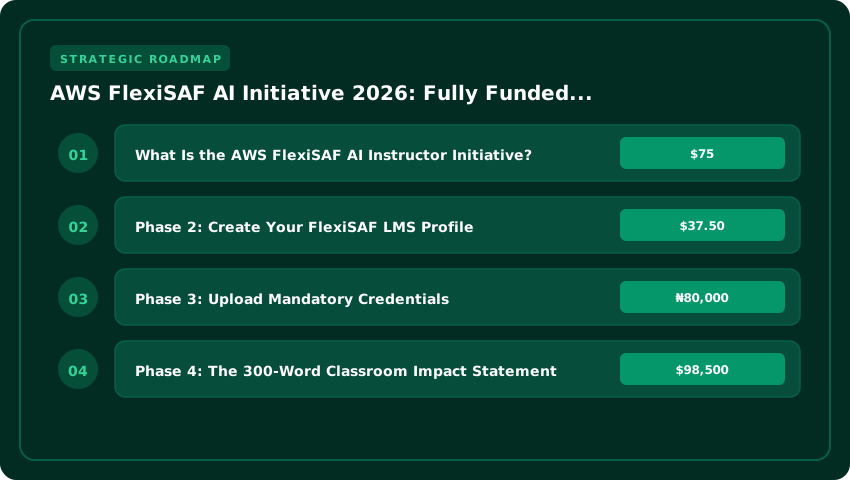
What Is the AWS FlexiSAF AI Instructor Initiative?
The AWS FlexiSAF AI Instructor Initiative is a landmark strategic partnership between Amazon Web Services (AWS) and FlexiSAF Edusoft, designed to fundamentally rewire how Artificial Intelligence is taught and understood in Nigerian secondary schools. Launched as a fully funded capacity-building program, it targets a critical bottleneck in our education ecosystem: the absence of confident, certified AI instructors capable of delivering the rigorous demands of the new NUC Core Curriculum Minimum Academic Standards (CCMAS) for Computer Studies and Data Science. This is not merely a workshop; it is a structured intervention to close the yawning gap between global AI advancements and the reality of the Nigerian classroom.
At its core, the initiative recognizes that curriculum reform on paper—such as the CCMAS mandate introducing Data Science, Machine Learning fundamentals, and Python programming at the senior secondary level—means little if the teacher at the front of the class lacks the practical fluency to teach it. For years, Nigerian educators have relied on outdated syllabi, often teaching theoretical definitions of “Expert Systems” while the world builds with Large Language Models and Generative AI. The AWS FlexiSAF partnership solves this by providing zero-cost, industry-grade training directly aligned with the AWS Certified AI Practitioner and AWS Certified Machine Learning Engineer – Associate learning paths, contextualized for the West African Examinations Council (WAEC) and National Examinations Council (NECO) assessment frameworks.
- Bridging the Skills Gap: The program equips teachers with hands-on proficiency in Amazon SageMaker, Bedrock, and responsible AI guardrails—tools that mirror the infrastructure students will encounter in tertiary institutions and the modern workforce.
- CCMAS Alignment: Every module maps directly to the CCMAS “Computer Studies” and “Data Science” learning outcomes, ensuring that when a teacher returns to their school in Lagos, Kano, or Enugu, they can immediately deliver lessons that satisfy NUC accreditation requirements for their institution.
- Train-the-Trainer Multiplier Effect: By certifying instructors as AWS Authorized Instructors (AAI) or AI Champions, the initiative creates a self-sustaining ripple effect. One trained teacher can mentor an entire department, impacting hundreds of students preparing for JAMB UTME Computer-Based Tests (CBT) and future STEM careers.
Critically, this initiative removes the financial barriers that typically gatekeep high-quality tech upskilling in Nigeria. There are no tuition fees—often running into hundreds of thousands of Naira (₦) for equivalent private certifications—and participants receive AWS Cloud credits, examination vouchers, and ongoing mentorship via the FlexiSAF learning management system. For a Vice Principal in a public unity school or a Computer Science HOD in a low-fee private academy, this represents an unprecedented opportunity to future-proof their career and their students’ prospects without touching the school’s meager operational budget. It is the quiet revolution the sector has waited for: practical, funded, and regulatorily compliant.
2026 Cohort Eligibility: Who Qualifies for Full Funding?
Understanding whether you qualify for the AWS FlexiSAF AI Initiative 2026 is the first practical step before committing your time, energy, and hopes to the application process. Because this is a fully funded programme sponsored jointly by Amazon Web Services and FlexiSAF Edusoft, the selection criteria are intentionally rigorous to ensure that public and private investment translates into measurable classroom impact across Nigerian and West African secondary schools. Below is a detailed breakdown of every eligibility dimension you must satisfy before your application is reviewed by the admissions panel.
1. Current Employment Status in a Recognised Secondary School. Applicants must be actively teaching in either a Junior Secondary School (JSS 1–3) or Senior Secondary School (SSS 1–3) at the time of application. Both public school teachers employed by state Universal Basic Education Boards (SUBEB), State Ministries of Education, or the Federal Ministry of Education, and private school teachers registered with their state’s Private School Board, are eligible. You will be required to upload a valid staff identification letter, a recent payslip, or an appointment letter on official school letterhead. Tutors at primary schools, lecturers at polytechnics or universities, and freelance educators without a verifiable institutional affiliation do not qualify for the 2026 cohort.
- Public school teachers: Must be on the government payroll or formally engaged through the UBEC/SUBEB scheme.
- Private school teachers: Must show proof of at least six months of continuous employment at a registered private secondary institution.
- Proprietors who also teach: Eligible, provided they can demonstrate active classroom instruction of at least 12 hours per week.
2. Subject Specialisation in STEM Priority Areas. To align with Nigeria’s national push for artificial intelligence readiness, the 2026 cohort prioritises educators who specialise in one or more of the following: Physics, Mathematics, Computer Science, or Chemistry. Teachers of Integrated Science, Basic Technology, or Digital Studies will also be considered on a case-by-case basis, especially if they can demonstrate cross-disciplinary teaching of the core STEM subjects. Candidates who teach only commercial or purely humanities subjects (Government, CRS/IRS, History, Yoruba, Hausa, Igbo, French, Literature) should not apply for this particular cohort, although future cohorts may broaden the specialisation scope based on the programme’s evolving needs.
3. NYSC Completion or Exemption Status. All Nigerian applicants between the ages of 18 and 35 are expected to have completed their National Youth Service Corps (NYSC) programme, or hold a valid NYSC exemption or exclusion certificate. This requirement aligns with the Federal Government’s standard for graduate-level employment in Nigeria. International applicants from other West African countries (Ghana, Sierra Leone, Liberia, The Gambia, Cameroon) are exempt from the NYSC requirement but must provide equivalent national service documentation or a sworn affidavit confirming their teaching professional status.
- NYSC discharge certificate, exemption letter, or exclusion certificate must be scanned and uploaded in PDF format.
- Discharged but not mobilised applicants should contact the FlexiSAF admissions office for guidance before applying.
- Foreign applicants must provide a valid ECOWAS travel document or national ID.
4. Digital Literacy Baseline Assessment. Every shortlisted applicant must pass a short digital literacy baseline covering the use of email, cloud folders, video conferencing tools (such as Zoom or Google Meet), and basic web navigation. This is not designed to exclude candidates but to ensure that once accepted, you can fully participate in the asynchronous and live online modules. Teachers who have never used a laptop before are encouraged to first complete the free NITDA Digital Literacy for Educators course, or the Google for Education Fundamentals pathway on Coursera, before submitting their application.
5. Clarification on NELFUND Loan Beneficiaries. A frequently asked question is whether teachers who previously benefited from the Nigerian Education Loan Fund (NELFUND) are excluded from full AWS FlexiSAF sponsorship. The answer is no. NELFUND and AWS FlexiSAF are independent funding streams serving different audiences: NELFUND primarily supports undergraduate tuition in tertiary institutions, while AWS FlexiSAF supports short-term professional upskilling for serving secondary school teachers. Receiving a NELFUND loan does not disqualify you. Likewise, receiving an AWS FlexiSAF scholarship will not affect your future eligibility for TETFund, UBEC intervention programmes, or state-level professional development grants.
6. Additional Soft Criteria That Strengthen Your Application. While not strictly mandatory, candidates who demonstrate any of the following tend to score higher during the document review stage: active membership in a recognised teachers’ council such as the Teachers Registration Council of Nigeria (TRCN); prior participation in STEM clubs, robotics competitions, or coding bootcamps; possession of a relevant professional certification (CCNA, Google Educator Level 1 or 2, Microsoft Innovative Educator); and a personal statement describing a specific classroom challenge you intend to solve using AI tools. These elements are not pass-or-fail filters but they give the selection committee confidence that you will maximise the ₦2.8 million to ₦3.5 million equivalent training value.
Actionable Takeaway: Before you begin your online application, gather your WAEC/NECO certificate, NYSC discharge or exemption letter, TRCN certificate (if available), a valid school-issued staff ID, and a one-page personal statement in PDF format. If you meet every hard requirement listed above, proceed to the FlexiSAF admissions portal and create your applicant profile. The 2026 cohort window is expected to close once 2,500 qualified applications are received, so early submission is strongly advised.
Step-by-Step Application Workflow via WhatsApp & Portal
The application process for the AWS FlexiSAF AI Initiative 2026 is deliberately designed as a hybrid journey, blending the immediacy of mobile messaging with the rigour of a formal Learning Management System (LMS). This dual-track approach ensures that even teachers in low-bandwidth areas across the North-Central, South-South, or rural South-West can stay informed without missing critical deadlines. Treat this workflow like a JAMB UTME registration: miss one step, and your profile remains incomplete.
Phase 1: Join the Official WhatsApp Intelligence Channel
Your first move is not a form—it is a subscription. Navigate to the official FlexiSAF Edusoft website or the verified AWS Africa social handles to locate the invite link for the “AI for Nigerian Educators” WhatsApp Channel (not a group). Channels are broadcast-only, meaning you receive real-time alerts—portal opening times, server maintenance windows, and document checklist updates—without the noise of 500 teachers asking “How far?” in a group chat. Action: Tap “Follow,” turn on notifications (bell icon), and screenshot the welcome message as proof of early engagement; some cohort selections prioritize early channel joiners.
Phase 2: Create Your FlexiSAF LMS Profile
Once the portal goes live—typically announced via the WhatsApp channel with a direct deep link—click through on a desktop or a mobile browser with “Desktop Site” enabled for better form rendering. Register using your official TRCN email or a dedicated Gmail address you check daily. You will verify via OTP. Critical: Ensure your full name matches your Teachers Registration Council of Nigeria (TRCN) certificate exactly. A mismatch between “Abdullahi Musa” on the portal and “Abdullahi M. Musa” on the certificate triggers an automatic manual review flag, delaying you by weeks.
Phase 3: Upload Mandatory Credentials
The portal dashboard presents a “Document Vault.” You must upload clear, legible PDFs or JPEGs (under 2MB each) for the following:
- TRCN Certificate & License: Both the certificate and the current annual practicing license (showing the 2025/2026 validity).
- Valid Government ID: NIN slip, Voter’s Card, or International Passport biodata page.
- School Affiliation Letter: A signed letter on school letterhead (public or approved private) confirming your current role as a classroom teacher. Heads of Department or Principals must sign; NYSC discharge certificates are accepted for corps members currently teaching.
- Passport Photograph: White background, recent (not older than 6 months), standard WAEC/NECO specification.
Name files logically: Surname_Firstname_TRCN.pdf, Surname_Firstname_ID.pdf. This helps the verification bot parse your folder faster.
Phase 4: The 300-Word Classroom Impact Statement
This is the differentiator. It is not a generic motivation letter. The prompt asks: “Describe a specific learning gap in your current classroom and how you envision integrating Generative AI tools to bridge it within one academic term.” You have exactly 300 words (the portal counters enforce a hard stop at 305).
- Be granular: Do not write “I want to improve STEM.” Write: “My JSS 2 class in Gwagwalada struggles with algebraic variable isolation; I plan to use AWS PartyRock to build a no-code tutor bot that generates stepwise worked examples in Pidgin and Hausa.”
- Show constraints: Mention power, device ratio, or data costs. Reviewers love realism.
- Align with CCMAS: Reference the NUC Core Curriculum Minimum Academic Standards or the new Basic Education Curriculum strands.
Draft offline in MS Word, run a word count, paste into the portal text box, and hit Submit Application. You will receive an instant “Application Received” toast on screen and a confirmation message on your WhatsApp channel DM. Save that Transaction ID—it is your admission ticket for the selection webinar.
Curriculum Deep-Dive: From Prompt Engineering to Classroom Deployment
The AWS FlexiSAF AI Initiative 2026 is not a surface-level workshop or a weekend seminar. It is a meticulously engineered 12-week intensive syllabus designed to take Nigerian educators from foundational cloud literacy to full-scale AI deployment in live classroom environments. For teachers juggling WAEC preparation, NECO marking scripts, and overcrowded JSS3 classrooms, the curriculum is structured to be practical, immediately applicable, and respectful of their time. Every module is built around real Nigerian pedagogical challenges, not abstract Silicon Valley theory.
The journey begins with Weeks 1–3: AWS Cloud Practitioner Essentials. Here, teachers are introduced to the backbone of modern AI—cloud computing. Rather than drowning in jargon, educators learn what the cloud actually means for a school in Kano or a rural classroom in Ebonyi. They explore how AWS services like Amazon S3, EC2, and Lambda power the educational apps their students already use. The goal is demystification: by the end of week three, a biology teacher should understand why their school’s e-learning portal slows down during WAEC registration season and how cloud scalability solves that problem. This foundational knowledge is critical because every subsequent AI tool they build will live on AWS infrastructure.
Weeks 4–7: Generative AI Prompt Engineering for Lesson Plans is where the curriculum truly comes alive. Teachers learn the art and science of communicating with large language models to generate curriculum-aligned lesson plans, differentiated worksheets, and formative assessment questions. The focus is not generic prompting but context-aware prompting tailored to the Nigerian educational ecosystem. Teachers learn to craft prompts that produce content aligned with NUC’s CCMAS standards for tertiary preparation, WAEC syllabus specifications, and NECO examination formats. A chemistry teacher in Lagos, for instance, learns to prompt an AI model to generate a lesson plan on electrolysis that references local examples—like the electroplating industries in Abeokuta—making the content culturally resonant and pedagogically sound.
Weeks 8–10: Building Low-Code AI Tools for WAEC/NECO Revision shifts educators from consumers to creators. Using AWS services like Amazon Bedrock and low-code platforms, teachers build functional AI-powered revision tools without needing advanced programming skills. These tools can generate practice questions, provide instant feedback, and adapt difficulty based on student performance. For a nation where private WAEC tutoring can cost ₦15,000 to ₦50,000 per term, these freely deployable tools represent a quiet revolution in educational equity.
The programme culminates in Weeks 11–12: The Mandatory Capstone Project. Every participating teacher must deploy a functional AI tutor bot for a specific Nigerian curriculum topic. This is not a theoretical exercise—it is a live deployment. Whether it is a JAMB UTME mathematics bot that guides students through quadratic equations step-by-step, or a WAEC English Language bot that helps students master essay structures, the capstone demands real-world functionality. Teachers present their projects to a panel comprising AWS solutions architects, FlexiSAF Edusoft product managers, and NUC curriculum consultants. Successful deployment earns the teacher their AWS FlexiSAF AI Instructor Certification, a credential increasingly recognized by progressive school administrators across West Africa.
- Module 1 (Weeks 1–3): AWS Cloud Practitioner Essentials—cloud fundamentals, AWS core services, security basics, and educational use cases
- Module 2 (Weeks 4–7): Generative AI Prompt Engineering—LLM fundamentals, prompt design patterns, lesson plan generation, and WAEC/NECO content alignment
- Module 3 (Weeks 8–10): Low-Code AI Tool Development—Amazon Bedrock, no-code bot builders, student feedback systems, and revision tool deployment
- Module 4 (Weeks 11–12): Capstone Project—AI tutor bot design, deployment, testing with real students, and panel defense
The brilliance of this curriculum lies in its immediate applicability. A teacher does not wait until certification to impact their classroom. By week five, they are already generating lesson plans. By week nine, their students are interacting with AI revision tools. This is not training for tomorrow—it is transformation happening today, one Nigerian classroom at a time.
Post-Certification ROI: Salary Bumps, TRCN Points & Career Pivots
Completing the AWS FlexiSAF AI Instructor Initiative is not merely a line on your CV; it is a verifiable asset that unlocks tangible financial and professional leverage within the Nigerian education ecosystem. The most immediate return for classroom teachers is the accumulation of Teachers Registration Council of Nigeria (TRCN) Professional Development (PD) points. This programme is structured to deliver the mandatory credit units required for your annual license renewal, saving you the hassle and cost of sourcing disjointed workshops. More critically, these certified hours count directly toward the Master Teacher cadre qualifications under the revised Scheme of Service, fast-tracking your eligibility for promotion from Grade Level (GL) 09 up to GL 12. In practical Naira terms, bridging the gap between GL 09 and GL 12 represents an annual basic salary increment of roughly ₦1.2 million to ₦2.5 million, excluding peculiar allowances and the new minimum wage adjustments.
Beyond the civil service ladder, the technical toolkit you acquire—proficiency in Amazon SageMaker, Bedrock, and AI-driven curriculum design—opens a lucrative freelance economy. EdTech giants like uLesson, Afretec, and emerging startups in Yaba and Abuja are aggressively hunting for educators who can bridge pedagogy and cloud architecture. We are seeing contract rates for curriculum mapping and AI content auditing ranging from ₦150,000 to ₦400,000 per project for certified alumni. This allows you to build a “side hustle” that often rivals a principal’s take-home pay, all while remaining in the classroom if you choose.
- TRCN Compliance: Earn 15–20 verified PD points per cohort cycle, covering 100% of your biennial renewal requirement.
- Grade Level Velocity: Certified AI competency is now a weighted criterion for “Master Teacher” promotion interviews at SUBEB and Federal Unity Colleges.
- Freelance Pipeline: Direct referral access to FlexiSAF’s partner network for paid curriculum localization and LMS administration gigs.
- AWS Certification Discount: Graduates receive a 50% discount voucher for the AWS Certified AI Practitioner (AIF-C01) exam, reducing the fee from ~$75 (approx. ₦112,500) to ~$37.50 (approx. ₦56,000)—a globally recognized credential that validates your cloud fluency.
The pathway to the AWS Certified AI Practitioner badge is arguably the highest ROI multiplier. It transforms you from a “tech-savvy teacher” into a cloud-verified education technologist, making you eligible for roles like Instructional Designer, EdTech Product Manager, or Digital Learning Consultant at multinational firms and NGOs operating across West Africa. This single certification effectively future-proofs your career against the automation anxiety sweeping the sector, positioning you as the human-in-the-loop that every AI deployment desperately needs.
Critical Deadlines & Common Disqualification Triggers (2026 Cycle)
Missing a deadline on a fully funded international programme is not just an inconvenience; it is a five-year opportunity lost. Because the AWS FlexiSAF AI Instructor Initiative is a high-trust, high-visibility partnership between Amazon Web Services and FlexiSAF Edusoft, the 2026 recruitment window operates on a strict, non-negotiable timetable that mirrors global corporate training calendars rather than the more relaxed rhythm of local scholarship applications. Every Nigerian applicant, whether you are submitting from a quiet classroom in Asaba, a busy co-working space in Yaba, or a remote village in Adamawa, must treat these dates as fixed borders on a map. There are no extensions for “network issues,” no second chances for late uploads, and no favouritism for candidates with strong stories but weak timelines.
Based on the verified 2026 cycle calendar released to partner institutions, the application window opens on Monday, 13 January 2026 at 9:00 AM West Africa Time (WAT) and closes sharply on Sunday, 23 February 2026 at 11:59 PM WAT. This six-week window is intentionally narrow because AWS instructors must be onboarded and certified before the July 2026 cloud practitioner cohort begins. After submissions close, the Aptitude and Computational Thinking Test window runs from Tuesday, 10 March to Thursday, 12 March 2026, delivered online with a 72-hour flexibility buffer for candidates writing JAMB UTME in overlapping states. The final selection announcement is scheduled for Friday, 17 April 2026, followed by the mandatory virtual bootcamp orientation on 22 to 24 April 2026. Candidates who fail to attend any portion of the orientation forfeit their slot automatically, and the seat cascades to the next ranked applicant within 48 hours.
Beyond the calendar itself, what truly eliminates otherwise strong candidates are the four silent disqualification triggers that catch even experienced educators off guard. Understanding these pitfalls is worth more than any extra certificate on your CV.
- Incomplete or Illegible TRCN Uploads: The Teachers Registration Council of Nigeria (TRCN) certificate is mandatory, but many applicants photograph only the front page, upload expired prints, or submit documents larger than the 2MB portal limit. A blurry TRCN scan is treated identically to a missing one. Scan both sides in PDF, compress to under 2MB, and double-check that your full name matches your application exactly.
- Personal Emails Instead of Official School Domains: Using Gmail, Yahoo, or Hotmail addresses immediately flags your file for manual review and significantly reduces trust scores. Whether you teach at a public school in Kano or a private academy in Port Harcourt, your school-issued email (or a formally verified institutional address) is the expected standard. If your school lacks a domain, request a verified alternative through the FlexiSAF partner liaison before submitting.
- Plagiarism in the 500-Word Impact Statement: The impact essay is screened through Turnitin and an internal AI-detection layer. Copying paragraphs from FlexiSAF’s own marketing materials, previous winners, or generic AI-generated text guarantees instant disqualification. Write in your own voice, cite specific classroom data, and show measurable outcomes such as a 30% improvement in your students’ basic literacy assessments.
- Failure to Attend the Mandatory Virtual Bootcamp Orientation: Even after selection, skipping the three-day orientation (22 to 24 April 2026) without a documented medical or JAMB conflict voids your admission. The orientation covers AWS Academy logistics, stipends disbursement via NELFUND-linked accounts, and the NUC CCMAS-aligned curriculum framework. Attendance is tracked via unique login tokens tied to your application ID.
Actionable Takeaway: Block all four dates on your phone calendar today. Set reminders for 14 January 2026 (application start), 20 February 2026 (three-day warning), 9 March 2026 (aptitude test eve), and 21 April 2026 (orientation eve). Prepare your TRCN scan, verify your school email, and draft your impact statement offline before the portal even opens. In a cycle where thousands of qualified Nigerian teachers will compete for roughly 500 funded slots, discipline around deadlines and disqualifiers is the single biggest competitive advantage you control.
| Metric | AWS FlexiSAF AI Initiative | Typical Nigerian AI Bootcamp | International AI Certification (e.g., Coursera/DeepLearning.AI) |
|---|---|---|---|
| Tuition Cost (Nigerian Educators) | ₦0 (Fully Funded) | ₦150,000 – ₦400,000 | ₦80,000 – ₦250,000 (self-funded USD equivalent) |
| Certification Value | AWS + FlexiSAF Co-Branded Certificate | Provider-issued Certificate | Industry-recognized (Coursera, Stanford-backed) |
| Application Cut-off | Rolling (Cohort-based; typically 4–6 weeks per cycle) | Open enrollment / Fixed quarterly intakes | Continuous enrollment |
| Program Duration | 8–12 Weeks (Part-time, teacher-friendly) | 4–16 Weeks (Full-time or hybrid) | 4–24 Weeks (Self-paced) |
| Target Audience | Nigerian Secondary School Teachers | Developers / General Public | Global Professionals / Tech Learners |
| Curriculum Focus | AI Pedagogy + AWS Cloud Foundations (K-12 aligned) | Generic AI/ML Coding Skills | Technical AI Engineering (Python, TensorFlow, LLMs) |
| Career ROI (Nigerian Context) | High — Promotes to AI-Lead Teacher; ₦50k–₦120k salary uplift potential | Moderate — Entry-level developer roles | High globally; Limited direct recognition in Nigerian public schools |
| Stipend / Materials | Yes — AWS credits, data bundles, teaching kits included | Not typically provided | No (audit-only free option available) |
| Selection Criteria | Teaching experience + Basic digital literacy | Basic coding knowledge / Laptop required | None (open access) |
| Post-Program Pathway | AWS Educate Ambassador Network + FlexiSAF School Network | Job placement assistance (limited) | LinkedIn-credible badge; portfolio building |
Frequently Asked Questions
What is the AWS FlexiSAF AI Instructor Initiative 2026?
The AWS FlexiSAF AI Instructor Initiative 2026 is a fully funded partnership between Amazon Web Services and FlexiSAF Edusoft designed to train Nigerian secondary school teachers in artificial intelligence pedagogy and AWS Cloud Foundations. It equips educators to deliver AI literacy curriculum aligned with K-12 learning outcomes across Nigeria.
Is the AWS FlexiSAF AI program truly free for Nigerian teachers?
Yes. The program is 100% fully funded with no tuition, hidden fees, or material costs for accepted Nigerian educators. AWS and FlexiSAF cover training, certification, AWS cloud credits, data bundles, and teaching kits. This removes the ₦150,000–₦400,000 financial barrier typical of comparable AI bootcamps in Nigeria.
What are the eligibility requirements for the AWS FlexiSAF AI Initiative?
Applicants must be currently teaching in a Nigerian secondary school, demonstrate basic digital literacy, and show commitment to integrating AI into classroom instruction. No advanced coding background is required. Priority is given to STEM teachers, female educators, and teachers serving underserved rural communities nationwide.
How does the AWS FlexiSAF certification boost a Nigerian teacher's career?
The co-branded AWS + FlexiSAF certificate qualifies graduates for AI-Lead Teacher roles, unlocking an estimated ₦50,000–₦120,000 monthly salary uplift. It also grants entry into the AWS Educate Ambassador Network and FlexiSAF's 200+ partner school network, accelerating promotion pathways within Nigeria's evolving EdTech ecosystem.
Strategic Final Takeaway
Success in evaluating AWS FlexiSAF AI Initiative 2026: Fully Funded Teacher Training Guide relies on early preparation, adherence to verified accredited requirements, and cross-referencing official portals. Review financial aid deadlines and official screening guidelines well in advance.