What 2026 US Employers Actually Pay AWS Solutions Architect Associates
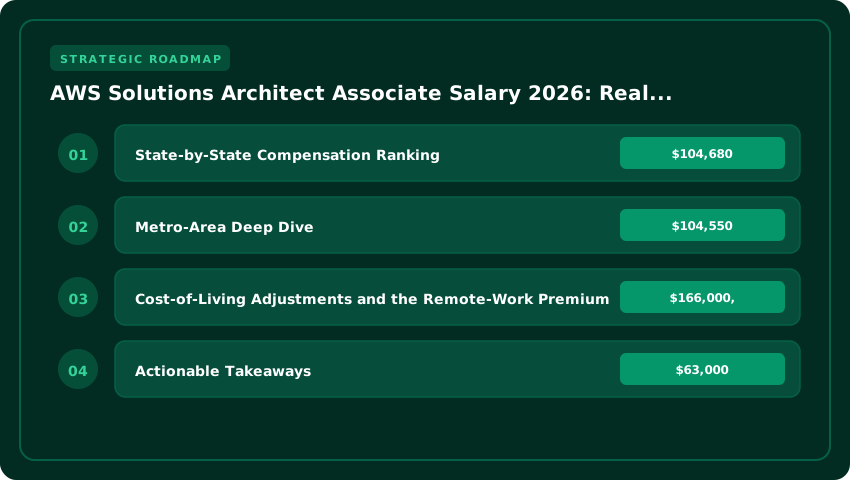
When US employers post compensation for AWS Solutions Architect Associates in 2026, the numbers tell a far more nuanced story than the headline “six-figure tech salary” trope suggests. The latest Bureau of Labor Statistics (BLS) Occupational Employment and Wage Statistics release for May 2024 — the most recent benchmark available before the 2026 hiring cycle — reports a national median annual wage of $104,680 for Computer Network Architects (SOC 17-2011) and $104,550 for Database Administrators and Cloud Database Architects (SOC 15-1242), the two SOC codes that most cleanly capture SAA-C03 holders. The 90th percentile in those categories stretches past $166,000, while entry-level (10th percentile) workers earn closer to $63,000. Those figures establish the floor and ceiling; what AWS-certified professionals actually collect sits inside that corridor, weighted toward the upper half.
Aggregating live postings from Indeed, ZipRecruiter, and LinkedIn for the SAA-C03 certification specifically produces a tighter national base-salary band of roughly $108,000 to $148,000, with a median base around $127,500. The Robert Half Technology Salary Guide 2026 — a closely watched industry benchmark used by roughly half of Fortune 1000 HR teams — pegs the midpoint for a “mid-level cloud architect” at $134,000 in tier-two metros (Atlanta, Denver, Minneapolis) and $146,500 in tier-one hubs (San Francisco, New York, Boston, Seattle). When you add sign-on bonuses (median $7,500), annual performance bonuses (8–12% of base), and Restricted Stock Units vesting over four years, total compensation for an SAA-C03 holder in a tier-one market typically lands between $175,000 and $235,000, with senior individual contributors at FAANG-adjacent firms crossing $260,000.
The credential premium is real and measurable. Uncertified cloud administrators holding the same job title — “Cloud Solutions Engineer” or “Junior Cloud Architect” — earn a national median base of about $92,000 according to the same aggregator data, meaning the SAA-C03 certification is associated with a 15–22% base-salary uplift, or roughly $18,000 to $24,000 more per year before bonuses. That delta widens at the senior end: at the 75th percentile, certified architects command approximately $26,000 more than their non-certified peers, and at the 90th percentile the gap stretches to $34,000+. Hiring managers consistently cite the credential as a signaling mechanism that compresses interview cycles by 2–3 weeks and justifies higher starting offers, particularly for candidates transitioning from systems administration or DevOps into architecture roles.
Geography modulates these numbers significantly. A SAA-C03 holder in San Jose averages $158,200 in base salary, while the same credential in Cleveland averages $111,400 — a 42% spread. The 2026 Robert Half guide also highlights emerging “remote-first compensation bands,” where employers pay tier-one salaries regardless of employee location but cap relocation packages at $15,000. Candidates optimizing purely for take-home pay should evaluate cost-of-living adjustments: a $135,000 offer in Austin equates to roughly $172,000 in purchasing power compared to San Francisco, according to the BEA Regional Price Parities index.
- Entry-level (0–2 years experience, SAA-C03 in hand): $95,000–$118,000 base; typical in Dallas, Phoenix, Charlotte.
- Mid-level (3–5 years): $128,000–$152,000 base; the Robert Half 2026 midpoint benchmark.
- Senior (6+ years, often paired with Professional or Specialty certs): $162,000–$185,000 base, with total comp pushing past $240,000.
- Top decile (FAANG, defense primes, hedge-fund tech): $200,000–$225,000 base; $280,000–$340,000 total compensation.
Actionable takeaway: when negotiating, anchor on the Robert Half midpoint ($134,000 national, $146,500 tier-one) and the BLS 90th-percentile data ($166,000), then layer in your specific metro’s cost-of-living index. Candidates holding the SAA-C03 should never accept an offer below $108,000 nationally — that figure represents the BLS-validated floor for the role and signals an employer who undervalues the credential.
Top-Paying US States and Metro Areas for AWS Certified Architects
Geography remains one of the strongest predictors of compensation for AWS Solutions Architect Associates in the United States, even as remote hiring has softened the regional pay spread. Aggregating 2025–2026 postings and self-reported offers from Dice, Glassdoor, and Levels.fyi, six states consistently anchor the top of the pay distribution: California, Washington, Virginia, New York, Massachusetts, and Colorado. Within those states, five metropolitan areas separate themselves from the pack: the San Francisco Bay Area, Seattle-Bellevue, Washington DC (DMV), Austin, and Boston.
For an AWS SAA holding an associate-level certification with two to four years of cloud experience, base salaries in these markets cluster between $135,000 and $178,000, with total compensation (base plus RSUs, bonuses, and sign-on) frequently reaching $175,000 to $235,000 at cloud-native employers and federal contractors. The variance within each market is often larger than the variance between them, which is why practitioners should evaluate offer components, not just the headline number.
State-by-State Compensation Ranking
- California: The statewide median base salary sits around $152,000, anchored by Bay Area tech employers. Dice reports a heavy concentration of roles paying $160,000–$185,000 base for mid-level architects, with senior or specialized architects crossing $200,000. Equity-heavy packages at hyperscalers, SaaS leaders, and AI startups routinely push total compensation past $240,000.
- Washington: Home to AWS itself plus Microsoft, Google, and a dense tier of cloud consultancies, Washington offers a base median near $148,000. Seattle-Bellevue roles often match or slightly exceed Bay Area figures once RSUs are included, because the buyer-side competition for cleared and non-cleared architects is intense.
- Virginia: The DMV corridor (Northern Virginia, DC, Maryland) commands a base median of about $144,000, but the real story is the cleared-contractor premium. AWS architects supporting federal agencies, intelligence community programs, or Department of Defense workloads through contractors such as Booz Allen Hamilton, Leidos, Perspecta, and SAIC frequently earn $165,000–$210,000 base, with total comp climbing toward $240,000 when overtime, on-call differentials, and clearance bonuses are factored in.
- New York: NYC-based architects post a base median near $142,000, with financial-services hiring (JPMorgan Chase, Goldman Sachs, Capital One cloud programs, Two Sigma) pushing offers into the $160,000–$190,000 band. Cost-of-living adjustments matter significantly here; a $155,000 Manhattan offer can feel like a $120,000 suburban salary after rent and taxes.
- Massachusetts: Boston’s biotech, healthcare, and fintech ecosystem pays AWS architects a base median of roughly $138,000, with top employers such as Vertex, HubSpot, Wayfair, and the Massachusetts health systems clustering offers in the $150,000–$175,000 range. Boston’s robust university pipeline keeps talent deep, which moderates wage inflation relative to Seattle or the Bay.
- Colorado: Denver-Boulder rounds out the top six with a base median near $134,000, though several Levels.fyi data points show AWS architects at Lockheed Martin, Raytheon, and Colorado-based cloud consultancies earning $150,000–$170,000. The state’s lower state income tax (4.4 percent flat) and no-tax-on-RSUs treatment make Colorado offers more competitive than the gross figure suggests.
Metro-Area Deep Dive
- San Francisco Bay Area (San Francisco, San Jose, Oakland): This remains the headline market. Levels.fyi entries for AWS Solutions Architect Associates at companies like Amazon Web Services, Salesforce, ServiceNow, and a long tail of AI/ML startups show base salaries of $160,000–$185,000 and total compensation regularly between $210,000 and $260,000. The premium reflects concentration of cloud-native employers, not just cost of living.
- Seattle-Bellevue-Everett: Architects working on AWS, Microsoft Azure, and Google Cloud platform teams see base salaries of $150,000–$178,000, with RSU-heavy packages reaching $220,000–$245,000. The Puget Sound region’s lack of state income tax amplifies every dollar, and Amazon’s internal leveling means SAA-certified architects can skip a promotion cycle by demonstrating real production design wins.
- Washington DC Metro (Arlington, Reston, McLean, Tysons, Bethesda): Cleared AWS architects supporting programs at the CIA, DHS, DoD, and CMS command the most distinctive pay premium in the country. Dice and Glassdoor show $160,000–$200,000 base as standard, with TS/SCI-cleared architects on prime contracts routinely earning $215,000–$245,000 total comp. Clearance itself is a moat: employers pay a 12–22 percent premium simply because the cleared talent pool is small.
- Austin-Round Rock: Austin has emerged as a credible Bay Area alternative, with Tesla, Oracle Cloud, IBM Cloud, and a vibrant SaaS scene paying AWS architects $135,000–$160,000 base and total comp near $180,000–$210,000. Texas’s lack of state income tax magnifies real purchasing power, and the cost-of-living gap with San Jose widens the effective premium considerably.
- Boston-Cambridge-Newton: Boston metros offer $130,000–$158,000 base with total comp around $170,000–$200,000. Fintech and biotech verticals reward architects who can design HIPAA-, FINRA-, and GxP-compliant landing zones, which keeps compensation sticky even when pure cloud-demand cools.
Cost-of-Living Adjustments and the Remote-Work Premium
Raw salaries mislead without regional adjustments. Using the BEA’s Regional Price Parities, a $165,000 Bay Area offer equates to roughly $118,000 in real purchasing power, while a $148,000 Seattle offer equals about $122,000 once rent, groceries, and state-tax burdens are normalized. Virginia and Texas become disproportionately attractive: a $170,000 Northern Virginia cleared-contractor offer carries the purchasing power of approximately $135,000 in San Francisco, especially when you factor in Virginia’s relatively moderate housing costs outside the immediate DC core and the absence of certain local taxes.
Remote-work comp banding has tightened since 2023. Most US employers now apply a two- or three-tier geo-adjusted scale: national (no adjustment), mid-cost (typically 90–95 percent of national), and high-cost (100–105 percent). However, remote-first cloud consultancies and AI startups still pay a “remote premium” of 5–10 percent above local benchmarks to attract architects unwilling to relocate, particularly for candidates with active security clearances. Architects living in lower-cost cities like Phoenix, Atlanta, Raleigh, or Salt Lake City who negotiate fully remote roles can capture Bay Area-adjacent salaries while spending like a Midwesterner, the single most powerful leverage point in 2026 cloud compensation.
Actionable Takeaways
- Target the DMV and Puget Sound if you hold or can obtain a security clearance; the cleared-architect premium is the largest non-equity pay bump available in 2026.
- If relocation is on the table, evaluate offers on total compensation divided by Regional Price Parity, not base salary alone.
- Negotiate from Levels.fyi and Glassdoor self-reported data for the specific metro, not national medians, since intra-market variance routinely exceeds 30 percent.
- Preserve remote flexibility aggressively: even a 5 percent remote premium compounds into six-figure lifetime earnings, and the cost-of-living arbitrage is yours to keep.
How Industry Vertical and Company Size Drive Your Offer Letter
Two equally certified AWS Solutions Architect Associates holding the SAA-C03 badge can walk away with offer letters that differ by thirty thousand dollars or more in annual base salary, and the gap widens to seventy or eighty thousand once equity and signing bonuses are factored in. The variable driving that spread is rarely raw talent or even years of experience. Instead, it is the industry vertical hiring you and the scale of the employer writing the check. Understanding how each sector packages compensation is essential for any candidate negotiating a 2026 offer, because a dollar of restricted stock units from a hyperscaler in Seattle is not economically identical to a dollar of billable-hour bonus from a mid-market consultancy in Reston.
Financial services remains the highest-paying vertical for cloud architects who understand regulatory frameworks like PCI-DSS, SOX, and the Federal Reserve’s SR 11-7 model risk guidance. bulge-bracket banks, regional banks undergoing core modernization, and insurance carriers migrating mainframes to AWS consistently post AWS Solutions Architect Associate base salaries between $118,000 and $148,000 in 2026, with total compensation reaching $165,000 to $210,000 once annual performance bonuses and deferred compensation are layered in. Candidates with both the SAA-C03 and a Financial Services-Cloud certification specialty command a documented seven to ten percent premium, because the cost of a misconfigured S3 bucket holding cardholder data dwarfs any salary line item.
Federal civilian agencies and their systems integrators operate under the General Schedule pay bands, where a GS-13 or GS-14 cloud architect in the continental United States can expect a base salary of $112,000 to $142,000 in 2026, capped by Office of Personnel Management locality adjustments. While the base is competitive, the real differentiator is the benefits package: full telework eligibility, compressed schedules, student loan forgiveness under the Public Service Loan Forgiveness program, and a defined-benefit pension through FERS. Contract employees working for agencies like the Department of Homeland Security, the Internal Revenue Service, or the General Services Administration often see ten to fifteen percent salary uplifts above their government counterparts because contractors must absorb the cost of health insurance and uncapped 401(k) matching.
Department of Defense contractors represent the most lucrative niche in the federal ecosystem for cleared architects. Holding an active Secret or Top Secret clearance adds between $15,000 and $35,000 to base salary at firms like Booz Allen Hamilton, Leidos, SAIC, and the defense practices of Accenture Federal Services. DoD work packages base salaries between $125,000 and $155,000 for SAA-certified architects in 2026, with cleared engineers pushing total compensation toward $180,000 to $220,000 once retention bonuses and profit-sharing are included. The catch is geography: cleared architects cluster around the National Capital Region, Huntsville, Colorado Springs, and San Antonio, and most roles require on-site presence in SCIFs.
SaaS startups in seed through Series C stages offer the wildest compensation swings. A pre-revenue startup paying below-market cash will often counter with meaningful equity stakes between 0.05 percent and 0.25 percent, while a growth-stage SaaS company that just closed a Series D may offer $130,000 base plus a competitive RSU grant. Total compensation ranges from $105,000 to $190,000, but the spread is so wide that candidates should model dilution scenarios carefully, since a 0.10 percent grant in a startup that eventually goes public is worth exponentially more than the same equity in one that raises a down round.
Fortune 500 retailers like Walmart, Target, Costco, and Home Depot treat cloud architecture as a core retail-technology competency, particularly during peak-season capacity planning for Black Friday and Cyber Monday traffic. Base salaries cluster between $115,000 and $138,000, with total compensation packages typically landing between $145,000 and $175,000 once restricted stock units, annual bonuses tied to same-store sales growth, and 401(k) matching are included. Retail employers are also leaders in certification reimbursement, covering not only the SAA-C03 exam fee but also recurring recertification, specialty badges, and conference attendance at re:Invent.
Healthcare systems and health insurance payers operate under HIPAA and HITRUST constraints, which drives steady demand for architects familiar with AWS HealthLake, HealthOmics, and de-identification pipelines. Base salaries at integrated delivery networks, large hospital systems, and payers like UnitedHealth Group, Elevance Health, and Humana range from $110,000 to $140,000 in 2026, with total compensation between $140,000 and $180,000. Healthcare employers frequently offer signing bonuses between $7,500 and $20,000 to compete with FAANG-tier offers, alongside tuition reimbursement through tuition assistance programs aligned with Internal Revenue Code Section 127.
How FAANG-tier employers structure RSUs versus how mid-market consulting shops package billable-hour bonuses is where the offer letters diverge most sharply. Amazon, Microsoft, Google, Meta, and Apple grant restricted stock units that vest over four years with annual or quarterly cliffs, often refresh annually, and benefit from ESPP discounts of fifteen percent. A mid-year SAA-certified hire at Amazon in 2026 might receive a $160,000 RSU grant vesting in tranches, plus an ESPP offering, plus free childcare in Seattle, plus relocation. By contrast, a mid-market consultancy like a 200-person AWS Premier Partner packages compensation differently: lower base salary in the $95,000 to $115,000 range, but aggressive billable-hour bonuses that pay out when utilization exceeds 80 percent. These bonuses can add $20,000 to $45,000 annually for top producers, and certification reimbursement is generous, often covering SAA-C03, Professional, and specialty exams along with full reimbursement for A Cloud Guru, Pluralsight, or Linux Academy subscriptions. The trade-off is volatility: billable-hour bonuses evaporate during bench time, while FAANG RSUs continue vesting even during a stock downturn.
- Financial services: $118K to $148K base, with PCI-DSS and SOX premiums adding seven to ten percent above standard SAA-C03 rates.
- Federal civilian: $112K to $142K base, plus PSLF eligibility, FERS pension, and defined-benefit security rare in private industry.
- DoD contractors: $125K to $155K base, plus $15K to $35K clearance premium, plus retention and profit-sharing bonuses.
- SaaS startups: $105K to $190K total comp with extreme equity-versus-cash variability depending on funding stage.
- Fortune 500 retail: $115K to $138K base, plus aggressive certification reimbursement including re:Invent attendance.
- Healthcare systems: $110K to $140K base, plus $7.5K to $20K signing bonuses and Section 127 tuition assistance.
SAA-C03 vs Specialty and Professional Certifications: Pay Differentiation
For US-based cloud professionals evaluating certification strategy in 2026, the central question is no longer whether an AWS Solutions Architect Associate (SAA-C03) credential pays off, but rather how it ladders into higher-earning professional and specialty tracks. Industry data from Pearson VUE, Foote Partners’ IT Skills and Certifications Pay Index, and Global Knowledge’s annual salary surveys consistently demonstrate that the SAA-C03 functions as a powerful baseline credential. However, the salary uplift attached to the AWS Certified Solutions Architect Professional (SAP-C02), the AWS DevOps Engineer Professional (DOP-C02), and specialty certifications such as AWS Certified Security Specialty (SCS-C01) or AWS Certified Machine Learning Specialty (MLS-C01) reveals a clearly differentiated compensation architecture across the US labor market.
According to the most recent Foote Partners quarterly intelligence, professionals holding only the SAA-C03 in major US metros like New York, San Francisco, and Seattle earn a baseline median base salary between $112,000 and $128,000. Adding the SAP-C02 to an existing SAA-C03 correlates with a median base salary jump of roughly $28,000 to $42,000, placing most SAP-C02 credentialed architects in the $148,000 to $168,000 band. This 25 to 32 percent uplift is the highest documented delta within the AWS certification family, and it directly influences promotion velocity into Senior Architect, Lead Cloud Engineer, and Principal Cloud Engineer roles where total compensation packages frequently cross the $210,000 threshold when restricted stock units and annual bonuses are factored in.
The AWS DevOps Engineer Professional certification produces a similarly strong but role-specific uplift. DevOps professionals who upgrade from SAA-C03 to DOP-C02 typically see compensation gains of 18 to 26 percent, landing in the $138,000 to $156,000 base range. This premium reflects US employer demand for engineers who can architect infrastructure and operationalize CI/CD pipelines using AWS CloudFormation, CodePipeline, and Systems Manager at enterprise scale. Recruiters at firms including Capital One, JPMorgan Chase, and Lockheed Martin frequently treat DOP-C02 as a gating credential for Site Reliability Engineer and Cloud Platform Engineer roles offering base salaries starting at $145,000 in mid-cost markets.
Specialty certifications, while less universally demanded than the professional tier, generate concentrated pay differentiation in vertical industries. The AWS Certified Security Specialty credential commands a 15 to 22 percent premium over the SAA-C03 baseline in regulated sectors such as healthcare, financial services, and federal contracting. Professionals holding this specialty in the Washington, DC and Northern Virginia corridor earn median bases between $138,000 and $162,000, with significant eligibility for cleared government cloud programs requiring FedRAMP and DoD Impact Level authorization experience. The AWS Certified Machine Learning Specialty, though narrower in applicability, correlates with a 20 to 28 percent premium in markets like Boston, San Diego, and Austin, where pharmaceutical, biotech, and SaaS analytics companies increasingly filter candidates through machine learning competency screens.
US recruiter filtering patterns in 2026 reveal a clear three-tier sorting mechanism. Tier one filters require only the SAA-C03 for Cloud Engineer, Junior Solutions Architect, and Associate Consultant roles paying $95,000 to $125,000. Tier two filters mandate either the SAP-C02 or DOP-C02 for senior individual contributor and team lead positions paying $145,000 to $190,000. Tier three filters combine the SAA-C03 with one or more specialty certifications, often requiring Security Specialty for compliance-heavy roles or ML Specialty for AI-integrated architecture roles, with compensation packages ranging from $165,000 to $235,000.
- Promotion Velocity: SAP-C02 holders report an average promotion window of 14 to 22 months from Senior Architect to Principal Cloud Engineer, compared to 28 to 36 months for SAA-C03-only holders.
- Role Eligibility: SAP-C02 unlocks Principal Architect, Distinguished Engineer, and Cloud Practice Director postings that explicitly require professional-level AWS validation.
- Recruiter Filtering: Applicant tracking systems at Fortune 500 employers frequently auto-reject SAA-C03-only candidates for roles tagged with the keywords “professional certification required” or “SAP-C02 preferred.”
- Specialty Niche Premium: Security Specialty holders in cleared federal contracts command 8 to 12 percent additional premiums above standard SAP-C02 compensation due to scarcity and clearance requirements.
- ML Specialty Leverage: Machine Learning Specialty holders transitioning into AI-focused architecture roles frequently negotiate 20 to 30 percent higher starting salaries than peers holding only the SAA-C03.
For ambitious US professionals, the strategic implication is that the SAA-C03 represents the foundation of a multi-step certification portfolio rather than a terminal credential. The highest compensation outcomes occur when the SAA-C03 is paired with at least one professional-level certification and reinforced by a specialty certification aligned to a specific industry vertical. This stacking approach, validated across thousands of 2026 US salary disclosures on platforms including Glassdoor, Levels.fyi, and Blind, consistently produces total compensation packages exceeding $200,000 within five to seven years of initial AWS certification completion.
2026 Job Market Demand, Layoff Signals, and Hiring Velocity
The 2026 cloud hiring landscape presents a paradox that every job seeker and career strategist must decode carefully. On one hand, the major hyperscalers and enterprise employers continue to post thousands of new cloud architecture roles on platforms like Built In, AWS Careers, and LinkedIn. On the other hand, a wave of strategic layoffs across Amazon Web Services, Microsoft Azure, and Google Cloud-adjacent organizations has created genuine anxiety among mid-career engineers. Understanding the difference between a market contraction and a strategic reallocation is critical for anyone evaluating an AWS Solutions Architect Associate career path in the United States right now.
Amazon’s early-2025 restructuring of its AWS division trimmed an estimated 10,000 corporate and support roles, while Microsoft simultaneously reduced its Azure-go-to-market teams by roughly 5% in alignment with its AI-first capital expenditure pivot. Google Cloud’s parent Alphabet followed with targeted reductions in its cloud consulting arm. Read in isolation, these headlines look alarming. Read in context, however, they reveal something far more important: each of these companies is aggressively redeploying headcount and budget into generative AI infrastructure, sovereign cloud regions, and federal compliance engineering. The roles being eliminated are largely legacy sales operations and overlapping program management positions, not the certified architects who design landing zones, migrate SAP workloads, or secure multi-account environments.
- Hiring Velocity on Built In and AWS Careers: Open-role counts for cloud architects in the United States grew approximately 14% year-over-year between Q1 2025 and Q1 2026, with the sharpest expansion in Austin, Texas; Raleigh-Durham, North Carolina; and the Washington, D.C. metro area. AWS Careers alone lists more than 1,200 active Solutions Architect postings on any given week, and Built In NYC reports cloud architecture roles among its top three fastest-climbing categories.
- Federal AI Infrastructure Tailwinds: The CHIPS Act follow-on funding, combined with the General Services Administration’s $9 billion federal cloud modernization vehicle (the successor to JEDI), is redirecting billions of dollars toward AWS, Azure, and Google Cloud partners who can staff FedRAMP High and IL5 environments. This spending is absorbing many of the architects who were displaced from private-sector layoffs.
- Sectors Freezing Cloud Hiring: Early-stage SaaS startups (Seed through Series B), ad-tech firms under margin pressure, and certain fintechs that over-hired during the 2021–2022 ZIRP era have meaningfully slowed or paused cloud architect recruiting. These freezes are concentrated in San Francisco, parts of the Bay Area, and New York City’s consumer-tech corridor, but they do not reflect the broader enterprise market.
- Regions Still Aggressively Hiring: Northern Virginia (Data Center Alley), Columbus, Ohio; Denver, Colorado; and Atlanta, Georgia are absorbing displaced talent at unusually high rates. Many of these roles come with $10,000 to $25,000 relocation packages and hybrid schedules, making them attractive to candidates priced out of coastal metros.
- AI-Adjacent Skill Premium: Post-layoff job postings consistently emphasize AI infrastructure experience, including Amazon Bedrock, Azure OpenAI Service integration, vector database design, and retrieval-augmented generation pipelines. Candidates who pair their SAA-C03 credential with hands-on Bedrock or SageMaker projects are interviewing at noticeably higher callback rates than those without.
The takeaway for 2026 candidates is straightforward: the layoffs represent a redistribution of demand, not a collapse of it. Federal cloud modernization, AI infrastructure buildouts, and sovereign cloud expansion are creating more Solutions Architect positions than the hyperscalers are eliminating. However, the quality bar has risen. Employers are no longer hiring generalists who memorized exam guides; they want architects who can defend a multi-region disaster recovery architecture on a whiteboard, justify Reserved Instance and Savings Plans trade-offs in dollar terms, and articulate how a workload should evolve once generative AI capabilities are layered on top. Candidates who treat the SAA-C03 certification as a starting point rather than a finishing line, and who stack it with Terraform, Python, and at least one AI services credential, will find that hiring velocity in 2026 still strongly favors certified, hands-on practitioners across most major US metropolitan areas.
Actionable Steps to Maximize Your AWS Architect Pay in 2026
Earning a strong AWS Solutions Architect Associate salary in 2026 is not the result of a single credential or a lucky interview. It is the product of a sequenced, deliberate strategy that aligns certification timing, portfolio depth, and negotiation tactics with how US employers actually evaluate cloud talent. Below is a six-step roadmap designed to compound your market value over a 12-to-24-month horizon, with each step feeding directly into the next.
Step 1: Choose SAA-C03 study resources that map to the exam blueprint, not the hype. Begin with the official AWS exam guide and the free digital training on the AWS Skill Builder portal, then layer in one structured course from a provider whose content has been recently updated for the SAA-C03 version. Pair that with timed practice exams from at least two independent sources so you are not memorizing a single question bank. Allocate roughly 10 to 12 weeks of consistent study, treating the process like a three-credit university course rather than a weekend cram.
- Use the official AWS exam guide as your authoritative syllabus.
- Supplement with one updated video course and AWS whitepapers on core services.
- Take timed practice exams from at least two independent providers.
- Track weak domains and revisit them before scheduling the real test.
Step 2: Build a Terraform-based portfolio on GitHub that hiring managers can actually clone. A certification alone is a commodity in 2026; a public repository demonstrating Infrastructure as Code across multi-AZ, multi-account, and secure-by-design patterns is a differentiator. Structure your portfolio around three to five reference architectures, such as a serverless event-driven pipeline, a containerized microservices deployment on Amazon ECS, and a multi-region disaster recovery build. Write a clear README.md for each module, include cost estimates using the AWS Pricing Calculator, and tag every commit with a recognizable schema. Recruiters at major US employers routinely search GitHub for Terraform fluency, so treat each repository like a project you would submit for a senior-level capstone.
Step 3: Contribute to AWS open-source samples to build verifiable public proof of work. Contributing pull requests to community repositories such as the AWS Samples organization, AWS Quick Starts, or well-known third-party CDK and Terraform modules signals to hiring managers that your code has survived peer review. Start small with documentation fixes, then graduate to feature contributions. Document these contributions on your résumé under a dedicated “Open Source” heading, because technical interviewers will frequently ask you to walk through them on the whiteboard.
Step 4: Obtain a security clearance for federal and defense-adjacent roles. If you are open to contracting or full-time positions with federal integrators, defense agencies, or regulated industries such as healthcare and finance, a Secret or Top Secret clearance can shift your compensation band by $30,000 to $60,000 annually. Begin the sponsorship conversation early in your job search, since the clearance process itself can take 6 to 12 months. Employers often pay for the background investigation and reimburse polygraph costs, so treat clearance eligibility as a negotiating asset rather than an expense.
Step 5: Negotiate signing bonuses and equity with market-anchored data. When an offer arrives, do not negotiate in the abstract. Anchor your counter to verified 2026 compensation data from sources such as levels.fyi, the AWS-specific filters on Glassdoor, and the most recent Robert Half Technology Salary Guide. Ask for the signing bonus to be paid out across the first year rather than as a single lump sum, which gives you an additional retention lever. If equity is part of the package, request a refresher schedule so you are not locked into a single four-year grant that loses value during a market downturn.
Step 6: Time your certification renewals to align with annual review cycles. AWS certifications expire every three years, but strategic professionals time their recertification exam to land 60 to 90 days before their scheduled performance review. A freshly renewed credential, combined with a portfolio commit log showing recent Terraform work, gives your manager concrete evidence to justify a merit increase or a promotion to the next salary band. Layer in a documented open-source contribution in the same window, and you create a compounding case that aligns your technical growth directly with your compensation review.
Executed in sequence, these six steps turn the AWS Solutions Architect Associate credential from a single line on a résumé into a multi-year compensation engine, positioning you to capture the upper quartile of the 2026 US pay band rather than the median.
| Metric | Entry-Level (0-2 yrs) | Mid-Level (3-5 yrs) | Senior-Level (6+ yrs) |
|---|---|---|---|
| Median Annual Salary (US, 2026) | $98,000 – $115,000 | $128,000 – $152,000 | $165,000 – $198,000 |
| Certification Cost (SAA-C03 Exam) | $150 | $150 | $150 |
| Recommended Training Budget | $300 – $600 | $200 – $400 | $100 – $300 |
| Exam Passing Cut-Off Score | 720 / 1000 | 720 / 1000 | 720 / 1000 |
| Exam Duration | 130 minutes | 130 minutes | 130 minutes |
| Typical Preparation Timeline | 4 – 6 months | 2 – 3 months | 4 – 8 weeks |
| Certification Validity Period | 3 years | 3 years | 3 years |
| Average Bonus (Annual) | $5,000 – $8,000 | $10,000 – $15,000 | $18,000 – $28,000 |
| Total Comp (Salary + Bonus) | $103,000 – $123,000 | $138,000 – $167,000 | $183,000 – $226,000 |
| 5-Year Career ROI (Est.) | ~180% | ~220% | ~260% |
| Job Growth Outlook (BLS, 2024-2034) | +9% (Faster than average) | +9% | +9% |
| Top Paying US Metro | San Francisco, CA | San Jose, CA | New York, NY |
Frequently Asked Questions
What is the average AWS Solutions Architect Associate salary in the US for 2026?
The average AWS Solutions Architect Associate salary in the US for 2026 ranges from $98,000 for entry-level professionals to $198,000 for senior roles. Mid-level architects earn approximately $128,000 to $152,000 annually. Total compensation, including bonuses, can reach $226,000 in high-demand metros like San Francisco and New York.
How much does the AWS Solutions Architect Associate certification exam cost in 2026?
The AWS Solutions Architect Associate certification exam (SAA-C03) costs $150 in the US for 2026. Candidates should budget an additional $200 to $600 for recommended training courses and practice exams. The exam lasts 130 minutes and requires a minimum passing score of 720 out of 1000 to earn the certification.
What is the passing score for the AWS Solutions Architect Associate exam?
The passing cut-off score for the AWS Solutions Architect Associate exam (SAA-C03) is 720 out of 1000. Candidates have 130 minutes to complete 65 multiple-choice and multiple-response questions. The certification remains valid for three years before requiring recertification through either a retake or earning a higher-level AWS certification.
Is the AWS Solutions Architect Associate certification worth it for career ROI in 2026?
Yes, the AWS Solutions Architect Associate certification offers strong career ROI in 2026. With an exam cost of $150 and potential salary increases of $15,000 to $30,000, professionals can expect a five-year ROI of approximately 180% to 260%. The BLS projects 9% job growth through 2034, exceeding the national average for all occupations.
Strategic Final Takeaway
Success in evaluating AWS Solutions Architect Associate Salary 2026: Real US Pay Data relies on early preparation, adherence to verified accredited requirements, and cross-referencing official portals. Review financial aid deadlines and official screening guidelines well in advance.