The True Cost of Cybersecurity Bootcamps in 2026: Tuition, Hidden Fees, and Financing
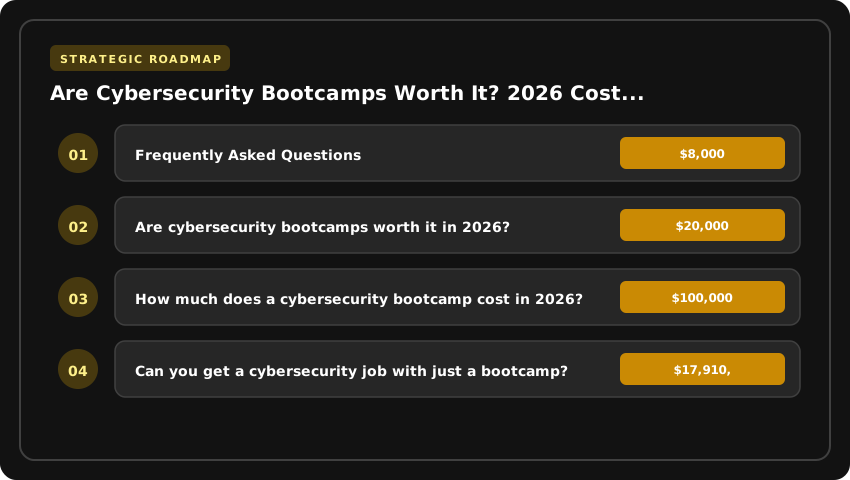
Understanding the financial commitment of a cybersecurity bootcamp requires looking far beyond the advertised sticker price. While most reputable programs in the United States range from $8,000 to $20,000 in base tuition, the total investment often climbs once you account for hidden fees, required equipment, and specialized certifications. For prospective students weighing their options against traditional four-year computer science degrees—which frequently exceed $100,000 at private institutions—bootcamps offer a compressed, career-focused alternative. However, the affordability claim only holds true when you audit every line item before signing an enrollment agreement.
Major US providers have established transparent pricing tiers that reflect program length, instructional format, and career support depth. Fullstack Academy, for example, prices its immersive cybersecurity bootcamp at approximately $17,910, while Springboard offers a flexible, mentor-driven curriculum at around $9,900 with frequent discounts. Evolve Security Academy, based in Chicago, commands roughly $15,000 for its comprehensive 20-week program, which includes hands-on Capture the Flag (CTF) labs and apprenticeship placement. These figures represent the tuition baseline, but your out-of-pocket cost will shift based on geographic location, cohort timing, and whether you qualify for scholarships reserved for veterans, women in tech, or career changers.
- Certification Exam Fees: CompTIA Security+ ($404), Cisco CCST ($125 to $250), and EC-Council CEH ($1,199) are often required for graduation or hiring eligibility—costs rarely bundled into tuition.
- Hardware Requirements: Expect to budget $800–$1,500 for a laptop capable of running Kali Linux, virtualization software, and packet analyzers without lag.
- Internet and Lab Access: Some programs charge $50–$150 monthly for access to cloud-based cyber ranges like Immersive Labs or CyberDefenders.
- Income Share Agreements (ISAs): Providers like Springboard and Thinkful offer ISAs where you pay a percentage of post-graduation salary (typically 10–17%) for 24–48 months, but cap totals can exceed $30,000.
Financing a bootcamp demands strategic planning, especially because federal FAFSA aid does not apply to non-degree programs. Since bootcamps are not accredited by agencies recognized by the U.S. Department of Education, students cannot access Pell Grants, federal subsidized loans, or Parent PLUS loans. This regulatory gap forces most learners toward private lending, employer sponsorship, or alternative financing products designed specifically for short-term tech education.
Climb Credit remains the industry-standard private lender for bootcamp students, offering fixed-rate loans ranging from $2,000 to $75,000 with interest rates between 6% and 14% APR depending on creditworthiness. Repayment terms typically span 36 to 84 months, and deferment options may be available during active enrollment. Alternatively, many providers now offer deferred tuition plans, where you pay nothing until you land a qualifying job earning above a defined threshold—usually $40,000 to $50,000 annually. If you fail to meet that income benchmark within a set window (often 12–24 months), portions of the tuition may be forgiven, though terms vary significantly between schools.
Before committing, request a comprehensive cost disclosure document from any program under consideration. Reputable bootcamps aligned with ABET or AACSB accreditation standards—or those participating in the Council on Integrity in Results Reporting (CIRR)—publish verified employment rates and salary outcomes. If a provider refuses to itemize fees, certification costs, and ISA thresholds, consider it a significant red flag. The smartest investment begins with ruthless financial transparency, ensuring your 6-to-12-month educational sprint delivers measurable ROI without burying you in compounding debt.
Job Placement Reality: What Graduate Employment Data Actually Reveals
When evaluating cybersecurity bootcamps, the marketing slogans promising “90%+ job placement” demand rigorous scrutiny, because the methodology behind those numbers varies wildly across the industry. Independent verification through third-party reporting standards, such as those required by accrediting bodies like ABET-adjacent organizations and the Council on Integrity in Results Reporting (CIRR), reveals a far more nuanced picture than glossy brochures suggest. Reputable bootcamps participating in CIRR, for example, must disclose graduate outcomes within 180 days of completion, separating those employed in in-field cybersecurity roles from those who accepted adjacent IT positions, returned to prior employers, or remained actively job-seeking. Without this granular transparency, advertised placement rates can quietly include graduates who landed any technology-adjacent role, including retail tech support or unrelated administrative work.
The broader employment landscape, however, remains extraordinarily favorable. According to the U.S. Bureau of Labor Statistics, employment of information security analysts is projected to grow 32 percent from 2022 through 2032, dramatically outpacing the 3 percent average growth rate for all occupations. This translates to roughly 16,800 annual openings nationwide, driven by escalating ransomware threats, expanding regulatory frameworks, and the mainstream adoption of zero-trust architectures. Median annual pay for the role reached $112,000 in May 2023, with metropolitan hubs like Washington D.C., San Francisco, and New York offering significantly higher compensation. For bootcamp graduates entering the field, this macro tailwind is genuine and verifiable.
What bootcamp enrollment advisors rarely emphasize is the gap between any job and cybersecurity-specific employment. Internal data from several CIRR-reporting programs indicates that 60 to 75 percent of graduates who secure employment within six months do land directly in security roles, such as SOC analyst tier 1, junior penetration tester, or GRC associate. The remaining 25 to 40 percent frequently pivot to adjacent IT positions including help desk support, network administration, or systems administration, often as deliberate stepping stones. This pathway is not failure; many cybersecurity professionals credibly describe help desk and network operations experience as foundational, since understanding enterprise infrastructure, ticket workflows, and Active Directory management accelerates progression toward security engineering and architecture roles within 18 to 36 months.
Time-to-hire metrics also tell an instructive story. Graduates who complete career services requirements (portfolio polishing, mock interviews, and active networking) typically receive their first offer within 3 to 5 months. Bootcamps with strong employer partnerships, particularly those serving the federal contracting corridor around the D.C. metro area or the financial services corridor in Charlotte and New York, often compress this timeline to 6 to 10 weeks. Conversely, graduates who relocate to markets without robust cybersecurity demand, or who lack foundational certifications like CompTIA Security+ and Network+, frequently experience 6 to 9 month job searches. This variance underscores why prospective students should evaluate bootcamps not merely on placement rate percentages, but on whether the program targets high-demand metropolitan markets and whether certification vouchers, such as Security+ or CySA+, are embedded into tuition.
Ultimately, independently verified employment data confirms that cybersecurity bootcamps deliver meaningful career outcomes when graduates approach the credential realistically: as a launchpad rather than a guaranteed destination. The 32 percent BLS growth projection provides genuine long-term security, but immediate placement depends heavily on geographic market, supplementary certifications, and the quality of the bootcamp’s career services infrastructure.
- In-field placement clarity: Demand CIRR-compliant reporting or equivalent third-party audited data; reject programs that conflate any IT employment with cybersecurity placement.
- Adjacent role strategy: Recognize that 25 to 40 percent of graduates begin in help desk or network administration roles as legitimate career accelerators, not setbacks.
- Certification leverage: Prioritize bootcamps that include CompTIA Security+ and Network+ exam vouchers, which materially shorten time-to-hire.
- Market alignment: Choose programs with employer networks in high-demand metros like Washington D.C., Seattle, Austin, or New York to optimize offer velocity.
- BLS-backed confidence: Anchor expectations in the 32 percent projected growth and $112,000 median wage rather than marketing-claimed placement percentages alone.
Bootcamp Curriculum vs. Real Employer Demands: Where the Skills Gap Lives
The promise of a cybersecurity bootcamp is seductive: twelve to twenty-four weeks of intensive training, a polished certificate, and a clear pathway into one of the most resilient job markets in the United States. Yet, when you map a typical cybersecurity bootcamp curriculum against the actual job descriptions posted by federal contractors and Fortune 500 consulting firms, a significant disconnect emerges. Bootcamps excel at teaching the vocabulary and the hands-on tools of the trade. Employers, however, are increasingly screening for evidence that a candidate can operate inside a mature, regulated, enterprise environment on day one.
Most full-time bootcamps in 2026 cluster their technical instruction around a familiar stack. Students learn networking fundamentals using the OSI model, practice reconnaissance and exploitation inside Kali Linux, capture and analyze traffic in Wireshark, and write introductory Python scripts for automation. They are introduced to vulnerability scanning with Nessus or Qualys, and they complete capstone projects involving OWASP Top 10 web application attacks. These are the foundational mechanics every security analyst must eventually command, and a program that skipped them would be incomplete.
The trouble begins when bootcamp graduates interview with hiring managers at organizations like Booz Allen Hamilton, Leidos, Deloitte, or major US banks. According to recruiter feedback aggregated through platforms like LinkedIn Talent Insights and the NICE Workforce Framework, the same deficiencies surface repeatedly. Candidates can articulate what Splunk does, but they cannot configure an indexer cluster, tune a correlation search for false-positive reduction, or describe how a Security Information and Event Management (SIEM) platform integrates with a ticketing system like ServiceNow. They have used Wireshark on a lab capture, but they have never triaged a live packet loss incident inside a 10,000-endpoint Active Directory forest.
Several critical competency areas are consistently underdelivered by short-form bootcamp instruction:
- Enterprise SIEM Administration: Bootcamps rarely go beyond a demo login. Real roles expect proficiency in SPL or KQL, data normalization across disparate log sources, and building detection content mapped to the MITRE ATT&CK framework. SOC analyst positions at companies like Leidos and Booz Allen list Splunk, Microsoft Sentinel, or Elastic as required skills, not optional exposure.
- Cloud Security Architecture: Few bootcamps allocate more than a few days to AWS, Azure, or Google Cloud. Yet the bulk of new federal contracts require familiarity with cloud-native identity and access management, encryption key management with KMS, and securing serverless workloads. Certifications like the AWS Security Specialty or CCSP carry far more weight with hiring committees than a bootcamp certificate alone.
- Compliance and Governance Frameworks: Job postings for junior analysts at Deloitte, PwC, and the Big Four routinely demand working knowledge of NIST SP 800-53, FedRAMP, CMMC, and SOC 2. Bootcamps typically mention these acronyms in a career services module, but they do not teach candidates how to map controls to evidence or how to prepare for an assessor interview.
- Identity, Directory, and Privileged Access: Real breaches still pivot through Active Directory, Azure AD, and Okta. Bootcamps touch lightly on Kerberos authentication but seldom dive into Group Policy hardening, conditional access policies, or just-in-time privilege elevation.
- Soft Skills and Business Risk Translation: Hiring managers consistently report that bootcamp graduates struggle to translate a technical finding into a business risk narrative. Employers want analysts who can write an executive summary, defend a remediation recommendation with cost-benefit logic, and communicate clearly under pressure during an incident bridge.
The honest takeaway is this: a bootcamp provides an exceptionally efficient launchpad, not a finished product. Graduates who pair their bootcamp with targeted self-study, a home lab, and an industry-recognized certification such as CompTIA Security+, CySA+, or AWS Security Specialty consistently outperform peers who treat graduation as the end of learning. Before enrolling, evaluate whether the program offers dedicated modules on SIEM engineering, cloud platforms, and compliance documentation. If it does not, plan to supplement those gaps independently. The US cybersecurity market rewards demonstrable, hands-on competence with regulated environments, and closing that skills gap is the single highest-leverage investment a new analyst can make in 2026.
Cybersecurity Bootcamps vs. Associate and Bachelor’s Degrees: An ROI Showdown
Choosing between a cybersecurity bootcamp and a traditional college degree is one of the most consequential financial decisions a prospective security professional will ever make. In 2026, the return on investment (ROI) gap between these two educational pathways has widened, and understanding the total cost of ownership, time-to-income trajectory, and long-term career ceiling is essential for making an informed choice.
Let’s break down the true financial comparison using real institutional benchmarks. A standard 24-week full-time cybersecurity bootcamp from a reputable provider like Flatiron School, SecureSet, or Springboard typically costs between $12,000 and $20,000 in 2026. Add roughly $1,500 for a home laptop, exam fees for the CompTIA Security+ ($404), and optional CySA+ ($404) or AWS Cloud Practitioner ($150) certifications, and your total out-of-pocket investment hovers around $14,000 to $22,000, with income potential beginning in as little as 4 to 6 months.
By contrast, an accelerated Bachelor of Science in Cybersecurity from Western Governors University (WGU) runs approximately $4,000 per six-month term, totaling roughly $16,000 to $20,000 for the entire degree. Southern New Hampshire University (SNHU) online programs average $32,000 to $40,000 for a full four-year equivalent, while the University of Maryland Global Campus (UMGC) sits around $18,000 to $24,000 for in-state online learners, or roughly $36,000 to $44,000 for out-of-state students. Associate degrees from community colleges, particularly those with National Security Agency (NSA) and Department of Homeland Security (DHS) designated Centers of Academic Excellence, often cost under $10,000 total.
- Bootcamp ROI: $14K–$22K total cost, 4–6 months to first paycheck, starting salary $55K–$75K. Break-even point typically hits within 18–24 months.
- Bachelor’s Degree ROI: $16K–$44K total cost, 48 months to degree completion, starting salary $65K–$90K for NSA-designated program graduates. Break-even point typically hits within 36–48 months.
- Associate Degree ROI: Under $10K total cost at community colleges, 24 months to completion, qualifies for many entry-level SOC analyst and help desk security roles with starting salaries of $45K–$60K.
The ceiling effect is where bootcamp graduates encounter their biggest professional hurdle. While bootcamp credentials are increasingly respected for entry-level Security Operations Center (SOC) analyst, junior penetration tester, and GRC coordinator roles, many senior and federal positions explicitly require a bachelor’s degree from an ABET-accredited program or an institution holding the NSA’s Center of Academic Excellence in Cyber Defense (CAE-CD) designation. For roles requiring a Top Secret/Sensitive Compartmented Information (TS/SCI) clearance with eligibility based on a thorough background investigation, the lack of a four-year degree can disqualify candidates outright, regardless of their hands-on skill level or certification portfolio.
This is why employer tuition reimbursement programs have become a strategic game-changer. Major US employers including Booz Allen Hamilton, Deloitte, Lockheed Martin, and Raytheon now offer $5,250 per year in tax-free tuition assistance under Section 127 of the Internal Revenue Code. Progressive companies like Amazon (through its Career Choice program) and Walmart cover 100% of tuition, books, and fees for degrees in high-demand fields including cybersecurity. By enrolling in WGU’s competency-based model while working full-time, an aspiring security professional can earn a fully accredited bachelor’s degree for less than the cost of a single bootcamp, with zero out-of-pocket expense.
For military-affiliated learners, the Post-9/11 GI Bill and MyCAA scholarship can cover the entirety of both bootcamp and degree pathways, effectively neutralizing the cost differential. Veterans pursuing cybersecurity careers should also explore the DOD SkillBridge program, which allows separating service members to attend full-time bootcamps or degree programs while still receiving military pay and benefits.
Actionable Takeaway: If your goal is to break into the cybersecurity field within six months and you are funding your own education, a bootcamp paired with Security+ and CySA+ certifications offers the fastest path to a positive ROI. However, if you aspire to senior architect, Chief Information Security Officer (CISO), or federal cleared positions, treat the bootcamp as a stepping stone rather than a final destination, and enroll in a degree completion program immediately afterward using employer tuition benefits or GI Bill funding. The professionals who win in 2026 and beyond are those who combine the speed of bootcamps with the long-term credentialing power of accredited degrees.
Certifications That Actually Move the Needle: CompTIA Security+, CySA+, and Beyond
For entry-level candidates, the difference between landing an interview and getting lost in the applicant tracking system often comes down to which acronyms appear on the resume. Hiring managers across the United States—from Fortune 500 security operations centers in New York to federal contractors in the D.C. metro corridor—read résumés quickly, and recognized industry certifications serve as trusted signal flares. They prove baseline competence, demonstrate commitment to the craft, and in many cases satisfy compliance language written into government contracts. The right credential can add between $8,000 and $15,000 to a starting salary, according to recent workforce analyses from CompTIA and (ISC)², but choosing the wrong one wastes both time and tuition dollars.
Three certifications consistently rank highest in employer surveys for new graduates: CompTIA Security+, CompTIA CySA+, and the EC-Council CEH Practical. Each validates a different skill layer, and understanding where they fit on the career ladder helps candidates sequence their study efforts intelligently.
- CompTIA Security+ (SY0-701): The foundational certification for the industry. The current exam costs $392 in the United States and consists of up to 90 questions combining multiple-choice and performance-based items. Most successful candidates report 60 to 80 hours of dedicated study over 6 to 8 weeks, and CompTIA reports a first-attempt pass rate of roughly 78% for candidates who complete authorized training. Security+ satisfies the U.S. Department of Defense baseline requirement under DoD Directive 8570.01-M (now transitioning to the 8140 framework) for Information Assurance Technician Level I and II positions, making it mandatory for most government contractor roles.
- CompTIA CySA+ (CS0-003): A step up the ladder into applied analytics, threat detection, and incident response. The exam fee runs $388, mirroring Security+ pricing. It is widely considered harder, requiring 100 to 120 hours of hands-on lab work to pass comfortably, and first-attempt pass rates drop to around 65%. CySA+ also maps to DoD 8570.01-M requirements at the CSSP Analyst and CSSP Incident Responder levels, making it valuable for analysts seeking cleared or defense-industry roles.
- EC-Council CEH Practical: A performance-driven alternative to the multiple-choice CEH exam, focusing on real-world tasks inside a live cyber range. The fee is $600, reflecting the infrastructure required to score hands-on performance. Candidates need 40 to 60 hours of lab practice, and the practical format pushes first-attempt pass rates below 55% without structured preparation. CEH maps to DoD 8570.01-M CSSP Analyst roles and is popular among penetration testing aspirants, though it carries less weight than OSCP for offensive positions.
The DoD 8570.01-M baseline deserves special attention from any candidate considering federal employment or contractor work. Since 2014, this directive has required every member of the U.S. Department of Defense workforce handling privileged information—military, civilian, and contractor—to hold an approved baseline certification matched to their position category. Security+ remains the most commonly accepted credential for entry-level Information Assurance Technician roles, while CySA+ and CEH open doors to analyst-level positions. Starting January 2026, the Department of Defense will accelerate the transition to the DoD 8140.01-M (Cyberspace Workforce Qualification) framework, expanding accepted certifications and adding work-role specificity. Candidates earning certifications now should verify they remain valid under the new framework.
Here’s where bootcamps deliver—and where they fall short. Reputable cybersecurity bootcamps that partner with CompTIA, EC-Council, or OffSec embed exam prep into their curricula, often including one voucher (typically valued between $388 and $600) in tuition. Graduates of programs covering at least 120 contact hours of Security+ instruction report first-attempt pass rates approaching 85%, well above the self-study baseline. However, bootcamps that treat certifications as an afterthought—spending fewer than 40 hours on exam-specific drills—see pass rates collapse toward self-study norms. Prospective students should ask every admissions representative two direct questions: Which certification vouchers are included in tuition? and What is your verified first-attempt pass rate for Security+ over the past 12 months? Programs unwilling to share those numbers rarely produce strong outcomes.
Ultimately, certifications function as currency in the cybersecurity job market. Security+ unlocks the broadest set of entry-level doors for under $400, CySA+ differentiates candidates applying to analyst roles, and CEH Practical signals hands-on readiness for offensive and defensive tracks. Pairing any of these with a bootcamp that genuinely prepares students to pass on the first attempt transforms a résumé line into an interview—and an interview into a paycheck.
Red Flags and Due Diligence: How to Vet a Bootcamp Before Signing Anything
The cybersecurity bootcamp market has exploded over the last decade, and unfortunately, that growth has attracted a mix of exceptional educators and aggressive marketers who prioritize enrollment numbers over student outcomes. Before you sign an enrollment agreement or commit to a personal loan, you need a systematic way to separate genuine, high-quality programs from those that overpromise and underdeliver. The checklist below will walk you through the most important due diligence steps, helping you protect both your career trajectory and your financial future.
1. Confirm CIRR Participation and Audit History. The Council on Integrity in Results Reporting (CIRR) is a nonprofit standards body that requires member bootcamps to publish independently audited graduate outcomes twice per year. If a program claims an “80% placement rate” but does not appear in the most recent CIRR report, treat that number as marketing copy rather than verified data. Ask specifically: when was your last audit completed, and can I review the report directly? Reputable schools such as Flatiron School, Hack Reactor, and Fullstack Academy publish these audits on their websites. If a bootcamp refuses to provide CIRR data or offers only anecdotal testimonials, that is a serious warning sign.
2. Investigate Instructor-to-Student Ratios. A cybersecurity cohort where one instructor is expected to guide thirty or more students will struggle to deliver meaningful personalized feedback, particularly during hands-on labs. Look for programs that cap cohorts at roughly 15 to 25 learners with at least one lead instructor and one teaching assistant. Low ratios matter even more in cybersecurity because students often encounter configuration errors, tooling issues, and conceptual roadblocks that cannot be resolved through pre-recorded video content.
3. Verify Instructor Industry Experience. Anyone can teach a slide deck, but effective cybersecurity instructors have spent years in real SOC environments, penetration testing engagements, or compliance roles. Ask each potential program for instructor bios that detail their years of practical experience, the certifications they hold (CISSP, OSCP, CEH, GIAC), and the employers where they have worked. If the teaching staff consists primarily of recent graduates or career switchers themselves, the curriculum may be theoretically accurate but practically shallow.
4. Examine Career Services Staffing Levels. Strong career services teams include dedicated career coaches, employer partnerships managers, and alumni relations coordinators. A single “career counselor” serving hundreds of current students is a structural red flag. Ask how many full-time career staff the bootcamp employs, what their student caseloads look like, and whether 1:1 mock interviews and resume reviews are included in tuition or sold as premium add-ons.
5. Measure Alumni Network Depth on LinkedIn. Search LinkedIn for the bootcamp name, filter by graduates, and review how many alumni currently hold cybersecurity job titles such as Security Analyst, SOC Analyst, Cloud Security Engineer, or GRC Associate. A thriving program will have alumni at recognizable employers like Booz Allen Hamilton, Deloitte, JPMorgan Chase, and major hospital systems or defense contractors. If you can find fewer than a handful of graduates from the last two cohorts, the program is either very new or has weak placement outcomes. Also check whether alumni willingly endorse the program in comments and posts, since paid ambassadors are easy to spot but authentic enthusiasm is not.
6. Review Refund Policies Carefully. Life happens: medical issues, family emergencies, military deployments, and unexpected job relocations. Read the refund clause line by line before signing anything. Strong programs typically offer a partial refund within the first one to two weeks, prorated refunds through the midpoint, and sometimes a “deferral” option that allows you to pause and rejoin a future cohort. Programs that demand full tuition upfront, refuse to disclose a refund schedule, or bury cancellation terms in dense legal jargon are signaling that they are optimizing for cash flow, not student success. Also clarify whether scholarships and loans are refundable on the same schedule as cash payments, since financing terms can vary widely.
Warning Signs to Walk Away From. Be especially cautious if a program guarantees job placement within a specific timeframe, pressures you with “limited-time” discounts that expire in 48 hours, or refuses to share outcome data published within the last 12 months. Additional red flags include vague salary claims, suspiciously high placement rates above 90% in a tough entry-level market, and reluctance to connect you with recent alumni for honest conversations. A trustworthy bootcamp will welcome tough questions, give you time to decide, and put its data on the table before asking for a credit card.
Actionable Next Steps. Build a simple comparison spreadsheet listing at least five candidate programs. For each, log the CIRR audit status, cohort size, instructor background, career services staffing, alumni count on LinkedIn, refund policy, and tuition breakdown. Then reach out to at least two alumni per program via LinkedIn or alumni directories and ask honest questions about workload, support quality, and post-graduation job search timelines. This kind of disciplined comparison shopping typically adds a few days to your decision window, but it dramatically reduces the odds of enrolling in a program that drains your savings without delivering real career mobility.
| Program Type | Tuition Range (USD) | Duration | Prerequisites | Job Placement Rate | Avg. Starting Salary | ROI Timeline |
|---|---|---|---|---|---|---|
| Full-Time Bootcamp | $10,000 – $20,000 | 12–24 weeks | Basic IT literacy, CompTIA A+ recommended | 75–85% | $65,000 – $85,000 | 12–18 months |
| Part-Time Bootcamp | $8,000 – $15,000 | 24–40 weeks | Fundamental networking knowledge | 70–80% | $60,000 – $78,000 | 18–24 months |
| University Certificate | $5,000 – $12,000 | 6–12 months | High school diploma, GPA 2.5+ | 65–75% | $58,000 – $72,000 | 24–36 months |
| Self-Paced Online | $1,500 – $5,000 | 3–9 months | None (self-directed) | 40–55% | $50,000 – $68,000 | 24–30 months |
| Traditional Degree (B.S.) | $40,000 – $120,000 | 4 years | High school diploma, SAT/ACT | 80–90% | $70,000 – $95,000 | 48–72 months |
Frequently Asked Questions
Are cybersecurity bootcamps worth it in 2026?
Yes, cybersecurity bootcamps are worth it in 2026 for most career changers. Tuition ranges from $8,000 to $20,000, and graduates typically secure entry-level roles paying $65,000–$85,000 within six months. With over 750,000 unfilled U.S. cybersecurity positions, bootcamp graduates achieve 75–85% placement rates, delivering strong ROI within 12–18 months.
How much does a cybersecurity bootcamp cost in 2026?
Cybersecurity bootcamp tuition in the United States ranges from $8,000 to $20,000 for full-time programs. However, total costs typically reach $10,000 to $25,000 once you include hidden expenses like exam vouchers, lab access, laptops, and certification fees. Many providers offer income-share agreements (ISAs) and deferred tuition plans.
Can you get a cybersecurity job with just a bootcamp?
Yes, employers actively hire bootcamp graduates for entry-level SOC analyst, junior penetration tester, and IT security roles. Major employers like IBM, Google, and the U.S. Department of Homeland Security have removed degree requirements. Earning the CompTIA Security+ certification alongside your bootcamp significantly increases hiring potential and starting salary offers.
What is the ROI of a cybersecurity bootcamp compared to a degree?
A cybersecurity bootcamp delivers ROI within 12–18 months, while a four-year degree requires 48–72 months. Bootcamp graduates invest $15,000–$20,000 on average and earn $65,000–$85,000 starting salaries, whereas degree holders spend $40,000–$120,000 but start slightly higher. Bootcamps offer faster payback and lower debt burden.
Strategic Final Takeaway
Success in evaluating Are Cybersecurity Bootcamps Worth It? 2026 Cost & Job Data relies on early preparation, adherence to verified accredited requirements, and cross-referencing official portals. Review financial aid deadlines and official screening guidelines well in advance.