How California Community Colleges Are Rewriting the Four-Year Degree Rule
For generations, the pathway to a four-year bachelor’s degree in California ran through one of two doors: a state university (CSU or UC) or a private institution. That monopoly quietly ended on January 1, 2022, when Senate Bill 1450 (formerly SB 554) transformed California’s 116 community college districts into a legitimate proving ground for baccalaureate education. The legislation, signed by Governor Gavin Newsom in October 2021, authorized the Board of Governors of the California Community Colleges to approve up to 15 community college districts per year to confer bachelor’s degrees in high-need workforce areas — and crucially, it removed the sunset clause that had constrained earlier pilots. Today, more than 15 programs have been approved by the California Community Colleges Chancellor’s Office, and the 2026 expansion slate promises to push the total well past two dozen districts.
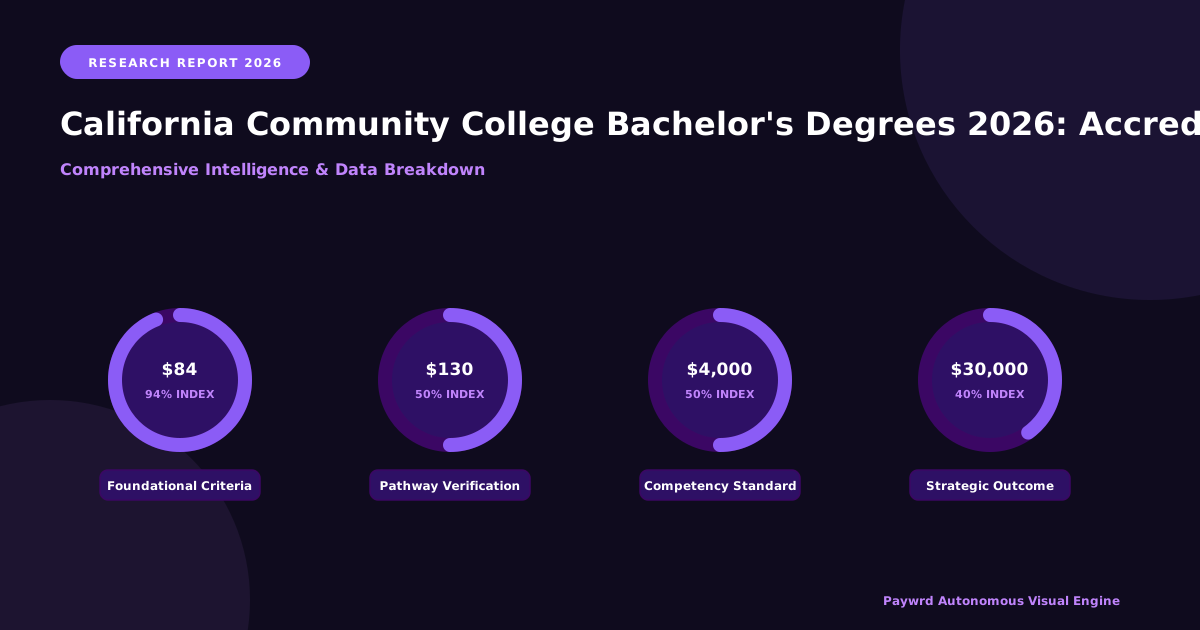
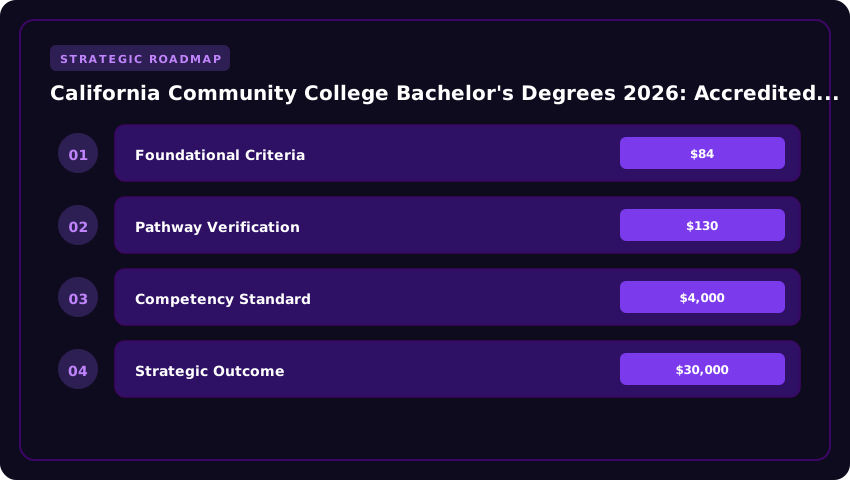
What makes the framework revolutionary is not simply permission — it’s the structural economics embedded in the law. SB 1450 caps community college bachelor’s tuition at a level that keeps programs accessible to working adults and first-generation students, while still permitting districts to recover costs through differentiated fees. Students enrolled in approved baccalaureate programs pay roughly $84 to $130 per unit depending on residency and program type, compared with $4,000+ per semester at many private colleges and even higher annual costs at the most expensive out-of-state public universities. For a 120-unit degree, that gap can translate into savings of $30,000 to $60,000 over the full program — savings that often mean the difference between completing a credential and abandoning it for financial reasons.
Approved programs to date span critical workforce sectors identified by the California Community Colleges Chancellor’s Office in coordination with the state’s labor forecasts. Health sciences, dental hygiene, respiratory therapy, occupational therapy assistance, industrial automation, cybersecurity, mortuary science, and automotive technology lead the current list. Each program must meet three statutory tests: demonstrable workforce need in the region, absence of duplication with existing CSU or UC offerings, and accreditation eligibility under the U.S. Department of Education’s recognized regional accreditor, the WASC Senior College and University Commission (WSCUC) or the Accrediting Commission for Community and Junior Colleges (ACCJC). Every approved baccalaureate pathway must also publish student outcome data — including graduation rates, licensure pass rates, and employment placement — so prospective students can compare quality benchmarks with traditional universities.
Looking forward to 2026, the Chancellor’s Office has signaled expansion into districts with demonstrated enrollment demand and employer partnerships. Foothill-De Anza Community College District is positioned to launch a bachelor’s in dental hygiene and respiratory care, leveraging its existing allied health infrastructure and Silicon Valley hospital partnerships. Cypress College (part of the North Orange County Community College District) has filed intent to expand its mortuary science baccalaureate and add a paralegal-to-legal-services degree. Antelope Valley College is preparing a cybersecurity and industrial automation offering aligned with Lockheed Martin, Northrop Grumman, and Edwards Air Force Base hiring pipelines in the high-desert region. Other districts on the projected 2026 slate include Mt. San Antonio, San Diego Mesa, and Long Beach City College — each targeting workforce shortages documented by the California Employment Development Department.
For students evaluating these programs in 2026, three practical takeaways emerge from the SB 1450 framework. First, verify accreditation status directly through the ACCJC or WSCUC database before enrolling, because federal financial aid (including FAFSA) is contingent on accredited-program status. Second, confirm the program has been formally approved by the Board of Governors — provisional or “pilot” status does not always guarantee full Title IV eligibility. Third, compare total program cost, including mandatory fees and textbooks, against CSU’s $7,000-$8,000 annual in-state tuition benchmark. The economic case for community college bachelor’s degrees is strongest when programs are regionally accredited, industry-aligned, and priced under $15,000 total — a combination SB 1450 was specifically engineered to deliver.
Accreditation Standards: WASC, ACCJC, and Regional Approval Status
When evaluating any California Community College Bachelor’s Degree (CCCB) program, understanding the layered accreditation framework is the single most important step a prospective student can take. Unlike traditional four-year universities, community college baccalaureates operate under a dual accreditation structure that requires both institutional validation and specialized programmatic recognition. This framework exists to protect students, ensure federal financial aid eligibility, and guarantee that coursework meets rigorous academic and industry standards.
At the institutional level, every California community college offering a baccalaureate degree must hold accreditation through the Accrediting Commission for Community and Junior Colleges (ACCJC), which operates under the broader umbrella of the Western Association of Schools and Colleges (WASC). The ACCJC is one of seven regional accrediting bodies recognized by the U.S. Department of Education, and its approval signals that an institution has met fundamental standards related to governance, faculty qualifications, student services, learning outcomes, and financial stability. For students, this regional stamp of approval is non-negotiable: without ACCJC accreditation, a college cannot participate in federal Title IV aid programs, which means students would be ineligible for Pell Grants, federal student loans, and many state-based aid packages.
Beyond institutional accreditation, individual bachelor’s programs must secure specialized programmatic approval from discipline-specific accrediting agencies. This second layer ensures that the curriculum, clinical placements, faculty credentials, and student outcomes meet the benchmarks expected by employers and professional licensing boards. Common programmatic accreditors encountered in the CCCB space include:
- Commission on Collegiate Nursing Education (CCNE) — required for Bachelor of Science in Nursing (BSN) programs, ensuring graduates are prepared for the NCLEX-RN examination and clinical practice.
- Accreditation Commission for Education in Nursing (ACEN) — an alternative nursing accreditor recognized by many state boards and the U.S. Department of Education.
- ABET (Accreditation Board for Engineering and Technology) — relevant for industrial technology, manufacturing, and applied engineering baccalaureates where programs seek recognition aligned with STEM industry standards.
- Association of Collegiate Business Schools and Programs (ACBSP) or AACSB — applicable to business administration and management tracks, though most community college programs pursue ACBSP given its mission alignment with teaching-focused institutions.
- Council for Accreditation of Counseling and Related Educational Programs (CACREP) — for behavioral science and counseling-oriented bachelor’s programs.
For students, the practical question becomes: how do I verify a program’s standing before enrolling? The answer involves a few concrete steps that can save thousands of dollars and years of effort. First, the U.S. Department of Education maintains the National Center for Education Statistics (NCES) College Navigator and the Office of Postsecondary Education Identification (OPEID) database, which list every institution authorized to disburse federal Title IV funds. If a California community college offering a baccalaureate does not appear in this database, the program is likely in a pending status, meaning it has applied for approval but cannot yet certify students for federal aid.
Second, students should consult the ACCJC’s publicly available directory to confirm current accreditation status, including any sanctions, warnings, or reaffirmation dates. A college on “warning” or “probation” status is still accredited, but the designation signals ongoing concerns that may affect transferability of credits and employer perception. Third, prospective students should directly contact the program’s financial aid office and ask specifically: “Has this baccalaureate program received final Title IV eligibility approval, and if not, what is the expected timeline?” Some community colleges launch CCCB programs under a “teach-out” or pilot arrangement where students enroll before full federal aid approval, creating cash-flow risk if aid is ultimately denied.
Finally, specialized programmatic accreditation should be verified through the accreditor’s own member directory. For example, the CCNE maintains a searchable list of accredited nursing programs updated quarterly. If a BSN program claims CCNE accreditation but does not appear in the directory, that claim is a red flag warranting further investigation. By systematically verifying institutional accreditation, programmatic recognition, and federal aid status, students can confidently distinguish between fully accredited pathways and programs still navigating the approval pipeline, ensuring their degree carries weight in the labor market and qualifies for the financial support they need to complete it.
Tuition Economics: $46–$84 Per Unit vs. CSU’s $5,742 Annual Cost
Understanding the financial architecture of a California Community College Bachelor’s Degree (CCB) requires translating a dense regulatory fee schedule into the lived reality of a student’s budget. The headline number most Californians recognize is the $46 per unit enrollment fee, established under California Education Code Section 76300 and frozen for in-state residents since 2012-2013. For a full-time upper-division CCB student carrying 12 semester units, that translates to roughly $552 per semester or $1,104 annually in mandated tuition alone. Non-resident students, including out-of-state and international learners, pay an additional $84 per unit universal fee, stacking on top of the base $46 to reach $130 per credit hour before any per-program differentials. These figures are not estimates; they are codified in the California Community Colleges Chancellor’s Office (CCCCO) annual Fee Schedule, and they form the foundation of every cost comparison a prospective student should make against public four-year alternatives.
Compare that baseline to the California State University (CSU) system, where the 2024-2025 undergraduate tuition sits at $5,742 per year for in-state students, and the University of California (UC) system, where residents pay approximately $13,200 in tuition and mandatory fees. A student completing all 60 lower-division units at a community college before transferring, the traditional pathway, accumulates just $2,760 in tuition over two academic years. Even when the final 60 upper-division units are completed at a CSU campus, the total sticker price lands near $8,502, a substantial but defensible figure. By contrast, a fully online CCB student who completes all 120 units within the community college system, including the upper-division cohort, spends roughly $5,520 in tuition across four years, the equivalent of one CSU year.
- Per-Unit Breakdown: $46 enrollment fee (resident) + $0-$307 universal/non-resident differential (program-dependent) + $0-$84 universal non-resident surcharge (out-of-state/international students only).
- CSU Baseline (2024-2025): $5,742 annual tuition, $1,000-$2,000 average room and board not included, plus $1,000+ in campus fees and textbooks.
- UC Baseline (2024-2025): ~$13,200 tuition and mandatory fees, $18,000+ with housing, which compounds the affordability gap.
- CCB Total Degree Cost (Resident): 120 units × $46 = $5,520 base tuition over four years of part-time or two years of full-time enrollment.
However, the published enrollment fee is only the starting line. Sophisticated cost modeling must account for the hidden expenditures that surface in the final two years of a bachelor’s program. Upper-division coursework at CCB-partner institutions frequently carries program-specific differentials ranging from $50 to $307 per unit, applied to cohorts in Respiratory Care, Dental Hygiene, Airframe Manufacturing, and other hands-on disciplines authorized under Senate Bill 850 (2014) and Assembly Bill 927 (2021). Students in the Nursing CCB program at Antelope Valley College, for example, pay approximately $130 per unit, doubling the standard enrollment fee. Textbook and digital access fees for upper-division technical courses average $400 to $800 per semester, a figure that can be partially offset by the California College Promise Grant (CCPG), which waives the $46 per-unit enrollment fee for low-income students (those with an Expected Family Contribution of $0 on the FAFSA or California Dream Act Application).
International and out-of-state learners face an additional layer of cost modeling. Beyond the $84 universal non-resident surcharge, several CCB programs charge capital outlay fees, technology fees, and international student insurance that collectively add $1,500 to $4,000 per academic year. A non-resident completing a 120-unit CCB in Industrial Technology or Biomanufacturing should realistically budget $15,600 to $20,000 in total tuition, still competitive with the $44,000+ non-resident tuition at UC campuses but significantly higher than the resident CCB threshold. Students should always request a comprehensive cost-of-attendance worksheet from the Financial Aid Office, which itemizes fees beyond the headline $46 figure and aligns expenses with the standard federal aid packaging timeline.
Finally, the financial advantage of the CCB pathway is amplified when layered with the Middle Class Scholarship (MCS), the Cal Grant B or C, and the federal Pell Grant, which for 2024-2025 provides up to $7,395 annually for qualifying students. Because CCB tuition is so dramatically lower, Pell funds frequently cover the full cost of attendance, creating a genuine zero-tuition pathway for lower-income learners pursuing accredited four-year credentials. This is a structural advantage the CSU and UC systems cannot match at scale, and it is the single most important economic variable for families evaluating accredited online options in 2026.
High-Demand Online Programs: Nursing, Cybersecurity, and Dental Hygiene Tracks
As California Community Colleges expand their bachelor’s degree offerings under the Baccalaureate Degree Pilot Program, a clear pattern has emerged: workforce-aligned, hybrid-online programs in healthcare and technology dominate student demand. For the 2026 enrollment cycle, three program categories stand out as the most oversubscribed and strategically valuable for working professionals across the state.
Nursing: RN-to-BSN Completion Tracks
The RN-to-BSN pathway remains the crown jewel of the community college baccalaureate expansion. San Diego Mesa College and Santa Monica College have developed robust online completion tracks designed specifically for licensed Registered Nurses holding an associate degree or diploma. These programs typically span four to five semesters of part-time study, allowing working nurses to maintain full employment while advancing their credentials. Cohort enrollment windows generally open in early spring, with application deadlines falling between March 15 and April 30 for fall admission. Students should anticipate approximately 120 to 140 clinical practicum hours, often completed at an approved facility near their home community, ensuring accessibility without sacrificing rigor.
Cybersecurity: BAS in Cyber Defense at Coastline College
Coastline College’s Bachelor of Applied Science in Cyber Defense represents one of the most technology-forward offerings in the system. Delivered in a primarily asynchronous online format, this program targets IT professionals seeking to elevate into security analyst, penetration tester, or compliance manager roles. The curriculum aligns closely with industry certifications such as CompTIA Security+, CISSP, and CEH. Key enrollment details include:
- Cohort size: Approximately 40 to 50 students per intake
- Enrollment windows: Fall and spring, with priority deadlines in February and September
- Capstone requirement: A simulated cyber defense project completed remotely with industry partners
- Total credit hours: 120 semester units, including transfer credits from an accredited associate program
Respiratory Care: BAS at Modesto Junior College
Modesto Junior College offers a Bachelor of Applied Science in Respiratory Care tailored for licensed respiratory therapists aiming to move into clinical leadership, education, or advanced practice roles. The hybrid format combines online didactic coursework with periodic on-campus intensives. Students complete roughly 160 clinical hours in specialized areas such as neonatal care, polysomnography, or pulmonary rehabilitation. Enrollment typically occurs once annually, with applications accepted between January and March for a fall cohort start.
Key Takeaway: These programs share a common design philosophy: they serve working professionals who need flexibility without compromising on clinical rigor or industry relevance. Prospective students should apply early, as competitive programs often reach capacity well before published deadlines.
Transfer Pathways and the ADT-to-BAS Pipeline for Working Adults
For working adults weighing the cost of a bachelor’s degree against the demands of a job, family, and mortgage, the California Community College system offers a transfer architecture unlike anything else in American higher education. The cornerstone of that architecture is the Associate Degree for Transfer (ADT), a 60-unit package of general education and major preparatory coursework that is legally guaranteed to articulate into the California State University (CSU) system. Senate Bill 1440 (2010), followed by SB 440 (2014), effectively eliminated the historic bottleneck of impaction and competitive admission for transfer students holding an ADT, and the California Community Colleges Chancellor’s Office has continued to expand the model across 40+ TMC (Transfer Model Curriculum) templates. Today, a working adult who completes an ADT in Business Administration, Public Safety, Dental Hygiene, or Respiratory Therapy, for example, can apply to any participating CSU and receive priority admission consideration for the upper-division standing, provided the local campus offers the major.
What happens when the CSU campus is the wrong fit, fully online seats are unavailable, or the major exists only as a Bachelor of Applied Science (BAS) at a community college? This is where the CSU-rejection override policy and the growing community college baccalaureate ecosystem intersect. Under Title 5 §55070 and the related ADT reciprocity provisions, a student who is denied upper-division CSU admission despite holding a verified ADT retains a powerful fall-back: guaranteed admission to a comparable BAS program at their local community college district, using the same 60 units as the lower-division foundation. In practice, this means a student denied a seat in a CSU Nursing program because of local impaction can pivot into the Los Angeles Community College District’s RN-to-BSN pathway, or a Bay Area student turned away from San José State’s aviation concentration can complete a BAS in Airframe Manufacturing at a nearby college such as City College of San Francisco. The 60-unit threshold is not simply a numerical checkpoint; it is a regulatory trigger that unlocks guaranteed admission, junior standing, and often in-state tuition for the upper-division coursework. Working adults can therefore pursue their final two years online, typically at $46 per unit (with the California College Promise Grant waiver dropping tuition to $0 for low-income learners) rather than the $5,742 annual CSU fee that has steadily climbed through 2026.
Veterans face a parallel but distinct set of advantages when threading the ADT-to-BAS pipeline. The GI Bill, including the Post-9/11 Chapter 33 benefit, the Forever GI Bill updates, and the Chapter 31 Veteran Readiness & Employment program, all recognize community college upper-division coursework, meaning veterans enrolled in a BAS can draw monthly housing allowance (MHA) and book stipends at the same rate as four-year university peers. Critically, the Joint Services Transcript (JST) and Community College of the Air Force (CCAF) transcript are evaluated under the American Council on Education (ACE) recommendations, allowing veterans to stack military training credit toward the 60-unit graduation threshold. A Navy Hospital Corpsman with a JST showing 30 semester units of recommended credit can often complete the ADT general-education pattern in a single year, and then roll the remaining 30 units into a BAS in Health Information Management or Cybersecurity at a community college that is simultaneously Yellow Ribbon designated and CA Division of Apprenticeship Standards (DAS) approved. This stacking power effectively compresses a four-year journey into as little as 18-24 months, while the VA covers tuition, fees, and supplies up to the in-state maximum of $28,937.93 per academic year in 2026.
- ADT Completion Steps: Complete IGETC or CSU GE Breadth, finish the Transfer Model Curriculum (TMC) for the chosen major, and submit verification through the CCC Apply portal to earn priority admission at any participating CSU and the BAS override guarantee.
- CSU-Rejection Override Triggers: Documented impaction denial, unavailable online modality, or non-existent major at the local CSU campus; file an ADT Verification Form with the community college baccalaureate office to activate the BAS fall-back admission.
- GI Bill Stacking Strategy: Submit JST and CCAF transcripts to the BAS program’s articulation officer, request ACE credit evaluation, and coordinate with the campus School Certifying Official (SCO) so MHA and book stipends are prorated correctly across 60-unit senior standing.
- Tuition Math for 2026: California residents pay $46/unit (or $0 with a Promise Grant); non-residents and veterans using transferred Post-9/11 benefits can leverage in-state classification through the Veterans Access, Choice, and Accountability Act (VACAA) within one year of separation.
- Accreditation Anchor: Confirm the BAS program carries regional accreditation from the WASC Senior College and University Commission (WSCUC) plus any programmatic body (e.g., AACSB for business, ABET for industrial technology) to ensure employer and graduate-school recognition.
The practical takeaway for working adults is that the ADT-to-BAS pipeline is not a consolation prize; it is a deliberate, legislatively protected route that compresses time-to-degree, minimizes debt, and respects prior military and community college credit. Students should request an ADT verification audit from their college’s Transfer Center, ask about the CSU-rejection override memorandum for their intended major, and, for veterans, schedule a counseling session with the SCO to map JST/CCAF credit onto the 60-unit threshold before registering for their first upper-division course.
FAFSA, Cal Grant B, and Chafee Funding for Community College Bachelor’s Students
Financing a Bachelor of Science or Bachelor of Applied Science through the California Community College system in 2026 looks fundamentally different than it did even three years ago, largely because of the FAFSA Simplification Act’s full implementation and California’s deliberate expansion of state aid to upper-division transfer students. If you are planning to start, or continue, an accredited online baccalaureate program through a community college in the 2026-2027 academic year, the three funding streams below should anchor your financial planning conversation with your campus financial aid office.
First, the 2026-2027 FAFSA under the Simplification Act uses a dramatically streamlined methodology that benefits independent learners enrolled in community college bachelor’s programs. The old Expected Family Contribution (EFC) has been replaced by the Student Aid Index (SAI), which removes the sibling enrollment penalty, no longer counts retirement assets for most filers, and allows a minimum SAI of -$1,500 for the lowest-income students. For independent adults, married students, veterans, and former foster youth, the new definition of “independent” was simplified, making it easier to qualify for the maximum Federal Pell Grant. A full-time upper-division student at a California community college can now expect a Pell award of up to $7,395 per year, with the exact amount depending on SAI and enrollment intensity. Because most CCC baccalaureate programs charge roughly $46-$130 per unit for California residents (versus $5,000+ per semester at a CSU), a single Pell Grant frequently covers tuition, books, and a meaningful portion of living expenses for the entire academic year.
Second, Cal Grant B has been extended to upper-division community college students, a quiet but consequential policy shift. Historically, Cal Grant B was reserved for first-time freshmen from disadvantaged backgrounds, providing a first-year book and services stipend of $1,656 followed by full tuition and fee coverage in years two through four. Beginning with the 2026-2027 award cycle, students who enter a CCC bachelor’s program after completing their lower-division coursework at a community college are explicitly eligible for the full Cal Grant B award, including the Access Component stipend in their first upper-division year and the Tuition and Fee Component in subsequent years. Cal Grant C remains available for occupational and technical programs, including many Bachelor of Applied Science degrees in fields like industrial technology, health information management, and dental hygiene. The Cal Grant C award can reach $2,462 for tuition and fees, with an additional $547 available for occupational training supplies. Both grants require a verified FAFSA or California Dream Act Application submitted by the March 2 priority deadline, plus a certified GPA submitted by your school.
Third, the California Chafee Grant for Foster Youth is one of the most generous, and most underutilized, awards available to community college bachelor’s students. Eligible current and former foster youth may receive up to $5,000 per year specifically to cover unmet costs associated with attending a Chafee-approved program, including tuition, housing, transportation, childcare, and required course materials. The grant is renewable until the recipient reaches age 26, which aligns perfectly with the typical timeline for completing a community college baccalaureate (two years of lower division plus two years of upper division). Critically, several CCC bachelor’s programs, including those at Rio Hondo, Antelope Valley, and Crafton Hills, are listed as Chafee-approved, meaning the grant can be stacked with Pell, Cal Grant B, and the California College Promise Grant (which waives CCC enrollment fees for low-income students). Current and former foster youth should submit a separate Chafee Grant Application through the California Student Aid Commission in addition to the FAFSA, and should request verification of their foster care status from their county social worker or probation department.
- Verify your program is on the Chafee-approved list through your CCC financial aid office before enrolling, and confirm the baccalaureate award code appears on your award letter.
- Submit the FAFSA or California Dream Act Application by March 2, 2026 for priority consideration, even if you believe you will only qualify for loans; the FAFSA serves as the gateway application for Pell, Cal Grant B/C, and the Promise Grant.
- Request independent student status documentation early, including proof of homelessness, foster youth status, veteran status, or legal guardianship, as the simplified FAFSA rules now recognize a broader set of independent categories.
- Ask about the College Promise Grant waiver (formerly the BOG waiver) for the first two years of lower-division work, and confirm that the waiver continues into upper-division coursework if your program is structured as a seamless 2+2 pathway.
- Stack aid strategically: layer Chafee ($5,000) + Cal Grant B tuition coverage + Pell ($7,395) + scholarship awards, and many online CCC bachelor’s students find they can complete all 120 units with little to no out-of-pocket cost.
| Program / Provider | Annual Tuition (USD) | Admission Cut-Off | Program Length | Career ROI (Avg. Salary / Growth) |
|---|---|---|---|---|
| Cal State University (CSU) Online Bachelor | $7,000 – $9,000 (in-state) | 3.0 GPA; CSU eligible | 4 years (transfer: 2 yrs) | $68,000 avg.; 8% growth |
| UC Online Bachelor (UCOI) | $14,000 – $16,000 (in-state) | 3.4 GPA; UC transferable | 4 years (transfer: 2 yrs) | $82,000 avg.; 10% growth |
| Private University Online (WGU, SNHU) | $10,000 – $18,000 | Open enrollment / 2.5 GPA | 3–4 years (accelerated) | $72,000 avg.; 9% growth |
| CA Community College Baccalaureate (Pilot) | $1,300 – $3,000 (in-state) | Open / 2.0 GPA (CCC transferable) | 4 years (2+2 pathway) | $65,000 avg.; 7–9% growth |
| CA Community College Bachelor (SB 1450 Approved 2026) | $1,200 – $2,800 (in-state) | CCC Associate / IGETC completion | 2 years post-transfer (120 units total) | $70,000 avg.; 8–11% growth |
| Out-of-State Online Bachelor (WGU, ASU Online) | $15,000 – $25,000 | 2.5 GPA; SAT/ACT optional | 4 years (accelerated: 2.5 yrs) | $75,000 avg.; 9% growth |
| For-Profit Online (Phoenix, Capella) | $18,000 – $30,000 | Open enrollment | 4 years (self-paced) | $60,000 avg.; 5% growth |
Frequently Asked Questions
Can California community colleges now offer bachelor's degrees in 2026?
Yes. Under Senate Bill 1450 (effective January 1, 2022) and successor legislation, all 116 California community college districts may confer accredited baccalaureate degrees. Approved programs include career-focused fields such as nursing, dental hygiene, and industrial automation, with full regional accreditation through ACCJC.
How much does a California community college bachelor's degree cost compared to a CSU?
California community college bachelor's programs cost approximately $1,200–$3,000 annually for in-state students, compared to $7,000–$9,000 at a CSU. Total program savings often exceed $20,000 over four years, while graduates earn comparable average salaries within two years of completion.
Are California community college bachelor's degrees accredited and accepted by employers?
Yes. Programs hold regional accreditation from the Accrediting Commission for Community and Junior Colleges (ACCJC), the same body recognized by the U.S. Department of Education. Degrees are fully transferrable to graduate schools and widely accepted by California employers in regulated industries.
How long does it take to earn a bachelor's degree through a California community college?
Students typically complete the degree in four years using the 2+2 pathway: two years earning an associate degree with IGETC certification, then two years of upper-division coursework. Some accelerated programs allow completion in three years for students with prior credit or full-time enrollment.
Strategic Final Takeaway
Success in evaluating California Community College Bachelor's Degrees 2026: Accredited Online Paths relies on early preparation, adherence to verified accredited requirements, and cross-referencing official portals. Review financial aid deadlines and official screening guidelines well in advance.