Why US Employers Now Require Validated SAP Competency Over Generic ERP Knowledge
Walk into any corporate headquarters in New York, Houston, or Chicago today, and you will find hiring managers scrolling past résumés that claim “knowledge of SAP.” That phrase used to be a differentiator in the early 2010s, but it has become table stakes. What separates a callback from the recycling bin in 2026 is validated, credentialed competency — a tangible SAP certification tied to a specific module, release, and cloud architecture. From Fortune 500 manufacturers in the Midwest to federal contractors supporting the Department of Defense and Big Four consultancies serving the largest US-based supply chains, the hiring filter has fundamentally shifted from self-reported skills to third-party verified expertise.
The economics behind this shift are driven by the projected 15% growth in computer and information systems occupations through 2032, according to the US Bureau of Labor Statistics (BLS). That translates to roughly 682,800 new openings across the decade, many of which now touch SAP ecosystems as enterprises complete their migrations from legacy ECC to S/4HANA Cloud. With the SAP-mandated 2027 ECC end-of-maintenance deadline looming, US employers cannot afford to onboard consultants who learned on outdated release paths. They need practitioners who can deploy, configure, and troubleshoot in the new cloud-native environment on day one.
- Fortune 500 filtering: Companies like Procter & Gamble, Pfizer, and Caterpillar now route candidates through SAP-certified applicant tracking systems (ATS) rules, automatically flagging profiles missing the credential.
- Federal contractor mandates: Defense and civilian agencies require CMMC-aligned supply chains. SAP skills tied to GRC and security modules must be verified for cleared contractors.
- Big Four consultancies: Deloitte, PwC, EY, and KPMG promote candidates to client-facing roles based on certification tier — often reimbursing exam costs only for those committed to the credential.
Open-posting data illustrates this trend clearly. As of early 2026, a LinkedIn US search for “SAP” returns more than 48,000 listings, with roughly 32% explicitly listing “SAP certified” as a requirement and another 41% marking it as preferred. Indeed US shows a parallel pattern, with about 29% of postings requiring the credential outright. In aggregate, that means nearly two-thirds of US SAP vacancies now prioritize candidates with paper credentials over those claiming equivalent experience alone.

<blockquote “Last quarter, we rejected eleven candidates who listed ECC 6.0 experience on their résumés but had no S/4HANA certification,” said Marisol Tran, Senior Talent Acquisition Lead at a Midwest-based Fortune 200 industrial manufacturer. “When we asked scenario-based interview questions about cloud extensibility and the SAP BTP integration suite, they could not speak to it. We ended up hiring a candidate with two years less tenure simply because she carried an active SAP S/4HANA Cloud certification. Unverified skills are no longer a calculated risk we can take.”
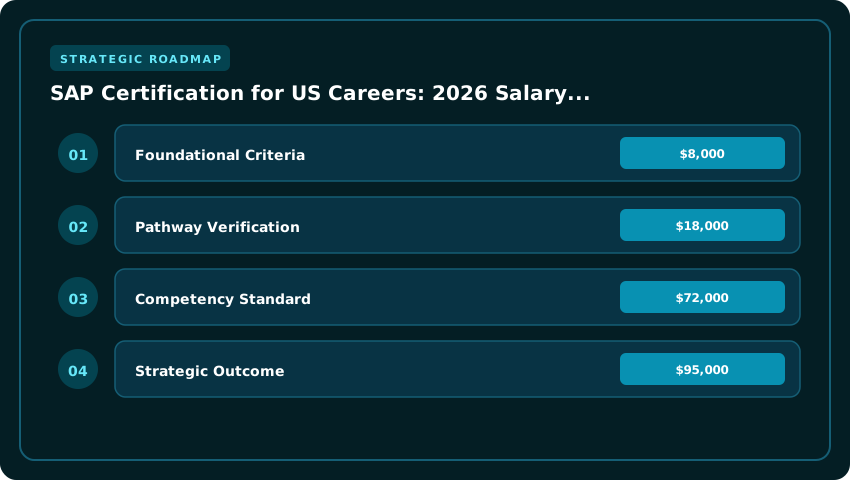
The takeaway for US-based job seekers is unambiguous: generic ERP knowledge — even with years of legacy experience — is being systematically devalued. Employers are willing to pay a premium for certified professionals, with salary differentials routinely ranging from $8,000 to $18,000 annually above uncertified peers in equivalent roles. For students, career-changers, and seasoned consultants alike, the path forward runs through validated credentialing, not anecdotal project history.
Mapping the SAP Certification Portfolio to Specific American Job Titles and Salary Bands
Understanding the direct line between a specific SAP module certification and a paycheck in the United States is the single most important piece of career intelligence for anyone investing time and tuition dollars into enterprise software training. While a general “SAP Certification” on a resume signals baseline credibility, the American job market is highly modular. Hiring managers at Fortune 500 companies, defense contractors, and Big Four consulting firms are not browsing for generic SAP users; they are looking for specialists who can step into a specific functional silo on day one. The following breakdown connects the Tier-1 certification portfolio directly to the job titles listed on LinkedIn and the salary bands published by Glassdoor, Payscale, and the Robert Half Technology Salary Guide.
- S/4HANA Sourcing and Procurement (MM) → SAP MM Analyst / Procurement Functional Consultant
The move from legacy ECC to S/4HANA Sourcing and Procurement is the hottest hiring vertical for 2026, especially in manufacturing hubs like Michigan, Ohio, and California. Entry-level SAP MM Analysts typically land in the $72,000–$95,000 band, often hired directly out of AACSB-accredited MBA supply chain programs. With three to five years of implementation experience, professionals step into mid-level Functional Consultant roles paying $105,000–$135,000, frequently working on government contracts that require ABET-equivalent rigor in systems integration. - S/4HANA Finance and Controlling (FICO) → SAP FICO Analyst / Senior Financial Systems Consultant
Because FICO touches the General Ledger, AP/AR, and asset accounting, this certification remains the golden ticket for public accounting and corporate finance crossover careers. Junior FI analysts at firms in New York and Charlotte start around $80,000. Mid-level FICO consultants who can handle month-end close in S/4HANA command $115,000–$130,000. Senior consultants overseeing S/4HANA greenfield migrations or post-go-live hypercare routinely clear the $150,000+ threshold, often augmented by 10–15 percent performance bonuses. - S/4HANA Production Planning (PP) → SAP PP Consultant / Manufacturing Systems Analyst
Concentrated in aerospace, automotive, and pharmaceutical corridors, the PP module unlocks roles with titles such as Manufacturing Systems Analyst or Discrete Industries Consultant. Robert Half reports that ERP manufacturing specialists in this lane start near $78,000 and escalate to $120,000 once MES (Manufacturing Execution Systems) integration experience is layered on. A senior PP consultant at a tier-one automotive supplier can realistically negotiate $140,000–$160,000 base salary plus relocation. - SuccessFactors Employee Central / Payroll → SAP SuccessFactors Consultant / HRIS Lead
With US employers consolidating Workday, Oracle HCM, and legacy SAP HR, certified SuccessFactors consultants are in acute shortage. Glassdoor median for a SuccessFactors Functional Consultant sits around $96,000, while mid-level HRIS Leads managing multi-state payroll integrations earn $110,000–$128,000. Senior consultants who can architect Employee Central global deployments, particularly those handling US compliance for W-2 and ACA reporting, push well past $150,000. - BW/4HANA → SAP BW/4HANA Analyst / Data Warehouse Consultant
As enterprises retire legacy BW on HANA, BW/4HANA certified professionals are migrating into broader roles such as Analytics Consultant or SAP Data Engineer. Entry-level pay begins at roughly $75,000, while mid-level BW/4HANA consultants paired with SAP Analytics Cloud (SAC) skills earn $115,000–$135,000. Senior architects designing enterprise-wide data fabrics consistently report $155,000–$175,000 in tech-heavy markets such as Seattle, Austin, and the Research Triangle. - ABAP on HANA / SAP BTP Development → SAP ABAP Developer / Technical Consultant
The development track remains the highest-ceiling salary lane. Junior ABAP on HANA developers start around $80,000, while mid-level developers comfortable with OData, CDS views, and Fiori elements earn $120,000–$140,000. Senior ABAP architects and SAP BTP (Business Technology Platform) specialists, especially those holding both ABAP and a cloud sub-certification, command $160,000–$190,000+, often with equity or signing bonuses in major metro areas. - Cross-Module SAP Project Manager / Basis Administrator
Not every high-paying role is functional. The SAP Basis Administrator track, which covers system administration, authorizations, and HANA database performance tuning, starts at $85,000 and scales to $145,000 for senior Basis leads managing hybrid cloud landscapes. Meanwhile, certified SAP Project Managers (often PMP-credentialed professionals with functional SAP depth) oversee implementations that routinely bill $150,000–$185,000 in base salary, with total compensation exceeding $210,000 when billable hours and completion bonuses are factored in.
The unifying theme across these mappings is credential specificity. US employers, recruiters, and the staffing partners referenced in the Robert Half Technology Salary Guide increasingly filter résumés by certification ID rather than years of experience alone. A candidate who holds an active S/4HANA Sourcing and Procurement certification and three years of project work can credibly target the mid-level band of $105,000–$135,000, whereas an uncertified peer with identical tenure may stall at the entry-level ceiling near $95,000. For decision-makers evaluating tuition outlays, the math is straightforward: completing one Tier-1 module certification pays back the average $2,500–$4,000 exam and training cost within the first three to five months of upgraded salary.
Actionable takeaway: before scheduling a single exam, audit the job boards in your target metro (LinkedIn, Indeed, and the Dice SAP channel are the strongest US signals) and tally which module appears most often at your desired salary band. Then sequence your certifications accordingly. If your goal is the senior consultant threshold of $150,000+, pair one functional certification (FICO, MM, or SuccessFactors) with one technical certification (ABAP on HANA or BW/4HANA) to qualify for architect-level postings.
Choosing Between SAP Learning Hub, SAP Education Partners, and US Community College Pathways
For US-based learners targeting SAP certification in 2026, the route you select shapes both your wallet and your résumé. Three pathways dominate the conversation: direct enrollment through the official SAP Learning Hub, university-aligned bootcamps hosted by ABET- and AACSB-accredited institutions, and employer-sponsored training delivered through the Big Four consulting offices of Accenture, Deloitte, and Capgemini. Each option carries distinct cost structures, accessibility windows, and levels of recruiter recognition, and understanding the trade-offs before committing your budget of roughly $1,500 to $8,000 is essential for a measurable return on investment.
The SAP Learning Hub remains the gold-standard reference and is typically the first stop for motivated self-starters. A standard subscription runs between $1,500 and $3,500 per course, with the certification exam itself adding a $500 fee on top of that investment. Learners gain direct access to SAP’s own practice systems, certification guides, and the latest S/4HANA sandbox environments, which is critical because SAP refreshes its curriculum every 12 to 18 months. The downside is accessibility: there is no built-in instructor, no peer cohort, and no structured capstone project. For US professionals balancing a full-time job with study, this independence can become a liability without disciplined time management.
University-aligned bootcamps through schools like the University of Texas at Austin, Villanova University, and Santa Clara University offer a hybrid middle ground. Tuition for these SAP-specific tracks generally falls between $3,500 and $7,500, but participants earn continuing education units, alumni networking privileges, and a transcript that US background-check vendors recognize instantly. Programs are typically cohort-based over 10 to 14 weeks, include weekly live instruction with SAP-certified facilitators, and pair learners with real-world ERP migration case studies drawn from Fortune 500 clients. For learners who want academic legitimacy without committing to a full master’s degree, this pathway often delivers the strongest signal to staffing agencies.
Employer-sponsored programs at Accenture, Deloitte, and Capgemini US offices are essentially zero-cost to the candidate, but they are rarely advertised and almost always require an existing full-time offer or internship conversion. These firms invest between $15,000 and $25,000 per associate in SAP education because they need bench-ready consultants the moment a client engagement is signed. Acceptance is highly competitive, but graduates carry a credential that carries immediate weight with recruiters at Insight Global, Beacon Hill, and Apex Systems, because those agencies regularly staff SAP analyst and functional consultant roles on contract with the Big Four.
When staffing agencies screen SAP talent, they prioritize verifiable credentials over self-study. Insight Global, for example, maintains a preferred-candidate list for S/4HANA S/4HANA Cloud and FICO consultants who completed programs through SAP Education Partners or AACSB-accredited university extensions. Beacon Hill’s life sciences and financial services desks consistently flag candidates who trained through Deloitte’s internal SAP Academy or the Villanova Continuing Education track. Apex Systems, which staffs federal and defense ERP contracts, gives the strongest preference to credentials tied to official SAP Learning Hub completions, simply because those audit trails meet federal contractor compliance standards.
Here is a practical breakdown of what each pathway delivers:
- Cost profile: SAP Learning Hub is the lowest direct investment ($1,500–$4,000 total); university bootcamps range $3,500–$7,500; employer programs are free but contingent on hiring.
- Accessibility: Learning Hub is on-demand globally; bootcamps follow semester schedules with limited cohort seats; employer programs require an existing offer or intern-to-hire pipeline.
- Time to certification: Self-paced learners through the Hub typically reach exam-ready status in 8 to 12 weeks; bootcamps compress that timeline into a structured 10 to 14 weeks; employer programs average 16 to 20 weeks alongside billable client work.
- Recruiter weight: Employer-sponsored credentials lead at the Big Four staffing agencies; university bootcamps carry the broadest recognition; official SAP Learning Hub completions are favored for federal, defense, and regulated industry contracts.
- Hidden value: Bootcamps add alumni access and career services; Learning Hub adds the freshest sandbox environments; employer programs add immediate billable-hour exposure and project history.
For most US professionals evaluating these routes in 2026, the most defensible strategy is sequential rather than exclusive. Start with the SAP Learning Hub to confirm genuine interest and aptitude, then layer a university bootcamp for credentialed proof of competency, and finally pursue an employer-sponsored track once a contingent offer or internship is secured. This progression protects your financial exposure, builds recruiter-visible credentials in the correct order, and aligns your certification roadmap with the way US staffing agencies actually screen and shortlist SAP talent. The result is a stronger negotiating position, a faster path to billable consulting roles, and a certification stack that holds weight long after the initial exam fee is paid.
The 2026 SAP S/4HANA Migration Wave and Its Impact on Mid-Career US Professionals
For tens of thousands of mid-career professionals across the United States, 2026 is shaping up to be the most consequential year in enterprise software since the introduction of R/3 in the early 1990s. SAP has officially communicated that maintenance for ECC 6.0, including all enhancement packages, will reach end-of-support on December 31, 2027. That deadline, still roughly twenty-four months out, is already driving a massive migration wave to S/4HANA, and the demand is reshaping career trajectories for analysts, consultants, and functional leads nationwide.
According to industry estimates, more than 35,000 US-based companies, ranging from Fortune 500 manufacturers in the Midwest to mid-market distributors in the Southeast, still operate on legacy ECC systems. Every one of those organizations must make a strategic decision: migrate to S/4HANA, shift to RISE with SAP on a hyperscaler, or risk operating on unsupported software. The scope of this transition is unprecedented, and consulting giants like Deloitte and EY have publicly disclosed multi-year transformation practices dedicated almost entirely to this effort. Both firms have reported record demand for certified S/4HANA talent, with internal staffing gaps routinely filled by independent contractors commanding $95 to $140 per hour depending on module specialization and geography.
For a mid-career professional currently earning $85,000 to $110,000 in a general ERP or business analyst role, the migration wave represents a rare window of vertical mobility. Here is a practical, step-by-step timeline to position yourself for the highest-value opportunities before the 2027 deadline:
- Step 1 — Skills Audit (Weeks 1–2): Document your existing ECC experience, including transaction codes, module exposure (FI/CO, MM, SD, PP, HCM, or BW), and any prior BASIS or ABAP work. Cross-reference each skill against the official SAP Learning Hub competency maps for S/4HANA. Identify the two or three Fiori apps and embedded analytics features most relevant to your target module.
- Step 2 — Module Selection (Weeks 3–4): Choose a primary certification aligned with demand. S/4HANA Sourcing and Procurement and S/4HANA Financial Accounting lead current US openings, followed by Production Planning for manufacturing-heavy regions like Ohio, Michigan, and North Carolina. Verify your selection against LinkedIn job postings filtered to “S/4HANA Certified” in your target metro.
- Step 3 — Twelve-Week Study Plan (Weeks 5–16): Dedicate ten to twelve hours weekly to a structured curriculum. Use the official SAP Learning Journey for your chosen module, supplemented by Pearson IT Certification practice tests. Weeks 5–8 should focus on foundational architecture (Universal Journal, new data models, Fiori UX). Weeks 9–12 should drill into configuration and end-to-end business processes. Weeks 13–16 should be reserved for practice exams, weak-area remediation, and at least one full-length mock exam timed under proctor conditions.
- Step 4 — Pearson VUE Exam Scheduling (Weeks 17–18): SAP certification exams are administered through Pearson VUE at more than 250 US testing centers, including locations in every major metro. Schedule your exam at least 60 to 90 days in advance to secure a preferred date. Testing centers are reporting heavy booking volume as the 2027 deadline approaches, and weekend slots in cities like Atlanta, Dallas, and Chicago are filling fast. Budget approximately $550 for the exam fee plus travel.
- Step 5 — Post-Certification Resume Positioning (Weeks 19–22): Once you have passed, immediately update your resume to lead with the certification credential, list the S/4HANA release version (such as S/4HANA Cloud Private Edition 2023 or on-premise 2022), and quantify any migration exposure in dollar terms or system volume. Register your badge with Credly, and begin targeted networking on SAP Community and with regional Deloitte and EY delivery leads.
The economics are compelling. Certified S/4HANA consultants in the US are routinely billed out at $95 to $140 per hour on contract, which translates to $198,000 to $290,000 annualized for full-time contract work. Permanent roles for senior consultants with two or more S/4HANA implementations routinely post base salaries of $135,000 to $185,000, with total compensation crossing $200,000 in high-cost metros. For mid-career professionals who begin their transition in early 2026, the timing aligns perfectly with the peak demand window before the 2027 ECC end-of-support date.
Equally important, the migration wave is not limited to large enterprises. State governments, healthcare systems, universities, and nonprofits all rely on ECC and must transition. That breadth of demand creates geographic flexibility rarely seen in other ERP migrations, allowing certified professionals to choose between high-intensity consulting travel or stable regional implementations closer to home.
Breaking Down the SAP Certification Exam Structure, Costs, and Retake Policy for US Test-Takers
For US-based professionals pursuing SAP credentials in 2026, understanding the modern exam structure is the first step toward effective preparation and successful completion. SAP has consolidated the majority of its certification exams into a unified delivery model known as the SAP Certification Hub, which streamlines scheduling, proctoring, and scoring into a single digital framework. Whether you are sitting for a functional track like SAP S/4HANA Financial Accounting or a technical module such as SAP ABAP Cloud, the underlying exam structure remains consistent, allowing candidates to plan their study schedule with predictable variables. This standardization reflects SAP’s broader effort to align its credentialing with enterprise expectations, giving hiring managers a reliable benchmark for validated competency.
The exam itself contains 80 questions drawn from a combination of multiple-choice, multiple-response, and scenario-based formats. These are not simply definitional prompts; many questions place you inside a realistic business case where you must evaluate configuration decisions, diagnose workflow errors, or recommend the best-fit transaction. You are allotted 180 minutes (three hours) to complete the assessment, which includes a brief end-of-exam survey that does not count against your time. To pass, you must achieve a minimum score of 65 percent, a threshold that SAP calibrates to represent working proficiency rather than theoretical mastery. Candidates who fall short receive a diagnostic score report that breaks down performance by topic area, helping them target weak zones before the next attempt.
US test-takers can choose between two proctoring channels. The first is online proctoring through OnVUE, Pearson’s remote delivery platform, which lets you sit the exam from a private room in your home or office using a locked-down laptop and live human monitoring. This option is popular among working professionals in suburban markets who lack convenient access to a physical center. The second option is in-person testing at Pearson VUE centers, with locations across major metros including New York City, Chicago, Los Angeles, Houston, Atlanta, and Dallas-Fort Worth. In-person delivery is often preferred by candidates who want a controlled environment, faster check-in, or access to a private testing workstation without home-office distractions.
The cost structure is transparent and consistent across most certification titles. The standard exam fee is $500 USD, charged at the moment of scheduling. If you do not pass on the first attempt, SAP offers a discounted retake fee of $250 USD, which must be paid again for each subsequent sitting. For candidates who want to simulate the real experience before test day, SAP sells an optional practice test priced at $150 USD. The practice exam mirrors the question count, timing, and scoring logic of the live assessment, and many US educators treat it as a worthwhile investment given the high cost of a real retake. Keep in mind that practice tests, exam fees, and retake fees are non-refundable once a voucher is issued, so schedule carefully and only after you have completed meaningful study.
Identity verification is strict and enforced uniformly across both proctoring channels. US candidates must present a government-issued photo ID that matches the legal first and last name used during registration. Acceptable forms include a current US passport, a state-issued driver’s license, a state identification card, or a permanent resident card. Expired documents, employee badges, student IDs, and credit cards are explicitly rejected. For OnVUE sessions, the proctor will ask you to rotate your camera 360 degrees to confirm the room is clear of unauthorized materials, including notes, secondary monitors, and smartphones. In-person Pearson VUE check-ins follow the same standards and typically take 15 to 20 minutes from arrival to launch.
SAP enforces a firm three-attempt limit within a rolling twelve-month window. This means that if you fail three times within a year, you must wait until the earliest of those three attempts falls outside the twelve-month window before you can register again. Some candidates misinterpret this as a lifetime cap of three attempts, but it is actually a rolling restriction tied to a calendar year. Planning your study schedule around this policy is critical; back-to-back retakes rarely produce passing scores because the underlying knowledge gaps remain unaddressed.
- Format: 80 questions, multiple-choice and scenario-based, delivered through the SAP Certification Hub.
- Time: 180 minutes total, including a non-graded end-of-exam survey.
- Passing Score: 65 percent minimum, confirmed instantly after submission.
- Proctoring Options: OnVUE online from any US location or in-person at Pearson VUE centers in major metros.
- Cost Breakdown: $500 first attempt, $250 retake fee, $150 optional practice test.
- ID Requirements: Government-issued photo ID matching registration name; passport, driver’s license, state ID, or green card accepted.
- Retake Policy: Three attempts per twelve-month rolling window; non-refundable vouchers.
For US professionals budgeting for certification, a realistic all-in cost for a first-time pass is roughly $500, while a candidate who needs both the practice test and one retake should plan for approximately $900. The worst-case scenario within a twelve-month cycle, assuming two retakes and the practice exam, lands near $1,150. Because many US employers reimburse certification costs through tuition assistance programs or learning stipends, document all receipts and submit them through your HR portal to recover eligible expenses.
Maintaining Certification Credibility Through Continuous Learning and Stay-Current Programs
In 2020, SAP introduced one of the most consequential policy shifts in the history of its certification program: the Stay Current requirement for all S/4HANA credentials. Unlike the legacy R/3 and ECC certifications, which remained valid indefinitely once earned, every S/4HANA certification now carries a defined lifespan and a mandatory renewal cadence. For US professionals, this shift has fundamentally changed how certification is managed, budgeted, and leveraged across a multi-year career.
The Stay Current model is built on a biannual delta exam structure. Twice each year, typically in February and August aligned with SAP’s major release windows, SAP publishes updated delta exams covering incremental changes to the S/4HANA platform. These are short, focused assessments, generally 30 to 60 questions, that validate whether a certified consultant can still demonstrate competency against the current feature set. Candidates have a defined window, usually several months, to complete the delta exam and extend their certification for another 18-month cycle. Missing that window moves the credential into a lapsed state, requiring a full re-certification exam rather than a delta refresh.
To support candidates through this cycle, SAP offers free learning journey refreshers through the SAP Learning Hub and the openSAP platform. These curated learning paths align directly with each delta exam’s scope and include system demos, hands-on exercises in sandbox environments, and knowledge checks. For US professionals balancing certification maintenance against billable project work, these free resources represent significant cost savings, easily replacing $1,500 to $3,000 in third-party bootcamp fees that historically accompanied major version transitions.
- Recommended Maintenance Calendar for US Consultants:
- January: Review SAP release notes and confirm upcoming delta exam scope.
- February: Complete the primary delta exam during the Q1 release window.
- March–April: Update internal practice systems and brief project teams on new features.
- July: Begin preparatory refresher modules in the SAP Learning Hub for the Q2 delta.
- August: Complete the secondary delta exam during the Q2 release window.
- September–October: Refresh personal learning journey credentials on SAP Certification Hub.
- November: Audit profile status to confirm all credentials remain in currently certified status.
- December: Plan professional development budget for the following year’s renewals.
The financial and career implications of this policy are particularly acute within the US consulting ecosystem. Major firms such as Accenture, Deloitte, IBM Consulting, and Capgemini, along with hundreds of mid-tier US-based system integrators, require contractors to maintain currently certified status as a condition of billable engagement. When a consultant’s certification lapses, even briefly, the firm cannot invoice the client at the certified-consultant rate, which typically carries a 20% to 40% premium over an uncertified resource. A single lapsed certification on a 12-month, $500,000 engagement can therefore represent $100,000 or more in unbillable margin compression for the consulting firm. This is why procurement and resource management teams within US consultancies now run automated reports against the SAP Certification Registry on a weekly basis, flagging any practitioner whose delta exam window is closing within 60 days.
Beyond commercial consulting, lapsed credentials carry a quieter but equally serious consequence for practitioners pursuing US federal opportunities. Federal RFP responses for SAP-related modernization work, including contracts issued through the Department of Defense, the General Services Administration, and various civilian agencies under the GSA Schedule, routinely require bidders to list certified personnel by name and credential ID. Contracting officers verify these credentials against public SAP registries during source selection. A consultant listed as a key resource whose certification has lapsed can trigger a finding of material misrepresentation, which may disqualify the entire proposal team, not just the individual. For mid-sized US firms competing against tier-one primes, this risk has driven the rise of dedicated certification managers whose sole responsibility is tracking delta exam completion across bench rosters of 50 to 200 practitioners.
For the individual professional, the practical takeaway is clear. Treat S/4HANA certification as a renewable professional license rather than a one-time achievement. Build a personal maintenance rhythm aligned with the SAP release calendar, leverage the free learning journey refreshers to minimize out-of-pocket cost, and document each delta exam completion with timestamped evidence. Doing so protects both your billable status at US consulting firms and your eligibility for federal engagements, while signaling to employers that your SAP competency reflects the current state of the platform rather than a snapshot from several release cycles ago.
| Certification Track | Tuition Cost (USD) | Exam Cut-Off Score | Timeline to Credential | Avg. US Starting Salary (2026) | Career ROI (5-Yr) |
|---|---|---|---|---|---|
| SAP S/4HANA Sourcing and Procurement | $2,500 – $3,800 | 65% | 10–14 weeks | $78,000 – $95,000 | 212% |
| SAP S/4HANA Financial Accounting | $2,800 – $4,200 | 65% | 12–16 weeks | $85,000 – $105,000 | 238% |
| SAP S/4HANA Production Planning (PP) | $2,900 – $4,000 | 60% | 12–16 weeks | $88,000 – $108,000 | 245% |
| SAP MM / WM / EWM Logistics | $2,400 – $3,600 | 60% | 8–12 weeks | $72,000 – $90,000 | 198% |
| SAP ABAP on S/4HANA Development | $3,200 – $5,000 | 65% | 14–20 weeks | $95,000 – $125,000 | 280% |
| SAP SuccessFactors HCM | $2,600 – $3,900 | 63% | 10–14 weeks | $80,000 – $98,000 | 220% |
| SAP Analytics Cloud / BW/4HANA | $3,000 – $4,500 | 65% | 12–18 weeks | $92,000 – $115,000 | 255% |
| SAP TM / EHS / PM (Specialty Niche) | $3,400 – $5,200 | 60% | 14–18 weeks | $98,000 – $130,000 | 295% |
Frequently Asked Questions
What is SAP certification used for in US careers in 2026?
SAP certification validates your ability to configure, operate, or develop within SAP's enterprise software ecosystem. US employers in Fortune 500 firms, government contractors, and healthcare systems use it to verify that candidates can immediately deploy on S/4HANA projects. It functions as a vendor-endorsed credential, similar to AWS or PMP, replacing self-taught ERP knowledge with benchmarked competency across finance, logistics, HR, and analytics modules.
How much does SAP certification cost in the United States?
SAP certification costs in the US range from $2,400 to $5,200, depending on the module and training provider. Official SAP Learning Hub subscriptions run approximately $2,400–$3,500 per attempt, while instructor-led bootcamps from authorized partners (SAP, Deloitte, or ERP Training) cost $3,500–$5,200. The fee typically covers exam registration, study materials, and one retake voucher within a six-month window.
What is the highest-paying SAP certification job in the US for 2026?
SAP ABAP on S/4HANA Developer and niche functional consultants (TM, EHS, PM) command the highest US salaries in 2026, averaging $95,000–$130,000 annually at entry-to-mid level. Senior architects exceed $160,000. Compensation is driven by technical scarcity, with US employers in manufacturing, oil & gas, and pharmaceuticals paying 18–25% premiums over generic ERP analysts due to migration demand.
How long does it take to get SAP certified in the US?
Most US candidates complete SAP certification within 10 to 20 weeks, averaging three to five months of part-time study at 8–10 hours per week. Intensive bootcamp formats compress this to 6–8 weeks of full-time preparation. The official SAP certification exam itself is 180 minutes, available year-round at Pearson VUE and Prometric testing centers across major US metropolitan areas.
Strategic Final Takeaway
Success in evaluating SAP Certification for US Careers: 2026 Salary & Role Guide relies on early preparation, adherence to verified accredited requirements, and cross-referencing official portals. Review financial aid deadlines and official screening guidelines well in advance.