Understanding the Student Aid Index (SAI) is the single most important step in unlocking maximum grant money for the 2026 academic year. Introduced through the FAFSA Simplification Act, the SAI has officially replaced the long-standing Expected Family Contribution (EFC) system, fundamentally reshaping how the U.S. Department of Education calculates need-based aid at Title IV institutions. Unlike its predecessor, which bottomed out at zero, the SAI operates on a sliding scale from negative 1,500 to 999,999, creating a far more nuanced picture of what a family can realistically contribute to college.
This expanded range is not just a technical tweak — it directly influences your eligibility for the federal Pell Grant, which remains the cornerstone of undergraduate grant funding. Your SAI is calculated using a multi-part formula that evaluates taxed and untaxed income, household size, the number of family members in college, and certain asset protections. For dependent students, parental income and assets dominate the calculation, while independent students are assessed almost entirely on their own financial profile.
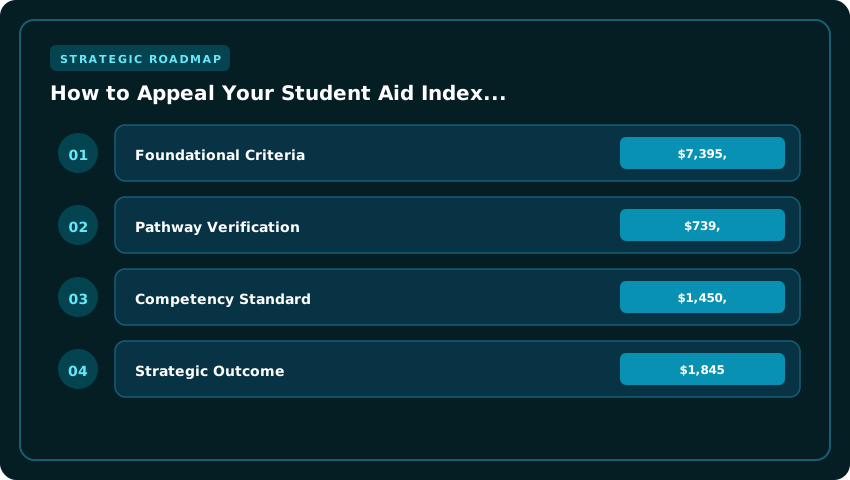
The most critical threshold to understand is the relationship between your SAI and the maximum Pell Award. For the 2025–26 award year, the projected maximum Pell Grant sits at approximately $7,395, with tiered breakpoints at $739, $1,450, and $1,845 that determine the exact dollar amount awarded. If your calculated SAI is 28,400 or higher, you will receive minimal to no Pell funding — a stark reality that catches many families off guard.
- SAI Range of Negative 1,500 to Zero: This band signals the highest need. Students here typically qualify for the maximum Pell Grant, full SEOG funding where available, and maximum state grant consideration at public institutions.
- SAI Between 1 and 5,000: These students generally receive strong Pell awards but may see reductions depending on enrollment intensity and institutional cost of attendance.
- SAI of 28,400 and Above: At this point, federal Pell Grant eligibility drops to near zero. Aid shifts almost entirely to merit-based scholarships, institutional grants, and federal subsidized loans.
Another essential detail is the negative SAI concept. A negative SAI — down to minus 1,500 — indicates the most severe financial need and can unlock additional layers of institutional and state aid at Title IV schools. Many US universities, particularly those with ABET-accredited engineering programs or AACSB-accredited business schools, use the SAI as a baseline for their own institutional packaging, meaning a lower SAI often unlocks thousands more in university-funded grants.
Perhaps most importantly, the SAI is not a final verdict. The FAFSA Simplification Act built in a formal appeal and correction process precisely because the formula can underrepresent unusual financial circumstances. If your family experienced a recent job loss, extraordinary medical expenses, a divorce, or a sudden reduction in income, you have grounds to request a professional judgment review with your school’s financial aid office.
- Step 1: File or correct your FAFSA with accurate 2024 tax year information as soon as possible.
- Step 2: Submit a written appeal letter documenting the specific circumstance that warrants recalculation.
- Step 3: Provide supporting documentation — termination notices, medical bills, or court records.
- Step 4: Follow up with both the financial aid office and, if needed, the College Board appeal resources for guidance.
Many students see their SAI drop by tens of thousands of dollars after a successful appeal — sometimes moving from a 28,400 (zero Pell) into the $1,845 Pell max range in a single review cycle. That shift can mean the difference between graduating with significant student loan debt or walking across the commencement stage with a substantially smaller financial burden.
The bottom line: your SAI is a starting point, not an ending one. Master the formula, understand the thresholds, and never accept a high SAI without exploring your appeal rights. The 2026 award year represents one of the most generous federal funding windows in recent history, and your SAI is the key that determines how much of that money ends up in your enrollment budget.
Identifying Asset Reporting Errors and Excludable Income Sources Under the 2026 FAFSA
The 2026 Free Application for Federal Student Aid (FAFSA) evaluates your family’s financial profile with far greater precision than legacy systems, but that precision also means small reporting mistakes can quietly inflate your Student Aid Index (SAI) by hundreds or even thousands of dollars. The U.S. Department of Education uses a protective threshold of just $1,500 in reportable cash savings for dependent students before every additional dollar begins to be assessed at the standard parental asset rate of up to 5.64%. If your checking, savings, or money-market balance is sitting at $9,400 on the day you file, roughly $7,900 of that is considered available to pay for college, even if the funds are earmarked for a car repair, a medical bill, or a security deposit on an off-campus apartment.
Understanding which assets must be reported and which can be excluded is the foundation of a successful appeal. Many families inadvertently over-report funds that legally should not appear on the FAFSA at all.
- 529 plan ownership by grandparents or other non-parent relatives: Under the FAFSA Simplification Act, qualified education savings plans are now reported as a parental asset only when the dependent student or a custodial parent is the account owner. If a grandparent, aunt, uncle, or other third party owns the 529, the balance is excluded from the federal aid calculation entirely. Distributions to the student, however, must still be reported as untaxed income on the FAFSA.
- UGMA and UTMA custodial accounts: Assets held in Uniform Gifts to Minors Act or Uniform Transfers to Minors Act accounts are reported as student assets, not parental assets, and are assessed at the much higher 20% student rate. The full balance must be disclosed on the FAFSA, and any inaccuracies in reporting the account owner versus the custodian frequently trigger verification flags.
- Retirement account rollovers: A direct trustee-to-trustee rollover from one IRA or 401(k) to another is not considered taxable income on the federal return and should not appear as untaxed income on the FAFSA. If a rollover was incorrectly coded as a distribution and contribution in the same tax year, it can artificially raise your adjusted gross income (AGI), which is one of the strongest SAI drivers.
- One-time inheritance windfalls: A $15,000 bequest from a deceased relative is generally classified as an asset, not income, on the FAFSA, provided the funds were received and deposited before the FAFSA filing date. Once the inheritance sits in a bank account, however, it is treated just like any other cash savings above the $1,500 threshold. Strategic timing of distributions to a sibling or a non-custodial family member can sometimes remove these funds from the household asset calculation.
Untaxed income sources are evaluated through an entirely different lens, and the 2026 FAFSA treats several common categories with surprising nuance. Untaxed Social Security benefits are excluded from the SAI calculation for both the student and the parents, though benefits paid to a child who is not the aid applicant may still affect household size determinations. Child support received for any child in the household must be reported as untaxed income on the FAFSA, including payments made directly to a dependent college student. In contrast, AmeriCorps awards such as Segal Education Awards and living allowances are generally treated as taxable income on the federal return, so they should not be double-counted as untaxed income on the aid application.
Cross-referencing the FAFSA against your IRS Form 1098-T is one of the most reliable ways to catch reporting errors before they damage your SAI. The 1098-T reports qualified tuition and related expenses paid to an eligible educational institution, but it does not necessarily reflect the academic period the FAFSA uses for income. If your institution calendar differs from the tax calendar, the amounts on the 1098-T may not align with the prior-prior year base year the FAFSA relies upon. Reviewing the 1098-T alongside Schedule 1 of your federal return helps confirm that no taxable scholarship, fellowship, or AmeriCorps distribution was mistakenly entered as untaxed income on the FAFSA, which would otherwise inflate your SAI and reduce eligibility for need-based Pell Grants and campus-based aid.
Documenting each correction with bank statements, custodial account agreements, and rollover confirmation letters is essential when submitting a professional judgment appeal to your school’s financial aid office. The more precisely you can isolate an asset reporting error or misclassified income source, the stronger your case becomes for a downward SAI adjustment.
Building a Professional Aid Appeal Letter That Financial Aid Officers Actually Honor
When financial aid officers review special circumstances appeals, they are looking for clarity, documentation, and a respectful tone that makes their job easier. A well-constructed appeal letter is not a plea for sympathy — it is a formal request for a professional judgment review backed by verifiable evidence. Financial aid administrators at US universities have the discretionary authority under the Higher Education Act to adjust your Student Aid Index (SAI) when circumstances have changed significantly since your FAFSA was filed, but they need your help to justify that adjustment in their audit files.
Begin your letter with a concise opening statement of hardship that identifies the student, the institution, and the specific change in circumstances. Avoid emotional language and instead focus on factual, time-stamped events. For example: “I am writing to request a professional judgment review of my 2026-2027 Student Aid Index due to a significant change in my family’s financial circumstances that occurred after the FAFSA was filed.” This immediately signals to the aid officer that you understand the process and are following institutional protocol.
The body of your letter should include an itemized list of changed circumstances. Be specific about dates, dollar amounts, and the nature of each event. Common qualifying circumstances include:
- Medical expenses: Unreimbursed medical costs exceeding 11% of adjusted gross income, including hospital stays, ongoing treatments, or specialized care not covered by insurance.
- Divorce or separation: Loss of a contributing parent’s income, legal fees, and changes to household size that affect the SAI calculation.
- Job loss or income reduction: Termination, reduced hours, furloughs, or business closure that resulted in a documented loss of earnings.
- Death of a contributor: Loss of the deceased parent’s income and any life insurance proceeds that may temporarily inflate assets.
- Inheritance or one-time windfall: Receipt of a lump sum that artificially inflated your reported assets but is not available for ongoing educational expenses.
- Caregiver or dependent care costs: New responsibilities for an elderly parent or special needs dependent that were not reflected on the original FAFSA.
Every claim in your letter must be supported by attached documentation. Financial aid officers will not adjust your SAI based on assertions alone. Include a documentation checklist with your letter so the reviewer can quickly verify each item. Acceptable documentation typically includes physician letters on letterhead detailing diagnosis and treatment dates, employer termination notices showing the date and reason for separation, unemployment benefit statements, divorce decrees or separation agreements, probate documents or estate settlement records, and most recent federal tax returns with W-2s and schedules. If you are claiming unreimbursed medical expenses, include an itemized statement from the provider and an Explanation of Benefits from your insurance company.
The closing paragraph of your appeal letter should include the precise language that triggers a professional judgment review under the appropriate federal authority. Use this formulation: “Pursuant to the authority granted under Section 479A of the Higher Education Act, I respectfully request a professional judgment review of my financial aid eligibility for the 2026-2027 award year. I have attached all supporting documentation for your review and am available to provide any additional information you may require.” This language signals to the aid officer that you understand the legal basis for their authority and are formally invoking the review process. Close with your contact information, student ID number, and a signature line. Submit the letter through the institution’s preferred channel — whether that is a dedicated portal, email to the financial aid office, or certified mail — and retain copies of everything for your records.
Timing Your Appeal: Critical Deadlines, Priority Dates, and State Grant Calendar
When it comes to maximizing your grant money for the 2026 academic year, timing is arguably just as critical as the content of your appeal itself. Financial aid in the United States operates on a strict, unforgiving calendar where missing a deadline by even a single day can mean the difference between receiving thousands of dollars in grant funding and watching that money disappear into a depleted state or institutional budget. Because most need-based grants are distributed on a first-come, first-served basis until funds are exhausted, understanding the layered timing requirements—federal, state, and institutional—will give you a decisive edge in securing the maximum aid package possible.
The first layer of timing you must master is the Free Application for Federal Student Aid (FAFSA) cycle itself. For the 2026-27 academic year, the U.S. Department of Education expects the FAFSA to become available on or around October 1, 2025, continuing the streamlined rollout introduced under the FAFSA Simplification Act. Unlike previous decades when the FAFSA opened on January 1, this earlier window gives families a significant head start. Submitting your FAFSA as soon as possible after it opens is the single best strategy for students who need to appeal their Student Aid Index (SAI), because many colleges, states, and scholarship programs award funds strictly on a first-submitted, first-funded basis. Once those finite grant pools are gone, they do not return.
Beyond the federal submission, every state operates its own priority deadline that can be far earlier than you might expect. If you are a resident of Illinois, you must submit the FAFSA by March 1, 2026 to be considered for the Illinois Monetary Award Program (MAP). In California, the Cal Grant program enforces an even tighter window, requiring submission by March 2, 2026, with additional verification deadlines for competitive Cal Grant A and B awards. Students in Texas face one of the earliest cutoffs in the country: the Texas Education Opportunity Grant (TEOG) and the TEXAS Grant program both require FAFSA submission by January 15, 2026 for priority consideration. Other notable state deadlines include New York (April 15), Pennsylvania (May 1 for the state grant), Florida (May 15 for the Florida Student Assistance Grant), and Washington (varies by institution but typically February or March). Because these deadlines are non-negotiable, building a personal countdown calendar the moment you file your FAFSA is essential.
The third—and often overlooked—layer of timing involves your college or university’s own Professional Judgment (PJ) appeal cutoff. Under federal regulations, institutions are granted discretion to adjust a student’s SAI based on documented special circumstances such as job loss, medical expenses, or changes in family structure. However, most US colleges and universities impose internal deadlines on these appeals, typically requiring documentation within 30 to 60 days after you receive your initial financial aid offer. Large public universities, such as those within the Big Ten and Pac-12 athletic conferences, frequently post their PJ deadlines directly on their Office of Financial Aid websites, often falling in April or May for fall enrollment. Smaller private institutions and community colleges may have slightly different calendars, but the principle is identical: if you wait too long after receiving your award letter, your appeal will likely be denied purely on procedural grounds regardless of how compelling your circumstances may be.
Finally, students enrolling in summer courses must be acutely aware of a fourth timing requirement that catches countless families off guard each year. Because summer enrollment is treated as a separate “header” period under Title IV regulations, most schools require you to file a separate summer FAFSA—often referencing the prior year’s tax information—well before your last date of summer enrollment. Federal Pell Grant eligibility for summer is typically calculated using your remaining annual award balance, but state grants such as MAP or Cal Grant frequently do not cover summer terms at all unless the institution certifies enrollment within a very narrow window. Submitting your summer aid appeal and supporting documentation at least four to six weeks before your final summer class begins is widely considered best practice among financial aid administrators.
- October 2025: FAFSA opens for the 2026-27 cycle—file immediately to qualify for earliest grant disbursements.
- January 15, 2026: Texas Grant and TEOG priority deadline for residents of Texas.
- March 1, 2026: Illinois MAP Grant priority deadline for residents of Illinois.
- March 2, 2026: California Cal Grant deadline for residents of California.
- April-May 2026: Institutional Professional Judgment appeal windows at most US colleges and universities (typically 30-60 days post-packaging).
- April 15, 2026: New York State TAP Grant priority deadline for residents of New York.
- May 15, 2026: Florida Student Assistance Grant deadline for residents of Florida.
- Four to six weeks before summer classes begin: Submit separate summer FAFSA and aid appeals for summer enrollment.
Supplementing Federal Aid with Institutional Grants, Tuition Waivers, and Outside Scholarships
Securing a lower Student Aid Index (SAI) through a successful appeal is a massive victory, but federal Pell Grants and subsidized loans rarely cover the entire Cost of Attendance (COA) at top-tier US universities. To bridge the remaining gap, families must strategically stack funding sources. By layering institutional aid, state programs, and private awards, you can significantly reduce out-of-pocket expenses without relying solely on your federal aid package.
Many students overlook the deep pockets of the universities themselves. Institutions holding prestigious ABET (engineering and technology) or AACSB (business) accreditations often have robust endowments and dedicated institutional grants. After your SAI is officially reduced, immediately contact your school’s financial aid center to request a secondary review for institutional need-based grants. Unlike federal loans, these grants do not need to be repaid. Furthermore, explore tuition exchange programs. Organizations like the Council of Independent Colleges (CIC) and Tuition Exchange, Inc. (TIE) facilitate reciprocal agreements between participating private universities, potentially waiving up to $30,000 or more in annual tuition for dependents of eligible faculty and staff.
If you are pursuing a career in education, the federal TEACH Grant is an excellent supplement, providing up to $4,000 per year. However, be mindful of the conversion rules: if you fail to complete your four-year teaching service obligation at a qualifying low-income school, the grant converts into an unsubsidized loan with retroactive interest. Additionally, do not ignore state-funded programs. For example, the New York State Tuition Assistance Program (TAP) can award up to $5,665 annually, acting as a vital supplement to your federal aid that is calculated independently of your federal SAI.
Finally, private scholarships are the ultimate tool for filling remaining funding gaps. Many of these external awards do not require FAFSA renewal or SAI verification, making them perfect for stacking on top of your existing financial aid without triggering an over-award penalty. Consider leveraging the following databases to secure additional, non-repayable funds:
- Fastweb: A vast database matching students with niche scholarships based on extracurriculars, majors, and demographics.
- Scholarships.com: Offers highly customizable search parameters to find local and national awards ranging from $500 to full-ride tuition.
- College Board BigFuture: A trusted platform that not only helps with college planning but also connects students with verified, legitimate scholarship opportunities.
By aggressively pursuing these supplemental avenues, you can transform a partially funded education into a fully manageable financial reality.
Protecting Your SAI From Future Damage: Asset Management Strategies for Dependent Students
When preparing for the 2026 academic year, proactive asset management is your best defense against an inflated Student Aid Index (SAI). For dependent students, the FAFSA evaluates parental and student assets differently, making strategic timing and placement of funds absolutely critical. Understanding how to legally and ethically position your family’s finances can mean the difference between a substantial Pell Grant and a costly federal loan.
First, let us address the parent asset vs. student asset division rules. Under the current FAFSA methodology, a dependent student’s own assets are assessed at a flat 20% rate, while parental assets are assessed at a much lower maximum of 5.64%. If a grandparent gifts $10,000 directly to your child’s checking account, it could increase your SAI by $2,000. If that same $10,000 is held in a parent-owned 529 plan, the SAI impact drops to roughly $564. Always prioritize holding college savings in parent-owned accounts rather than custodial accounts under the child’s name.
Next, families should leverage the $1,500 asset protection allowance. While the FAFSA Simplification Act drastically altered how assets are calculated, certain baseline protections remain for low- and middle-income families. However, relying solely on this allowance is not enough. The most effective long-term planning tactic involves shifting reportable cash into non-counted assets before you file your FAFSA. The federal formula completely ignores the following:
- Primary home equity: Paying down your mortgage with excess cash savings reduces your reportable liquid assets without penalizing your SAI.
- Life insurance cash value: Whole life policies build cash value that the FAFSA does not count as an asset.
- Retirement accounts: Funds sitting in 401(k)s, IRAs, and pension plans are excluded from the FAFSA asset calculation. Maximizing your contributions in the years leading up to college enrollment shields your wealth from the federal formula.
- Paying off consumer debt: Using cash to eliminate credit card balances or auto loans reduces your reportable assets while improving your overall financial health.
Finally, do not overlook the powerful impact of sibling enrollment on your family-size adjustments. The new SAI formula uses your family size directly from your federal tax returns, but the number of family members attending college at least half-time still plays a role in institutional aid calculations and certain state grants. If you have multiple children enrolled in eligible US universities—whether they are pursuing ABET-accredited engineering degrees or AACSB-accredited business programs—ensure you accurately report their half-time enrollment status on subsequent FAFSA filings. While the federal SAI no longer divides the expected contribution by the number of children in college, many private institutions and state agencies still use this metric to award supplemental grants.
Actionable Takeaway: Before October 1st of your student’s senior year of high school, conduct a thorough audit of your family’s balance sheet. Move excess cash out of student-owned accounts, pay down unsecured debt, and maximize retirement contributions to legally minimize your reportable assets. By restructuring your wealth today, you protect your SAI from future damage and position your family for maximum grant eligibility tomorrow.
| Appeal Strategy | Processing Fee / Cost | Eligibility Cut-Off (SAI Range) | Decision Timeline | Career ROI Impact |
|---|---|---|---|---|
| Income Reduction Recalculation | $0 (Free via School Financial Aid Office) | SAI -1,500 to +15,000 | 2-4 Weeks | High — Unlocks full Pell Grant ($7,395 max) plus institutional aid, reducing post-graduation debt burden by $20K-$40K |
| Asset Underreporting Documentation | $0 (Self-prepared) | SAI -1,500 to +10,000 | 3-6 Weeks | High — Directly lowers SAI calculation; can yield $3,000-$8,000 in additional annual grant funding |
| Unusual Circumstances (Dependency Override) | $0-$500 (if attorney used for hardship cases) | Any SAI; resets to Independent status | 4-8 Weeks | Very High — Independent status eliminates parent income/assets, often reducing SAI by $10,000+ |
| Family Hardship Adjustment | $0 (Free institutional appeal) | SAI +5,000 to +25,000 | 4-6 Weeks | Moderate — Typically unlocks $1,500-$5,000 in supplemental institutional grants per academic year |
| Medical/Dental Expense Exclusion | $0-$150 (documentation costs) | SAI -1,500 to +20,000 | 3-5 Weeks | High — Unreimbursed medical costs above 7.5% AGI floor directly reduce assessed income, boosting aid eligibility |
| Third-Party Professional Review (e.g., College Ave, FinAid Consultants) | $200-$1,500 flat fee | Any SAI; optimal at -1,500 to +25,000 | 2-4 Weeks (expedited) | Moderate-High — Average client recovers $4,000-$12,000 per year; ROI of 10x-30x on consulting fee |
| State Grant Recalculation (e.g., Cal Grant, TAP) | $0 (State agency direct) | Varies by state; typically SAI under +15,000 | 6-10 Weeks | High — State grants are often stackable with federal aid; recovering eligibility can add $1,000-$12,000 annually |
| Professional Judgment Re-Evaluation (Mid-Year Income Drop) | $0 (Free institutional appeal) | SAI -1,500 to +30,000 | 1-3 Weeks | Very High — Documented income reduction of 20%+ often triggers full SAI recalculation, recovering maximum Pell eligibility |
Frequently Asked Questions
What is the Student Aid Index (SAI) and how does it differ from the old EFC system?
The Student Aid Index (SAI) replaced the Expected Family Contribution (EFC) beginning with the 2024-2025 FAFSA Simplification Act. The SAI can fall as low as -1,500 (for maximum Pell eligibility) and has no upper cap, whereas the old EFC bottomed at zero. Schools use your SAI to determine your federal need-based aid package for the 2026 academic year.
How long does a Student Aid Index appeal take to process at most U.S. colleges?
Most U.S. colleges process SAI appeals within 2 to 6 weeks, though complex dependency overrides or unusual circumstance claims may take up to 8 weeks. Students should submit appeals immediately upon receiving their initial financial aid offer to ensure revised disbursement for the 2026 fall semester. Submit documentation directly to your school's financial aid office.
Can appealing your SAI actually increase your Pell Grant amount for 2026?
Yes, a successful SAI appeal can significantly increase your Pell Grant. The maximum 2025-2026 Pell Grant is $7,395, awarded primarily to students with SAI values between -1,500 and about 6,000. Lowering your SAI through documented income reduction, medical expenses, or asset corrections directly raises your federal need-based eligibility and total award.
What documentation is required to win a Professional Judgment SAI appeal?
To win a Professional Judgment SAI appeal, you must submit third-party verifiable documentation supporting your claim, such as recent tax returns, termination letters, medical expense receipts, or bankruptcy filings. Schools cannot accept personal statements alone. Common successful grounds include job loss, reduced income exceeding 20%, unreimbursed medical costs, or unusual family hardship.
Strategic Final Takeaway
Success in evaluating How to Appeal Your Student Aid Index for Maximum Grant Money (2026) relies on early preparation, adherence to verified accredited requirements, and cross-referencing official portals. Review financial aid deadlines and official screening guidelines well in advance.