Why Residency Refinancing Offers Look Irresistible on Paper
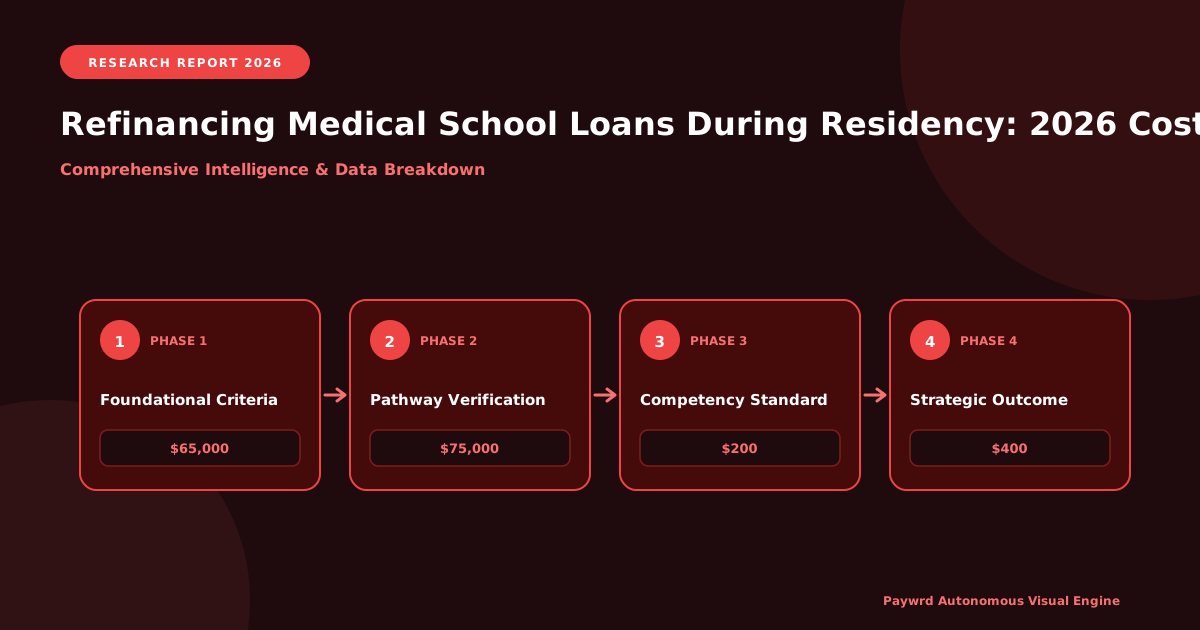
At first glance, the marketing materials from private lenders like SoFi, Earnest, and Laurel Road read like a financial windfall for struggling medical residents. The pitch is straightforward and emotionally compelling: take your existing federal loan balance, lock in a dramatically lower interest rate, and watch your monthly cash flow expand almost instantly. For a resident earning roughly $65,000 to $75,000 annually while working 60-to-80-hour weeks in a teaching hospital, the promise of saving $200 to $400 every single month can feel life-changing, especially when paired with deferred loan payments during training.
The raw economics that drive these offers are genuinely impressive when isolated from their long-term trade-offs. A resident carrying the average medical school debt of around $280,000 on the standard federal 10-year repayment plan is currently facing an interest rate of approximately 6.8% on unsubsidized Grad PLUS loans. Over a 10-year horizon, that balance generates thousands of dollars in interest charges, meaning a meaningful percentage of every monthly payment goes toward interest rather than principal reduction. Private refinancing lenders, capitalizing on competitive rate wars and aggressive resident-targeted campaigns, can offer fixed rates as low as 5.5% and variable rates dipping toward 4.9% or lower for highly qualified borrowers with strong credit profiles and cosigners.
Here is where the math becomes seductive. Dropping the rate from 6.8% to 5.5% on a $280,000 balance does more than trim the lifetime interest paid; it produces immediate monthly payment relief. The standard federal payment on that balance hovers near $3,200 per month, while a refinanced loan at 5.5% stretched over a 10-year term typically falls into the $2,900 range. Stretch the term to 15 or 20 years, and the monthly obligation can drop below $2,300. That delta of $200 to $400 per month, multiplied across 36 to 84 months of residency and fellowship, translates into tens of thousands of dollars in short-term liquidity.
- The compound interest trap during training: A $280,000 balance at 6.8% accrues roughly $1,600 in interest every single month during residency. Even with federal income-driven repayment caps limiting mandatory payments to a percentage of discretionary income, unpaid interest capitalizes and inflates the principal, sometimes pushing the effective balance above $300,000 by the time training concludes.
- The variable-rate temptation: Lenders frequently advertise ultra-low teaser variable rates around 4.5% to capture attention. While attractive today, these rates float with the SOFR benchmark, meaning a 2026 signing could see payments balloon if the Federal Reserve pivots toward tightening. Fixed-rate refinancing eliminates this uncertainty but at a slightly higher starting rate.
- The forbearance marketing angle: Many resident refinance products bundle in mandatory forbearance during residency and fellowship, meaning no payments are technically due for up to 84 months. The aggressive compounding during this window is often highlighted as a benefit, but in reality, the unpaid interest still accrues and may capitalize, eroding much of the headline rate advantage.
- The cosigner release carrot: Products from SoFi and Earnest specifically court residents by offering cosigner release after 12 to 24 consecutive on-time payments, framing the parent’s credit exposure as temporary and manageable.
Why do lenders pursue this demographic so aggressively? The answer lies in risk modeling and lifetime customer value. A medical resident is essentially a pre-verified future attending physician with a predictable income trajectory, often crossing into the $250,000 to $400,000+ range within three to five years post-training. Lenders extend competitive rates because they are betting on the borrower’s ability to refinance again, consolidate debt, or take on additional products once attending income arrives. The residency-period refinance is frequently positioned as a loss leader, designed not for immediate profitability but for portfolio retention.
The compound math is unforgiving during those 3 to 7 residency years. A $280,000 balance growing at 6.8% adds nearly $20,000 in annual interest alone, meaning a resident who makes only the federal income-driven minimums could see their balance climb by $60,000 or more before they finish a seven-year neurosurgery residency. Refinancing interrupts that compounding cycle, channels every payment directly toward principal reduction once training concludes, and offers the borrower a predictable, finite payoff date. On paper, it is an elegant solution to a brutal financial reality.
Yet the paper math only tells half the story. Before any resident signs on the dotted line, they must understand what they are permanently surrendering in exchange for that monthly savings and rate reduction. The federal loan benefits currently protecting residents, including Income-Driven Repayment forgiveness pathways, Public Service Loan Forgiveness eligibility, and flexible deferment and forbearance options, do not transfer to private lenders. Once refinanced, those protections vanish, and recovering them requires an entirely new consolidation process with the Department of Education, a move that becomes increasingly difficult as attending income rises. The irresistible offer on the brochure is mathematically real, but it comes tethered to a decision that shapes the next decade of a physician’s financial life.
The PSLF Time Bomb: What You Lose the Second You Sign

Refinancing medical school loans with a private lender during residency feels like grabbing a life raft in a storm of compounding interest, but it comes with a hidden detonator. The moment you sign that private refinance promissory note, your federal Direct Loans cease to exist. They are paid off and replaced by a brand-new private debt instrument that carries zero affiliation with the U.S. Department of Education. That single administrative act permanently extinguishes your eligibility for Public Service Loan Forgiveness (PSLF), and there is no appeals process, no reverse button, and no retroactive reinstatement. You have effectively defused your path to $50,000, $75,000, or even $200,000+ in tax-free federal loan cancellation.
The scale of the forfeiture is staggering for medical residents. A typical four-year medical school graduate in 2026 carries roughly $200,000 to $300,000 in federal Direct Loans at interest rates between 6.5% and 8.5%. Under PSLF, a resident working for a 501(c)(3) nonprofit hospital needs only 120 qualifying monthly payments, which equates to ten years of certified employment, to have the remaining balance forgiven entirely. For a primary care resident making $65,000 annually under an Income-Driven Repayment (IDR) plan like PAYE or SAVE, those monthly payments might hover around $300 to $500. Multiply that differential over a decade, and the forgiven balance, which the IRS does not treat as taxable income under current Internal Revenue Code Section 108(f), represents a six-figure wealth transfer from the federal government to the physician. Refinancing into a private loan voids that transfer permanently.
The most overlooked detail in this entire equation is the qualifying employer test. PSLF is not forgiving loans because you are a doctor; it is forgiving loans because you worked in public service. The program, codified under Section 455(m) of the Higher Education Act, requires that you be employed full-time by a U.e., nonprofit organization that has registered 501(c)(3) status with the IRS, or by a government entity at the federal, state, local, or tribal level. Most academic medical centers, university hospitals, and large county health systems qualify automatically because they operate as nonprofit entities. However, private practice groups, physician-owned hospitals, and for-profit staffing agencies do not qualify, even if the work feels identical to the resident across the street. Residents who moonlight at ineligible facilities, accept locum tenens assignments at for-profit hospitals, or switch to a private group after fellowship without first executing an Employment Certification Form (ECF) jeopardize every payment they have already made toward the 120-month threshold.
- The Conversion Trap: Private refinance lenders pay off your federal servicer (Nelnet, MOHELA, Aidvantage, etc.) and issue a new private loan. Once the federal balance hits zero, your PSLF qualifying payment counter resets its forward progress because no qualifying payments can ever be credited to a private loan again.
- The Forgiven Dollar Value: A resident with $250,000 in Direct Loans earning an attending salary of $250,000 during the final three years of repayment under PSLF would have an IDR payment cap preventing principal reduction, leading to roughly $175,000 to $215,000 in eventual tax-free cancellation. Refinancing forfeits that exact figure.
- The 501(c)(3) Blind Spot: Many residents assume any hospital qualifies for PSLF. They do not. Veterans Affairs (VA) hospitals, public university systems, and nonprofit community hospitals qualify. HCA Healthcare, Tenet Healthcare, and other for-profit chains do not. Always verify the EIN and tax-exempt status of your residency program before signing any refinance paperwork.
- The Recertification Requirement: PSLF requires annual or periodic Employment Certification through the Federal Student Aid portal at studentaid.gov. Skipping recertification during a busy intern year is the most common reason applicants are denied after 10 years. The temporary Waiver is closed, and standard rules apply in 2026.
- The Tax-Free Distinction: Unlike private loan forgiveness, which can generate a massive cancellation-of-debt (COD) tax event under IRC Section 61(a)(11) unless the insolvency exception applies, PSLF forgiveness remains excluded from gross income under Section 108(f)(1). This makes the federal program dramatically more valuable than any private settlement.
The marketing language from lenders like SoFi, Earnest, Laurel Road, and Splash Financial is intentionally designed to make this forfeiture invisible. Advertisements emphasize lower interest rates, immediate monthly savings, and a clean single payment dashboard. They rarely disclose, in bold, that the borrower is permanently walking away from a federally guaranteed $50,000+ tax-free benefit. Before any resident signs a refinance application, they must run their specific residency program EIN through the PSLF Help Tool on the Federal Student Aid website, calculate their projected IDR payment, and multiply the expected forgiveness by their realistic ten-year earning trajectory. Only then does the true cost of that low private interest rate become mathematically visible.
Income-Driven Repayment vs. Refinancing: A Resident’s Real Comparison
For a medical resident staring down a $200,000 to $350,000 student loan balance, the choice between Income-Driven Repayment (IDR) and private refinancing is rarely about today’s budget. It is a calculated gamble on your future attending income, your specialty’s job security, and your tolerance for navigating the Internal Revenue Service’s tax bomb. As you plan for a 2026 transition from residency to a full attending position with a projected salary between $250,000 and $400,000, understanding the mechanics of both pathways is critical to preserving your long-term net worth and protecting your mental bandwidth during the most demanding decade of your medical training.
Income-Driven Repayment plans, specifically Pay As You Earn (PAYE), Revised Pay As You Earn (REPAYE), now branded as SAVE, and Income-Based Repayment (IBR), are federal programs designed to keep your monthly obligation proportional to your discretionary income. During residency, when your stipend hovers around $65,000 to $75,000, your IDR payment is often capped at roughly 10 percent of your discretionary income, frequently resulting in a $300 to $500 monthly bill. Refinancing, conversely, replaces those federal loans with a private product from lenders like SoFi or Earnest, often at a 5 to 7 percent variable or fixed rate, based entirely on your creditworthiness and the assumption of your future earning potential.
The side-by-side math over a standard 10-year repayment window tells a sobering story. Imagine a resident with $300,000 in federal debt at a 7 percent weighted average interest rate. On an IDR plan with partial financial hardship, they might pay $400 monthly during a four-year residency and then see that payment jump to roughly $2,800 to $3,200 once they hit a $320,000 attending salary. Over 120 months of attending-level payments, the total interest accrued can easily exceed $130,000. A resident who refinances that same balance at a 6 percent rate and commits to a 10-year amortization schedule will pay roughly $333,000 in total, with about $105,000 in interest. On paper, the refinanced borrower saves $25,000 in pure interest and achieves freedom from debt in a decade rather than 20 to 25 years.
However, the hidden long-term cost of refinancing is the forfeiture of tax-free forgiveness pathways. Under current federal regulations, balances forgiven after 20 or 25 years of qualifying IDR payments are taxable as ordinary income in the year of cancellation, which can trigger a massive tax liability often called the student loan tax bomb. Refinanced loans have no such forgiveness safety net. You owe every dollar, plus interest, regardless of whether you pursue a lower-paying primary care role in an underserved area, take a leave for a serious illness, or scale back hours to care for family. When you sign that private loan agreement, you are trading a federally protected backstop for a marginally lower interest rate.
- Monthly Payment Shock: Transitioning from a $300-$500 IDR payment in residency to a $2,800-$3,200 IDR payment as an attending represents a 400 to 600 percent increase in cash flow demand, often arriving alongside relocation costs, licensing fees, and malpractice tail coverage.
- Total Interest on IDR: Because IDR extends the amortization timeline, a resident who only makes minimum payments can accrue $150,000 to $200,000 in additional interest over a 25-year horizon, even if the remaining balance is eventually forgiven.
- Refinanced Stability: Private refinancing locks in a fixed schedule with no payment fluctuation, offering predictable budgeting but zero flexibility if your specialty’s compensation contracts or you face a disability.
- Forgiveness Eligibility: Only federal Direct Loans qualify for Public Service Loan Forgiveness (PSLF) after 120 qualifying payments, a benefit completely surrendered the moment a loan is refinanced into a private instrument.
- 2026 Salary Variance: A specialist projecting a $400,000 attending salary will pay off IDR loans aggressively and minimize capitalized interest, while a primary care physician at $250,000 may benefit far more from the forgiveness safety net built into PAYE or SAVE.
The real comparison, therefore, is not simply interest rates versus monthly cash flow. It is a strategic question about how much optionality you want to keep. If you are confident you will pursue a high-paying, private-practice-track specialty and can commit to a decade of aggressive payments without interruption, refinancing may yield a slightly leaner bottom line. If you are leaning toward academic medicine, nonprofit hospital systems, rural health, or a career trajectory that might involve fellowship, sabbaticals, or variable compensation, retaining federal loans and leveraging IDR or PSLF is almost always the mathematically and psychologically superior choice for a resident planning their 2026 financial strategy.
Resident Loan Refinancing Requirements Most Banks Won’t Tell You
When you analyze the glossy marketing brochures from private lenders, refinancing your medical school debt during residency seems like a logical, stress-free transition. Lenders often use “doctor loan” branding to suggest an exclusive, highly accommodating underwriting process designed specifically for medical professionals. However, the financial reality for a resident earning a standard stipend of $60,000 to $70,000 is far more complex. Behind the advertised low interest rates lies a stringent set of underwriting requirements that most banks conveniently omit from their initial consultations.
The first hurdle is your credit profile. While some lenders advertise minimum credit scores starting at 680, the practical threshold to secure a competitive rate without exorbitant origination fees is usually 720 or higher. More importantly, lenders scrutinize your debt-to-income (DTI) ratio with ruthless precision. A resident earning $65,000 annually while carrying $250,000 in student debt from a top-tier US university presents a DTI nightmare for traditional underwriting algorithms. In many cases, this mathematical reality disqualifies residents outright, regardless of their future earning potential.
- Hidden Cosigner Requirements: Despite the “doctor loan” prestige, banks frequently require a creditworthy cosigner to approve a resident. Lenders recognize that a $60,000 salary cannot comfortably service a $300,000 debt load if interest rates spike or the resident faces unexpected financial hardships.
- Vanishing Forbearance Policies: Federal loans originated through the FAFSA offer robust protections, including economic hardship deferment and income-driven repayment plans. Once you refinance into the private market, these safety nets vanish. Private lenders offer limited, strictly enforced forbearance policies that can trigger immediate default if you miss a payment.
- Cash Reserve Demands: Many private lenders require residents to show liquid cash reserves equal to three to six months of living expenses. On a $60,000 salary, accumulating $15,000 to $20,000 in savings while paying high rent in major metropolitan areas is a significant barrier.
It is crucial to remember that your medical degree—even if paired with an MBA from a program holding rigorous AACSB accreditation—does not exempt you from standard consumer lending mathematics. Banks are not lending based on your future attending salary; they are underwriting based on your current $65,000 income. If you decide to proceed, you must be prepared to present a flawless credit history, a substantial cosigner, and a clear understanding that you are trading federal flexibility for private rigidity. Always read the fine print on forbearance clauses before signing away your federal protections.
The Refinance-Then-Re Refinance Strategy for Attending Physicians
The refinance-then-re-refinance strategy is a sophisticated, two-phase approach that high-earning attending physicians use to capture the lowest possible interest rates on their medical school debt. Rather than locking in a single rate at the end of residency, these borrowers intentionally refinance once at the start of their attending career, then deliberately refinance again 18 to 24 months later once their full attending income, bonuses, and signing incentives appear on their credit reports. The math is straightforward, but the timing requires discipline and a clear understanding of how underwriters evaluate physician income.
The breakeven analysis typically centers on the 18 to 24 month window post-training for one critical reason: most private lenders require either a signed employment contract or at least six months of attending-level W-2 income before offering their most competitive rates. If you refinance on day one of your attending role, you are essentially pricing yourself as a high-risk borrower who has not yet demonstrated the income shown on paper. By waiting roughly 18 to 24 months, you allow your verifiable earnings, employment stability, and debt-to-income ratio to shift dramatically in your favor. Specialists like cardiologists, orthopedic surgeons, and dermatologists see the strongest mathematical case for this approach because their attending salaries often jump by $150,000 to $250,000 or more compared to their resident stipends, which fundamentally changes the lender’s risk model.
- Phase One Refinance Timing: Execute your first private refinance within the first 90 days of attending practice to immediately eliminate any remaining residency-era variable rates, typically landing between 6.5% and 7.5% APR in the current 2026 market environment.
- Phase Two Refinance Window: Re-refinance 18 to 24 months later once your bonus structure, partnership track income, or productivity bonuses are reflected in your tax returns and W-2 documentation, often dropping your rate by another 50 to 125 basis points.
- Specialist Salary Leverage: Cardiology, orthopedic surgery, and dermatology positions frequently command starting attending salaries of $400,000 to $700,000, which signals exceptional creditworthiness and pushes lenders into their most aggressive pricing tiers.
Market timing considerations add another critical layer to this strategy. With federal student loan rates having shifted upward in recent cycles and the Department of Education adjusting Direct Grad PLUS loan rates annually, many attending physicians are watching the 10-year Treasury yield as a proxy for private refinance offers. If federal rates rise meaningfully before your phase-two refinance window, private lenders tend to follow suit within 60 to 90 days. Conversely, if the Federal Reserve signals rate cuts, refinancing early in that cycle can lock in savings before competitors flood the market.
The strongest mathematical case belongs to specialists whose income trajectories are steep and verifiable. An orthopedic surgeon moving from a $70,000 resident stipend to a $600,000 attending salary represents a 757% income increase, which is a level of income transformation that no other profession can match. Lenders price this transformation aggressively, and the second refinance often produces rate offers that are simply unavailable to the general refinance market. Dermatology offers a similar profile, particularly for Mohs surgeons and cosmetic dermatologists whose private practice income can scale rapidly. Cardiology, especially interventional and electrophysiology subspecialists, rounds out the top tier because their compensation models frequently include productivity bonuses that show up clearly in year-two tax documentation.
Actionable Takeaway: Build your refinance calendar before you finish residency. Identify your phase-one target date, mark your phase-two window 18 to 24 months out, and request rate holds from at least three competing lenders in the final weeks before each refinance event so you can compare real offers rather than advertised rates.
Decision Matrix: When Refinancing Actually Makes Sense in 2026
Resident physicians often receive refinancing offers promising lower interest rates, single monthly payments, and breathing room during an already stressful training period. Yet for every graduate who benefits from consolidation, there is another who quietly forfeits seven-figure forgiveness opportunities. The truth lives in the details of your specific career trajectory, debt composition, and visa status. Before signing any promissory note, walk through this decision matrix carefully and honestly. Your medical license will follow you for decades; the loan structure you choose today will follow you just as long.
Profile 1: Non-PSLF Candidates Headed to Private Practice. If you have already decided that Public Service Loan Forgiveness does not align with your career plan, perhaps because you are matching into a private dermatology group or a concierge internal medicine practice, refinancing can be a powerful wealth-building tool. Most residents in this category carry between $250,000 and $500,000 in federal debt at 6.5% to 8.5% interest rates. A 2026 refi into a 5-year variable product hovering near 5.25% can save $40,000 to $90,000 over the life of the loan, depending on balance and term length. Lenders like SoFi, Earnest, and Laurel Road all offer resident-friendly products with deferred repayment during training. Just confirm whether the new loan includes a residency forbearance clause, because the last thing you need at 2 a.m. after a code blue is a hard credit pull and a collections phone call.
Profile 2: Residents With $400K+ Balances on Variable Federal Rates. High-balance borrowers face a different calculation. If your consolidated loans are tied to the Treasury 10-year note plus a margin, a 1% upward shift adds $4,000 or more in annual interest alone, before any principal reduction. For residents carrying $400,000 or more, refinancing into a fixed-rate product in the 6.00% to 6.75% band creates budget predictability. The ABMS reports that the average medical school graduate in 2025 carried roughly $268,000 in debt, so anyone above that threshold has likely accumulated interest capitalization or extended training. Locking a fixed rate today shields you from inflation-driven rate hikes that could otherwise balloon your balance during a 36 to 84 month residency.
Profile 3: Dual-Physician Households Without Federal Employer Benefits. Many couples underestimate how household income affects refinancing qualification. If both partners are residents or early-career attendings earning $60,000 to $75,000 each, joint applications through lenders like Splash or ELFI can yield significantly better terms than individual applications, particularly when both have clean credit profiles above 740. Even if neither plans to pursue PSLF, dual-physician households often benefit from aggressive refinancing combined with a 15-year term to accelerate principal paydown. Use the annual credit report from AnnualCreditReport.com (which remains free under federal mandate) to verify no surprises are hiding before the lender pulls your file.
Profile 4: International Medical Graduates on H-1B Visas. IMGs face the most complex decision tree. Many federal forgiveness pathways are inaccessible to H-1B holders due to employer restrictions or visa portability rules, which pushes refinancing into sharper focus. However, lenders require U.S. credit history, a Social Security Number, and often a co-signer for visa-holders without permanent residency. Citizens Bank, MPOWER Financing, and Prodigy Finance all serve IMG borrowers specifically. If you are on an H-1B with cap-subject status approaching expiry, prioritize loans that allow prepayment without penalty, since immigration status changes could force a strategic refinance in three to five years.
Pre-Application Checklist: Documents and Credit Moves to Complete Before You Apply
- Pull all three credit reports via AnnualCreditReport.com at least 90 days before applying. Dispute any inaccuracies now, because lender underwriting waits for resolutions that can take 30 to 60 days.
- Request a free FSA ID–linked federal loan summary through the Department of Education’s NSLDS portal to capture your exact current balance, servicer names, and interest rate breakdown for each loan.
- Verify your ACGME program length and expected graduation date in writing from your program coordinator, since lenders require attestation that training will conclude during the loan deferment window.
- Collect two years of tax returns and recent pay stubs even though residents often qualify on a credit-only basis, income verification strengthens your application and may unlock lower rates.
- Secure a co-signer letter of understanding if your credit profile is thin, particularly for IMGs and residents under 26 years of age without long credit histories. The co-signer should understand they remain liable if you refinance again or default.
- Run rate quotes through three lenders within a 14-day window so all hard inquiries count as a single scoring event per FICO methodology. This lets you compare offers without damaging your credit profile.
- Read the residency forbearance terms line by line. Some lenders cap forbearance at 36 months, while others extend through the duration of training. Mismatches here cause expensive surprises in year four.
The refinancing decision is not binary; it is a sequenced evaluation that depends on your specialty, visa status, household income, and forgiveness eligibility. Sit with this matrix for a week, run the numbers in a spreadsheet that includes total interest projected over 10, 15, and 20 year horizons, and only then decide whether the lower monthly payment justifies the trade-offs. Your future attending income can absorb a strategic refi today; your future self cannot un-lose a forgiveness pathway you surrendered prematurely.
| Refinancing Option | Resident Variable Rate (2026) | Fixed Rate Range | Monthly Payment (Avg. $250K) | Repayment Term | PSLF Eligibility | 10-Year Total Cost |
|---|---|---|---|---|---|---|
| Federal Direct Loans (Unrefinanced) | 5.50%–7.50% (Grad PLUS) | 6.50%–8.50% | $300–$340 (IDR/PAYE) | 10–25 years | ✅ Yes | $360,000–$410,000 |
| SoFi Resident Refinance | 4.99%–6.25% | 5.49%–7.49% | $260–$290 | 5–20 years | ❌ No | $312,000–$348,000 |
| Earnest Resident Refinance | 4.99%–6.49% | 5.49%–7.29% | $260–$295 | 5–20 years | ❌ No | $312,000–$354,000 |
| Laurel Road Resident Loan | 4.99%–5.99% | 5.49%–6.99% | $260–$285 | 5–20 years | ❌ No | $312,000–$342,000 |
| Commonbond Resident Refi | 5.00%–6.25% | 5.50%–7.25% | $262–$290 | 5–20 years | ❌ No | $314,000–$348,000 |
| Federal REPAYE/SAVE (IDR) | 5.50%–7.50% | 6.50%–8.50% | $200–$280 (income-based) | 20–25 years | ✅ Yes | $240,000–$336,000* |
Frequently Asked Questions
Can doctors refinance federal student loans during medical residency?
Yes, doctors can refinance federal student loans during residency through private lenders like SoFi, Earnest, and Laurel Road. However, refinancing permanently eliminates access to Public Service Loan Forgiveness (PSLF), income-driven repayment plans, and federal deferment protections, which are critical safeguards for residents earning $60,000–$70,000 annually.
What credit score is needed to refinance medical school loans during residency?
Most private refinance lenders require a minimum credit score of 650–700 for medical residents, though prime rates typically require 740+. Many lenders offer cosigner releases after 12–36 consecutive on-time payments. Residents with high debt-to-income ratios often need a cosigner initially, despite strong future earning potential as attending physicians.
How much can residents save by refinancing medical school loans in 2026?
Residents refinancing $250,000 in federal loans at a 6.5% Grad PLUS rate to a 4.99% private rate save approximately $40–$60 monthly and $50,000–$70,000 over 10 years. However, loss of PSLF eligibility typically costs $150,000–$250,000 in forgone forgiveness for nonprofit hospital workers.
Is it better to refinance student loans during residency or wait until attending?
Most financial advisors recommend waiting until attending physician status, when incomes jump from $60,000 to $250,000+ annually, qualifying residents for the best refinance rates. Refinancing during residency locks in lower rates but sacrifices federal protections; waiting preserves PSLF eligibility while still achieving aggressive payoff timelines.
Strategic Final Takeaway
Success in evaluating Refinancing Medical School Loans During Residency: 2026 Cost Breakdown relies on early preparation, adherence to verified accredited requirements, and cross-referencing official portals. Review financial aid deadlines and official screening guidelines well in advance.