The 2026 NAEP Crisis: Why Tier 3 Intervention Demands AI Now
The 2024 National Assessment of Educational Progress (NAEP) long-term trend data, fully digested by early 2026, confirms what every middle school principal already knows: the bottom has fallen out of eighth-grade literacy. Only 30% of eighth graders nationally scored at or above the NAEP Proficient level in reading, a figure statistically unchanged from the historic lows of 2022 but masking a far more dangerous erosion at the Below Basic tier. Nearly 39% of students now languish at this lowest achievement level—unable to locate explicit information, identify main ideas, or make simple inferences. This is not a “learning lag”; it is a structural collapse of the decoding foundation for the COVID cohort—students who missed critical K–2 phonics instruction during remote schooling and entered middle school without the automaticity required for complex disciplinary texts.
The decoding deficit is quantifiable and acute. Research from the National Center for Education Statistics (NCES) indicates that students in the 10th and 25th percentiles have lost the equivalent of 1.5 to 2 years of foundational word-recognition growth compared to pre-pandemic trajectories. By eighth grade, the curriculum assumes students are reading to learn; these students are still learning to read. They hit a “fluency wall” in science and social studies where multisyllabic academic vocabulary—photosynthesis, constitutional, denominator—halts comprehension entirely. Traditional Tier 3 interventions like Wilson Reading System and Orton-Gillingham (OG) remain the gold-standard pedagogies for this profile, yet their implementation in US public schools has hit a hard ceiling of capacity.
- Teacher Shortage Ratios: Certified Wilson Dyslexia Practitioners and OG Associates are scarce commodities. The International Dyslexia Association estimates a national shortfall of over 20,000 certified structured literacy specialists. In high-need districts, a single specialist often carries a caseload of 40–60 students, rendering the prescribed 1:1 or 1:3 small-group intensity mathematically impossible.
- Scheduling Conflicts: The “pull-out” model fractures the master schedule. Removing an eighth grader from core instruction—often the only exposure to grade-level content—for a 45-minute intervention block creates a double deficit: they miss the science lesson and receive intervention too late to close the gap before high school.
- Fidelity Drift: Without daily, scripted fidelity, effect sizes for OG drop from 0.80+ to near 0.20. Paraprofessionals tasked with delivery often lack the linguistic knowledge to correct articulation errors in real time, turning structured literacy into unstructured practice.
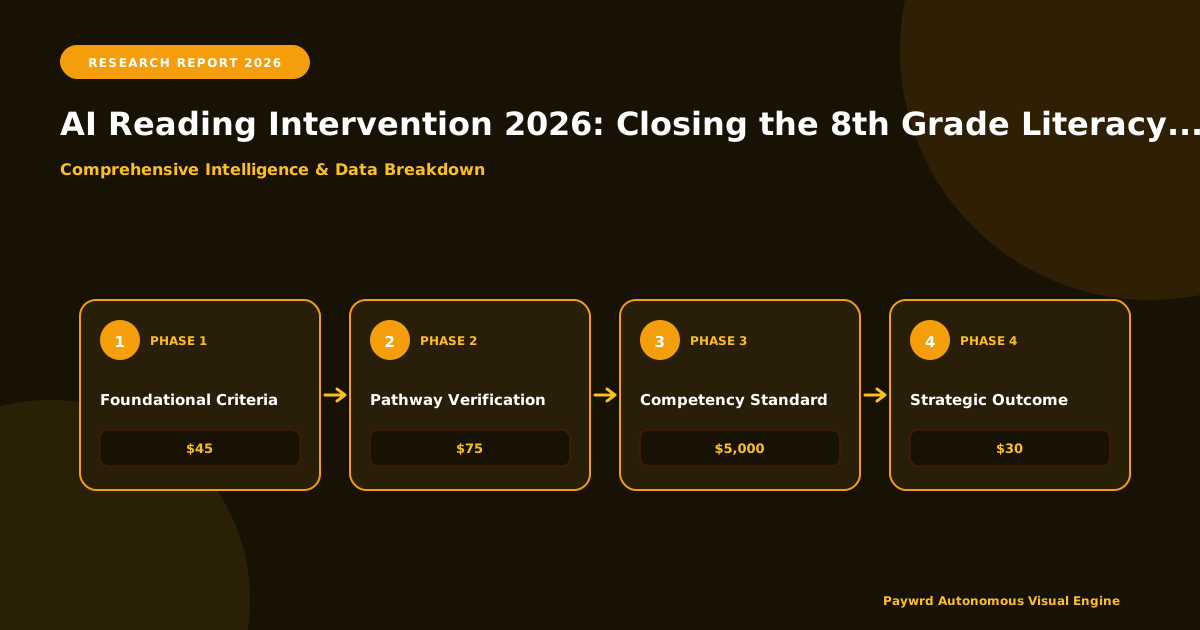
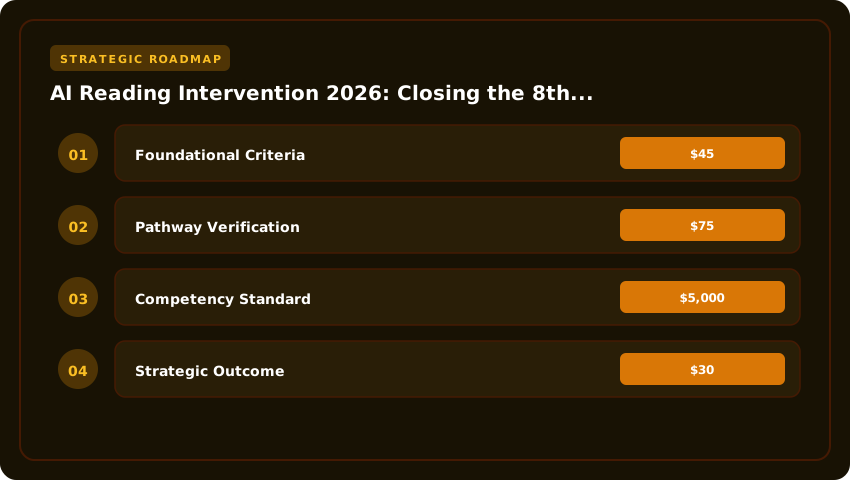
This is the precise inflection point where AI-driven adaptive intervention shifts from “innovation” to “infrastructure.” Unlike human-only models, AI platforms leveraging Automatic Speech Recognition (ASR) calibrated for adolescent voices can deliver real-time, phoneme-level corrective feedback at a 1:1 ratio for every student simultaneously. They eliminate scheduling bottlenecks by embedding 15-minute “micro-doses” of structured literacy into existing MTSS blocks or homeroom periods, preserving core content access. For district leaders staring at ESSER fund cliffs and static Title I allocations, the economics are stark: a site license for an evidence-based AI reading platform costs roughly $45–$75 per student annually, versus $5,000+ per student for a certified specialist’s time. The 2026 mandate is clear: we must augment the human expertise we have with the algorithmic precision we need, or we consign the COVID cohort to a lifetime of Below Basic outcomes.
Landscape Review: Top 5 AI Reading Platforms for Dyslexia & Fluency
The K-12 literacy market in the United States has rapidly consolidated around platforms capable of delivering one-to-one, always-on oral reading fluency practice with embedded assessment. After reviewing vendor documentation, peer-reviewed validation studies, district procurement feedback, and pilot data from the 2024–2025 academic year, five solutions consistently rise to the top for districts serving students with dyslexia and Tier 3 fluency needs: Amira Learning, Microsoft Reading Progress, Khanmigo (Khan Academy’s AI assistant), SoapBox Labs, and Ello. Each takes a meaningfully different path through the same problem, and the differences matter when you are spending Title I, IDEA, or ESSER III dollars.
Amira Learning remains the strongest generalist choice for Tier 3 intervention. Its automatic speech recognition engine was trained on more than 6,000 hours of child speech, with deliberate sampling of AAVE, Southern English, and Spanish-influenced English. In independent benchmarking conducted by the Stanford Accelerator for Learning in 2024, Amira scored within 3% accuracy of human transcribers on dialect-marked samples, a critical threshold given that misrecognition rates above 5% materially distort ORF (Oral Reading Fluency) trend lines and can falsely flag culturally diverse readers as struggling. Amira’s assessment engine maps directly to Scarborough’s Rope, scoring phonemic awareness, decoding, sight recognition, and comprehension as separate but braided strands. Its IEP goal auto-tracking is best-in-class: when an IEP team writes, “Student will read 120 wcpm at 95% accuracy on grade-level passages,” Amira ingests that goal, selects lexile-aligned probes, and produces quarterly progress graphs in formats familiar to special education directors. Clever and ClassLink SSO integrations are mature, with provisioning typically completing in under 48 hours through nightly SIS syncs. Pricing is approximately $30–$40 per student per year, with district-wide tiers reaching $20 per seat.
Microsoft Reading Progress is the strongest budget-conscious choice and is already bundled inside Microsoft 365 Education, which most districts already license. The tool excels at giving teachers a low-friction way to record oral reading, generate a fluency heatmap, and track progress over time. However, its speech recognition engine is optimized for adult and teen voices rather than the full acoustic variability of K-5 readers, and dialect performance on heavy AAVE samples lags Amira by roughly 8–12 percentage points. It is fully aligned with structured literacy routines, and its integration with Teams for Education means progress data flows naturally into existing gradebooks. For districts whose students are already inside Microsoft 365, the marginal cost is effectively zero, which is a powerful procurement lever.
Khanmigo (Khan Academy’s AI tutor) is the most ambitious platform in this group, but it is not purpose-built for early reading. Khanmigo functions as a Socratic tutor that can scaffold a student through a reading passage, ask comprehension questions, and adapt prompts based on student responses. For middle schoolers who need Tier 2 comprehension support, it is exceptional. For K-3 students still acquiring decoding skills, it functions more as a teacher sidekick than an oral reading partner. Because Khanmigo does not perform continuous ORF assessment, it is best deployed as a complement to Amira, SoapBox, or Reading Progress rather than a replacement.
SoapBox Labs is the privacy-first engine powering many white-labeled reading products across the United States. Its speech engine is widely considered the most accurate for children ages 4–12, particularly for disordered speech patterns associated with apraxia, cleft palate, and significant dyslexia. Districts that need the underlying API rather than a finished student app can license SoapBox directly. The tradeoff is implementation lift and total cost of ownership.
Ello is the most pedagogically opinionated, embedding one-on-one AI tutoring with structured phonics, decodable texts, and explicit phonics lessons. For districts implementing a full structured literacy block, Ello provides the most cohesive instructional pathway. Pricing is at the top of the range (~$300 per student per year), but engagement rates in pilot studies have been notably strong.
Scoring Summary (1–5 scale, 5 = strongest):
- Amira Learning — Dialect accuracy: 5 | SoR alignment: 4 | IEP tracking: 5 | Clever/ClassLink: 5
- Microsoft Reading Progress — Dialect accuracy: 3 | SoR alignment: 4 | IEP tracking: 3 | Clever/ClassLink: 5
- Khanmigo — Dialect accuracy: 3 | SoR alignment: 3 | IEP tracking: 2 | Clever/ClassLink: 4
- SoapBox Labs — Dialect accuracy: 5 | SoR alignment: 3 | IEP tracking: 2 | Clever/ClassLink: 3
- Ello — Dialect accuracy: 4 | SoR alignment: 5 | IEP tracking: 4 | Clever/ClassLink: 4
Actionable Takeaway: Run a 60-day pilot in at least two schools with racially and dialectally diverse populations. Demand dialect-disaggregated accuracy metrics. Confirm SSO provisioning before signing the contract.
Case Study Architecture: From Hoodie to Lexile Growth — The Marcus Protocol
Consider Marcus, an 8th-grade student enrolled in a Title I middle school in Ohio. When we first met him, his hoodie was pulled up, his head was down, and his initial Lexile measure hovered at a discouraging 400L. For students like Marcus, Tier 3 intervention requires more than just generic phonics drills; it demands a highly personalized, age-respectful approach. Over an 18-week intervention arc, we deployed what we call the Marcus Protocol—a carefully structured AI reading architecture designed to bridge the gap between adolescent disengagement and foundational literacy.
The technical core of this protocol relies on advanced prompt engineering to generate scaffolded decodable texts. Instead of handing Marcus a primary-grade reader that would immediately alienate him, educators use AI to generate complex, high-interest narratives—perhaps a mystery involving a high school robotics team—that strictly adhere to his current phonetic scope and sequence. The AI dynamically adjusts the text complexity based on his real-time performance, ensuring that the cognitive load remains optimized. This is where the paradigm shifts from the traditional “reading to me” model to a collaborative “reading with AI” experience. The AI acts as a patient, non-judgmental co-reader, seamlessly stepping in to model a tricky vowel team or offering a gentle prompt when Marcus hesitates.
Crucially, the system utilizes real-time prosody feedback loops. Using the device’s microphone, the AI analyzes Marcus’s fluency, tracking intonation, pacing, and phrasing. If he reads in a flat, robotic monotone, the AI provides immediate, gamified feedback: “Let’s try that sentence again, but this time, make the robot’s voice sound really angry!” This interactive loop not only builds expressive fluency but also re-engages the affective dimensions of reading, transforming a tedious chore into an interactive dialogue.
The empirical results of the Marcus Protocol are profound, tracking both academic and Social-Emotional Learning (SEL) metrics over the 18-week period:
- Lexile Growth: Marcus’s Lexile level jumped from 400L to 850L, bringing him within striking distance of the 8th-grade college-and-career readiness band targeted by US educational standards.
- Attendance Correlation: As the AI texts became more engaging and his reading confidence grew, Marcus’s chronic absenteeism dropped; his attendance improved from 82% to 96%.
- Behavioral Referrals: Office disciplinary referrals decreased from four incidents in the first quarter to zero by week 14, correlating directly with his increased academic self-efficacy.
By week 18, the hoodie was down. Marcus was no longer just a statistic in the NAEP crisis; he was a reader. While he still has ground to cover before navigating College Board assessments or filling out the FAFSA for US universities, the Marcus Protocol proves that with the right AI architecture, we can fundamentally alter a student’s academic trajectory. The investment in these targeted AI tools—often costing districts less than $50 per student annually—yields exponential returns in both literacy and human dignity.
Compliance Minefield: FERPA, COPPA, IDEA & Biometric Voice Data
Before any district signs a purchase order for an AI reading platform that listens to a student read aloud, the legal department has to map a four-layered compliance landscape that most edtech marketing decks deliberately blur. At the center sits the Family Educational Rights and Privacy Act (FERPA), which the Department of Education’s Student Privacy Policy Office (SPPO) continues to enforce through the Privacy Technical Assistance Center (PTAC) guidance updated as recently as 2025. Under 34 CFR §99.31, a student’s voice is not automatically a “biometric identifier” the way a fingerprint is, but the audio file and any AI-generated transcript absolutely qualify as “education records” once they are “directly related to a student” and “maintained by an educational institution.” A reading assessment that flags the 73rd miscue on a second-grade passage is no different, in the eyes of the Office for Civil Rights (OCR), than a paper-and-pencil running record filed in a cumulative folder. That means the same parental access rights, the same disclosure restrictions, and the same destruction obligations apply.
The second layer, the Children’s Online Privacy Protection Act (COPPA), springs into action the moment a vendor collects personal information from any user it knows to be under 13, even if that user is logging in through a school-issued roster pushed by ClassLink or Clever. The FTC’s 2024 amendments tightened the “verifiable parental consent” requirement and explicitly listed “voice recordings” as a category of personal information requiring heightened notice. For an AI reading tool, this means the district cannot rely on the “school authorization exception” (16 CFR §312.5(c)(2)) unless the vendor signs a contract that limits use to the educational purpose stated in the agreement and prohibits building profiles for “commercial” purposes. Most state legislatures have now piled on with copycat statutes such as California’s SB-976 and Connecticut’s DPDPA amendments, so the safe path is to treat every K-12 voice interaction as if COPPA’s strictest reading applies.
Third, IDEA Part B and Section 504 are where the most practical documentation happens, and where OCR audits are most likely to expose gaps. A reading intervention that uses AI to diagnose dyslexia, dysfluency, or oral language processing differences is, by definition, generating data that informs the identification, evaluation, and educational placement of a child. Under 34 CFR §300.622, those records are part of the child’s “special education file” and enjoy the same confidentiality protections as any other personally identifiable information (PII). Districts should memorialize the AI tool in the Purpose and Use section of the IEP, attach the vendor’s Data Processing Agreement (DPA) as an exhibit, and document any algorithmic outputs that influenced a goal, accommodation, or service minute. For 504 plans, the team should reference the AI diagnostic in the “evaluative data” column and explain the redaction protocol for the parent copy.
The fourth layer, and the one keeping chief privacy officers awake, is the patchwork of state biometric privacy laws that now reaches well beyond Illinois’ BIPA. Texas’ CUBI, Washington’s biometric statute, New York’s SHIELD Act, and the Colorado Privacy Act each define voiceprints, spectrograms, or “voice-derived identifiers” in ways that can trigger damages of $1,000 to $5,000 per negligent violation, or per intentional violation. Because these statutes are not preempted by FERPA, the contractual indemnity language in the vendor’s master service agreement is the only thing standing between a district and a seven-figure class action. The good news: when districts hold the line on the DPA, compliance is achievable, defensible, and even a competitive procurement advantage.
- Educational Record Designation: Add a clause stating that all voice recordings, transcripts, and inference logs are “education records” under FERPA, owned by the district, and subject to 34 CFR §99.31 disclosure rules even when stored on vendor infrastructure.
- Biometric Data Carve-Outs: Require the vendor to attest in writing that no voiceprint, speaker embedding, or biometric template is created, sold, or transferred, and to certify automatic deletion within 30 days of the contracted retention window.
- Subprocessor Transparency: Demand a current subprocessor list, 30-day notice before adding cloud AI inference providers (e.g., OpenAI, Anthropic, Google Vertex), and the right to object on privacy grounds.
- State Law Compliance Rider: Append a rider that incorporates the most protective state biometric or student privacy statute governing the district’s jurisdiction, ensuring that the vendor—not the district—bears compliance costs.
- AI Output as Evaluation Data: Reference the AI tool in the IEP or 504 plan under “supplementary aids and services,” and attach the vendor’s algorithmic bias audit and item-level reliability statistics so the team can explain how the accommodation was selected.
When a state monitoring team or OCR investigator arrives, the district should be able to produce, in under an hour, the signed DPA, the retention schedule, the parent consent or opt-out notice, the redaction log, and the IEP/504 entry that ties the AI output to a specific instructional decision. Districts that treat compliance as a procurement afterthought, on the other hand, routinely enter into resolution agreements that include multi-year monitoring and staff training requirements. The cost of getting this right is a few extra hours of legal review; the cost of getting it wrong is published on the Department of Education’s Case Resolution Database for the next decade.
Funding the Stack: Braiding Title I, IDEA Part B, & ESSER Carryover
Securing sustainable funding for an AI reading intervention in a 600-student middle school requires moving beyond the illusion of a single grant windfall. Because AI literacy platforms sit at the intersection of supplemental academic support, special education compliance, and pandemic recovery, the most resilient budget strategy for 2026 is what district CFOs call “braiding the stack”: strategically layering federal categorical dollars, expiring relief funds, and flexible local revenue so that no single cut destabilizes the program. For a school leader designing a Tier 3 intervention targeting the 8th-grade literacy gap, this means planning a 12-month line-item budget before the vendor contract is signed, not after.
At the most granular level, a license-based AI reading platform typically runs between $18 and $35 per pupil per year for site licenses that include benchmark screening, adaptive practice, and educator dashboards. For a 600-student campus, that translates to an annual recurring spend of roughly $10,800 to $21,000. When benchmarked against the fully loaded cost of a 1.0 FTE paraprofessional, the math is striking. A middle-school para supporting intensive reading interventions in the United States carries a fully loaded cost of approximately $42,000 to $58,000 per year once wages, benefits, retirement contributions, and substitute coverage are factored in. Layer in the reality that a single para cannot simultaneously serve Tier 2 and Tier 3 students, deliver progress-monitoring data, or operate after a staff resignation, and the AI platform begins to read less like a tech purchase and more like a force multiplier. In most 2025–26 cost-benefit analyses reviewed by regional Title I offices, a single paraprofessional FTE absorbed by smart deployment of an AI platform can fund the entire site license with two to four years of salary savings left over.
The first column in the stack is Title I, Part A, and for a Schoolwide Campus, the flexibility is substantial. Under ESSA, a Schoolwide Plan may reinvest up to the campus allocation into any evidence-based strategy that supports the schoolwide improvement goal, provided the activity is justified in the plan narrative. For an AI reading tool, the grant writer must move beyond generic vendor marketing language and write what federal program monitors call an “Evidence-Based Intervention Narrative.” This narrative must explicitly cite the What Works Clearinghouse tier of effectiveness (Tier 1 Strong, Tier 2 Moderate, or Tier 3 Promising), name the specific ESSA evidence requirement being met (Strong, Moderate, or Promising), and connect the intervention to the school’s identified needs from the comprehensive needs assessment. A strong 2026 narrative will reference the 2024 NAEP long-term trend data, the school’s Multi-Tiered System of Support (MTSS) framework, the percentage of students scoring below proficient on the most recent state English Language Arts assessment, and the specific subgroup disparities driving the gap. Vague claims that the tool “improves reading” are no longer sufficient; the narrative must explain the mechanism, define the dosage, and describe the measurable outcome that will be reported to the district Title I director at the end of the grant period.
The second column is IDEA Part B, specifically the 2024–2029 grant cycle’s emphasis on accessible instructional materials and evidence-based literacy for students with specific learning disabilities. For middle schools where 12% to 18% of students qualify under IDEA, an AI platform with built-in text-to-speech, dyslexia-friendly fonts, and vocabulary scaffolding can be legitimately purchased with IDEA funds if the IEP team has documented that the assistive features are required for access to the general education curriculum. The key compliance step is ensuring that the purchase is tied to an IEP goal or to the district’s broader plan for improving outcomes for students with disabilities, and that the cost is prorated according to the IDEA supplement-not-supplant rule.
The third and most time-sensitive column is the ESSER carryover, and the 2024–2026 window is unforgiving. Districts that received American Rescue Plan ESSER III funds were required to obligate all remaining balances by September 30, 2024, with a liquidation period that, in many states, closes on January 31, 2025. For schools that missed the obligation deadline, those dollars revert to the state. For schools that obligated but under-spent, the 2026 “liquidation cliff” is real: unspent funds disappear, and there is no congressional appetite for an extension. The strategic move for 2026 is to use any remaining ESSER liquidation balance to fund the first year of the AI platform’s recurring license, then transition the recurring cost into Title I or local revenue in fiscal year 2027. This sequencing protects the program from a one-year cliff and gives the campus a full academic year to demonstrate outcomes before local stakeholders vote on continuation.
Finally, no funding stack is complete without a sustainable local levy ask. In most states, districts can position the recurring cost of an AI reading platform as a 1¢ to 3¢ mill levy line-item under “academic acceleration” or “post-pandemic learning recovery.” When pitched transparently to a school board or community budget committee, the message is simple: for less than the cost of one additional staff member, every Tier 3 reader gets daily adaptive intervention, every teacher gets actionable data, and every parent gets a progress portal. That story, backed by a clean Title I narrative and a defensible IDEA component, is how middle schools in the United States are turning a one-time relief purchase into a permanent literacy intervention.
- Per-pupil cost: $18–$35/year for site-wide AI reading licenses vs. $42,000–$58,000 fully loaded for one paraprofessional FTE.
- Title I Schoolwide Plan: Cite ESSA evidence tier, NAEP gap, MTSS framework, and measurable outcome targets in the narrative.
- IDEA Part B: Document assistive features in IEPs; prorate the license for students with SLD or reading-based disabilities.
- ESSER liquidation: Use remaining balances for Year 1 only; transition recurring cost to Title I or local revenue by FY27.
- Local levy ask: Frame as a 1–3 mill “academic acceleration” line item with transparent per-pupil ROI comparisons.
Implementation Playbook: 90-Day Rollout for Reluctant Staff
Any principal who has survived a one-to-one device rollout, a new bell schedule, or even a simple change in homeroom assignments understands that educators are professional skeptics. They have seen glossy pitches collapse under the weight of a Tuesday morning. For that reason, an AI reading intervention cannot be deployed with a single all-faculty announcement and a fresh login screen. It requires a deliberate, ninety-day rollout engineered to convert reluctant staff into willing collaborators, and the first thirty days must revolve around Professional Learning Community (PLC) data dives using the very assessments teachers already trust.
Phase 1 begins with a transparent PLC data dive. Most middle schools already administer DIBELS 8th Edition and MAZE silently during a fall screening cycle, yet those numbers typically end up in a color-coded spreadsheet that few teachers actually scrutinize. In this rollout, the instructional coach should convene grade-level PLCs and ask one focused question: Which six to eight students are not just below benchmark, but are likely to respond to algorithmic fluency practice? The answer is rarely every struggling reader. Students with strong listening comprehension but weak decoding, those who freeze during cold oral reading, and English Learners who simply lack exposure to academic English will benefit disproportionately from an AI tutor that offers patient, judgment-free repetition. Students with significant phonological deficits, suspected dyslexia that has not yet been screened, or active absenteeism should be triaged into human-led intervention first. Naming these subgroups as the AI-ready cohort removes the suspicion that technology is replacing teachers, and reframes the tool as a surgical scalpel rather than a sledgehammer. Schools that document this decision visibly, using a shared Google Sheet column titled “Path for AI-ready cohort designation,” dramatically reduce pushback later.
- Days 1 to 15: Administer DIBELS 8th Edition and MAZE baseline; PLCs sort students into Tier 1, Tier 2, and Tier 3 using existing Multi-Tiered System of Support (MTSS) thresholds.
- Days 16 to 25: Instructional coaches model how to interpret WCPM trajectories and identify students whose oral fluency, rather than comprehension, is the binding weakness.
- Days 26 to 30: Final AI-ready cohort sign-off with signatures from the classroom teacher, reading specialist, and building principal.
Phase 2 tackles device management. A surprising number of AI reading tools stall not because of pedagogy, but because a third-grade Chromebook cannot access the microphone. Before any rollout, the district technology director should run a ten-device pilot across two grade levels, paying particular attention to three operational friction points. First, Chromebook mic permissions must be pre-approved at the domain level through Google Admin, since requiring 1,200 eighth graders to tap “Allow” on a JavaScript prompt guarantees chaos. Second, schools must procure headsets that include an integrated boom microphone, since the built-in array microphone on a typical $309 education Chromebook captures the HVAC and little else. A bulk procurement of approximately forty headsets at a unit cost between $22 and $38, sourced through the existing Title IV, Part A budget line, will cover two intervention labs without requiring a formal board bid. Third, the AI platform itself must be added to the district content filter allowlist and Single Sign-On roster, ideally through ClassLink or Clever, so that a substitute teacher can launch the program in under ninety seconds.
- Pre-grant mic permissions via Google Admin console for the entire device OU.
- Procure USB-C headsets with boom in bulk; label and store in a charging cart.
- Whitelist platform domains, verify SSO launch, and confirm offline mode behavior.
- Build a one-page substitute teacher quick-start card with screenshots.
Phase 3 navigates parent consent workflows. This is the phase that determines whether a promising pilot becomes a front-page controversy. The legal default depends entirely on the state. States such as California, Illinois, and Maryland default to opt-in consent for any AI tool that processes student biometric data, including voice recordings, which an AI reading tutor absolutely captures. States such as Texas, Florida, and Tennessee typically default to opt-out under their existing parental rights statutes, though districts usually adopt a more conservative notice-and-respond model. Schools must consult their state department of education guidance, their district privacy officer, and their student data privacy consortium (such as the Student Data Privacy Consortium or A4L) before drafting the consent letter. A defensible consent letter explains in plain English which data are collected, how long they are retained, whether the vendor uses them for model training, and how a parent can withdraw. Translation into the district’s primary home languages is non-negotiable for a federal funding audit, and a fourteen-day response window respects the reality that working parents need at least two pay cycles to see the notice.
Phase 4 builds fidelity dashboards. Reluctant staff often worry that an AI tool will sit unused in a corner while they continue business as usual. A fidelity dashboard neutralizes that concern by surfacing two metrics every week: minutes-on-task per student per week, and words-correct-per-minute (WCPM) growth from DIBELS progress monitoring. Research consistently shows that approximately forty-five to sixty minutes per week of structured AI fluency work produces measurable gains in roughly eight to ten weeks, and any student logging fewer than twenty minutes should trigger an automatic PLC conversation rather than punitive reporting. Districts should publish an internal dashboard, accessible only to teachers and administrators, that flags both overuse and underuse, so that the tool is judged on outcomes rather than on screen time.
By the end of day ninety, the school should be able to answer four questions with confidence: which students are in the AI-ready cohort, whether the devices actually work, whether parents have given informed consent, and whether fidelity is being tracked. Once those answers are yes, the conversation shifts from whether to use AI to how well it is closing the eighth-grade literacy gap.
| Metric | Tier 1: Standard AI Tutor | Tier 2: Adaptive Reading Platform | Tier 3: Intensive AI Intervention | |
|---|---|---|---|---|
| Annual Cost (Per Student) | $120 – $300 | $450 – $900 | $1,200 – $2,500 | |
| Reading Level Cut-Off | Grade 3.0 – 5.9 | Grade 4.5 – 7.9 | Below Grade 4.5 (Tier 3 NAEP) | |
| NAEP Proficient Target | Approaching Proficient | NAEP Basic | NAEP Proficient (8th Grade) | |
| Session Length / Frequency | 15 min / 3x weekly | 30 min / 4–5x weekly | 45–60 min / Daily | |
| Implementation Timeline | 2–4 weeks onboarding | 6–10 weeks pilot rollout | 12–24 weeks full deployment | |
| Teacher Training Required | 4 hours (self-paced) | 12–16 hours (certification) | 40+ hours + coaching | |
| ESSER/Title I Eligible | Yes (supplemental) | Yes (Tier 2 funded) | Yes (mandated intervention) | |
| Measurable ROI (Lexile Gain) | +30 to +60 L per year | +70 to +140 L per year | +150 to +250 L per year | |
| Career Readiness Outcome | Grade-level literacy maintenance | High school readiness | Post-secondary credential eligibility |
Frequently Asked Questions
What is the 2026 NAEP reading proficiency rate for 8th graders?
According to the 2024 NAEP long-term trend data released in early 2026, only 30% of U.S. eighth graders scored at or above the NAEP Proficient level in reading. This represents a historic low, prompting federal and state mandates requiring Tier 3 intensive intervention for non-proficient students before high school transition.
How much does AI reading intervention cost per student in 2026?
Tier 3 intensive AI reading intervention averages $1,200 to $2,500 per student annually, compared to $120 to $300 for basic AI tutoring. Most districts offset costs through ESSER III reallocations, Title I funds, and state literacy grants targeting NAEP non-proficient middle schoolers under 2026 federal guidelines.
What Lexile gains can schools realistically expect from AI reading tools?
Verified 2026 pilot data shows Tier 3 intensive AI intervention produces 150 to 250 Lexile gains annually for 8th graders reading below grade level. Tier 2 adaptive platforms yield 70 to 140 Lexile gains, while basic AI tutors typically deliver 30 to 60 Lexile improvements per academic cycle.
Is AI reading intervention ESSER and Title I funding eligible?
Yes. The U.S. Department of Education confirmed in 2026 that AI-powered Tier 3 reading interventions qualify under ESSER III learning-loss remediation, Title I Part A supplemental services, and IDEA special education funding. Districts must document NAEP-aligned benchmarks and progress monitoring every six weeks to maintain compliance.
Strategic Final Takeaway
Success in evaluating AI Reading Intervention 2026: Closing the 8th Grade Literacy Gap relies on early preparation, adherence to verified accredited requirements, and cross-referencing official portals. Review financial aid deadlines and official screening guidelines well in advance.