What Does an Early Childhood Education Bachelor’s Degree Actually Cost in 2026?
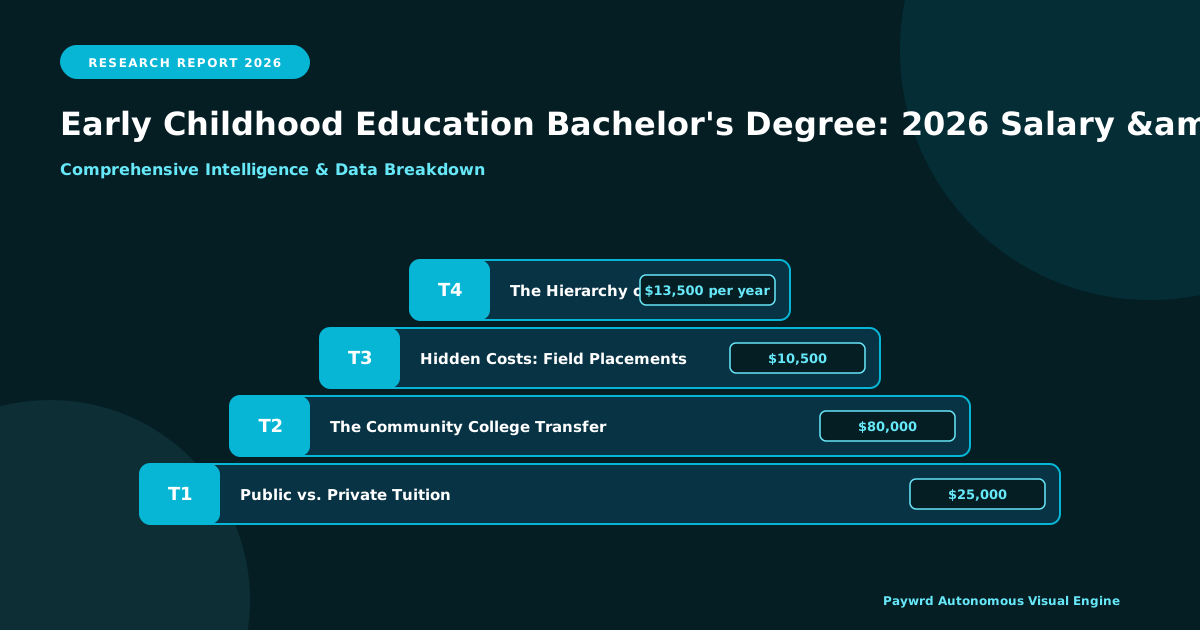
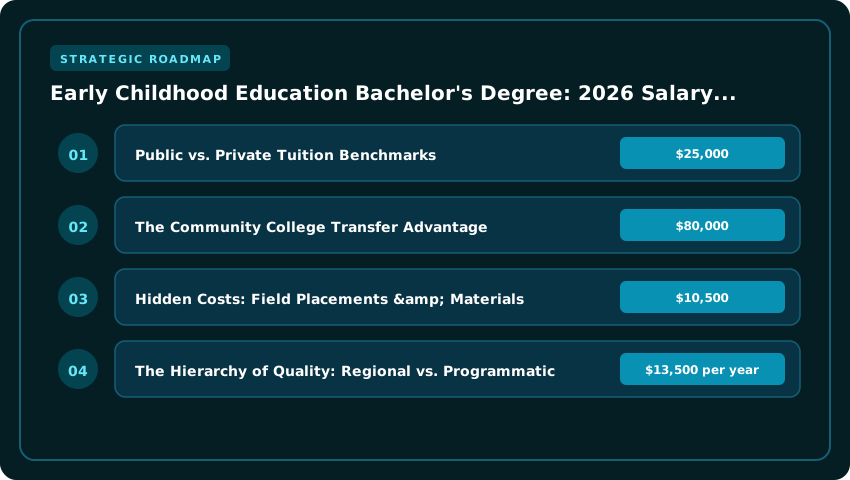
Let’s talk numbers, because understanding the true price tag is the first step toward graduating with minimal debt. For the 2026 academic year, the total cost of attendance for a Bachelor’s in Early Childhood Education (ECE) typically lands between $25,000 and $80,000. Where you fall on that spectrum depends almost entirely on institutional control—public versus private—and your residency status.
Public vs. Private Tuition Benchmarks
At a public four-year university, in-state students should budget roughly $10,500 to $13,500 per year for tuition and mandatory fees alone. Out-of-state students at those same institutions often face rates double or triple that amount, pushing annual tuition toward $28,000–$35,000. Private nonprofit colleges carry a higher sticker price, averaging $36,000 to $42,000 per year before institutional aid. However, don’t let the sticker price scare you; private schools frequently offer deeper merit-based discounting, sometimes bringing the net cost closer to public university levels.
The Community College Transfer Advantage
If you are coming from a community college with an Associate of Applied Science (AAS) or Associate of Arts (AA) in Early Childhood Education, you hold a powerful financial lever. Most articulation agreements allow you to transfer 60 credits—effectively half the degree. Completing your first two years at a community college (average tuition ~$3,800/year) and transferring to a public four-year program can slash your bachelor’s tuition bill by 40% to 50%. Always verify that your specific courses align with the receiving university’s programmatic requirements, not just general education, to avoid losing credits in transfer.
Hidden Costs: Field Placements & Materials
ECE programs carry unique “hidden” fees that general liberal arts degrees do not. Budget an additional $1,200 annually for textbooks and digital course materials, as specialized curricula and assessment manuals are pricey. Crucially, you must factor in field placement compliance costs:
- Background Checks & Fingerprinting: Required for every practicum site; budget $75–$150 per placement (often 2–3 placements total).
- TB Tests & Immunization Tracking: ~$50–$100 annually.
- Professional Liability Insurance: Often mandatory for student teachers; ~$25–$50 per year via student associations.
- Transportation: Unpaid travel to practicum sites 15–30 miles away adds up fast.
Funding Your Degree: Federal, State & Employer Dollars
Before taking loans, maximize “free money.” The Federal Pell Grant remains the bedrock for low-income students. The maximum award was $7,395 for the 2024–25 award year and is projected to rise to approximately $7,800 for 2026–27. Eligibility is determined solely by your FAFSA Student Aid Index (SAI); file the 2026–27 FAFSA the moment it opens (typically October 1, 2025) to lock in your share.
For those already working in the field, the T.E.A.C.H. Early Childhood® Scholarship program is a game-changer. Available in over 20 states (including major markets like Texas, Florida, Pennsylvania, and North Carolina), T.E.A.C.H. typically covers 80–90% of tuition and books, provides a travel stipend, and offers a raise or bonus upon completion in exchange for a commitment to stay at your sponsoring center for a set period (usually one year per year of scholarship).
Finally, investigate employer tuition reimbursement. Head Start and Early Head Start programs—federally funded and held to high staff qualification standards—are among the most generous employers. Data from the National Head Start Association indicates that over 70% of grantees offer tuition assistance, often covering $2,000–$5,000 annually for coursework leading to a bachelor’s degree. Ask your HR director specifically about “CDA-to-BA pathway funding” or “Section 648A staff development funds.”
Actionable Takeaway: Build a “Total Cost of Attendance” spreadsheet. List tuition (minus 60 transfer credits), fees, books ($1,200/yr), field placement compliance ($300–$500 total), and transport. Subtract projected Pell ($7,800), T.E.A.C.H. awards, and employer reimbursement. The remainder is your true funding gap—target that number with savings or federal direct loans only.
Accreditation Standards That Actually Matter: NAEYC, CAEP, and State Licensing Boards
If you take one piece of advice from this guide, let it be this: accreditation is not a bureaucratic checkbox—it is your career insurance policy. In the United States, the early childhood landscape is a patchwork of 50 distinct state licensing systems, and your degree’s pedigree determines whether you can teach in a public pre-K classroom in Texas, a Head Start center in Ohio, or a private academy in California without starting over.
The Hierarchy of Quality: Regional vs. Programmatic
Before you look at specialized stamps of approval, verify the bedrock: institutional regional accreditation (now often referred to as institutional accreditation by bodies like HLC, MSCHE, SACSCOC, WSCUC, NWCCU, or NECHE). This is non-negotiable. Without it, you cannot access federal financial aid (FAFSA), your credits will likely not transfer, and no state Department of Education will recognize your degree for initial licensure. Once that box is checked, you evaluate the programmatic layer.
- NAEYC Accreditation (The Gold Standard for Content): The National Association for the Education of Young Children accredits degree programs specifically for their adherence to the Professional Standards and Competencies for Early Childhood Educators. An NAEYC-accredited bachelor’s program guarantees rigorous coursework in child development theory (birth through age 8), developmentally appropriate practice (DAP), family engagement, and assessment. It signals to employers—especially Head Start and NAEYC-accredited centers—that you graduated from a program vetted for the specific nuances of early learning, not just generic elementary pedagogy.
- CAEP Recognition (The Licensure Gateway): The Council for the Accreditation of Educator Preparation (formerly NCATE/TEAC) accredits the entire educator preparation provider (EPP)—the college’s school of education. If your goal is a state teaching license (often required for public school pre-K through 3rd grade), CAEP accreditation is frequently the prerequisite for streamlined state approval. Many states have reciprocity agreements that hinge on the program holding CAEP status, making it significantly easier to move your license across state lines later.
State Licensing Boards: The Final Arbiter
Here is where theory meets reality: the state Department of Education holds the keys. A program can be NAEYC-accredited and CAEP-recognized, but if it hasn’t been approved by the specific state where you intend to teach, you cannot get licensed there. Always cross-reference the program’s “State Authorization” page against the target state’s list of approved educator preparation programs. Some states (like New York or California) have unique coursework mandates—such as specific workshops on autism, mandated reporter training, or English Language Learner (ELL) strategies—that an out-of-state program might not embed automatically.
Curriculum Non-Negotiables: What You Must See on the Transcript
Beyond the seals on the website, audit the curriculum map. A legitimate bachelor’s completion program for 2026 must include:
- Child Development Theory (Birth–Age 8): Deep coverage of cognitive, social-emotional, physical, and linguistic domains, including atypical development and neurodiversity.
- Curriculum Design & Assessment: Methods for integrated, play-based, and inquiry-driven curriculum across literacy, STEM, and the arts, aligned with state Early Learning Standards.
- Practicum Hours (100–200+ Clock Hours): Supervised field experiences in at least two distinct age groups (e.g., infants/toddlers and preschool/primary) before student teaching. These are distinct from student teaching and focus on observation and guided practice.
- Student Teaching (Clinical Practice): A full-time, semester-long (typically 12–16 weeks) immersion in a licensed setting (public pre-K, Kindergarten, or 1st–3rd grade) under a certified mentor teacher. This is the capstone requirement for state licensure.
Actionable Takeaway: Request the program’s “State Licensure Disclosure” and “Professional Licensure Determination” documents. If an admissions counselor cannot confirm that the curriculum meets the specific coursework and clock-hour requirements for your target state’s license, keep looking. The $15,000–$30,000 you save on tuition at a non-aligned program will cost you years in transcript evaluations and remedial coursework later.
2026 Salary Benchmarks: What Early Childhood Educators Actually Earn by State and Setting
If you have ever wondered whether an early childhood education degree actually moves the needle on your paycheck, the short answer is yes, sometimes dramatically. The long answer, however, depends heavily on where you work, who employs you, and how much credentialing you stack under your name. Drawing from the most recent Bureau of Labor Statistics (BLS) Occupational Employment and Wage Statistics release (May 2024), then projecting forward to the 2026 wage landscape using a conservative 2.4 percent annualized growth model, here is what early childhood educators actually take home in real dollars.
The three flagship roles inside this field still show clear stratification. Preschool teachers working in standalone centers reported a national median wage of $37,130 in 2024, which projects to roughly $38,880 by 2026 before adjusting for local cost-of-living premiums. Kindergarten teachers, almost universally employed by public school districts, posted a median of $63,670, climbing to approximately $66,730 by 2026 when district step-and-lane salary increases are factored in. Preschool and childcare center directors, the operations leaders who manage staff, licensing, and family engagement, earned $56,310 nationally in 2024, projecting to about $59,020 in 2026.
Geography reshapes these numbers in ways that surprise most students. In California, preschool teacher pay averages roughly $45,200, driven by the state’s Transitional Kindergarten expansion and Title 5 requirements; Massachusetts preschool teachers earn around $44,900, buoyed by Boston-area private and public-pre-K demand. In New York, preschool educators in New York City pull closer to $48,300, largely because of 3-K for All and unionized early childhood programs. Conversely, Mississippi preschool teachers average near $28,600, while Arkansas lands around $30,100. The headline gap of nearly $20,000 between California and Mississippi looks stark until you plug in a cost-of-living calculator, where the parity shrinks to roughly $5,000 in real purchasing power. Still, the nominal salary difference matters for loan repayment, retirement contributions, and the ability to save for a home.
The credential differential is where lifetime earnings truly diverge. A teacher entering the field with only a Child Development Associate (CDA) credential typically tops out between $28,000 and $33,000 nationally, even with a decade of experience. A candidate holding a Bachelor of Science in Early Childhood Education, especially one paired with a state teaching license, sees starting wages of $38,000 to $42,000 in the same market. Over a 30-year career, this compounds into $180,000 to $360,000 in additional cumulative earnings, depending on district step increases, master’s lane credits, and pension vesting. That range maps directly to the $15,000 to $25,000 annual advantage cited in most ROI analyses.
Setting matters just as much as geography. Public school district employment offers the most predictable wage growth, with structured salary schedules, defined-benefit pensions in many states, and strong health benefits. A kindergarten teacher in a suburban Texas district can move from $55,000 to $72,000 across ten years without changing employers. Private childcare centers, by contrast, frequently start teachers at $32,000 to $38,000, with raises tied to enrollment rather than tenure, and benefits packages that lean more heavily on voluntary plans. Head Start programs, federally funded and operated by local grantees, sit in the middle: starting pay around $40,500 for teachers with a bachelor’s, often with stronger benefits than private centers but less generous retirement than public districts.
For prospective students evaluating a four-year investment, the practical takeaway is this: target public school district roles or Head Start grantees whenever possible, pursue state licensure alongside your bachelor’s, and consider states like California, Washington, and New York if maximizing nominal salary is the priority. If lower cost-of-living and faster career advancement into director roles appeal more, look at emerging markets in the Southeast, where workforce shortages are pushing wage growth well above the national average heading into 2026.
Job Outlook Through 2032: Where the Real Demand Is and Where It’s Oversaturated
Let’s be honest about what the labor data actually shows, because headlines can be deceiving. According to the U.S. Bureau of Labor Statistics Occupational Outlook Handbook, preschool teachers are projected to see approximately 3% employment growth from 2022 through 2032, which translates to roughly 60,800 openings annually when you factor in replacements for workers who transfer occupations or exit the field entirely. Meanwhile, the broader childcare workers category, which includes assistant teachers, nannies, and daycare staff without a bachelor’s degree, is projected to decline by about 4% over the same decade. On the surface, this looks like a contradiction. It isn’t. The split reflects exactly what we’d expect when a profession matures: the floor rises while the ceiling stays open, and the workers who invested in a four-year credential separate themselves from those who didn’t.
Here’s the nuance most articles miss. The 4% decline in childcare worker roles isn’t because families need less care. It’s because credentialed teachers are absorbing roles that used to be filled by workers with only a Child Development Associate (CDA) credential or a high school diploma. States like Massachusetts, New Jersey, and Connecticut now require lead teachers in publicly funded pre-K classrooms to hold a bachelor’s degree, and that regulatory floor is reshaping the entire pipeline. Translation: if you’re earning your bachelor’s in Early Childhood Education (ECE) right now, you’re not competing for a shrinking pie. You’re being elevated into a tier that the market is actively building.
But not all specializations are created equal, and this is where strategic career planning really pays off. The following roles are showing the strongest demand signals through 2032:
- Early Intervention Specialists serving children from birth to age three under IDEA Part C, the federal mandate that funds services for infants and toddlers with developmental delays. With the CDC reporting that roughly 1 in 6 children has a developmental disability, and Part C programs chronically understaffed, this is one of the tightest labor markets in education.
- Bilingual Early Childhood Educators, particularly Spanish-English, who can serve dual language learners in states with large immigrant populations. Districts in Texas, California, Florida, and New York are offering signing bonuses and loan forgiveness specifically for bilingual ECE graduates.
- Special Education Inclusion Teachers working with children ages three through five under IDEA Part B, Section 619. Inclusive preschool classrooms require teachers who can hold both an ECE credential and special education competencies, a rare combination that commands premium pay.
- Infant-Toddler Care Specialists, a segment quietly booming because employer-sponsored childcare benefits (think Amazon, Google, and hospital systems) are creating demand for credentialed infant care that simply didn’t exist five years ago.
Geography matters enormously. Right now, six states have fully funded universal pre-K programs serving all four-year-olds regardless of income: Florida, Georgia, Illinois, Iowa, Oklahoma, and West Virginia. The District of Columbia also qualifies. Another four states have active universal pre-K legislation moving through their legislatures in 2025 and 2026, including New Mexico, Vermont, Colorado, and Minnesota, where bipartisan coalitions have put expansion bills on the table. If you’re willing to relocate, these are your highest-leverage job markets, and many of them are pairing expansion with teacher scholarship programs that can wipe out significant chunks of your student loan balance.
The other wildcard, and frankly the most exciting development I’ve seen in a decade, is how AI-driven assessment tools are transforming the day-to-day work of early childhood educators. Tools like Teaching Strategies Gold, COR Advantage, and emerging platforms using computer vision to analyze classroom interactions are generating more developmental data than any teacher could ever synthesize alone. This is creating an entirely new career track: the Early Childhood Data Coach, a specialist who helps teachers interpret assessment outputs, align interventions with screening results, and communicate progress to families in plain language. Universities like Wheelock College of Education at Boston University and Bank Street College of Education have started embedding data literacy modules into their ECE programs precisely because districts are beginning to budget for these roles. Median salaries for instructional coordinators and education coaches already sit around $66,000 to $74,000 annually, and the ECE-specific coaching track is tracking 8–12% higher than the general K–12 equivalent because the supply of qualified candidates is so thin.
So where’s it oversaturated? Honestly, generic lead teacher positions in saturated urban markets where multiple programs churn out graduates every May. If your degree says only “early childhood education” with no specialization, no bilingual endorsement, and no special education coursework, you’re walking into the most competitive slice of the market. The bachelor’s degree gets you in the door. The specialization gets you the salary bump, the signing bonus, and the schedule flexibility. Plan accordingly.
The Community College Transfer Pathway: Maximizing Credits and Cutting Debt by $30,000+
The 2+2 transfer model remains one of the most powerful—and most underutilized—financial strategies for earning a bachelor’s degree in Early Childhood Education. In this structure, a student completes roughly 60 semester credit hours of lower-division coursework at a community college, earning an associate degree along the way, and then transfers as a junior into a four-year institution to complete the remaining 60 credits of upper-division ECE coursework, including student teaching. When executed through an approved articulation agreement, this pathway can save students $30,000 to $45,000 in tuition, fees, and housing costs compared to four years at a public flagship university.
For Early Childhood Education majors specifically, the 2+2 model works exceptionally well because the first two years of any bachelor’s degree are dominated by general education courses that are standardized across institutions. Most transfer applicants complete the following lower-division requirements before moving on: English Composition I and II, College Algebra or Quantitative Reasoning, Introduction to Psychology, Introduction to Sociology, American or Texas Government, American History, Natural Science with lab, Humanities electives, Child Development (CDEC/CD 1350 series in Texas), Statistics, and Foundations of Education. These courses are universally accepted at accredited schools and rarely require re-taking at the receiving university.
- English Composition (6 credits) – Satisfies writing proficiency requirements and often doubles as a core curriculum requirement.
- Statistics (3 credits) – Critical for ECE assessment courses; usually taught as MATH 1342, PSYC 2317, or MATH 1325 depending on the school.
- Intro to Psychology (3 credits) – Counts as both a general education social science and an ECE program prerequisite.
- Child Development (3 credits) – Often TECA 1354 or CDEC 1356 in Texas; this is the most important course for ECE transfer students because it validates content knowledge before student teaching.
- Speech or Public Speaking (3 credits) – Recommended for early childhood educators who will lead parent conferences and presentations.
To verify transferability before enrolling, students should consult two key resources: College Board’s Transfer Credit Evaluator and the u.select articulation database (now operated by the National Student Clearinghouse). These tools allow prospective transfers to enter a planned community college course and instantly see how it will transfer to a specific receiving university. Many state systems also maintain their own transfer guarantee programs—Texas has the Field of Study curriculum for EC-6 Generalist, Florida has the Common Prerequisites, and California has ADT (Associate Degree for Transfer) guarantees through the ICAS system. In Texas specifically, the Core Curriculum is a 42-semester-credit-hour block that, once completed at any Texas public community college, transfers wholesale to any other Texas public university as fully satisfied general education credit.
Students pursuing this pathway must choose between two foundational associate degrees: the Associate of Arts (AA) and the Associate of Science in Teaching (AST). The AA is a broader liberal-arts degree that covers most general education requirements and is widely accepted at private and out-of-state universities. The AST, however, is specifically designed for education majors and includes additional pedagogy-focused coursework aligned to state teaching standards. For students committed to a Texas public university ECE program, the AST often provides the smoothest transfer because it is intentionally aligned with the lower-division requirements of bachelor of science in education programs.
Case Study — Maria, Houston Community College to University of Texas at Arlington: Maria enrolled at Houston Community College in Fall 2024 with a goal of becoming a bilingual early childhood educator. She completed the Texas Core Curriculum plus the Education Field of Study, earning her AST in May 2026 with zero out-of-pocket tuition through the Texas Education Grant and Pell Scholarship. Her 60 credits transferred in full to UTA’s Bachelor of Science in Interdisciplinary Studies with EC-6 certification. She graduated in May 2028 with $0 student loan debt and accepted a first-year teacher salary of $58,500 in Houston ISD. Her total cost-of-degree savings compared to a traditional four-year UT Austin path exceeded $38,000.
Finally, ambitious students should understand the Reverse Transfer Credit process, which awards an associate degree to a student who has already transferred to a four-year university but accumulates enough total credits (typically 90+ semester hours including transfer credits) to meet associate degree requirements. Programs like the Texas Reverse Transfer Initiative and similar programs in 12 other states allow ECE students to receive both an associate degree and a bachelor’s degree upon graduation. Holding both credentials strengthens a resume, satisfies future substitute-teaching qualifications, preserves a community college credential if the bachelor’s program is interrupted, and qualifies graduates for tuition reimbursement programs at community colleges nationwide.
Upskilling Beyond the Bachelor’s: Alternative Certification, Microcredentials, and Career Acceleration
Earning a Bachelor of Science or Bachelor of Arts in Early Childhood Education is a tremendous accomplishment, but in a field evolving as rapidly as 2026’s learning landscape, the diploma you receive at commencement is really just your professional launchpad. The educators commanding the highest respect, the strongest job security, and the most competitive salaries are the ones who treat their bachelor’s as a foundation rather than a finish line. Whether you are drawn to the rigor of a state-approved alternative certification track, the flexibility of a digital badge earned over a long weekend, or the long-term salary boost of a master’s degree, the post-baccalaureate ecosystem for early childhood educators has never been richer, more affordable, or more aligned with measurable career outcomes.
One of the most accessible accelerators is the alternative teaching certification pathway. Programs like Teach for America and state-level TROOPS (Teacher Residency Options for Other Pathways to Service) initiatives allow career-changers and recent graduates to enter high-need classrooms while completing their pedagogy coursework on an accelerated schedule. For early childhood educators specifically, TFA corps members placed in Pre-K and kindergarten settings often receive a $4,000 to $6,000 AmeriCorps education award, plus loan forbearance on federal student loans, which can soften the financial transition into the profession. State TROOPS alternatives, such as New York’s Transitional B pathway or California’s District Intern model, similarly combine paid classroom placement with evening and weekend university coursework, making them ideal for paraeducators already working in Head Start or public Pre-K programs who want to convert their experience into full state licensure without quitting their paycheck.
For educators interested in the instructional technology side of the field, Google Career Certificates in Education Technology have emerged as a surprisingly powerful credential. Priced at roughly $49 per month through Coursera, the certificate can be completed in three to six months and signals competency in learning management systems, assistive technology integration, and data-informed instructional design. Districts from Houston Independent School District to Miami-Dade County Public Schools now offer stipends of $1,200 to $2,500 for educators who earn the credential and apply it to classroom practice. When you stack that on top of a bachelor’s, you position yourself for hybrid roles such as instructional coach or technology integration specialist, which typically pay 8% to 14% more than a standard classroom position.
Specialized stackable credentials are another high-return investment. The Montessori Primary Diploma from an AMI-affiliated training center typically costs between $9,000 and $14,000 and adds an average of $7,500 to annual earnings at private and charter Montessori schools nationwide. The IB Educator Certificate in Primary Years Programme, offered through the International Baccalaureate Organization, runs about $4,200 and is increasingly required for lead teacher roles in IB World Schools, which tend to cluster in higher-cost metropolitan areas and offer correspondingly higher salaries. Both credentials are stackable, meaning you can earn one, work for a year or two, and then layer the next onto your resume without starting over.
For the most dramatic salary impact, however, nothing compares to adding a master’s degree or earning National Board Certification. In unionized districts governed by collective bargaining agreements in states like California, New York, Illinois, and Washington, a master’s degree plus a clear Credential or Professional Clear Administrative Services Credential typically bumps a teacher onto a higher salary column, translating to a $10,000 to $18,000 annual raise once you cross the threshold from bachelor’s to master’s lane. National Board Certification adds another layer, with most districts offering a $2,500 to $10,000 annual bonus, and a growing number of states, including North Carolina, Mississippi, and Louisiana, providing a state-level stipend on top. The time investment is real, often 200 to 400 hours of candidacy work, but the lifetime earnings differential consistently ranks National Board Certification among the highest-return professional credentials in K-12 education.
Finally, an ECE bachelor’s opens doors far beyond the traditional public school classroom. Corporate trainers at education technology companies like Curriculum Associates, Renaissance Learning, and Scholastic Education frequently come from ECE backgrounds and earn $72,000 to $95,000 in mid-career roles. Museum education specialists at institutions such as the Children’s Museum of Manhattan or the Smithsonian Early Enrichment Center blend curriculum design with public engagement, often requiring a bachelor’s plus a content-area credential. Pediatric hospital child life specialists, who support young patients and their families through medical experiences, increasingly prefer candidates with ECE degrees paired with the Association of Child Life Professionals’ Certified Child Life Specialist credential, a path that can push earnings above $70,000 within five years. Family advocacy roles within nonprofit organizations, court-appointed special advocate programs, and early intervention service coordinators similarly value the developmental expertise embedded in an ECE degree, often pairing it with a Child Development Associate (CDA) credential for added credibility.
The through-line across all of these pathways is intentionality. Each credential, certificate, and advanced degree is a deliberate investment in a specific professional direction, and the educators who treat their career as a portfolio of stackable competencies, rather than a single job title, consistently out-earn and out-influence their peers. Start by identifying the salary differential in your district’s collective bargaining agreement, research which microcredential aligns with your target role, and give yourself an eighteen-month runway to complete the work. Your future students, and your retirement account, will thank you.
| Pathway | Total Tuition Cost (2026) | Program Length | Admission Cut-Off | Starting Salary (2026) | 10-Year Career ROI |
|---|---|---|---|---|---|
| Community College (2+2 Transfer) | $10,000 – $25,000 | 4 years total | 2.5 GPA / Open enrollment | $36,000 – $42,000 | High (low debt) |
| In-State Public University | $40,000 – $60,000 | 4 years | 2.7 GPA + SAT/ACT | $38,000 – $45,000 | Moderate |
| Private University (On-Campus) | $100,000 – $160,000 | 4 years | 3.0 GPA + Essays | $40,000 – $48,000 | Low–Moderate |
| Online / Accelerated (WGU, SNHU) | $25,000 – $45,000 | 2.5–4 years | 2.0 GPA / No SAT | $37,000 – $44,000 | High (flexibility) |
| Tuition-Free / Employer Sponsored | $0 – $5,000 (fees) | 3–4 years | Employment-based | $38,000 – $46,000 | Very High |
Frequently Asked Questions
How much does a Bachelor's in Early Childhood Education cost in 2026?
Total 2026 attendance costs range from $25,000 to $80,000, depending on institution type. Community college 2+2 transfer programs average $10,000–$25,000, in-state public universities run $40,000–$60,000, while private universities can exceed $160,000 including room and board.
What salary can an Early Childhood Education graduate expect in 2026?
Entry-level ECE bachelor's graduates earn $36,000–$45,000 annually in 2026, with preschool teachers averaging $37,000 and kindergarten teachers closer to $45,000. Master's-credentialed educators in public schools can reach $55,000–$65,000 within five years of experience.
Is a Bachelor's in Early Childhood Education worth the debt in 2026?
Yes, for most students. The 2026 BLS projects 3% job growth for preschool teachers and steady demand for elementary educators. Community college pathways yield ROI above 150% over ten years, while private degrees often require 8–12 years to break even on tuition investment.
What are the admission requirements for ECE bachelor's programs in 2026?
Most 2026 ECE programs require a minimum 2.5 high school GPA, with competitive universities expecting 3.0+ and SAT scores above 1050. Transfer students need an associate degree with 60 credits. All candidates must pass a background check and complete fieldwork prerequisites before student teaching.
Strategic Final Takeaway
Success in evaluating Early Childhood Education Bachelor's Degree: 2026 Salary & Career Path relies on early preparation, adherence to verified accredited requirements, and cross-referencing official portals. Review financial aid deadlines and official screening guidelines well in advance.