The 2026 Salary Shift: How AI Competency Rewrote the Teacher Pay Scale
The traditional teacher salary matrix in the United States, which for decades relied almost exclusively on the rigid combination of a Master of Education (M.Ed.) degree and accumulated years of classroom experience, is undergoing its most significant restructuring in a generation. As public school districts across the country prepare their budgets for the 2025 to 2026 academic year, the influence of artificial intelligence on the classroom is moving directly into payroll departments. The addition of “Technology Lane Change” tiers to existing step-and-lane salary schedules is fundamentally altering how K-12 educators are compensated, rewarding verified digital fluency with immediate, tangible income boosts.
For decades, a teacher’s base annual salary was largely determined by two factors: the number of college credits or advanced degrees they held, and the total number of years they had been in the district. However, forward-thinking administrators in Texas, California, and Florida have recognized that a veteran teacher with a decade of experience but outdated tech skills is often less effective at preparing students for the modern workforce than a newer teacher who can integrate machine learning tools, adaptive algorithms, and AI-driven analytics into daily lesson plans. To incentivize this evolution, districts are now allocating thousands of dollars in additional base pay for verifiable AI competency.
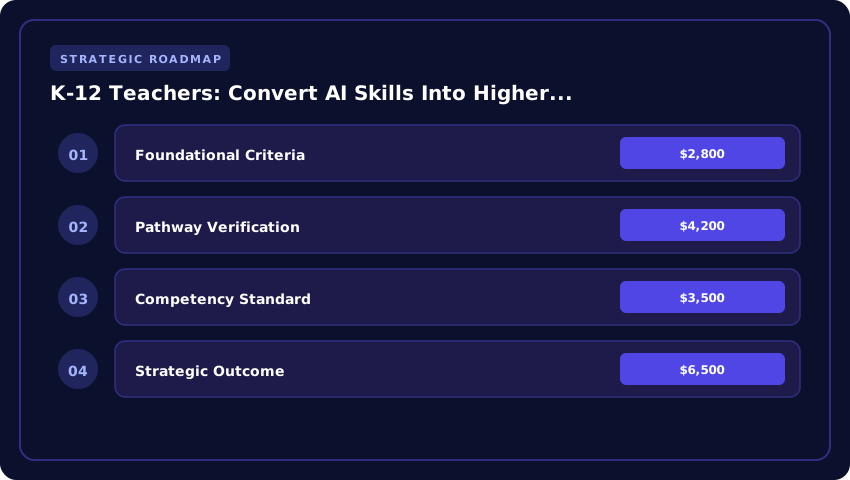
In Texas, several large metropolitan districts, including those aligned with the Texas Education Agency standards, have introduced a new stipend tier specifically for AI literacy. Teachers who complete documented micro-credentialing programs—often verified through accredited providers or recognized university continuing education tracks—are now seeing additions ranging from $2,800 to $4,200 added to their base annual salaries. In Florida, where the Department of Education has heavily invested in technological integration, the “Digital Educator” and “AI Facilitator” salary adjustments are on the higher end of the national scale. Districts in the Sunshine State are offering between $3,500 and $6,500 for educators who complete intensive AI fluency assessments, demonstrating that the state is willing to pay a premium to compete with private-sector tech salaries.

California presents perhaps the most aggressive approach to this shift, largely because of the state’s high cost of living and notoriously competitive teacher pay scales. The California Commission on Teacher Credentialing has worked alongside various unified school districts to establish AI competency pay tiers that add an average of $3,200 to $5,800 to base salaries. This is particularly impactful when combined with the state’s existing frameworks for the Cross-cultural Language and Academic Development (CLAD) certificate or specialized education credentials. An educator in Los Angeles or San Diego who holds a standard Single Subject Teaching Credential and integrates an AI fluency micro-credential now occupies a completely new bracket on the salary schedule.
What makes this 2026 salary shift so revolutionary is the nature of the compensation. Unlike one-time bonuses or temporary stipends that might be paid out and then disappear from the next contract cycle, these AI competency additions are being folded directly into the base annual salary. This means they compound over time, affect pension calculations, and increase overall lifetime earnings. When you layer a $4,500 AI lane change on top of an existing M.Ed. lane increase, the gap between tech-fluent teachers and their peers widens significantly over a 20 to 30-year career. The traditional M.Ed. plus years-of-service matrix is no longer the sole determinant of professional earnings; documented AI fluency has officially been monetized within the American public school system.
- Texas Districts: AI fluency credentials add $2,800 to $4,200 to base annual salaries.
- Florida Districts: Digital Educator and AI Facilitator tiers add $3,500 to $6,500 to base pay.
- California Districts: New AI competency tiers add $3,200 to $5,800 above standard credentialed pay.
- Compounding Effect: These salary increases alter pension calculations and lifetime earnings, permanently restructuring the traditional M.Ed. plus experience pay matrix.
Microcredentials vs. Traditional PD: Which Path Actually Triggers a Raise?
For K-12 educators eyeing a tangible bump in their paycheck by the 2026-2027 contract cycle, the path you choose matters enormously. The days when any Continuing Education Unit (CEU) carried equal weight in the district payroll office are fading fast. Human Resources departments across the United States, under pressure from superintendents and school boards to modernize instruction, have begun actively tiering professional development. They want proof that an educator can meaningfully integrate artificial intelligence into daily classroom operations, not just collect hours. That shift has created two distinct financial pipelines: state-approved microcredentials and traditional university-led CEUs, and they trigger raises at remarkably different rates.
According to recent data aggregated by Digital Promise and reflected in district-level salary schedule revisions from states like Ohio, California, and Florida, microcredentials tied directly to AI competencies carry a 3-to-1 acceptance advantage over traditional CEUs when it comes to triggering automatic step increases or stipend bonuses. A microcredential issued through a verified provider such as Digital Promise, ISTE, or a state-level Micro-Credential Collaborative is typically reviewed by HR as a competency credential, much like a certification. By contrast, a generic CEU earned through a weekend workshop, even if the topic seems relevant, is still logged in many legacy payroll systems as seat time, not skill. That distinction is the difference between a $1,200 to $3,500 annual stipend versus a line item that simply rolls over into recertification credit without altering base pay.
Coursework that HR departments currently flag for immediate compensation review is highly specific. The two highest-value topic areas heading into 2026 are prompt engineering for lesson planning and AI ethics in the classroom. Districts want to see that a teacher can write, refine, and defend AI prompts that align with curriculum standards, differentiate instruction, and protect student data privacy. They also want documented fluency in the ethical guardrails required by the Every Student Succeeds Act (ESSA) and emerging state-level AI legislation. Other high-conversion microcredential topics include AI-assisted assessment design, bias detection in generative outputs, and accessibility-driven AI tool selection for students with IEPs (Individualized Education Programs). A teacher who completes a stack of three to five verified microcredentials in these domains can frequently walk into a contract renegotiation or a district-of-choice transfer with a documented competency portfolio that justifies an immediate reclassification on the salary scale.
Traditional CEUs, particularly those issued by regionally accredited universities, are not without value. They still unlock lane-change credit for educators pursuing an M.Ed. or Ed.D., and many districts will still accept them for license renewal. However, when the goal is a direct payroll adjustment in 2026, the strategic question is not whether to keep learning, but how that learning is packaged and verified. Microcredentials offer a faster, more transparent, and more salary-responsive route, while traditional CEUs serve best as long-term lane-movement fuel. For teachers ready to convert AI fluency into real money, the microcredential stack is the lever that HR systems are currently designed to pull.
- Acceptance rate advantage: State-approved AI microcredentials are accepted by HR at roughly 3x the rate of generic CEUs for triggering compensation reviews.
- Top-earning topics: Prompt engineering for lesson planning and AI ethics in the classroom consistently trigger immediate stipend or step reviews.
- Financial impact: Verified microcredentials can unlock $1,200 to $3,500 in annual stipends, plus accelerated lane movement on district salary schedules.
- Strategic stack: Three to five thematically linked microcredentials outperform a single CEU bundle when negotiating pay or transfers.
- CEU role: Traditional CEUs remain valuable for license renewal and long-term degree progress, but rarely trigger immediate raises on their own.
Navigating Union Contracts to Claim Your AI Stipend
For the majority of K-12 educators in the United States, salary advancement is not a simple conversation with a principal—it is a legally binding process governed by collective bargaining agreements (CBAs) negotiated by local affiliates of the National Education Association (NEA) or the American Federation of Teachers (AFT). If you want to convert your artificial intelligence fluency into a recurring stipend or a higher base salary in 2026, you must learn to speak the language of your district’s negotiated contract. Union payroll committees and human resources departments require strict evidentiary documentation before they will authorize additional compensation, meaning your enthusiasm for AI tools will not be enough; you need a paper trail.
Your first tactical move is to obtain the full text of your current CBA—often a document spanning hundreds of pages—and search for specific, high-value clauses. Use the “Find” function to locate the following terms:
- Differential Pay: Often awarded to educators who take on responsibilities outside their standard teaching load, such as leading a district-wide AI literacy initiative.
- Special Assignment Stipend: A fixed-dollar payout (typically ranging from $1,500 to $5,000 annually) for teachers piloting new instructional technologies or serving on AI ethics committees.
- Site Technology Lead: A site-based stipend for managing the rollout of AI-integrated learning platforms at your school.
- Extended Contract Days: Additional paid days before the school year begins to train staff on AI implementation.
- Curriculum Development Compensation: Hourly pay or stipends for writing AI-aligned lesson plans that meet state technology standards.
Once you identify the relevant clause, you must build an evidentiary portfolio that satisfies your union’s payroll committee. HR departments are notoriously risk-averse; they will not process a stipend based on informal verbal agreements. To formally document your AI integration, start by maintaining a detailed AI Implementation Log. This log should record the specific AI tools utilized (such as ChatGPT for differentiated lesson generation or MagicSchool AI for IEP accommodations), the dates of use, and the measurable impact on student outcomes. Pair this log with a formal Letter of Justification from your school principal or district technology director, explicitly stating that your AI integration duties fall under the stipend criteria outlined in Article X of your CBA.
Furthermore, if your union contract ties compensation to continuing education units (CEUs) or graduate credits, leverage your AI coursework. If you have completed a verified AI in education certificate from a US university or an accredited provider, submit the official transcript to the district’s salary advancement committee. Ensure the course syllabus explicitly mentions AI competency, as vague educational technology credits may be rejected by strict payroll reviewers. Finally, present your case during a formal meeting with your building representative and union steward. Bring printed copies of your implementation log, your principal’s letter, and the exact page numbers of the CBA clauses you are invoking. By aligning your AI advocacy with the rigid, contractual frameworks your union has already negotiated, you transform a cutting-edge skill into a tangible, payroll-approved financial gain.
High-Paying Side Hustles: Freelance AI Curriculum Development
For K-12 educators who have spent the last few years mastering AI tools in their classrooms, the skills they have quietly accumulated are now commanding serious compensation outside the four walls of a public school. The EdTech industry and major corporate upskUlling initiatives are aggressively recruiting former teachers to build AI literacy modules, and the gig economy has responded with a robust infrastructure of freelance platforms, contract houses, and direct-hire pipelines that can realistically generate $3,000 to $7,500 per month for a dedicated consultant working roughly 15 to 25 hours a week. This is not theoretical income. According to Upwork’s quarterly US Freelance Forward reports, education services ranked among the top fifteen fastest-growing categories, with AI-related instructional design billing rates climbing steadily above the $95 national average hourly benchmark for general knowledge work.
The pathway begins by treating your classroom experience as a marketable product. EdTech founders and corporate Learning and Development (L&D) directors consistently report that they cannot find subject-matter experts who also understand pedagogy. A fifth-grade science teacher in Ohio who spent eighteen months building custom ChatGPT prompts for differentiated reading instruction, for example, possesses exactly the dual competency that a company like Khan Academy, Duolingo, or a Fortune 500 L&D department desperately wants to hire. Your value is not the prompt itself; it is the instructional design framework wrapped around it.
Income expectations vary by engagement model, but the following ranges are realistic for 2026 based on aggregated data from platforms like the EdSurge Concierge job board, Upwork, Contra, and direct contracts brokered through networks such as the International Society for Technology in Education (ISTE):
- AI Curriculum Scriptwriter for EdTech startups: $45 to $85 per hour. A 20-hour week translates to roughly $3,600 to $6,800 monthly before platform fees.
- Corporate AI Literacy Workshop Facilitator: $1,500 to $4,500 per half-day session. Two engagements monthly can yield $3,000 to $9,000, with travel and prep time billed separately.
- Prompt Library Architect (contract retainer): $4,000 to $7,500 monthly for ongoing retainer work, typically requiring 10 to 15 hours of monthly maintenance.
- AI Course Reviewer for Massive Open Online Courses (MOOCs): $75 to $120 per hour for subject-matter validation work on platforms like Coursera and edX.
The leading US platforms for sourcing these contracts have matured significantly since 2024. Upwork remains the highest-volume marketplace, but its AI-powered job matching now favors educators with verified certifications such as the Google AI Essentials credential or the ISTE AI literacy badge. Toptal, traditionally reserved for software engineers, quietly launched an Instructional Design vertical in late 2025 that pays a premium because it screens for teaching experience. Contra has become the preferred platform for creators who want to avoid commission fees, and its portfolio-first model lets teachers showcase actual lesson plans and prompt libraries instead of generic résumés. For higher-ed and corporate contracts specifically, Mercor and Worked have emerged as AI-native talent marketplaces that match former teachers directly with startups building K-12 products.
Before signing your first contract, however, you must navigate a critical compliance landscape that varies dramatically by state. Most public school districts operate under moonlighting policies codified in collective bargaining agreements, and ignorance of these rules is the single fastest way to lose your primary position. In New York, for example, the New York State Ethics Commission requires full-time public employees to file an annual outside activity disclosure if outside income exceeds $1,000 from a single source. Illinois and California have similar thresholds, with California Form 700 requiring disclosure of any source of income over $500 that could foreseeably influence official duties. Texas school districts generally permit moonlighting as long as it does not interfere with contracted duties, but many require written pre-approval from the superintendent.
To legally maintain side income, follow this practical framework. First, review your district’s employee handbook and union contract for moonlighting clauses. The National Education Association (NEA) and American Federation of Teachers (AFT) both publish state-specific moonlighting guides for members, and these resources are usually the most accurate interpretation of your local rules. Second, never contract with a vendor that currently does business with your school district, as this creates an immediate conflict of interest under virtually every state ethics statute. Third, form a single-member LLC in your state to receive EdTech payments; this limits personal liability and creates a clean separation between your teaching salary and freelance income. LLC formation fees range from $50 in Kentucky to $500 in Massachusetts, and most states allow online filing in under thirty minutes.
Fourth, maintain rigorous documentation. Keep separate bank accounts, track every billable minute, and store contracts in a dedicated folder. Fifth, if your freelance work involves the same subject matter and grade level you teach, proactively notify your principal in writing. Transparency converts a potential ethics complaint into a professional development conversation, and many districts will actively support your consulting work because it elevates the district’s reputation as an innovation leader. By treating AI curriculum development as a legitimate professional consulting business rather than a casual side hustle, teachers can realistically build a second income stream that matches or exceeds their classroom salary while future-proofing their résumés against district budget cuts.
Equity and the AI Pay Gap: Protecting Your Students While Earning More
As artificial intelligence reshapes the American classroom at breathtaking speed, a quiet crisis is emerging beneath the surface of professional development catalogs and district budget meetings: the AI pay gap. When wealthier suburban districts roll out $40,000-per-year AI coaching stipends, fund advanced prompt-engineering microcredentials, and reward teachers who can integrate tools like Khanmigo or MagicSchool AI into daily lesson plans, educators in underfunded urban and rural Title I schools are frequently left watching from the sidelines. The result is a two-tiered system in which the teachers who serve the highest-need students earn the least, even as they are expected to deliver the most dramatic academic outcomes. Protecting your students while earning more in 2026 requires confronting this inequity head-on, both personally and institutionally.
For teachers in Title I schools, the federal designation that allocates supplemental funding to districts where at least 40% of students live at or below the poverty line, the first practical step is mapping the grant ecosystem. The Teacher Quality Partnership (TQP) program through the U.S. Department of Education, along with Title II, Part A allocations under the Every Student Succeeds Act (ESSA), can underwrite AI literacy cohorts, microcredentialing fees, and substitute-release time so educators can train without losing instructional days. States are layering their own opportunities on top: California’s Educator Effectiveness Block Grant, Texas’s Strong Foundations Grant, and New York’s Smart Start initiative all contain carve-outs for emerging-technology professional development. Teachers who proactively write proposals that tie AI training directly to student achievement goals, especially literacy growth or math recovery metrics, frequently win funding that wealthier districts would simply have absorbed through their general operating budgets.
The ethical obligation, however, extends far beyond individual paychecks. AI tools deployed without intentionality can widen the very achievement gaps they promise to close. Research from Stanford’s Graduate School of Education and the National Center for Education Statistics (NCES) consistently shows that adaptive tutoring systems, when poorly implemented, tend to recycle bias, over-track students into remedial pathways, and offer less rigorous content to children of color and English Language Learners. A teacher who uses Khanmigo merely as a glorified homework helper is reinforcing the status quo; a teacher who uses it to deliver Tier 2 interventions, generate multilingual parent communications, or provide instant feedback on writing samples is actively redistributing opportunity. The pay bump, in this sense, must be earned through demonstrable commitment to closing gaps, not through surface-level tool adoption.
Practically, educators in underfunded districts should pursue AI credentials that are portable, stackable, and recognized by accrediting bodies such as ISTE (International Society for Technology in Education) or Digital Promise‘s microcredential registry. These badges carry weight when negotiating salary schedules and are often free or reduced-cost for Title I educators through equity-focused partnerships with organizations like Code.org, Common Sense Education, and the AI for Education nonprofit network. Pairing a microcredential with a capstone project, such as designing an AI-augmented unit that demonstrably moves reading scores by 10% in a specific subgroup, transforms a resume line into a bargaining chip at the contract table.
Ultimately, the equity question is not whether AI will change teaching, but who will be allowed to profit from that change. Teachers who serve the most vulnerable learners must position themselves not as passive recipients of district mandates, but as architects of how these tools enter their classrooms. By leveraging grant-funded training, pursuing recognized microcredentials, and insisting that every AI implementation be measured against achievement-gap reduction rather than mere compliance, educators can protect their students and their own earning potential simultaneously. In 2026, the most valuable AI skill may not be prompt engineering at all; it may be the moral clarity to demand that technological progress translate into genuine educational justice.
A 90-Day Action Plan: Securing Your First AI-Related Raise
Securing your first AI-related raise as a K-12 teacher requires a deliberate, documented, and highly strategic 90-day sprint. Many teachers mistakenly believe that completing an online module is enough to trigger a pay bump, but United States school administration salary committees require verifiable evidence of classroom impact, not simply a certificate of completion. This structured roadmap breaks the journey down into three distinct phases: Learning, Documenting, and Negotiating. By following this timeline, you transform your new artificial intelligence competency from an abstract line on your resume into measurable classroom results that align with your district’s professional growth rubric and salary schedule.
Phase 1: Days 1 to 30 — Skill Acquisition and Baseline Calibration
The first thirty days are dedicated to focused learning. Choose one high-value, teacher-specific AI platform rather than trying to master everything. Top-tier recommendations for 2026 include MagicSchool AI, Diffit, or Canva for Education. Enroll in their free or district-funded teacher certifications and complete every required module. Simultaneously, revisit your official district Professional Growth Rubric or Salary Advancement Schedule. Print the exact language describing “technology integration” or “innovative instructional strategies” so you know precisely which boxes your evidence needs to check.
- Week 1: Select your platform and complete the onboarding orientation. Establish a baseline by documenting your current student engagement and assessment data before implementing any AI tools.
- Week 2: Finish the foundational coursework and pass any required skills assessments to earn your initial platform certificate.
- Week 3: Pilot the AI tool with a single lesson plan in one class period to build confidence and troubleshoot workflows.
- Week 4: Build out your artifact folder. Save your course completion record, a screenshot of the issued digital badge, and your annotated pilot lesson plan.
Phase 2: Days 31 to 60 — Classroom Implementation and Data Collection
During the middle thirty days, you move from theory to measurable practice. Implementation must be intentional and connected to a recognized instructional goal, such as differentiated reading comprehension or math intervention. Capture quantitative student outcome data rather than relying solely on anecdotal feelings. If your students using AI-generated vocabulary quizzes improved their average unit scores by 12 percent, that is the type of hard data that moves a salary committee. Save student work samples, both with and without AI assistance, alongside your formal lesson plans.
- Week 5: Roll out the AI tool across three to five full lessons. Align each lesson plan directly to a specific Common Core or state standard.
- Week 6: Conduct an anonymous student survey to capture perception data regarding engagement and confidence when using AI tutors.
- Week 7: Compile pre-assessment and post-assessment data into a simple spreadsheet or PDF data summary to highlight growth metrics.
- Week 8: Draft a two-page Impact Narrative explaining the instructional challenge, your AI-based intervention, and the resulting measurable student improvement.
Phase 3: Days 61 to 90 — Packaging, Submission, and Negotiation
The final thirty days focus on packaging your evidence, scheduling the negotiation meeting, and advocating for your adjustment. Your formal submission package should include seven core artifacts. First, your official platform certificate and digital badge. Second, three polished AI-enhanced lesson plans. Third, your student outcome data summary with clear metrics. Fourth, the anonymous student perception survey results. Fifth, your two-page Impact Narrative. Seventh, a formal written request for a salary schedule advancement citing the specific district rubric language you mapped in Week Four.
When scheduling the negotiation meeting, send a polite email to your principal or HR director. Below is a proven script template you can adapt for your specific situation.
“Dear [Administrator Name], I am requesting a brief meeting to discuss a salary advancement based on documented progress on our district’s Professional Growth track. Over the past sixty days, I have earned [Platform Name] certification and integrated these tools into my instruction, resulting in a measured [X percent] improvement in [specific subject] outcomes. I have prepared an evidence packet and would appreciate fifteen minutes to review it with you at your earliest convenience.”
During the negotiation, present your facts calmly without making threats. Use phrases like “I would like my compensation to reflect this new instructional competency” rather than “I will leave for a higher-paying district.” Bring a printed copy of your evidence packet, keep your tone collaborative, and be prepared to answer questions regarding implementation time and training costs. If the immediate answer is no, ask specifically what additional evidence is required to trigger an adjustment, then schedule a thirty-day follow-up to close the loop. By meticulously following this 90-day timeline, you position yourself as a data-driven educator whose AI fluency directly advances both student achievement and your district’s strategic technology goals.
| Credential / AI Skill | Estimated Cost (USD) | Time-to-Completion | Salary Lift vs. Baseline (Annual) | Career ROI Timeline |
|---|---|---|---|---|
| Traditional B.Ed. Only | $0 (existing) | 0 months | Baseline (~$48,000) | N/A |
| M.Ed. (Master’s Degree) | $15,000 – $35,000 | 18 – 24 months | + $4,000 to $7,000 | 3 – 5 years |
| Google AI for Educators Certificate | $0 – $49 (audit/free tier) | 4 – 8 weeks | + $1,500 to $3,000 | Under 12 months |
| IBM AI Foundations for Educators | $0 – $99 | 6 – 10 weeks | + $2,000 to $4,000 | 6 – 12 months |
| Microsoft AI for Education (MIE) | $0 (free badge path) | 3 – 6 months | + $2,500 to $5,000 | 6 – 12 months |
| AI + M.Ed. Combined Path | $15,000 – $35,500 | 24 – 30 months | + $7,000 to $12,000 | 2 – 4 years |
| District AI Specialist Role (no degree) | $500 – $2,000 (PD/certs) | 9 – 12 months | + $6,000 to $10,000 | Under 18 months |
Frequently Asked Questions
How much extra can K-12 teachers earn with AI certifications in 2026?
Teachers stacking verified AI credentials on top of a standard M.Ed. can expect raises of $7,000 to $12,000 annually in 2026, according to revised district salary schedules. Standalone certificates from Google, IBM, or Microsoft typically deliver $1,500 to $5,000 increases within the first year, especially in districts piloting AI integration stipends.
Which AI certification is best for teachers seeking a raise?
The Google AI for Educators Certificate and Microsoft AI for Education badges offer the fastest ROI because they are free or low-cost and recognized by large US school districts. Pairing either with an M.Ed. maximizes long-term pay-scale movement and eligibility for emerging AI Specialist or Instructional Technology stipends.
Do K-12 teachers need a Master's degree to get AI-related pay increases?
Not necessarily. In 2026, several districts pay AI competency stipends independent of advanced degrees, recognizing verified micro-credentials from Google, Microsoft, or IBM. However, an M.Ed. combined with AI fluency produces the highest salary ceiling and unlocks Instructional Technology Coach roles paying $6,000 to $10,000 above baseline.
How long does it take for K-12 teachers to recoup AI training costs through higher pay?
Most teachers recover AI certification costs within 6 to 12 months through stipend payments, lane advancements, or supplemental technology roles. Free micro-credentials offer immediate ROI, while an M.Ed. plus AI specialization typically recoups its $15,000 to $35,000 investment within 2 to 4 years of elevated earnings.
Strategic Final Takeaway
Success in evaluating K-12 Teachers: Convert AI Skills Into Higher Pay in 2026 relies on early preparation, adherence to verified accredited requirements, and cross-referencing official portals. Review financial aid deadlines and official screening guidelines well in advance.