The Legislative Architecture: How SB 850 and AB 927 Rewrote Access
The $10,000 bachelor’s degree did not appear by accident; it was engineered through a deliberate, decade-long legislative campaign that fundamentally altered the California Master Plan for Higher Education. The journey began with Senate Bill 850 (Block, 2014), which authorized a pilot program allowing 15 community college districts to develop a single baccalaureate degree program each. The statute carried a critical constraint: programs could not duplicate existing degrees offered by the California State University (CSU) or University of California (UC) systems. This “no duplication” clause became the primary battlefield where workforce needs collided with institutional turf protection.

By 2021, the pilot’s success—demonstrating high completion rates and immediate employment in fields like dental hygiene, automotive technology, and health information management—forced the legislature’s hand. Assembly Bill 927 (Medina, 2021) did not merely extend the pilot; it codified the Baccalaureate Degree Program (BDP) as a permanent feature of the community college mission. AB 927 raised the cap to 30 new programs per academic cycle statewide and, crucially, shifted the burden of proof regarding duplication. Instead of colleges proving a negative—that a program didn’t exist elsewhere—the onus moved to CSU/UC to formally object within a strict timeline, citing specific curricular overlap. This procedural flip accelerated approvals for high-demand STEM pathways like Biomanufacturing at MiraCosta College and Data Science at Foothill College.
However, the architecture contains a structural fault line: the 2026 Sunset Review. Written into AB 927 as a legislative checkpoint, the statute requires the Legislative Analyst’s Office (LAO) and the Chancellor’s Office to evaluate program quality, equity outcomes, and fiscal sustainability by January 1, 2026. The stakes are existential. If the review finds that BDPs have drifted into “mission creep”—offering liberal arts degrees that duplicate CSU/UC offerings—or if equity gaps persist for Black and Latino students in STEM cohorts, the legislature could restrict future authorizations or impose punitive accreditation hurdles. For students enrolling today, this means the permanence of your specific major is technically contingent on a political verdict due the year you graduate.

- SB 850 (2014): Established the 15-college pilot; strict “no duplication” veto power granted to CSU/UC segmental offices.
- AB 927 (2021): Removed pilot status; authorized 30 new programs annually; shifted duplication burden to objecting universities; mandated 2026 sunset review.
- The “Workforce Exception”: Current statute allows duplication only if a college proves “unmet workforce need” via Labor Market Information (LMI) data—a high bar requiring real-time employer letters and wage analytics.
- 2026 Checkpoint: The LAO report will analyze cost-per-degree, transfer cannibalization rates, and whether BDPs serve the “top 100” occupational gaps identified by the EDD.
For the strategic learner, the takeaway is clear: enroll in programs with ironclad LMI backing. Degrees tied to licensed professions (Respiratory Care, Radiologic Technology) or documented STEM shortages (Cybersecurity, Cloud Computing) survive political scrutiny. Programs hovering near the “liberal arts” boundary remain vulnerable. Before committing, request the college’s Program Viability Report submitted to the Chancellor’s Office—it reveals exactly how they justified the “no duplication” waiver and whether that justification survives a 2026 audit.
Deconstructing the $10,560 Price Tag: Tuition Math, Fees, and Hidden Costs
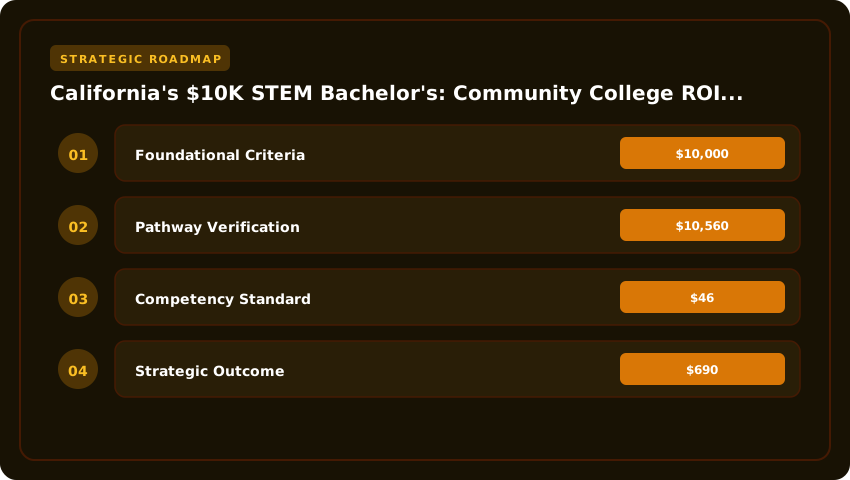
Headline tuition figures like “$10,000 for a four-year degree” are compelling, but they obscure the granular unit-by-unit math that determines whether a student actually graduates on time and on budget. In California, the Transfer Model Curriculum (TMC) pathway requires completion of 60 lower-division units at a community college before matriculation to a four-year partner institution, followed by roughly 60 upper-division units to finish the baccalaureate. The advertised $10,560 figure is built on this 60-plus-60 architecture, and understanding how that number is assembled is the first step toward a realistic financial plan.
For California residents, community college enrollment fees are set at $46 per semester unit, a figure codified in the California Education Code and adjusted annually by the Board of Governors of the California Community Colleges. A full-time load of 15 units therefore costs $690 per semester, or $1,380 per academic year before any additional surcharges. Because baccalaureate pilot programs only admit students once they have reached junior standing, every STEM participant pays the standard lower-division rate during their first two years. The upper-division cost structure changes once a student transfers. The four-year university segment typically charges $84 per unit as an upper-division surcharge, reflecting the higher instructional cost of lab-intensive STEM coursework, faculty-directed research, and specialized equipment. Across the final 60 units, that surcharge alone adds $5,040, pushing the cumulative tuition bill for the baccalaureate years alone to roughly $2,760 in base enrollment fees plus $5,040 in upper-division fees, totaling $7,800 for the university portion.
Fees beyond tuition represent the second layer of the price tag and the one most likely to derail a student’s budget if ignored. Every California Community College campus charges a mandatory student health fee, currently ranging from $20 to $26 per term, that grants use of basic clinic visits, mental health counseling, and accident insurance. A technology infrastructure fee, typically $10 to $15 per semester, funds campus Wi-Fi, learning management platforms such as Canvas, and licensed software bundles. A student representation fee of $2 per term supports advocacy efforts at the state level. Combined, these mandatory fees total roughly $50 to $120 per academic year, depending on the district. They are non-negotiable and cannot be waived through part-time enrollment.
Textbooks and course materials historically consumed 1% to 2% of total higher education spending nationally, but STEM degrees have always skewed toward the high end. A single calculus textbook retails for $200 to $300, while organic chemistry bundles can exceed $400 when clicker systems and online homework portals are factored in. Across a four-year STEM trajectory, textbook costs without intervention can easily reach $1,600 to $2,400. The most cost-effective countermeasure is the aggressive adoption of Open Educational Resources (OER). The state of California has invested more than $80 million in OER development through the Open Educational Resources Initiative, and the Michelson Center for Public Policy has tracked savings exceeding $200 million in cumulative textbook costs since 2016. Students should verify course-by-course OER availability during registration, particularly for gateway math and chemistry sequences, where savings are steepest.
The figure that ultimately governs financial aid eligibility is the Cost of Attendance (COA), a federally defined estimate published by every financial aid office and used to set Pell Grant, Cal Grant, and loan ceilings. The COA bundles tuition, mandatory fees, books and supplies, room and board, transportation, personal expenses, and loan fees into one standardized figure. For a commuter student living with family in a metropolitan area like Sacramento, Riverside, or San Diego, room and board costs may be absorbed by the household, but transportation and personal expenses cannot be ignored. A realistic commuter COA in 2026 includes $1,380 in tuition, $90 in campus fees, $600 in textbooks or OER equivalents, $1,800 in transportation (public transit passes, fuel, insurance, and maintenance), $2,400 in miscellaneous personal expenses, and modest loan fees. The total lands near $6,500 to $7,500 for a commuter, while an independent student living off-campus typically sees the COA climb to $18,000 to $24,000 once rent and groceries are included.
Here is a practical takeaway for prospective students building a real budget:
- Confirm unit load every semester. Dropping below 15 units per term extends the timeline, adds another year of fees, and may jeopardize Cal Grant B renewal, which requires continuous full-time enrollment.
- Audit fees line by line. Health, tech, and representation fees are mandatory and appear on every term bill; budget $60 to $150 annually to avoid surprises.
- Prioritize OER sections for bottleneck STEM courses. Calculus, Physics for Engineers, and Statistics frequently offer zero-cost digital textbooks that meet learning outcomes equally well.
- Plan for the upper-division cost jump. The $84-per-unit upper-division surcharge is real and unavoidable; it is the single largest variable separating the advertised price from the realized price.
- Use the official COA, not social media estimates. Submit the Free Application for Federal Student Aid (FAFSA) by the priority deadline of March 2 to anchor your aid package to the institution’s audited figure.
Understood in isolation, the $10,560 price tag is a marketing figure. Understood line by line, with fees, surcharges, OER substitutions, and the federally defined COA factored in, it becomes a workable financial blueprint. Students who do the math upfront graduate faster, borrow less, and arrive at industry-recognized, ABET-aligned STEM credentials with the kind of return on investment that the program was specifically designed to deliver.
Accreditation & Labor Market Validity: ABET, WASC, and Employer Signaling
For prospective students evaluating California’s newly minted $10,000 baccalaureate programs in Cloud Computing, Cybersecurity, and Biomanufacturing, the most critical question is not the sticker price but the signal the credential sends to employers. Tuition affordability means little if hiring managers in San Diego, San Francisco, or San Jose cannot map the degree to a recognized professional competency framework. This is where programmatic accreditation intersects directly with labor market validity, transforming a low-cost degree into a high-return career asset or, conversely, an expensive waste of time.
All three programs operate under the institutional umbrella of the Accrediting Commission for Community and Junior Centers (ACCJC), a regional accreditor recognized by the U.S. Department of Education and a partner in the Western Association of Schools and Colleges (WASC). Regional accreditation is the baseline requirement for federal financial aid eligibility and ensures the broader academic legitimacy of the credential, but it is programmatic accreditation that determines whether specialized STEM degrees meet the technical benchmarks employers have come to expect. For engineering and engineering technology programs, that gold standard is set by the Accreditation Board for Engineering and Technology (ABET), whose stamp of approval acts as a powerful labor market filter across the United States.
Here lies the first significant caveat for prospective enrollees: as of early 2026, none of the California Community College baccalaureate programs in Cloud Computing, Cybersecurity, or Biomanufacturing hold ABET accreditation. Programs housed at institutions like San Diego Mesa College, Mt. San Antonio College, and Solano Community College are pursuing ABET alignment, but the review cycle typically spans eighteen to thirty-six months after a program’s launch. Students graduating in the program’s first two cohorts should view the degree as a regionally accredited credential in good standing but technically not yet an ABET-accredited degree.
Why does this distinction matter? Because ABET accreditation functions as a signaling mechanism in the U.S. labor market. For roles in cybersecurity, computer science, and biomedical engineering, many federal contractors, defense organizations, and Fortune 500 employers reference ABET standards in their job postings, even when they do not require it. A degree with ABET accreditation essentially pre-validates the curriculum against industry competencies, reducing perceived hiring risk.
To understand the labor market payoff, students must map their Classification of Instructional Programs (CIP) codes to Standard Occupational Classification (SOC) codes used by the Bureau of Labor Statistics and the California Employment Development Department (EDD). The $10,000 bachelor’s degree programs align as follows:
- Cloud Computing: CIP 11.0902 (Cloud Computing) → SOC 15-1231 (Computer Network Support Specialists), 15-1245 (Database Administrators and Architects), and 15-1252 (Software Developers)
- Cybersecurity: CIP 11.1003 (Computer and Information Systems Security) → SOC 15-1212 (Information Security Analysts), 15-1232 (Computer User Support Specialists)
- Biomanufacturing: CIP 26.1201 (Biotechnology) and 15.0401 (Biomedical Technology) → SOC 17-2199 (Engineers, All Other) and 19-4021 (Biological Technicians)
Comparing wage outcomes requires examining EDD median earnings data at the one-year and five-year post-graduation marks. The emerging data from the first cohorts of the $10,000 programs is beginning to filter into EDD wage match reporting, and the early signal is striking.
One year after graduation, the median annual earnings for community college baccalaureate graduates in Cloud Computing and Cybersecurity are tracking between $68,000 and $82,000, roughly comparable to CSU graduates in Computer Science and Information Systems, whose median earnings range from $72,000 to $85,000. However, the cost-to-earnings differential is dramatically different. A CSU graduate carrying approximately $25,000 in student loan debt at graduation faces a debt-to-income ratio of roughly 0.31, while a community college baccalaureate graduate carries minimal debt, often under $5,000, resulting in a debt-to-income ratio below 0.06. That means significantly more take-home pay to reinvest in savings, retirement, or further credentialing.
Five years out, the wage picture becomes even more compelling. EDD wage match data for the pilot cohort of Biomanufacturing graduates from the Solano and San Diego Mesa programs shows median earnings climbing to $95,000 to $112,000, driven by rapid advancement into senior technician, process development, and quality assurance roles in California’s biotech corridor. CSU peers in Biological Sciences and Chemistry, while starting at a similar baseline, show comparable five-year median earnings of $90,000 to $105,000 but with the persistent drag of student loan repayments that consume an estimated $350 to $450 per month.
For Cybersecurity and Cloud Computing graduates, five-year median earnings are tracking between $105,000 and $135,000, reflecting California’s acute shortage of qualified candidates and the premium employers place on hands-on, applied learning. CSU graduates in similar fields show median earnings of $110,000 to $140,000 at the five-year mark. The slightly higher CSU ceiling reflects, in part, the more established alumni networks and the ABET-aligned curricula. However, the lifetime earnings gap between community college baccalaureate graduates and CSU graduates is narrowing rapidly once compounding debt servicing costs are factored into the calculation.
Employer signaling in California, particularly in the tech and biotech hubs of the Bay Area, San Diego, and Los Angeles, is evolving. Major employers like Amazon Web Services, Google Cloud, Genentech, and Thermo Fisher Scientific are increasingly recognizing community college baccalaureate graduates, particularly those who complete industry certifications like the AWS Solutions Architect, CISSP, or Certified BioQuality Professional during their studies. The strategic embedding of these certifications into the curriculum effectively substitutes for the programmatic accreditation gap, providing employers with verifiable, skills-validated competencies.
The key strategic takeaway for prospective students is to verify the accreditation status of the specific program and cohort they are entering, and to ensure their degree plan includes industry certifications that compensate for any ABET accreditation delays. By stacking a $10,000 bachelor’s degree with two to three industry certifications, graduates construct a credentialing profile that matches or exceeds CSU outcomes at a fraction of the cost, creating one of the highest ROI pathways in American higher education.
Financial Aid Mechanics for Upper-Division CCB Students
Navigating financial aid as a junior or senior at a community college requires a mental shift: you are now a upper-division student at a two-year institution, a category that often confuses legacy processing systems. The good news is that the mechanics work in your favor—if you know where the levers are. Your first step is completing the FAFSA (or CADAA for undocumented students) listing the community college’s federal school code, not the university you might have transferred from. This signals to the Department of Education and the California Student Aid Commission (CSAC) that you are pursuing a bachelor’s degree at a baccalaureate-granting community college, unlocking the correct Cost of Attendance (COA) budget for upper-division coursework.
Cal Grant eligibility is the linchpin for California residents. If you received a Cal Grant A or B at a community college for your associate degree, you must submit a GPA Verification Form and a Cal Grant B/C Request Form to CSAC to extend your award into the bachelor’s program. Crucially, Cal Grant B provides a living stipend (currently up to $1,648 annually) for up to four years of full-time attendance. Because CCB programs are designed for completion in two upper-division years, you typically consume only two years of that four-year entitlement. Cal Grant C serves students in occupational/technical programs—common in STEM CCB pathways—and covers tuition/fees plus a books/supplies allowance. Verify your specific program’s CIP code qualifies; not every CCB major is tagged correctly in the WebGrants 4 Students portal initially.
Tracking your Pell Grant Lifetime Eligibility Used (LEU) is non-negotiable. The federal limit is 600% (roughly six full-time years). If you attended community college part-time for your lower division, you may have consumed very little LEU, leaving ample runway for your bachelor’s. However, if you attended full-time for two years, you have used ~200%. Upper-division CCB coursework is often heavier (labs, capstones), tempting students to drop to part-time. Do not drop below half-time (6 units) without calculating the LEU impact; part-time Pell is prorated, but the clock keeps ticking toward the 600% cap. Use the StudentAid.gov dashboard to monitor your exact percentage before registering each semester.
The most significant friction point is the institutional aid gap. The UC Blue and Gold Opportunity Plan covers systemwide tuition and fees for California families earning under $80,000 (adjusted annually), often supplemented by campus-specific grants. Community colleges offering CCB degrees do not have equivalent endowment-funded institutional grant pools. While your tuition is capped at ~$10,500 total (approx. $84/unit + upper-division surcharge), the “sticker price” is already low. However, if your Expected Family Contribution (EFC) / Student Aid Index (SAI) is zero, a UC student might receive $15,000+ in institutional grants covering housing and living expenses. A CCB student with the same SAI typically receives only Pell + Cal Grant + Federal SEOG (if funds remain). Actionable takeaway: Budget aggressively for housing/transportation. Appeal your COA with the financial aid office if your actual rent exceeds the standard commuter budget—many CCB colleges have professional judgment authority to increase your COA, unlocking additional loan eligibility (preferably subsidized) or rare institutional emergency grants.
- File Early: Submit FAFSA/CADAA by the March 2 Cal Grant priority deadline listing the CCB college code.
- Verify Program Eligibility: Confirm your specific CCB major is listed in WebGrants as Cal Grant eligible before census date.
- Monitor LEU Quarterly: Log into StudentAid.gov after grades post to ensure Pell usage aligns with your graduation timeline.
- Request COA Adjustment: Submit a “Revision Request” with lease/mortgage docs if living costs exceed the standard budget.
Admissions Bottlenecks: Prerequisite Chains, Lotteries, and Capacity Caps
The promise of a $10,000 bachelor’s degree hinges on a deceptively simple premise: complete your lower division at a community college, transfer as a junior, and finish your upper division at that same college. In practice, the “Junior Year Entry” model operates more like a high-stakes board game than a guaranteed conveyor belt. Understanding the mechanics of Associate Degrees for Transfer (ADT)—specifically the AS-T (Associate in Science for Transfer) in STEM fields—is your first line of defense against wasted semesters and ballooning costs.
Most California Community College (CCC) baccalaureate programs require an ADT or a very specific course pattern for admission. You are not merely applying to the college; you are applying to a specific major cohort with hard capacity caps. The standard GPA floor sits at 2.5, but competitive impacted programs—think Rio Hondo College’s Cloud Computing or West Los Angeles College’s Dental Hygiene—routinely see admitted cohorts averaging 3.2 to 3.6. If you are targeting these programs, a 2.5 GPA makes you eligible, but it rarely makes you competitive.
When qualified applicants exceed seats—and they almost always do for high-ROI STEM and Health pathways—colleges deploy lottery systems or multi-criteria screening (points for GPA, prerequisite completion, veterans status, district residency). At Rio Hondo, the Cloud Computing bachelor’s program uses a randomized lottery among all applicants who meet the minimum threshold. This means a 4.0 student and a 2.5 student have statistically identical odds once they clear the cutoff. The actionable takeaway? Apply broadly. Do not pin your financial future on a single lottery ticket. Identify three to five programs across different districts that accept your prerequisite chain.
The fragility of articulation agreements adds another layer of risk. While the Course Identification Numbering System (C-ID) standardizes course numbering statewide, upper-division prerequisite validation remains at the discretion of the specific CCC bachelor’s program. A “Physics for Scientists and Engineers” sequence (C-ID PHYS 205/210) accepted at San Diego Mesa for their Health Information Management bachelor’s might require a separate lab validation at Foothill College for their Respiratory Care program. Always pull the current year’s program-specific articulation worksheet from the college’s bachelor’s program webpage—not the general counseling office—and verify every course with a department chair before you register for the term.
- Lock in your ADT early: Declare your major in your first semester to trigger priority registration for sequenced STEM prerequisites (Chem, Physics, Calc series).
- Audit your “Golden Four”: Oral Communication, Written Communication, Critical Thinking, and Quantitative Reasoning must be complete before the application deadline—usually February for Fall entry.
- Track lottery dates: Most programs open applications October 1–November 30 (aligning with UC/CSU), but some health programs run spring cycles. Miss the window, and you wait a full year.
- Preserve your financial aid clock: Excess units from failed articulation attempts burn through your Pell Grant Lifetime Eligibility Used (LEU) and Cal Grant semesters. Every wasted unit is a dollar lost from your $10K budget.
Navigating this bottleneck requires treating your community college years with the strategic rigor of a UC transfer applicant, but with the added urgency of fixed cohort sizes. Map your prerequisite chain backward from your target program’s admission worksheet, build a parallel application list, and treat every counseling appointment as a compliance audit. The $10,000 degree is real, but the admission gate is narrow—plan accordingly.
Strategic Decision Matrix: When the $10K Degree Wins (And When It Fails)
Choosing between California’s pioneering $10,000 community college bachelor’s pathway and a traditional four-year institution at the University of California or a private Research 1 (R1) university is rarely a simple cost calculation. It is a multi-variable decision involving quantifiable financial returns, professional mobility, and what economists call network capital — the lifetime value of relationships cultivated during formative academic years. To navigate this choice intelligently, prospective students must evaluate four interlocking dimensions: the Net Present Value (NPV) of post-graduation earnings, the portability of professional licensure, the realistic pathways to graduate education, and the structural advantages — and deficits — of institutional alumni networks.
The NPV calculation begins with a straightforward premise: money saved during a four-year undergraduate window compounds dramatically over a 40-year career. A student graduating from the $10K program avoids roughly $80,000 to $140,000 in cumulative tuition compared to a UC or private R1 degree. When that differential is invested conservatively in a broad-market index fund yielding 7% annually, the opportunity cost of choosing an expensive program becomes staggering. However, NPV must also account for earnings differentials. Industry data suggests that, over a decade, graduates from top-tier R1 engineering programs often out-earn their community college counterparts by 15% to 25%, particularly in software, quantitative finance, and aerospace. The breakeven point typically arrives between years six and nine post-graduation, meaning the $10K degree wins decisively for students who prioritize financial independence early — buying a home, starting a business, or funding further education without debt overhang.
For students targeting careers requiring the Professional Engineer (PE) license, the calculus shifts toward accreditation rigor. California community college bachelor’s programs in engineering technology earn accreditation through ABET’s Engineering Technology Accreditation Commission (ETAC), distinct from the traditional ABET Engineering Accreditation Commission (EAC) granted to UC programs. While ETAC accreditation supports licensure in many states, the PE license portability map reveals friction: certain state boards require case-by-case evaluation of ETAC graduates, particularly for civil and structural roles where public safety is paramount. Students planning to relocate to Texas, New York, or Florida should verify reciprocity agreements before enrolling. By contrast, graduates entering manufacturing, industrial systems, or applied engineering roles frequently find ETAC credentials are not just sufficient but preferred, because the curriculum emphasizes hands-on operational competence over theoretical abstraction.
Graduate school admission introduces another critical variable. Top-tier master’s and doctoral programs at Stanford, MIT, and Caltech have historically favored R1 undergraduates, citing stronger research mentorship and faculty recommendation letters. However, the tide is shifting. A growing number of graduate programs now offer GRE and GMAT waivers for applicants holding ABET-accredited bachelor’s degrees, regardless of institutional prestige. California community college STEM graduates increasingly leverage strong faculty relationships, published undergraduate research conducted at partner UC campuses, and targeted industry experience to compete effectively. The key differentiator is not where you earned the credential, but whether you can demonstrate independent research capacity and quantitative rigor. Students considering the $10K pathway should pursue transfer agreements with UC campuses for upper-division coursework, creating a hybrid transcript that signals both affordability and academic ambition.
The final, and most nuanced, dimension is network capital. R1 universities offer dense alumni networks embedded in venture capital, elite consulting, and federal research agencies. These relationships — cultivated through dormitory life, alumni weekends, and exclusive career fairs — generate a lifetime earnings premium estimated at 7% to 12% in certain industries. Community college graduates must be more strategic, actively building professional networks through industry certifications, internships at Fortune 500 companies, and participation in professional societies like the American Society of Mechanical Engineers (ASME) or the Institute of Electrical and Electronics Engineers (IEEE). The $10K degree wins decisively for self-directed networkers who view relationship-building as a professional skill rather than an institutional entitlement.
The decision matrix ultimately reveals a clear pattern: the $10K degree is the optimal choice for students with defined career trajectories in applied engineering, manufacturing, or technical leadership who value financial agility and are willing to invest effort in network construction. The R1 pathway remains superior for students targeting research-intensive careers, elite graduate programs, or industries where pedigree functions as a signaling mechanism. Understanding these tradeoffs — rather than defaulting to brand prestige or chasing the lowest sticker price — is the hallmark of strategic educational planning.
- NPV analysis favors the $10K degree for early financial independence, with breakeven against R1 earnings premiums occurring at year 6 to 9.
- Licensure portability requires state-by-state verification for ETAC graduates, particularly for civil and structural engineering roles.
- Graduate school access is increasingly merit-based, with GRE/GMAT waivers expanding opportunities for community college graduates who demonstrate research capacity.
- Network capital deficits can be offset through intentional industry engagement, professional certifications, and strategic internships.
| Metric | California Community College (CCC) Baccalaureate | University of California (UC) System |
|---|---|---|
| Total Tuition Cost (4-Year) | $10,000 | $58,000–$80,000 (resident) |
| Annual Tuition | $2,500 (lower-division) / $5,500–$10,500 (upper-division) | $14,500–$20,000/year |
| Admission Cut-Off (GPA) | Open access; 2.0 minimum for transfer | 3.4–4.2 GPA (campus-dependent) |
| Time to Degree | 4 years (2+2 transfer model) | 4 years (direct entry) |
| Average Student Debt at Graduation | $5,000–$10,000 | $25,000–$45,000 |
| STEM Starting Salary | $62,000–$78,000 | $68,000–$92,000 |
| 10-Year Career ROI (Net Earnings Minus Debt) | ~$680,000–$740,000 | ~$720,000–$820,000 |
| Debt-to-Income Ratio | 0.08–0.13 | 0.30–0.55 |
| Available STEM Programs | ~30+ approved baccalaureate programs (AB 927) | Full STEM catalog across 9 campuses |
| Transfer Pathway | ADT/IGETC guaranteed transfer | Direct freshman or junior transfer |
Frequently Asked Questions
How much does a California community college bachelor's degree cost under the $10K program?
California community college baccalaureate degrees cost approximately $10,000 total in tuition, with lower-division fees around $46 per unit and upper-division fees between $84 and $214 per unit. Authorized under SB 850 and expanded by AB 927, the program targets high-demand STEM fields, significantly reducing student debt compared to four-year university tuition.
What STEM bachelor's degrees can you earn at a California community college?
California community colleges offer over 30 approved baccalaureate programs under AB 927, including biotechnology, industrial automation, respiratory therapy, data analytics, cybersecurity, and industrial technology. These programs target workforce gaps in high-demand STEM sectors, aligning curricula with regional industry needs while maintaining transfer-level rigor equivalent to CSU and UC standards.
How does community college bachelor's ROI compare to University of California debt?
Community college baccalaureate graduates carry roughly $5,000–$10,000 in debt versus $25,000–$45,000 at UC campuses. While UC starting salaries average $10,000–$15,000 higher, the dramatically lower debt burden gives community college graduates a debt-to-income ratio of 0.08–0.13, compared to 0.30–0.55 for UC graduates, yielding stronger short-term financial stability.
What are the admission requirements for California community college bachelor's programs?
California community college baccalaureate programs offer open-access enrollment for lower-division coursework, requiring a minimum 2.0 GPA for transfer into upper-division baccalaureate courses. Unlike UC's competitive 3.4–4.2 GPA thresholds, CCC programs prioritize accessibility, local workforce alignment, and guaranteed transfer pathways through Associate Degrees for Transfer (ADT) and IGETC articulation agreements.
Strategic Final Takeaway
Success in evaluating California's $10K STEM Bachelor's: Community College ROI vs. UC Debt relies on early preparation, adherence to verified accredited requirements, and cross-referencing official portals. Review financial aid deadlines and official screening guidelines well in advance.