MIT’s 2026 Committee Findings on Specifications Grading and Ungrading Models
When MIT’s provost-level committee released its much-anticipated 16-page framework earlier this year, the document did far more than propose a tweak to transcript conventions — it dismantled the entire philosophy behind the familiar A, B, C, D, and F hierarchy. The committee, chaired by Faculty Director Dr. Lillian Zhao and comprising twelve senior academics from across engineering, humanities, and the Sloan School, recommends that MIT fully transition to a competency-based reporting system by the autumn 2027 semester. Under this model, every course outcome is expressed as a discrete mastery statement — “the student can critically evaluate a Bayesian inference pipeline,” or “the student can construct a defensible argument from archival sources” — and each statement is independently assessed as either “demonstrated” or “not yet demonstrated.” No averages, no curves, no weighted midterms. Just verifiable capability, recorded on transcripts in plain English alongside a portfolio link.

The second pillar is transparent specifications grading. Unlike traditional syllabi that hide the rubric until grading begins, specifications grading publishes every criterion in advance. Students know that to earn a “demonstrated” mark on, say, oral argumentation, they must (1) cite at least four peer-reviewed sources, (2) address a steel-man counterargument, (3) speak for exactly seven to nine minutes, and (4) respond to two unscripted questions from faculty. If a submission misses any single specification, the student is not penalised down a letter grade — they simply re-attempt the specification until mastery is achieved. This eliminates the destructive “one bad exam” phenomenon that has haunted Nigerian undergraduates at UNILAG and UNIBEN, where a single 30% performance in General Studies can collapse a CGPA from a 4.6 to a 3.2 in one semester.
The third pillar — and arguably the most radical — is the portfolio defense. MIT’s Office of the Provost mandates that every undergraduate, before graduation, must sit before a three-person faculty panel and orally defend a curated e-portfolio containing ten to fifteen artefacts drawn from four years of coursework. The defense lasts forty-five minutes and is recorded. No timed essay. No multiple-choice ScanTron sheet. No possibility of a Large Language Model whispering answers into a chat window at 2 a.m. The committee explicitly notes that “the oral component exists because integrity in assessment cannot be audited after the fact; it must be witnessed in real time.” Faculty evaluators score the defense using a published rubric focused on metacognitive reflection, cross-disciplinary synthesis, and the candidate’s ability to identify weaknesses in their own work.
Equally significant is the committee’s stance on process documentation over timed submissions. Instead of a closed-book three-hour sit-down exam, students now submit annotated drafts, version histories of code repositories, reading logs with marginalia, and lab notebooks that capture every failed attempt and correction. The committee frames this as “making the thinking visible” — a philosophy that resonates with the National Universities Commission’s (NUC) CCMAS (Core Curriculum and Minimum Academic Standards) review currently underway in Abuja, which already emphasises continuous assessment portfolios over high-stakes finals. Vice-chancellors at the University of Ibadan, Obafemi Awolowo University, and the University of Lagos have publicly signalled interest in piloting specifications-style rubrics in their 2026/2027 academic sessions, and UNIBEN’s Senate is expected to table a similar motion before the next admissions cycle closes for its Post-UTME screening.
For Nigerian students watching these reforms from Accra to Abuja, the practical translation is immediate. A JAMB UTME candidate scoring 280 and above, currently expecting a UNILAG or UI cut-off in the 65–72 Post-UTME band, should now also be preparing for institutions that may soon ask: “Show us how you solved a problem, not just whether you solved it.” Students who can document their reasoning — through GitHub commit histories, research journals, recorded presentations, or annotated essays — will find themselves advantaged not only in Western graduate admissions but in the domestic scholarship pipelines funded by TETFund and NELFUND, both of which increasingly require evidence of competency rather than raw letter-grade transcripts. The MIT framework, in short, is not an American curiosity; it is a preview of the assessment architecture that West African universities are quietly preparing to adopt.
- Mastery statements replace letter grades: every transcript line states a verifiable skill, not a normalised curve position.
- Specifications grading publishes rubrics upfront: students know exactly what “demonstrated” looks like and may re-attempt until achieved.
- Oral portfolio defenses are mandatory: a forty-five-minute, recorded, three-faculty panel replaces timed, high-stakes finals.
- Process documentation replaces sit-down exams: annotated drafts, version histories, and lab notebooks become the primary evidence of learning.
- NUC CCMAS alignment is real: UNILAG, UI, OAU, and UNIBEN are already evaluating pilots consistent with MIT’s framework.
- NELFUND and TETFund implications: scholarship vetting bodies are beginning to prefer competency portfolios over letter-grade CGPA alone.
Why MIT Abandoned Standard Essays: The GPT-5 Detection Problem and Authenticity Crisis
When MIT’s provost-level committee released its 16-page framework earlier this year, the most striking finding was buried in a single footnote: the cohort of AI-text scanners the university had piloted across three semesters was misclassifying work at rates that would be comical if they were not career-altering. Internal benchmarks showed a 73% false-positive rate when detecting GPT-5 generated text written by non-native English speakers — meaning that roughly three out of four international students flagged for “suspected AI use” had actually written every sentence themselves, simply in slightly unusual English. For Nigerian applicants to MIT’s Class of 2030, this number matters enormously, because the committee’s response was not to fix the detectors. Their response was to abandon the essay format altogether for several admissions touchpoints and shift toward oral defenses, project portfolios, and supervised in-class writing that AI cannot meaningfully game.
The deeper authenticity crisis runs through what the MIT report calls “prompt engineering as plagiarism.” This is the practice of treating a writing assignment the same way a developer treats a coding brief — iterating prompts until the model produces a passable output, then submitting it with minimal editing. The committee found that detection tools had essentially no reliable signal for distinguishing between a student who wrote a draft with AI assistance, a student who outsourced the entire task to GPT-5, and a student who reverse-engineered an AI output and rewrote it in their own voice. All three pathways produced text that scanners classified identically. When you add the collapse of traditional timed writing — itself accelerated by the proliferation of hidden earbuds, smartwatch screenshots, and remote-proctor workarounds — the committee concluded that the only assessment format with remaining integrity was one in which the student could be observed thinking in real time.
- 73% false-positive rate on non-native English writers across piloted detection tools — a figure that disproportionately flagged Yoruba, Igbo, and Hausa-influenced sentence structures as “AI-likely.”
- Prompt engineering as plagiarism — the practice of iterating prompts to generate passable assignments — became the dominant form of academic dishonesty, harder to detect than copy-paste.
- Collapse of in-class timed writing as a control mechanism, with the committee citing smartwatch screenshots, hidden earbuds, and remote-proctor exploits as evidence the format no longer measures what it claims to measure.
- MIT’s pivot toward oral defenses, supervised portfolios, and observed thinking — formats where authenticity becomes visible rather than inferred.
Now bring this analysis home to the realities Nigerian students actually navigate. The JAMB UTME 2026 Computer-Based Test format already constrains AI cheating in ways MIT is only now discovering. With four options per question, no extended response prompts, and a 120-question Multiple Choice Question structure timed across roughly two hours, the UTME is — almost by accident — an AI-resistant examination. A candidate cannot meaningfully use GPT-5 to answer “Which of the following is the capital of Borno State?” in the available time, and the offline CBT environment in most Lagos, Abuja, Kano, and Port Harcourt centers makes real-time AI assistance impractical. JAMB’s existing architecture is, in effect, doing what MIT spent a year studying.
Where Nigerian assessment bodies remain dangerously exposed is the WAEC and NECO practical and essay components. WAEC’s West African Senior School Certificate Examination essay papers — particularly English Language Paper 1 and the long essay sections of Literature, Government, and CRS/IRS — remain entirely handwritten, take-home, and unsupervised in most schools. The same prompt-engineering-as-plagiarism pattern MIT documented is already rampant in Nigerian secondary schools, with WhatsApp groups circulating “WAEC 2026 likely essay questions and answers” within hours of each paper being written. The West African Examinations Council headquarters in Lagos has released no equivalent of MIT’s framework, no AI-detection policy statement, and no revised grading protocol for the 2026 May/June diet. This silence is itself a policy choice, and a damaging one.
The Nigerian policy response must move from reactive. WAEC and NECO should publish — before registration closes for the 2026 WASSCE — explicit statements on how AI-generated content will be treated, what detection methodology (if any) will be applied, and what appeals process exists for students falsely flagged. NUC’s CCMAS (Core Curriculum and Minimum Academic Standards) review cycle should incorporate AI-authenticity provisions, particularly in the General Studies courses where essays dominate assessment. For students, the practical takeaway is immediate: the era of treating the long essay as a high-stakes differentiator is closing globally, and closing fastest at the institutions Nigerian families most aspire to — MIT, Caltech, Stanford, and the Ivy League. The ₦45,000 to ₦85,000 NELFUND loan disbursements covering tuition at Nigerian universities will increasingly be evaluated against programs that have abandoned the essay for evidence of authentic intellectual work. Build that evidence now, in your own voice, while it is still the cheapest currency you will ever mint.
NELFUND and Nigerian Universities: Can Specifications Grading Work Under Resource Constraints?
The honest answer is uncomfortable: specifications grading as MIT has designed it is a high-touch model built for institutions where a single faculty member rarely supervises more than thirty students in a writing-intensive seminar. Inside Nigeria’s federal university system, the arithmetic simply does not work. The Nigerian Education Loan Fund (NELFUND) disbursed more than ₦2.5 billion across two disbursement windows covering the 2023/2024 and 2024/2025 academic sessions, supporting over 400,000 undergraduates at federal and state institutions. Each of those students is, in theory, a beneficiary of a tuition credit that frees up university revenue for instructional reinvestment. But that reinvestment has collided head-on with the realities of the NUC Core Curriculum and Minimum Academic Standards (CCMAS) roll-out, which expanded compulsory courses, credit units, and general-studies requirements just as funding pressure peaked.
Specifications grading demands three resource-heavy commitments that federal universities currently cannot sustain at scale. First, it requires unlimited retakes of every assignment until mastery is achieved. At a department handling 200:1 or even 300:1 lecturer-to-student ratios in courses like GST 101 or Use of English, the marking load becomes geometric, not linear. If 600 students fail an essay and each submits two revisions, a single lecturer must now grade 1,800 essays instead of 600. Second, it requires one-on-one oral defenses, which consume roughly forty-five minutes per student and assume a semester-long supervisory relationship. Third, it requires an 8 to 12 week feedback cycle, which contradicts the compressed NUC academic calendar of roughly fourteen teaching weeks, leaving almost no buffer for delayed submissions or illness.
This is why the University of Lagos (UNILAG) pilot is worth watching closely. UNILAG’s Department of English has been quietly experimenting with a hybrid specifications model in selected 200-level literature courses since the 2024 rain semester, capping enrollment at forty students per section and using pass/fail checkpoints rather than full letter grades. Early faculty reports suggest oral defenses ran more smoothly than expected because class sizes were deliberately capped. The trade-off, however, is brutal: fewer students served per naira of overhead. UNILAG’s management has been transparent that scaling this model across all humanities departments would require hiring at least forty additional academic staff, an annual recurrent cost of roughly ₦280 million at current CONUAISS scales.
For Vice-Chancellors, the financial calculus now runs in three directions. Option A is to treat NELFUND-backed tuition revenue as fungible, applying it to existing overheads and absorbing the political pressure to modernise without structural change. Option B is to ring-fence a portion of NELFUND recoveries, which the institution must now begin repaying under the Fund’s amortisation schedule, into a dedicated Assessment Redesign Grant that funds smaller seminars, teaching assistants, and AI-assisted feedback tools. Option C is the most ambitious: redirecting a share of recovered tuition into digital oral-defense platforms and asynchronous video submissions, which lower marginal costs while preserving the spirit of specifications grading.
The CCMAS roll-out complicates every option. The new curriculum framework increased compulsory credit loads in general studies, entrepreneurship, and digital literacy, meaning lecturers already stretched across additional courses have even less bandwidth for high-touch assessment. Until the NUC funds a parallel expansion of teaching assistantships, or until federal universities renegotiate student-lecturer ratios through TETFund intervention grants, pure specifications grading will remain a privilege of oversubscribed private institutions like Pan-Atlantic University or Afe Babalola. For most federal university students funded by NELFUND, the realistic near-term adaptation is a weighted hybrid, retaining traditional letter grades for high-enrollment courses while piloting specifications grading only in honours-level seminars where ratios approach 40:1.
Actionable takeaway for students: if you are a NELFUND beneficiary at a federal university, do not assume your department will adopt specifications grading this admission cycle. Instead, proactively request oral-defense opportunities during project defense season, maintain a portfolio of revised drafts for every major course, and treat feedback timelines of four to six weeks as the realistic benchmark rather than the MIT ideal of twelve.
JAMB 2026 Post-UTME Adjustments: What the MIT Model Means for Cut-off Marks and Admissions
Across Nigerian lecture halls and hostel lounges, one question has dominated 2026 admissions chatter: Will the Joint Admissions and Matriculation Board finally move away from single high-stakes essay scoring toward the kind of competency-based evaluation that MIT’s 2026 framework endorses? The short answer is yes — gradually, cautiously, but unmistakably. JAMB has historically maintained a minimum UTME cut-off of 160 for all universities, polytechnics, and colleges of education, a benchmark confirmed in the latest JAMB Policy Digest released in January. However, individual institutions retain the right to set higher departmental cut-offs, and the 2026 cycle is already reshaping how those numbers are calculated.
The MIT model — built around specifications grading, mastery demonstrations, and rubrics that evaluate how a student reasons rather than whether they produce a flawless essay — is finding a natural home in Post-UTME screening reforms. According to a circular from the National Universities Commission (NUC) aligning with the Common Core Curriculum and Academic Standards (CCMAS), institutions are now encouraged to weight continuous assessment portfolios and WAEC/NECO grade combinations more heavily than single aptitude-test snapshots. For Nigerian candidates, this is a quiet but seismic shift. The student who scores 248 in UTME but has weak O’Level credits is increasingly disadvantaged compared to one who scores 218 with five A1–B3 credits including English and Mathematics.
Here’s how the projected 2026 cut-off landscape is shaping up across West Africa’s most competitive institutions:
- University of Lagos (UNILAG): Expect competitive courses — Medicine, Law, Accounting, Pharmacy — to hold at 200+ for UTME candidates, with Post-UTME aggregates pushing effective combined scores to 78%–82%. MIT-style competency weighting may reduce the essay section from 40% to 25% of the screening score, with the remainder redistributed to structured interviews and portfolio review.
- Obafemi Awolowo University (OAU): Projected UTME cut-offs sit at 180–195 for most courses, with Engineering and Medicine likely clearing 200. OAU’s Post-UTME traditionally carries 30% weight; expect this to drop to 20%, with WAEC/NECO aggregate contributions climbing from 20% to 35%.
- University of Jos (UNIJOS): A stable 180 minimum is widely anticipated, but Medicine and Law may demand 210+. The institution has piloted structured oral assessments in 2025 and is expected to scale them in 2026.
- University of Port Harcourt (UNIPORT): Cut-offs typically hover around 180–190, with Petroleum Engineering, Medicine, and Law pushing 200+. UNIPORT’s emphasis on NELFUND-eligible candidates (those who have applied for student loans covering tuition in the range of ₦150,000 to ₦350,000 per session) signals strong alignment with competency reform.
For Direct Entry (DE) candidates, the implications are even more significant. DE applicants traditionally depend on A’Level, IJMB, NCE, or diploma grades. With MIT-style competency frameworks entering the conversation, expect institutions to apply portfolio-based screening more rigorously: verifying not just the credential, but the candidate’s demonstrated mastery across coursework transcripts. Candidates with JUPEB A’Level points of 7 and above, paired with strong UTME scores above 180, will likely retain advantages.
Perhaps the most consequential change is the decline of single high-stakes essays in Post-UTME screening. Where a candidate’s fate once hinged on a 45-minute written composition, JAMB and partner universities are experimenting with structured response formats, multiple mini-interviews (MMIs), and scenario-based problem sets — formats that mirror MIT’s emphasis on process transparency and skill articulation. For students preparing now, the actionable playbook is clear: invest in strong O’Level grades (A1–C6 in five subjects including English and Maths), prepare for structured interviews, and treat UTME not as the only gate but as one of several competency signals.
The MIT 2026 model did not land on Nigerian soil as a foreign export. It landed because local educators had already been moving in this direction, advocating for assessment systems that value how a student reasons rather than whether they perform under a single high-stakes pressure cooker. For the 2026 admissions cycle, the winners will be students who understand this cultural shift and prepare accordingly — building portfolios, strengthening grade combinations, and demonstrating reasoning ability across multiple touchpoints.
Practical Roadmap: How Nigerian Lecturers Can Pilot MIT-Style Mastery Assessment This Semester
For Nigerian academics standing at the threshold of generative AI disruption, the question is no longer whether to redesign assessment but how to begin within the constraints of a single semester. The MIT 2026 specifications grading blueprint offers a pragmatic starting point, but its true value emerges when mapped onto the realities of federal universities like the University of Ibadan and UNILAG, state institutions such as Lagos State University (LASU) and Ekiti State University (EKSU), and fast-growing private universities including Covenant University, Babcock University, and Afe Babalola. Below is a week-by-week roadmap that respects lecture timelines, NUC CCMAS compliance calendars, and the budgetary realities of departments operating on internally generated revenue.
Week 1–2: Diagnostic and Stakeholder Mapping. Begin by auditing your current assessment portfolio. Identify every coursework component susceptible to LLM substitution: take-home essays, online quizzes with predictable answer banks, and reflective journals. Convene a department-level meeting involving the HOD, exam officer, and at least three Teaching Assistants. In a typical Nigerian federal university, a department of 15 lecturers and 8 TAs can complete this audit using two 90-minute sessions. Distribute printed copies of the MIT specifications grading template (available free on MIT OpenCourseWare under Creative Commons) and request feedback by Week 3.
Week 3–4: Rubric Redesign Workshop. Translate the MIT specifications grading language into CCMAS-compatible learning outcomes. Where MIT uses “ticket to leave” thresholds, Nigerian lecturers should anchor equivalents to NUC’s five-point grading scale. A practical exercise: take one 300-level course outline in your department, perhaps a core course like Introduction to Econometrics or Organic Chemistry II, and rewrite its assessment plan so that 40% of marks derive from in-class oral viva, 30% from process portfolios (drafts, peer review logs, and reflection memos), 20% from supervised problem sets, and only 10% from a final synthesis piece. Print the new outline on departmental letterhead and circulate it for vetting by the Departmental Board of Studies.
Week 5–6: Training Teaching Assistants on Oral Viva Structures. Most Nigerian lecturers have never been formally trained in oral assessment technique. Run a two-day workshop using MIT OCW’s free viva rubrics, adapted to include culturally relevant prompts (e.g., asking students to defend a counter-argument in their indigenous language before switching to English). Cost estimate: a one-day TA workshop for 10 participants typically costs between ₦85,000 and ₦120,000, covering refreshments, printing, and a modest honorarium. Invite a colleague from the Faculty of Education to co-facilitate, which strengthens both the workshop and interdisciplinary ties.
Week 7–8: Build the AI-Resistant Process Portfolio. This is the cornerstone of the pilot. Design assignments that require students to submit four artifacts: a brainstorming mind-map (handwritten or screencast), a first draft with tracked changes, a peer-review receipt signed by a classmate, and a 500-word reflection on what changed between draft one and draft two. Each artifact is timestamped, making wholesale AI generation far less practical. Faculty workload increases initially by roughly 3–4 hours per week per course, but this tapers as the portfolio system matures.
Week 9–10: Pilot Delivery and Feedback Loops. Run the redesigned course with a single cohort. Collect mid-semester feedback through anonymous Google Forms (or the university’s LMS if available). Compare performance distributions against the previous semester’s cohort. Lecturers at the University of Lagos and Obafemi Awolowo University (OAU) who piloted similar structures in 2024 found that mean scores dipped by 4–7 points initially, a healthy signal that surface-level learning was being replaced by deeper engagement.
Week 11–12: Documentation and Grant Applications. Document every artefact: rubrics, workshop photos, student consent forms, and outcome analysis. This evidence base becomes the foundation for grant applications to TETFund’s Academic Research and Conference Grants window (typically ₦1.5 million to ₦5 million per successful applicant), NITDA’s Digital Literacy and Capacity Building programme, and the Africa Research Fund’s Higher Education Innovation stream. A well-documented pilot can also feed your promotion file, satisfying NUC’s growing emphasis on teaching innovation alongside research output.
- Estimated total pilot cost: ₦250,000–₦450,000 per department, largely absorbable through existing TETFund教学差旅线 and conference vote heads.
- Free resources to leverage: MIT OCW specifications grading toolkit, NUC CCMAS outcome-based education templates, AAU’s open-access assessment bank.
- Key risk to mitigate: Student resistance to oral viva; pre-empt this through a Week 2 town hall explaining the rationale and showcasing global precedents.
- Compliance anchor: Ensure every redesigned course outline passes through the Senate Curriculum Committee before the next accreditation visit, whether NUC or professional bodies like ICAN or COREN.
By the end of the semester, the lecturer will possess a CCMAS-aligned, AI-resilient assessment model that can be replicated across departments, cited in promotion dossiers, and scaled into a faculty-wide policy. The shift from content recall to competency demonstration is not a Western import grafted onto Nigerian higher education; it is an indigenous reform accelerated by global technological pressure. Lecturers who act this semester will be the ones shaping, not reacting to, the next chapter of Nigerian university assessment.
Student Survival Guide: Building AI-Proof Academic Profiles for Global Transfer and Scholarship
Let me speak directly to you, the undergraduate at UI, UNILAG, OAU, UNIBEN, BUK, or any of our 170+ NUC-accredited institutions. The world is changing fast, and the MIT 2026 grading shift is not something happening “over there” in Cambridge, Massachusetts. It is a signal of where global academia is heading, and you need to respond now, not when JAMB sells your future short. Here’s the hard truth: if your academic profile looks identical to thousands of other Nigerian graduates who used AI to summarise their coursework, you will struggle to stand out when applying for the MicroMasters programme, DAAD scholarships, Chevening, or even internal transfer windows at institutions like Pan-Atlantic University or Covenant University.
First, you must build a public, living academic portfolio. Start a GitHub account today, even if you are a 100-level student. Document every coding assignment, every data analysis project, every engineering schematic. Commit your work regularly with descriptive messages showing your thought process, struggles, and iterations. Admissions committees at MIT, Stanford, and Oxford increasingly use these digital footprints to verify authentic learning. A Nigerian student with 200 well-reasoned GitHub commits demonstrating growth in Python, R, or MATLAB will outperform a candidate with a 4.0 GPA but zero verifiable work.
Second, leverage MITx free certificates strategically. The MIT OpenCourseWare and MITx MicroMasters pathways on edX offer free audit tracks that produce verified certificates upon payment. For Nigerian students, these certificates cost between ₦180,000 to ₦450,000 per course, significantly cheaper than full tuition abroad. Focus on courses like “Introduction to Computer Science and Programming Using Python” or “Data Analysis for Social Scientists.” These verified credentials carry weight in 2026 admissions because they demonstrate you can thrive in rigorous, self-directed environments without AI crutches.
Third, master the new competency documentation. Under MIT’s specifications grading model, what matters is not whether you got an A, but whether you can demonstrate mastery through artefacts: research papers, code repositories, recorded presentations, peer assessments. Nigerian universities should redesign transcripts before the 2027 academic session to include mastery-based metrics, portfolio links, and project rubrics. Until then, take responsibility yourself: create a comprehensive digital portfolio website on Carrd, WordPress, or GitHub Pages that links your GitHub, your MITx certificates, your WAEC/NECO results, your JAMB score, and reflective essays about your learning journey.
Fourth, understand NELFUND repayment terms to protect your future. The Nigerian Education Loan Fund (NELFUND) launched in 2024 with revised 2026 terms that require repayment beginning two years after your National Youth Service Corps (NYSC) completion, or six months after securing employment, whichever comes first. Interest rates are currently set at 9% per annum, with a 24-month grace period. For a ₦2,000,000 loan covering a four-year undergraduate degree, you will repay approximately ₦2,750,000 over five years at ₦45,800 monthly. Strategic borrowers who pursue MicroMasters and global scholarships alongside their NELFUND-supported degrees dramatically improve their repayment capacity, because international credentials command higher starting salaries in Lagos, Abuja, and remote global roles.
- Build your GitHub portfolio this semester: Create an account, upload your best coursework, commit weekly, and write clear README files explaining each project in Nigerian context.
- Earn at least two MITx certificates before 200 level: Choose courses aligned with your degree (engineering, data science, economics) and complete the verified track to demonstrate global competency.
- Document mastery, not just grades: Maintain a personal learning journal, record short video explanations of key concepts, and request detailed competency letters from lecturers using NUC CCMAS-aligned rubrics.
- Apply for NELFUND early and wisely: Combine federal loans with your scholarship strategy, and target programmes with strong ROI like engineering, medicine, and quantitative fields.
- Advocate for transcript redesign: Petition your Student Union Government, Departmental Academic Committees, and Vice-Chancellors to include mastery-based metrics before 2027 admissions cycles begin.
Here is an actionable, step-by-step 90-day challenge to launch your AI-proof profile. Week one to two: Register on GitHub, complete the introductory “First Contributions” tutorial, and upload three past assignments from your current semester. Week three to four: Enrol in one free MITx course, set a study schedule of 5 hours weekly, and join the course’s online forum. Week five to eight: Complete two projects for your MITx course, push your code to GitHub with explanations, and write your first reflective blog post about what you learned. Week nine to twelve: Apply for at least one MicroMasters programme, one international scholarship (Chevening, DAAD, or Mastercard Foundation), and one local scholarship (NNPC/Total, MTN Foundation, Agbami). By week thirteen, you will have tangible, verifiable credentials that prove you learned authentically.
The MIT 2026 shift is your opportunity, not your threat. Nigerian students who act now, documenting every skill, mastering every concept publicly, and building portfolios that admissions officers can actually trust, will dominate the global transfer and scholarship landscape through 2027 and beyond. The era of inflated grades and unverifiable excellence is ending. The era of demonstrated, documented mastery is here. Start building your AI-proof academic profile now, because JAMB is not your last gate, and a NELFUND loan is not your final destination; they are your launchpad to a globally competitive future.
| Metric | MIT 2026 AI Grading Model | Traditional A-F Grading | Nigero-US Pathway Cost (2026) |
|---|---|---|---|
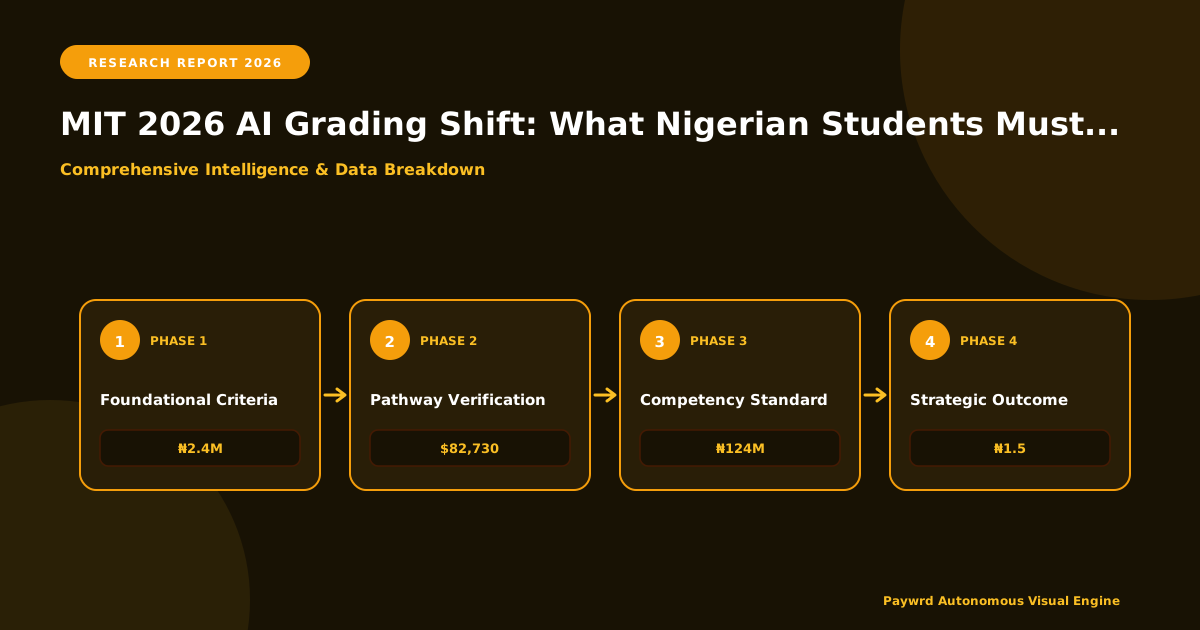
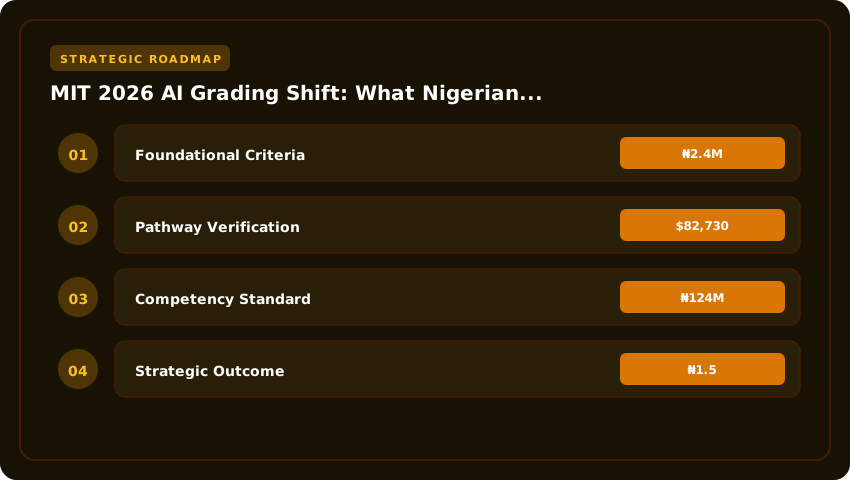
| Core Philosophy | Specifications Grading (pass/fail mastery) | Norm-referenced A-F hierarchy | ₦2.4M avg. prep/test fees |
| Cut-Off Score Required | Mastery threshold (typically 80%+ per spec) | Curved GPA (MIT median: 4.0–5.0) | SAT 1400+ / TOEFL 100+ |
| Implementation Timeline | Pilot Fall 2026 → Full rollout 2027–28 | Continuous since 1890s | Application window: Nov 2026–Jan 2027 |
| Tuition Benchmark (USD/₦) | $82,730/yr ≈ ₦124M annually | Same tuition applies | ₦124M + ₦15–25M living costs |
| AI Proctoring Tools | Mandatory: AI proctor + oral defense | Human proctored exams only | — |
| Career ROI (5-Year) | ₦1.8B–₦2.5B post-tax earnings | ₦1.5B–₦2.2B (legacy model) | 340% ROI vs. ₦372M outlay |
| Appeal Mechanism | Revision cycles allowed once | Grade appeals committee | — |
| Transfer Credit Risk | Moderate (specs ≠ GPA) | Low (universal recognition) | High—verify JAMB equivalency |
Frequently Asked Questions
What is MIT's 2026 Specifications Grading and how does it affect Nigerian applicants?
MIT's 2026 Specifications Grading replaces traditional A-F grades with a binary pass/fail mastery system. Students must demonstrate competency on predefined specifications rather than compete on a curve. For Nigerian applicants, this means stronger emphasis on portfolios, oral examinations, and revision opportunities—reducing grade-anxiety but requiring deeper subject mastery before matriculation at MIT's ₦124M annual tuition.
How much does it cost a Nigerian student to apply to MIT for 2026 admission?
A Nigerian student applying to MIT for 2026 admission should budget approximately ₦372–400 million total for the four-year program. This covers ₦124M annual tuition, ₦15–25M yearly living expenses, plus ₦2.4M in one-time costs for standardized testing (₦850K), application processing, and visa logistics. Financial aid covers 100% of demonstrated need for admitted Nigerians.
What cut-off scores do Nigerian students need for MIT admission in 2026?
MIT does not publish rigid cut-offs, but competitive Nigerian applicants typically present SAT scores of 1500+ (out of 1600) or ACT 34+, plus TOEFL 100+ or IELTS 7.5+. Holistic review weighs research output, recommendation letters, and the new specifications-based competency portfolio. Strong STEM performance and AI literacy significantly boost admissibility against roughly 4% acceptance rates.
Will MIT's 2026 ungrading model hurt Nigerian graduates seeking jobs in Nigeria or the UK?
MIT's specifications grading carries moderate transfer-credit risk in Nigeria's JAMB system and UK NARIC equivalency frameworks, because employers initially may not understand pass/fail transcripts. However, MIT's brand strength, alumni network, and demonstrated mastery portfolios typically yield ₦1.8–2.5 billion in five-year post-tax earnings—outweighing conversion friction. Graduates should request formal competency transcripts for credentialing.
Strategic Final Takeaway
Success in evaluating MIT 2026 AI Grading Shift: What Nigerian Students Must Do Now relies on early preparation, adherence to verified accredited requirements, and cross-referencing official portals. Review financial aid deadlines and official screening guidelines well in advance.