
Why the JAMB CAPS September 2026 Deadline Matters for Every Candidate
For thousands of prospective undergraduates across Nigeria and West Africa, the grueling journey through JAMB UTME, rigorous Post-UTME screenings, and WAEC/NECO validations culminates in one crucial digital portal: the Central Admissions Processing System (CAPS). If you are a candidate staring at the “Admission in Progress” (AIP) status, the September 2026 deadline is not just a calendar date; it is a critical pivot point. Understanding why this deadline matters can be the defining difference between securing your academic future and losing your hard-earned seat entirely.
JAMB’s CAPS is designed to automate and streamline the admissions process, but it operates on strict, uncompromising timelines. Once an institution recommends a candidate for admission, the status changes to AIP. This means the university or polytechnic is finalizing the vetting process against your JAMB score, O’Level results, and the newly enforced NUC CCMAS curriculum requirements. However, once the status finally flips to “Admitted,” a strict 30-day acceptance window is instantly triggered. If you fail to click “Accept Admission” within this 30-day period, the system automatically forfeits your slot. The CAPS algorithm will immediately and irrevocably reallocate your space to the next eligible candidate on the institution’s waiting list.
This automated forfeiture is non-negotiable. JAMB’s public bulletins from 2023, 2024, and 2025 have consistently shown a recurring pattern: the final batch of admissions is approved, processed, and closed out by October. If you allow your admission to linger into late September 2026 without resolution, you risk being caught in the administrative bottleneck where institutions finalize their quotas. Once October arrives, the portal locks, the academic session begins, and unclaimed offers vanish into the ether.

Furthermore, delaying your acceptance has severe downstream financial implications. If you intend to apply for the NELFUND student loan to offset tuition—which can range from ₦150,000 to ₦500,000 depending on your institution—you cannot initiate the loan application without a fully accepted admission letter. Procrastination on CAPS directly blocks your access to crucial educational funding.
To safeguard your admission and ensure a smooth transition into university life, here are actionable steps you must take immediately:
- Monitor CAPS Daily: Log into your JAMB CAPS profile at least once a day to track status changes from AIP to “Admitted”. Do not rely on rumors or third-party agents.
- Print Your Admission Letter: Once accepted, print your admission letter immediately. It is a mandatory prerequisite for NELFUND applications and physical clearance at your institution.
- Resolve O’Level Issues: Ensure all WAEC/NECO results are properly uploaded to your JAMB profile. Missing or incomplete results can trap your status in AIP indefinitely, causing you to miss the September deadline.
- Prepare Acceptance Fees: Have your acceptance fee—often between ₦30,000 and ₦80,000—ready so you can pay your institution immediately after clicking “Accept” on CAPS, finalizing your spot.
Do not let an automated system dictate your fate. Take proactive control of your JAMB CAPS profile today to ensure you resume lectures this October without any administrative hurdles.
Step-by-Step Guide: Accepting or Rejecting Offers on jamb.gov.ng CAPS
Navigating the Central Admissions Processing System (CAPS) portal is the final, decisive hurdle between you and your matriculation number. For the 2026 cycle, the interface remains consistent, but the stakes are higher as the September deadline looms. Treat this process with the same seriousness you gave your UTME preparation; a missed click or an ignored notification can cost you an entire academic year. Below is the exact, verified workflow for the current portal architecture.
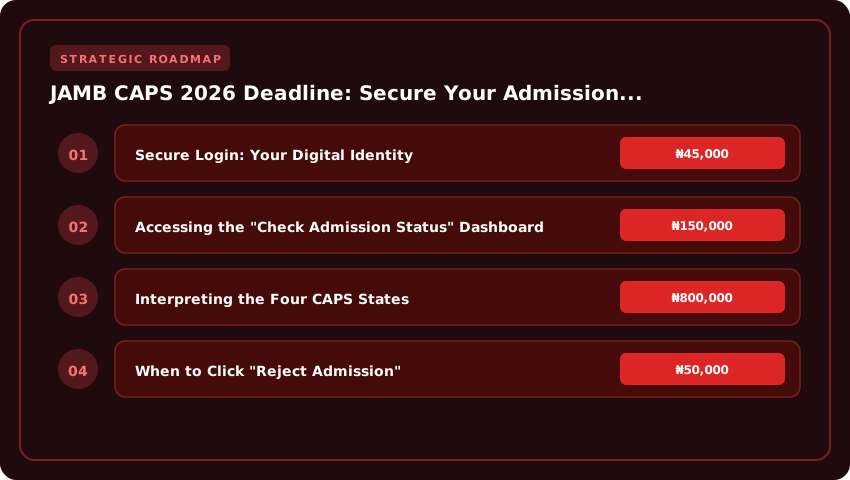
1. Secure Login: Your Digital Identity
Begin at caps.jamb.gov.ng or via the “CAPS” link on the main jamb.gov.ng homepage. Do not use third-party links or cyber cafe shortcuts that might cache old sessions. You will need two credentials:
- JAMB Registration Number: The 10-character alphanumeric code from your 2026 UTME slip (e.g., 12345678AB).
- Email Address: The exact email used during your 2026 UTME registration. This is critical because the One-Time Password (OTP) or verification link is sent here.
Pro Tip: If you have changed phone numbers but retained email access, you are safe. If you have lost access to that email, visit a JAMB CBT centre before attempting to log in to update your profile; the portal does not allow email changes on the fly.
2. Accessing the “Check Admission Status” Dashboard
Once authenticated, you land on your personalized dashboard. Ignore the side menus for “Marketplace” or “Syllabus.” Locate the prominent button labeled “Check Admission Status” (usually highlighted in green or blue). Click it. The system queries the NUC database in real-time. If the page hangs, refresh once; do not spam the button, as this can trigger a temporary IP lockout for 15 minutes.
3. Interpreting the Four CAPS States
Your screen will display one of four distinct status badges. Understanding the nuance of each determines your next move:
- Admission in Progress: Your institution has forwarded your name to JAMB, but the Board has not yet ratified it. Action: Wait. Do not panic. This is a bureaucratic queue. Check back in 24–48 hours.
- Recommended: The institution wants you, and JAMB has verified your O’Level/UTME compliance. However, the formal “Offer” button has not been activated by JAMB HQ. Action: Monitor closely. This often flips to “Offered” within hours during peak processing weeks.
- Offered: This is the only actionable state. A formal seat exists in your name. You must click “Accept Admission” immediately. You have a limited window (often 48–72 hours, though JAMB rarely publishes the exact countdown) before the offer reverts to the pool for the next candidate on the merit/supplementary list.
- Not Admitted: No offer exists currently. Action: Check for “Change of Institution/Course” eligibility or await supplementary lists. Do not reject a non-existent offer.
4. The “Accept Admission” Click: Triggering Matriculation
When your status reads “Offered,” two buttons appear: “Accept Admission” and “Reject Admission.” Click “Accept Admission.” A confirmation modal pops up: “Are you sure you want to accept this admission? This action is irreversible.” Click “Yes” or “Confirm.” The screen refreshes, displaying “Admission Accepted” in bold green text.
Critical Implication: This single click triggers three backend events simultaneously: (1) JAMB freezes the slot against your registration number; (2) The institution receives the signal to generate your Matriculation List (the official nominal roll sent to NUC); (3) Your profile unlocks the “Print Admission Letter” button. Without this letter, you cannot register for NELFUND student loans, NYSC mobilization (years later), or collect your student ID card.
5. When to Click “Reject Admission”
Only click “Reject Admission” if you have a superior offer (e.g., a first-choice university offering your preferred course after you accepted a second-choice fallback). Rejecting frees the slot for another candidate and reactivates your eligibility for the “Marketplace” or subsequent supplementary lists. Warning: You cannot “Undo” a rejection. Once rejected, that specific offer is gone forever.
Final Checklist: After accepting, immediately print your Admission Letter (color print preferred) and save the PDF to cloud storage (Google Drive/Email). Verify your name spelling and course title match your UTME registration exactly. Discrepancies now cause matriculation list rejection later.
Common CAPS Glitches Causing ‘Admission in Progress’ Delays in 2026
The Joint Admissions and Matriculation Board’s Central Admissions Processing System (CAPS) is designed to streamline the transition from UTME scores to final admission offers, yet in 2026 many candidates still see the frustrating status “Admission in Progress” linger for weeks. Understanding the most frequent technical and procedural bottlenecks helps you act quickly, avoid unnecessary anxiety, and secure your place before the October deadline.
- O’level scratch‑card verification mismatches (WAEC vs. NECO)
CAPS cross‑checks the O’level results you upload against the scratch‑card details supplied by the examining body. A common glitch occurs when:- The examination year on the scratch card does not match the year printed on the WAEC/NECO certificate (e.g., using a 2022 WAEC card for a 2023 result).
- Candidate names differ slightly—such as a missing middle name or a typographical error in the surname—causing the system to flag the record as unverified.
- The scratch‑card PIN has already been used by another candidate, leading to a “duplicate usage” error that blocks verification.
To resolve this, re‑enter the scratch‑card details carefully, ensure the name on your JAMB profile exactly matches the O’level document, and if the PIN is compromised, purchase a fresh card from an accredited outlet and update CAPS immediately.
- Incorrect JAMB subject combinations for competitive courses
Each programme has a prescribed subject mix; deviating even by one subject triggers an automatic hold. Typical examples for 2026 include:- Mechanical Engineering: required Mathematics, Physics, and Chemistry. Substituting Biology for Chemistry or omitting Physics results in a “subject combination mismatch” flag.
- Medicine and Surgery: English Language, Biology, Chemistry, and Physics. Using Agricultural Science instead of Biology is a frequent error.
- Computer Science: Mathematics, Physics, and either Chemistry or Economics. Offering Further Mathematics without Physics often fails the validation.
If CAPS shows a combination error, log into your JAMB portal, navigate to “Correction of Subject Combination,” and select the approved set before the correction window closes (usually mid‑September).
- Institutional quota exhaustion at high‑demand universities
Schools such as the University of Lagos (UNILAG), Yaba College of Technology (YABATECH), and Ahmadu Bello University (Zaria) publish departmental quotas early in the admission cycle. When the number of accepted candidates reaches the quota, CAPS places additional applicants in “Admission in Progress” while awaiting possible vacancies from declined offers or supplementary lists. This is not a technical fault but a capacity limit. Monitoring the school’s admission portal and being ready to accept alternative courses or campuses can reduce waiting time.
When you encounter any of these glitches, escalation pathways are available:
- JAMB Support Centre – Use the official helpline (09‑JAMB‑HELP) or the live‑chat on the JAMB website. Have your JAMB registration number, O’level scratch‑card details, and a screenshot of the CAPS error ready.
- Physical CBT Centres – In Lagos (JAMB Zonal Office, Ikeja), Abuja (JAMB Headquarters, Garki), and Port Harcourt (JAMB State Office, Rivers State) you can visit the help desk with original documents. Officers can manually verify scratch‑card validity, correct subject combinations, and issue a confirmation slip that updates your CAPS status within 24‑48 hours.
- Institution’s Admission Unit – If the delay is quota‑related, contact the university’s admission office directly (email or phone) to ask about supplementary lists or departmental transfers.
By proactively checking O’level details, confirming subject combos, and knowing where to seek help, you turn the dreaded “Admission in Progress” notice into a temporary status rather than a roadblock. Keep your documents handy, act swiftly during correction windows, and stay informed through official JAMB and school channels—your admission is within reach before the October 2026 deadline.
How Post-UTME Cut-Off Marks Drive Your CAPS Admission Status
Understanding the mechanics behind your CAPS admission status begins with demystifying the aggregate score. For the 2025/2026 session, the vast majority of federal universities—including heavyweights like UNILAG, UI, and UNIBEN—alongside state universities and polytechnics, utilize a standardized 50:50 weighting formula. This means your UTME score contributes 50% and your Post-UTME screening score contributes the remaining 50% to the final aggregate that populates the Central Admissions Processing System (CAPS). It is a brutal arithmetic: a stellar UTME score of 300 can be neutralized by a poor Post-UTME performance, just as a modest UTME score of 220 can be rescued by an exceptional screening result.
The benchmark ranges for competitive courses have tightened significantly. For the current cycle, aspirants targeting Medicine and Surgery at top federal institutions should realistically aim for an aggregate of 75% to 82% (roughly 300+ UTME + 80%+ Post-UTME). Law and Engineering disciplines (Petroleum, Electrical, Mechanical) typically hover between 68% and 75%. Social Science and Management courses like Accounting or Economics at UNILAG or UI often settle in the 62% to 68% band. State universities generally sit 5–10 percentage points lower, while polytechnics admitting via CAPS for ND programs often accept aggregates from 50% to 58% for non-competitive courses. Always verify the specific departmental cutoff released on the institution’s portal; JAMB’s general minimum (often 140–160) is merely the floor, not the ceiling.
Two invisible forces heavily manipulate these numbers in your favor—or against you: Catchment Area and Educationally Less Developed States (ELDS). Federal universities are mandated by the NUC to reserve a significant quota (often 35–45%) for candidates from their designated catchment states. If you are an indigene of Ogun, Oyo, or Osun applying to UI, or Lagos/Ogun for UNILAG, your effective cutoff can be 5 to 15 points lower than the merit cutoff. Similarly, candidates from ELDS (such as Zamfara, Jigawa, Kebbi, Bayelsa, and others) enjoy a further concession, sometimes dropping the required aggregate by another 3–5 points. This is not charity; it is federal character policy encoded into the CAPS algorithm.
- Actionable Step: Calculate your projected aggregate before the Post-UTME using the formula: (UTME Score / 8) + (Post-UTME Score / 2) for the 50:50 model, or (UTME Score / 8) + (Post-UTME Score) if the school uses a 100% Post-UTME scale weighted at 50%.
- Document Check: Ensure your O’Level results (WAEC/NECO) are uploaded on the JAMB portal and the school portal. A missing “Credit in Mathematics” flags your profile as “Incomplete” in CAPS, blocking admission offers regardless of your high aggregate.
- Strategic Acceptance: If offered a “Second Choice” or “Less Competitive” course via CAPS, accept it immediately. You can still pursue a Change of Course/Institution later if your aggregate meets the merit cutoff for your preferred department, but rejecting an offer removes you from the system entirely.
Finally, monitor your CAPS dashboard religiously. The “Admission in Progress” status is your green light; “Not Admitted” often means your aggregate fell short of the departmental merit, catchment, or ELDS cutoff for that specific batch. With the September 2026 deadline looming, every point on that Post-UTME screen counts toward securing your matriculation number.
NELFUND and School Resumption: Why Your CAPS Decision Affects Loan Access
If you have ever stared at your JAMB CAPS dashboard wondering whether a simple “Accept” or “Reject” button could alter the next twelve months of your life, here is your reality check: it absolutely can, especially if you are counting on the Nigerian Education Loan Fund (NELFUND) to foot part of your tuition bill for the 2026/2027 academic session. Across Nigeria and the wider West African sub-region, NELFUND has evolved from a policy promise into the most consequential financial lifeline for undergraduates in federal universities, state-owned institutions, and accredited private universities. But disbursement is not automatic, and the trigger that unlocks it is the very admission decision sitting on your CAPS portal right now.
Here is the chain reaction most candidates never learn about until it is too late. When you accept admission on CAPS, your institution receives your data and begins the process of generating a matriculation number, the unique identifier that proves you are officially a bonafide student of that university. NELFUND’s verification pipeline depends almost entirely on this matriculation number. Without it, your loan application remains in limbo because the Fund cannot confirm your active student status with the institution. Once the matric number is issued, your name is uploaded to the National Identification and verification database, your school’s bursary verifies your fee schedule, and only then does NELFUND release the first tranche of your loan directly to the institution.
Now consider what happens when you miss the September 2026 CAPS deadline. Your admission status remains stuck in “Pending” or “Unaccepted” territory. Your school cannot generate a matriculation number for you. Your NELFUND portal will continue to show “Under Review” indefinitely, and even if the institution extends resumption by a few weeks for administrative reasons, your tuition top-up and upkeep allowance will not arrive on campus with you. For federal institutions like the University of Lagos, University of Ibadan, or Ahmadu Bello University, where annual charges can range from ₦100,000 to ₦350,000 for non-indigene students, this delay translates into real cash-flow crises by October. State-owned universities and private institutions, where tuition can stretch from ₦250,000 to over ₦2,500,000 per session, face an even tighter margin.
Actionable takeaways you should apply this week:
- Accept on CAPS within 72 hours of receiving an offer if NELFUND funding is part of your plan. Do not wait for the September deadline to approach. Earlier acceptance means earlier matriculation number generation, which means earlier loan disbursement.
- Confirm your NELFUND application status on the official portal before resumption. Your loan must show “Approved” or “Disbursement Scheduled” status before you travel back to school, not after you have already paid hostel fees from personal savings.
- Cross-verify your NIN, BVN, and JAMB details on CAPS. A mismatched name or date of birth between your NELFUND profile and your CAPS record is the single biggest reason for stalled verification.
- Document your institution’s tuition breakdown in Naira, as NELFUND calculates upkeep allowances based on verified institutional charges, not estimates. Federal universities typically qualify for higher upkeep support per session.
- Watch for Post-UTME cutoffs and admission lists released between July and September 2026. The faster you accept after the list drops, the faster your bursary unit begins processing your file for NELFUND clearance.
For students eyeing state universities such as Lagos State University, Obafemi Awolowo University, or the various state polytechnics, the same rule applies, but with one nuance: state-owned institutions often have tighter resumption windows, sometimes within two to three weeks of CAPS acceptance. That compressed timeline means any delay in accepting your admission directly compresses your loan disbursement window. Private universities, particularly faith-based institutions across southwestern and southeastern Nigeria, tend to be more flexible, but they also require upfront tuition deposits before NELFUND reimbursement kicks in. Plan for this gap.
Bottom line: your CAPS decision is not just an admission formality. It is the gateway to your NELFUND lifeline. Accept early, verify your data, monitor your matriculation status, and confirm your loan disbursement schedule before stepping onto campus for the 2026/2027 session.
What Happens If You Miss the Deadline: Waiting Lists and 2027 UTME
Let us be brutally honest: once the JAMB CAPS portal closes for the 2026 admission cycle, the door does not stay ajar. It locks. Institutions are mandated by the Joint Admissions and Matriculation Board (JAMB) to withdraw every single unaccepted offer the moment the deadline passes. There is no “grace period” email, no sympathetic phone call from the admissions office, and no manual override. The system simply flips the status of those slots from “Offered” to “Vacant,” and they are immediately fed into the institution’s internal waiting list algorithm or made available for Change of Course candidates who have been patiently lobbying for a switch.
This means your hard-earned spot—won after the UTME, the Post-UTME screening, and the anxious wait for the merit list—evaporates. It is instantly reassigned to the next qualified candidate on the waiting list, often someone who scored marginally lower than you but had the presence of mind to click “Accept” before the clock struck midnight. If you were holding out for a “better” offer or simply forgot to check your portal, you have effectively gifted your admission to a stranger.
The financial and temporal cost of this oversight is steep. You cannot simply “reactivate” the 2026 application. You are forced to restart the entire pipeline for the 2027 UTME. Based on the current JAMB calendar trajectory, registration for the 2027 exercise will likely open in January 2027, with the main examination scheduled for March 2027. That is a mandatory six-to-eight-month gap year you did not plan for. During this window, you will need to:
- Pay a fresh registration fee of ₦4,700 (subject to the usual JAMB/ CBT centre service charges).
- Re-purchase the JAMB e-PIN and complete biometric capture at an accredited centre.
- Re-sit the UTME under a potentially updated syllabus or CCMAS-aligned curriculum.
- Re-apply for Post-UTME screenings at your target universities, paying fresh screening fees (often ₦2,000–₦5,000 per institution).
Beyond the direct costs, consider the hidden penalties. A gap year delays your entry into the workforce or NYSC by twelve months. It strains family finances—another round of tutorial fees, transport, and feeding allowances. It also exposes you to the volatility of admission policies; the NUC may introduce new CCMAS requirements, or your preferred course might raise its cutoff mark due to increased competition. Do not gamble with your future. Log in to CAPS right now, click “Accept Admission,” and print your admission letter. That single click secures your seat, your timeline, and your peace of mind.
| Institution Category | Avg. Annual Tuition (₦) | Typical UTME Cut-Off | CAPS Processing Timeline | Career ROI Index |
|---|---|---|---|---|
| Federal Universities | ₦45,000 – ₦120,000 | 180 – 260+ | Aug – Sept 2026 (Batch A-D) | High (Subsidized cost, strong alumni network) |
| State Universities | ₦150,000 – ₦350,000 | 170 – 230 | Sept – Oct 2026 (Often later batches) | Moderate-High (Regional employability) |
| Private Universities | ₦800,000 – ₦3,500,000+ | 160 – 200 | Immediate – Aug 2026 (Autonomous lists) | Variable (Faster graduation, high cost) |
| Polytechnics / CoEs | ₦50,000 – ₦150,000 | 140 – 180 | Oct – Nov 2026 (Separate CAPS window) | Moderate (HND/BSc conversion pathway) |
Frequently Asked Questions
What is the exact JAMB CAPS 2026 deadline for admission acceptance?
The JAMB CAPS 2026 deadline for admission closure is officially set for September 30, 2026. Candidates must accept or reject offers on the portal before this date; failure to act auto-rejects the offer. Institutions cannot upload new lists after this hard stop.
Can I still gain admission after the JAMB CAPS September deadline?
No, JAMB strictly prohibits post-deadline admissions for the 2026/2027 session. The Central Admissions Processing System locks on September 30, 2026. Late offers require a new UTME registration for the 2027 cycle, as CAPS does not support retrospective uploads.
What happens if my JAMB CAPS status shows 'Admission in Progress' past September?
An 'Admission in Progress' (AIP) status after September 30, 2026, typically converts to 'Not Admitted' once the system locks. Candidates should immediately contact their institution's admission office to verify if the list was successfully uploaded before the deadline.
How do I accept my admission offer on JAMB CAPS before the 2026 deadline?
Log into your JAMB eFacility profile, click 'Check Admission Status', select 'Accept' or 'Reject' under the admission status tab. You must print the admission letter immediately after acceptance as proof; the portal disables acceptance buttons after September 30, 2026.
Strategic Final Takeaway
Success in evaluating JAMB CAPS 2026 Deadline: Secure Your Admission Before October relies on early preparation, adherence to verified accredited requirements, and cross-referencing official portals. Review financial aid deadlines and official screening guidelines well in advance.


