The 2026 Policy Landscape: Perkins V Reauthorization & State Funding Shifts
If you are mapping a career trajectory that bypasses the traditional four-year campus, you need to understand the engine driving the funding: the Strengthening Career and Technical Education for the 21st Century Act (Perkins V). As we move through the 2026 fiscal cycle, the conversation has shifted from simple compliance to performance-based accountability. The reauthorization discussions currently circulating in the House Committee on Education and the Workforce signal a tightening of the “local needs assessment” requirements, meaning your local district or consortium must prove—with hard data—that their programs align with actual high-wage, in-demand sectors like advanced manufacturing, cybersecurity, and healthcare technology.

The allocation formula itself hasn’t radically changed—it still relies heavily on the age 15–19 population and per capita income metrics to distribute the roughly $1.4 billion federal baseline across states. However, the state-level categorical funding weights are where the real leverage lives. States like Texas, Indiana, and Colorado have aggressively supplemented federal dollars with state categorical grants that apply “weight multipliers” (often 1.5x to 3.0x standard ADA funding) for students enrolled in approved Programs of Study culminating in an Industry-Recognized Credential (IRC). For 2026, watch for states adopting tiered funding models: Tier 1 for exploratory courses (lower weight), Tier 2 for concentrator sequences, and Tier 3 for capstone work-based learning (WBL) placements tied to registered apprenticeships. This directly dictates whether your local high school can afford that new CNC lab or the cybersecurity range you need.
The accountability dashboard has undergone its most significant shift since 2018. The core indicators—specifically 3S1 (Post-Program Placement) and 5S3 (Program Quality – Participated in Work-Based Learning)—are now the gatekeepers for continued federal dollar flow.
- 3S1 (Placement): States must now report the percentage of CTE concentrators who, in the second quarter after exiting, are in postsecondary education, advanced training, military service, or employment aligned with their program of study. “Aligned” is the operative keyword here; flipping burgers doesn’t count if you studied welding. Programs failing to hit the state-adjusted performance level (typically 70–85%) enter improvement plans, risking loss of Perkins eligibility.
- 5S3 (Work-Based Learning Quality): This metric measures the percentage of concentrators participating in quality WBL—defined as sustained, supervised interaction with industry professionals (internships, apprenticeships, clinicals). Simple job shadowing often no longer qualifies. High performance here unlocks “Innovation & Modernization” grant eligibility, a competitive federal pool separate from formula funds.
Actionable Takeaway: When evaluating a local program, ask the CTE Director for their Local Application and Comprehensive Local Needs Assessment (CLNA) data. Ask specifically: “What is your current 3S1 placement rate for my intended pathway?” and “What percentage of concentrators complete a paid, credit-bearing WBL experience (5S3)?” If they cannot answer with current-year data, the program may be on the funding chopping block—or simply not delivering the ROI you deserve.
Deconstructing Models: CTE Concentrators vs. Youth Apprenticeships vs. P-TECH
Navigating the world of high-wage, non-degree career pathways requires understanding that not all programs are built the same. While Career and Technical Education (CTE), Youth Apprenticeships, and P-TECH schools all aim to bridge the gap between secondary education and the labor market, their operational architectures, time commitments, and financial underpinnings differ dramatically. For a student evaluating their future in 2026, choosing the right model is less about prestige and more about how you learn, how you earn, and how you transition into an industry that actually has a job waiting for you.
A traditional CTE Concentrator model remains the most familiar pathway for American high schoolers. Under the Strengthening Career and Technical Education for the 21st Century Act (Perkins V), a concentrator is a student who has completed at least two sequential courses in a specific career cluster—such as Health Science, Information Technology, or Advanced Manufacturing. The structure is heavily reliant on “seat-time” in a traditional classroom, supplemented by laboratory work and perhaps a capstone internship. Because this model is school-district funded, it offers high accessibility and low direct costs to families, but it often lacks the intensive, paid work-based learning found in other models. Students graduate with industry-recognized certifications, but the transition from school to full-time employment is usually a separate step they must navigate on their own.
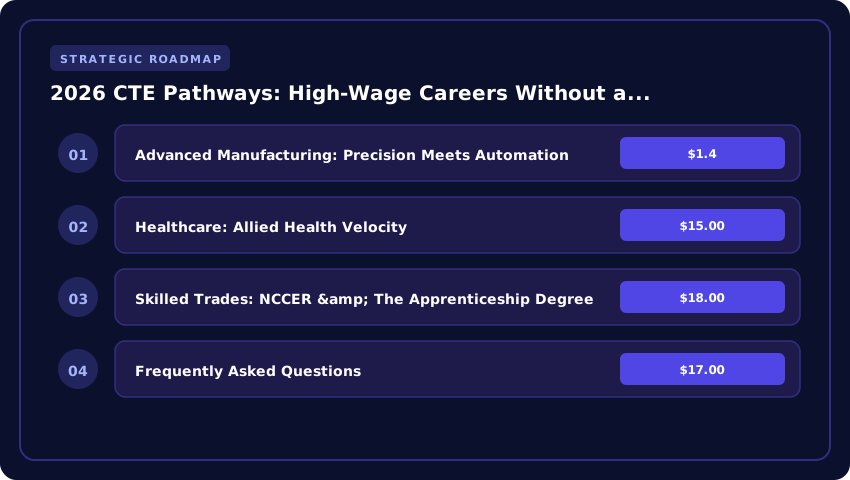
In stark contrast, the Youth Apprenticeship model is built around a registered apprenticeship framework, frequently aligned with the U.S. Department of Labor’s Industry-Recognized Apprenticeship Programs (IRAP) or state-run RA systems. Here, the architecture is inverted: the workplace is the primary classroom. Students split their week between academic instruction and paid, on-the-job training with a mentor. The financial mechanics are highly attractive. Because the apprentice is an employee from day one, they earn a progressive wage—often starting between $15.00 and $18.00 per hour in 2026—while learning. Furthermore, employers in these programs can tap into significant federal and state wage subsidies. Under the Inflation Reduction Act and various state-level intermediary grants, employers can often claim tax credits covering up to 50% of the apprentice’s hourly wage during the first year of training, dramatically lowering the barrier for companies to hire and mentor high school students. Because apprentices are tracked by hours and competencies rather than Carnegie Units, their graduation from the program yields a portable, nationally recognized journeyman credential.
The P-TECH (Pathways in Technology Early College High School) model represents a hybrid approach, blending the seat-time rigor of college with the deep employer partnership of an apprenticeship. Structured as a grades 9-14 program, P-TECH schools admit students directly from middle school, guaranteeing them a free associate degree alongside their high school diploma over six years. The funding here is a complex braid of public school per-pupil allocations, community college tuition waivers (often covered by state dual-enrollment grants), and private industry investment. While the wage-subsidy mechanism is less direct than a registered apprenticeship, P-TECH schools maintain strict mentor-to-student ratios, typically aiming for one industry mentor for every ten students. These mentors are paid by partner companies—like IBM, Toyota, or local hospital systems—and commit to providing worksite tours, job shadowing, and paid summer internships. By the time a P-TECH student reaches grade 12, they are often working 20 hours a week in a paid internship, earning between $17.00 and $22.00 per hour while completing their final college courses.
Ultimately, the choice between these three models comes down to a simple trade-off: accessibility versus immersion. CTE Concentrators benefit from programs that exist in nearly every public high school, but they must independently translate their skills into a job. Youth Apprentices secure immediate earnings and a guaranteed industry credential, but they require a higher level of maturity to balance academic and professional demands. P-TECH students earn a tuition-free degree, but they must commit to a single, highly structured school environment for six years. By understanding the seat-time versus hours-based distinction, and by weighing how employer subsidies and mentor ratios impact the quality of training, students and parents can select the architecture that best fits their economic and academic goals for 2026 and beyond.
High-ROI Clusters: Advanced Manufacturing, Cyber, Healthcare & Skilled Trades
When you align your Career and Technical Education (CTE) choices with Bureau of Labor Statistics (BLS) Occupational Employment and Wage Statistics (OEWS), four clusters consistently surface as high-return investments for 2026. These pathways offer median entry wages between $45,000 and $75,000, robust projected growth through 2032, and—critically—credential architectures that stack toward associate degrees or bachelor’s completion without locking you into four years of tuition debt upfront.
Advanced Manufacturing: Precision Meets Automation
The “dark factory” narrative is overblown; the reality is a desperate need for technicians who program, maintain, and troubleshoot CNC cells and robotic lines. BLS data places CNC Tool Programmers and Electro-Mechanical Technicians at median entry wages of $52,000–$62,000, with growth projections of 6–10% (faster than average). The gold-standard stack starts with NIMS (National Institute for Metalworking Skills) Level I credentials—Measurement, Materials & Safety, and CNC Milling/Turning. These 12–16 week certificates articulate directly into AAS degrees in Manufacturing Engineering Technology at community colleges partnered with the Manufacturing Skill Standards Council (MSSC). Actionable takeaway: Target programs offering Haas or Fanuc controller labs; employer tuition reimbursement often covers the next credential tier.
Cybersecurity & IT Infrastructure: The CompTIA Ladder
Entry-level Information Security Analysts and Network Support Specialists command median entry wages of $60,000–$75,000 per BLS OEWS 2023 data (released 2024), with a staggering 32% projected growth rate. The stackable highway here is vendor-neutral: CompTIA A+ → Network+ → Security+ → CySA+. Each cert typically requires 8–12 weeks of focused study. Critically, the DoD 8570/8140 compliance mandate makes this stack non-negotiable for federal contracting roles—a massive employer base in the DC, San Antonio, and Huntsville corridors. Many community colleges are now CompTIA Authorized Academies, meaning your Pell Grant covers exam vouchers. Compare this to a saturated entry-level CS bachelor’s market where junior dev roles often pay $55k–$65k after four years and $100k+ in debt.
Healthcare: Allied Health Velocity
Skip the RN bottleneck. Diagnostic Medical Sonographers, Radiologic Technologists, and Surgical Technologists enter at $50,000–$65,000 median wages with 6–10% growth. The credential stack is rigid but fast: CAAHEP-accredited certificate (12–18 months) → ARRT/ARDMS registry exam → State licensure. These credits transfer seamlessly into “Bridge to BSN” or Health Sciences bachelor’s completion programs later. The ROI clock starts ticking at month 14, not year 4.
Skilled Trades: NCCER & The Apprenticeship Degree
Electricians, HVAC/R Techs, and Plumbers show median entry wages of $48,000–$60,000 (journeyman rates push $80k+). The NCCER (National Center for Construction Education and Research) curriculum provides the portable transcript. The 2026 shift: Registered Apprenticeship-College Consortium agreements now let you earn an AAS during your apprenticeship—tuition paid by the employer/JATC. You graduate with zero debt, a journeyman card, and an associate degree. That is a bachelor’s-degree killer value proposition.
Credentials That Count: Industry-Recognized vs. Postsecondary Articulation
Not every certificate hanging on a wall carries the same weight with hiring managers or the Department of Labor (DOL). As you evaluate 2026 pathways, you must distinguish between a portable, industry-recognized credential and a completion certificate that rarely travels beyond the issuing institution. The gold standard remains the DOL-Registered Apprenticeship. These programs combine paid on-the-job training with structured technical instruction, culminating in a nationally recognized Journeyworker credential. Because they are registered with the DOL (or a recognized State Apprenticeship Agency), they guarantee wage progression, worker protections, and—critically—automatic articulation into associate degree programs at partner community colleges nationwide.
Running a close second are certifications from NCCER (National Center for Construction Education and Research) and NOCTI (National Occupational Competency Testing Institute). NCCER credentials are the lingua franca of the skilled trades—welding, electrical, HVAC, and heavy equipment. Their modular, competency-based curriculum is tracked in a national registry, allowing you to move from a Texas jobsite to a North Carolina union hall without restarting your training. NOCTI serves a broader CTE spectrum, offering Job Ready and Pathway assessments aligned with Perkins V standards. When a high school program boasts NOCTI validation, it signals that the curriculum has been psychometrically validated against actual industry standards, not just local advisory committee wish lists.
Then there is the articulation engine: dual-enrollment and dual-credit agreements. These allow you to bank transcripted college credit—often tuition-free—while still in high school. However, audit the articulation agreement carefully. Transcripted credit (appearing on an official college transcript with a letter grade) transfers broadly. Articulated credit (often “credit by exam” or “advanced standing”) frequently locks you into a single institution. For 2026, prioritize programs with statewide articulation agreements (common in Florida, Texas, and Ohio) that guarantee transfer into any public two-year or four-year college within that state system.
Finally, understand the accreditation gatekeeper for federal aid. If you are a non-degree seeker targeting a certificate program at a technical college, institutional accreditation determines your Pell Grant eligibility. The two primary national accreditors for career-focused institutions are ACCSC (Accrediting Commission of Career Schools and Colleges) and COE (Council on Occupational Education). Both are recognized by the U.S. Department of Education, meaning their accredited programs qualify for Title IV funding (Pell, FSEOG, Direct Loans) even if you are not pursuing an associate degree. Action item: Before enrolling, verify the school’s status on the College Navigator tool or the Database of Accredited Postsecondary Institutions and Programs (DAPIP). A program lacking this specific accreditation—even if it offers a great NCCER cert—will leave you paying 100% out of pocket.
- Verify Portability: Ask admissions: “Does this credential sit in a national registry (NCCER, DOL OA, CompTIA) or is it proprietary to this campus?”
- Check Articulation Type: Demand transcripted credit over articulated credit to protect your future transfer options.
- Confirm Pell Eligibility: Cross-reference the school’s ACCSC or COE status on DAPIP before signing an enrollment agreement.
The Permeability Factor: Articulation Agreements & Credit for Prior Learning
One of the most persistent myths plaguing American Career and Technical Education is the assumption that choosing a technical pathway represents a closed door. In reality, the modern CTE infrastructure across the United States is engineered with extraordinary permeability, allowing learners to carry earned credits into four-year institutions without surrendering their technical edge. The mechanism driving this flexibility is the articulation agreement, a formal contract between a community college, technical school, or high school CTE program and a four-year university that guarantees the acceptance of specific credits toward a baccalaureate degree. For the cost-conscious strategist, this framework is the single most underappreciated financial instrument in higher education, capable of saving a student between $20,000 and $45,000 in duplicated tuition while compressing a traditional four-year timeline into a more efficient two-plus-two configuration.
Statewide articulation frameworks function as the connective highways between secondary, postsecondary, and baccalaureate education. Ohio’s Transfer Assurance Guides (TAG) and Career Transfer Assurance Guides (CTAG) stand as national benchmarks for this model. Through CTAG, students who complete approved career-technical coursework at an Ohio Technical Center or secondary Career-Technical Education program receive guaranteed credit at any public Ohio college or university. The Ohio Department of Higher Education has codified these agreements so that courses in fields like Information Technology, Engineering Technology, and Health Sciences articulate as direct equivalents to freshman and sophomore-level university coursework. A student earning an industry credential such as a CompTIA A+ certification or a state-approved Nursing Aide certificate can convert those hours into transcripted college credit, accelerating degree completion and reducing out-of-pocket expenses.
Georgia provides another instructive model through the Technical College System of Georgia (TCSG) and its companion articulation with the University System of Georgia. TCSG guarantees that every Associate of Applied Science (AAS) degree carries a transferable block of credit toward a Bachelor of Applied Science (BAS) program at participating institutions like Georgia Southern University, Kennesaw State University, or the University of North Georgia. The BAS was specifically designed as the terminal destination for AAS holders, recognizing that technical expertise represents a legitimate academic specialization rather than a deviation from scholarly rigor. A welder who earns an AAS in Industrial Technology, for example, can pursue a BAS in Manufacturing Operations, a credential increasingly valued by aerospace and defense employers across the southeastern corridor.
The financial mathematics are compelling. The average sticker tuition at a public four-year institution for the 2026 academic year hovers near $11,260 for in-state students, while community college tuition averages approximately $3,990. By completing an AAS at a community college or technical school, a student captures two years of instruction at roughly 65% less cost than the university equivalent. Articulation agreements ensure those two years are not wasted; they convert into junior standing at a four-year institution, with only the upper-division coursework remaining. For a degree like the BAS in Applied Engineering Technology or the BAS in Information Technology Management, this pathway delivers a bachelor’s credential at a combined tuition cost that frequently falls below $25,000 total, a figure that renders the wage premium of a baccalaureate degree accessible to households operating on modest budgets.
Credit for Prior Learning (CPL) and Prior Learning Assessment (PLA) serve as the secondary highway within this permeability network. PLA allows students to translate industry certifications, military training, apprenticeships, and professional examinations into transcripted college credit. The American Council on Education (ACE) provides national recommendations through its Credit Recommendation Service, which evaluates military and corporate coursework for college-level equivalence. A veteran transitioning out of the armed forces, for instance, can translate portions of their training into 30 or more semester hours, dramatically shortening their degree timeline. Similarly, an electrician who has completed a registered apprenticeship through the Department of Labor may be eligible for credit covering entire course sequences in an Electrical Engineering Technology BAS program.
Understanding this permeability is essential to avoiding undermatching, a phenomenon studied extensively by economists and policy analysts. Undermatching occurs when a student’s academic aptitude qualifies them for rigorous four-year opportunities, yet they enroll in less demanding programs due to financial constraints, inadequate advising, or cultural perceptions about technical education. The danger is not the CTE pathway itself; the danger is choosing a terminal credential when a permeable route to a bachelor’s degree was available all along. By selecting CTE programs with verified statewide articulation agreements and actively pursuing PLA evaluations, students safeguard their upward mobility while preserving immediate workforce earning power.
The practical guidance is straightforward. Before enrolling in any CTE program, request a written copy of that program’s articulation agreements. Verify whether the target institution holds regional accreditation through agencies recognized by the U.S. Department of Education, such as the Higher Learning Commission or the Middle States Commission on Higher Education. Confirm that the credential you are earning maps to a specific BAS or BS completion pathway rather than a dead-end terminal certificate. Engage the financial aid office to map out how your FAFSA package interacts with the two-plus-two structure, particularly regarding Satisfactory Academic Progress (SAP) requirements that govern Pell Grant and Federal Supplemental Educational Opportunity Grant (FSEOG) disbursement. Finally, compile a portfolio of every industry certification, apprenticeship milestone, and standardized examination score you accumulate, because these artifacts become the raw currency of your Prior Learning Assessment portfolio.
- CTAG/Statewide Transfer Guides: Verify your CTE coursework transfers as guaranteed credit to any public university through state-level frameworks like Ohio’s TAG/CTAG system.
- AAS-to-BAS Block Transfer: Target Associate of Applied Science degrees that map directly to a Bachelor of Applied Science pathway, saving approximately $20,000-$45,000 in duplicated tuition.
- Prior Learning Assessment (PLA): Leverage ACE credit recommendations, military transcripts (JST), and apprenticeship records to convert professional experience into transcripted college credit.
- Undermatching Safeguards: Choose terminal technical credentials only after confirming no permeable bachelor’s pathway exists for your field of study.
- Regional Accreditation: Confirm both the technical school and the four-year destination hold recognized regional accreditation to ensure credits transfer cleanly and financial aid remains eligible.
Due Diligence Checklist: Evaluating Local Program Labor Market Alignment
When evaluating a local Career and Technical Education (CTE) pathway, glossy brochures and enrollment statistics only tell half the story. The true measure of a robust program lies in how deeply it is integrated with the regional economy, whether its equipment mirrors industry standards, and how transparently it reports student outcomes. As a decision-maker mapping a high-wage, non-college trajectory for the 2026 academic year, you must act like an auditor. This section provides a rigorous, four-part due diligence checklist designed to verify labor market alignment, ensuring that your investment of 1 to 4 years yields a verifiable return in the form of competitive wages and sustainable employment.
Federal legislation, particularly the Strengthening Career and Technical Education for the 21st Century Act (Perkins V), mandates that local programs utilize industry-driven data. However, local implementation varies dramatically. Use the following rubric to interrogate program directors, review public records, and confirm that the pathway you are considering is anchored in genuine economic demand rather than merely institutional convenience.
- 1. Advisory Board Minutes and Industry Representation Review: Every accredited CTE program is required to maintain a local advisory board comprising industry professionals. Do not simply ask if one exists; demand to review the actual meeting minutes from the previous 24 months. Look for documented evidence of programmatic changes, curriculum updates, and equipment recommendations driven by these stakeholders. Verify that the board is not stacked with alumni or part-time instructors, but features bona fide hiring managers from local trade unions, regional manufacturers, and credentialing bodies. High-functioning advisory boards meet at least twice annually and produce actionable, signed deliverables that directly influence the program of study.
- 2. Equipment Depreciation Schedules and Industry Currency: A common pitfall in high school CTE is training students on outdated machinery that local employers have already replaced. Request the program’s fixed asset depreciation schedule. If a computer numerical control (CNC) machine or automotive dynamometer has been fully depreciated on the books for over a decade, it likely lacks the technological integration found in modern shops. Cross-reference the equipment list against the curriculum of industry leaders, such as the National Institute for Metalworking Skills (NIMS) or the Automotive Service Excellence (ASE) Education Foundation. The equipment should align with current employer expectations, not legacy inventories.
- 3. Placement Verification Methodology Using UI Wage Records: The most critical, yet often obscured, metric is graduate placement methodology. Ask the program administrator directly: “Do you match graduate records against State Unemployment Insurance (UI) wage records?” Programs that rely solely on graduate self-reporting surveys (which often suffer from response bias and inflated salary claims) are less reliable than those utilizing secure, administrative data matches with state labor departments. For the 2026 cycle, seek programs that publish both the placement rate and the average quarterly wage within six months of graduation. This UI matching methodology provides an unvarnished view of whether the pathway leads to a sustainable, high-wage career.
- 4. CTSO Competitive Outcomes and SkillsUSA/FFA Metrics: Career and Technical Student Organizations (CTSOs), including SkillsUSA, the National FFA Organization, HOSA, and DECA, serve as the competitive proving grounds for CTE students. Examine the program’s record at regional, state, and national championships. A program that consistently advances students to the national level in SkillsUSA demonstrates rigorous coaching, mastery of industry standards, and a culture of excellence. Request a five-year history of competitive outcomes, noting how many students earned industry-recognized certifications or placed in the top tier of their respective skill clusters. These competitive results are a strong leading indicator of postsecondary labor market alignment.
Actionable Takeaway for Parents and Students: Before signing an enrollment agreement, schedule a campus visit and present these four questions to the program director. Request printed or digital copies of advisory board minutes, asset ledgers, wage record verification reports, and CTSO competitive rosters. A transparent program will welcome this scrutiny; a program that deflects these inquiries is signaling potential misalignment between the training provided and the actual demands of the local labor market. By demanding verifiable evidence of industry currency and graduate success, you position yourself to select a pathway that commands a genuine wage premium in the 2026 economy.
| CTE Pathway | Typical Program Length | Average Total Cost (USD) | Median Entry-Level Wage | Industry Credential Required | 10-Year Career ROI |
|---|---|---|---|---|---|
| Advanced Manufacturing / CNC Machining | 9–18 months | $1,200 – $6,500 | $24–$32/hr ($50K–$66K/yr) | NIMS CNC Operator / Haas CNC Certification | $650K – $900K cumulative earnings |
| Industrial Electrical / Mechatronics | 12–24 months | $2,500 – $11,000 | $28–$38/hr ($58K–$79K/yr) | ETA Journeyman / NCCER Electrical Level 3 | $850K – $1.2M cumulative earnings |
| Healthcare (Surgical Tech, Radiology, Sonography) | 18–24 months | $3,500 – $18,000 | $26–$35/hr ($54K–$73K/yr) | CAAHEP / ARRT / ARDMS Registry | $750K – $1.1M cumulative earnings |
| Information Technology / Cybersecurity | 6–18 months | $0 – $8,000 (many free via Perkins) | $30–$42/hr ($62K–$87K/yr) | CompTIA A+/Security+ / AWS Solutions Architect | $900K – $1.4M cumulative earnings |
| Skilled Trades (HVAC, Plumbing, Welding) | 2–4 year apprenticeship | $500 – $5,000 (apprentices earn while learning) | $25–$40/hr ($52K–$83K/yr) | State Journeyman Card / AWS D1.1 Welding Cert | $800K – $1.3M cumulative earnings |
| Diesel Technology / Heavy Equipment | 12–18 months | $2,000 – $9,000 | $24–$33/hr ($50K–$69K/yr) | ASE Medium/Heavy Truck Certifications | $700K – $1.0M cumulative earnings |
| Construction Management / Civil Tech | 18–24 months | $3,000 – $12,000 | $27–$36/hr ($56K–$75K/yr) | OSHA 30 / NCCER / LEED Green Associate | $750K – $1.1M cumulative earnings |
Frequently Asked Questions
What are the highest-paying CTE careers that do not require a four-year degree in 2026?
According to 2026 Bureau of Labor Statistics projections, the top high-wage CTE careers bypassing the bachelor's route include Industrial Electricians ($79K median), Cybersecurity Analysts ($87K), HVAC Mechanics ($83K), and Diagnostic Medical Sonographers ($73K). Each pathway requires a stackable industry credential—NCCER, CompTIA Security+, or ARDMS registry—achievable in 6–24 months.
How does Perkins V funding cover CTE programs for non-college-bound students?
The Strengthening Career and Technical Education for the 21st Century Act (Perkins V) allocates roughly $1.4 billion annually to states, distributed through secondary and postsecondary grants. For 2026, the 6% non-traditional-completion reserve and rural-skillset set-aside directly subsidize tuition, certification exams, and work-based learning for students pursuing non-degree credentials.
Is a CTE certificate or associate degree more valuable for long-term career earnings?
Georgetown CEW data shows CTE-focused associate degrees yield $400K–$700K more lifetime earnings than high school-only workers, while targeted certificates (under 12 months) recover their cost in 1.3 years on average. Stackable certifications—like AWS or NIMS—combined with apprenticeships consistently outperform generalized associate programs in wage growth.
What is the average cost of a CTE program versus a four-year college degree?
The College Board reports average 2024–25 four-year tuition at $11,610 (public in-state) to $42,120 (private). Comparable CTE programs range from $0 (Perkins-funded) to $18,000 for healthcare tracks, with apprenticeship pathways costing under $5,000 while students earn wages—yielding positive ROI within the first year of completion.
Strategic Final Takeaway
Success in evaluating 2026 CTE Pathways: High-Wage Careers Without a 4-Year Degree relies on early preparation, adherence to verified accredited requirements, and cross-referencing official portals. Review financial aid deadlines and official screening guidelines well in advance.