

Breaking Down The 150 Basis Point Cut: Why CBN Pushed T-Bills Down To 9.25%
When the Monetary Policy Committee (MPC) of the Central Bank of Nigeria announced a 150 basis point reduction in the stop rate of Treasury Bills during its August 2026 meeting, the move immediately sent ripples across bank queues in Lagos, Abuja, and Port Harcourt, as well as student WhatsApp groups where young Nigerians actively trade naira-denominated fixed income instruments to offset tuition costs. A basis point equals one-hundredth of a percentage point, meaning the committee shifted the T-Bills benchmark from roughly 10.75% down to 9.25%, a deliberate calibration designed to lower the cost of government borrowing while simultaneously signalling that disinflation is beginning to hold. For students preparing for JAMB UTME, paying Post-UTME fees ranging between ₦2,000 and ₦25,000, or budgeting for NELFUND loan disbursements, understanding this rate corridor is no longer optional financial literacy; it is a survival skill.

The mechanics behind the cut rest on a straightforward inflation targeting rationale. Throughout 2024 and 2025, headline inflation in Nigeria oscillated between 28% and 34%, forcing the MPR (Monetary Policy Rate) to remain elevated above 27% as a defensive anchor. However, by Q2 2026, food inflation moderated, the naira stabilised within a ₦1,500 to ₦1,550 band against the United States dollar on the NAFEM window, and core inflation trended toward 22.4%. Once these three data sets aligned, the MPC possessed the empirical justification to begin normalising policy without triggering a fresh round of currency depreciation. By lowering the T-Bill stop rate, the CBN reduces the yield investors demand for short-duration government paper, which in turn pressures banks to lower lending rates on the consumer credit and overdraft facilities that fund small businesses, school fees processing, and the working capital cycles of campus bookshops and POS agents.
The historical spread analysis reveals just how dramatic this pivot truly is. Between January 2024 and December 2025, T-Bill primary market auction stop rates oscillated between 18.5% on the short end and 22.7% on the 364-day paper, creating a punishing environment where the federal government absorbed roughly ₦1.2 trillion in debt service annually on rolled instruments alone. The new 9.25% benchmark therefore represents approximately a 49% to 59% compression in front-end yields when measured against the 2024-2025 average. Equally significant is the spread between the 9.25% T-Bill rate and the current MPR, which remains above 27%. That gap, roughly 18 percentage points, reflects a deliberate asymmetric stance: the CBN is easing at the short end of the curve to stimulate credit flow while keeping the MPR elevated to defend the naira and anchor inflation expectations.
- Rate Compression Effect: The 150 basis point cut shrinks the cost of overnight and 91-day financing, freeing roughly ₦180 billion in annual interest savings that can be redirected toward capital projects, education infrastructure, and NELFUND top-ups for the next academic cycle.
- Naira Stability Logic: Lower T-Bill yields reduce arbitrage pressure on the parallel market, where investors previously chased 20%+ returns in naira assets rather than converting to foreign currency. This behavioural shift eases FX demand and supports the ₦1,500 band the CBN has defended since March 2026.
- Signal to WAEC and NECO Candidates: Students writing the 2026 WAEC GCE or NECO SSCE should note that commercial banks are likely to reduce placement fees on fixed deposit accounts marketed to undergraduates, though education-focused savings products will lag the policy rate cut by 60 to 90 days.
- JAMB and Post-UTME Implication: Lower funding costs for fintechs processing JAMB UTME payments (₦4,200 per candidate) and Post-UTME screening fees translate into marginal transaction cost savings for parents managing multiple ward registrations across private and federal institutions.
- Spillover to Student Loans: With the federal government now borrowing more cheaply, NELFUND loan disbursement cycles should face fewer delays caused by debt service crowding out education allocations in the revised 2026 Appropriation Act.
For the Nigerian student community specifically, the practical takeaway is that any T-Bill ladder constructed in 2025 at 20%+ yields should now be rolled only with caution, because reinvestment rates of 9.25% will deliver significantly lower nominal returns. Instead, undergraduates enrolled in NUC-approved CCMAS curricula across federal universities, particularly those juggling side gigs in e-commerce or forex education, should treat the current spread of 18+ percentage points between the MPR and T-Bill rate as a temporary disequilibrium. Historically, such gaps close within six to nine months as the MPC aligns the corridor, meaning a second and possibly third rate cut may arrive before the 2027 academic session begins. Position your savings and your fixed deposit reinvestment schedule accordingly, and remember that the same disinflation that pushed the MPC toward this 150 basis point cut is the same force that will determine how much pocket money your ₦100,000 WAEC registration block truly buys you next year.
The ₦3.63 Trillion Bid Puzzle: Why Investors Are Flooding Short-Term Debt
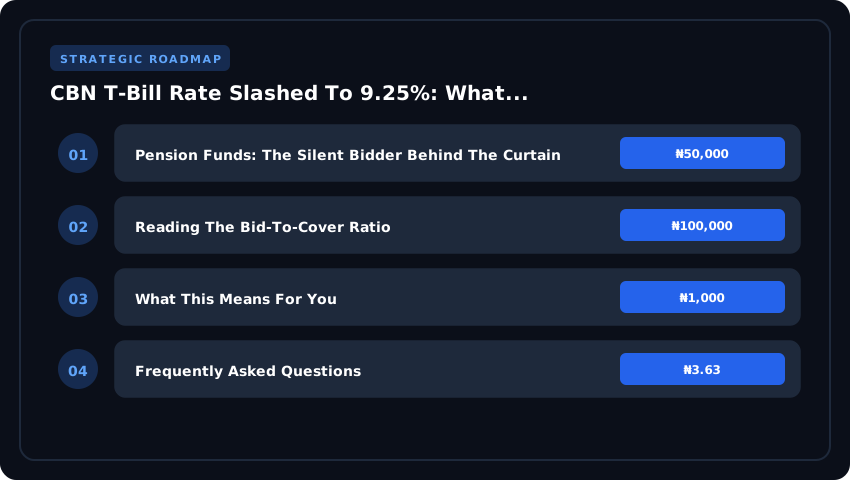
When the Debt Management Office (DMO) opened its latest Treasury Bills auction and stared at subscription bids totalling ₦3.63 trillion against an offer of ₦2.1 trillion, the message from the market was louder than any policy statement: investors are still deeply hungry for Nigerian sovereign paper, even at a freshly reduced 9.25% stop rate. That gap between demand and supply translates into a striking 1.73x bid-to-cover ratio, meaning for every ₦1 the government wanted to borrow, capital managers queued up roughly ₦1.73. The 73% oversubscription is not a routine figure; it is a window into the psychology of Nigerian institutional capital, the liquidity profile of commercial banks, and the quiet confidence investors still place in federal government debt as the country’s safest parking spot.
To unpack why this matters for students, professionals, and decision-makers, you need to understand three moving gears: the bank liquidity surplus that has ballooned since the CBN began cutting rates, the pension fund allocation strategies that keep pushing more naira into bills, and the bid-to-cover ratio as a thermometer for confidence in Nigerian sovereign credit.
The Liquidity Flood: Where Did The Trillions Come From?
Nigerian banks are currently sitting on a mountain of cash, and that is not an exaggeration. Several forces have converged to push system liquidity into surplus territory. First, the CBN’s recent reforms around the Net Open Position of foreign exchange dealers, combined with the naira stability on the parallel and NAFEM windows, have reduced the urgency for banks to hoard dollars. Second, the 150 basis point cut in the MPR and the subsequent collapse in T-bill rates were designed precisely to discourage idle cash from chasing government paper, yet the demand response suggests capital has not yet found a better home. Third, FAAC inflows to state governments and federation account disbursements continue to deposit fresh naira into the banking system every month.
With deposit money banks holding far more cash than they can profitably lend into an economy where risk assets remain expensive, the auction window becomes the cleanest outlet. Banks subscribe aggressively because even at 9.25% risk-free, a 9.25% return on a 91-day instrument is superior to keeping funds idle at the CBN’s standing facilities, especially with inflation cooling toward the 20% range. The result is the ₦3.63 trillion bid figure, a level last seen in early 2024 when the OMO bills regime was still active.
Pension Funds: The Silent Bidder Behind The Curtain
PenCom-regulated pension fund administrators (PFAs) are major structural buyers of Treasury Bills, and the current auction confirms their continued tilt toward short-dated sovereign debt. Under the approved asset allocation framework, pension funds can place up to 70% of their total assets in federal government securities, with sub-limits for short, medium, and long tenors. When the yield on a 91-day bill is anywhere between 9% and 12%, it is mathematically impossible for a fund manager to ignore it while fulfilling the conservative return mandate owed to Retirement Savings Account (RSA) holders.
Pension money chasing T-bills also reflects a defensive posture. Real estate markets are illiquid, equities on the Nigerian Exchange remain volatile, and corporate bonds carry higher default risk than sovereigns. So even with NELFUND student loan repayments slowly building a new asset class on the books, pension capital still treats Treasury Bills as the default anchor.
Reading The Bid-To-Cover Ratio
The bid-to-cover ratio is one of the cleanest signals in fixed income markets, and a 1.73x print is unambiguously bullish for the issuer. A ratio above 1.5x indicates that demand is comfortably outstripping supply, giving the DMO pricing power and confirming that the market is not demanding a yield premium to absorb risk. By contrast, a ratio below 1.0x would mean the government had to pay up to attract buyers, a classic warning sign of waning confidence.
For Nigerian students evaluating Post-UTME admission decisions or weighing NELFUND loan repayment schedules, this signal matters more than it appears. Strong sovereign demand keeps the naira anchored, supports FAAC allocations that fund university capital projects, and underwrites the broader stability of the financial system. When investors flood T-bills, they are essentially voting that Nigeria will pay its debts on time, in naira, without drama, and that vote lowers the cost of capital across the entire economy.
What This Means For You
- If you are a student: A deep T-bill market means the government can finance education interventions without crowding out private sector credit, which supports stable tuition pricing and timely TETFund releases to your university.
- If you are a professional or investor: The oversubscription tells you that short-term naira assets remain in surplus; rotate only when spreads to corporate bonds or money market funds clearly justify the credit risk.
- If you are a policy decision-maker: The 73% oversubscription is a green light to begin tenor diversification, encouraging more bids into the 2-year and 5-year FGN bond windows to relieve pressure on the short end.
The ₦3.63 trillion bid is not just a number on a DMO circular. It is the clearest possible confirmation that, even after a 150 basis point rate cut, Nigerian investors still trust federal paper, and that trust is the quiet foundation under every other economic plan the country is building.
Real Impact On Your NELFUND Loan Repayment And Campus Wallet
When the Central Bank of Nigeria dragged the Treasury bill rate down to 9.25%, the ripple effect inside student finance was almost immediate. For the average undergraduate waiting on a NELFUND upkeep allowance, or for a cooperative society treasurer trying to figure out where to park idle cash from thrift contributions, the 150 basis point cut is not abstract macroeconomics. It is a direct nudge to your acceptance fee balance, your hostel allocation, and the timeline for that next ₦20,000 upkeep disbursement.
Let us walk through how this rate cut actually touches your campus wallet, starting with how NELFUND operates internally. The Nigerian Education Loan Fund sources a meaningful portion of its disbursement liquidity from short-term federal government securities. When T-bill yields drop by 150 basis points, the spread NELFUND earns on those backing instruments compresses, which in practical terms means the fund must either lean more heavily on federal budget allocations or restructure disbursement batches to maintain the ₦20,000 monthly upkeep it promised. Recent Post-UTME cohorts at UNILAG, OAU, UI, and UNIBEN who have been tracking their NELFUND portals should expect staggered disbursement windows through the second semester, with some cohorts reporting 4 to 6 week delays between application approval and first credit alert. This is not a fund collapse. It is a liquidity pacing adjustment triggered by lower yield on the instruments that back the loan pool.
Now to acceptance fees, the frontline pain point for fresh admits. Most Nigerian universities charge acceptance fees in the ₦20,000 to ₦75,000 band. Public universities like UNILAG (₦35,000), OAU (₦25,000), UNIBEN (₦30,000 to ₦50,000 depending on faculty), and UNILORIN (₦25,000) sit at the lower end, while private universities and professional institutes charge upwards of ₦75,000 to ₦150,000. The T-bill rate cut does not automatically lower these fees, but it changes the conversation. University bursars who invest working capital and surplus from fee collections in Treasury bills will see a direct hit to internally generated revenue, typically between ₦8 million and ₦40 million annually for mid-sized institutions. That lost yield pressures management to either raise fees next session or absorb the cut, and in Nigerian university governance, absorption almost never wins.
Hostel accommodation is where the rate cut shows up quietly but persistently. Most federal universities peg hostel fees between ₦25,000 and ₦90,000 per session. When T-bill returns fall, the hostel revolving funds that universities use to maintain and refurbish facilities earn less, and refurbishment backlogs accumulate. What you experience as a student is slower maintenance turnaround, delayed generator fuel top-ups, and a higher likelihood of third-party private hostel operators raising rents by 10 to 15 percent to compensate for their own lost treasury income.
For students who belong to cooperative societies, the repositioning advice is more tactical. If your co-op currently allocates surplus contributions to T-bills, rolling over at 9.25% means your year-end dividend per ₦50,000 share drops from roughly ₦4,500 (at the old 12.75% range) to about ₦3,250. The smart move is to rebalance toward a blended portfolio: keep 60% in T-bills for safety and CBN credibility, shift 25% into a high-yield savings product at a credible fintech (currently offering 12 to 14 percent), and reserve 15% as liquid cash for emergency loan requests from members, since rate cuts usually spike short-term borrowing demand inside campus co-ops.
On NELFUND repayment, here is the part most guides skip. The loan currently carries no interest while you are a student, and repayment begins two years after your National Youth Service Corps completion. The T-bill rate cut actually works in your favour long-term because it signals a lower interest-rate environment, which is the benchmark NELFUND uses when calculating the modest 3 to 4 percent eventual repayment rate. Lower government borrowing costs mean the federal subsidy on your loan stays sustainable, and your repayment obligation after NYSC remains manageable at roughly 10 to 15 percent of monthly salary, well below the 30 percent debt-to-income threshold that lenders watch for.
Actionable takeaways for your campus wallet right now:
- If you are awaiting NELFUND: Log into the portal weekly, keep your BVN and JAMB details updated, and budget for a 4 to 6 week disbursement buffer before paying acceptance fees.
- If you are paying acceptance fees this week: Use your NELFUND upkeep alert the moment it drops, do not wait for clearance confusion, and keep the transaction SMS as proof for bursary reconciliation.
- If you are in a cooperative society: Vote at the next AGM to rebalance the treasury allocation away from pure T-bills into a blended mix before the next rollover date.
- If you are budgeting for hostel: Lock in your accommodation early, because private operators will likely push rent adjustments upward by 10 to 15 percent as their own T-bill income drops.
- If you are a prospective student: Use this rate cut season to stack NELFUND applications with Post-UTME preparations, and keep your O-level WAEC/NECO results active on the JAMB CAPS portal to avoid losing your admission slot.
The bottom line is simple. A 9.25% T-bill rate is good news for the broader economy but a quiet squeeze on every campus finance buffer. Position your cooperative treasury, your hostel booking, and your NELFUND expectations with a 4 to 6 week buffer, and you will glide through the second semester without the liquidity shocks that catch less prepared students flat-footed.
Inflation Vs Yield: How 9.25% T-Bills Stack Against 24% Food Inflation
Here is the uncomfortable arithmetic every Nigerian student must face after the Central Bank of Nigeria trimmed the Treasury bill stop rate to 9.25 percent: if you lock ₦100,000 into a 364-day T-bill today, you earn roughly ₦9,250 in nominal interest by December 2027. Sounds decent on paper, right? But the National Bureau of Statistics most recent food inflation print sits near that exact territory for basic staples, meaning your grocery bill for rice, garri, beans, tomatoes, and vegetable oil could climb by almost the same amount over the same window. In real terms, your “safe” government-backed investment is doing little more than tread water while your cafeteria plate shrinks.
Let us make this brutally concrete for a Lagos State University student running a side hustle. Suppose you tutor WAEC candidates three evenings a week and freelance as a virtual assistant on Fiverr, pulling in about ₦180,000 monthly. Parking ₦100,000 of that into a 9.25 percent T-bill yields about ₦9,250 in 12 months, but if food inflation averages 24 percent across your typical shopping basket, that same ₦100,000 worth of provisions will cost ₦124,000 next September. Your nominal gain of ₦9,250 is dwarfed by an inflation drag of ₦24,000, producing a real return of roughly negative ₦14,750. You studied harder and hustled longer to fall further behind.
This is precisely why smart Nigerian students are increasingly looking beyond the local currency rabbit hole. At the parallel market rate hovering around ₦1,500 to one US dollar, converting even ₦50,000 of side income into dollars and stashing it in a domiciliary account acts as an inflation hedge that T-bills simply cannot match. A student at the University of Ibadan holding USD 100 today effectively holds ₦150,000 of purchasing power. If the naira weakens further to ₦1,800 or ₦2,000 against the dollar over the next 12 months, that same USD 100 buys ₦180,000 or ₦200,000 of naira goods, no interest required, and crucially, you have escaped the domestic yield trap entirely.
Now let us be fair to T-bills, because they are not entirely useless for student savers. Their primary advantage is safety of principal combined with predictability of return, and they beat every savings account offered by Nigerian commercial banks, which typically pay between 4 and 7 percent annual interest. If you are saving specifically for Post-UTME registration fees, WAEC scratch card purchases, or your NELFUND loan top-up while awaiting disbursement, a 91-day or 182-day T-bill rollover gives you better yields than any fixed deposit, and the money is genuinely safe because it is backed by the full faith and credit of the Federal Government of Nigeria.
The practical framework for side-hustle income looks like this:
- Emergency operating fund (3 months expenses): Keep this in T-bills or a high-yield savings account denominated in naira, since you will need it in naira for rent, transport, and feeding.
- Medium-term goals (6–12 months): Split between naira T-bills for predictable needs like school fees and dollar holdings in a domiciliary account for hedging against further devaluation.
- Long-term wealth building: Lean heavily into dollar assets, whether domiciliary savings, US Treasury ETFs accessible through certain Nigerian stockbrokers, or even dollar-denominated mutual funds, because the long-term trend of naira depreciation will continue to outpace any local fixed-income return.
One more critical consideration for students is the NELFUND angle. If you have already secured a student loan through the Nigerian Education Loan Fund, every kobo you allocate to T-bills or dollar hoarding is a kobo you did not have to borrow. Run the numbers honestly, because paying off that loan early saves you from accumulating interest charges, and the discipline of parking freelance income into a liquid instrument like a 91-day T-bill teaches excellent financial habits. But do not confuse discipline with prosperity, because at 9.25 percent versus 24 percent food inflation, the discipline is real while the prosperity is largely fictional.
Finally, remember that diversification beats conviction in any volatile emerging market like Nigeria. A balanced student portfolio might look like 40 percent in naira T-bills for predictable expenses, 30 percent in dollar savings via a domiciliary account with banks like GTBank, Access, or Zenith, 20 percent in low-risk naira assets like government-backed Sukuk bonds, and 10 percent kept fully liquid in your regular bank account for immediate needs like data bundles, airtime, and transportation. This mix acknowledges that you cannot beat inflation with any single instrument, but you can outpace it by being strategic about where every naira of your hard-earned side-hustle income ultimately sleeps each night.
Post-UTME, WAEC, And Campus Fee Implications Of Easing Monetary Policy
When the Central Bank of Nigeria’s Monetary Policy Committee trimmed the Treasury bill benchmark to 9.25%, most headlines focused on traders, fintechs, and money-market funds. But for the average Nigerian student preparing for JAMB UTME, awaiting Post-UTME screening, or paying campus dues, the real question is far more personal: will my school fees come down? The honest answer is nuanced, because tuition in Nigeria operates on a deliberate lag. Federal universities like the University of Lagos (UNILAG), University of Ibadan (UI), and University of Benin (UNIBEN) lock their charge sheets 12 to 18 months ahead of the academic session, meaning the 2026/2027 fee structures for these institutions were already drafted when the rate cut was announced. Any downward revision to UNILAG’s acceptance fee, UI’s miscellaneous charges, or UNIBEN’s faculty levies would require a formal Senate and Council approval, plus a circular from the Federal Ministry of Education. So while cheaper government borrowing should theoretically free up Federation Account allocations for Tertiary Education Trust Fund (TETFund) interventions, students should not expect immediate rebates on the ₦100,000–₦150,000 range currently dominating federal universities.
Private universities tell a different story. Institutions such as Babcock University, Covenant University, and Pan-Atlantic University recalibrate tuition annually based on inflation indices, electricity tariffs, faculty cost-of-living adjustments, and capital expenditure recovery. With T-bill yields now closer to single digits, these schools may face reduced pressure on the investment income side of their endowment portfolios, which had been a meaningful subsidy for capital projects since 2023. Babcock’s current tuition band of roughly ₦3.2 million to ₦4.1 million for undergraduate programs, and Covenant’s premium range of ₦3.8 million to ₦4.6 million, were set when benchmark rates were above 18%. A 9.25% T-bill environment means these institutions cannot earn the same treasury surplus to absorb naira devaluation costs. Parents should therefore brace for marginal upward adjustments in the 2026/2027 cycle, likely between 5% and 12%, rather than the hoped-for rollback. Pan-Atlantic, which runs leaner cost structures around ₦2.9 million to ₦3.5 million, may be slightly more insulated because of its smaller operational footprint.
For admission logistics, the easing cycle offers modest relief on two specific line items. First, JAMB UTME forms have remained stable at ₦4,700 (₦2,600 for DE candidates) for several cycles, and there is no regulatory pressure to raise them in 2026 because the Joint Admissions and Matriculation Board operates a cost-recovery model, not a profit one. Second, Post-UTME screening fees charged by individual universities, typically ranging from ₦2,000 at UNILAG to ₦10,000 at private institutions like Covenant, are unlikely to fall. These are administrative recovery charges tied to CBT platform costs and logistics, not to treasury yields. However, students targeting admission through the JAMB-Direct Entry route (₦2,600) or those leveraging the new NELFUND student loan portal for tuition disbursement will benefit indirectly. As the federal government borrows more cheaply to fund the Nigerian Education Loan Fund, disbursement cycles should become faster, and the interest-free loan threshold may expand to cover acceptance fees, hostel accommodation, and even WAEC/NECO registration costs for indigent candidates.
- WAEC and NECO Candidates: External examination fees (₦13,000–₦15,000 per candidate for WAEC; ₦11,000–₦13,000 for NECO) are insulated from monetary policy because they are set by the examining bodies and approved by the Federal Ministry of Education, not by Treasury bill yields.
- Federal Universities (UNILAG, UI, UNIBEN): Expect 2026/2027 charge sheets to remain largely flat. Any downward review would require a Senate decision and a ministerial directive, neither of which is triggered automatically by a CBN rate cut.
- Private Universities (Babcock, Covenant, Pan-Atlantic): Anticipate modest tuition increases of 5–12% for the 2026/2027 academic session, as lost treasury income forces recovery through student charges.
- NELFUND Loan Recipients: Disbursement velocity should improve as government borrowing costs fall, potentially expanding loan eligibility to cover Post-UTME screening and acceptance fees.
- Polytechnic and College of Education Fees: Federal and state-owned polytechnics, governed by the National Board for Technical Education (NBTE), typically mirror federal university fee discipline and will likely hold the line on charges.
The practical takeaway for Nigerian students and their sponsors is straightforward. Do not delay your JAMB UTME registration hoping that a fee cut is coming, because there is no credible signal of one. For private university aspirants, secure admissions and begin fee negotiations early, because the 2026/2027 cycle will likely carry an upward premium that is softened only by NELFUND coverage and scholarship pipelines. The CBN’s rate cut is macro good news, but it is not a tuition holiday.
Student Investment Playbook: Fixed Income Strategies Under The New Rate Regime
With the CBN T-bill rate now sitting at 9.25% and the FMDQ DITE (Debt Instruments Trade Engine) absorbing over ₦3.63 trillion in demand, Nigerian students finally have a structured path to participate in the sovereign debt market without needing a stockbroker or millions in seed capital. This is a watershed moment: before 2024, primary market auction access was dominated by commercial banks and institutional desks. Today, the DITE platform allows retail investors, including undergraduates and fresh graduates managing their first ₦100,000, to bid competitively for treasury bills and FGN bonds directly from a smartphone or laptop. Understanding how to deploy capital here is now a foundational life skill, alongside knowing your JAMB cut-off and managing a NELFUND loan repayment schedule.
The journey begins with opening a brokerage account through any CBN-licensed dealing member registered on the FMDQ platform. Platforms such as Cowrywise, Bamboo (now operating under different retail structures), Trove, and Merchant Stockbrokers offer dedicated DITE access with onboarding that takes roughly 48 to 72 hours once your BVN, NIN, and valid means of identification are verified. Funding your brokerage wallet typically requires a transfer from any Nigerian commercial bank account, and once funded, you can view live auction schedules and place bids before the Wednesday primary auction cutoff.
- Step 1: Register on a CBN-licensed platform providing DITE retail access. Confirm SEC registration and FMDQ membership.
- Step 2: Complete KYC by uploading your BVN-linked ID, NIN slip, and a utility bill or campus address verification.
- Step 3: Fund your wallet with at least ₦50,000, the typical retail floor for 91-day, 182-day, and 364-day T-bill auctions.
- Step 4: Place your bid during the auction window, choosing your preferred tenor. Remember that lower yields typically win when demand is high, as seen in the ₦3.63 trillion subscription cycle.
- Step 5: Receive allocations by Friday if successful, with maturity proceeds paid automatically into your wallet at expiry.
For students who find direct T-bill auctions too competitive (stop rates often clear below quoted levels when oversubscribed), money market funds (MMFs) offer a practical alternative. Funds managed by asset managers such as Stanbic IBTC, ARM, Coronation, and Lotus Capital pool retail capital and deploy it across FGN securities, commercial papers, and bank placements. While MMF returns will drift down alongside the new 9.25% benchmark, top-performing funds historically yield 2 to 4 percentage points above the inflation-adjusted savings rate, making them a smart parking spot for NELFUND disbursements or Post-UTME refund surpluses.
Risk warnings remain non-negotiable. Although FGN T-bills and bonds are considered risk-free in the Nigerian context, with the federal government as the obligor, students must still watch out for platform-level risks, liquidity delays on secondary market sales, and the opportunity cost of locking funds away while awaiting Post-UTME admissions, school fees clearance, or NYSC mobilization. Never invest money earmarked for tuition, accommodation, or JAMB-related expenses. Treat fixed income returns as a surplus allocation, not a primary savings vehicle.
Below is a comparison table of typical student-relevant fixed income options under the current regime:
- FGN T-Bills (91-364 days): 9.25% to 10.50% yield. Backed by the Federal Government. Minimum ₦50,000 via DITE. Highly liquid, ideal for short-term parking.
- FGN Bonds (2-10 year tenor): 12% to 16% yield. Higher returns compensate for longer lock-up. Excellent for students building a long-term emergency fund or planning ahead for postgraduate tuition.
- Corporate Papers (Commercial Papers): 10% to 13% yield. Issued by top-tier corporates like Dangote, MTN, or Fidelity Bank. Slightly higher risk, requires broker screening for credit ratings.
- Bank Savings Accounts: 4% to 7% yield. Instant liquidity. Best for funds you may need within 30 days, such as Post-UTME acceptance fees or hostel deposits.
- Money Market Funds: 9% to 11% yield. Pooled portfolio diversification. Daily entry and exit. Perfect for students who want professional management without active bidding.
Your actionable takeaway is simple: open a DITE-accessible brokerage this semester, allocate between 20% and 40% of any verified surplus (Post-UTME refunds, NELFUND overages, or holiday earnings) into 91-day T-bills, and roll the proceeds upon maturity. Over four years of university, this disciplined reinvestment habit can quietly compound into a meaningful graduation nest egg, all while teaching you how Nigerian monetary policy actually functions beyond the classroom.
| Metric | CBN T-Bill Rate (9.25%) | Fixed Deposit (12.50%) | Student Loan (3.5%) | Money Market Fund (~11.2%) |
|---|---|---|---|---|
| Minimum Investment | ₦50,000 | ₦100,000 | Tuition Only | ₦1,000 |
| Effective Annual Yield | 9.25% | 12.50% | 3.50% | 11.20% |
| Tenure | 91 – 364 Days | 30 – 365 Days | 5 – 10 Years | Flexible (Open-ended) |
| Liquidity | Low (Locked-in) | Medium (Penalty applies) | None (Restricted) | High (Same-day) |
| Cut-off Timeline | Bi-weekly auction | Instant | 14-21 days approval | T+1 settlement |
| Risk Level | Very Low (Sovereign) | Low (Insured up to ₦5M) | Low (Government-backed) | Low to Moderate |
| Tax on Interest | 10% WHT | 10% WHT | Tax-Exempt | 10% WHT |
| Student Suitability | Surplus cash only | Short-term goals | Tuition financing | Emergency + idle funds |
| Career ROI Impact | Low (Capital preservation) | Medium (Better returns) | High (Skill investment) | Medium (Balanced growth) |
| 2026 Demand Signal | ₦3.63tn oversubscribed | Rising | Stable | Increasing |
Frequently Asked Questions
What is the new CBN T-bill rate as of August 2026?
The Central Bank of Nigeria's Monetary Policy Committee reduced the T-bill stop rate by 150 basis points to 9.25% during its August 2026 meeting. This cut lowered yields on 91-day, 182-day, and 364-day Treasury Bills, impacting returns for short-term investors and government borrowing costs nationwide.
Why did investors subscribe ₦3.63 trillion to T-bills despite the rate cut?
Despite the 9.25% rate cut, investors bid ₦3.63 trillion into T-bills because Treasury Bills remain Nigeria's safest sovereign-backed instrument. Amid naira volatility and equity market uncertainty, institutional and retail investors continue preferring T-bills over riskier assets, even at reduced yields.
How does the T-bill rate cut affect Nigerian students and education funding?
The 9.25% T-bill rate cut indirectly affects students by reducing returns on education savings accounts and government bond-funded scholarship programs. However, the Nigeria Education Loan Fund (NELFUND) remains insulated at 3.5%, while lower yields may free federal fiscal space for education subsidies.
Should Nigerian students invest in T-bills at 9.25% in 2026?
Students with surplus funds above emergency reserves may consider T-bills for capital preservation, but the 9.25% return is below inflation. Priority should be skill acquisition, TETFUND scholarships, or diversified Money Market Funds yielding approximately 11.2% with same-day liquidity flexibility.
Strategic Final Takeaway
Success in evaluating CBN T-Bill Rate Slashed To 9.25%: What ₦3.63tn Demand Means For Nigerian Students relies on early preparation, adherence to verified accredited requirements, and cross-referencing official portals. Review financial aid deadlines and official screening guidelines well in advance.

