

Charterhouse Lagos 2026 Scholarship Categories & Fee Remission Tiers
Understanding the financial architecture of a Charterhouse Lagos education is the first strategic step for any prospective family. For the 2026 academic session, the school maintains a transparent, tiered approach to financial support, clearly distinguishing between scholarships (awarded purely on merit and potential) and bursaries (awarded based on demonstrated financial need). This distinction is critical: a scholarship honours what your child achieves; a bursary supports what your family requires to access that excellence.

Before diving into the remission tiers, let us anchor the conversation in the 2025/2026 fee baseline (subject to annual review). Current annual tuition stands at approximately ₦18,500,000 for Day pupils and ₦28,750,000 for Full Boarders. These figures cover tuition, lunch (Day), and full accommodation, meals, laundry, and pastoral care (Boarding). Additional mandatory costs include a non-refundable Acceptance Fee (approx. ₦1,500,000) and a Refundable Caution Deposit (approx. ₦2,000,000). Knowing these numbers allows you to calculate the real Naira value of every percentage remission offered below.
Merit-Based Scholarship Categories (Fee Remission Tiers)
Charterhouse Lagos awards scholarships at three distinct remission levels: 25% (Exhibition), 50% (Scholar), and 100% (Foundation Scholar). The 100% tier is exceptionally rare, reserved for candidates demonstrating truly transformative potential aligned with the school’s founding ethos. Most awards fall within the 25%–50% band. Crucially, scholarships are not means-tested; a high-net-worth family winning an Academic Scholarship receives the same remission as a family of modest means.

- Academic Scholarships: Awarded based on performance in the competitive Scholarship Examination (English, Mathematics, Verbal/Non-Verbal Reasoning) and interview. Exhibitions (25%) recognise strong academic promise; Scholarships (50%) denote exceptional intellectual rigour; Foundation Scholarships (100%) require near-perfect scores plus a compelling interview demonstrating leadership and intellectual curiosity.
- Music Scholarships: Candidates audition on two instruments (or voice + instrument) at Grade 5 ABRSM/Trinity standard minimum (Grade 7+ for 50%+ tiers). Assessment includes sight-reading, aural tests, and a discussion on musical leadership. Remission tiers mirror academic: 25% (strong potential), 50% (outstanding musicianship), 100% (exceptional talent with ensemble leadership track record).
- Sport Scholarships: Awarded for excellence in core Charterhouse sports (Rugby, Cricket, Hockey, Football, Swimming, Athletics, Tennis). Candidates must represent at state/national level or equivalent academy standard. 25% for strong county/regional representation; 50% for national youth squad involvement; 100% for elite international pathway athletes.
- All-Rounder Scholarships: Unique to Charterhouse Lagos, this rewards pupils with combined high academic attainment (top 15% in entrance exams) plus significant contribution in two of: Music, Sport, Drama, Art, or Leadership/Service. Typically awarded at 25% or 50% remission. This category celebrates the “whole person” philosophy central to the Carthusian ideal.
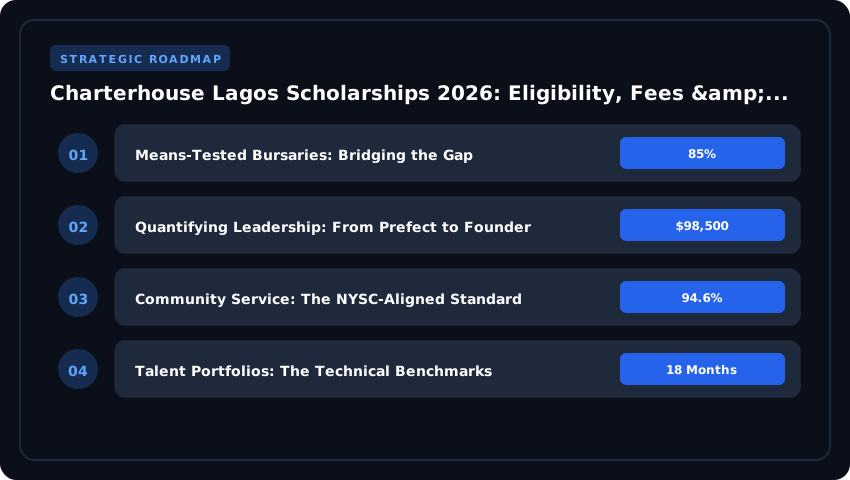
Means-Tested Bursaries: Bridging the Gap
Bursaries operate on a sliding scale, potentially covering up to 100% of tuition fees (and in exceptional hardship cases, contributing to boarding extras, uniform, and transport). They require full financial disclosure: tax returns (FIRS), bank statements (12 months), asset declarations, and a home visit by the Bursar’s office. Awards are reviewed annually. A family earning ₦15M–₦25M per annum with multiple dependents may qualify for 30–50% support; families below ₦15M may access 75–100%. Key strategic insight: You can hold a Merit Scholarship (e.g., 25% Academic) and a Bursary simultaneously to bridge the remaining gap, but total remission rarely exceeds 100% of tuition.
Actionable Takeaway: If your child is a high performer, target the Scholarship Examination route first—it carries prestige and zero financial intrusion. If fees remain prohibitive even with a scholarship, immediately request the Bursary Application Pack from the Admissions Office; the deadline typically aligns with the main entrance exam date in January 2026.
Eligibility Criteria: Academic Benchmarks & Age Requirements for 2026 Entry
Securing a place at Charterhouse Lagos for the 2026 academic session—and positioning yourself competitively for their prestigious scholarship programme—begins with a clear-eyed assessment of the non-negotiable entry thresholds. The school operates a highly selective entry point at Year 12 (Lower Sixth), designed explicitly for the two-year A-Level programme that feeds directly into top-tier global universities. Unlike the standard Nigerian Senior Secondary School (SS3) terminal point, this entry requires students to have completed their IGCSE, WAEC, or NECO examinations prior to September 2026. If you are currently in SS2 or Year 11, this is your target window; if you are in SS3 expecting results in August 2026, you are cutting it extremely fine and must have verified forecasts.
The academic benchmark is rigorous but transparent. For the 2026 cohort, the baseline requirement is a minimum of five (5) subjects at Grade B (or Grade 6) and above. In the IGCSE framework, this translates to grades A* to B (9–6). For candidates sitting the WAEC (WASSCE) or NECO (SSCE), the equivalent expectation is a minimum of Credit (C4, C5, C6) in five subjects including Mathematics and English Language, though competitive scholarship applicants typically present a profile of A1 to B3 grades across the board. It is critical to understand that “meeting the minimum” rarely secures a scholarship; the remission tiers are awarded to those whose transcripts demonstrate consistent excellence, typically 7–9 subjects at A*/A (9–7) or A1/B2.
Subject-specific prerequisites dictate your pathway options, and this is where many applicants lose momentum. You cannot simply present five good grades; they must be the right five grades for your intended A-Level combination:
- STEM Pathway (Sciences, Engineering, Medicine, Computer Science): You must present a minimum of Grade A (or 7/8/9) in Mathematics and the specific Sciences you intend to study (Physics, Chemistry, Biology). Further Mathematics at IGCSE/WAEC is a distinct advantage for Engineering and Physics candidates. A Grade B in English Language is the absolute floor; most successful STEM scholars hold A/A*.
- Arts, Humanities & Social Sciences Pathway (Law, Economics, Literature, History): A Grade A (or 7+) in English Language and English Literature is expected. For Economics or Business-related routes, a high grade in Mathematics (minimum B/6) is mandatory. History, Government, or Geography grades serve as strong supporting evidence.
- Creative Arts & Music: Beyond the academic floor (5 Bs/6s), a portfolio audition or practical assessment is mandatory. Academic grades in Art, Design Technology, or Music support the application but do not replace the practical evaluation.
Age eligibility is strictly enforced to ensure pastoral and academic maturity within the boarding environment. For September 2026 entry, candidates must have turned 16 years old on or before 1st September 2026. Candidates turning 17 during the academic year are standard; those who will be 18 before December 2026 may be considered “over-age” for Lower Sixth and should consult the Admissions Office directly regarding Upper Sixth (Year 13) direct entry, which is exceptionally rare and requires completed AS-Levels. There is no flexibility on the lower age limit—this is a safeguarding and curriculum-pacing requirement aligned with UK boarding standards.
Actionable Takeaway: Do not wait for final certificates. If your Mock exams or Year 11/SS2 promotion results show the required profile (minimum 5 As/Bs including core subject prerequisites), begin your application dossier immediately. Charterhouse Lagos evaluates predicted grades and school references heavily during the scholarship assessment window (typically October–January). Secure your Principal’s confidential reference early, and ensure your current school can provide verified transcripts and predicted grades on official letterhead by the application deadline.
The Application Timeline: Key Dates, Entrance Exams & Interview Stages
Navigating the Charterhouse Lagos scholarship application cycle requires strategic timing, especially for West African families balancing WAEC, NECO, and JAMB UTME preparations. The 2025-2026 admission cycle is designed to identify exceptional talent through a rigorous, multi-stage process. Here is your month-by-month roadmap to ensure you never miss a critical deadline.
- September – October 2025 (Registration Phase): The official scholarship portal opens in early September. Prospective applicants must submit their initial online forms before the mid-October deadline. The non-refundable application fee is typically around ₦50,000. Early registration is crucial, as it allows ample time to schedule prerequisite standardized tests and gather academic transcripts from your current school.
- November 2025 (Cognitive Assessments): Registered candidates will sit for the Cognitive Abilities Test (CAT4) or the UKiset. These assessments evaluate verbal, non-verbal, quantitative, and spatial reasoning. For Nigerian students accustomed to the objective formats of WAEC and NECO, these tests require a deliberate shift toward critical thinking and abstract problem-solving rather than rote memorization.
- December 2025 – January 2026 (Subject-Specific Papers): Following the cognitive assessments, shortlisted candidates proceed to subject-specific written examinations. Whether you are applying for a STEM, Humanities, or Arts scholarship, these papers test deep curriculum understanding. Expect questions that go beyond standard JAMB UTME formats, demanding analytical essays, complex problem-solving, and independent research skills.
- February 2026 (Scholarship Assessment Days): Candidates who excel in the written papers are invited to the Lagos campus for Assessment Days. This immersive experience includes collaborative group tasks, practical laboratory work, and interactive workshops. It is a golden opportunity for the admissions panel to observe leadership, teamwork, and adaptability in real-time.
- March 2026 (Panel Interviews & Final Decisions): The final hurdle is the formal panel interview. Families can expect final scholarship decisions by late March, allowing sufficient time to plan financially and logistically for the September 2026 resumption.
To ace the panel interview, candidates should articulate not just academic prowess, but character and community impact. Practice discussing your personal statement confidently, and be prepared to answer questions about how you plan to contribute to the Charterhouse community. Remember, the panel is looking for well-rounded future leaders, not just brilliant test-takers. Prepare a portfolio of your extracurricular achievements—whether in debate, sports, or community service—to demonstrate your holistic value. By aligning your WAEC/NECO study schedule with this timeline, you can approach the Charterhouse application with confidence and clarity.
Building a Competitive Portfolio: Beyond Grades (Leadership, Service & Talent)
At Charterhouse Lagos, the scholarship committee operates on a holistic All-Rounder Assessment Matrix that weighs character and contribution as heavily as academic distinction. For the 2026 intake, a straight-A WAEC or IGCSE result is merely the entry ticket; the scholarship itself is awarded to the student who demonstrates impact. Think of your portfolio as a professional curriculum vitae rather than a school report card. Every claim must be evidenced, quantified, and verified.
Quantifying Leadership: From Prefect to Founder
Leadership is scored on scope, autonomy, and legacy. Holding a prefect badge is the baseline (Tier 1). To compete for the top remission tiers (75–100%), you need Tier 2 and 3 evidence:
- Tier 1 – Institutional Roles: Head Boy/Girl, Senior Prefect, House Captain. Action: Submit a one-page impact report signed by your Principal detailing specific initiatives you led (e.g., “Redesigned the school waste management system, reducing landfill waste by 40%”).
- Tier 2 – Peer-Led Organisations: Founding a club, NGO, or social enterprise. Action: Provide CAC registration documents (if incorporated), a constitution, membership data, and audited accounts or project receipts. A student who founded a literacy NGO distributing 500 books to underserved Lagos communities scores significantly higher than a passive club president.
- Tier 3 – External Recognition: Selection for the African Leadership Academy Global Scholars Program, Yale Young African Scholars, or serving as a Youth Ambassador for a UN SDG goal. These external validations carry immense weight.
Community Service: The NYSC-Aligned Standard
Charterhouse expects service hours to mirror the rigour of the National Youth Service Corps (NYSC) Community Development Service (CDS) model—structured, sustainable, and measurable. Random weekend volunteering is discounted. You need a minimum 120 verified hours over 18 months, logged in a dedicated Service Logbook signed by a supervisor (not a parent).
- Strategic Alignment: Projects addressing SDG 4 (Quality Education), SDG 3 (Health), or SDG 13 (Climate Action) are prioritised.
- Documentation: Submit a “Project Charter” (objectives, timeline, budget), mid-term review, and final impact report with beneficiary testimonials and photographic evidence (geo-tagged).
- Pro Tip: Partner with a registered Nigerian NGO (e.g., Slum2School, LEAP Africa) to lend institutional credibility to your hours.
Talent Portfolios: The Technical Benchmarks
For Music, Sport, and Art/Drama scholarships, subjective “talent” is replaced by standardised external benchmarks.
- Music: ABRSM Grade 6+ (Distinction preferred) or MUSON Diploma equivalent is the non-negotiable floor for 100% remission. Submit unedited video recordings of two contrasting pieces (one Nigerian art music piece, one Western classical), plus aural test certificates and theory results.
- Sport: Representation at State Level (National Sports Festival) or National U-17/U-20 Squads. School-level medals (e.g., GTBank Masters Cup) are Tier 2. Provide federation-issued ID cards, selection letters, and performance analytics (times, rankings, match stats).
- Art & Drama: A curated digital portfolio (15–20 pieces) showing developmental process (sketchbooks, mood boards). For Drama, LAMDA Grade 6+ Gold Medal or verified lead roles in professional productions (e.g., Terra Kulture stage plays) are required. Include a 500-word artist’s statement linking your work to Nigerian cultural narratives.
Final Checklist: Bind everything into a single PDF portfolio: Academic Transcript → Leadership Impact Reports → Service Logbook (Supervisor Signed) → Talent Certificates/Links → Two Academic References + One Character Reference (non-family). The committee reads for authenticity; a smaller, genuine portfolio beats a padded, generic one every time.
Means-Testing & Bursary Application: Financial Disclosure Requirements for Nigerian Families
Securing a means-tested bursary at Charterhouse Lagos is not merely about proving you need help; it is about demonstrating financial integrity through a rigorous, forensic audit of your household economics. The school’s Confidential Statement of Financial Circumstances (CSFC) is the single most critical document in your bursary file. Treat it with the same gravity you would a Central Bank of Nigeria (CBN) audit or a NELFUND loan verification. Incomplete disclosure is the fastest route to automatic disqualification, regardless of your child’s academic brilliance.
The Document Checklist: Non-Negotiables for 2026
The admissions office requires a “whole picture” view. For the 2026 cycle, ensure these originals (and certified photocopies) are ready before you log into the portal:
- Tax Clearance Certificates (TCC): Valid for the last three assessment years (2023, 2024, 2025) for both parents/guardians. If you are a PAYE employee, your employer’s annual returns (Form H1) must align perfectly with your payslips. For business owners, Personal Income Tax returns filed with the relevant State Internal Revenue Service (e.g., LIRS, OGIRS) are mandatory.
- Six Months’ Bank Statements: Current, Savings, and Domiciliary accounts for all signatories to the household finances. The school’s bursary team runs algorithmic checks for “window dressing”—sudden large inflows/outflows immediately preceding the application. Be prepared to annotate any transaction above ₦500,000.
- CAC Documents (Business Owners): Certificate of Incorporation, Memorandum & Articles of Association (MEMART), Status Report (Form CAC 1.1), and—crucially—the last three years of Audited Financial Statements signed off by an ICAN/ACCA registered auditor. If your business is a “one-man show,” the distinction between personal drawings and company profit will be scrutinized heavily.
- Pension & Investment Slips: RSA statements (PENCOM), mutual fund statements, stockbroker portfolio valuations (CSCS), and property rental income schedules. Assets held in trust for the child (e.g., education endowment policies) must be declared; they reduce the bursary quantum but rarely eliminate eligibility.
- Liability Schedule: A signed declaration of all debts—mortgages (Federal Mortgage Bank or commercial), car loans, outstanding school fees for siblings, and family medical emergencies. This works in your favour by lowering your Adjusted Family Income.
How Charterhouse Calculates ‘Adjusted Family Income’ (AFI) in Naira
Charterhouse does not simply look at your Gross Annual Income. They apply a proprietary Adjusted Family Income (AFI) formula designed for the Nigerian cost-of-living reality. The logic flows roughly as follows:
- Start: Gross Combined Household Income (₦).
- Deduct: Statutory Deductions (PAYE, Pension 8%, NHF 2.5%).
- Deduct: Verified “Non-Discretionary” Costs: Rent/Mortgage (capped at 30% of Net Income), mandatory sibling school fees (capped at prevailing Federal Unity College rates + 20%), and documented chronic medical expenses.
- Add Back: “Discretionary Lifestyle Add-backs.” This is the trap. Luxury vehicle running costs (fuel/maintenance for SUVs > ₦30M), club memberships, frequent international travel (evidenced by passport stamps/forex spend), and domestic staff costs exceeding two helpers are added back to your income. The school assumes these are choices, not necessities.
- Result: Your AFI (₦). This figure slots you into the Fee Remission Tiers (e.g., AFI < ₦15M = Tier 1: 90% remission; AFI ₦15M–₦35M = Tier 2: 50–75%).
Common Disqualifiers: The “Red Flags” That Kill Applications
Year after year, strong candidates fall at this hurdle. Avoid these fatal errors:
- The “Cash Economy” Gap: Declaring a monthly income of ₦800,000 but bank statements show ₦2.5M in POS deposits and school fees paid in cash for siblings. Unexplained liquidity triggers a full forensic request.
- Asset/Income Mismatch: Living in a ₦15M/annum rental in Lekki Phase 1 on a declared AFI of ₦12M without a verifiable sponsor letter (notarized, with sponsor’s own TCC).
- Selective Disclosure: Omitting a spouse’s income because “they pay for their own things.” Charterhouse assesses the household unit. Separation of finances requires a legal Separation Agreement or Divorce Decree Absolute.
- Stale Documents: Submitting a 2022 Tax Clearance Certificate in a 2026 application. The portal will hard-reject the upload.
Pro Tip: Engage a chartered accountant (ICAN) to prepare a “Bursary Financial Health Report” summarizing your AFI calculation before you submit. It costs roughly ₦150,000–₦300,000 but pays for itself by preventing the “Request for Further Information” loop that misses the deadline. Honesty, backed by professional presentation, is the only currency Charterhouse accepts.
Post-Award Obligations: Retention Conditions, Renewal & Exit Pathways
Securing a Charterhouse Lagos scholarship is not a one-time achievement; it is the beginning of a renewable annual contract governed by clear academic and behavioural benchmarks. For Nigerian parents investing anywhere between ₦450,000 and ₦2,100,000 per session in tuition-related costs, understanding these retention conditions is critical to calculating the real return on investment. Unlike WAEC/NECO results that are issued once, scholarship status at Charterhouse is reviewed termly, and families must plan for continuous academic discipline, not just the initial admission letter.
The cornerstone of scholarship retention is the Academic Learning and Information System (ALIS) grading framework adopted across the school. Scholars are expected to maintain a minimum weighted average that places them in the top tier of their cohort. In practical terms, this translates to a GPA-equivalent of 3.6 or above on a 4.0 scale, with no grade dropping below a B equivalent in any core subject, including Mathematics, English Language, Sciences, and Humanities. Students who fall below this threshold are placed on a Probationary Academic Watch for one term, during which tutoring support and parental engagement meetings are mandatory. Failure to recover after probation typically triggers partial fee remission reduction rather than immediate cancellation, giving families a structured recovery window.
Beyond academics, every award letter includes a binding Code of Conduct clause. Charterhouse Lagos is explicit that scholarship recipients serve as ambassadors of the school’s values both on campus and on digital platforms. Breach of conduct — including cyberbullying, substance-related incidents, examination malpractice, or repeated absenteeism — can result in immediate forfeiture. Parents should read the behavioural contract carefully before signing, as the obligations extend to online behaviour monitored through the school’s digital citizenship programme, which aligns with Nigerian Child Protection Policy standards.
Co-curricular commitment is the third pillar. Scholars are required to participate in at least two structured extracurricular tracks annually, ranging from Model United Nations, debate, robotics, football, swimming, and the Duke of Edinburgh International Award. For Nigerian families considering long-term tertiary placement, this matters enormously: when a scholar’s transcript shows sustained leadership in Charterhouse MUN, Charterhouse Robotics, or community impact initiatives, international universities read it as evidence of the soft skills that separate candidates in highly competitive pools. The school strategically uses these activities as a pipeline to global placements, and the university’s track record speaks directly to the value delivered.
Charterhouse Lagos graduates over the last five cohorts have secured placements across a remarkable spread of tertiary institutions. In the United Kingdom, alumni have entered Russell Group universities including the University of Oxford, University of Cambridge, Imperial College London, University College London (UCL), the London School of Economics (LSE), and the University of Edinburgh. In the United States, the school has produced admits to Ivy League and Ivy-equivalent institutions such as Harvard, Yale, Princeton, Columbia, the University of Pennsylvania, as well as Stanford and MIT. Within Nigeria, scholars consistently gain admission into top-tier institutions including the University of Lagos (UNILAG), the University of Ibadan (UI), Covenant University, Pan-Atlantic University (formerly Pan-African University), and the African Leadership University (ALU) pathways. This dual-track placement record — global and local — means parents are not forced into a single ROI model. A family using NELFUND student loans to bridge higher-education costs can reasonably expect Charterhouse preparation to strengthen both international scholarship applications and domestic admission into NUC CCMAS-accredited programmes.
For families concerned about exit pathways, the policy is equally transparent. A scholar may voluntarily withdraw at any point with one full term’s written notice, and any prepaid tuition beyond the current term is refunded on a prorated basis, minus a non-refundable registration deposit of ₦150,000. If a scholar exits due to relocation outside Nigeria, the school assists with transfer documentation to accredited international institutions, a service that has become increasingly valuable for diplomatic, corporate, and diaspora families. Conversely, if the school terminates funding due to misconduct or sustained academic failure, there is a formal appeals window of fourteen working days during which the parent or guardian may submit mitigating evidence to a scholarship review panel.
For Nigerian families mapping the total cost trajectory from Year 7 through Year 12 and beyond, the strategic advice is to treat scholarship retention as a shared project between student, parent, and school. Set termly academic targets aligned with ALIS expectations, attend all scheduled parent-teacher conferences, engage actively with co-curricular offerings, and maintain documented evidence of community impact. The payoff is measurable: a Charterhouse Lagos scholar who successfully completes the programme with strong ALIS grades and a leadership-rich portfolio is, statistically, a competitive candidate for JAMB UTME admission into Nigerian universities, for direct entry into UK and US institutions, and for renewable international scholarships that can offset undergraduate tuition running into tens of millions of naira annually.
- Minimum GPA target: 3.6/4.0 across all ALIS-graded subjects, with no core subject below a B equivalent.
- Probation safeguard: One-term Academic Watch window before any fee remission reduction is applied.
- Conduct clause: Covers in-person behaviour, digital citizenship, and anti-malpractice compliance with Nigerian Child Protection Policy.
- Co-curricular requirement: Minimum two structured activities per academic year, including MUN, robotics, or Duke of Edinburgh Award.
- UK placement track: Oxford, Cambridge, Imperial, UCL, LSE, and Edinburgh within the Russell Group network.
- US placement track: Harvard, Yale, Princeton, Columbia, UPenn, Stanford, and MIT admits recorded in recent cohorts.
- Nigerian placement track: UNILAG, UI, Covenant University, Pan-Atlantic University, and ALU pathways.
- Voluntary exit: One full term’s written notice; prorated refund minus ₦150,000 non-refundable deposit.
- Forced exit appeal: Fourteen working days to submit mitigating evidence to the scholarship review panel.
| Metric | Charterhouse Lagos Scholarship 2026 | Typical Lagos Private Secondary (Benchmark) |
|---|---|---|
| Indicative Annual Tuition (Full Fee) | ₦4,500,000 – ₦6,200,000 (Senior Secondary) | ₦2,800,000 – ₦5,500,000 |
| Scholarship Fee Remission | 25% – 100% of tuition waived | 10% – 50% (rare, means-tested) |
| Bursary Award Ceiling | Up to 100% tuition + book stipend | Up to 75% tuition |
| Academic Cut-off (Entrance Exam) | ≥ 75% aggregate (English + Maths + Reasoning) | ≥ 65% aggregate |
| Application Window | October 1, 2025 – January 31, 2026 | November – March |
| Decision Timeline | 4–6 weeks post-interview | 6–10 weeks |
| Required Entry Age (Year 7) | 10–12 years (Sept 2026 cohort) | 10–12 years |
| External Exam Track | IGCSE + WAEC (dual certification) | WAEC only / IGCSE only |
| Career ROI (10-yr Net) | High — UK/US university placement rate > 85% | Moderate — local university placement dominant |
| Alumni Network Leverage | Pan-African + UK ties (Charterhouse UK) | Lagos/Nigeria-centric |
Frequently Asked Questions
What is the difference between a Charterhouse Lagos scholarship and a bursary for 2026?
A Charterhouse Lagos scholarship is awarded purely on merit — academic excellence, leadership, and entrance-exam performance — and remits 25% to 100% of tuition. A bursary is strictly means-tested, requiring documented financial need, and can cover full tuition plus a book stipend. Apply through separate forms by January 31, 2026.
How much does Charterhouse Lagos cost for the 2026 academic year?
Charterhouse Lagos tuition for the 2026 senior secondary session ranges from ₦4,500,000 to ₦6,200,000 annually, depending on year group and curriculum track (IGCSE or WAEC). Additional levies for books, uniforms, and tech total approximately ₦350,000–₦500,000 per year. Fee remission scholarships can reduce this by up to 100%.
What is the cut-off mark for Charterhouse Lagos scholarship entrance exams?
Charterhouse Lagos requires an aggregate score of at least 75% across English, Mathematics, and Verbal Reasoning for scholarship-track candidates in 2026. Standard entry candidates typically need 65% or above. Top-tier full-fee scholarships (100% remission) usually require 85%+ plus a distinguished interview performance.
When is the Charterhouse Lagos 2026 scholarship application deadline?
The Charterhouse Lagos 2026 scholarship application window opens October 1, 2025 and closes January 31, 2026. Late applications are not considered. Entrance examinations are held February–March 2026, with admission and scholarship decisions communicated to successful families within four to six weeks of interview.
Strategic Final Takeaway
Success in evaluating Charterhouse Lagos Scholarships 2026: Eligibility, Fees & Application Guide relies on early preparation, adherence to verified accredited requirements, and cross-referencing official portals. Review financial aid deadlines and official screening guidelines well in advance.

