Why the Traditional Woodshop Disappeared From American High Schools
Walk through almost any suburban American high school built before the year 2000, and you will find the ghosts of a vanished era: a converted woodshop now repurposed as a robotics lab, a darkened metals room that has been swallowed by a maker space, or a dust-covered kiln tucked behind the auditorium. The unmistakable smell of sawdust, linseed oil, and lacquer that once defined American secondary education has been carefully scrubbed away, replaced by the sterile hum of 3D printers and the bright glow of CNC routers. To understand why the traditional woodshop disappeared from American high schools, you have to look past the nostalgia and into the deeply political, economic, and cultural forces that reshaped what we ask our public schools to deliver.
The real inflection point arrived in 1998, when the nation’s governors and corporate leaders gathered in Palisades, New York, to demand that every American high school graduate be “college-ready.” That summit effectively framed vocational education as a second-class track, pushing districts nationwide to measure success by Advanced Placement exam scores, SAT benchmarks, and dual-enrollment credits rather than the number of students who could safely operate a table saw. Almost overnight, shop classes stopped being a celebrated rite of passage and started being viewed as a distraction from the new college-prep mandate.
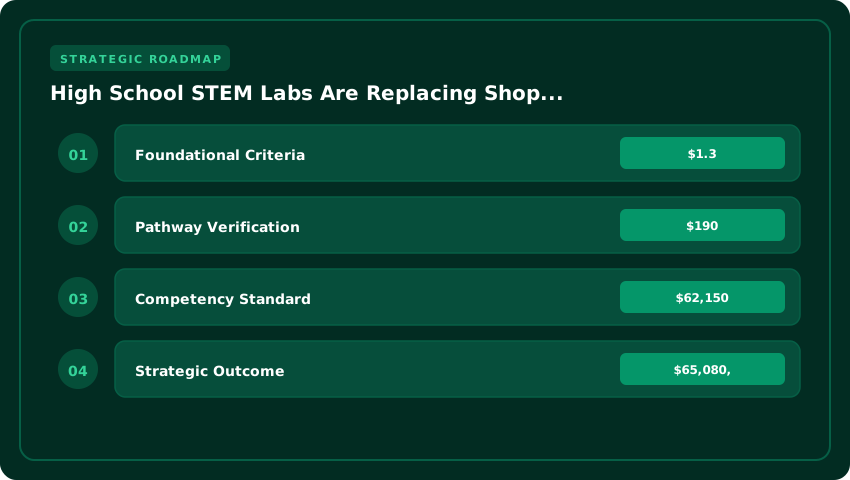
Federal funding followed that ideological shift almost immediately. The Carl D. Perkins Career and Technical Education Act, originally designed to underwrite shop classes, metalwork, and industrial arts, was repeatedly reauthorized with a sharper emphasis on STEM integration, industry certifications, and pathways to four-year degrees. The most recent Perkins V reauthorization in 2018 poured roughly $1.3 billion annually into career and technical education, but the dollars were redirected away from manual lathes and into credentialing programs, industry-recognized apprenticeships, and dual-credit STEM pathways aligned with the Department of Labor’s apprenticeship frameworks.

- 1998 College-Readiness Mandate: Shifted school accountability from career readiness to four-year college eligibility, stigmatizing shop classes as tracking tools.
- Perkins Act Amendments (1998, 2006, 2018): Reframed federal CTE dollars as a pipeline to STEM degrees and industry certifications rather than traditional manual trades.
- AP and Dual-Enrollment Expansion: Federal Title IV and state supplemental funding now reward schools for college-credit-bearing STEM courses, not vocational shop electives.
- ESSER Pandemic Spending: Roughly $190 billion in emergency education relief between 2020 and 2024 was largely directed toward technology upgrades, further displacing traditional shop infrastructure.
Local districts responded with a clear-eyed calculation. Administrators realized that state accountability systems, North Star metrics, and accreditation reviews through organizations like Cognia and AdvancED rewarded measurable academic outcomes, not workshop completions. Career counselors, who once guided students into union apprenticeships, plumbing licenses, and tool-and-die trades, were retrained to shepherd sophomores into AP Computer Science Principles and College Board’s AP 1 Algebra readiness tracks. A school that produced twenty certified welders earned the same funding as a school that produced twenty college interns, but only the second outcome moved the needle on state report cards.
Meanwhile, the manufacturing economy itself was undergoing a quiet revolution that the woodshop curriculum simply could not keep up with. According to the U.S. Bureau of Labor Statistics, the manufacturing sector now projects roughly 3.7 million total job openings through 2033, but the fastest-growing roles look nothing like the manual lathe work of the 1980s. Instead, demand is concentrated in fields such as industrial engineering technology, mechatronics, CNC programming, robotics integration, and additive manufacturing. Median wages for these hybrid roles, like Industrial Engineering Technologists, sit around $62,150 annually, while Electro-Mechanical and Mechatronics Technologists earn a median of $65,080, and Industrial Engineers command median pay of $99,380 per year. Even CNC operators and tool programmers now earn a median wage of approximately $62,090, nearly twenty percent above the national all-occupation median.
The career payoff has shifted in tandem with the curriculum. A graduate who once left high school with a finished cutting board and a passing grade in Woods I is now expected to walk out with a SolidWorks certification, a FANUC robotics credential, and college credit in pre-calculus or computer-aided drafting. The traditional shop class was not removed because Americans stopped valuing hands-on skills. It was replaced because the credential economy, the data-driven accountability movement, and the changing nature of advanced manufacturing demanded a more rigorous, technology-rich pathway that the old vocational model simply could not deliver.
For today’s students, the disappearance of the woodshop is not necessarily a loss; it is a transformation. The new shop class is a STEM lab, and the paycheck at the end of the pipeline is far more competitive than it was a generation ago. Understanding that history is the first step toward claiming the opportunities these modern labs create.
Inside the Modern High School Innovation Lab: Equipment That Rivals Community Colleges
Walk into the engineering wing of a well-funded American high school today, and the dusty lathes and drill presses of the old woodshop have been replaced by machines that look like they belong on an aerospace manufacturing floor. The modern high school innovation lab is no longer a converted classroom with a band saw and a handful of soldering irons. It is a tightly engineered ecosystem of digital fabrication tools that mirror what students will encounter in their first two years of a community college, technical institute, or even an entry-level university engineering program. For families evaluating the real career payoff of STEM education, understanding what is actually inside these labs is the single most important factor in determining whether a school is preparing students for credentials that translate into competitive wages.
At the top of the equipment hierarchy sits the five-axis CNC mill, a computer-controlled machining center that can cut complex aluminum, steel, and polymer parts with sub-thousandth-inch tolerances. Schools in districts like Plano, TX have invested in Haas Automation Mini Mills and TM series tooling, the same equipment used in the company’s factory in Oxnard, California. A five-axis machine allows students to produce real-world components like drone frames, robotics chassis, and engine brackets, building the exact muscle memory that machinists and manufacturing technicians use on $28 to $34 per hour shop floors. For a high school student, this is the difference between watching a YouTube video on subtractive manufacturing and actually clamping a workpiece, running G-code, and holding the finished part in their hands.
Laser cutters and 3D printers form the second layer of the modern lab. A 60-watt CO2 laser cutter can slice through plywood, acrylic, and leather in minutes, allowing students to iterate rapidly on design concepts. Industrial-grade 3D printers using carbon-fiber-reinforced nylon, polycarbonate, and even continuous fiber technology are now common in STEM-focused academies. These machines enable a full design-to-production cycle, from CAD modeling in Fusion 360 or SolidWorks to a finished functional prototype, in a single class period. The result is that students graduate having already done the kind of work that mechanical engineering interns perform during their first summer on the job.
The third pillar is the FPGA development board, a piece of hardware that distinguishes a serious electronics program from a casual Arduino club. Field-Programmable Gate Array kits from Xilinx and Intel allow students to design actual digital logic circuits using hardware description languages like VHDL and Verilog. This is college-level electrical engineering coursework, the kind of content taught in sophomore and junior year university programs accredited by ABET. When a high school student can blink an LED with Verilog on a Xilinx Artix-7 board, they have already cleared one of the major barriers to declaring an electrical or computer engineering major. Industry certifications from companies like Mouser and DigiKey, paired with these boards, give students stackable credentials before they have even submitted a FAFSA application.
However, the equipment access gap between wealthy and Title I districts remains one of the most consequential equity issues in American K-12 education. In Arlington, VA, where property tax revenues and corporate partnerships have produced overflowing CTE budgets, innovation labs feature multiple five-axis mills, industrial laser systems, and dedicated clean rooms for electronics work. Contrast this with a Title I school in a rural or under-resourced urban district, where the entire STEM lab budget might be $15,000, barely enough for a single mid-range 3D printer and a dozen laptops. This disparity directly affects credentialing, as students without access to industry-standard equipment cannot earn the certifications that translate into skilled-trade wages averaging $60,000 to $85,000 annually in manufacturing.
To bridge this gap, forward-thinking districts have turned to federal relief dollars and strategic public-private partnerships. The ESSER Fund, authorized under the CARES Act and expanded through CRRSA and ARP, allocated over $190 billion to American K-12 schools, and a meaningful portion has been directed toward STEM capital expenditures. Districts like Plano Independent School District used ESSER allocations to expand their CTE infrastructure, while simultaneously leveraging relationships with private-sector partners. Haas Automation’s factory education program has donated machines, software licenses, and curriculum directly to high schools nationwide. NASA, through its Office of STEM Engagement, has provided FPGA boards, sensor kits, and direct mentorship to schools participating in projects like the High School Aerospace Scholars program and the NASA TechRise Student Challenge.
The practical takeaway for families is straightforward. When touring a high school, ask to see the fabrication lab. Ask whether the school owns a CNC mill, or merely has a 3D printer in a corner. Ask which industry certifications students can earn before graduation, and whether the curriculum is articulated with local community colleges for dual enrollment credit that transfers toward an associate degree in mechanical, electrical, or manufacturing engineering technology. These are the markers that separate a real STEM launchpad from a rebranded shop class, and they are the foundation of the career payoff that makes this new model of American high school education worth the investment.
The CubeSat and Capstone Project Boom: Real Engineering Before a Diploma
Today’s high school STEM labs are no longer just places to learn basic circuitry; they have become incubators for genuinely complex engineering projects. Across the United States, students are designing and building CubeSats—miniature satellites that actually reach low Earth orbit—alongside underwater Remotely Operated Vehicles (ROVs) for the rigorous MATE ROV Competition. Meanwhile, thousands of students compete in FIRST Robotics, vying for the ultimate prize at the World Championship in Houston, Texas. These are not your grandfather’s woodshop projects. They are sophisticated, multi-disciplinary capstone projects that require students to master CAD software, embedded systems, and complex project management long before they ever set foot on a university campus.
The admissions offices at top-tier US universities have taken notice. When evaluating applicants for ABET-accredited engineering programs, admissions committees increasingly look for evidence of sustained, hands-on engineering experience. Building a functional ROV or contributing to a successful FIRST Robotics team demonstrates a level of grit, teamwork, and applied physics that a perfect GPA alone simply cannot convey. Consequently, students who participate in these advanced lab-track programs are seeing significantly higher admission rates into competitive ABET-accredited engineering programs. These applicants have already proven they can survive the grueling design-build-test-redesign cycle that defines an undergraduate engineering degree.
This hands-on rigor also translates directly into academic performance in the classroom. According to data trends tracked by the College Board, students enrolled in rigorous STEM lab-track programs consistently outperform their peers on STEM-focused Advanced Placement (AP) exams. Specifically, students involved in long-term engineering projects like CubeSats and FIRST Robotics demonstrate higher rates of scoring a 3 or better on AP Physics C: Mechanics and AP Calculus BC. The applied nature of these projects cements theoretical concepts, allowing students to analyze complex systems with a practical, real-world lens rather than just memorizing formulas for a test.
- Document the Journey: Keep a detailed engineering logbook of your MATE ROV or FIRST Robotics build. ABET-accredited programs love to see your troubleshooting process in your college essays.
- Leverage AP Synergies: Use your hands-on lab experience to contextualize College Board AP material, boosting your scores and potentially earning valuable college credit.
- Target Scholarships Early: High-level STEM competition alumni often qualify for specialized institutional merit aid, which can drastically reduce out-of-pocket tuition and maximize your FAFSA financial positioning.
Ultimately, the payoff of this capstone boom is both academic and financial. By entering college with the practical skills of a sophomore engineering student, these high school graduates are better positioned to secure lucrative internships, often earning $20 to $30 an hour during their undergraduate years. The shift from traditional shop class to advanced STEM labs is not just changing how we educate our youth; it is fundamentally rewiring their career trajectory, turning high school hallways into the true launchpads for tomorrow’s engineering elite.
Articulation Agreements and Dual-Enrollment Pathways to STEM Degrees
Across the United States, a quiet but consequential shift is reshaping how teenagers transition from high school fabrication labs into four-year STEM degree programs. State university systems, community college networks, and individual K-12 districts are now signing formal articulation agreements that guarantee undergraduate credit for advanced manufacturing coursework completed in a high school machine shop, robotics cell, or Computer-Aided Design (CAD) studio. These MOUs function as academic bridges, mapping specific competencies mastered in grades 11 and 12 onto entry-level technical courses at partner institutions.
Once confined to community college transfer compacts, modern articulation agreements increasingly link high school programs directly to flagship research universities. The mechanics are straightforward but rigorous: a student who completes a certified sequence in CNC machining, mechatronics, or non-destructive testing may receive three to twelve semester hours of credit, depending on the rigor of the high school program and the credential of the partner college.
- Credit-by-Articulation (CBA): The high school program is audited by university faculty. Students who pass a standardized skills assessment receive guaranteed transfer credit.
- Dual-Enrollment: The student simultaneously enrolls in a Pell Grant–eligible community college course, taught on the high school campus or online, while earning both high school and college credit.
- Stackable Credentials: Short-term certificates, such as the Computerized Numerical Control (CNC) Technician certificate, ladder into an Associate of Applied Science (AAS) and then into a Bachelor of Science in Mechanical Engineering Technology, Manufacturing Engineering Technology, or Industrial Systems Engineering.
The Computerized Numerical Control (CNC) Technician certificate is a particularly strong example. Typically requiring 18 to 30 credit hours, programs at community colleges such as Ivy Tech (Indiana), Pikes Peak State College (Colorado), or Sinclair College (Ohio) cover G-code programming, blueprint interpretation, precision metrology, and Haas or Mazak controller operation. Because these programs are Title IV–eligible, high school students enrolled in an eligible dual-enrollment pathway can apply the Federal Pell Grant to cover tuition, fees, and sometimes books. For the 2024–2025 award year, the maximum Pell Grant is $7,395, and many dual-enrolled students qualify for the full amount depending on their family’s Expected Family Contribution (EFC) under the FAFSA Simplification rules.
Here is how the stack typically works. A junior at a participating high school might enroll in “Introduction to CNC Operations” at a local community college, satisfying both a high school elective and the first technical elective in a CNC certificate. By the end of senior year, the student has earned 12 to 18 college credits, an OSHA-10 credential, and a NIMS (National Institute for Metalworking Skills) measurement, materials, and safety certification. After graduating, the student enrolls full-time at the community college, finishes the remaining certificate credits in one semester, and enters the workforce as a CNC technician earning $48,000 to $58,000 annually, based on Bureau of Labor Statistics (BLS) Occupational Employment and Wage Statistics (OEWS) for South Carolina, Ohio, and Texas.
For students who want the bachelor’s degree, the articulation framework typically guarantees junior standing at the receiving university. Purdue University’s Mechanical Engineering Technology program in the Polytechnic Institute, for example, accepts AAS transfer credit from regionally accredited institutions, and Purdue Global offers additional structured pathways for students holding applied technology associate degrees. Virginia Tech’s College of Engineering, through its Department of Engineering Education, similarly reviews AAS holders for admission to its Industrial and Systems Engineering and Mechanical Engineering programs on a case-by-case basis, often requiring supplemental calculus and physics sequences.
To maximize credit transfer, students should verify three checkpoints before enrolling in any high school pathway: (1) accreditation of the community college by a regional body such as the Higher Learning Commission (HLC) or Southern Association of Colleges and Schools Commission on Colleges (SACSCOC), (2) the receiving university’s published transfer equivalency guide, which lists course-by-course matches, and (3) the FAFSA filing deadline for the state, since most dual-enrollment Pell eligibility is processed through the home institution’s financial aid office.
For parents and counselors evaluating the long-term payoff, the numbers are compelling. A student who completes an articulated CNC pathway enters the workforce two years earlier than a traditional four-year engineering student, accumulates industry wages during the associate-degree phase, and often finishes the bachelor’s degree with zero remaining general-education debt. The result is a credentialed, debt-aware pathway into advanced manufacturing, robotics, aerospace, and biomedical engineering, all of which are projected to grow between 6% and 14% through 2032 according to BLS employment projections.
The Workforce ROI: Comparing STEM Lab Graduates to Traditional College-Only Pathways
When families map out the financial trajectory of a STEM education, the conversation inevitably turns to return on investment. According to the US Bureau of Labor Statistics (BLS), the median annual wage for CNC machinists sits near $47,000, with experienced technicians in aerospace tooling clusters often clearing $65,000 within five years. By contrast, a manufacturing engineer holding a bachelor’s degree from an ABET-accredited program commands a median salary closer to $78,000, while mechatronics specialists with both credentials and industry certifications frequently exceed $85,000. On paper, the four-year degree appears to dominate. But the ledger only tells the truth when you account for the cost side of the equation and the time value of money.
Consider the immediate-earner pathway. A student who completes a rigorous high school STEM lab sequence, earns a recognized industry credential such as the NIMS Machining Level I, and enters the workforce at 18 generates roughly $40,000 in taxable wages during year one. Over a four-year horizon, that learner accumulates $160,000 in gross earnings, pays Social Security and Medicare taxes, invests in a Roth IRA, and avoids student debt entirely. Apply a conservative 4% net present value (NPV) discount rate, and the present-day value of those four years of earnings lands near $144,000. There is no tuition bill, no loan servicer, and no parent loan default anxiety.
Now compare that to the ABET-degree route. Tuition at a private institution currently averages $110,000 across four years, before room, board, and textbooks. After filing the FAFSA, the average undergraduate still borrows about $7,000 annually, leaving a graduate with the national average student loan debt of $29,000. That graduate forgoes approximately $160,000 in earnings while enrolled, plus interest accrual on unsubsidized loans. Once employed, their starting salary in manufacturing engineering hovers around $65,000, with the $85,000+ mechatronics benchmark reserved for those who stack certifications on top of their degree. When you discount the delayed earnings, subtract the tuition, and add the debt service at today’s 6.5% federal undergraduate rate, the NPV of the degree pathway trails the immediate-entry route by a surprising margin, especially during the first decade of a career.
- Year 1–4 Cash Flow: STEM-lab graduate earns $160,000; degree-track student accrues -$110,000 tuition plus -$160,000 in foregone wages.
- Debt Load at Graduation: $0 for credentialed entrants versus roughly $29,000 for the average bachelor’s recipient, according to Federal Reserve data.
- Salary Ceiling: The ABET graduate eventually overtakes the technician, often by age 32, particularly in aerospace systems engineering and supervisory mechatronics roles.
- Break-Even Age: Approximately 30–34, depending on regional cost-of-living adjustments and whether the degree holder pursues an advanced role.
- Compounding Advantage: The early earner’s invested wages frequently outpace the late starter’s 401(k) contributions, assuming a 7% market return.
The honest conclusion is not that one path defeats the other. The data shows that STEM lab credentials deliver extraordinary short-term ROI, while the four-year ABET pathway delivers stronger long-term ceiling, especially for engineers pivoting into management, research, or aerospace design roles regulated by the Federal Aviation Administration. Smart families treat these not as rival tracks but as a stack: high school STEM lab as the launchpad, an ABET degree or a Pell Grant-funded state university pathway as the upgrade.
What Parents Should Ask During a High School Tour to Evaluate STEM Lab Quality
A polished makerspace sign on a brochure does not guarantee meaningful learning. When you walk the hallways with an admissions director or department chair, you need a tactical checklist that separates a genuinely well-equipped STEM lab from a glorified storage closet with a 3D printer in the corner. Before committing to a school district, ask direct, specific questions and demand verifiable answers.
Begin with instructor credentials. Ask whether the lead engineering or manufacturing teacher holds National Board Certified Teacher (NBCT) status, which signals rigorous peer-reviewed mastery of pedagogy and content. If the program is technical, request evidence of industry credentials such as NIMS Machining Level I, AWS (American Welding Society) certification, or a Siemens Certified Mechatronics Assistant credential. A teacher with a decade of corporate engineering experience and an active NBCT certification will deliver a dramatically different classroom experience than a rotating substitute filling a vacancy.
- Lab time per student: “How many hours per week does each student actually spend in the lab, and is that time protected from being canceled for assemblies or testing?” Aim for a minimum of three to five dedicated lab hours weekly in foundational courses, scaling upward in advanced manufacturing, robotics, or biotechnology tracks.
- Class size and equipment ratios: “How many students share each CNC mill, laser cutter, oscilloscope, or robotics workstation?” Industry-aligned programs target a 1:2 or 1:3 ratio of advanced equipment to learners to ensure every student gains hands-on proficiency.
- Industry mentorship programs: “Does the school partner with local manufacturers, engineers, or hospitals for mentorship, job shadowing, or capstone project sponsorship?” Programs connected to organizations like the SME Education Foundation, Project Lead the Way (PLTW), or SkillsUSA often indicate a structured pathway rather than an isolated elective.
- SME Education Foundation participation: “Is our campus a recognized SME PRIME (Partners in Manufacturing Education) school or a participant in the STEM-focused initiatives?” PRIME schools receive direct industry support, curriculum alignment, and scholarship pipelines that benefit graduating seniors.
- Student access policies: “Can students access the lab outside scheduled class hours for independent projects or competition prep?” Open access signals an investment in student-driven inquiry, while locked-door policies may suggest limited capacity or liability concerns.
- Equipment maintenance and refresh cycle: “When was the major equipment last updated, and what is the annual capital budget for lab improvements?” A lab full of 2005-vintage CNC machines cannot adequately train students for Industry 4.0 environments.
Equally important is asking for student outcome data. Request the number of students who earned industry certifications last year, the percentage who placed in regional STEM competitions, and the average scholarship dollars awarded through programs like the SME Education Foundation’s family of awards. A quality STEM lab should be able to produce concrete metrics, not just glossy marketing language. Ask about articulation agreements with local community colleges, which can save families thousands of dollars in future tuition by allowing students to earn college credit while still in high school.
Finally, trust your eyes. Walk into the lab and observe whether safety protocols are posted, whether Personal Protective Equipment is readily available, and whether students are actively engaged with tools rather than watching a video. A high-functioning STEM lab hums with purposeful activity, displays student-built prototypes on the walls, and has a teacher who can articulate exactly how each station connects to a specific career pathway. If the tour guide hesitates, deflects, or offers vague answers, consider it a warning sign and keep evaluating alternatives before signing that district commitment.
Strategic Final Takeaway
Success in evaluating High School STEM Labs Are Replacing Shop Class—Here's the Real Career Payoff relies on early preparation, adherence to verified accredited requirements, and cross-referencing official portals. Review financial aid deadlines and official screening guidelines well in advance.