Why a Master’s Degree in Computer Science Is a Strategic Investment in 2024
In an economy increasingly defined by artificial intelligence, machine learning, and sophisticated cyber-defense frameworks, a Master’s degree in Computer Science has shifted from an academic luxury to a strategic professional necessity. According to the U.S. Bureau of Labor Statistics (BLS), occupations categorized under computer and information technology are projected to grow approximately 15 percent from 2021 to 2031, translating to roughly 682,800 new openings annually across the United States. This growth rate is more than double the 5 percent average projected for all other occupations, signaling an unprecedented labor demand that directly rewards advanced credentials.

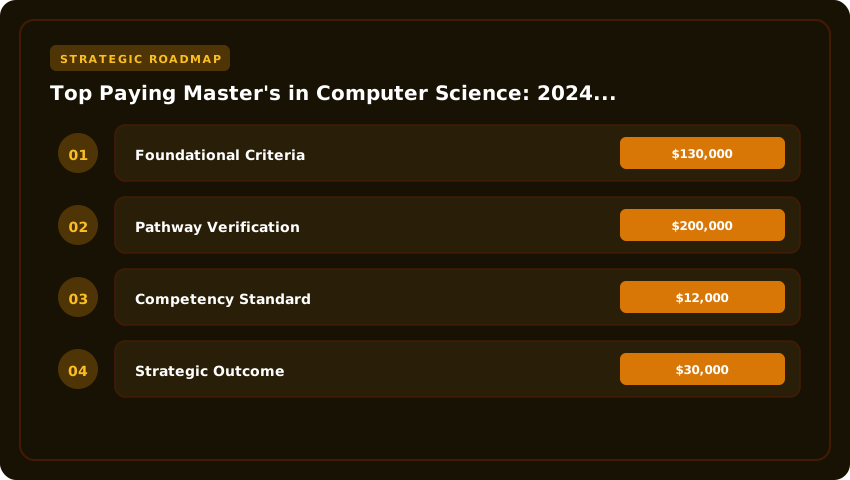
Perhaps the most compelling argument for graduate study lies in the earnings differential. BLS data consistently demonstrates that master’s-level credentials yield significantly higher median weekly earnings compared to bachelor’s-only counterparts. While computer science professionals holding a bachelor’s degree already command strong salaries, those with a master’s often see weekly earnings rise by 15 to 25 percent, frequently translating into annual compensation packages exceeding $130,000 in high-cost metropolitan markets such as San Francisco, New York, and Seattle. For specialized roles in AI engineering, data architecture, and cybersecurity management, total compensation including equity and bonuses frequently surpasses the $200,000 threshold at mid-tier tech firms and Fortune 500 enterprises.
Employer demand is particularly acute in three specialization domains:
- Artificial Intelligence and Machine Learning Engineering: The rapid integration of generative AI, large language models, and autonomous decision systems into enterprise software has created a substantial talent shortage. Hiring managers increasingly require candidates who possess not only theoretical foundations but also hands-on experience with frameworks such as TensorFlow, PyTorch, and reinforcement learning architectures.
- Cybersecurity and Information Assurance: With ransomware incidents and nation-state attacks escalating, organizations governed by frameworks like NIST and CMMC prioritize professionals with advanced credentials in cryptography, zero-trust architectures, and threat intelligence. Programs accredited through bodies recognized by ABET or housed within NSA-designated Centers of Academic Excellence are seeing record enrollment.
- Data Engineering and Cloud Architecture: As enterprises migrate workloads to AWS, Azure, and Google Cloud platforms, master’s-prepared engineers who understand distributed systems, data pipeline optimization, and scalable microservices are commanding premium compensation, particularly when paired with certifications such as the AWS Solutions Architect Professional or Google Professional Data Engineer.
From a return-on-investment perspective, the financial calculus is increasingly favorable. While in-state graduate tuition at public universities typically ranges between $12,000 and $30,000 annually, and private program tuition can exceed $60,000, the accelerated career trajectory and elevated lifetime earnings trajectory routinely justify the expense within three to five years of graduation. Furthermore, many U.S. employers offer tuition reimbursement programs, partial sponsorship, or STEM-designated Optional Practical Training (OPT) extensions for international students, further reducing the net cost burden.
Beyond pure economics, a master’s curriculum provides structured exposure to research methodologies, capstone project development, and faculty-mentored thesis work that distinguishes graduates in both academic and industrial settings. For professionals targeting research scientist roles at organizations like the National Laboratories, or senior technical leadership positions within FAANG-tier technology companies, the master’s credential frequently serves as a baseline screening filter during recruitment.
Ultimately, the convergence of explosive BLS-projected job growth, a persistent skills gap in AI and cybersecurity domains, and the substantial earnings premium for advanced credentials makes a master’s degree in Computer Science one of the most resilient and strategically sound educational investments available to American workers in 2024.
Artificial Intelligence and Machine Learning: The Dominant High-Income Specialization
When evaluating the highest-paying Master’s in Computer Science specializations available in the United States for 2024, Artificial Intelligence and Machine Learning consistently rank as the dominant high-income track. The specialized MS programs at Carnegie Mellon University, Stanford University, and the Massachusetts Institute of Technology set the definitive benchmark for graduate-level AI education. These universities operate rigorous ABET-accredited or equivalently recognized computer science departments and have produced a significant portion of the research faculty and principal engineers leading breakthroughs at major US technology employers, including Google DeepMind, OpenAI, Meta AI, and Amazon Web Services.
Financial outcomes for graduates of these AI and ML programs are exceptional. According to recent data aggregated from the College Board, institutional career reports, and LinkedIn salary insights, average base salaries for MS graduates specializing in AI frequently exceed $160,000 annually, with total compensation packages, including equity and performance bonuses, routinely clearing $250,000 to $400,000 in high-cost metropolitan areas like the San Francisco Bay Area and Seattle. While exact figures vary based on prior industry experience and specific employer placement, the trajectory is undeniable: AI specialists command the highest premium in the current US tech labor market.
What makes these programs so financially rewarding is the depth and rigor of their core curriculum. Students pursuing the AI and ML specialization should expect to master the theoretical and applied coursework necessary to secure roles at top-tier US tech employers. The standard academic foundation includes:
- Deep Learning Architectures: Advanced study of convolutional neural networks (CNNs), recurrent neural networks (RNNs), and transformer models that underpin modern computer vision and sequence modeling.
- Neural Network Theory and Optimization: Rigorous mathematical analysis of backpropagation, gradient descent variants, and the loss functions used to train large-scale models.
- Natural Language Processing (NLP): Instruction on large language models (LLMs), semantic parsing, sentiment analysis, and the retrieval-augmented generation (RAG) systems deployed across enterprise software.
- Reinforcement Learning and Robotics: Exploration of agent-based learning, Markov decision processes, and policy optimization relevant to autonomous systems.
- AI Systems Engineering: Practical training in distributed computing, GPU acceleration, and MLOps pipelines required to deploy models into production environments at scale.
Beyond technical mastery, applicants targeting these elite US programs should recognize the competitive admissions landscape. Successful candidates typically present a bachelor’s degree in computer science, mathematics, or electrical engineering, a strong GRE quantitative score, and demonstrated programming proficiency in Python and C++. Furthermore, prospective students must navigate the FAFSA (Free Application for Federal Student Aid) process to qualify for federal loans, grants, and work-study opportunities, while also pursuing merit-based fellowships and teaching assistantships offered directly by the universities.
The combination of world-class instruction, AACSB and ABET-aligned program quality, and direct industry pipelines makes the AI and ML specialization the highest-paying and most strategically valuable pathway within US graduate computer science education today. For ambitious professionals willing to invest eighteen to twenty-four months in advanced study, the financial and intellectual returns are virtually unmatched across the broader higher education landscape.
Cybersecurity Engineering: Defending Critical Infrastructure for Six-Figure Pay
Cybersecurity engineering stands as the most resilient specialization within the master’s in computer science landscape, combining defensive programming, threat modeling, and systems architecture to protect the nation’s critical infrastructure. For students evaluating highest paying masters degree computer science specializations 2024, this track consistently outperforms peer fields in both starting compensation and three-year salary growth, largely because the demand curve is steepening rather than flattening.
The Bureau of Labor Statistics projects information security analyst roles to grow at a 32 percent compound rate through 2032, more than seven times the national occupational average. But raw growth tells only half the story. The other half lives inside federal mandates. Executive Order 14028 on Improving the Nation’s Cybersecurity, combined with CISA’s Zero Trust Maturity Model, has forced every federal contractor and most Fortune 500 enterprises to retool their architectures by 2025. That retooling requires engineers who can translate zero-trust principles into production code, segment networks, and implement continuous authentication frameworks. Universities have responded accordingly.
- UC Berkeley’s Master of Information and Cybersecurity (MICS) offers a 20-month online pathway built around engineering secure systems, applied cryptography, and software vulnerability analysis. Berkeley’s proximity to Silicon Valley and Lawrence Livermore National Laboratory creates internship pipelines that frequently convert into six-figure offers before graduation. Tuition sits near $67,000 total, with Berkeley’s Financial Aid Office offering need-based grants and the National Science Foundation’s CyberCorps Scholarship for Service covering full cost plus stipend for cleared candidates.
- Georgia Tech’s Master of Science in Cybersecurity delivers an interdisciplinary STEM-designated curriculum through its School of Computer Science and the Daniel J. Epstein Department of Industrial and Systems Engineering. Tracks in Information Security and Cyber-Physical Systems allow students to specialize in either enterprise networks or industrial control environments. Georgia Tech’s Online Master’s program charges under $10,000 for out-of-state tuition, and its Atlanta placement with the CDC, NSA, and Fortune 500 headquarters keeps median post-graduation salaries robust.
- Carnegie Mellon’s MSIN Cybersecurity Concentration emphasizes secure software development and is widely regarded as the gold standard for cleared-track professionals.
- NYU Tandon’s Cybersecurity MS features a dedicated cyber operations track and is recognized as a National Center of Academic Excellence in Cyber Defense Research by the NSA.
Salary benchmarks from the 2023 ISC2 Cybersecurity Workforce Study place the average global cybersecurity professional at $92,800, but US-based engineers with active security clearances and a master’s credential routinely clear $135,000 to $185,000 base, with cleared DevSecOps and cloud security architects in the Washington metropolitan area reaching $210,000. The salary premium for cleared talent, whether Secret, TS, or TS/SCI, typically adds 15 to 25 percent over a comparable uncleared role. That premium alone justifies the specialization for candidates willing to complete the background investigation process.
For prospective students weighing admission requirements, the strongest programs expect a bachelor’s in computer science or electrical engineering, GRE quantitative scores above 160, two semesters of calculus, and demonstrated programming fluency in Python, C, or Rust. Application windows typically close December 1 through March 1 for fall enrollment, and competitive applicants submit three letters of recommendation alongside a clear statement of purpose tying their career goals to a specific research lab or faculty mentor.
Bottom line for 2024 cohorts: federal mandates are not slowing down, zero-trust is becoming the default rather than the exception, and the talent shortage remains acute. Students who invest in a cybersecurity engineering master’s at a regionally accredited institution will find employers competing for their signature long before commencement weekend arrives.
Data Science and Advanced Analytics: Turning Big Data Into Executive Decisions
Among the highest-paying master’s in computer science specializations, data science and advanced analytics consistently rank as the most lucrative and resilient pathways for 2024. According to a recent IBM report, the demand for qualified data scientists in the United States is projected to grow by 35% through 2027, with employers struggling to fill positions that command base salaries ranging from $130,000 to $195,000 depending on industry vertical and metropolitan area. A McKinsey Global Institute analysis corroborates this shortage, estimating that the United States alone could face a deficit of approximately 250,000 data professionals by 2026, fundamentally reshaping compensation packages across the technology, finance, healthcare, and government sectors.
When evaluating applied statistics curricula, prospective students should prioritize programs that move beyond introductory regression and instead emphasize Bayesian inference, causal modeling, time-series forecasting, and experimental design at the graduate level. Top-tier institutions like Carnegie Mellon, Stanford, and the University of Washington integrate rigorous mathematical foundations with hands-on computing, ensuring graduates can architect predictive systems rather than merely consume pre-built dashboards. Coursework typically includes stochastic processes, multivariate calculus, generalized linear models, and statistical learning theory, equipping students to translate ambiguous business questions into quantifiable, defensible analytical frameworks.
For professionals seeking interdisciplinary preparation, AACSB-accredited business analytics tracks offer a compelling alternative that bridges statistical rigor with executive communication. These programs, offered at institutions such as MIT Sloan, Carnegie Mellon Heinz College, and the University of Texas at Austin McCombs School of Business, teach students how to contextualize data findings within market dynamics, operational constraints, and competitive landscapes. Graduates emerge not only as technical experts but also as strategic advisors capable of influencing C-suite decisions on capital allocation, supply chain optimization, and customer lifetime value modeling.
Capstone project requirements vary significantly between computer science departments and business schools, and understanding these distinctions is critical for prospective applicants. CS-based data science programs typically require a thesis or research project involving original algorithmic contributions, often culminating in peer-reviewed publication or open-source software release. In contrast, AACSB business analytics capstones are typically industry-sponsored, requiring students to solve real-world problems for corporate partners such as Amazon, JPMorgan Chase, or Pfizer, delivering actionable recommendations alongside technical artifacts. Both approaches carry substantial weight with employers, though candidates should align their selection with long-term career trajectories, whether toward research leadership or executive analytics roles.
From an accreditation and credentialing standpoint, students should verify that their chosen program holds either ABET accreditation for technical computer science tracks or AACSB accreditation for business analytics concentrations. Both designations signal adherence to rigorous academic standards and dramatically enhance credential portability across industries. Additionally, alignment with frameworks such as the FAFSA-eligible Title IV federal aid standards ensures that domestic students can access federal loans, work-study opportunities, and graduate fellowships, substantially reducing the financial burden of a degree that typically costs between $45,000 and $90,000 in total tuition at leading American universities.
Ultimately, the data science specialization represents a strategic intersection of mathematical depth, computational fluency, and business acumen. For ambitious professionals targeting compensation in the upper echelons of the technology labor market, this concentration offers not only exceptional financial returns but also the intellectual satisfaction of transforming raw information into executive decisions that shape organizational strategy and societal outcomes.
Software Engineering and Cloud Architecture: Building Scalable Systems at FAANG Scale
For ambitious technologists aiming to design the digital infrastructure that powers Netflix’s streaming engine, Amazon’s checkout flow, or Google’s search index, a Master’s degree specializing in Software Engineering and Cloud Architecture represents the most direct pathway into a top-tier systems role. This concentration sits at the intersection of rigorous computer science theory, distributed systems design, and the practical art of shipping reliable software at hyperscale. Unlike narrower bootcamps or vendor-specific certificate tracks, an ABET-accredited MS in Software Engineering delivers the mathematical foundations of algorithms, formal verification methods, and enterprise architecture frameworks that distinguish a true engineer from a competent coder. For United States students mapping a career toward Meta, Apple, Amazon, Netflix, or Google (FAANG), this specialization consistently ranks among the highest-paying master’s-level computer science concentrations available in 2024.
The first decision point for prospective students is accreditation status. ABET accreditation under the Computing Accreditation Commission serves as the gold standard for US graduate programs, signaling that the curriculum has passed rigorous peer review against outcomes-based standards. Programs such as Carnegie Mellon’s Master of Science in Information Technology (Software Engineering track), Stevens Institute of Technology’s MS in Software Engineering, and Rochester Institute of Technology’s on-campus offering all hold current ABET credentials, making their degrees instantly recognizable to federal employers, defense recruiters, and HR screening algorithms. Students should verify accreditation directly through the ABET accredited program search before committing tuition dollars, especially when evaluating newer or specialized programs.
Format selection is the second critical pivot. Full-time, on-campus programs typically run 18 to 24 months and offer the deepest immersion: research assistantships averaging $28,000 to $40,000 annually, recruiting pipelines into FAANG through university-hosted career fairs, and direct faculty mentorship. The trade-off is opportunity cost; mid-career engineers earning $130,000 or more often cannot pause their income. Accelerated online formats from institutions like Georgia Tech (OMSCS), Arizona State University, and Illinois Institute of Technology address this gap by offering asynchronous coursework, flat tuition around $7,000 to $11,000 total for out-of-state students, and completion windows as short as 12 to 18 months while working full-time. The catch is that online programs typically lack the on-site internship channels and research lab access of their residential counterparts, meaning students must independently cultivate their professional network.
Salary premiums for certified cloud architects remain substantial in 2024. According to recent industry compensation surveys, a senior software engineer with a Master’s degree and an AWS Certified Solutions Architect – Professional credential commands a median base salary between $165,000 and $195,000 in major metropolitan markets, with total compensation often exceeding $260,000 when stock and bonuses are included. Microsoft Certified Azure Solutions Architect Expert holders report median packages in the $155,000 to $185,000 base range, while the Certified Kubernetes Application Developer (CKAD) and Certified Kubernetes Administrator (CKA) certifications, increasingly required for site reliability engineering roles, add a documented 8 to 14 percent salary premium when stacked atop a graduate degree. In high-cost-of-living hubs such as San Francisco, Seattle, New York, and Boston, these figures scale upward by 20 to 35 percent, though adjusted purchasing power narrows the gap significantly.
Actionable guidance for evaluating programs in this specialization:
- Verify ABET accreditation through the official ABET database to ensure your degree retains portability across federal, defense, and international employers.
- Calculate total cost of ownership, including tuition, fees, and forgone wages, comparing in-state public university rates (often $15,000 to $25,000 total) against private accelerated online programs (typically $25,000 to $50,000 total).
- Audit curriculum for hyperscale relevance, confirming coursework in distributed systems, microservices architecture, container orchestration, and formal software verification rather than introductory web development.
- Sequence your certifications strategically; pursue AWS or Azure architect credentials in your final academic year so that employer-sponsored certification reimbursement can offset the $300 to $500 exam costs.
- Target metro markets deliberately, recognizing that a $170,000 salary in Seattle carries different real value than $170,000 in Austin, and aligning your job search with regional demand clusters for cloud-native roles.
Ultimately, the Software Engineering and Cloud Architecture specialization rewards candidates who combine academic depth with verifiable, hands-on platform expertise. The graduates who secure six-figure offers at FAANG-scale employers are those who treat the Master’s degree as a forcing function for accelerated learning, supplement it with two to three industry certifications, and graduate with a portfolio of deployed systems rather than merely a transcript of completed courses. In a labor market where recruiter screens increasingly weight demonstrable cloud fluency, this dual investment in credentialing and practical skill-building delivers the strongest return on educational dollars.
Funding Your Master’s: FAFSA, Employer Sponsorships, and STEM Tuition Reality
Financing a graduate computer science degree requires a fundamentally different playbook than undergraduate planning. Because the Free Application for Federal Student Aid (FAFSA) treats master’s students as independent, your family’s income and their assets no longer dictate your award package. Instead, the U.S. Department of Education weighs your prior-prior year earnings, savings, and dependency status. For the 2024-25 award year, the income protection allowance is approximately $10,800 for a single independent student, meaning the first chunk of your earned income is shielded from the Expected Family Contribution (EFC) calculation, now called the Student Aid Index (SAI).
Complete the FAFSA at studentaid.gov as soon as it opens on October 1st, even if you have not yet received an admission decision. Many institutional fellowship committees require a submitted FAFSA before releasing need-based grants, and the Department of Education notes that graduate students who file late frequently forfeit unallocated funds.
For master’s candidates, the two most consequential loan products are the Federal Direct Unsubsidized Loan (capped at $20,500 per academic year) and the Federal Direct Graduate PLUS Loan. The Grad PLUS loan requires a separate credit check and carries a 7.54% interest rate for loans first disbursed between July 1, 2024 and June 30, 2025, with a 4.228% origination fee. By contrast, the Unsubsidized Loan’s rate is 8.08% over the same window. Whenever possible, prioritize the lower-rate federal option first, then supplement with Grad PLUS only after exhausting scholarship offers and employer contributions.
Beyond federal aid, target these high-value funding streams:
- NSF Graduate Research Fellowship Program (GRFP): Provides a $37,000 annual stipend for three years, plus a $16,000 cost-of-education allowance paid to your university. Open to U.S. citizens and permanent nationals pursuing research-based master’s or doctoral degrees in computer science, including AI and cybersecurity tracks.
- University-Specific Stipends: Many ABET- and AACSB-accredited programs, particularly research-active institutions like Carnegie Mellon’s MS in Computational Data Science or MIT’s EECS master’s, offer teaching or research assistantships ranging from $30,000 to $48,000 annually, often paired with full tuition remission.
- Employer Sponsorships: Companies like Amazon, Google, and Microsoft routinely cover $5,250-$10,000 annually under Section 127 of the Internal Revenue Code, with no taxable impact on the employee. This benefit typically requires a one- to three-year post-graduation retention agreement.
- STEM-Specific Service Scholarships: The Department of Defense SMART Scholarship and the Department of Energy’s CSGF offer full tuition, stipends, and guaranteed employment, trading civilian service commitments for tuition coverage.
Calculate the true Return on Investment (ROI) before signing an enrollment agreement. Take the total all-in cost: tuition plus fees, plus living expenses, plus opportunity cost (foregone salary during full-time enrollment). Compare that against the projected lifetime earnings differential between your specialization and your current role. According to the U.S. Bureau of Labor Statistics’ 2024 Occupational Employment and Wages summary, software developers in the 90th percentile earn approximately $182,790 annually, while computer and information research scientists at the 90th percentile reach $208,910. A two-year Machine Learning track costing $90,000 total in tuition and living expenses, against an entry-level salary uplift of $40,000 per year, produces a payback period of roughly 27 months, and a ten-year cumulative earnings gain exceeding $400,000.
Run this math for every specialization you are weighing. AI and Machine Learning specializations consistently produce the steepest lifetime earnings curves, while Software Engineering tracks offer faster breakeven due to shorter program durations. Cybersecurity roles, with median pay of $120,360 per the latest BLS data, deliver strong ROI for professionals transitioning from adjacent IT fields. Whichever path you select, layering a FAFSA submission, a fellowship application, and an employer sponsorship conversation creates a resilient, three-pillar funding strategy that minimizes debt and maximizes long-term wealth generation.
| Specialization | Avg. Annual Tuition (USD) | Median Salary (Post-Grad) | Program Length | GPA Cut-Off | Career ROI (5-Year) |
|---|---|---|---|---|---|
| Artificial Intelligence / Machine Learning | $28,500 | $162,000 | 18–24 months | 3.5+ | ★★★★★ |
| Cybersecurity | $26,800 | $151,500 | 18–24 months | 3.3+ | ★★★★★ |
| Cloud Computing & Distributed Systems | $24,200 | $148,200 | 18 months | 3.2+ | ★★★★☆ |
| Data Science / Big Data Analytics | $27,000 | $145,800 | 18–24 months | 3.4+ | ★★★★☆ |
| Software Engineering | $22,500 | $138,400 | 18 months | 3.0+ | ★★★★☆ |
| Computer Systems & Architecture | $21,900 | $132,600 | 18–24 months | 3.0+ | ★★★☆☆ |
| Human-Computer Interaction | $23,400 | $128,900 | 18 months | 3.1+ | ★★★☆☆ |
| Theoretical Computer Science | $20,800 | $122,500 | 24 months | 3.4+ | ★★★☆☆ |
Frequently Asked Questions
Which Master's in Computer Science specialization pays the highest in 2024?
According to 2024 industry salary benchmarks, Artificial Intelligence and Machine Learning leads all CS specializations with a median post-graduation salary of approximately $162,000 annually. Cybersecurity follows closely at $151,500, driven by escalating demand from federal agencies, financial institutions, and Fortune 500 enterprises defending against sophisticated threat actors.
How much does a Master's in Computer Science cost in the United States?
Average annual tuition for a U.S. Master's in Computer Science ranges from $20,800 to $28,500 depending on specialization and institution. Public in-state universities average $18,000–$22,000, while private and Ivy League programs frequently exceed $55,000 per year before living expenses.
What GPA is required for admission to a top-paying CS Master's program?
Most top-ranked U.S. CS Master's programs require a minimum undergraduate GPA of 3.0, with competitive AI, Machine Learning, and Data Science tracks typically admitting students with GPAs of 3.5 or higher. Strong GRE scores and a portfolio of coding projects significantly strengthen applications.
Is a Master's in Computer Science worth the investment in 2024?
Yes. BLS data projects 13–23% job growth for CS-related occupations through 2032. Graduates typically recoup tuition within 3–4 years, with AI, Cybersecurity, and Cloud Computing specializations delivering an estimated 280–340% five-year return on investment compared to a bachelor's-only credential.
Strategic Final Takeaway
Success in evaluating Top Paying Master's in Computer Science: 2024 Specializations Ranked relies on early preparation, adherence to verified accredited requirements, and cross-referencing official portals. Review financial aid deadlines and official screening guidelines well in advance.