
Why the 2026 Canadian Immigration Shakeup Hits Nigerian Applicants Hardest
If you are a Nigerian graduate eyeing Canadian Permanent Residency (PR) in 2026, you are walking straight into the most disrupted immigration landscape the country has seen in over two decades. The Immigration, Refugees and Citizenship Canada (IRCC) has rolled out a series of aggressive policy shifts that fundamentally alter the strategy our people have relied on for years. These are not minor adjustments; they represent a structural redesign of the international student and temporary foreign worker pathway, and Nigerian applicants—who historically lead Sub-Saharan African student migration to Canada—are uniquely exposed to the fallout.
The most consequential change is the introduction of an IRCC cap on international student permits, designed to stabilize housing, healthcare, and labour market absorption capacity. Provinces are now allocated fixed quotas based on infrastructure readiness and population density. For Ontario, British Columbia, and Manitoba—the three provinces where roughly 78% of Nigerian students settle—this means designated learning institutions (DLIs) will issue significantly fewer Letter of Acceptances (LOAs) in 2026. Colleges in the Greater Toronto Area and Vancouver, which historically welcomed Nigerian cohorts with open arms, are trimming intake by 15% to 30% depending on the program cluster.
Equally disruptive is the tightening of Post-Graduation Work Permit (PGWP) eligibility. Effective January 2026, programs delivered through curriculum licensing agreements—where a private college awards a degree granted by a public university—will no longer qualify graduates for PGWP unless the program is delivered on the physical campus of the public institution. This single provision has collapsed a popular workaround that hundreds of Nigerian students used to secure work permits after studying through affiliated pathways in Toronto, Brampton, and Surrey.

Additionally, IRCC has flagged specific college-level programs—particularly one- and two-year diplomas in areas like general business, hospitality management, and certain IT support tracks—as no longer aligning with long-term labour shortages. Graduates of these programs will either be ineligible for PGWP or restricted to shorter permit durations. For fresh Nigerian graduates from polytechnics and universities in Lagos, Abuja, Port Harcourt, and Benin City who chose Canada precisely because a Nigerian HND or bachelor’s degree alone rarely secures a job offer in regulated Canadian professions, this feels like the door is being shut mid-crossing.
The Lagos-Toronto corridor—the informal term for the recruitment pipeline connecting Nigerian education agents, Canadian private colleges, and downstream PR pathways—is now under heavy regulatory pressure. IRCC has signalled forthcoming audits of immigration consultants, mandatory compliance reviews for DLIs with high refusal rates, and a new requirement that study permits must be tied to programs demonstrably linked to labour market demand. The era of treating any Canadian credential as a stepping stone to PR is effectively over.
- Permit Caps: Provincial allocation means earlier application deadlines and stricter document scrutiny—submitting your study permit application by September 2025 for September 2026 intake is now advisable.
- PGWP Restriction: Confirm that your chosen DLI delivers the program directly, not through a third-party licensing arrangement, before paying tuition (often ₦15 million to ₦35 million for a two-year program).
- Program Selection: Prioritize programs in healthcare, skilled trades, STEM, and applied sciences—these remain priority sectors under the 2026 NOC-based eligibility framework.
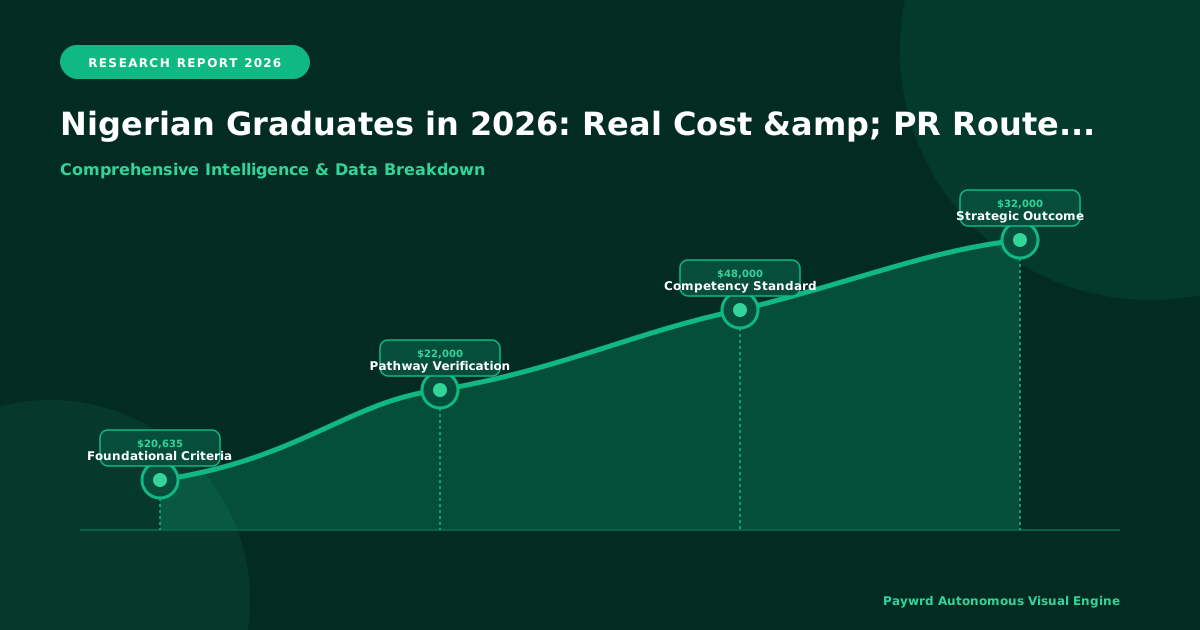
- Financial Proof: IRCC now requires proof of funds equivalent to first-year tuition plus ₦22 million (approximately CAD $20,635) for a single applicant outside Montreal, up from previous thresholds.
- NELFUND Coordination: If you plan to use Nigerian student loan support for tuition, verify with your DLI that refunds and disbursement timelines align with Canadian payment deadlines.
For Nigerian applicants, the practical implication is clear: the volume-based strategy of “study in Canada, work in Canada, apply for PR through Canadian Experience Class” is being replaced by a quality-and-scarcity model. Fewer seats, stricter program eligibility, and higher proof-of-funds thresholds mean that the application you submit in 2026 must be tighter, more strategic, and supported by stronger documentation than ever before. The shakeup is harsh, but it also weeds out the rushed, poorly-researched applications that gave Nigerian agents a reputation for compliance failures in recent years.
Understanding exactly which programs at which DLIs still carry PGWP eligibility—and which provincial nomination streams remain accessible to international graduates—is now the single most important factor in protecting your investment. The next section breaks down the 2026 cost reality, including tuition benchmarks, living expenses in Toronto, and how to structure your finances without falling into the debt traps that have stranded previous cohorts.
Funding the ₦120M+ Leap: CAD Tuition, GIC, and Surviving the FX Crisis
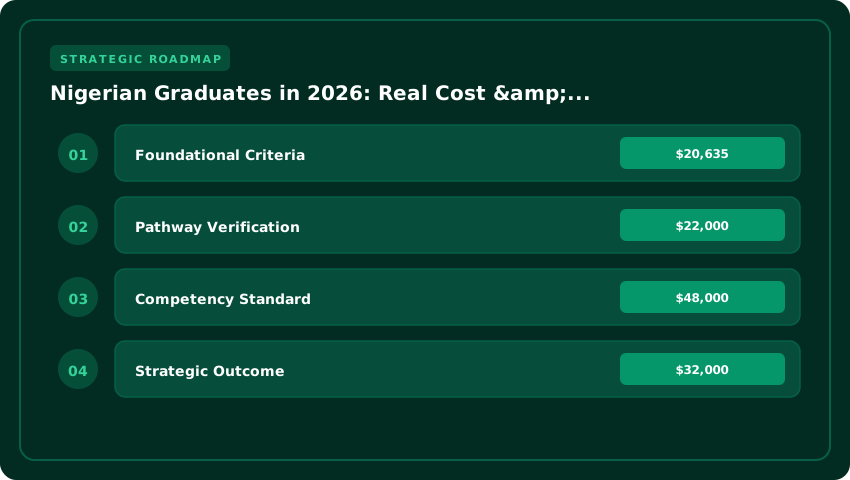
Let us be completely transparent about the numbers, because a miscalculation here can derail your entire Lagos-to-Toronto pipeline. For the 2026 academic intake, a Nigerian graduate pursuing a Master’s degree or Postgraduate Diploma in Ontario should budget between CAD $22,000 and CAD $48,000 for tuition alone, depending on the institution and program. A two-year Master of Science at the University of Toronto or a Master of Engineering at the University of Waterloo will typically sit around the CAD $32,000 to CAD $48,000 range over the full program. Meanwhile, a one-year Postgraduate Diploma at colleges like Humber, Seneca, or George Brown — popular PR-friendly routes under the PGWP pathway — usually costs between CAD $15,000 and CAD $22,000. When you layer in compulsory fees, health insurance (UHIP runs roughly CAD $900 annually), textbooks, and living expenses in cities like Toronto, Mississauga, or Brampton, the realistic all-in budget for a single academic year climbs to between CAD $45,000 and CAD $65,000.
Now, here is where the conversation gets painful. Using the parallel market rate that has held between ₦1,580 and ₦1,650 to CAD $1 throughout 2025 (and is projected to remain volatile into 2026 due to Nigeria’s FX crisis and ongoing demand pressure), your ₦120 million-plus total budget breaks down roughly as follows: a mid-range Master’s program will demand approximately ₦72 million to ₦95 million just for tuition and fees, while the full first-year landing cost (tuition, GIC, housing deposits, flights, and settling-in funds) can easily push toward ₦100 million to ₦130 million. This is not a figure you raise through savings alone; it demands deliberate, strategic financial engineering.
The Guaranteed Investment Certificate (GIC) is the single most important financial instrument you will interact with during your Canadian study permit application. Under the Student Direct Stream (SDS) — which remains the fastest processing lane for Nigerian applicants — Immigration, Refugees and Citizenship Canada (IRCC) requires you to purchase a GIC of CAD $20,635 from a participating Canadian bank such as Scotiabank, RBC, or CIBC. This is not a fee; it is a locked investment that the bank releases to you in monthly or bi-monthly installments once you arrive in Canada, proving to IRCC that you have genuine settlement funds. At parallel rates, that single GIC purchase consumes roughly ₦32.6 million to ₦34 million — a sobering number that explains why funding strategy is everything.
To survive the FX crisis and assemble this capital without losing 15-20% to conversion spread, structure your funding pipeline using three proven channels:
- Domiciliary (Dom) Accounts: Open a USD or CAD-denominated domiciliary account with Nigerian banks like GTBank, Access Bank, or Zenith. You can fund it through legitimate forex channels and then wire directly to your Canadian bank or Canadian forex broker like Coracle or Flywire. Dom accounts typically offer better spreads than black-market cash swaps and provide clean, traceable transaction histories that satisfy IRCC’s source-of-funds scrutiny.
- Fintech Apps like Chipper Cash: Use Chipper Cash to receive CAD payments from relatives abroad or to convert small-dollar savings into Canadian dollars gradually. While Chipper is excellent for accumulating funds, remember that large tuition payments are best routed through your Canadian bank’s official international transfer portal to avoid flagged transfers.
- NELFUND and Education Loans: The Nigerian Education Loan Fund (NELFUND) launched in 2024 now offers up to ₦2 million annually for undergraduate and postgraduate studies, and while it does not yet cover foreign tuition directly, it can offset your domestic expenses and free up personal savings for your Canadian leap. Pair this with diaspora loans from family members, recorded as gifts with proper documentation.
Actionable takeaway: Build your GIC and tuition liquidity at least 6 months before your study permit application. Use a combination of dom account accumulation, diaspora remittances via Chipper Cash, and documented family gifts to assemble the CAD $20,635 GIC plus first-semester tuition. Do not, under any circumstances, rely on the parallel market cash swap rate at the airport — IRCC will reject unexplained large cash deposits, and the FX spread will silently cost you millions of Naira in lost value.
PGWP, Express Entry, and the New Category-Based Draws: What Lagos Graduates Need to Score
If you have just finished your degree in Lagos, Abuja, or anywhere across the six geopolitical zones, and your eyes are fixed on a Canadian Permanent Residency stamp in your passport by 2027, then three acronyms must become your daily vocabulary: PGWP, CRS, and NOC. The Post-Graduation Work Permit is no longer a guaranteed golden ticket. Express Entry is no longer a single-pool lottery. And the National Occupation Classification code you choose to brand yourself with will either fast-track your file or leave it sitting in a stagnant general pool for twenty-four months. Let us break down exactly what a Nigerian graduate needs to score, save, and strategize to land an Invitation to Apply in this new landscape.
First, the Post-Graduation Work Permit (PGWP). For 2026, Immigration, Refugees and Citizenship Canada (IRCC) has tightened the eligibility net considerably. Only graduates from programs of eight months or longer at a Designated Learning Institution (DLI) qualify, and crucially, your program must now align with sectors experiencing documented labour shortages, such as healthcare, skilled trades, and STEM. A general B.Sc. in Philosophy or Sociology from a random Nigerian university with a Canadian twinning partner may no longer secure a three-year open work permit. Instead, you may be granted a permit whose duration matches your actual study length, often twelve to twenty-four months. For Nigerian students who paid between ₦35 million and ₦70 million for a Canadian undergraduate degree, this reduction in PGWP validity is a costly blow. You now have less time to accumulate the 1,560 hours of skilled work experience required for the Canadian Experience Class.
Second, the Comprehensive Ranking System (CRS) reality. A few years ago, a Nigerian applicant with a master’s degree, age 29, strong IELTS (Listening 8.5, Reading 8.0, Writing 7.5, Speaking 7.0), and one year of Canadian work experience could comfortably expect a CRS of 480 to 500. In 2026, general draws have collapsed to historic lows, with cutoffs hovering between 485 and 510, but with category-based draws dropping to the 430 to 460 range for targeted occupations. Without a provincial nomination or category-based eligibility, an average Nigerian graduate is mathematically locked out.
This brings us to the most important strategy: the Category-Based Draws. IRCC now runs parallel pools for healthcare, STEM, trades, transport, and agriculture. For a Lagos graduate, this is a massive opportunity if you select the right NOC code from day one. Consider the following high-demand profiles:
- Healthcare Priority: NOC 31301 (Registered Nurses), NOC 32102 (Medical Laboratory Technologists), and NOC 33102 (Nurse Aides). A Nigerian-trained nurse who obtains an NCAS assessment and secures a provincial health authority job offer in Manitoba or Saskatchewan can be working within six months of landing.
- STEM Priority: NOC 21211 (Data Scientists), NOC 21231 (Software Engineers), and NOC 21310 (Electrical and Electronics Engineers). A Lagos tech worker with three years at Andela, Flutterwave, or a fintech startup can stack significant CRS points through employer-specific LMIA-backed offers.
- Skilled Trades Priority: NOC 72311 (Automotive Service Technicians), NOC 75110 (Construction Trades Helpers), and NOC 73110 (Industrial Electricians). These occupations often require only a college diploma and a Red Seal certification pathway, making them ideal for Nigerian applicants who completed polytechnic programs before relocating.
- Education Priority: NOC 41200 (University Professors and Lecturers), NOC 41111 (Secondary School Teachers with STEM specialization), and NOC 42202 (Early Childhood Educators). These remain chronically underfilled across provinces like Quebec and New Brunswick.
To convert these NOC targets into an actual Invitation to Apply, you must engineer a minimum CRS score of 460. Here is the proven Lagos formula for 2026. Start with age optimization. At 29, you receive the maximum 110 age points; at 30, it drops to 105; by 35, it plummets to 77. Apply before your 30th birthday. Layer in language excellence. A CLB 9 or CLB 10 in IELTS (Listening 8.0, Reading 7.0, Writing 7.0, Speaking 7.0 minimum) adds up to 136 first-language points, while a perfect CLB 10+ yields 136 and can push your score above 490. Add Canadian educational credentials. A one-year Canadian post-grad certificate plus a four-year Nigerian bachelor’s degree generates 128 to 153 education points, far superior to a foreign-only combination.
The final accelerator is provincial nomination. A Provincial Nominee Program (PNP) endorsement from Ontario, British Columbia, or Alberta adds 600 points to your CRS, effectively guaranteeing an ITA in the next draw. For Nigerian applicants, the Ontario Immigrant Nominee Program’s Human Capital Priorities stream and BC PNP Tech pathway remain the most accessible. Both require a valid Express Entry profile and typically target NOC codes in healthcare and software development, with job offers from designated employers.
Now, the financial lens. Funding the PGWP-to-PR transition requires careful planning in Naira. A one-year Canadian college program costs between ₦35 million and ₦55 million in tuition and living expenses, while a two-year master’s runs ₦60 million to ₦120 million. With the Nigerian Education Loan Fund (NELFUND), eligible students can now borrow up to ₦2.5 million annually for domestic and select international programs, though Canadian tuition still demands substantial family contribution or diaspora sponsorship. Plan a monthly survival budget of ₦1.5 million to ₦2.2 million equivalent while job hunting, and maintain an emergency reserve of at least ₦8 million to cover rent arrears, SINP application fees, and credential evaluation costs through World Education Services, which runs about $CAD 220 (roughly ₦260,000) per credential.
Here is your actionable checklist. Before you book your flight from Murtala Muhammed International, confirm that your Canadian program appears on the DLI list and that your NOC code falls inside a 2026 priority category. Secure an IELTS Academic score of 7.5 or higher in every band. Pre-validate your Nigerian degree and transcripts through WES before arrival. Connect with regulated professions like nursing or engineering before stepping on the plane. And finally, treat the PGWP not as the finish line, but as a twelve to twenty-four month window to engineer a CRS score that no general draw can ignore.
The bottom line for Lagos graduates is this: the 2026 Canadian immigration system rewards precision, not optimism. Pick the right NOC, master the English test, stack Canadian credentials, secure a provincial nomination, and your Invitation to Apply is not a matter of luck, but a matter of arithmetic you can control from your laptop in Yaba, Lekki, or Surulere today.
Provincial Nominee Programs (PNPs) vs. Study Permit: The OINP, BC PNP, and Manitoba Route
For Nigerian graduates mapping out a 2026 Canada PR strategy, choosing between a traditional Post-Graduation Work Permit (PGWP) pathway and a Provincial Nominee Program (PNP) stream is not just an academic decision; it is a financial and immigration-shaping one. While studying in Canada remains a popular route, the Lagos-to-Toronto Pipeline is increasingly favoring applicants who deliberately align their study permit with provinces that have active, graduate-friendly nominee streams. The Ontario Immigrant Nominee Program (OINP), the British Columbia Provincial Nominee Program (BC PNP), and the Manitoba Provincial Nominee Program (MPNP) are three of the most strategic pathways for Nigerian graduates who want to convert a Canadian credential into permanent residence without spending years in a low-wage survival job in Toronto or Calgary.
The OINP Master’s Graduate Stream remains one of the most powerful tools for Nigerian students who can secure admission into a publicly funded Ontario master’s program. This stream does not require a job offer, which is a massive advantage for fresh graduates navigating a tight 2026 Canadian labour market. Under current NCLC-equivalent English benchmarks, applicants typically need a minimum CLB 7 or higher, a completed eligible master’s degree from an Ontario university, and proof of legal status in Canada. Because the nomination carries +600 CRS points under Express Entry, the OINP essentially guarantees an Invitation to Apply (ITA) in the next federal draw. For a Nigerian graduate who would otherwise be stuck in the CRS 400–480 range, this is a permanent residency fast track worth every kobo of the ₦8 million to ₦15 million average annual tuition cost for Ontario master’s programs.
The BC PNP International Graduate category, on the other hand, is built for graduates who are ready to work in the province. Unlike the OINP Master’s stream, BC requires a valid job offer in a skilled occupation, typically at NOC TEER 0, 1, 2, or 3. For Nigerian graduates who studied at institutions like the University of British Columbia, Simon Fraser University, or Thompson Rivers University, this route is exceptionally reliable. BC’s Tech Stream and Health Care streams are particularly attractive because they offer expedited processing and priority nomination. The cost of a typical BC master’s program ranges from CAD $25,000 to $45,000 annually, which translates to roughly ₦28 million to ₦50 million at current exchange rates. However, the investment pays off because BC PNP nominations are also worth 600 CRS points, and the province’s strong tech sector in Vancouver offers a clear runway from graduation to skilled employment.
Then there is the Manitoba Provincial Nominee Program (MPNP), often called the “friendliest PNP for international graduates.” Manitoba stands out because of its lower cost of living, affordable tuition, and exceptionally high nomination-to-PR conversion rate. Graduates from institutions like the University of Manitoba, Red River College, and the University of Winnipeg can apply under the International Education Stream, which does not require a job offer and offers priority processing. Manitoba tuition typically ranges from CAD $15,000 to $22,000 per year, significantly cheaper than Ontario or BC, making it an attractive option for Nigerian families financing education through NELFUND student loans or personal savings.
Strategically, Nigerian graduates should evaluate three core factors: tuition affordability, nomination reliability, and post-study job market access. OINP offers the highest prestige and strongest labour market but at premium cost. BC PNP offers strong tech-sector alignment and a job-offer-driven model. Manitoba offers affordability, easier nomination pathways, and faster PR timelines. For 2026 applicants, the smartest move is to secure admission in a province where the PNP stream aligns with your WAEC/NECO academic profile, JAMB UTME post-UTME cutoff realities, and NUC CCMAS-aligned academic standing, then map your study permit directly into a guaranteed nomination track.
- OINP Master’s Graduate Stream: No job offer required, +600 CRS points, ideal for high-achieving Nigerian graduates with strong English proficiency (CLB 7+).
- BC PNP International Graduate: Requires a skilled job offer, strong tech and healthcare demand, premium tuition but high earning potential in Vancouver.
- Manitoba International Education Stream: No job offer required, lower tuition and living costs, faster nomination-to-PR turnaround.
- Strategic Tip for Nigerians: If your JAMB score and WAEC results qualify you for admission into competitive programs, aim for OINP-eligible schools. If budget is a constraint, Manitoba offers the most affordable PNP-aligned pathway.
From Offer Letter to Landing in Toronto: The Visa Refusal Triggers Nigerians Must Avoid
Securing an admission letter from a Canadian Designated Learning Institution (DLI) is only the halfway mark. The study permit application, processed through the Immigration, Refugees and Citizenship Canada (IRCC) visa application centres in Abuja or Lagos, remains the single largest filter between Nigerian talent and a Toronto arrival gate. In 2026, with IRCC officers tightening scrutiny under new allocation directives, refusal rates for West African applicants have climbed above 38% according to recent public data trends. Understanding the precise refusal triggers is the difference between a stamp in your passport and a costly 12-month setback.
The first, and arguably most damaging, refusal trigger is failure to demonstrate academic progression. A graduate who already holds a Master’s degree applying for a second Master’s in a loosely related field, without a coherent narrative, raises immediate red flags. IRCC officers are trained to ask: “Why this program, at this level, at this institution, at this time?” If your Letter of Explanation (LoE) cannot convincingly connect the dots between your University of Lagos or Covenant University transcript and a PG diploma at Humber College, the officer assumes the real intent is work, not study. Nigerian applicants must frame their academic journey as a logical escalation, not a random pivot.
The second trigger is weak or poorly structured financial proof. IRCC requires proof of funds covering tuition plus living expenses (currently benchmarked around CAD $20,635 per year outside Quebec, roughly ₦24.7 million at current parallel market rates of around ₦1,200 to CAD $1). The mistake most Nigerian families make is presenting a savings account balance that has been turbocharged by a single large deposit one week before the application. Officers use a 6-month transaction history review. If the money appears suddenly, or is parked in a fixed deposit meant to be liquidated, the officer issues a refusal under Section 22 of the Immigration and Refugee Protection Act (IRPA) for failure to satisfy the officer that you are a genuine student with established means. Sponsorship letters from parents or guardians must be backed by verifiable income evidence: tax returns, business registration with the Corporate Affairs Commission (CAC), or a current bank reference letter showing consistent inflows over 12 to 24 months.
The third, and increasingly common trigger in 2026, is poor demonstration of ties to Nigeria. Officers need confidence that you will leave Canada when your permit expires. If your Statement of Purpose is entirely silent on your parents, siblings, property, or ongoing business interests in Lagos, Abuja, or Port Harcourt, you are painting yourself as a flight risk. Strong LoEs explicitly mention family responsibilities, inheritance expectations, community roles, and career ambitions that require returning home, even if your ultimate goal is PR through Canadian Experience Class after graduation.
Writing a strong Letter of Explanation (LoE) is the cheapest yet most overlooked insurance against refusal. The LoE should be a one-page, structured document that opens with a clear declaration of intent, proceeds to explain academic progression, addresses any gaps in your timeline, justifies your choice of institution and city, and closes with a paragraph on strong ties to Nigeria. Avoid emotional language. Instead, mirror the language IRCC uses in its program delivery instructions: legitimate, temporary, and beneficial to both countries. Upload the LoE under the “Letter of Explanation” field in the IRCC portal, and reference it in your online document checklist so the officer sees it immediately.
- Academic Progression Check: Ensure your new program is a logical vertical or lateral step from your previous degree, supported by a credible career narrative.
- Financial Proof Strategy: Maintain a consistent savings history for at least 6 months. Combine fixed deposits, current accounts, and sponsorship letters with CAC business documents or PAYE slips.
- Strong Ties to Nigeria: Document family property, a registered business, a binding employment offer, or community leadership roles. Attach supporting evidence to your portal upload.
- LoE Best Practices: One page, professional tone, structured with bold headings for “Academic Intent,” “Financial Capacity,” and “Ties to Home Country.”
- Biometrics & Medical Timing: Book biometrics at the Abuja or Lagos VAC immediately after submission. Delays in medical confirmation from panel physicians like Drs. Nicol and Associates can push your file past processing benchmarks.
For Nigerian applicants targeting Toronto specifically, remember that institutions such as the University of Toronto, Toronto Metropolitan University, and Seneca Polytechnic remain DLIs with strong reputations. However, IRCC is matching program reputation against applicant profile. A graduate with a Second Class Upper from a Nigerian university who gains admission to a high-cost program without a scholarship, but shows weak financial liquidity, is statistically the most refused profile. Fund your account early, document every inflow, and treat your LoE as a legal pleading rather than a casual cover letter. These three fixes alone can lift your approval probability from average to exceptional within the 2026 allocation cycle.
Life After Arrival: Housing in Scarborough, Rent Realities, and the Naira-to-CAD Salary Reality
Touching down at Toronto Pearson with two suitcases and a Confirmation of Permanent Residence is exhilarating, but the real marathon begins the moment you start hunting for a one-bedroom apartment in Scarborough while your naira-denominated savings bleed value by the day. For Nigerian graduates arriving in 2026, the first six months are a brutal financial boot camp where settlement funds, rent deposits, and remittance margins quietly decide whether your Canadian chapter becomes a success story or a cautionary tale whispered across Lagos WhatsApp groups.
Let’s ground every number in the current GTA reality. Immigration, Refugees and Citizenship Canada (IRCC) still expects a single applicant to show roughly CAD $14,690 in settlement funds, plus several months of runway beyond that, but the bigger shock is rent. As of early 2026, a standard one-bedroom apartment in Scarborough, whether along Markham Road, near Scarborough Town Centre, or in the Sheppard-McCowan corridor, rents between CAD $1,950 and CAD $2,400 unfurnished. Landlords almost universally demand first and last month’s rent upfront, a credit check, proof of employment or income, and increasingly, twelve-month post-dated cheques or direct debit agreements. That means your move-in cost alone can swallow CAD $4,000 to CAD $4,800 before you flip a light switch. Hydro, tenant insurance, internet, and a TTC monthly pass add another CAD $350 to CAD $450 monthly, so build your runway calculator conservatively.
Now let’s talk income, the half Nigerian graduates often romanticise. Entry-level CAD salaries for international graduates in 2026 cluster around the following realistic bands:
- Customer service, retail, and warehouse roles: CAD $38,000 to CAD $44,000 annually, or roughly CAD $19 to CAD $22 per hour under current Ontario minimum wage adjustments.
- Junior IT support, QA testers, and helpdesk analysts: CAD $52,000 to CAD $65,000, especially if you landed a co-op term and converted it.
- Accountants, financial analysts, and logistics coordinators with one to three years of Nigerian experience: CAD $58,000 to CAD $72,000.
- Registered nurses and PSW-certified caregivers (your fastest PR accelerator under category-based draws): CAD $62,000 to CAD $85,000, with overtime pushing gross earnings noticeably higher.
Converted at a parallel-market naira rate hovering around ₦1,580 to ₦1,680 per CAD 1 in early 2026, that CAD $44,000 entry-level salary translates to roughly ₦69.5 million to ₦73.9 million naira equivalent annually, a figure that looks impressive in Lagos but loses its shine the moment rent, groceries, car insurance, and remittances leave your account. The hard truth is that your first job’s naira-equivalent purchasing power will likely be lower than what a solid mid-level Lagos job paid you in 2023, and your family will not always understand that.
This brings us to the remittance conversation, the financial plumbing that keeps most Nigerian households afloat and quietly funds property purchases in Lekki, Ibadan, and Asaba. Avoid the parallel market at all costs. The Central Bank of Nigeria’s official window, accessed through your Canadian bank’s wire transfer service into a domiciliary account or naira account at GTBank, Zenith, Access, or First Bank, currently clears CAD quickly with rates between ₦1,560 and ₦1,600 per CAD, compared to the street rate that often swings wildly and can trap you in CBN scrutiny. Wise (formerly TransferWise), LemFi, and Chipper Cash offer competitive mid-market rates for smaller transfers under CAD $3,000, but for property purchases, school fees, or business capital, always route through your bank and declare the source of funds. Keep every IRCC document, employment letter, and paystub ready; Nigerian banks now demand them for inbound forex, and EFCC and CBN compliance audits have intensified.
Your post-landing financial runway, therefore, should look like this: arrive with at least CAD $20,000 in verifiable, bank-statement-visible funds (roughly ₦32 million at official rates), secure a lease using first-and-last and a guarantor or insurance bond where possible, stack three months of living expenses in a high-yield savings account like EQ Bank or Wealthsimple Cash earning 4 to 5 percent APY, and only then begin remitting to Nigeria through official banking rails. Skip the aboki, skip the crypto P2P platforms that flag accounts, and remember that every clean dollar you remit through official channels builds your credibility for future property purchases, business registration with CAC, and even Canadian mortgage applications two to three years down the line. The goal is not just to survive Scarborough rent season; it is to build a dual-country financial identity that works for both your Toronto life and your Lagos future.
Strategic Final Takeaway
Success in evaluating Nigerian Graduates in 2026: Real Cost & PR Route to Canada relies on early preparation, adherence to verified accredited requirements, and cross-referencing official portals. Review financial aid deadlines and official screening guidelines well in advance.

