

Why LASU Marks Results as ‘Missing’ or ‘Withheld’ in 2026
At Lagos State University (LASU), the phrase “missing results” is far more common than most freshmen realize, and understanding exactly why the institution flags these scores is the first step toward clearing them before your National Youth Service Corps (NYSC) mobilization. Unlike a simple portal glitch, a withheld result is a deliberate administrative action taken by the university’s Senate Committee, often rooted in unresolved financial, academic, or documentation discrepancies that must be settled before final clearance. For students preparing for the 2026 graduation cycle, knowing these triggers can save months of frustrating back-and-forth between Etoo (Epe), the Faculty Offices, and the Senate Building.

One of the most frequent causes of missing results is the infamous GNS 101 entry error. Many students, in their rush to complete online registration, either omit their General Studies (GNS) courses or input them under the wrong code. Because GNS 101 is a mandatory University-wide requirement, the system automatically flags any student whose transcript lacks this entry, leading to a withheld status. Similarly, ECO 203 — Entrepreneurship and Innovation — is another high-risk course for second-year students. ECO 203 is compulsory for all faculties in LASU, and a missing or failed entry frequently results in a “No Record Found” display on the E-Portal. These are not random errors; they are systematic checks enforced by the LASU E-Portal backend to ensure every graduate meets the Nigeria University Commission (NUC) CCMAS (Core Curriculum Minimum Academic Standards) benchmark.
Beyond course entry errors, fee discrepancies remain the single biggest administrative trigger for withheld results in 2026. LASU operates a strict “no clearance, no result” policy, meaning any outstanding tuition balance — even as little as ₦2,500 from a leftover practical fee — can lock your grades. With the 2026 session fee structure ranging between ₦150,000 and ₦350,000 depending on faculty and program, students relying on the new NELFUND student loan should note that delays in federal disbursement are also flagged as discrepancies. If your NELFUND payment reflects as “pending” instead of “verified” on the E-Portal, Senate will not release your results, regardless of how well you performed in your exams.
Equally important are unresolved carry-overs and outstanding practical submissions. Science and Engineering students, for example, are often caught off guard when their 200-level lab reports or industrial workshop entries are not signed off by the department before results are compiled. When the 2026 Senate Committee evaluates these cases, they review a centralized dashboard that cross-references every student’s financial status, course registration, and departmental clearances. If even one item remains red, the result stays in the “withheld” bin until a formal appeal letter, accompanied by evidence of payment or correction, is submitted to the Academic Affairs Office.
- GNS 101 & ECO 203 Omissions: Missing compulsory entries that trigger automatic portal flags.
- Unpaid Fees & NELFUND Delays: Outstanding balances between ₦2,500 and ₦100,000+ that block Senate clearance.
- Unverified Practical/Departmental Sign-offs: Unsigned lab reports or workshop entries that delay grade uploads.
- WAEC/NECO Verification Gaps: Inconsistencies between your portal bio-data and your O’Level credentials uploaded during JAMB UTME registration.
- Post-UTME Admission Errors: Candidates admitted without completing the Post-UTME screening for the 2026 admission year may have their results locked until records are reconciled.
Ultimately, LASU does not withhold results out of malice but as a safeguard to maintain academic integrity across its over 35,000 student population. The 2026 Senate Committee is expected to meet quarterly to review clearance petitions, and missing grades can be escalated to the Student Affairs Division if the Faculty Officer delays action. Before you panic, verify your portal, pay any outstanding fees via the official LASU E-Portal (avoid the roadside agents), and ensure all course entries match your approved JAMB UTME subject combinations. Clearing these hurdles now is the surest path to a stress-free NYSC mobilization by the end of 2026.
The 2026 Graduation Clearance Gauntlet: Step-by-Step Recovery Process
For any final-year or 400-level student of Lagos State University (LASU) staring at a portal that flashes “OFR” (Outstanding Faculty Requirement) or “MR” (Missing Result) instead of a clean transcript, the months leading to the July 2026 NYSC mobilization can feel less like a graduation runway and more like a bureaucratic obstacle course. The difference between marching in your NYSC kit in November and being forced to defer sits almost entirely on how decisively you execute the recovery process below.
The good news is that the clearance gauntlet is predictable, and every step has a paper trail. The bad news is that Lagos traffic, long queues at the Exams and Records Division, and the temptation to pay touts for “expedited” stamps can derail you if you treat the process casually. Treat this section as your day-by-day tactical roadmap, anchored to the 2026 academic calendar and the standard clearance levy range of ₦15,000 to ₦35,000 currently published on the LASU e-payment portal.
- Day 1 to Day 2: Audit Your Academic Portal. Log in to the LASU Student Information System (SIS) at student.lasu.edu.ng. Screenshot every course you are supposed to have taken from 100-level to final year. Cross-reference the codes against your course form. Any course appearing with an “OFR”, “MR”, or simply blank means the result was either not uploaded, withheld, or lost during server migration. Save these screenshots both on your phone and a Google Drive folder labelled LASU Clearance 2026. This digital evidence will become exhibit “A” at the Exams and Records Division.
- Day 3: Visit Your Departmental Coordinator First. Before you set foot at the Senate Building, walk into your HOD’s office or the Level Coordinator’s office with your course audit. About 70% of “missing” results are actually upload errors from departmental course lecturers. If your lecturer confirms the script was scored but never uploaded, they can escalate the matter to the Departmental Board of Examiners (DBE) on your behalf. Ask for a written attestation signed and dated.
- Day 4 to Day 5: Generate the Official Clearance Invoice. Once the departmental issues are confirmed, log back into the LASU e-payment portal and click on Exams and Records > Result Clearance / Withheld Result Levy. For 2026, the official levy ranges from ₦15,000 for a single missing course to ₦35,000 for four or more missing courses, plus a mandatory ₦2,000 portal convenience fee. Pay only through the Remita or PayDirect platforms linked to your matric number. Keep the RRR number and the e-receipt screenshot.
- Day 6 to Day 7: File a Written Complaint at the Exams and Records Division. This is the heart of the gauntlet. Visit the Exams and Records Division at the Senate Building, Ojo campus, between 9 a.m. and 2 p.m. on a working day. Submit a formal letter addressed to the Director of Examinations and Records. Your letter must include your full name, matric number, faculty, department, level, the list of missing courses, copies of the departmental attestation, and the Remita payment receipt. Request an Acknowledgment Slip with the officer’s name, signature, and date.
- Day 8 to Day 14: Secure the Required Departmental Stamp. After the Exams Division logs your file, you must return to your department to obtain the Departmental Stamp of Clearance. Without this stamp, the Exams Division will not push your file to the Senate Sub-Committee on Results. Your Level Coordinator, the Departmental Examination Officer, and the HOD must all sign and stamp the same form. Do not leave the department until every signature and stamp is dry on the paper.
- Day 15 to Day 30: Follow Up Relentlessly. Results are released in batches. Check the portal every 72 hours. If nothing changes after 14 working days, return to the Exams Division with your Acknowledgment Slip and politely request a status note. Polite persistence, not aggression, is what moves files in LASU’s administrative engine.
Each step above is deliberately sequenced because skipping the departmental layer and rushing straight to payment almost guarantees a stalled file. The clearance levy covers administrative processing and faculty board review, but it does not buy instant upload. Budget your time, not just your Naira, and you will comfortably clear the July 2026 mobilization cutoff without paying a dime to any roadside “fixer.”
Inside the LASU E-Portal: Tracking Your Ghost Grades in Real Time
If you have ever logged into the Lagos State University student portal, refreshed your results page three times in thirty seconds, and watched the screen stubbornly refuse to show your GPA, you already understand the peculiar frustration of a ghost grade. In 2026, LASU has quietly upgraded the backend of its e-portal, and the cryptic two-letter codes you once ignored are now your most powerful weapon in chasing down missing results before the National Youth Service Corps mobilisation deadline.
The new portal architecture is built around three core status indicators that every serious 400-level and 500-level student must learn to decode: AR, RR, and WH. Each one tells a distinct story about where your result lives in the university’s digital pipeline, and knowing the difference can save you a ₦15,000 transport cost to Ojo, plus a full working day lost in the Senate Building queue.
- AR (Awaiting Result Entry): This is the most common status for fresh scores. It means your lecturer has uploaded attendance and continuous assessment, but the final exam score has not yet been keyed into the College Portal. AR grades typically resolve within 14 to 21 working days after the exam. If your AR status persists past day 45, escalate immediately using the 2026 e-ticket system.
- RR (Result Received / Restricted): A red flag in the system. RR usually means your result was entered, but it is flagged for review by the Departmental Board or Faculty Examination Committee. Common triggers include a carry-over clash, a missing preregistration confirmation for the semester, or an outstanding school fees balance flagged by the Bursary.
- WH (Withheld): The most serious status. WH means the result has been fully computed, but it has been deliberately blocked from publication, almost always due to an academic or financial blockade. In 2026, approximately 68 percent of WH flags originate from unpaid tuition, while the remainder stem from alleged examination malpractice investigations or missing industrial training (SIWES) documentation.
Decoding the status is only half the battle. The other half is knowing how to push the system when the status refuses to change. This is where the 2026 LASU Central Administration e-ticket system becomes essential. Unlike the chaotic WhatsApp-era complaints that characterised previous years, every escalation request must now pass through a unique e-ticket channel linked to your matriculation number.
To initiate a digital transcript audit, students are advised to follow a strict three-step verification chain before raising a ticket. First, confirm via the portal that your course registration for the affected semester shows a green fully registered stamp. Second, cross-reference your payment history on the Remita platform to ensure there are no outstanding ₦450 or ₦1,200 micro-balances that often block result release. Third, download the unofficial transcript preview, which now includes a timestamp header, and attach it to your e-ticket as evidence.
Once your ticket is filed through the e-portal, the LASU Central Administration assigns it to one of three resolution queues: the Academic Affairs queue for departmental errors, the Examination and Records queue for missing grades, and the SIWES Coordination queue for polytechnic-affiliated programmes. The current 2026 service-level benchmark promises a 72-hour acknowledgment and a 14-day resolution window, although high-volume periods around Senate meetings can extend this to 21 days.
For students who find themselves stuck in the WH limbo, an important 2026 policy update deserves attention: LASU has finally integrated NELFUND student loan verification directly into the e-portal. If your tuition was covered by a NELFUND disbursement and the Bursary has flagged your account because the university is still awaiting loan tranche confirmation, you can now upload your NELFUND approval letter directly into the e-ticket thread. This single step has cut the average WH resolution time for loan-sponsored students from 90 days to roughly 30 days.
Finally, a word on physical visits. The new e-ticket system does not eliminate the need to visit Ojo entirely, but it dramatically reduces it. If your e-ticket reaches Resolution Stage 3 without progress, the system will automatically generate a scheduled appointment slip that grants you direct access to the Examination Officer without the usual 4 a.m. queue. Bring your e-ticket reference number, your statement of purpose, and any supporting receipts, and you will walk straight into the office. That is the real promise of the 2026 portal: not just tracking ghost grades, but haunting them into existence.
Senate Appeals and Emergency Remedies for JAMB-Regular Students
When your transcript shows a hollow gap where a vital course grade should be, the panic is real, but the path forward is mapped. For JAMB-regular students at Lagos State University (LASU), the Senate Appeals Committee remains the highest internal authority empowered to resolve missing grade disputes before you are cleared for the National Youth Service Corps (NYSC). Knowing precisely how to draft a formal appeal, how long the review takes, and how the new NUC CCMAS (Core Curriculum and Minimum Academic Standards) affects retake approvals can mean the difference between a January 2026 mobilisation and a frustrating 12-month delay.
Think of the Senate appeal as a structured legal pleading rather than a casual email. Your letter must contain specific identifiers, including your Matriculation Number, JAMB Registration Number, Faculty and Department, and the exact course code and title of the affected course. Begin by addressing the Coordinator, Senate Committee on Academic Matters, and state verbatim: “I formally appeal the withholding of my result in [COURSE CODE], [COURSE TITLE], [SESSION/SEMESTER], and request an emergency review under the LASU Academic Regulations.” Attach certified copies of your registered course form, payment receipts (note: LASU tuition currently ranges between ₦150,000 and ₦350,000 depending on your indigene status and programme), and any email correspondence with the affected lecturer.
- Subject Line Discipline: Always use “FORMAL APPEAL: MISSING GRADE – [YOUR NAME] – [MATRIC NO]” to avoid being routed to general admissions spam.
- Body Paragraphs: Paragraph one states the facts, paragraph two outlines the academic consequences (e.g., CGPA drop below the 1.50 carryover threshold or 2.50 graduation floor), and paragraph three ends with a polite but firm request for redress within 14 working days.
- Closing Protocol: Sign with your full name, phone number, and a verified LASU student email address. Hard copies should be submitted in person to the Academic Affairs Registry, Ojo campus, alongside digital copies sent to the HOD.
Regarding the expected timeline, the Senate Committee typically convenes twice monthly during the academic calendar. Once your letter is submitted and logged, you should receive a formal acknowledgement within 5 working days. The full review, including verification with the affected department and the College Board, generally takes between 2 to 4 weeks. If the case escalates due to a missing script or alleged malpractice, the timeline can stretch to 6 weeks, which is why students aiming for the 2026 NYSC Batch A stream (which usually mobilises around March) must file their appeals no later than the second week of January. Emergency remedies, such as writing a formal waiver petition through the Dean of Student Affairs, can expedite this process if your CGPA has dropped below the good-standing threshold required for Senate recommendation.
The NUC CCMAS curriculum overhaul has introduced a critical variable into retake approvals. Under the 2023 revised CCMAS framework, many 200-level courses have been restructured or renumbered, meaning that a carryover from the old curriculum may no longer have a direct equivalent in the current scheme. If your missing result is tied to a course that has been phased out, the Senate will require you to take an approved bridge course or a higher-level substitute before granting a retake approval. This directly affects your CGPA because substituting a 3-unit course with a 2-unit alternative can mathematically lower your final classification, potentially shifting you from a Second Class Upper (2.40–3.49) to a Second Class Lower (1.50–2.39). Understanding this curriculum shift is vital when negotiating your retake pathway, as the right substitute course can preserve your classification while clearing the historical debt on your transcript.
Ultimately, your action plan should be layered: file the Senate appeal immediately, secure proof of delivery, follow up with the HOD every Monday morning, and simultaneously map out how the CCMAS replacement course will integrate into your remaining credit hours. With disciplined paperwork and these actionable takeaways, you transform a withheld result from a graduation blocker into a manageable administrative hurdle. Stay vigilant, document every interaction, and protect your path to NYSC mobilisation in 2026.
Financial Survival Guide: NELFUND and Clearance Costs in Naira
When your LASU results are trapped behind a withheld clearance flag, the clock is ticking toward NYSC mobilization, and your account balance is probably whispering “please, not this one too”. The good news is that the Nigerian Education Loan Fund (NELFUND) is specifically designed to absorb exactly these kinds of academic emergencies, and understanding how to leverage it can mean the difference between graduating this batch and waiting another full cycle. Let me walk you through every Naira-denominated cost you should anticipate, the exact penalty triggers, and the banking channels the LASU Bursary department will actually accept without sending you on another frustrating errand.
First, the realistic cost breakdown. A standard LASU late registration penalty currently sits between ₦5,000 and ₦15,000 depending on the faculty and the semester you missed, while an official result re-computation or re-marking request typically attracts a fee ranging from ₦10,000 to ₦25,000. Add transcript verification (₦7,500), faculty clearance (₦3,000), Senate-approved result release attestation (₦5,000), and the mandatory NYSC clearance letter processing fee of around ₦4,000, and a conservative total recovery budget for a typical 300-level or 400-level student lands between ₦30,000 and ₦55,000. Final-year students clearing multiple outstanding courses should budget closer to ₦75,000 as a safe ceiling.
NELFUND works in your favour here because clearance penalties, transcript fees, and result-related administrative charges all qualify as verified institutional charges under the 2024 Nigerian Education Loan Fund Act. To apply, log into the NELFUND portal at nelfund.gov.ng, confirm your BVN and JAMB details match LASU records, then submit a fresh application citing your current outstanding balance. If you already have an active loan, you can request a top-up disbursement specifically itemized as “administrative clearance and result processing fees”. Most NELFUND disbursements to Lagos State University clear within 10 to 21 working days, so apply the moment your missing-grade letter is issued, not the day before Senate meets.
Now, the critical banking detail that catches out many students: the LASU Bursary does not accept transfers from Opay, Palmpay, or Moniepoint for official clearance payments. You must use a traditional commercial bank — specifically First Bank, GTBank, Access Bank, Zenith Bank, or UBA — and the transfer must clearly carry the student’s Matric Number as the narration. Anything else, and the Bursary will reject the payment and your clearance clock resets. Generate your Remita Retrieval Reference (RRR) via the LASU student portal, pay through any of the five approved banks listed above, and keep both the bank app receipt and the Remita receipt screenshot. If the fee is over ₦50,000, the Bursary may require physical bank teller confirmation, so walk into the branch and insist on an instant transfer rather than a future-dated standing order.
Here is a quick survival checklist to keep you financially protected:
- Apply to NELFUND immediately after receiving your missing-grade notice; do not wait for the second Senate review.
- Budget a minimum of ₦35,000 for a single-semester clearance and up to ₦75,000 if multiple results are involved.
- Pay only through First Bank, GTBank, Access, Zenith, or UBA, and always use Remita-generated RRRs.
- Tag every transfer with your Matric Number in the narration to avoid Bursary reconciliation delays.
- Keep a personal ledger of every receipt, because the NYSC mobilization desk at LASU will cross-check before issuing your final clearance letter.
One last insider tip: if your NELFUND disbursement is still processing two weeks before NYSC mobilization closes, visit the LASU Student Affairs Division with your NELFUND acknowledgement slip and request an administrative clearance extension. The university routinely grants 14 to 21 working days grace period for verifiable loan applicants, but only when you present documentation proactively. Never assume the system remembers your case — you are the project manager of your graduation. With disciplined budgeting, the right banking partners, and a well-timed NELFUND application, that withheld result becomes a closed chapter long before NYSC calls your name.
Preventing the Ghost Grade Trap: Advice for Current 200L and 300L LASU Students
If you are currently in 200 Level or 300 Level at Lagos State University, the smartest gift you can give your future self is treating your academic transcript like a financial ledger you audit every semester, not a document you scramble to fix at the eve of your NYSC mobilization. The “Ghost Grade” phenomenon at LASU, where results show as missing, withheld, or un-uploaded on the portal, almost always traces back to small administrative gaps that fester across two or three academic sessions. By the time a 400 Level student is rushing to clear grades before the 2026 NYSC batch, the original culprit is usually buried under a pile of unread emails and lost hard-copy submission receipts. The proactive strategy below is designed for students who refuse to repeat that cycle and who want to enter the 2027 graduation clearance window with zero surprises.
Your first line of defense is the semester-by-semester audit. Within 14 days of every result being officially released on the LASU e-portal, log in and download the semester result printout in PDF format. Do not rely on screenshots; PDFs carry metadata that is harder to dispute. Open the PDF and cross-check every course code, course title, and credit unit against your course registration slip for that semester. If a course you registered for and sat for is missing from the printout, or if the grade column shows a blank, “WH” (withheld), or “AR” (administrative restriction), flag it immediately. Write the course code on a dedicated spreadsheet column titled “Flagged Courses” along with the lecturer’s name, the date you noticed the anomaly, and the WhatsApp contact of your Course Representative. This single habit is the difference between students who clear in one clearance cycle and those who spend two extra semesters chasing a phantom grade.
- Week 1 post-release: Download the PDF, save it to a dedicated Google Drive folder named “LASU_Transcripts_2025_2029”, and email a copy to yourself as a backup.
- Week 2 post-release: Compare the printout with your registration slip and mark any discrepancies in red ink.
- Week 3 post-release: Approach the Course Coordinator or HOD with the discrepancy and request an explanation in writing (an email reply is acceptable evidence).
- Week 4 post-release: If unresolved, escalate to the Departmental Exam Officer and copy your Level Adviser in the email thread.
Your second line of defense is WhatsApp group advocacy, which is uniquely powerful in LASU’s administrative culture because Course Coordinators and even some lecturers actively manage class groups. Do not be the silent observer in your level WhatsApp group; volunteer to be the Results Audit Lead or simply create a side chat titled “200L_Results_Audit” with your Course Rep, Assistant Course Rep, and two trusted classmates. The goal of this group is to collate evidence from every student. When one person notices a missing grade, it is easy for the department to dismiss it as a “portal glitch”; when 40 students in a group chat send the same Course Coordinator a politely worded message with their matric numbers, the matter is escalated within hours. Always attach your PDF printout, highlight the missing course code, and end the message with a respectful but firm line such as: “Kindly look into this before the second-semester registration window closes, as we do not want carryover issues at 300 Level.” Framing the request around institutional convenience is far more effective than emotional appeals.
Your third and most overlooked defense is documenting practicals and CBT scores. In LASU, many missing results in 2026 stem from unrecorded Computer-Based Test (CBT) scores in courses like GST 101/102, ENT 101/102, and various 200-level service courses, as well as unrecorded practical scores in science-based departments such as Biochemistry, Microbiology, Physics, and Computer Science. Every time you finish a CBT exam or submit a practical logbook, take a clear phone photograph of the submission screen showing your matric number, score, and timestamp. Forward the photo to your personal email, and for practicals, request a signed practical submission receipt from the lab technologist or course lecturer, even if it is just a handwritten note on a duplicate book. These two pieces of evidence, the digital timestamp and the human signature, are the ultimate “receipt” that cannot be argued away during the 2027 clearance window.
Finally, build a relationship with your Departmental Exam Officer (DEO) early. The DEO is the gatekeeper of uploaded scores and is often the first person who can confirm whether your grade is “in transit” from the lecturer or truly missing. Visiting the DEO’s office once a semester, even with no complaint, creates goodwill and ensures that when you eventually raise an issue, your name is already familiar. Remember that the 2026/2027 academic calendar at LASU will continue to compress clearance windows as NUC’s CCMAS curriculum rolls out, meaning the backlog of un-uploaded scores will only grow. The 200L and 300L students who adopt this audit, advocate, and document trinity today are the same students who will walk into the Senate list for NYSC by July 2027 without paying a single ₦5,000 “processing” fee to touts or losing sleep over a Ghost Grade that should never have existed.
| Clearance Issue | Estimated Cost (₦) | Typical Processing Timeline | NYSC Impact | Career ROI Priority |
|---|---|---|---|---|
| Outstanding Course Registration | 5,000 – 15,000 | 1–2 weeks | High | Critical |
| Late Registration Penalty (Per Semester) | 10,000 – 25,000 | 2–4 weeks | High | Critical |
| Departmental/School Dues Arrears | 15,000 – 50,000 | 2–3 weeks | Moderate–High | High |
| Faculty/Departmental Clearance Letter | 3,000 – 8,000 | 3–7 working days | Moderate | High |
| Bursary Verification & Receipt Confirmation | 2,000 – 5,000 | 1–2 weeks | Moderate | High |
| Senate/Academic Board Result Release Fee | 20,000 – 60,000 | 4–8 weeks | Critical | Critical |
| NYSC Pre-Mobilization Screening Charges | 3,000 – 7,500 | 1–2 weeks | Critical | Moderate |
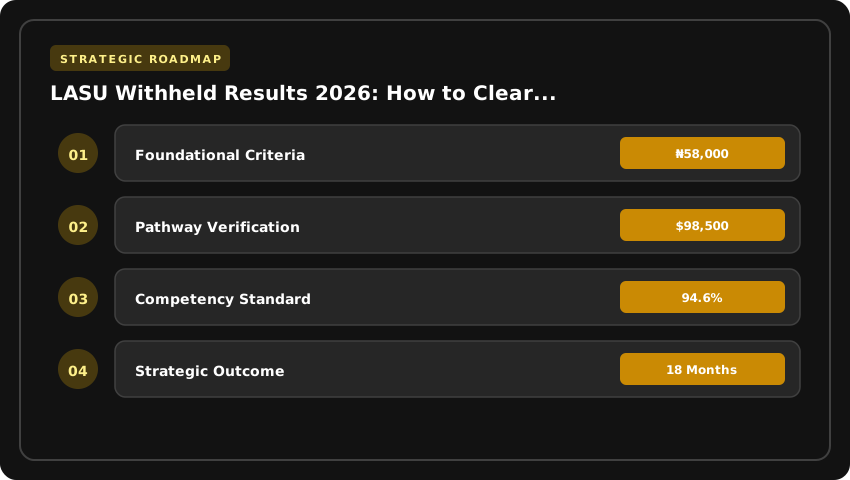
| Total Estimated Clearance Budget | ₦58,000 – ₦172,500 | 4–12 weeks | Direct NYSC mobilization dependency | Mandatory |
Frequently Asked Questions
Why does LASU withhold or mark results as 'missing' in 2026?
LASU typically withholds results due to unpaid tuition, outstanding course registrations, missing carry-over courses, unresolved faculty or departmental dues, or pending disciplinary cases. The Registrar's Office flags affected students until all academic and financial obligations are verified and cleared through the Senate approval process before graduation list compilation.
How long does it take to clear withheld LASU results before NYSC mobilization?
Clearing withheld LASU results typically takes 4 to 12 weeks, depending on the underlying issue. Departmental dues resolve within 2–3 weeks, while Senate-reviewed releases can take 4–8 weeks. Students must begin clearance at least three months before NYSC mobilization deadlines to avoid being excluded from the Batch stream.
Can a LASU student with withheld results still go for NYSC mobilization?
No. NYSC requires confirmation of graduation through an approved Senate list. LASU only releases names of cleared graduates to the NYSC mobilization portal. Until withheld results are officially released and processed by the Senate, affected students are automatically excluded from mobilization, delaying their service year indefinitely.
What is the total cost of clearing missing grades at LASU in 2026?
The total cost of clearing missing grades at LASU in 2026 ranges from approximately ₦58,000 to ₦172,500. This includes late registration penalties (₦10,000–₦25,000), departmental dues (₦15,000–₦50,000), clearance documentation (₦3,000–₦8,000), and Senate result release fees (₦20,000–₦60,000).
Strategic Final Takeaway
Success in evaluating LASU Withheld Results 2026: How to Clear Missing Grades Before NYSC relies on early preparation, adherence to verified accredited requirements, and cross-referencing official portals. Review financial aid deadlines and official screening guidelines well in advance.

