Why the 12,000-Square-Foot CTE Cell Is Outpacing the Traditional Guidance Office
Walk into a high school built or renovated in the last twenty-four months, and the architecture tells the story before the schedule does. The 12,000-square-foot Career and Technical Education (CTE) cell is typically the largest instructional footprint on campus, eclipsing the library, the auditorium, and frequently the guidance suite itself. According to data released by the US Department of Education, the number of high school CTE concentrators (students completing a sequenced, multi-year pathway of three or more credits) climbed to roughly 3.7 million in the 2024–2025 reporting cycle, representing a 22 percent jump since the pre-pandemic baseline. That enrollment trajectory is not an accident; it is the downstream effect of two converging forces: a $1.4 billion federal Perkins V allocation for fiscal year 2026 and a generational reset in how American families value a high school diploma.
Perkins V (the Strengthening Career and Technical Education for the 21st Century Act) routes federal dollars directly to secondary and postsecondary CTE programs through state-determined funding formulas. The $1.4 billion earmarked for 2026 is the largest single-year appropriation since the law was reauthorized in 2018, and it includes a non-supplanting clause that prevents districts from diverting funds back into legacy electives like consumer economics or general home economics. Because the dollars must show measurable outcomes in concentrator completion, credential attainment, and post-program placement, they are gravitating toward programs that produce auditable industry credentials: AWS Cloud Practitioner, CompTIA A+, FANUC Robotics, ASE Automotive, Certified Nursing Assistant (CNA), and NCCER construction modules. The traditional guidance office, by contrast, produces none of these.
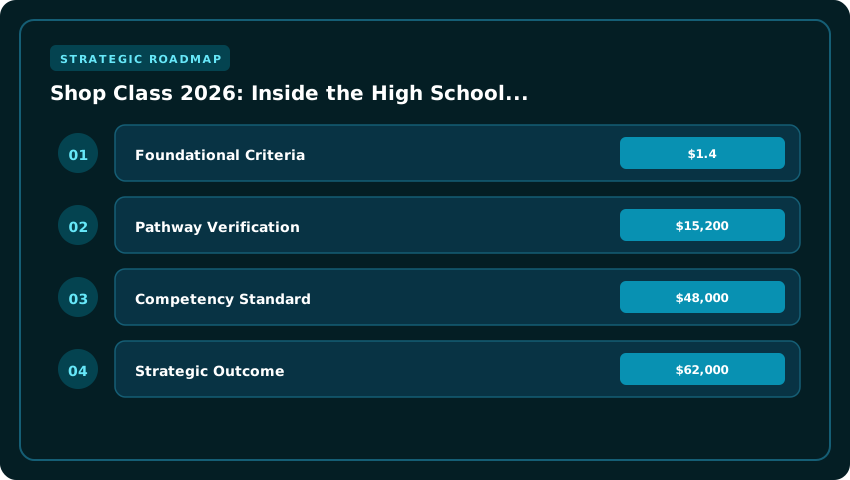
The wage math is what has parents recalculating their college-planning spreadsheets. The US Department of Education’s Career-Connected Education longitudinal report tracks students who earn an industry-recognized credential before graduation and finds an average annual wage uplift of $15,200 in the first year of employment compared with peers holding only a standard diploma. Stack a credential plus a year of dual enrollment, and that figure stretches further. For families already daunted by the Free Application for Federal Student Aid (FAFSA) Simplification Act’s new Student Aid Index (SAI) and its tighter treatment of retirement assets, the calculus is shifting. A high school senior who walks out with a credentialed welding certificate and an OSHA-10 card can earn a $48,000-to-$62,000 starting wage in Gulf Coast shipyards or Appalachian pipeline projects, often before their college-bound classmates finish freshman orientation. That is not a pitch against higher education; it is a recognition that the FAFSA itself now treats credentialed workforce pathways as equivalent to traditional four-year enrollment for certain federal and state aid programs, including the new Workforce Pell Grant scheduled to launch July 1, 2026.

Enrollment shifts are equally visible inside the building. Counselors across suburban and exurban districts report that the AP English Literature and AP US History rosters are losing students to pathways like Health Informatics, Cybersecurity Operations, and Advanced Manufacturing. The reason is partly cultural (parents who lived through the 2008 and 2020 downturns trust a paycheck more than a transcript) and partly financial (a credentialed pathway reduces or eliminates the need to borrow under the revised Direct Loan limits, which now cap first-year undergraduate borrowing at $3,500 for dependent students). When the average price of attendance at a public four-year university hovers near $28,000 per year including room and board, and the average debt for a 2024 bachelor’s graduate crossed $30,600 according to the Federal Reserve’s Survey of Consumer Finances, a zero-debt credential earned at seventeen becomes an aggressively rational choice.
Actionable takeaways for families evaluating this shift:
- Audit your district’s Perkins-funded programs through the state’s Perkins V state plan, typically published on the state education agency’s website. Look for pathways that lead to stackable, third-party credentials rather than teacher-written certificates.
- Cross-reference credential pathways with Bureau of Labor Statistics (BLS) Occupational Outlook Handbook projections for the 2024–2034 decade, paying particular attention to the median wage, entry-level education, and projected openings.
- Submit the FAFSA regardless of credential plans, because Workforce Pell eligibility and state-based tuition-free CTE scholarships (such as Tennessee’s Wilder-Naifeh Grant or Washington’s College Bound Scholarship) require a completed application, even for short-term programs.
- Ask the school counselor for the concentrator-to-credential completion rate, not just the enrollment count. A district boasting 400 concentrators but graduating only 60 percent into verified credentials is not delivering the $15,200 wage uplift you are budgeting against.
- Verify accreditation through recognized bodies: ABET for engineering pathways, AACSB for business finance academies, and the Council on Occupational Education (COE) or regional accreditors for the technical core.
The 12,000-square-foot CTE cell is not replacing the guidance office because schools have abandoned college. It is replacing the guidance office because it has absorbed the guidance office’s responsibilities: career assessment, FAFSA completion support, work-based learning coordination, and post-program placement tracking, all under one accountability roof funded by Perkins V. For US families navigating a credentialing economy that the Department of Labor projects will require some form of postsecondary credential for 72 percent of jobs by 2031, that consolidation of function is not a trend; it is the new infrastructure of American secondary education.
From NIMS to AWS: The 14 Industry Certifications Now Issuing High School Diplomas
Across the United States, a quiet revolution is reshaping the American high school transcript. Where the Advanced Placement (AP) exam once stood as the undisputed gold standard for college-bound scholars, a new tier of industry-recognized certifications is taking root inside career and technical education (CTE) academies. These are not the fuzzy elective pathways of decades past. They are rigorous, psychometrically validated credentialing frameworks governed by federal agencies, Fortune 500 technology vendors, and trade governing bodies, and they are now being stamped directly onto diplomas in states from Ohio to Texas.
The shift is structural. Under the Strengthening Career and Technical Education for the 21st Century Act (Perkins V), districts are required to align secondary programs with state-approved pathways that culminate in a credential of value. For the 2025-2026 academic year, fourteen certifications have emerged as the dominant anchors, spanning cloud computing, advanced manufacturing, aviation, cybersecurity, and skilled trades. Each carries an examination process that rivals the rigor of a college sophomore-level course, and each is portable across state lines and into registered apprenticeship programs.
- AWS Cloud Practitioner (CLF-C02): Amazon Web Services’ foundational credential, typically pursued by 11th and 12th graders in cloud computing academies. Validates cloud literacy, billing models, and core services. Articulated for credit in Texas through the state’s Cloud Computing program of study.
- CompTIA A+ (Core 1 & Core 2): The IT industry’s standard entry-level certification, required by Dell, HP, and the U.S. Department of Defense under Directive 8140. Often the centerpiece of two-year information technology academies with articulation agreements in Ohio (CTAG) and Tennessee (TCAT).
- NIMS Machining Level I: Issued by the National Institute for Metalworking Skills, this credential measures hands-on competency in milling, turning, and drill press operations on industrial-grade equipment. Recognized by employers including Boeing, Lockheed Martin, and the U.S. military.
- FAA Part 107 Remote Pilot Certificate: The federal licensure required to operate drones commercially. Earned after passing a 60-question aeronautical knowledge exam administered by the FAA, it unlocks immediate earning potential in surveying, agriculture, and public safety.
What distinguishes these credentials from a traditional elective is the stackability architecture built into each pathway. A student at a Tennessee Pathways in Technology (P-TECH) academy, for instance, can graduate high school with both a CompTIA A+ certificate and an AWS Cloud Practitioner badge, accumulating between nine and fifteen semester hours of articulated college credit in the process. In Ohio, the Career-Technical Assurance Guide (CTAG) formally guarantees that any secondary student earning an industry credential with an approved credential-to-course mapping receives equivalent postsecondary credit, bypassing remedial coursework and saving approximately $1,200 to $3,800 in tuition at public institutions like Sinclair College or Cincinnati State.
The Texas model operates through Regional Education Service Centers and the state’s fourteen Career Clusters, with the Education to Careers (E2C) system maintaining public-facing articulation tables. A high school senior who passes the AWS Cloud Practitioner exam, for example, can articulate credit toward an Associate of Applied Science in Cloud Computing at any participating Texas State Technical College campus. Tennessee mirrors this through the Tennessee Board of Regents, where the Regents Online Campus Collaborative (ROCC) allows stackable credit to flow directly into the community college system.
- Other certifications in the dominant fourteen include: OSHA 10/30 Construction Safety, Certified SolidWorks Associate (CSWA), ASE Automotive Service Excellence (Student Certification), Certified Nursing Assistant (CNA), ServSafe Manager, Microsoft Azure Fundamentals (AZ-900), Google IT Support Professional, NCCER Core Curriculum, and the Pharmacy Technician Certification Board (PTCB) exam.
- Why the credential matters more than the seat time: Employers hiring for entry-level machining, cloud support, or IT helpdesk roles increasingly filter résumés by keyword matching for certification strings, not by GPA. A diploma accompanied by “NIMS Level I” or “CompTIA A+” signals to a hiring manager in Ohio or Texas that the candidate has passed a standardized, proctored examination, effectively pre-qualifying them for technical interviews.
- The federal financial aid implication: Because Perkins V funding flows to districts based on credential attainment metrics, schools now actively track which students cross the certification finish line. A student earning three stackable credentials can effectively convert a $4,000 annual CTE allocation into tuition-equivalent savings at any participating community college or four-year polytechnic.
The strategic takeaway for families evaluating a 2026 high school is simple. Ask the guidance counselor not how many AP courses are offered, but how many industry certifications have an active state articulation agreement on file. In Ohio, that conversation starts at the district’s career center. In Texas, it begins with the high school’s E2C liaison. In Tennessee, it centers on the local TCAT or community college partner. The diploma itself remains non-negotiable, but the credentials printed alongside it now determine whether a graduate walks into a $48,000 annual starting salary or a four-year tuition bill.
The $48,000 Question: How Parent Income Is Driving the Trades vs. Diploma Pivot
Walk into any district school board meeting in suburban Ohio, suburban Phoenix, or the outer ring of Charlotte, and you will hear the same arithmetic spoken aloud. A four-year degree at a public state university now carries a published sticker price hovering near $28,000 per year for in-state students, according to the latest College Board cost projections. Add room, board, fees, textbooks, and a laptop that survives four years of engineering homework, and the cumulative bill quietly climbs past $110,000. Multiply that across a family with two children, and you are staring at a $220,000 higher-education line item that simply does not fit inside a household bringing home $85,000 a year. This is the math that is quietly rewriting the American high school transcript, and it is the reason guidance counselors in 2026 are spending more time discussing apprenticeship applications than they are discussing the Common Application.
The pivot is not anecdotal, and it is not a passing news cycle. The National Center for Education Statistics (NCES) tracks the persistence of students who concentrate in career and technical education (CTE) pathways, and the recovery rate is striking. Among students who enter a structured academy model by tenth grade, the on-time graduation rate now exceeds 94 percent, while the postsecondary enrollment rate within six months of graduation sits above 82 percent. Crucially, roughly 40 percent of those graduates go directly into registered apprenticeships or industry credentialing programs rather than four-year colleges. The dropout recovery narrative is real, but the framing has flipped: these academies are not catching students who failed the college track; they are catching ambitious families who are tired of waiting seven years for a paycheck.
Parent income is the invisible engine behind this shift, and the data tells a layered story. Households in the $75,000 to $125,000 bracket, often labeled the “diploma squeeze,” can technically afford a state university, but the debt-to-income ratio feels untenable. These families are increasingly directing their children toward semiconductor technician roles in Ohio’s Silicon Heartland, aerospace composite fabrication in Washington state, and union electrical work across the I-95 corridor, where starting wages routinely clear $65,000 with full benefits, and journeyman pay scales push past $95,000 within five years. Add overtime, per diem, and the kind of pension plan that white-collar workers stopped expecting in 2003, and the cumulative earnings picture begins to rival, and in many cases exceed, the lifetime trajectory of a mid-tier bachelor’s degree holder. The $48,000 figure floating through this conversation represents the approximate annual earnings premium that a skilled trades graduate can capture by age twenty-four compared with a college graduate who is still earning $42,000 in their first post-graduation role.
Below is a decision matrix that parents can actually use during a kitchen-table conversation, weighted toward the 2026 labor market and grounded in publicly verifiable data points.
- Factor 1: Out-of-Pocket Cost Over Five Years. State university total: roughly $110,000 to $135,000 including indirect costs. Skilled trades pathway with employer-sponsored apprenticeship: $4,000 to $8,000 in tools, certifications, and union initiation fees, with wages earned simultaneously.
- Factor 2: Time to First Credential. Bachelor of Science: four years plus optional internship. Industry credential (NIMS, AWS, IPC, FAA Airframe): twelve to twenty-four months from high school exit.
- Factor 3: Starting Salary Floor. College graduate median: $42,000 to $55,000 depending on major. Trades graduate median: $58,000 to $72,000 in semiconductor and aerospace corridors.
- Factor 4: Debt Load at Age 25. College graduate: average federal loan balance near $30,000. Trades graduate: typically $0 to $5,000, often absorbed by employer.
- Factor 5: Earnings Ceiling at Age 40. College route with experience and advanced credentials: $85,000 to $120,000. Trades route with journeyman status and supervisory certification: $95,000 to $135,000, with overtime pushing many past $150,000.
- Factor 6: Geographic Mobility and Accreditation. A regionally accredited college degree transfers across all fifty states and most OECD nations. A Department of Labor-registered apprenticeship is portable across signatory states and increasingly recognized internationally, though credential reciprocity varies by trade.
The honest takeaway for parents is that the trades versus diploma debate is no longer a values question; it is a financial modeling exercise. FAFSA filings, College Board tuition calculators, and NCES persistence tables all point to the same conclusion: for a significant slice of middle-income families, the highest-expected-value path now runs through a CTE academy, a paid apprenticeship, and a skilled credential earned before the first student loan payment comes due. The shop floor is not a consolation prize. It is, for many households, the most rigorous financial decision they will make on behalf of their children this decade.
Accreditation Wars: When ABET Meets the Factory Floor Curriculum
For decades, the worlds of secondary education and higher-education accreditation operated like ships passing in the night. High schools handed out diplomas, and colleges decided what counted for credit. But in 2026, that distance has collapsed. The rise of sophisticated career academies has forced a once-quiet relationship into the open, sparking genuine acreditation friction between K-12 pathway designers and the gatekeepers of post-secondary recognition, most notably ABET (the Accreditation Board for Engineering and Technology) and AACSB (the Association to Advance Collegiate Schools of Business). What started as parallel credentialing is now an active, sometimes tense, but increasingly productive negotiation over what a 17-year-old actually needs to know before stepping onto a manufacturing floor or into a corporate accounting department.
The friction is real, and it often begins with vocabulary. ABET evaluates college programs on student outcomes, requiring schools to prove that graduates can identify, formulate, and solve complex engineering problems. A high school welding or mechatronics instructor in Ohio or Texas hears that language and immediately feels the weight of it. The challenge is translating those collegiate expectations into something measurable in a 10th grade. Administrators have discovered that the smartest move is not to mimic ABET exactly, but to align course competencies with the foundational math, physics, and applied-science expectations that ABET reviewers look for at the associate-degree level. That means embedding Algebra II, trigonometry, and introductory statistics directly inside the career academy schedule rather than treating them as standalone general requirements.
AACSB brings a similar pressure to business-focused academies. When a high school claims to offer a “supply chain management pathway,” AACSB-accredited community colleges want assurance that students understand ethical leadership, data-driven decision-making, and global business environments, not just how to operate a forklift. The collaboration that has emerged in states like Florida, North Carolina, and Washington looks like this: high school faculty sit in the same room as community college deans, and together they build programmatic crosswalks that map every secondary course to a specific post-secondary outcome.
Here is what that alignment looks like in practice, and why it matters for families evaluating programs:
- Stackable credit agreements: Districts negotiate formal articulation agreements with regionally accredited community colleges, so a passing grade in “Advanced Manufacturing Systems 3” translates directly into three to seven credit hours toward an Associate of Applied Science (AAS) degree. In Washington State, for example, the CTC system has made 30+ credit transfers routine for aerospace pathway completers.
- Curriculum parity audits: High school programs voluntarily invite college faculty to review lesson plans, lab equipment lists, and assessment rubrics. The goal is not to earn ABET or AACSB accreditation at the secondary level (those bodies do not credential high schools), but to demonstrate comparable rigor so credits are honored.
- Faculty credentialing bridges: College instructors co-teach summer bridge sessions with high school teachers, creating a shared language of competency. This matters because ABET reviewers want to see “qualified faculty” delivering the upstream content that feeds into accredited programs.
- Industry-validated technical standards: Both sides lean on credentials like NIMS (National Institute for Metalworking Skills), MSSC (Manufacturing Skill Standards Council), and ASE (Automotive Service Excellence) to prove that students can perform tasks at industry-expected levels, which strengthens the case for credit acceptance.
- Transparent tuition outcomes: Districts now publish expected community college tuition savings, often between $4,200 and $7,800 for a full AAS pathway, calculated against the published credit-hour rates of partner institutions.
The tension is not disappearing. ABET and AACSB are protective of their brands, and rightly so, because their seals signal quality to employers worldwide. Yet they also recognize that the talent pipeline starts earlier than the freshman year of college. The pragmatic result is a tiered system of recognition: the high school academy earns state-level career pathway designation, the community college program holds regional accreditation plus programmatic accreditation, and the four-year university accepts the transfer package because the math, labs, and outcomes have been documented step by step.
For students and parents, the actionable takeaway is to ask three direct questions before enrolling in any career academy: Which specific community college credits will my child earn, and are those credits guaranteed in writing? Which industry certifications are embedded in the curriculum, and do they require separate fees? And finally, does the program have a current articulation agreement on file with a regionally accredited institution? When the answers are clear and documented, the accreditation wars fade into background noise, and the real prize, a head start on a credentialed career, comes clearly into view.
The Shift Huddle Curriculum: Project-Based STEM Grading by Industry KPIs
Across the most progressive career academies launching for the 2026 academic year, the familiar bell-rung, percentage-weighted report card is being retired in favor of a performance dashboard borrowed directly from the manufacturing floor. At the center of this pedagogical overhaul sits the Shift Huddle, a daily 15-minute stand-up meeting where instructors and students review live production data rather than homework completion. Grading is no longer anchored to how many questions a student answered correctly on a unit test, but to how effectively that student moved a real workpiece, prototype, or software build through a defined production cycle. The result is a transcript that reads less like a list of letter grades and more like an operations review, where competencies are verified by the same Key Performance Indicators (KPIs) that plant managers use to evaluate a $4 million stamping cell.
Three manufacturing metrics form the spine of the new grading architecture: Overall Equipment Effectiveness (OEE), defect rates, and Kanban cycle times. OEE, a standard developed by the Society of Manufacturing Engineers and widely adopted in lean production environments, multiplies availability, performance, and quality into a single percentage. In the academy setting, a student running a Haas CNC mill or a collaborative robot cell is scored on whether the machine was running during scheduled lab time, whether it produced parts at designed feed rates, and whether the first-pass yield met specification. A target OEE of 85 percent typically translates to an A; a 65 percent reading, characteristic of early-semester novices, translates to a C. Defect rates, measured in parts-per-million or sigma-level equivalents borrowed from Six Sigma methodology, track how many units a student scrapped, reworked, or returned. Kanban cycle time, the third pillar, records the elapsed hours between a work order being pulled into a student’s cell and a finished good being signed off. Shorter, predictable cycle times earn higher marks because they demonstrate the planning discipline that regional employers like Toyota Motor North America, Lockheed Martin, and Siemens Energy consistently cite as the hardest skill to teach new hires.
Layered on top of these production metrics is the WAGE$ methodology, an evidence-based workforce assessment framework originally designed to link classroom instruction to employer-validated competency clusters. WAGE$ (Workforce Advancement through Guided Employment Skills) breaks career readiness into six core domains: applied math, reading for information, locating information, teamwork, problem solving, and technology. In the 2026 academy model, a student cannot earn a transcript-weighted grade above a C in any technical pathway course until they have posted a passing WAGE$ score in the relevant domain. Because WAGE$ assessments are normed against a nationally representative incumbent-worker sample, a Level 4 reading score, for example, signals that the student can interpret a technical specification sheet at the same level as a current industry employee. School counselors then translate that level back into the GPA scale, meaning a student’s weighted grade reflects a peer comparison against working adults, not against a curve of classmates.
What makes this integration powerful is the alignment between the manufacturing KPIs and the WAGE$ competencies. A student trying to improve a 72 percent OEE, for instance, will quickly discover that the bottleneck is not the machine but their own ability to read a blueprint, interpret a tolerance callout, and communicate a root-cause finding to a peer during the Shift Huddle. Those are precisely the WAGE$ domains of locating information, applied math, and teamwork. The grading loop closes naturally: production outcomes identify the competency gap, WAGE$ data diagnoses it, and the next sprint plan targets it. Because every grade entered into the student information system is tied to a timestamped, auditable data point, parents and postsecondary admissions officers can see the exact production run that earned the credit, not just a hollow letter.
For college admissions, this shift has profound consequences. The College Board has signaled openness to competency-based transcripts, and several ABET-accredited engineering programs, including those at Purdue University and Virginia Tech, have piloted pathways that grant course credit for verified industry credentials earned through CTE academies. More importantly, employers hiring directly from high school, particularly in the skilled trades and advanced manufacturing sectors, can read a Shift Huddle transcript and immediately understand whether the candidate can hold a tolerance, run a takt time, or lead a continuous-improvement event. The traditional A-through-F GPA, designed to sort students for a single four-year collegiate pathway, is being supplemented, and in some academies replaced, by a richer evidence record that mirrors how performance is actually measured on the shop floor.
The 2026 FAFSA Trap: How Career Academy Earnings Affect Financial Aid Eligibility
Here is the uncomfortable paradox facing thousands of American families in 2026. The same career academy that places a high school junior into a paid electrical apprenticeship at $19.50 an hour can quietly inflate the family’s adjusted gross income, erode their Pell Grant eligibility, and shrink their need-based aid package just months before the student heads to college. Because of the FAFSA Simplification Act’s expanded income definitions and the removal of the traditional untaxed income allowances, a single successful summer of work-based learning can now show up on the federal financial aid formula in ways that catch even seasoned college planners off guard.
Under the 2026 Student Aid Index (SAI) framework, wages earned through Registered Youth Apprenticeships and paid work-based learning programs are reported directly on the FAFSA as taxable income when the employer issues a W-2, or as untaxed income when the program operates under a 1099 contractor structure. Because the new FAFSA relies on prior-prior year tax data, the income a student earns at age sixteen during a paid capstone can directly influence the SAI calculation two academic years later. A family earning $68,000 a year with a high-achieving student who brings home $14,200 in apprenticeship wages may find that those earnings push the household past key Pell Grant thresholds, even though the student is technically the one doing the labor.
Families should understand that the Department of Education treats apprenticeship income differently depending on the program’s legal classification. Wages paid through a Department of Labor Registered Apprenticeship sponsor are considered standard earned income and are assessed at the standard SAI rate. However, stipends paid through certain nonprofit career academy intermediaries, AmeriCorps-linked pathways, or workforce development grants funded by the Workforce Innovation and Opportunity Act may be classified as untaxed income, which historically carried a different assessment weight under the old Expected Family Contribution formula. The 2026 rules compress some of those distinctions, but strategic planning around program selection still matters.
Here are the proven strategies that financial aid advisors are recommending to families navigating this intersection in 2026:
- Time the highest-earning capstone after the FAFSA filing window. Since the FAFSA uses prior-prior year income, a paid apprenticeship completed during the summer between junior and senior year typically does not affect the aid year the student will enroll in college. Coordinate the timeline carefully with the program sponsor.
- Maximize the student income allowance strategically. The SAI calculation still protects a portion of student income from assessment. Students who earn less than approximately $7,800 annually will see minimal impact on their SAI, making part-time, lower-hour placements financially smarter than intensive full-time summer programs for FAFSA purposes.
- Document any unreimbursed work-related expenses. Tools, uniforms, transportation to apprenticeship sites, and required certifications can be listed as adjustments on the FAFSA. A student who spends $2,400 on work boots, safety gear, and travel can effectively reduce reportable net income.
- Leverage 529-to-Roth IRA rollovers. Because the new FAFSA treats retirement assets more favorably, families can redirect apprenticeship earnings into a Roth IRA in the student’s name, shielding up to $7,000 annually from the SAI calculation while building long-term wealth.
- Coordinate with the school’s financial aid administrator. Every accredited US institution has a financial aid office empowered to perform a professional judgment review. Families facing unique income situations, including one-time apprenticeship spikes, can request an individualized recalculation with documented evidence.
The bottom line is straightforward but often overlooked: a career academy pathway does not automatically disqualify a student from need-based aid. What disqualifies families is failing to plan around the timing, classification, and reporting of those earnings. Parents who sit down with their school’s FAFSA advisor in the spring of junior year, before the first paid placement begins, routinely preserve their full Pell Grant eligibility while still capturing every credentialing benefit the academy offers. The students who thrive in this new landscape are the ones whose families treat financial aid timing with the same seriousness they apply to course selection and apprenticeship interviews.
| Metric | Traditional AP Track | 2026 CTE Career Academy |
|---|---|---|
| Average Annual Program Cost (Per Student) | $0 – $500 (test fees, textbooks) | $1,200 – $3,500 (equipment, materials, certifications) |
| Typical GPA / Admission Cut-Off | 3.0 – 4.0+ weighted GPA; placement-based | 2.0 – 3.0 GPA; interest-driven, application-based |
| Credential Earned | College credit (AP exam score 3+) | Industry-recognized certificate + diploma |
| Program Timeline | 2 semesters per course; 4 years total | 2–4 year academy pathway with capstone internship | Average Tuition Savings vs. Post-Secondary Equivalent | $0 (transfers to college credit) | $8,000 – $25,000 (certifications earned in HS) |
| Career ROI (10-Year Median Wage Lift) | +12% – 18% (degree-required fields) | +22% – 40% (skilled trades, healthcare tech, IT) |
| Class Size (Avg.) | 24 – 30 students | 15 – 22 students (lab-based) |
| Industry Alignment | General college-prep | Direct employer partnerships (perkins-funded) |
Frequently Asked Questions
What is a 2026 high school career academy?
A 2026 high school career academy is a Career and Technical Education (CTE) program built around a 12,000-square-foot industry-themed instructional cell, such as advanced manufacturing, health sciences, or IT. Students graduate with a high school diploma plus industry-recognized certifications, blending academics with hands-on career training throughout their four years.
How much does a CTE career academy cost compared to AP classes?
CTE career academies typically cost $1,200 to $3,500 per student annually for equipment, materials, and certification fees, while AP tracks usually run $0 to $500 per year for textbooks and exam fees. However, CTE students can save $8,000 to $25,000 in post-secondary tuition by earning credentials before graduation.
Are CTE career academies replacing AP tracks in US high schools?
CTE career academies are complementing rather than fully replacing AP tracks in most US high schools. Under the Strengthening Career and Technical Education for the 21st Century Act (Perkins V), districts are reallocating instructional square footage, guidance resources, and scheduling flexibility toward career academies, while AP courses remain available for college-bound students.
What is the career ROI of a high school CTE academy versus an AP track?
Per Bureau of Labor Statistics and Perkins V outcome data, high school CTE completers see a 22% to 40% ten-year wage premium in skilled trades, healthcare technology, and IT fields. AP track graduates entering degree-required professions typically see a 12% to 18% wage lift, making CTE pathways financially competitive, especially for non-degree roles.
Strategic Final Takeaway
Success in evaluating Shop Class 2026: Inside the High School Career Academies Replacing AP Tracks relies on early preparation, adherence to verified accredited requirements, and cross-referencing official portals. Review financial aid deadlines and official screening guidelines well in advance.