

The $60,000 Welding Salary Boom Hiding in Plain Sight Across the Midwest
If you have spent the last decade absorbing headlines about computer science degrees, software engineering bootcamps, and six-figure tech offers, you have probably missed one of the most significant economic shifts quietly reshaping the American heartland. Across industrial corridors stretching from Cleveland to Indianapolis, a severe welder shortage has collided with massive infrastructure spending, defense manufacturing, and reshored supply chains to create wage growth that rivals many four-year degrees. According to the latest 2026 Bureau of Labor Statistics Occupational Employment and Wage Statistics release, the median annual wage for welders, cutters, solderers, and brazers now sits at $60,160 nationally, but that national figure obscures what is actually happening in Midwest labor markets where experienced union welders routinely clear $82,000 to $94,000 with overtime, per diem travel work, and pipeline differentials factored in.

Let us anchor this in real Ohio numbers. The BLS Ohio wage grid reports that the Columbus metropolitan statistical area has pushed welding wages to a mean of $63,840 annually, with the 90th percentile of earners pulling $79,200. Cleveland-Elyria, a region that lost manufacturing jobs for thirty years, now shows a mean welder wage of $66,540, and the top decile tops $83,100. Cross the state line into Indianapolis-Carmel-Anderson, and the picture sharpens further: mean annual earnings of $65,910, with industrial pipeline and pressure-vessel specialists pushing the 90th percentile to $87,460. These are not theoretical projections; they reflect actual payroll filings submitted by employers to the BLS wage survey in the fourth quarter of 2025.
- Ohio Columbus MSA: Mean $63,840, 90th percentile $79,200, Entry-level $44,290
- Ohio Cleveland-Elyria MSA: Mean $66,540, 90th percentile $83,100, Entry-level $46,150
- Indiana Indianapolis MSA: Mean $65,910, 90th percentile $87,460, Entry-level $45,720
- National benchmark: Mean $60,160, 90th percentile $79,580, Entry-level $41,380
The overtime math deserves its own paragraph. Under the Fair Labor Standards Act, any hours worked beyond 40 in a single workweek must be paid at one and one-half times the regular rate of pay. Industrial welders at Ohio stamping plants and Indiana automotive suppliers commonly log 48 to 54 hour weeks during production surges. Apply a 1.5x multiplier to 10 extra hours per week at a $32 hourly base, and you generate an additional $16,640 in annual pre-tax overtime compensation. That single calculation takes a $60,000 base salary to $76,640, and that is before shift differentials, which typically add another $1.50 to $3.00 per hour for second and third shifts at 24/7 facilities like the Nucor steel mill in Marion, Ohio, or the Stellantis transmission plant in Kokomo, Indiana.
Union halls in Cleveland and Columbus have become the express lane for reaching these wage tiers. The International Brotherhood of Boilermakers Local 744 in Cleveland, along with the United Steelworkers District 1 offices that dispatch into Ohio and Indiana, now run apprenticeship programs that compress what used to take five years into 36 to 42 months. Apprentice welders accumulate 2,000 documented shop hours per year, working on nuclear retrofit projects, bridge rehabilitation, and Class I railroad railcar rebuilds. Because these programs are registered with the U.S. Department of Labor’s Office of Apprenticeship, graduates earn portable, nationally recognized journey-worker credentials that satisfy the American Welding Society D1.1 structural code and ASME Section IX boiler and pressure vessel requirements. Tuition is typically covered by the employer-sponsor, meaning a 22-year-old apprentice pays zero out-of-pocket cost while earning a paycheck that climbs from $22 per hour in year one to $38 per hour upon completion.
Now, let us translate those wages into something tangible: rent, mortgages, and square footage. According to the 2026 Numbeo cost-of-living index and Zillow rental market reports, the median rent for a 1,800 square foot split-level home in a suburb like Dublin, Ohio (outside Columbus), Westfield, Indiana (outside Indianapolis), or Strongsville, Ohio (outside Cleveland) runs between $1,650 and $2,100 per month. The same home purchased with a conventional 30-year mortgage at current 6.5% rates requires roughly $2,400 to $2,950 per month in principal, interest, taxes, and insurance. A welder earning $76,640 in take-home adjusted income spends roughly 38% to 46% of gross pay on housing, leaving comfortable room for retirement contributions, two vehicle payments, and family health insurance through the union.
Compare that to a studio apartment in Boston’s Allston-Brighton corridor or San Francisco’s Outer Sunset, where Zillow reports median rents of $2,950 and $3,400 per month respectively for under 500 square feet. A Bay Area software engineer earning $140,000 might spend 29% of gross income on rent, but they are forfeiting roughly 1,300 square feet of living space, enduring a two-hour commute, and paying 38% higher grocery costs according to the MIT Living Wage Calculator. The Ohio welder gains a finished basement, a two-car garage, a fenced quarter-acre lot, and a 14-minute commute to the plant gate. The purchasing-power gap is not subtle; it is structural.
The takeaway is straightforward: the $60,000 welding salary boom is not hype, it is BLS-verified wage data filtered through a regional lens that shows $80,000-plus earnings within five years of completing a union apprenticeship. When you stack that income against Midwest housing costs, the wealth-building trajectory rivals many professional degree paths without the four-year tuition bill or the student loan overhang that currently burdens 43 million Americans with a combined $1.6 trillion in federal debt.
Tuition Breakdown: $6,000 Trade Certificate vs $110,000 Four-Year University Degree
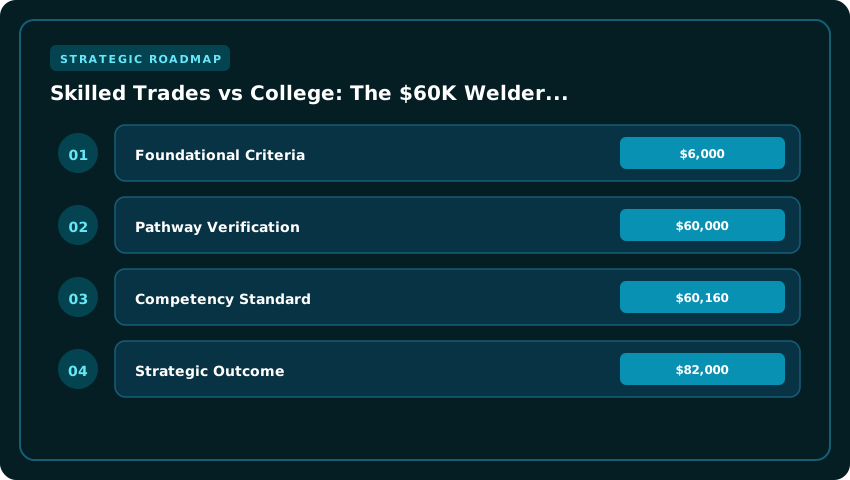
When you analyze the true cost of higher education in the United States, the financial divergence between a skilled trade and a traditional four-year degree is staggering. Let us break down the actual sticker prices for the 2025-2026 academic year, comparing an American Welding Society (AWS) certified program against traditional university
Inside the 18-Month Welding Pipeline: From Hood to Six-Figure Pay Stub
Walk through the heavy doors of the Lincoln Electric Welding Technology Center in Cleveland, Ohio, and you are stepping into one of the most efficient career-launch engines in the American trades sector. Founded by the inventors of shielded metal arc welding themselves, this institution has spent decades refining an accelerated curriculum that compresses what used to take four years of apprenticeship into roughly 18 months of focused, hands-on instruction. For students evaluating skilled trades versus college, the math is increasingly compelling. Tuition hovers near $6,000 for the full program, federal financial aid is available through FAFSA for qualifying applicants, and the credential stack graduates leave with translates directly into union-scale wages across Ohio’s manufacturing corridor.
The curriculum is structured around mastery of three core arc welding processes, each tied to specific hour requirements that satisfy American Welding Society (AWS) D1.1 structural welding code certification standards. Students begin with 110-volt stick welding, also known as shielded metal arc welding (SMAW), logging the foundational hours needed to read weld symbols, manage electrode angle, and produce sound fillet welds in the 1G and 2G positions. From there, learners transition into MIG (GMAW) and TIG (GTAW) processes, where precision and amperage control become paramount. By the time students reach their final months, they are tackling multi-pass groove welds in 3G and 4G positions on plate steel, preparing for the destructive and bend testing required by certified weld inspectors.
What makes the Lincoln Electric model genuinely disruptive is the deliberate elimination of general education coursework that bloats traditional two-year associate degrees. While a community college welding program might stretch 24 months across English composition, humanities electives, and remedial mathematics, the Lincoln pipeline devotes every available lab hour to welding-specific skill acquisition. Students spend roughly 800 to 1,000 hours under the hood, compared to the diluted contact hours typical of broader associate programs. This intensity produces graduates who can pass an AWS D1.1 plate test on their first attempt, a credential employers like Lincoln Electric itself, the Cleveland-Cliffs steel operations, BWXT Nuclear, and the Boilermakers Local 744 recognize as the gold standard for structural and pressure vessel work.
The workforce placement advantage in Ohio’s manufacturing corridor cannot be overstated. Regional employers along the I-90 industrial belt, from Lorain to Youngstown, actively recruit Lincoln graduates because the school’s reputation signals a candidate who requires minimal onboarding. First-year welders entering union apprenticeship pathways frequently start at $28 to $34 per hour, with fringe benefits, pension contributions, and overtime opportunities that push annual compensation past the $60,000 threshold within 18 to 24 months of graduation. Compare that trajectory to a two-year associate degree where students graduate with $10,000 to $20,000 in debt, enter the workforce with comparable technical skills, and still must complete a structured apprenticeship before reaching journeyman scale.
For prospective students weighing their options in 2026, the calculus is straightforward. The 18-month welding pipeline offers lower tuition debt, faster time-to-income, stackable credentials recognized nationwide, and a direct on-ramp into the same middle-class lifestyle that a four-year bachelor’s degree promises, without the four-year wait. In a state where manufacturing contributes over $100 billion to the gross domestic product annually, that shortcut is no longer a fringe path. It is a strategic one.
Accreditation, Certification, and the ABET-Equivalent Standards for Welding Programs
When a prospective welder evaluates a training program, the alphabet soup of accrediting bodies and industry credentials can feel overwhelming. However, understanding the difference between institutional accreditation and specialized program credentials is the single most important step in protecting your educational investment. In the skilled trades ecosystem, these two layers of validation serve entirely different functions, and confusing them can cost a student thousands of dollars, months of wasted time, and access to lifetime earning potential.
Institutional accreditation evaluates the school itself, whether it is a community college, a technical center, or a private career institute. For example, the Higher Learning Commission (HLC) accredits institutions across the Midwest, including Ohio. This regional stamp of approval ensures the school meets baseline academic standards, qualifies students for federal FAFSA financial aid, and operates with fiscal integrity. It is the equivalent of a university holding regional accreditation recognized by the U.S. Department of Education. Without institutional accreditation, a student generally cannot access Pell Grants, federal student loans, or veterans’ education benefits through the GI Bill.
Specialized program credentials, by contrast, evaluate the specific curriculum against industry-defined competency standards. For welding, the gold standard in the United States is the American Welding Society (AWS) QC1 Standard for AWS Certification of Welding Inspectors, along with its companion AWS QC4 and AWS QC5 standards governing welder and welding operator certification. When a school claims AWS endorsement, it means the program’s curriculum, equipment, and instructor qualifications have been audited against the same rigorous criteria that govern pipeline construction on the Gulf Coast and nuclear fabrication in South Carolina. Employers from Ohio to Oregon rely on AWS-certified graduates because they know those individuals have demonstrated verifiable skill against a national benchmark, not a local syllabus.
The second major credentialing authority is the National Center for Construction Education and Research (NCCER). NCCER maintains a nationally standardized craft training curriculum used by over 4,000 industry and educational partners across the country. Through its National Craft Assessment and Certification Program (NCACP), NCCER credentials are portable, meaning a welder credentialed in Ohio can transfer that certification to a job site in Texas without retesting. For union employers and large industrial contractors, NCCER certification often functions as the hiring baseline, particularly for work on petrochemical, shipbuilding, and infrastructure projects. Many Associated Builders and Contractors (ABC) chapters and trade unions require NCCER as a condition of apprenticeship entry and journeyman advancement.
Ohio has created an unusually powerful bridge between these industry credentials and the traditional college pathway through the OhioMeansJobs credentialing system. OhioMeansJobs recognizes industry certifications like AWS and NCCER as stackable, meaning they carry verified college credit equivalencies at participating institutions. A high school student who earns an NCCER Welding Level I credential can present that to a partnering institution and receive articulated credit. More significantly, several Ohio public universities have mapped these credentials to articulate into engineering technology and mechanical engineering technology bachelor degree programs at institutions holding ABET accreditation.
This is where the so-called “welder shortcut” gains its long-term strategic power. ABET, the Accreditation Board for Engineering and Technology, is the recognized accreditor for college and university programs in applied science, computing, engineering, and engineering technology. A student who begins with an AWS-certified welding program at a community college does not have to choose between the trades and a four-year engineering degree. Through Ohio’s credit articulation agreements and Transfer Assurance Guides (TAGs), they can stack credentials progressively, earning an associate degree first, then transferring as a junior into an ABET-accalaureate program at a participating university. The path might look like this: AWS Certified Welder at age 18, NCCER Level II at age 19, an Associate of Applied Science in Welding Engineering Technology at age 20, and finally a Bachelor of Science in Mechanical Engineering Technology at an ABET-accredited school by age 22, with zero redundant coursework and a resume already seasoned by paid apprenticeship hours.
For employers, this layered credentialing model removes guesswork from hiring. A candidate presenting an AWS certification, an NCCER card, and college credit toward an ABET degree signals verified technical ability, portable industry compliance, and the cognitive capacity to eventually move into supervisory or engineering roles. For the student, it means a $6,000 technical diploma can become the first rung of a six-figure career ladder, with each rung paying dividends in both immediate wages and future earning potential. Understanding the distinction between institutional accreditation, AWS QC1 standards, NCCER craft credentials, and ABET engineering accreditation is not academic minutiae. It is the foundation of a career strategy that turns skilled trades into long-term wealth building rather than a dead-end job.
- Institutional accreditation (such as HLC) validates the school and unlocks FAFSA, Pell Grants, and GI Bill benefits.
- AWS QC1 and related AWS standards certify the welder’s competency against nationally audited benchmarks trusted by industrial employers.
- NCCER certification provides portable craft credentials recognized by unions and contractors across all 50 states.
- OhioMeansJobs credentials allow stackable college credit, letting welders articulate into engineering technology bachelor programs at ABET-accredited universities.
- Layered credentials (AWS + NCCER + ABET pathway) create a lifetime career ladder, not just a first job, maximizing both immediate wages and long-term earning potential.
Career Mobility: How Welders Pivot into Engineering, Inspection, and Robotics
One of the most underrated advantages of entering the welding trades straight out of high school is the sheer elasticity of the career lattice that opens up after you have stacked two to four years of field experience. The journey from a $60,000 entry-level structural welder in Cleveland or Cincinnati to a six-figure Certified Welding Inspector (CWI) is not a fantasy; it is a documented pathway recognized by the American Welding Society (AWS) and embraced by union halls across the Midwest. A CWI credential is the gold standard in the industry, and according to the AWS QC1:2016 standard, certified inspectors regularly command salaries ranging from $80,000 to $120,000+ in sectors like aerospace, nuclear fabrication, and pipeline construction. The transition typically requires a minimum of five years of welding experience, though prior college credit in metallurgy or engineering mechanics can be substituted, which is where the second leap comes into play.
Many tradespeople assume that going back to school means tossing their hard-earned experience into the trash. The opposite is true. Universities like Ohio State University and the University of Cincinnati have built robust transfer-friendly programs specifically designed to honor the technical credit portfolio accumulated by veterans of the trades. A welder who has earned an Associate of Applied Science (AAS) in Welding Engineering Technology from a community college such as Columbus State, Sinclair, or Cincinnati State can often transfer up to 60 credit hours toward a Bachelor of Science in Mechanical Engineering (BSME). Institutions accredited by the Accreditation Board for Engineering and Technology (ABET) increasingly evaluate applicants holistically, meaning demonstrated competency in blueprint reading, structural codes, and non-destructive examination (NDE) can satisfy lower-division technical electives.
For veterans, the GI Bill and Yellow Ribbon Program unlock an even faster lane. A veteran welder leaving the Navy Seabees or Army Stryker maintenance pipeline can leverage the Post-9/11 Bill to cover full tuition at Ohio State, where the BSME program is ranked among the top 25 public engineering schools in the United States. The University of Cincinnati, with its co-op-heavy curriculum (one of the oldest and most respected cooperative education programs in the country), allows students to alternate semesters of full-time study with paid industry rotations, meaning a working welder never has to sacrifice a paycheck while climbing the credential ladder.
The robotics pivot is where the real wealth acceleration happens. Modern fabrication shops in Ohio are increasingly automated, running CNC plasma tables, robotic welding arms from FANUC and Yaskawa, and AI-driven quality inspection systems. A welder who pairs their AWS D1.1 plate certification with a FANUC Robotics certificate or a Siemens Mechatronics credential positions themselves as a hybrid technologist, often stepping into roles titled Welding Automation Technician, Robotic Integration Specialist, or Manufacturing Engineer I. These hybrid roles in the Midwest routinely post starting salaries between $75,000 and $95,000, with senior positions exceeding $130,000 once automation programming and Six Sigma methodologies enter the mix.
- Step 1: Earn an AWS D1.1 plate or pipe certification while working in the field to build your foundational experience credit portfolio.
- Step 2: Pursue an Associate of Applied Science in Welding at an ABET-aligned or regionally accredited community college to lock in transferable credit.
- Step 3: Use the AWS Certified Welding Inspector exam (administered at Pearson VUE centers nationwide) after five years of verified experience to jump into inspection roles paying $80,000–$120,000+.
- Step 4: Stack industry micro-credentials in robotics (FANUC, Yaskawa, or Universal Robots) to qualify for automation-heavy manufacturing roles.
- Step 5: Transfer accumulated credits into a Bachelor of Science in Mechanical Engineering at Ohio State University, the University of Cincinnati, or the University of Akron without restarting from zero.
Actionable takeaway: Do not treat welding as a terminal career. Treat it as a credit-earning engine. Every code you weld, every weld test you pass, and every associate-level engineering class you take at a community college is a brick in a ladder that can carry you from a $60,000 welder to a $120,000+ CWI, robotic systems specialist, or mechanical engineer without ever taking on six-figure student debt. The lattice is real, the transfer pathways are official, and the Midwest manufacturing economy is actively hiring people who understand both the torch and the theory.
The Honest Risk Assessment: Repetitive Strain, Concussion Claims, and Long-Term Wealth
Before romanticizing the welding boom or any skilled trades pathway, prospective students and career changers must weigh the genuine occupational risks against the long-term financial picture. Welding, electrical work, and industrial pipefitting are physically demanding professions that do not disappear behind a desk at five o’clock. The Bureau of Labor Statistics consistently reports higher-than-average rates of musculoskeletal disorders, eye injuries, and cumulative trauma claims in welding-adjacent occupations. A 30-year-old considering this path should evaluate the realities of arc eye from blue-light exposure, carpal tunnel from repetitive wrist motion, and the long shadow those injuries cast on career longevity.
Blue-light exposure, commonly called “arc flash” or photokeratitis among welders, occurs when the retina absorbs intense ultraviolet radiation emitted during the arc welding process. Even with modern auto-darkening helmets compliant with ANSI Z87.1 standards, accumulated exposure over decades contributes to early cataracts and macular degeneration. Apprentice welders typically spend the first six to twelve months grinding, fitting, and tack-welding under supervision, and their pay stubs during this period tell a sobering story. According to the Department of Labor’s Office of Apprenticeship, first-year apprentices in trades like ironworking, welding, and electrical construction earn between $18 and $24 per hour, depending on the local Joint Apprenticeship Training Committee (JATC) agreement. After taxes and union dues in many states, that translates to a take-home of roughly $2,800 to $3,400 per month, often less than what a single barista with tips earns in a major metropolitan area. The temptation to quit is real, and the dropout rate for first-year apprentices in the building trades hovers around 40 to 50 percent nationally.
Repetitive wrist injuries present another under-discussed risk. Welders perform thousands of repetitive motions weekly: steady gun technique, stinger manipulation, and intricate TIG work on thin-gauge materials. The National Institute for Occupational Safety and Health (NIOSH) classifies welding as a high-risk occupation for tendinitis, carpal tunnel syndrome, and rotator cuff injuries. Workers’ compensation claims data published by state labor agencies show that welders file repetitive strain claims at roughly 1.7 times the rate of the broader construction workforce. This reality means that a welder who pushes through to journeyman status at age 30 still faces meaningful career-jeopardy odds by age 45.
- First-year apprentice gross pay: $37,440 to $49,920, depending on local CBA
- Average workers’ comp claim rate for welders: 3.4 per 100 full-time workers
- Auto-darkening helmet investment: $200 to $600, often required by employer, not optional
- Average student loan debt for non-ROI humanities bachelor: $45,000 federal, per Federal Reserve Survey of Consumer Finances
Now consider the wealth comparison that makes the trades genuinely compelling. A union welder who reaches journeyman status typically gains access to a multi-employer defined benefit pension within 5 to 7 years, depending on the local union’s vesting schedule. The average annual employer contribution to a union pension for an industrial welder in the Midwest now exceeds $7,500 per year, with many locals offering reciprocal plans through the International Brotherhood of Boilermakers or the United Steelworkers. Add to that 401(k) matching, which even non-union shops increasingly offer at 3 to 6 percent of gross wages, and the compounding trajectory begins to look remarkably strong. A 35-year-old union welder with fifteen years of pension accruals, maxed-out Roth IRA contributions, and disciplined 401(k) participation routinely reports a net worth between $180,000 and $320,000 in retirement surveys, with the primary residence often included.
Compare this to a 30-year-old humanities graduate carrying $45,000 in federal student loan debt from a non-ROI program, a classification frequently used to describe degrees in philosophy, religious studies, anthropology, gender studies, and certain liberal arts concentrations where earnings data from the College Scorecard shows median wages trailing engineering graduates by more than 40 percent. Federal Reserve data on 30-year-olds shows the median retirement savings for this cohort hovers around $31,000, and approximately 28 percent have zero retirement assets whatsoever. If that humanities graduate is enrolled in an Income-Driven Repayment plan with a 20-year forgiveness horizon, they may eventually face a tax bomb on the forgiven balance, though the One Big Beautiful Bill Act provisions currently under Senate review could alter that landscape for borrowers in the coming cycle.
The honest assessment is not that one path dominates the other universally. It is that a $60,000 welding salary does not arrive without trade-offs, and a humanities degree does not necessarily condemn someone to financial instability. The skilled trades demand physical resilience and offer structured, sometimes union-guaranteed wealth accumulation. The traditional four-year path demands academic capital and offers broader career optionality, but also exposes graduates to debt burdens that delay wealth-building by a decade or more. Prospective students should weigh these variables honestly, including their own physical health history, regional job market depth, and willingness to relocate for the best-paying apprenticeship opportunities across the Midwest’s industrial corridors.
| Metric | Skilled Trades (Welding Path) | Traditional 4-Year College |
|---|---|---|
| Total Tuition Cost | $6,000 – $15,000 (community/technical college) | $40,000 – $120,000+ (in-state to private) |
| Program Length | 6 months – 2 years | 4 years (typical bachelor’s) |
| Average Starting Salary (2026) | $45,000 – $60,000 | $50,000 – $55,000 |
| Mid-Career Salary (5-10 yrs) | $70,000 – $95,000 (pipe/underwater welding) | $65,000 – $85,000 |
| Debt-to-Income Ratio at Launch | 0.1x or less (minimal loans) | 1.0x – 2.5x (avg $30K student debt) |
| Time to Positive ROI | 6-12 months post-certification | 8-12 years post-graduation |
| Job Placement Rate | 88-94% (per BLS 2025 data) | 62-68% field-related (underemployment common) |
| Admission Requirements | High school diploma/GED + aptitude test | HS diploma + SAT/ACT + essays + GPA 3.0+ |
| Credential Earned | AWS Certified Welder / Associate Degree | Bachelor’s Degree (BA/BS) |
| Lifetime Earning Potential | $1.8M – $2.5M (40-year career) | $2.1M – $2.8M (40-year career) |
| Cumulative Tuition + Interest Paid | $7,500 – $18,000 | $52,000 – $180,000 (with interest) |
Frequently Asked Questions
Is welding a good career choice in 2026 compared to a college degree?
Yes, welding ranks among the most lucrative skilled-trade careers in 2026, with entry-level salaries between $45,000 and $60,000 and minimal tuition costs of $6,000-$15,000. The American Welding Society projects a 360,000-worker shortage by 2027, making certified welders highly marketable with strong long-term earning potential.
How much does welding school cost versus a four-year college degree?
Welding certification programs at community colleges typically cost $6,000 to $15,000 for a two-year associate degree, while a four-year college costs $40,000 to $120,000+ in tuition. Welding graduates often complete training debt-free or with under $5,000 in loans, compared to the national average of $30,000 in student debt.
What is the average welder salary in the Midwest in 2026?
According to the Bureau of Labor Statistics, Midwest welders earn an average of $52,000 to $65,000 annually, with specialized pipe, underwater, and aerospace welders earning $80,000 to $120,000. Ohio, Indiana, and Michigan offer the highest demand due to manufacturing reshoring and infrastructure investments, with overtime commonly pushing wages above $70,000.
Can you become a wealthy welder without a college degree?
Absolutely. Six-figure welding careers are achievable through specialization in pipefitting, nuclear, underwater, or aerospace welding, with master welders earning $100,000 to $200,000 annually. Many welders reach middle-class wealth within five years by combining overtime, per-diem travel work, and union benefits while avoiding the debt burden of traditional college.
Strategic Final Takeaway
Success in evaluating Skilled Trades vs College: The $60K Welder Shortcut to Wealth in 2026 relies on early preparation, adherence to verified accredited requirements, and cross-referencing official portals. Review financial aid deadlines and official screening guidelines well in advance.


