2026 Nigerian Army India Training Programme: Strategic Overview & Bilateral Scope
The 2026 iteration of the Nigerian Army–India defence cooperation framework marks a decisive shift from generic peacekeeping modules to high-intensity, theatre-specific warfighting. Signed off during the 2026 Joint Defence Cooperation Committee (JDCC) meeting in New Delhi, the current cycle prioritizes Counter-Insurgency (COIN) and Counter-Terrorism (CT) interoperability, directly mirroring the operational realities of Nigeria’s six Theatre Commands. For officers selected this year, the curriculum is less about diplomatic box-ticking and more about importing India’s hard-won lessons from the Kashmir grid and the Northeast insurgency theatres—environments that bear striking tactical resemblance to the Sambisa Forest and the Lake Chad Basin.

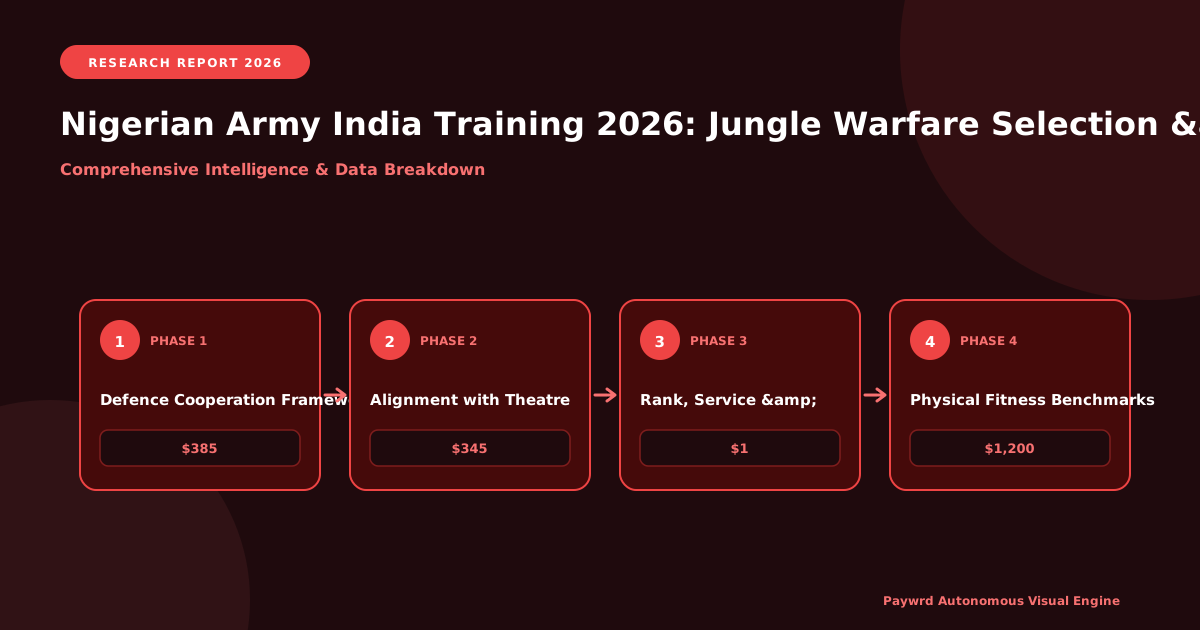
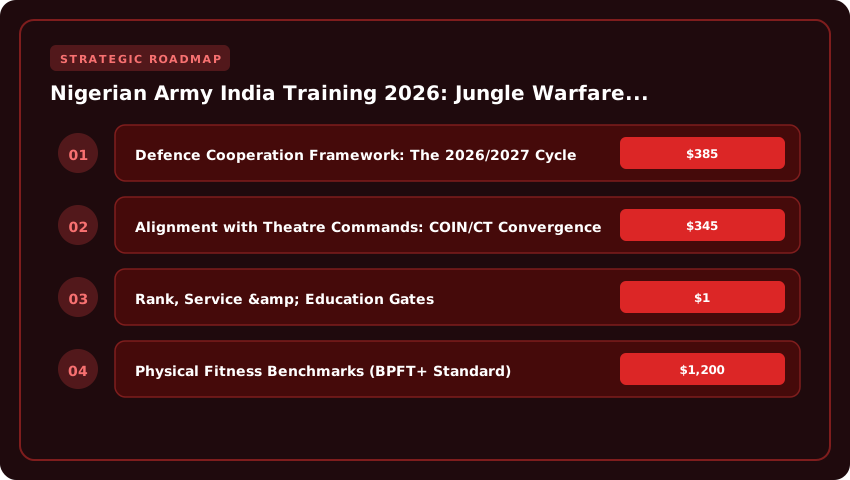
Defence Cooperation Framework: The 2026/2027 Cycle
This bilateral cycle operates under the expanded Memorandum of Understanding (MoU) on Defence Cooperation (2026–2028), but the 2026/2027 work plan introduces three critical structural changes:
- Institutional Anchoring: Training is now formally linked to the Nigerian Army’s Doctrine and Combat Development Centre (DCDC) in Jaji, ensuring after-action reports feed directly into doctrine revision rather than gathering dust in filing cabinets.
- Tri-Service Integration: For the first time, the Indian Army’s Counter Insurgency and Jungle Warfare School (CIJWS) at Vairengte and the High Altitude Warfare School (HAWS) at Gulmarg are hosting joint Nigerian Army-Air Force-Navy cohorts, reflecting the Theatre Command structure’s joint mandate.
- Tech Transfer Clauses: The framework now includes licensed production talks for Indian Netra MkII AEW&C radar feeds and Akash missile maintenance protocols, moving the relationship beyond training into sustainment.
Alignment with Theatre Commands: COIN/CT Convergence
The strategic value lies in the doctrinal convergence. India’s “Area Domination” and “Search and Destroy” doctrines, refined over decades in the Red Corridor and Jammu & Kashmir, map directly onto the Nigerian Army’s current “Operation Hadin Kai” and “Operation Safe Haven” mandates. The 2026 syllabus specifically addresses:

- Urban Counter-Terrorism: Modules on room intervention and IED defeat in built-up areas, critical for the North East and North West theatres where Boko Haram/ISWAP and bandit groups increasingly operate in populated centres.
- Drone & Electronic Warfare Integration: Indian instructors are deploying Heron TP and Harop loitering munition case studies, training Nigerian officers to fuse ISTAR feeds into the Theatre Command’s Decision Support Systems (DSS).
- High-Altitude/Jungle Crossover: While Nigeria lacks Himalayan peaks, the physiological conditioning and load-carriage doctrines from HAWS Gulmarg are being adapted for the Mambilla Plateau and Obudu operational areas where altitude sickness degrades infantry effectiveness.
Ultimately, this pipeline is the Nigerian Army’s fastest route to standardizing Joint All-Domain Operations across the Theatre Commands without waiting for Western export licences. The officers returning in late 2026 will carry the doctrinal DNA to rewrite the Field Service Pocket Book for the next decade.
Jungle Warfare Selection Criteria: 2026 Eligibility Matrix & Medical Standards
The Counter Insurgency and Jungle Warfare School (CIJWS) track in Vairengte is not a tourism slot; it is a high-stakes filtration system. For the 2026 cycle, the Nigerian Army’s Directorate of Army Training and Operations (DATOPS) has tightened the gates. If your records do not align precisely with the matrix below, your application dies at the brigade screening board.
Rank, Service & Education Gates
The programme targets the tactical leadership tier—officers who lead platoons and companies in Theatre Commands North East, North West, and Central. The 2026 eligibility window is rigid:
- Rank Bracket: Substantive Lieutenant to Lieutenant Colonel. Acting ranks are disregarded; you must hold the substantive rank on the Army List by 1 January 2026.
- Service Years: Minimum 3 years post-commissioning for Lieutenants/Captains; maximum 18 years total service for Majors/Lt. Cols. This ensures candidates have sufficient command experience but enough runway to deploy the skillset.
- Army Education Corps (AEC) / NUC Prerequisite: A minimum of a Bachelor’s degree (Second Class Lower Division) from an NUC-accredited institution is non-negotiable. Possession of a Postgraduate Diploma (PGD) in Strategic Studies, International Relations, or Military History from the Nigerian Defence Academy (NDA) or affiliated universities (like NDA Kaduna or BUK) confers a 15-point advantage on the Order of Merit List (OML).
- Professional Military Education (PME): Completion of the Young Officers Course (YOC) or Junior Staff Course (JSC) is mandatory. Senior Staff Course (SSC) graduates are prioritized for the Lt. Col slots.
Physical Fitness Benchmarks (BPFT+ Standard)
The standard Basic Physical Fitness Test (BPFT) is the floor, not the ceiling. CIJWS Vairengte operates at 800–1,200m altitude with 90% humidity. The 2026 BPFT+ standard, validated at the Army Physical Training Corps (APTC) Zaria, demands:
- 2.4 km Run: Sub-10:30 minutes (Officers 30–39); Sub-11:00 minutes (Officers 40+).
- Push-ups: 50 strict reps in 2 minutes.
- Sit-ups: 55 reps in 2 minutes.
- Load Carriage: 12 km march with 25kg fighting order (weapon, helmet, water) in under 2 hours. This is the single biggest eliminator—failure here signals inability to sustain patrol tempo in the Mizoram jungles.
Psychological Resilience & Medical Clearance
The psychological screen is conducted by the Nigerian Army Reference Hospital (NARH) Yaba psychiatric wing using the Military Resilience Inventory (MRI-26). Candidates are assessed for stress tolerance, claustrophobia triggers (critical for tunnel/bunker clearance drills), and decision-making fatigue under sleep deprivation. A “Category A” psychological fitness rating is mandatory; “Category B” requires a waiver from the Chief of Training (Army), rarely granted.
On the medical front, tropical disease prophylaxis starts 21 days pre-departure. The 2026 protocol mandates:
- Mefloquine (Lariam) 250mg weekly or Doxycycline 100mg daily for malaria chemoprophylaxis (choice determined by NARH hematology panel).
- Yellow Fever vaccination certificate (valid for life per WHO 2026 guidelines).
- Typhoid Vi polysaccharide vaccine and Hepatitis A/B series completion.
- Dental Fitness Class 1 or 2 only. Class 3 (urgent treatment needed) is an automatic disqualifier—no dental officers deploy with the contingent.
Final clearance requires the “Fit for Overseas Deployment (FOD)” stamp from the Corps Medical Officer (CMO) 8 Division Medical Services, countersigned by the Director General Medical Services (DGMS) AHQ. No stamp, no flight—regardless of your OML ranking.
Training Curriculum: CIJWS Vairengte Modules vs. Nigerian Operational Realities
The Counter Insurgency and Jungle Warfare School (CIJWS) at Vairengte has long been the gold standard for sub-conventional ops, but the 2026 syllabus delivered to the Nigerian contingent reads less like a textbook and more like a mission rehearsal for Operation Hadin Kai. The Indian Army has stripped out generic peacekeeping drills, replacing them with a high-tempo, tech-heavy progression that mirrors the specific geometry of the Sambisa Forest and the Mandara Mountains.
Small Team Tactics: From Section Battle Drills to Autonomous Cells
Vairengte’s core doctrine has always centered on the “buddy pair” and the eight-man section. For 2026, the instruction has shifted toward autonomous 4-to-6 man reconnaissance-strike cells capable of operating 48–72 hours without resupply. This maps directly to the Nigerian Army’s need for “Silent Operations” deep inside Sambisa’s Triple Canopy, where large formations attract IEDs and drone observation. Indian instructors emphasized fire and maneuver at the fire-team level, integrating loitering munitions and man-portable mortars into the immediate battle drill—something the Theatre Command has struggled to standardize across Sector 1 and Sector 2.
IED Detection: Moving Beyond Visual Indicators
The Mandara Mountains and the Gwoza axis present a hybrid threat: victim-operated pressure plates on MSRs (Main Supply Routes) and command-wire devices in complex terrain. The CIJWS module now mandates ground-penetrating radar (GPR) handheld units paired with AI-assisted pattern analysis tablets. Nigerian officers ran lanes where the “enemy” used 3D-printed non-metallic triggers—simulating the improvised workshops uncovered in Timbuktu Triangle. The critical takeaway wasn’t just detection; it was the forensic exploitation SOP—tagging, geofencing, and feeding component data into the Theatre Command’s intelligence fusion cell in real-time via tactical mesh networks.
Drone Surveillance Integration: Penetrating the Canopy
Dense canopy defeats standard ISR. The 2026 curriculum forced students to fly micro-UAVs (sub-250g class) beneath the treeline for route clearance and target acquisition, then immediately hand off coordinates to loitering munitions or artillery fire missions. This “sensor-to-shooter” loop, compressed to under four minutes, is the exact capability gap identified during the 2026/2027 dry season offensives. Indian SOPs for electronic warfare hardening of these links—frequency hopping and directional antennas—were stressed heavily, anticipating the increasing jammer density around Lake Chad Basin forward operating bases.
Adapting Indian SOPs to North-East Terrain
- High-Altitude Acclimatization: Mandara peaks demand the same physiological conditioning as the Mizoram hills; the training mandated staged ascents with load, directly transferable to Gwoza/Pulka axis patrols.
- Riverine Crossings: CIJWS riverine modules (using improvised flotation) were adapted for the Lake Chad shoreline and Yedseram River crossings, replacing the standard assault boat reliance which fails in low-water seasons.
- Human Terrain Mapping: Indian “Hearts & Minds” modules were rebranded Civil-Military Cooperation (CIMIC) Intelligence Preparation, focusing on biometric enrollment and displaced persons screening—critical for the Borno State rehabilitation corridors.
The verdict from the 2026 cohort? The Indian syllabus provides the tactical grammar, but Nigerian officers must write the operational syntax—translating Vairengte’s bamboo thickets into Sambisa’s elephant grass and the Mandara’s volcanic rock. The 2027 training cycle is already being scoped to include joint simulation exercises at the Nigerian Army School of Infantry, Jaji, using the exact terrain data captured this year.
Financial Package 2026: Consolidated Allowances, Estacode & Naira Equivalents
The 2026 financial envelope for the India training pipeline is governed by the revised Federal Government Estacode Supplement (Circular Ref: SWC/S/04/S.212/Vol.II/109) effective January 2026. Officers selected for the Counter-Insurgency and Jungle Warfare (CIJW) course at Vairengte and the High Altitude Warfare School (HAWS) at Gulmarg fall under Estacode Group B (Non-Commonwealth) for Daily Subsistence Allowance (DSA) purposes. This classification is critical: it yields a higher dollar rate than Commonwealth postings but demands strict adherence to the Central Bank of Nigeria (CBN) official exchange rate on the date of Payment Voucher (PV) generation.
Daily Subsistence Allowance (DSA) Breakdown
For 2026, the approved DSA rate for India (Group B) stands at $385 per night for officers in the rank of Major to Brigadier General. Captains and Lieutenants draw $345 per night. Using the projected 2026 CBN weighted average rate of ₦1,520/$1 (based on Q1 2026 IMF Article IV consultation projections), the Naira equivalents land as follows:
- Maj – Brig Gen: $385 × ₦1,520 = ₦585,200 per night.
- Lt – Capt: $345 × ₦1,520 = ₦524,400 per night.
Note: DSA covers accommodation, meals, and local incidental expenses. Officers booked into Indian Army Officers’ Mess facilities (standard for HAWS/Vairengte) must submit a “Certificate of Non-Availability” from the Mess Manager to claim the full hotel-rate DSA; otherwise, the “Messing Rate” (approx. 40% of full DSA) applies automatically per Treasury guidelines.
Kit Allowance & Outfit Grant
A one-off Kit Allowance of $1,200 (≈ ₦1,824,000) is payable upon final selection confirmation on the Army Portal (AIS). This is distinct from the annual Uniform Allowance. It is designed for procurement of specialized high-altitude gear (Gore-Tex layers, insulated boots, glacier goggles) not held in Nigerian Army Central Stores. Payment is triggered by the Director of Army Training (DAT) signal releasing the Nominal Roll. Officers previously issued kit for similar courses within the last 36 months are ineligible for a repeat draw per the 2026 Kit Maintenance Policy.
Government Transport Class (GTC) & Travel Grant
Travel is strictly Economy Class (GTC) on approved carriers (Air Peace, Ethiopian Airlines, or Air India via Addis/Delhi hubs). The 2026 GTC ceiling for the Abuja–Delhi–Abuja sector is capped at ₦2,100,000 inclusive of airport taxes and 23kg baggage allowance. Excess baggage for training equipment requires prior approval from the Army Headquarters Department of Logistics (DOL) with a nominal roll endorsement. No Business Class upgrades are authorized regardless of rank, per the 2026 Cost-Cutting Directive (MOD/ADMIN/112/VOL.IV).
Family Separation Allowance (FSA) Applicability
FSA remains payable for the duration of the course (typically 8–12 weeks for CIJW/HAWS combined) provided the officer’s family resides at the last duty station in Nigeria. The 2026 rate is ₦45,000 per month (Harmonized Public Service Rate), paid directly into the officer’s IPPIS-linked salary account. Crucially, FSA ceases immediately if the officer is accompanied by dependents to India—a scenario strictly prohibited for these high-intensity tactical courses. Officers must submit a statutory declaration (Form FSA-2026) countersigned by the Unit Adjutant confirming family location in Nigeria before the first tranche releases.
Bottom Line: A Major attending the full 10-week pipeline stands to earn approximately ₦41.2M in gross allowances (DSA + Kit + FSA) against a domestic posting. Factor in the CBN rate volatility risk: if the Naira strengthens below ₦1,450/$ before PV processing, the DSA Naira value drops proportionally. Lock in your rates by ensuring your PV hits the Defence Accounts Department (DAD) before the monthly CBN rate circular drops.
Application Workflow: AHQ DOA Portal, Nomination Channels & Deadline Tracker
The administrative pipeline for the 2026 India training cycle runs strictly on the Army Records Portal (ARP) and the Directorate of Army Training (DAT) signal chain. There is no paper-based fallback. If your name is not on the ARP nominal roll validated by your Formation Headquarters, you are not going to the Counter Insurgency and Jungle Warfare School (CIJWS) in Vairengte or the High Altitude Warfare School (HAWS) in Gulmarg. The process starts at the Unit Adjutant’s desk and terminates at AHQ DOA (Department of Army Administration) with a movement signal—nothing less.
Step-by-Step: From Unit Adjutant to DAT Final Signal
- ARP Profile Verification (Weeks 1–2): Log into the Army Records Portal using your Army Number and PIN. Confirm your posting history, medical classification (must be M1 or M2), and qualification codes match your Service Record (AF N 103). Discrepancies here trigger automatic rejection at Formation level.
- Unit Adjutant Endorsement: The Adjutant initiates the Application for Foreign Training (AF N 127) on the portal. This requires a digital signature from the Commanding Officer (CO). The CO’s endorsement confirms you have zero pending disciplinary cases (Summary of Evidence/ Court Martial) and meet the 2026 physical fitness standard (BPFT 2.4km run under 11:30 mins for officers/SNCOs).
- Formation HQ Vetting (G1 Training Branch): The Brigade or Division G1 Training filters the nominal roll. They cross-reference against the Posting Projection List to ensure no conflict with operational deployments (e.g., Operation HADIN KAI or WHIRL STROKE rotations). Only Formation-cleared lists move to AHQ DOA.
- AHQ DOA Selection Board: The Directorate of Army Training (DAT) convenes the board. They apply the 2026 weighting: 40% operational experience (Theatre Command hours), 30% professional courses (YOC, JSC, PSC), 30% medical/physical grading. The output is the Provisional Nomination Signal.
- Medical Board Sitting (44 NARH Kaduna / 68 NARH Yaba): Provisional nominees report for the mandatory Class 1 Aviation/High Altitude Medical Board. This is the hardest gate. Failure here—often due to undocumented hypertension or dental class 3—results in immediate replacement from the reserve list.
- Final Movement Order (Signal DAT/TRG/XX/2026): Only after medical clearance and Indian visa issuance (Note Verbale facilitated by Defence Adviser, High Commission of India, Abuja) does DAT release the Movement Order. This signal authorizes DTA (Defence Travel Allowance) payment and airlift from NAF Base Abuja.
Critical 2026 Cut-Off Dates (Hard Deadlines)
Miss one, and your slot goes to the next qualified officer on the reserve list. These dates are anchored to the Indian academic calendar which commences April 2026 for the Spring/Summer cycle.
- ARP Portal Opens: 15 January 2026 (0001 hrs).
- Unit/Formation Nomination Signal Release Deadline: 28 February 2026. Formation G1 must push the consolidated nominal roll to AHQ DOA by this date. Late signals are returned unopened.
- Medical Board Sitting Window: 3–14 March 2026. No extensions. Bring original AF N 103, vaccination card (Yellow Card mandatory), and dental records.
- Visa Application Submission (VFS Global Abuja/Lagos): 18–25 March 2026. DAT provides the Note Verbale; you handle the biometric appointment.
- Final Movement Order Issuance: 28 March 2026. Airlift scheduled for 1–3 April 2026 via NAF C-130 or chartered commercial carrier.
Pro Tip: Track your status daily on the ARP “Training” tab. If your status stalls at “Pending Formation Endorsement” past 20 February, physically visit your Brigade G1 Training with a printout of your ARP dashboard. Signals get lost in the SIGCEN queue; physical presence forces action. The 2026 cycle has zero tolerance for administrative lag—India has already allocated slots and syllabus dates; they will not wait for Nigerian bureaucracy.
Post-Course Career Trajectory: Instructor Postings, Staff College Weighting & Promotion Leverage
Completing the Indian Jungle Warfare or High-Altitude Warfare courses in 2026 is not merely a badge of honour; it is a calculated career accelerator with quantifiable weight on the Lieutenant Colonel to Colonel promotion board. The Nigerian Army’s personnel management system (APMS) assigns distinct credit values to foreign professional military education (PME). Graduates of the Counter Insurgency and Jungle Warfare School (CIJWS) Vairengte or the High Altitude Warfare School (HAWS) Gulmarg typically earn the psc(j) (Passed Staff College – Jungle Warfare) or psc(+) designator, depending on the specific course duration and syllabus depth. This designator carries a weighted score of 15–20% in the “Professional Military Education” pillar of the promotion matrix, often tipping the scales in a competitive board where margins are razor-thin.
Staff College Entry Advantage & The “psc(+)” Multiplier
For officers yet to attend the Armed Forces Command and Staff College (AFCSC) Jaji, the India tab is a golden ticket. The Directing Staff (DS) at AFCSC prioritize candidates with proven high-intensity operational exposure. Holding a psc(j) or psc(+) from a Tier-1 foreign institution like CIJWS signals validated doctrinal currency—specifically in the “Clear, Hold, Build” framework now standard across Theatre Commands. Historically, officers with this credential secure top 10% standing on the AFCSC Order of Merit List (OML), guaranteeing choice staff appointments (GSO1 Operations/Intelligence) upon graduation. This early positioning creates a compounding advantage for the Colonel board: better staff jobs = better Annual Confidential Reports (ACRs) = higher board scores.
The Instructor Bond: Mandatory NASI Jaji Tour
The ROI calculation must account for the mandatory instructor bond. Army Headquarters (AHQ) policy dictates that all officers returning from specialized foreign warfare courses—especially those funded under the Technical Aid Corps (TAC) or bilateral JDCC agreements—serve a minimum 24-month instructor tour at the Nigerian Army School of Infantry (NASI), Jaji. This is non-negotiable. You are not returning to your battalion immediately; you are reporting to the Chief Instructor (CI) NASI to domesticate the Indian SOPs.
- Curriculum Development: You will rewrite the NASI Jungle Warfare Phase syllabus, integrating Indian “Small Team Operations” and “Drone-Assisted Interdiction” modules.
- Train-the-Trainer: You run the Pre-Deployment Training (PDT) packages for Theatre Command rotations (OP HADIN KAI, OP SAFE HAVEN).
- Allowance Uplift: Instructor duty at NASI attracts the Special Instructor Allowance (₦45,000–₦60,000/month) plus Field Training Allowance during field exercises, partially offsetting the opportunity cost of delayed command.
Strategically, this bond is leverage, not a penalty. The “NASI Instructor” annotation on your record (AF Form 2A) is a force multiplier for the Colonel board. It proves you have “given back” and possess the instructional competence required for a Commanding Officer (CO) slot or Directing Staff role at AFCSC. Officers who attempt to bypass this tour via “compassionate posting” requests flag themselves as lacking institutional loyalty—a red flag on the promotion grid. Embrace the Jaji tour; it is the final exam that converts the India training from a personal qualification into an institutional asset.
Frequently Asked Questions: 2026 Cycle Specifics & Contingency Planning
Deferment Policy: Operational Deployment Clashes (Op SAFE HAVEN / Op WHIRL STROKE)
The 2026 training directive explicitly anticipates friction between the Counter-Insurgency (COIN) rotation calendar and the India reporting timeline. If your unit receives a warning order for Op SAFE HAVEN (Plateau/North Central) or Op WHIRL STROKE (Benue/North East) that overlaps with the Vairengte reporting window—typically the third quarter of 2026—automatic deferment is not guaranteed. You must initiate a “Training vs. Operations” arbitration request through your Brigade G1/G3 branch before the Movement Order (MOVORD) is cut.
The Army Headquarters (AHQ) Department of Army Training and Operations (DATOPS) holds the final veto. Historically, officers and soldiers on the “Principal” list for the Jungle Warfare Course (JWC) or the High Altitude Warfare School (HAWS) package retain priority unless the Theatre Commander certifies the deployment as “irreducible operational necessity.” If deferred, you roll to the 2027 tranche; you do not lose seniority, but you forfeit the 2026 Daily Subsistence Allowance (DSA) advance. Keep your medical categorisation (SHAPE 1) current—medical downgrades during deployment are the leading cause of permanent removal from the India pipeline.
Spouse Accompaniment: Visa Rules & Schooling in Vairengte
Let us clear the WhatsApp noise: Spouses are not authorised to accompany personnel on the 2026 JWC/HAWS serials. The Indian Army training establishments at Vairengte (Mizoram) and Gulmarg (Jammu & Kashmir) operate under strict “Unaccompanied Duty” status for foreign military trainees. The Indian Ministry of Defence issues a specific “Conference/Training Visa” (Category C) valid strictly for the nominated officer/soldier. Dependent visas are not processed under this bilateral MoU.
Regarding schooling: There are no Nigerian-curriculum or international schools in Vairengte. The nearest civilian educational infrastructure is in Aizawl (approx. 2.5 hours by road), which hosts CBSE-affiliated Indian schools (e.g., Kendriya Vidyalaya, Don Bosco). However, enrolling dependents there requires the spouse to hold a valid Indian long-term visa (Employment/Entry Visa), which the training programme does not facilitate. Any officer attempting to move family to Aizawl on a tourist visa risks visa violation penalties and immediate recall by AHQ. Plan for geographic bachelor status for the 12–14 week duration; the DSA rates (approx. $120–$150/day paid in Naira equivalent at CBN rate) are calibrated for single occupancy.
Contingency: Medical Repatriation & Course Failure
If you sustain an injury during the “Battle Physical Efficiency Test” (BPET) or High Altitude Acclimatisation phase at Gulmarg, the Indian Army medical board decides retention. If repatriated on medical grounds (Category ‘C’ or ‘D’), the Nigerian Army Medical Corps (NAMC) assumes responsibility at 44 NARH Kaduna or 68 NARH Yaba. Course failure (RTU – Returned to Unit) for disciplinary or proficiency reasons triggers an automatic AHQ Board of Inquiry. It reflects on your Annual Confidential Report (ACR) and suspends future foreign course eligibility for 24 months. Prepare physically now; the 2026 syllabus has increased the load-carry march to 40km with 25kg fighting order.
Strategic Final Takeaway
When evaluating Nigerian Army India Training Programme 2026 Jungle Warfare Selection Criteria Allowances in 2026 and beyond, base your decisions on accredited institutional standards, verified return on investment (ROI), and up-to-date official guidelines. Always verify specific dates and requirements through official regulatory portals.