
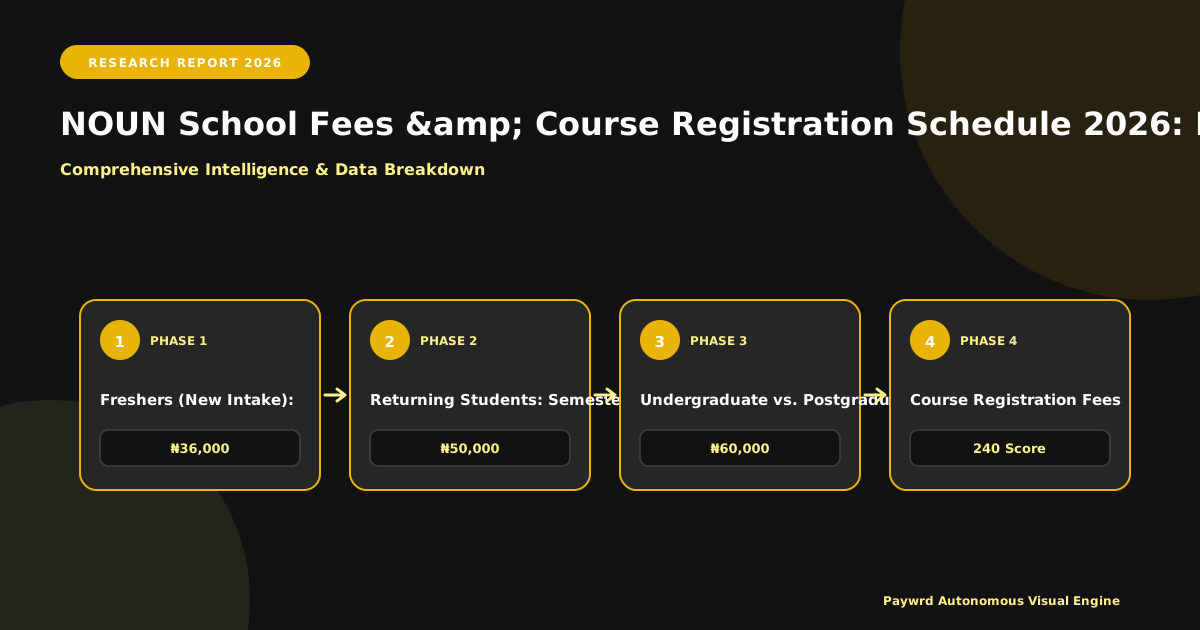
Key Takeaway: For the 2026 academic session, a fresh undergraduate at NOUN should budget a minimum of ₦120,000–₦135,000 for first-semester compulsory fees alone, while returning students face a leaner ₦36,000–₦48,000 per semester. Postgraduate candidates must add a non-negotiable ₦10,000–₦15,000 project supervision levy in their final year.
Official NOUN 2026 Fee Structure: New vs Returning Students
The National Open University of Nigeria (NOUN) operates a “pay-as-you-go” model, but the first semester for freshers carries a heavy front-loaded cost that catches many applicants off guard. Unlike conventional universities where acceptance fees are the only upfront shock, NOUN bundles Acceptance, Matriculation, ID Card, and Course Registration into a single mandatory payment gateway before your portal unlocks. For 2026, the Senate-approved schedule maintains the distinction between Compulsory Fees (fixed regardless of course load) and Course Registration Fees (per credit unit).
Freshers (New Intake): The 2026 Entry Bill
If you just secured admission via JAMB CAPS or Direct Entry for the 2026 session, your financial obligation splits into two distinct buckets. The Compulsory Administrative Fees are fixed at approximately ₦36,000 for undergraduates (Acceptance: ₦10,000; Matriculation: ₦5,000; ID Card: ₦2,500; Library/Development/ICT Levies: ~₦18,500). Postgraduate freshers pay a higher administrative baseline of roughly ₦41,000 due to elevated development levies.
On top of this, you must register courses. Undergraduates pay ₦1,000 per credit unit; a standard 18–20 unit load adds ₦18,000–₦20,000. Postgraduates pay ₦2,000 per credit unit. Therefore, a typical new undergraduate walks away with a first-semester receipt of ₦54,000–₦56,000, while a new PGD/Masters student faces ₦70,000–₦85,000 depending on credit load. Note: NELFUND loan applicants must ensure their “Institutional Charge” entry on the portal matches these exact line items to avoid disbursement delays.

Returning Students: Semester-by-Semester Obligations
Returning students enjoy a significantly lighter load because Acceptance, Matriculation, and ID Card fees are one-off payments. For 2026, the Compulsory Returning Fees stand at roughly ₦18,500 per semester (ICT, Library, Development, Examination, and Result Verification levies). Course registration remains ₦1,000/unit (UG) and ₦2,000/unit (PG).
- Undergraduate (18 Units): ~₦18,500 (Compulsory) + ₦18,000 (Courses) = ₦36,500/semester.
- Postgraduate (12–15 Units): ~₦23,500 (Compulsory + higher levies) + ₦24,000–₦30,000 (Courses) = ₦47,500–₦53,500/semester.
Critical nuance: Project/Thesis Supervision attracts a separate ₦10,000 (PGD/Masters) or ₦15,000 (PhD) fee payable in the final semester of research. Failure to pay this blocks your final defense scheduling on the portal.
Undergraduate vs. Postgraduate Variance
The structural difference is the per-unit cost and the compulsory levy baseline. Postgraduate programmes (PGD, M.Sc, MBA, PhD) carry a ~30% premium on administrative levies and a 100% premium on tuition (₦2k vs ₦1k/unit). Furthermore, PG students must budget for External Examiner/Defence logistics (approx. ₦20,000–₦30,000) in their terminal semester—costs absent in the undergraduate cycle. Always verify the exact breakdown on your NOUN Student Portal (portal.noun.edu.ng) before initiating Remita payment; the portal generates a unique RRR tied to your specific matric number and programme code.
Course Registration Fees Per Credit Unit & Faculty
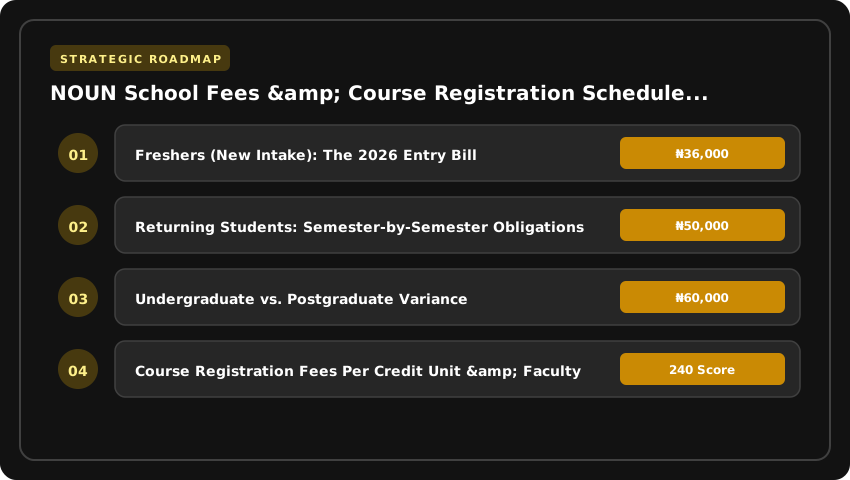
Budgeting for the 2026 academic session at the National Open University of Nigeria (NOUN) requires a clear understanding of the “Credit Unit” system. Unlike traditional universities with flat tuition, NOUN charges students based on the volume of courses they register for each semester. This means your total bill fluctuates depending on your faculty’s tariff and the number of units you select via the student portal.
Faculty Tariff Bands for 2026
The cost per credit unit is not uniform across the university. To account for laboratory maintenance, specialized software, and professional accreditation requirements, NOUN categorizes faculties into two primary pricing tiers:
- Standard Tariff (Arts, Education, and Management Sciences): These faculties operate on a leaner cost structure. For the 2026 session, students in these disciplines are charged a base rate of ₦2,500 to ₦3,500 per credit unit. If you register for a 3-unit course, your cost for that specific subject will range between ₦7,500 and ₦10,500.
- Premium Tariff (Science, Health Sciences, Law, and Agriculture): Due to the high cost of practicals and specialized instructional materials, these faculties attract a higher rate. The 2026 tariff for these disciplines is set between ₦4,000 and ₦5,500 per credit unit. A standard 3-unit course in Law or Nursing, for instance, can cost up to ₦16,500.
Credit Load Limits under NUC CCMAS 2026
With the full implementation of the National Universities Commission (NUC) Core Curriculum and Minimum Academic Standards (CCMAS) for 2026, NOUN has streamlined the maximum and minimum credit loads to ensure academic quality and prevent student burnout in an e-learning environment.
For undergraduate students, the maximum credit load per semester is strictly capped at 24 units. This prevents students from overloading their schedules and ensures they can effectively engage with the TMAs (Tutor-Marked Assignments) and online discussions. Conversely, the minimum credit load is 12 units; registering below this threshold may categorize a student as “part-time,” potentially extending the duration of the degree program.
To forecast your budget accurately, multiply your intended credit load (e.g., 18 units) by your faculty’s specific unit rate. Remember to add these costs to your compulsory semester fees to avoid registration errors on the NOUN portal during the 2026 window.
Semester Payment Deadlines & Remita RRR Generation Walkthrough
Missing a payment window at the National Open University of Nigeria (NOUN) is more than just a clerical error; it is a direct threat to your academic progress. For the 2026 academic session, the university has tightened its synchronization between the Remita gateway and the student portal to ensure real-time registration updates.
2026 Registration Windows & Key Dates
To avoid the last-minute portal crashes common during peak registration periods, mark these critical windows in your calendar:
- Semester 1 (Main Window): Payments typically open in July 2026 and close by late September 2026.
- Semester 2 (Main Window): Payments generally commence in January 2027 and conclude by March 2027.
- Late Registration Grace Period: A two-week window usually follows the main deadline, though this attracts a mandatory late fee.
Step-by-Step Remita RRR Generation Guide
The Remita Retrieval Reference (RRR) is the only valid payment identifier recognized by the NOUN treasury. Follow this precise sequence to avoid double payments or “pending” status errors:
- Access the Portal: Log into your official NOUN student portal using your matriculation number and password.
- Navigate to Payments: Select the “Payment” tab from the dashboard and choose “Generate RRR” for the specific semester fee.
- Verify Amount: Ensure the system reflects the correct fee based on your status (New vs. Returning). Do not manually alter the amount.
- Generate & Save: Click “Generate RRR.” Once the 12-digit code appears, take a screenshot or print the payment slip immediately.
- Execute Payment: Visit the Remita website or use your mobile banking app. Select “Pay Remita,” input your RRR, and complete the transaction.
The Cost of Delay: Penalties & Portal Lockouts
The NOUN administration maintains a strict policy regarding payment timelines. If you fail to settle your fees within the stipulated 2026 windows, you face the following consequences:
- Late Registration Penalty: A surcharge (typically ranging from ₦2,000 to ₦5,000) is added to your total balance if you pay during the grace period.
- Portal Lockout: Once the final deadline expires, your portal access is revoked. You will be unable to register for courses, access study materials, or upload assignments.
- Exam Ineligibility: Students with outstanding balances are automatically excluded from the 2026 examination lists, regardless of their attendance in TMAs (Tutor-Marked Assignments).
Faculty-Specific Levies: Science, Health Sciences & Law Surcharges
While the base tuition at the National Open University of Nigeria (NOUN) remains standardized across most disciplines, students in specialized faculties must account for “hidden” mandatory levies. These are not part of the core tuition but are essential for professional certification and academic clearance. Failing to budget for these surcharges often leads to registration delays or inability to access practical assessments during the 2026 academic session.
STEM and Laboratory Surcharges
Students enrolled in the Faculty of Science and Technology face additional costs associated with the “blended learning” model. Because NOUN utilizes designated study centers and partner laboratories for practicals, students must pay specific workshop and laboratory fees. For the 2026 session, these levies typically range between ₦15,000 and ₦25,000 per semester, depending on the intensity of the course units (e.g., Chemistry or Physics practicals).
Health Sciences & Law Professional Fees
Programmes in Nursing, Public Health, and Law carry the highest overheads due to regulatory requirements from professional bodies. These are non-negotiable costs that ensure your degree is recognized upon graduation:
- Clinical Posting Fees: Nursing and Health Science students must budget for clinical rotation levies, which cover the administrative costs of placements in accredited tertiary hospitals.
- Professional Indemnity: A mandatory insurance levy is often required for students entering clinical environments to cover potential liabilities during practical training.
- Law Moot Court & Internship Levies: Law students face specific surcharges for moot court simulations and the administrative processing of their mandatory Law School preparatory internships.
Education and Fieldwork Levives
For those in the Faculty of Education, the primary additional cost is the Teaching Practice (TP) levy. This fee covers the supervision of student-teachers by university assessors and the administrative coordination with host secondary schools. Depending on the region, this levy typically sits between ₦10,000 and ₦20,000 for the duration of the practical period.
To avoid budget shortfalls, we strongly advise students to check their specific course brochures on the NOUN portal. If you are applying for NELFUND student loans for the 2026/2027 cycle, ensure you include these faculty-specific levies in your total cost of study application, as the basic tuition alone will not cover your professional certifications.
NELFUND Student Loan Eligibility & Disbursement for NOUN 2026
For the 2026 academic session, the Nigerian Education Loan Fund (NELFUND) has fully integrated the Open and Distance Learning (ODL) model into its funding framework. This means National Open University of Nigeria (NOUN) students are no longer sidelined due to the university’s non-traditional structure. Because NOUN is a federally funded institution with full NUC accreditation under the new Core Curriculum and Minimum Academic Standards (CCMAS), all eligible undergraduate students can now apply for interest-free loans to cover their academic expenses.
Application Workflow for NOUN Students
Applying for the loan requires a synchronized effort between the NELFUND portal and the NOUN student portal. To ensure a successful disbursement for 2026, follow this specific workflow:
- JAMB CAPS Verification: Fresh students must ensure their admission is fully accepted and processed via the JAMB Central Admissions Processing System (CAPS) before attempting a NELFUND application.
- NELFUND Portal Registration: Create an account using your National Identification Number (NIN) and BVN. Ensure the name on your NIN matches your NOUN admission letter exactly to avoid verification failure.
- Institutional Validation: Once you apply, NELFUND sends a request to NOUN’s bursary and academic registry to verify your current enrollment status and the exact fee balance for the 2026 session.
- Approval and Disbursement: Upon validation, funds are not paid to the student but are remitted directly to the NOUN corporate account to clear tuition and registration arrears.
Loan Coverage: Tuition, Registration, and Upkeep
It is critical for NOUN students to understand that NELFUND does not provide a blanket sum of money. The disbursement is split into two distinct categories: Institutional Fees and Student Maintenance.
- Institutional Fees: This covers 100% of your compulsory tuition and course registration fees. For a 2026 fresher, this typically covers the initial ₦120,000–₦135,000 threshold. For returning students, it covers the semesterly registration costs.
- Upkeep Allowance: NELFUND provides a monthly stipend intended for data subscriptions, textbooks, and study materials. Given NOUN’s digital nature, this allowance is vital for students relying on the Learning Management System (LMS).
- Exclusions: The loan generally does not cover private external certifications or optional professional workshops not listed in the official NOUN 2026 fee schedule.
Students are advised to complete their applications at least four weeks before the registration deadline to avoid late registration penalties, as the verification process between the fund and the university can take several business days.
Hidden Costs: Exam Fees, Project Supervision & Convocation Levies
Budgeting for NOUN in 2026 isn’t just about the compulsory semester fees we broke down earlier. The “pay-as-you-go” model means variable costs hit you at specific pressure points—exam registration, project year, and graduation. If you don’t plan for these, they will stall your academic progress faster than a portal outage during registration week.
Semester Examination Registration: The Per-Course Reality
This is the most recurring hidden cost. Unlike conventional universities where exam fees are bundled, NOUN charges per course unit registered for exams. For the 2026 session, the standard rate remains ₦1,000 per course for undergraduates and ₦1,500 per course for postgraduates.
A typical undergraduate carrying the maximum 24 units (roughly 8 courses) per semester faces an exam bill of ₦8,000. Postgraduates taking 6 courses pay ₦9,000. Miss the portal deadline? The late registration penalty is a steep ₦5,000 flat fee plus the standard per-course charge. Pro tip: Register the moment the portal opens—usually Week 8 of the semester—to avoid the penalty trap.
Final Year Project Supervision & Defence: The PG & UG Gap
This is where the budget diverges sharply by programme level.
- Undergraduates: Project supervision is largely covered in your compulsory fees, but binding and printing the final hard copies (usually 4–6 copies for department, library, and supervisor) costs ₦15,000–₦25,000 depending on page count and print shop location (Abuja/Lagos centres are pricier).
- Postgraduates (PGD/Masters/PhD): The ₦15,000 Project Supervision Levy (referenced in the key takeaways) is mandatory and paid before a supervisor is assigned via the PG School portal. On top of that, external assessment and defence logistics often require an additional ₦20,000–₦35,000 for external examiner honoraria (often handled by the department) and binding (₦20,000+ for high-volume theses). PhD candidates should budget ₦100,000+ for the full lifecycle including journal publication fees required for graduation clearance.
Convocation Fees: Graduating Class of 2026 Schedule
Convocation is not automatic; it is a paid clearance event. For the 2026 graduating class (those clearing results by September 2026 Senate approval), the schedule is tiered:
- Academic Gown Rental (Compulsory): ₦5,000 (Undergraduate) | ₦7,000 (Postgraduate) | ₦10,000 (PhD). This is non-refundable.
- Alumni Association Fee: ₦5,000 (Lifetime membership, mandatory for certificate release).
- Convocation Programme Fee: ₦3,000 (Covers brochure, venue logistics, and security).
- Certificate Processing: ₦5,000 (Standard) | ₦15,000 (Express/On-demand if you need it before the physical ceremony).
Total Convocation Budget: Budget ₦18,000–₦20,000 for undergraduates and ₦20,000–₦25,000 for postgraduates. Note: NOUN typically allows a “Certificate in Absentia” application (₦10,000 extra) if you cannot attend the physical ceremony in Abuja, but you still pay the Alumni and Gown fees.
Bottom Line: A 2026 graduating undergraduate who carried full course loads every semester spent roughly ₦64,000–₦80,000 on exam fees alone over 4–5 years. Add project binding and convocation, and the “hidden” tail-end cost hits ₦100,000+. Factor this into your freshman year savings plan.
Verifying Fee Updates on NOUN Portal & Avoiding Payment Scams
Every academic session, fraudsters clone the National Open University of Nigeria (NOUN) payment gateway to harvest Remita Retrieval Reference (RRR) codes and card details. In 2026, the sophistication of these phishing sites has increased; they now replicate the SSL padlock and mimic the Remita landing page pixel-for-pixel. Your first line of defence is treating any link sent via WhatsApp broadcast, SMS, or unofficial Telegram groups as hostile until proven otherwise.
Official NOUN Digital Channels for 2026
Bookmark these verified endpoints and access them strictly by typing the address into your browser—never click a redirect.
- Primary Portal:
https://nouonline.net(Student Portal for registration, RRR generation, and result checking). - Corporate Website:
https://noun.edu.ng(Official announcements, academic calendar, and fee schedule PDFs signed by the Registrar). - Remita Payment Gateway:
https://remita.net— Always initiate payment from the “Pay Invoice” button inside yournouonline.netdashboard. This auto-populates the RRR, eliminating manual entry errors. - Verified Social Handles:
@nounigeriaon X (Twitter),National Open University of Nigeriaon Facebook (blue verified badge), andnounigeriaon Instagram. The Directorate of Media & Advocacy pushes fee circulars here first.
Spotting a Cloned Remita Page
A genuine Remita transaction for NOUN will display the Biller Name: “NATIONAL OPEN UNIVERSITY OF NIGERIA” and the Service Type/Purpose matching your portal selection (e.g., “Compulsory Fees,” “Exam Registration,” “Project Supervision”). Red flags include:
- URL variations like
remita-pay.com,remita-noun.net, or HTTP (non-HTTPS) connections. - Requests for your portal password or JAMB registration number on the payment page—Remita only needs the RRR, email, and phone.
- Pop-ups demanding “OTP verification” before redirecting to your bank; legitimate 3D Secure OTPs come from your bank’s domain, not the payment aggregator.
If the RRR generated on nouonline.net fails to pull up your name and matric number on the Remita review screen, stop immediately. Clear your browser cache, log in fresh, and regenerate the code.
Resolving Disputes via the Directorate of Student Affairs
Double debits, “payment successful” status not reflecting on your portal after 24 hours, or erroneous RRR generation require official escalation. Do not rely on study centre agents who promise “manual backend updates.” Instead:
- Log a ticket via the Helpdesk module inside your nouonline.net dashboard (Menu > Support > Create Ticket). Attach the Remita receipt PDF and bank debit alert screenshot.
- Email
studentaffairs@noun.edu.ngwith your Matric Number, RRR, Transaction ID, and a concise description. Use the subject format:PAYMENT DISPUTE - [Matric No] - [RRR]. - For urgent walk-ins, visit the Directorate of Student Affairs at the Headquarters, Jabi, Abuja, or your Study Centre’s designated Student Affairs Officer during working hours (Mon–Fri, 8:00 AM – 4:00 PM).
NOUN’s 2026 policy mandates a 48-hour resolution window for verified payment discrepancies. Keep your ticket reference number; it is your audit trail if the issue escalates to the Bursary Department.
| Student Category | First Semester Estimate (₦) | Subsequent Semesters (₦) | Key Mandatory Inclusions | Payment Gateway Access |
|---|---|---|---|---|
| New Undergraduate (100 Level / Direct Entry) | ₦120,000 – ₦135,000 | ₦36,000 – ₦48,000 | Acceptance Fee, Matriculation, ID Card, Course Registration, Exam Fee, Library, ICT Levy | Portal unlocks only after full first-semester bundle payment |
| Returning Undergraduate (200 Level+) | ₦36,000 – ₦48,000 | ₦36,000 – ₦48,000 | Course Registration, Exam Fee, Library, ICT Levy, Student Union Dues | Per-semester ‘pay-as-you-go’ via Remita/NOUN Portal |
| New Postgraduate (PGD / Masters / PhD) | ₦140,000 – ₦160,000 | ₦50,000 – ₦70,000 | Acceptance, Matriculation, ID Card, Course Reg, Exam, Library, ICT, Faculty Levy | Full first-semester bundle required for matriculation number issuance |
| Returning Postgraduate (Final Year) | ₦60,000 – ₦85,000 | ₦60,000 – ₦85,000 | Standard fees + Project Supervision Levy (₦10,000 – ₦15,000) | Project levy mandatory before supervisor allocation in final semester |
Frequently Asked Questions
What is the total compulsory fee for a new NOUN undergraduate student in the 2026 first semester?
For the 2026 academic session, a new NOUN undergraduate student must budget between ₦120,000 and ₦135,000 for the first semester. This front-loaded bundle covers Acceptance Fee, Matriculation, Identity Card, Course Registration, Examination, Library, and ICT levies. The portal remains locked until this full amount is paid via Remita.
How much do returning NOUN students pay per semester in 2026?
Returning NOUN undergraduate students pay between ₦36,000 and ₦48,000 per semester in 2026. This recurring 'pay-as-you-go' cost covers Course Registration, Examination Fees, Library Access, ICT Levies, and Student Union Dues. Unlike freshers, returning students do not pay Acceptance or Matriculation fees again.
Does NOUN charge a separate project supervision fee for final-year postgraduate students in 2026?
Yes, final-year NOUN postgraduate students (Masters and PhD) face a mandatory Project Supervision Levy of ₦10,000 to ₦15,000 in 2026. This fee is non-negotiable and must be paid before a supervisor is officially assigned and the project defense schedule is released on the student portal.
Can I pay NOUN 2026 school fees in installments per course unit?
NOUN operates a 'pay-as-you-go' model, but fees are billed per semester, not per individual course unit. Students must pay the total semester fee (Course Registration + Exam + Levies) to unlock exam registration for all registered courses. Partial payments do not grant portal access for examinations in the 2026 session.
What is the difference between NOUN freshers' fees and conventional university acceptance fees in 2026?
Conventional universities typically charge a standalone Acceptance Fee (₦20k–₦50k). NOUN's 2026 freshers' fee (₦120k–₦135k) is a comprehensive bundle combining Acceptance, Matriculation, ID Card, and full Course Registration. NOUN requires this full bundle upfront before the student portal activates, whereas conventional schools often allow staggered payments.
Strategic Final Takeaway
When evaluating National Open University Of Nigeria NOUN Course Registration Fees And School Fees Schedule 2026 in 2026 and beyond, base your decisions on accredited institutional standards, verified return on investment (ROI), and up-to-date official guidelines. Always verify specific dates and requirements through official regulatory portals.

