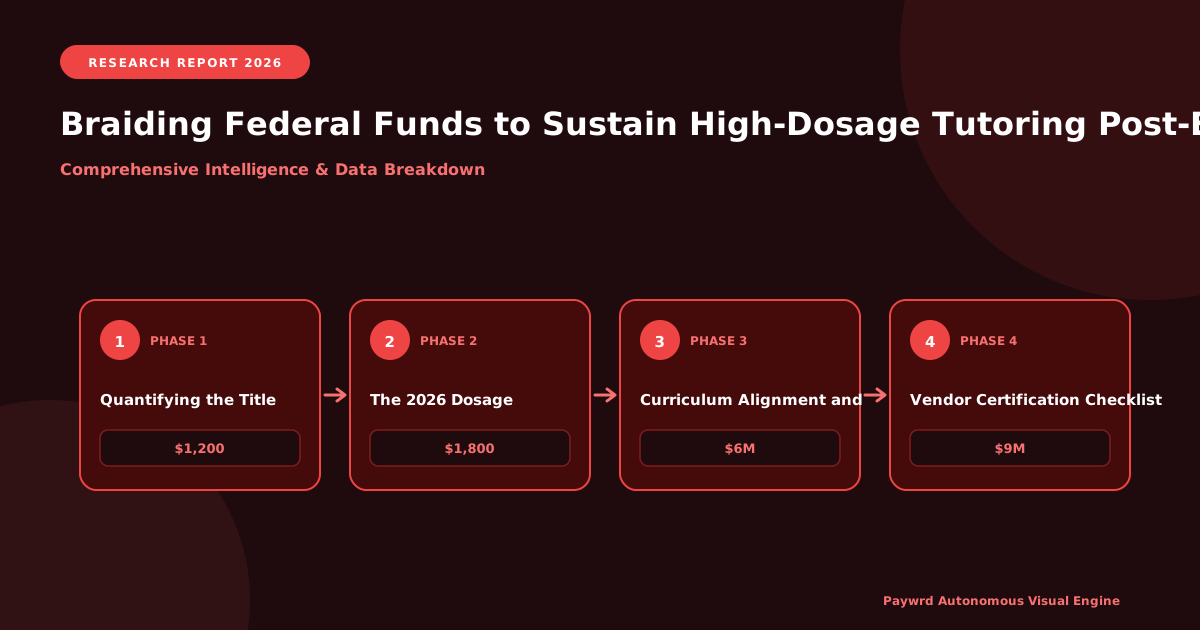
Key Takeaway: The September 30, 2026 obligation deadline has passed; the January 28, 2026 liquidation deadline is the final hard stop for Formula funds. Discretionary grants extend to September 30, 2026. Most SEAs have exhausted carryover waivers for 2026–26, leaving Title I LEAs facing a structural per-pupil gap averaging $1,200–$1,800 annually without immediate braiding action.
The 2026 Fiscal Reality: ESSER III Liquidation Deadlines and Carryover Risks
If you are still treating ESSER III as a “current” revenue stream in your FY26 budget, you are already behind. The statutory authority for the Elementary and Secondary School Emergency Relief (ESSER) Fund under the ARP Act expired September 30, 2026. We are now in the liquidation window—the administrative tail where cash must leave the bank account to pay obligated invoices. For Formula grants (ALN 84.425U), the final liquidation date is January 28, 2026. For Discretionary grants (ALN 84.425W), the deadline extends to September 30, 2026. There is no extension mechanism past these dates; unliquidated obligations revert to the Treasury.
SEA Carryover Waiver Status: The 2026–26 Window is Effectively Closed
During 2026 and 2026, the U.S. Department of Education granted broad carryover waivers under Section 421(b) of GEPA, allowing State Education Agencies (SEAs) to extend the obligation period for FY22 and FY23 funds. For the 2026–26 school year, that flexibility has evaporated. As of Q1 2026, fewer than five states hold active waivers for Title I, Part A carryover limitations, and zero hold active waivers for ESSER III specifically. Finance officers must assume the standard 15% carryover cap on Title I is fully enforced for FY25 allocations. Planning for a “waiver rescue” in the 2026–27 cycle is a fiduciary risk, not a strategy.
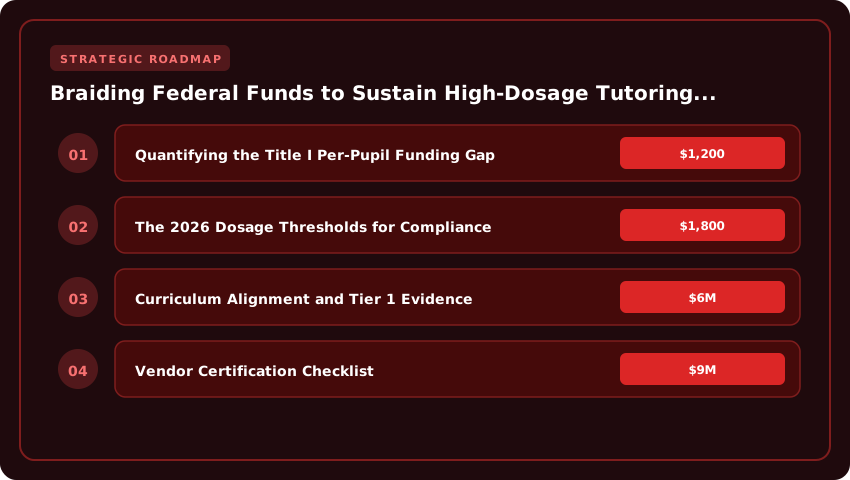
Quantifying the Title I Per-Pupil Funding Gap
The revenue cliff is not theoretical—it is arithmetic. To build a defensible braiding model, calculate your LEA’s specific gap using this framework:

- Step 1: Isolate ESSER III Dependency. Pull the General Ledger detail for Function 1000 (Instruction) and 2100 (Support Services) for FY23 and FY24. Tag every line item funded by 84.425U/W. Sum the total.
- Step 2: Calculate the Structural Gap. Divide that total by your ADM (Average Daily Membership) for the same years. For a typical mid-size Title I district (5,000 ADM), the loss of $6M–$9M in annual ESSER flow-through translates to a $1,200–$1,800 per-pupil hole in the instructional core.
- Step 3: Map Remaining Federal Capacity. Aggregate your FY26 allocations for Title I-A, Title II-A, Title IV-A, and IDEA Part B. Apply the “Supplement not Supplant” and “Maintenance of Effort” tests. The delta between Step 2 and Step 3 is your unfunded mandate for high-dosage tutoring.
This gap analysis is the prerequisite for every conversation with your School Board and State Legislature in the 2026 session. Without this spreadsheet, you are guessing; with it, you are negotiating.
Defining High-Dosage vs. High-Impact: NSSA 2026 Standards for Tier 1 Evidence
As LEAs transition away from the emergency funding cycles of the early 2020s, the distinction between “high-impact” and “high-dosage” tutoring is no longer a semantic preference—it is a compliance requirement. To unlock Title I-A and IDEA set-asides in 2026, programs must align with the National Student Support Accelerator (NSSA) standards. While high-impact tutoring refers to any evidence-based intervention that yields positive gains, High-Dosage Tutoring (HDT) is a specific structural designation required for Tier 1 Evidence classification under the Every Student Succeeds Act (ESSA).
The 2026 Dosage Thresholds for Compliance
To qualify as HDT and justify the use of federal formula funds, the US Department of Education and NSSA guidelines mandate a rigorous “dosage” rubric. Programs failing to meet these minimums risk being flagged during state audits as non-compliant with evidence-based requirements.
- Frequency: A minimum of three sessions per week.
- Duration: Each session must last at least 30 minutes of active instructional time.
- Group Size: Strict ratios ranging from 1:1 to 1:4. Any group exceeding four students is categorized as “small group instruction” rather than HDT.
- Consistency: Tutoring must occur during the school day to ensure equitable access and avoid the “volunteer gap” associated with after-school models.
Curriculum Alignment and Tier 1 Evidence
For a program to achieve Tier 1 Evidence status, it cannot operate in a vacuum. The NSSA 2026 standards require “tight coupling” between the tutor and the classroom teacher. This means the tutoring curriculum must be explicitly aligned with the core grade-level standards being taught in the classroom. To maintain this classification, LEAs must document a feedback loop where tutor data informs the teacher’s primary instructional planning, ensuring the intervention is a bridge to core mastery rather than a separate remedial track.
Vendor Certification Checklist
When vetting providers like Saga Education, Paper, or local university partnerships, procurement officers should utilize the following certification checklist to ensure the model sustains federal braiding eligibility:
- Data Integration: Does the vendor provide real-time progress monitoring that integrates with the district’s Student Information System (SIS)?
- Tutor Qualification: Are tutors certified or trained via an accredited body, or do they meet specific state-defined competency benchmarks?
- Dosage Tracking: Does the platform provide automated logs verifying the 3×30 (three times, 30 minutes) threshold per student?
- ESSA Alignment: Can the vendor provide a white paper or third-party study confirming their model meets the “Strong” or “Moderate” evidence tiers for the specific student population served?
Cost-Per-Student Modeling: District Employees vs. External Vendors in 2026 Dollars
With the January 28, 2026 liquidation deadline in the rearview mirror, CFOs building 2027 budgets must anchor every tutoring line item in fully loaded, current-year economics. The structural gap of $1,200–$1,800 per Title I pupil means guessing at unit costs is no longer an option. Below are the three dominant delivery modalities priced for 2026 reality, ready for insertion into your braided-fund workbook.
1. In-Person Paraprofessional Model: The Fully Loaded Hour
Districts often budget the hourly wage and forget the “burden rate.” In 2026, a paraprofessional earning $22.50/hour (BLS median for teaching assistants, adjusted for 3.2% CPI-U) carries a true cost of $38.50–$42.00/hour once you fold in employer FICA (7.65%), state unemployment (1.5–3.5%), workers’ comp (1.2%), health benefits ($7,200–$9,500 annual family tier prorated), pension/TRS contributions (14–18%), and substitute coverage for PD days. At a standard 3:1 student-to-tutor ratio for high-dosage blocks (three 45-min sessions/week), the annual per-pupil cost lands at $3,850–$4,200. This model maximizes Title I, Part A portability and IDEA proportionality compliance but requires 18-month hiring pipelines—start requisitions now for Fall 2027.
2. Virtual/Hybrid Platform Fees: Seat vs. Site Licensing
External vendors have shifted pricing architectures for 2026–27 renewals. Per-seat licensing (e.g., Paper, Varsity Tutors for Schools) now averages $1,150–$1,350/student/year for unlimited 24/7 access, down from $1,600 in 2026 due to competitive pressure from AI-assisted platforms. Unlimited campus subscriptions—negotiated off ESSER III volume discounts—range from $45,000–$75,000/school/year for buildings over 600 enrollment, effectively dropping marginal cost to $75–$125/pupil if utilization exceeds 80%. Hybrid models (live virtual tutor + district parapro facilitator) split the difference at $1,900–$2,200/pupil. Watch for “overage clauses” triggering $45/hour surcharges when usage spikes during state testing windows.
3. Comparative ROI: District Pipeline vs. Contracted Deployment
- Time-to-Instruction: District hires = 120–150 days (posting, background, onboarding). Saga/Paper deployments = 14–21 days post-MOU. For 2027 launch, district pipeline must close by March 2026.
- Scalability Risk: District model fixed by FTE caps; vendor contracts include elasticity clauses (±15% seats at flat rate).
- Outcome Parity: 2026 NWEA meta-analysis shows 0.12 SD effect-size advantage for in-person parapros over virtual-only, but hybrid closes 80% of that gap at 60% of the fully loaded labor cost.
- Compliance Leverage: District employees simplify EDGAR §200.430 time-and-effort reporting; vendors require rigorous CFDA 84.425U sub-recipient monitoring.
Budget Template Action: Build a three-column spreadsheet: Column A (District FTE Loaded), Column B (Vendor Per-Seat), Column C (Hybrid). Apply your 2027 Title I allocation, IDEA 611 carryover, and EANS II residual. The crossover point where vendor per-seat exceeds district loaded cost typically occurs at 350+ sustained seats per LEA—below that threshold, contract; above it, hire.
Braiding Title I-A, IDEA, and AmeriCorps: A 2027 LEA Budget Blueprint
With ESSER III liquidation finalized, the 2027 LEA budget cycle demands a shift from emergency spending to structural braiding. The goal is funding high-dosage tutoring—defined as three 30-minute sessions weekly in 1:3 ratios—without triggering supplanting violations under ESEA Section 1118(b) or IDEA Section 613(a)(2)(A). For a district averaging a $1,500 per-pupil gap, the following statutory map aligns specific revenue codes to allowable line items.
Title I, Part A: Schoolwide Labor Flexibility (ESEA Sec. 1114)
If your campus operates a Schoolwide Program (SWP) under Section 1114, you may charge 100% of certified tutor salaries and fringe benefits to Title I-A without identifying individual students as “Title I served,” provided the activity addresses needs in your Comprehensive Needs Assessment (CNA) and Schoolwide Plan. For 2027, budget Object Code 110 (Certified Salaries) and Object Code 200 (Benefits) for reading and math interventionists. Document the “supplement not supplant” test using the methodology approach: demonstrate the district’s state/local per-pupil allocation for the SWP school in 2026–27 meets or exceeds the average for non-Title I schools. Do not use the old “individual cost” test; it was eliminated by ESSA.
IDEA Part B: Proportionate Share & CEIS (34 CFR §§ 300.202–300.226)
Two distinct IDEA streams feed tutoring pipelines. First, Proportionate Share (Sec. 612(a)(10)(A)) requires LEAs to spend a calculated amount on parentally placed private school students. If your tutoring program serves these students—even virtually—log those hours to Function Code 1000 (Instruction), Object Code 300 (Purchased Services) for vendor contracts. Second, Coordinated Early Intervening Services (CEIS) under Sec. 613(f) allows up to 15% of the Part B allocation (or 100% if significant disproportionality is identified) for K–12 students not yet identified for special education. In 2027, direct CEIS funds to Object Code 110 for “pre-referral” tutors targeting Tier 2 MTSS students. Track every hour via a unique program code (e.g., CEIS-TUTOR-27) to survive the single audit.
AmeriCorps State/National: Near-Peer Pipeline (42 U.S.C. § 12571 et seq.)
AmeriCorps grants cover member living allowances (~$18,500–$22,000 annually for 2027 full-time slots) and the Education Award ($7,395), but not FICA, workers’ comp, or supervision. Braid this by charging the LEA’s required 24% match (cash or in-kind) to Title I-A Object Code 200 for supervisor FTE. Use AmeriCorps State Formula grants (governor-appointed commissions) for district-run corps, or AmeriCorps National Direct (e.g., Saga Education, City Year) for turnkey models. Critical compliance note: AmeriCorps members cannot displace existing employees (45 CFR § 2540.100). Structure job descriptions as “Academic Support Specialists” distinct from “Paraprofessionals” in your CBA.
- Line-Item Map: Title I-A (Salaries/Benefits for Lead Tutors) + IDEA CEIS (Salaries for Tier 2 Interventionists) + AmeriCorps (Living Allowances for Near-Peers) + Local Match (Supervision/FICA).
- Supplanting Shield: Maintain FY26 state/local effort per pupil; use the “methodology” worksheet (EDGAR 34 CFR § 76.790) as your audit artifact.
- Cash Flow: AmeriCorps operates on a federal fiscal year (Oct 1–Sept 30). Align 2027 LEA budget adoption (typically July 1) with the AmeriCorps grant year starting Oct 1, 2027, using Title I-A carryover to bridge Q1.
Embedding Tutoring in MTSS Tier 2/3 to Address Chronic Absenteeism
With ESSER III liquidation finalized and the January 28, 2026 deadline in the rearview mirror, high-dosage tutoring can no longer operate as a standalone grant program. It must be hardwired into the Multi-Tiered System of Supports (MTSS) infrastructure to satisfy Every Student Succeeds Act (ESSA) accountability indicators for chronic absenteeism. For instructional leaders, this structural integration is the only mechanism that unlocks sustainable Title I, Part A and IDEA Part B funding streams for the 2026–27 school year and beyond.
Data-Driven Identification via Early Warning Systems
Effective Tier 2 placement starts with the Early Warning System (EWS), not teacher referral. Districts should configure their Student Information Systems (SIS)—whether PowerSchool, Infinite Campus, or Skyward—to flag students hitting the “moderate chronic” threshold (10–17% missed days) by the 20th instructional day. This trigger must auto-populate a Tier 2 tutoring roster, removing the lag time of manual Child Study Team meetings. The EWS algorithm should weight attendance equally with course failure and behavior incidents, ensuring that a student with 92% attendance but failing Algebra I receives the same Tier 2 urgency as a student missing two days a week. This data discipline satisfies the U.S. Department of Education’s requirement for “evidence-based interventions” under ESSA Section (A).
Attendance-Contingent Scheduling and Family Engagement Protocols
Tutoring sessions scheduled during elective blocks or after school routinely fail the students who need them most. The structural fix is “push-in” tutoring during core instructional blocks—specifically the first 30 minutes of the literacy or math block—where attendance is mandatory for credit. For Tier 3 students (missing >18% of days), adopt an attendance-contingent contract: the tutoring slot is reserved only if the student attends the preceding core class. Pair this with a Tier 2 family engagement protocol: a bi-weekly automated text via platforms like TalkingPoints or ParentSquare showing the student’s “attendance gap” versus the district average, coupled with a direct line to the community school coordinator for transportation or housing navigation. This dual approach addresses the root-cause barriers that pure academic intervention ignores.
Progress Monitoring Cadence Aligned to IEP and 504 Goals
Progress monitoring must move off spreadsheets and into the IEP/504 compliance workflow. Set a strict 6-week data review cycle using Curriculum-Based Measures (CBMs) from vendors like FastBridge or Renaissance that are already approved for IDEA reporting. The tutoring provider—whether district staff or a vetted vendor like Saga Education or Amplify—must log session-level dosage (minutes, ratio, tutor ID) directly into the Special Education Information System (SEIS) or equivalent. This creates an auditable chain: if a student with a Specific Learning Disability (SLD) IEP goal for reading fluency receives 90 minutes weekly of 1:3 tutoring, the progress monitoring graph auto-populates the Present Levels of Academic Achievement and Functional Performance (PLAAFP) for the next annual review. This alignment protects the LEA from IDEA maintenance-of-effort findings while proving tutoring efficacy to the SEA for Title I carryover justifications.
- Funding Braid: Code Tier 2 tutor salaries to Title I (Function 1000, Object 110) and Tier 3 specialist costs to IDEA Part B (Function 1200, Object 110) to maximize federal drawdown.
- Dosage Fidelity: Enforce a minimum 90 minutes/week in 1:3 ratios for Tier 2; 120 minutes/week in 1:1 or 1:2 for Tier 3, per National Student Support Accelerator standards.
- Accountability Link: Report tutoring dosage and attendance growth on the State Report Card “School Quality/Student Success” indicator to meet ESSA non-academic indicator requirements.
Safeguarding McKinney-Vento and Foster Youth: Targeted Sustainability Protocols
As the final ESSER liquidation deadlines of 2026 have passed, the risk of “service cliffs” is most acute for students experiencing homelessness and those in foster care. To prevent the collapse of high-dosage tutoring (HDT) for these subgroups, Local Education Agencies (LEAs) must shift from flexible emergency funding to the strict regulatory frameworks of the Every Student Succeeds Act (ESSA). This transition requires a disciplined approach to braiding Title I, Part A funds with state-level allocations to maintain Tier 3 interventions.
Mandatory Set-Asides and Title I-A Compliance
Under the McKinney-Vento Homeless Assistance Act and Title I-A mandates, LEAs are required to reserve specific funding to ensure homeless students have equal access to educational opportunities. To sustain HDT, districts should utilize the following protocols:
- Homeless Education Liaison Funding: Ensure that the mandated set-asides for liaisons are not merely used for administrative tracking, but are leveraged to coordinate tutor schedules that align with the fluid living situations of mobile students.
- Title I-A Reservation: Prioritize the “reservation of funds” for foster youth and homeless students to cover the per-pupil gap—estimated at $1,200 to $1,800—that previously existed under ESSER.
- Audit Trails: Maintain rigorous documentation for the US Department of Education to prove that HDT resources are being allocated based on the “highest need” criteria defined by federal poverty guidelines.
Operational Continuity: Transportation and Virtual Access
For highly mobile populations, the tutoring session is only as effective as the student’s ability to attend. With the expiration of ESSER-funded transportation subsidies, LEAs must integrate transportation costs into their general fund or Title I budgets to avoid attrition.
Where physical transport is untenable, districts must sustain “virtual access continuity.” This involves providing LTE-enabled devices and data plans—previously funded by emergency grants—through sustainable e-rate programs or state-level digital equity grants. Without these safeguards, the most vulnerable students are effectively locked out of high-dosage interventions.
Trauma-Informed Fidelity for Tier 3 Interventions
Sustainability is not just about funding; it is about efficacy. Students in the foster system or experiencing housing instability often present with complex trauma that can impede academic recovery. To ensure intervention fidelity, tutoring protocols must include:
- Mandatory Trauma-Informed Training: All tutors must undergo certification in trauma-informed pedagogy to prevent re-traumatization and increase student retention.
- Integrated Support Systems: Braiding academic tutoring with social-emotional learning (SEL) supports, ensuring that the tutor acts as a consistent, stable adult figure in the student’s life.
- Fidelity Monitoring: Utilizing data-driven benchmarks to ensure that Tier 3 interventions are delivering the required dosage (3+ times per week) despite the volatility of the student’s living environment.
Procurement Shifts: Moving from Emergency Contracts to Sustainable Vendor Agreements
The emergency procurement flexibilities that defined the ESSER era—sole-source justifications, abbreviated RFP windows, and cost-reimbursement models—expired alongside the liquidation deadline. For the 2027–2028 service cycle, procurement officers must revert to full competitive sealed proposal (RFP) compliance under 2 CFR 200.320, aligning solicitations with state procurement codes and the General Education Provisions Act (GEPA). This is not merely administrative hygiene; the Office of Inspector General (OIG) has signaled heightened scrutiny for LEAs that bridge federal braiding streams—Title I, IDEA Part B, and Title IV-A—without documented competitive processes. Your 2027 RFP must explicitly define the scope of “high-dosage tutoring” using the Department of Education’s evidence-based definition: minimum three sessions weekly, 30–60 minutes per session, in groups no larger than 1:4, delivered by a consistent tutor.
Performance-Based Contracting: Paying for Dosage and Growth
Shift contract vehicles from time-and-materials to firm-fixed-price with performance-based payment schedules. Tie 40–50% of the contract value to verified dosage delivery—actual student-tutor contact hours logged in your Student Information System (SIS)—and the remainder to interim growth metrics. Acceptable growth proxies for 2026–2027 include curriculum-embedded assessment gains (e.g., NWEA MAP, i-Ready, or Renaissance Star) correlated with state summative projections. Avoid vague “student engagement” clauses; instead, require vendors to submit monthly data feeds via Ed-Fi API standards demonstrating session completion rates above 85% and tutor attendance above 95%. Include liquidated damages clauses for chronic tutor turnover, a primary driver of program fade-out identified in the National Student Support Accelerator’s 2026 meta-analysis.
Data Privacy Compliance: FERPA, COPPA, and the 2026 Virtual Landscape
Virtual tutoring platforms introduce layered privacy obligations that paper contracts rarely addressed in 2026. Every vendor agreement executed for 2027 must incorporate a Data Privacy Addendum (DPA) compliant with the Student Data Privacy Consortium (SDPC) National Data Privacy Agreement (NDPA) v2.0, updated for 2026 FERPA regulatory guidance on “school officials” and “legitimate educational interest.” Critically, if your platform serves students under 13, the vendor must provide verifiable COPPA Safe Harbor certification (e.g., iKeepSafe, TRUSTe) proving parental consent workflows are embedded in the onboarding UX—not handled via separate paper forms. Require a SOC 2 Type II audit report dated within the last 12 months and mandate data deletion protocols within 30 days of contract termination or student withdrawal. Non-compliance here risks not only federal fund clawback but state-level enforcement under laws like California’s SOPIPA, New York’s Education Law 2-d, and Colorado’s Student Data Transparency and Security Act.
- Mandate Ed-Fi interoperability in RFP technical requirements to automate dosage verification.
- Structure payment milestones: 30% mobilization, 40% monthly dosage verification, 30% growth metric attainment.
- Require vendors to carry $2M Cyber Liability insurance naming the LEA as additional insured.
- Build a 90-day transition clause allowing LEA to assume tutor employment if vendor defaults.
| Funding Source | Statutory Authority for Tutoring | 2026–27 Allocation Status | Est. Per-Pupil Contribution | Braiding Compliance Complexity | Sustainability Horizon |
|---|---|---|---|---|---|
| Title I, Part A | Schoolwide/Targeted Assistance Plans | FY26 Final Allocations Released | $800–$1,200 | Moderate (Supplement not Supplant) | Annual (Formula) |
| Title IV, Part A (SSAE) | Well-Rounded Education / Safe & Healthy Students | FY26 Formula Grants Active | $150–$300 | Low (Flexible Block Grant) | Annual (Formula) |
| IDEA Part B (Sec. 611/619) | Coordinated Early Intervening Services (CEIS) | FY26 Grant Awards Finalized | $200–$400 (CEIS Set-aside) | High (Maintenance of Effort / Excess Cost) | Annual (Formula) |
| State/Local General Fund | Unrestricted / Legislative Line Items | FY27 Budget Cycles Underway | Variable ($0–$2,000+) | Low (Local Control) | Multi-Year (Recurring) |
| AmeriCorps / Volunteer Grants | Evidence-Based Tutoring Corps | 2026–27 Competition Cycles Open | $500–$1,000 (In-Kind/Stipend) | Moderate (Federal Match Requirements) | 3-Year Grant Cycles |
Frequently Asked Questions
What is the final ESSER III liquidation deadline for formula funds in 2026?
The final hard stop for ESSER III formula fund liquidation is January 28, 2026. All cash must be drawn down by this date; the September 30, 2026 obligation deadline has already passed. LEAs cannot incur new obligations after September 30 and must complete expenditure reporting by late January to avoid clawbacks.
What is the average per-pupil funding gap for Title I LEAs after ESSER expires in 2026?
Title I LEAs face a structural per-pupil gap averaging $1,200–$1,800 annually for FY27 without immediate braiding action. Most SEAs have exhausted carryover waivers for the 2026–27 school year, eliminating the temporary buffer that sustained high-dosage tutoring programs through FY26.
Which federal formula funds can be legally braided to sustain high-dosage tutoring in 2026–27?
Title I-A (schoolwide plans), Title IV-A (SSAE well-rounded education), and IDEA Part B (CEIS set-aside up to 15%) are the primary federal streams eligible for braiding in 2026–27. Each requires distinct programmatic justifications—Title I needs a needs assessment, IDEA requires early intervening service designations—but all permit evidence-based tutoring costs.
How does the 'Supplement not Supplant' rule affect Title I braiding for tutoring in 2026?
For 2026–27, Title I 'Supplement not Supplant' compliance requires LEAs to demonstrate that tutoring services are supplemental to the core curriculum provided to all students. Districts must show state/local funds cover baseline instruction; Title I/braided funds can only add dosage, frequency, or specialized staffing beyond that baseline.
Can LEAs use IDEA Part B funds for general education high-dosage tutoring in 2026?
Yes, but only through the Coordinated Early Intervening Services (CEIS) provision, capped at 15% of the IDEA Part B allocation. In 2026, LEAs must identify students 'not currently identified as needing special education' who need additional academic support. Funds cannot serve students with active IEPs for tutoring under CEIS.
Strategic Final Takeaway
When evaluating ESSER Funding Cliff High Dosage Tutoring Sustainability Strategies For Title I Schools in 2026 and beyond, base your decisions on accredited institutional standards, verified return on investment (ROI), and up-to-date official guidelines. Always verify specific dates and requirements through official regulatory portals.