Divergent Policy Landscapes: NYC DOE vs. LAUSD AI Restrictions in 2026
Procurement officers navigating the 2026 buying cycle must internalize a fundamental split: New York City regulates through Chancellor’s Regulation A-812 (Revised), a procedural framework, whereas Los Angeles Unified governs via Board Resolution 042-25/26, a legislative mandate. This distinction dictates your vendor questionnaire strategy. NYC’s regulation mandates a “Privacy & Instructional Impact Review” before any tool touching student PII or generating content goes live. The burden of proof sits on the vendor to demonstrate FERPA/COPPA compliance and alignment with the DOE’s Instructional Principles. LAUSD’s resolution, conversely, establishes a presumptive ban on “unmediated generative interfaces” for students, requiring a specific Board waiver—rarely granted—for any tool where a student prompts an LLM directly.

Chancellor’s Regulations vs. Board Resolutions: The Mechanics of Approval
In NYC, the pathway is administrative. Vendors submit to the Software Approval Pipeline (SAP), where the Division of Instructional and Information Technology (DIIT) conducts a technical security audit while the Office of Curriculum evaluates pedagogical fit. Turnaround averages 60–90 days. Critically, NYC distinguishes between “Teacher-Facing Analytics” (fast-tracked) and “Student-Facing Generative” (full review). LAUSD operates differently. The Board Resolution tasks the Instructional Technology Initiative (ITI) with maintaining a “Green List” of approved AI modules. If a tool isn’t on the Green List, it cannot be piloted—period. There is no provisional “teacher-only” sandbox for generative features in LAUSD; the resolution explicitly covers any system where a student ID authenticates into an AI session.
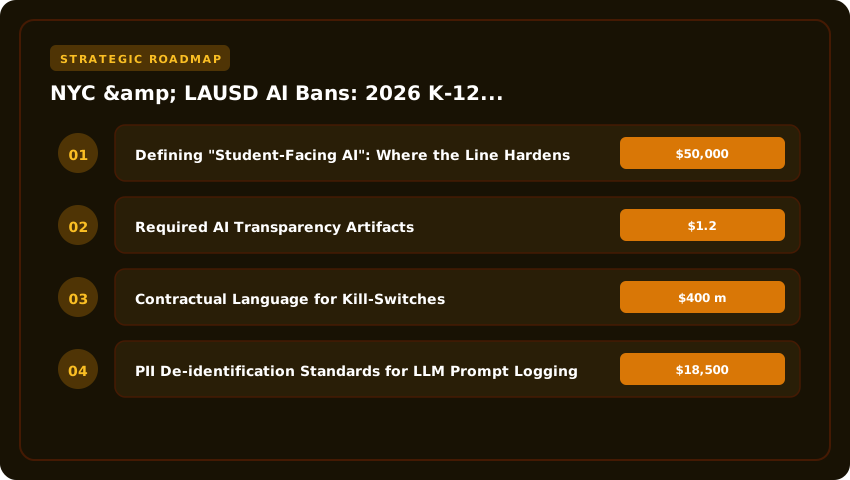
Defining “Student-Facing AI”: Where the Line Hardens
This is where 2026 procurement lives or dies. Both districts agree: a dashboard summarizing student data for a teacher is not student-facing AI. The divergence starts at interactive generative interfaces.

- NYC DOE: Permits student-facing AI if the prompt engineering is constrained by the curriculum provider (e.g., a “Writing Coach” that only offers feedback on thesis statements for a specific 9th-grade ELA unit). Open-ended chat? Rejected.
- LAUSD: Classifies any interface allowing a student to input natural language to an LLM as “Student-Facing Generative,” regardless of guardrails. The only approved path is “Invisible AI”—backend tools like adaptive pacing engines or auto-grading where the student never knows an LLM processed their input.
For your 2027 roadmap: NYC is piloting a “District-LLM” sandbox (NYC-GPT) for approved vendors; LAUSD is doubling down on deterministic, non-generative adaptive logic. Categorize your vendor stack now—“Constrained Generative” for NYC, “Backend Only” for LA—or expect contract delays past the fiscal year close.
Mandatory Vendor Vetting: Updated 2026 Procurement Compliance Checklists
If you are responding to an RFP from NYC DOE or LAUSD in 2026, generic SOC 2 reports and vague “privacy by design” claims will get your proposal discarded. Both districts now demand artifact-level proof that your AI stack respects student data sovereignty before a single license key is issued. Below is the field-tested checklist our procurement team uses to pre-qualify vendors—copy it directly into your compliance matrix.
Required AI Transparency Artifacts
New York Education Law 2-d and the California Student Data Privacy Agreement (CSDPA) addendums converge on one non-negotiable: you must prove the model’s lineage. Attach these three documents to every bid response or expect an automatic disqualification.
- Model Cards (v2.0+ Schema): Submit a completed model card following the Partnership on AI schema updated for 2026 K-12 contexts. It must disclose training data cut-off dates, intended use cases (e.g., “essay feedback for Grade 8 ELA”), known failure modes for multilingual learners, and the specific fine-tuning dataset provenance. Redacted cards are rejected; NYC’s Office of EdTech requires full visibility into synthetic data ratios.
- Independent Bias Audits: LAUSD Resolution 042-25/26 mandates a third-party audit conducted within the last 18 months by a firm accredited under the NIST AI Risk Management Framework. The report must quantify disparate impact ratios across race, gender, IEP status, and English Learner classifications. Internal “red teaming” summaries do not satisfy this requirement.
- Data Provenance Ledger: Provide an immutable ledger (SHA-256 hashed) tracing every student PII field ingested during inference. This includes prompt logs, retrieval-augmented generation (RAG) corpus sources, and embedding vectors. Under NY Ed Law 2-d, you must certify that no student interaction data trains or fine-tunes the base model—ever.
Contractual Language for Kill-Switches
Transparency gets you to the table; contractual kill-switches keep you there. Both districts now require embedded “circuit breakers” that allow district admins to disable specific AI features within 15 minutes of a compliance finding—without vendor intervention.
- Feature-Level Toggle Architecture: Your Master Services Agreement (MSA) must stipulate that every generative capability (text generation, code synthesis, image creation) runs behind a district-controlled feature flag accessible via a secure API endpoint (OAuth 2.0 mTLS). NYC DOE requires this endpoint to be documented in the System Security Plan (SSP) submitted with the RFP.
- Immediate Disablement Clause: Insert explicit language: “Upon written notice of a verified violation of FERPA, COPPA, NY Ed Law 2-d, or CSDPA Exhibit E, District may invoke Kill-Switch API to suspend non-compliant modules. Vendor waives cure period for safety-critical violations involving PII leakage or hallucinated harmful content.” LAUSD legal counsel rejects any clause allowing a 30-day cure window for student safety issues.
- Audit Trail Retention: Kill-switch activations must write immutable logs to the district’s SIEM (Splunk or Microsoft Sentinel) within 60 seconds. Vendors are liable for $50,000 per incident in liquidated damages if logs are missing or tampered with, per the 2026 CSDPA penalty schedule.
Final pro tip: Bundle these artifacts into a single “Compliance Packet” PDF with a cover sheet mapping each artifact to the specific regulatory citation (e.g., “Model Card §3.2 → NY Ed Law 2-d §121.3(b)”). Procurement officers in both cities score bids on “administrative completeness” before technical evaluation begins. Missing one mapping row costs you the contract.
Data Governance Architecture: FERPA, COPPA, and State Law Alignment
Building a compliant edtech stack in 2026 means engineering for the strictest common denominator across New York Education Law §2-d, California’s SOPIPA and CCPA amendments, FERPA, and COPPA. For vendors targeting both NYC DOE’s 1.1 million students and LAUSD’s 540,000, the architecture must enforce data minimization by default—treating every prompt, completion, and metadata log as a potential education record under 34 CFR §99.3.
PII De-identification Standards for LLM Prompt Logging
Open-ended LLM interactions generate high-risk telemetry. In 2026, compliant architectures cannot rely solely on basic regex scrubbing. NYC’s Chancellor’s Regulation A-820 and LAUSD’s Board Resolution 042-25/26 require cryptographic separation of identity from inference data. The production standard now mandates a three-layer pipeline:
- Client-Side Tokenization: Before any payload leaves the browser or managed device, a WASM module strips direct identifiers (name, OSIS/SSID, DOB) and replaces quasi-identifiers (school code, grade cohort) with salted, rotating pseudonyms derived from a district-managed Hardware Security Module (HSM).
- Differential Privacy Injection: For aggregate analytics—such as model drift detection or bias audits—vendors must inject calibrated Gaussian noise (ε ≤ 0.5) into prompt embedding clusters. This satisfies NYSED’s “reasonable de-identification” threshold and CA’s “de-identified” definition under Civ. Code §1798.140(h) without destroying pedagogical signal.
- Zero-Retention Inference Zones: LAUSD’s default-deny posture requires that raw prompts never persist in vendor logs. Architecture must route traffic through ephemeral, encrypted containers (e.g., AWS Nitro Enclaves or GCP Confidential VMs) where memory is wiped on process exit. Audit trails record only hash commitments (SHA-256 of prompt+completion) for dispute resolution, not content.
Parental Consent Workflows: Automating Opt-In/Opt-Out at Scale
Managing granular consent for 1.6 million combined students demands infrastructure that treats consent as a first-class data object, not a checkbox in a SIS. The 2026 compliance baseline requires:
- Consent Receipts as Verifiable Credentials: Using W3C VC-DM standards, districts issue signed JSON Web Tokens (JWTs) encoding scope (e.g., “math_tutor_v3:prompt_logging:true, pii_sharing:false”), expiration (academic year), and revocation endpoints. These flow via LTI 1.3 Advantage `NRPS` and `AGS` services directly into the LMS (Google Classroom, Schoology, Canvas).
- Real-Time Policy Enforcement Points (PEPs): An API Gateway (Kong, Apigee, or custom Envoy sidecar) intercepts every `/v1/completions` request. It validates the student’s JWT against the district’s Consent Registry—synced nightly via OneRoster 1.2 CSV or Clever/ClassLink Secure Sync—returning HTTP 403 if scope is missing or revoked. This satisfies FERPA’s “school official” legitimate interest exception only when technical controls enforce the parental directive.
- Multilingual Self-Service Portals: COPPA and NY Ed Law §2-d require “clear and conspicuous” notice. Portals must render in the top 10 home languages (Spanish, Chinese, Bengali, Russian, Arabic, Haitian Creole, Korean, Urdu, French, Polish) with WCAG 2.1 AA accessibility. Parents toggle granular modules—e.g., “Allow AI Essay Feedback” vs. “Allow Adaptive Reading Diagnostics”—triggering immediate webhook updates to the vendor’s PEP cache.
Vendors who hardcode these patterns into their CI/CD pipelines—automated contract testing for consent enforcement, chaos engineering for de-id pipeline failures—will clear the 2026 procurement gates. Those bolting on privacy as an afterthought will remain locked out of the two largest districts in the country.
Budget Reallocation Strategies: Pivoting from Generative Tools to Compliant Analytics
With New York City’s conditional “walled garden” and LAUSD’s default-deny posture effectively freezing new generative AI procurements for the 2026–27 buying cycle, Chief Financial Officers and Chief Technology Officers must rapidly re-baseline edtech budgets. The immediate opportunity lies in reclassifying expiring federal relief dollars and recurring formula grants toward deterministic, district-hosted predictive analytics—tools that satisfy FERPA, COPPA, and the new state-level AI transparency mandates without triggering the procurement blocks currently hitting open-ended LLM interfaces.
Reclassifying ESSER III & Title IV-A Funds for Deterministic AI Safety Layers
The final obligation deadline for ESSER III (ARP ESSER) is September 30, 2026. Districts sitting on unliquidated balances—NYC DOE still carries roughly $1.2 billion in ARP allocations as of Q1 2026, while LAUSD holds an estimated $400 million—can legally redirect these funds toward “evidence-based interventions” that address learning loss. Predictive early-warning systems (attendance, course failure, SEL risk scoring) qualify under the U.S. Department of Education’s Evidence-Based Practices guidance because they drive Tier 2/3 MTSS interventions with peer-reviewed efficacy data.
Simultaneously, Title IV-A (Student Support and Academic Enrichment) formula allocations for FY 2026 average $18,500 per school nationally. CFOs should file budget amendments reclassifying line items originally coded for “Generative AI Tutoring Pilots” (Object Code 6432) to “Algorithmic Transparency & Safety Infrastructure” (Object Code 6519). This covers:
- On-premise model hosting hardware (GPU clusters estimated at $45,000–$65,000 per node for NVIDIA H100 equivalents).
- Deterministic safety layers: rule-based PII redaction, prompt-injection firewalls, and audit-log immutability.
- Third-party algorithmic audits required by NYC Local Law 144 and California AB 2026 (approx. $25,000–$50,000 per model per year).
Cost Modeling: Open Source vs. Proprietary Wrappers for District-Hosted Models
The total cost of ownership (TCO) over a three-year horizon favors open-source foundations (Llama 3.1 70B, Mistral Large 2, or Nemotron 3 Ultra) wrapped in district-controlled inference stacks, provided internal DevOps capacity exists.
- Open-Source Stack (Self-Hosted): Year 1 CapEx $380,000 (4-node cluster, networking, storage) + $220,000 OpEx (2 FTE ML engineers @ $110k loaded). Year 2–3 OpEx drops to $240,000 annually. 3-Year TCO: ~$1.08M.
- Proprietary Wrapper (e.g., Microsoft Azure AI Studio / Google Vertex AI Model Garden with VPC-SC): Year 1 OpEx $550,000 (managed inference tokens, private link egress, premium support). Annual escalator ~7%. 3-Year TCO: ~$1.85M.
For a district the size of LAUSD (540k students), the open-source route saves roughly $770,000 over three years per major model deployment, but requires passing a SOC 2 Type II audit for the hosting environment—budget $60,000 for a Big Four readiness assessment. NYC DOE’s central Office of EdTech can amortize this across 1,600 schools, driving per-pupil cost below $1.50/year. The financial justification writes itself: redirect the $2.4M previously earmarked for generative chatbot licenses (avg. $4.50/student/yr) into a compliant analytics fabric that survives the next policy shift.
Professional Development Procurement: Training Mandates for 2026-2027
Procurement officers cannot treat professional development (PD) as a line-item afterthought in the 2026-2027 cycle. With NYC DOE’s “walled garden” and LAUSD’s default-deny posture locking down student-facing tools, the compliance burden has shifted entirely to human capital. If teachers cannot articulate the difference between a district-approved embedded model and an open LLM—and document that distinction for auditors—the district faces liability exposure regardless of the software contract.
Mandatory AI Literacy Modules: UFT and UTLA Contractual Training Hour Requirements
Both the United Federation of Teachers (UFT) in New York and United Teachers Los Angeles (UTLA) have baked AI literacy into their current collective bargaining agreements, creating non-negotiable procurement specs for vendor capacity.
- NYC DOE / UFT: The 2026-2027 contract mandates a minimum of 15 hours of “Emerging Technology Pedagogy” per school year for all pedagogues, with a specific 2026-2027 rider requiring 6 dedicated hours to Generative AI Ethics, Bias Mitigation, and Chancellor’s Regulation A-831 compliance workflows. Vendors bidding on NYC PD contracts must demonstrate capacity to deliver these modules in synchronous cohorts no larger than 30 participants to satisfy UFT “effective professional development” clauses.
- LAUSD / UTLA: Under the 2026-2027 agreement, UTLA secured a 12-hour “Digital Safety & AI Literacy” mandate tied directly to Board Resolution 042-25/26. Critically, LAUSD requires 3 hours of this training to occur before a teacher receives credentials to access any AI-enabled dashboard (e.g., the Ed platform or approved curriculum-locked tools). Procurement specs must stipulate vendor availability for “just-in-time” onboarding windows aligned with the district’s quarterly credentialing audits.
Failure to bake these hourly floors and cohort-size caps into the RFP scope of work will result in grievances that stall implementation past the 2027 audit deadline.
Procuring Certified PD Providers: ISTE Standards Alignment vs. District Custom Curricula
The vendor market splits sharply between “off-the-shelf” ISTE-aligned providers and boutique firms building district-custom curricula. Procurement strategy must match the district’s risk profile.
- ISTE Standards Alignment (The Safe Harbor Route): Vendors carrying the ISTE Seal of Alignment for Standard 1.1 (Empowered Learner) and 1.2 (Digital Citizen) offer a defensible procurement position. In 2026, roughly 40 providers hold active seals for AI-specific modules. Cost basis typically runs $1,800–$2,500 per cohort of 25 for a 6-hour sequence. The advantage: auditors accept the ISTE crosswalk as prima facie evidence of rigor. The gap: generic modules rarely address the specific “walled garden” workflow of NYC’s vetted tool list or LAUSD’s Resolution 042-25/26 prompt-engineering guardrails.
- District Custom Curricula (The Compliance Route): For NYC and LAUSD, custom builds are effectively mandatory for the “mandate-specific” hours (the 6 UFT hours / 3 LAUD pre-access hours). Budgets here range $45,000–$75,000 per district for curriculum development plus delivery. RFPs must require the vendor to co-develop with the district’s Office of EdTech (NYC) or ITD/Instructional Technology Initiative (LAUSD) and submit final slide decks and facilitator guides for legal review 30 days prior to the first session. Intellectual property clauses must assign derivative works to the district to avoid vendor lock-in for the 2027-2028 renewal cycle.
Smart procurement officers are issuing dual-track RFPs: a base contract for ISTE-aligned foundational literacy (scalable to all staff) and a negotiated task order for the mandated, district-specific compliance modules. This isolates the high-cost custom work while ensuring the baseline workforce hits the 2027 audit threshold.
Audit Readiness: Preparing for 2027 State Education Department Reviews
If you are waiting for the official audit notification letter from NYSED or the California Department of Education (CDE) to start organizing your compliance artifacts, you have already failed the 2027 review cycle. The regulatory tempo has shifted from periodic spot-checks to continuous evidence demands. Both New York and California now treat algorithmic transparency and data minimization as baseline procurement requirements, not optional add-ons. Your district’s ability to produce a complete, machine-readable evidence package within 72 hours of a request is the new benchmark for funding eligibility.
Evidence Package Automation: Generating Software Bill of Materials (SBOM) for Every Deployed Tool
Manual spreadsheets tracking vendor compliance are a liability. In 2026, the only defensible posture is automated SBOM generation for every piece of software touching student data—whether it’s a core SIS integration or a pilot writing assistant used by three teachers. You need a pipeline that ingests vendor SBOMs (NTIA minimum elements: supplier name, component name, version, unique identifier, dependency relationship, author, and timestamp) and cross-references them against your approved inventory in real time. Tools like Syft or Trivy, integrated into your CI/CD procurement gate, should reject any purchase order where the vendor cannot produce a valid SPDX or CycloneDX file. This satisfies NYSED’s Part 121 requirement for “reasonable safeguards” and CDE’s focus on third-party risk management under AB 1584. Budget roughly $15,000–$25,000 annually for the orchestration layer and developer time to maintain the ingestion schemas; it is a fraction of the $50,000+ in legal exposure a single unreported dependency vulnerability creates.
Red Teaming Protocols: Internal Penetration Testing Schedules for Student Data Exposure
Annual penetration tests are obsolete the moment the report lands. You need a continuous red teaming cadence aligned to your deployment velocity. Schedule automated adversarial simulations—specifically targeting prompt injection, training data extraction, and PII leakage—every sprint cycle for high-risk AI tools (any LLM with student-facing chat interfaces) and monthly for static edtech platforms. Use frameworks like MITRE ATLAS and the NIST AI RMF Playbook to structure your test cases. Document every finding, remediation timestamp, and regression test result in your centralized GRC platform; auditors from NYSED’s Office of Information Technology Services (ITS) and CDE’s Technology Services Division will ask for the history of the vulnerability, not just the current status. Allocate 0.5 FTE for a dedicated security engineer or a managed service provider ($120k–$180k/year) to own this loop. If you cannot show a ticket closed within 30 days for a Critical CVE on a student-facing system, you are non-compliant.
- Automate SBOM Ingestion: Mandate CycloneDX/SPDX from vendors at contract signing; block procurement if absent.
- Continuous Red Teaming: Sprint-aligned adversarial testing for GenAI; monthly for legacy stack.
- 72-Hour Evidence Rule: Build dashboards that export full audit packages (SBOMs, pen test logs, DPIA records) on demand.
- Budget Line Item: Treat compliance automation as CapEx, not OpEx—$150k+ annually for a mid-size district is the new floor.
| Compliance Criteria | NYC DOE (Chancellor’s Reg A-812 Revised) | LAUSD (Board Resolution 042-25/26) |
|---|---|---|
| Governance Mechanism | Procedural Framework (Central Vetting) | Legislative Mandate (Default-Deny) |
| Student-Facing GenAI Access Model | Conditional “Walled Garden” (Central Office of EdTech Approval Required) | Blocked unless embedded in Pre-Approved, Curriculum-Locked Platform |
| Primary Review Trigger | Privacy & Instructional Impact Review (PII Touchpoints) | Board Resolution Compliance Audit (All LLM Integrations) |
| Vendor Questionnaire Focus | Data Governance, Instructional Alignment, Interoperability | Curriculum Lock Verification, Zero Open-Ended Prompting, Data Sovereignty |
| Procurement Timeline (2026 Cycle) | Rolling Review; 6-8 Weeks Post-Submission | Semi-Annual Board Docket; 12-16 Weeks (Resolution Alignment) |
| Appeal / Exception Pathway | Chancellor’s Designee Waiver (Instructional Necessity) | Board Amendment Only (Supermajority Vote Required) |
| Estimated Compliance Cost per Tool (USD) | $12,000 – $25,000 (Legal/Privacy Audit) | $20,000 – $40,000 (Platform Hardening + Audit) |
| 2027 Forward Outlook | Expansion of Approved Vendor Registry (API-First) | Potential Resolution 042 Amendment for “Agentic AI” Pilots |
Frequently Asked Questions
What is the difference between NYC DOE and LAUSD AI procurement rules in 2026?
NYC DOE uses Chancellor’s Regulation A-812, a procedural framework requiring a Privacy & Instructional Impact Review for central Office of EdTech vetting. LAUSD enforces Board Resolution 042-25/26, a legislative default-deny mandate blocking student-facing LLMs unless embedded in a pre-approved, curriculum-locked platform.
How long does AI tool approval take for NYC DOE vs LAUSD in the 2026 buying cycle?
NYC DOE operates a rolling review process averaging 6 to 8 weeks post-submission for the Privacy & Instructional Impact Review. LAUSD follows a semi-annual Board docket cycle requiring 12 to 16 weeks for Resolution 042-25/26 alignment verification and potential supermajority votes.
What are the estimated compliance costs for EdTech vendors targeting NYC and LA in 2026?
Vendors budget $12,000–$25,000 for NYC DOE compliance covering legal and privacy audits for the walled garden model. LAUSD compliance costs run higher at $20,000–$40,000 due to mandatory platform hardening, curriculum-lock engineering, and legislative audit requirements under Resolution 042.
Can a vendor appeal a rejection from NYC DOE or LAUSD AI procurement boards in 2026?
NYC DOE allows a Chancellor’s Designee Waiver based on documented instructional necessity. LAUSD offers no administrative appeal; vendors require a Board Resolution amendment passed by supermajority vote, making exceptions legislatively difficult during the 2026 cycle.
What defines "Curriculum-Locked Platform" under LAUSD Resolution 042-25/26 for 2026 procurement?
A curriculum-locked platform restricts student interaction to pre-defined, standards-aligned prompts with zero open-ended generative capability. The LLM backend must be inaccessible for direct prompting, logging all interactions to a district-auditable ledger, ensuring zero PII leakage outside the approved instructional scope.
Strategic Final Takeaway
When evaluating New York Los Angeles Student Facing AI Ban Impact On K12 Edtech Procurement Compliance 2026 in 2026 and beyond, base your decisions on accredited institutional standards, verified return on investment (ROI), and up-to-date official guidelines. Always verify specific dates and requirements through official regulatory portals.