
Updated 2026 JUPEB Syllabus Alignment for All Subject Combinations
The Joint Universities Preliminary Examinations Board (JUPEB) has synchronized its 2026 subject outlines with the National Universities Commission’s (NUC) CCMAS framework, which replaced the old BMAS in 2026. This alignment means the examinable content for the 2026/2027 session now mirrors the exact competency benchmarks expected of first-year university students under the new curriculum. Candidates relying on syllabi downloaded before the 2026/2027 session are effectively studying a deprecated curriculum.

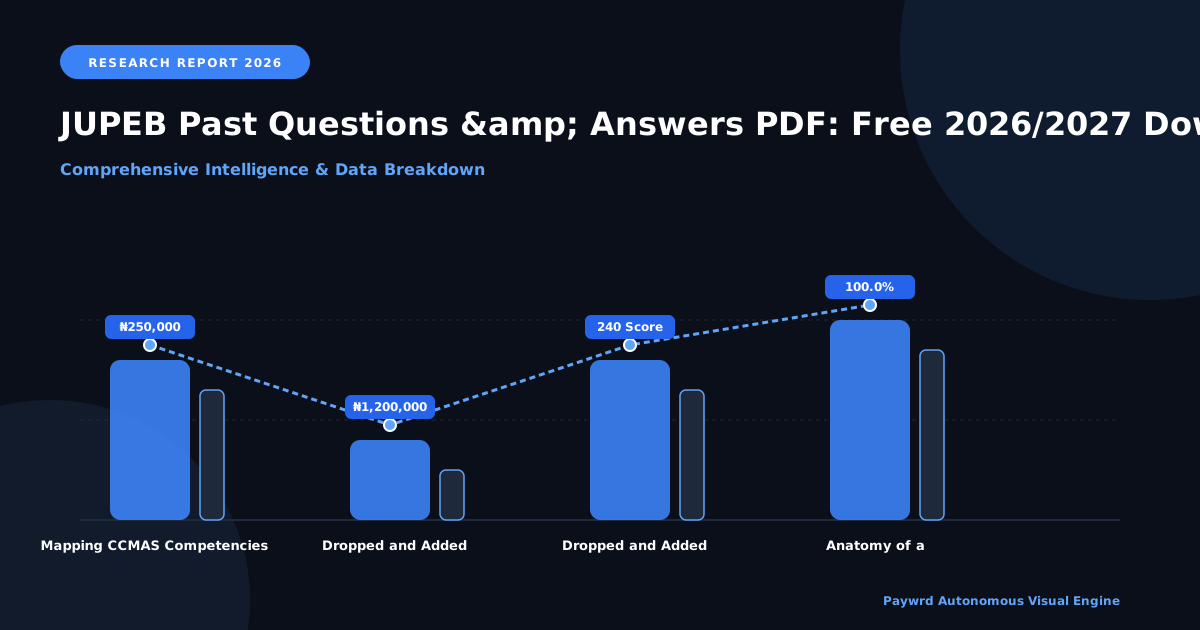
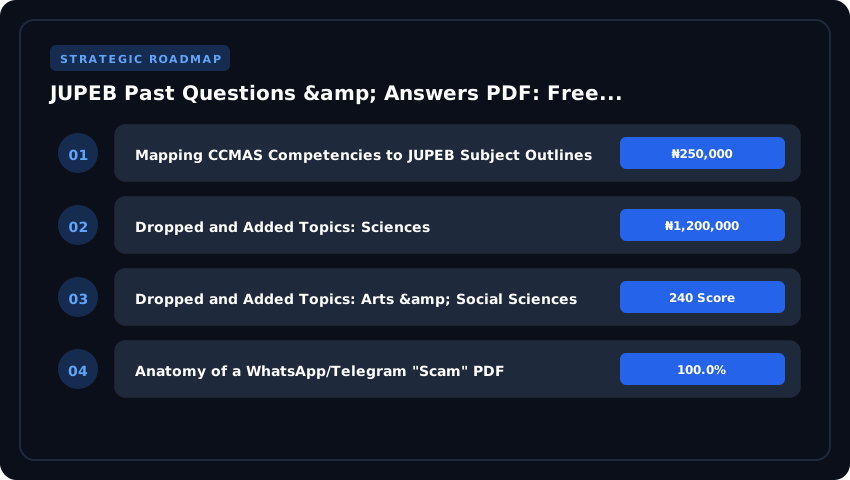
Mapping CCMAS Competencies to JUPEB Subject Outlines
The CCMAS shift moved university education from rigid content lists to learning outcomes and entrepreneurial skills. JUPEB’s 2026 syllabus documents now explicitly tag every topic with a corresponding CCMAS competency code. For instance, in Biology, the old “Ecology” module has been restructured into “Environmental Sustainability and Biodiversity Conservation,” adding mandatory sub-topics on Climate Change Mitigation and Carbon Credits—topics absent in the 2026 syllabus. In Economics, the CCMAS mandate for “Digital Economy” introduces examinable units on Fintech Regulation, Blockchain Basics, and the e-Naira policy framework, replacing the generic “Banking” module.
Dropped and Added Topics: Sciences
- Physics: Removed: Detailed derivations of outdated semiconductor physics (e.g., specific germanium transistor biasing). Added: Renewable Energy Physics (Solar PV efficiency calculations, Wind turbine dynamics) and Introductory Nanotechnology applications.
- Chemistry: Removed: Extensive qualitative analysis schemes for rare cations. Added: Green Chemistry Principles (Atom Economy, E-factor calculations), Polymer Chemistry for packaging, and Computational Chemistry basics (Molecular Docking concepts).
- Computer Science: Major overhaul. Removed: Legacy Pascal/Fortran references. Added: Python for Data Science (Pandas, NumPy), Introductory Machine Learning workflows, and Cybersecurity Fundamentals (CIA Triad, Nigerian Data Protection Act 2026 compliance).
Dropped and Added Topics: Arts & Social Sciences
- Government: Removed: Rote memorization of pre-independence constitutions (Clifford, Richards, Macpherson) as standalone topics. Added: Comparative Constitutionalism focusing on the 2026 Constitution (as amended), Electoral Act 2026 provisions (BVAS, IReV), and Nigeria’s Foreign Policy in the AfCFTA era.
- Literature-in-English: The prescribed text list has rotated. The Lion and the Jewel and Look Back in Anger are out. New mandatory African texts include The Son of the Woman (or current NUC selection) with a new focus on Eco-criticism and Digital Humanities approaches to textual analysis.
- Accounting/Business Management: IFRS updates (IFRS 17 Insurance Contracts, IFRS 16 Leases) are now examinable. Added: Forensic Accounting basics, ESG (Environmental, Social, Governance) Reporting standards, and FIRS TaxPro Max filing procedures.
Action Plan: Download the official 2026 JUPEB Syllabus PDF directly from the JUPEB portal (jupeb.edu.ng) or your study centre’s dashboard. Cross-reference the “Topic Weighting” column against your past questions; any question falling outside the 2026 outline should be discarded from your revision stack immediately.
Verified Sources for Malware-Free JUPEB PDF Downloads in 2026
The internet is flooded with “free JUPEB past questions,” but in 2026, clicking the wrong link is a fast track to a compromised phone or a corrupted file that wastes your study time. Since this is the first examination cycle fully aligned with the NUC’s CCMAS, you need papers that reflect the current curriculum structure, not the old BMAS archives circulating on WhatsApp. Your safest bet remains the official JUPEB portal (jupeb.edu.ng) or the dedicated e-learning platforms of accredited partner universities like UNILAG, OAU, or UI. These institutions typically gatekeep the most recent, watermarked examiner’s reports and marking guides behind student portals—access usually requires your JUPEB registration number or a valid institutional email.
Accredited Study Centres: The Physical Verification Layer
If the portal is down or navigation feels like a maze, walk into your accredited JUPEB study centre. Legitimate centres—those listed on the JUPEB website’s “Accredited Centres” directory—receive bulk DVDs or secure download links directly from the board’s secretariat in Lagos. They print master copies for registered candidates. Ask your centre coordinator for the 2026/2027 session examiner’s report; it contains the only past questions validated against the new CCMAS benchmarks. Avoid any “tutorial centre” operating out of a cybercafé backroom without a verifiable JUPEB centre code.
Anatomy of a WhatsApp/Telegram “Scam” PDF
You know the drill: a broadcast message promises “Complete JUPEB 2026 Physics & Chemistry PDF – 100% Free.” Here is how to spot the trap before you hit download:
- Watermark Overload: Authentic JUPEB papers carry a faint, diagonal JUPEB CONFIDENTIAL or university-specific watermark. Scam PDFs often plaster loud, opaque watermarks like “Downloaded from ExamRuns.com” or “Call 080xxxxxxx for Answers” across every page, obscuring diagrams and marking schemes.
- File Size Anomalies: A genuine 5-subject compilation with marking guides usually sits between 15MB–40MB. A 2.5MB file claiming “All Subjects” is almost certainly a blank template or a malware dropper (often
.apkor.exedisguised as.pdf). - Pre-2026 Content: Scroll to the syllabus mapping page. If you see topics like “Old BMAS Module 3: Specific Heat Capacity” without the new CCMAS Course Learning Outcomes (CLOs) codes, delete it. You are studying a dead curriculum.
- Permission Requests: A PDF should never ask for “Access to Contacts,” “SMS,” or “Phone Storage” upon opening. That is spyware, not a past paper.
Bottom line: In 2026, the cost of a “free” download from a Telegram channel is often your Bank Verification Number (BVN) data or a bricked device. Pay the nominal printing fee at your centre or log in to your university’s LMS. Your 200-Level admission depends on studying the right material, not just any material.
Decoding the 2026 JUPEB Marking Scheme & Grading Thresholds
Understanding the JUPEB grading architecture is non-negotiable if you are targeting competitive Direct Entry (DE) slots in 2026. The board operates a standardized 5-point scale where your raw examination scores are converted into Grade Points (GP). The conversion is rigid: 70–100% = A (5 points), 60–69% = B (4 points), 50–59% = C (3 points), 45–49% = D (2 points), 40–44% = E (1 point), and Below 40% = F (0 points). Each of your three principal subjects carries a maximum of 5 points, capping the total obtainable aggregate at 15 points. There are no half-points; you either hit the threshold or you don’t.
The “Magic 5” Baseline vs. Competitive Reality
Officially, the minimum aggregate for DE consideration is 5 points (typically EEE or a combination like DDE). However, treating 5 points as a target is a strategic error. In the 2026 admission cycle, universities—especially federal institutions—apply departmental cut-offs that dwarf the board’s minimum. For high-stakes programmes, the aggregate requirement is effectively the maximum or near-maximum.
- Medicine & Surgery (MBBS): Most universities (UI, UNILAG, OAU, ABU, UNN) demand 15/15 points (AAA) in Biology, Chemistry, and Physics. A single B (14 points) often disqualifies you at the screening stage.
- Law: Competitive faculties require 14–15 points (AAB or AAA) in Literature-in-English, Government/History, and CRS/IRS/Economics.
- Engineering (Civil, Mechanical, Electrical): The baseline is usually 13–14 points (AAB/AAC) in Mathematics, Physics, and Chemistry.
- Pharmacy & Nursing: Expect cut-offs around 14–15 points (AAA/AAB).
Setting Realistic Per-Paper Targets for 2026
Because the 2026 papers align with the NUC’s CCMAS—emphasizing application over rote recall—you must aim for 75%+ raw scores in every paper to secure the ‘A’ buffer. A 65% (B) in Physics might cost you Medicine. Structure your revision using the JUPEB Past Questions & Answers PDF to practice hitting 70+ consistently under timed conditions. Remember, JUPEB does not moderate scores upward; your raw performance is your final grade. Calculate your target aggregate backwards: if you need 14 points for Law, you need two As and one B. Plan your study hours to guarantee the As in your strongest subjects first.
CBT vs Paper-Based Practice: Simulating the 2026 Exam Environment
Let’s be clear: downloading the PDF is the easy part. Actually passing the 2026 JUPEB examination requires you to train exactly how you fight. For this session, that means mastering a hybrid format—Computer-Based Testing (CBT) for your objective papers and the traditional answer booklet for essays. Most candidates in Lagos, Abuja, or Port Harcourt prepare for one and neglect the other. That is a fast track to a resit.
Mastering the CBT Interface with Offline Apps
The 2026 JUPEB objective papers (Physics, Chemistry, Biology, Mathematics, Government, Economics, etc.) are delivered via CBT. You cannot afford to see the interface for the first time inside the hall. You need offline CBT software—think JUPEB CBT Practice, Myschool CBT, or the JAMB CBT Practice app configured for JUPEB subject combinations. These tools run on Android and Windows without data, simulating the exact timer, navigation buttons, and “Review” flagging system used by the board.
Set a strict two-hour block every weekend. Treat your phone or laptop like the exam terminal: no calculator apps (use the on-screen one), no browser tabs, no pausing. Train your eyes to scan the question stem, eliminate distractors, and hit “Next” without hesitation. The 2026 CCMAS-aligned questions are heavier on application and data interpretation than recall; the clock is your real opponent. If you finish a 50-question Physics paper in 90 minutes with 85% accuracy offline, you walk into the centre with a psychological edge that no amount of cramming provides.
Navigating the Answer Booklet for Essay Subjects
For Literature-in-English, History, CRS/IRS, and Government essays, the paper booklet remains king. The 2026 format demands specific discipline: you write in blue or black biro only, within the ruled margins, and you must number your questions exactly as they appear on the question paper (e.g., “Question 2(a)”). Examiners mark hundreds of scripts daily; a messy booklet with crossed-out paragraphs or missing question numbers gets penalised before they even read your thesis statement.
Practice writing three full essays in 90 minutes using a downloaded JUPEB answer booklet template (print it on A4). Feel the hand fatigue. Learn to structure your argument—Introduction, Body Paragraphs with textual evidence, Conclusion—in the first five minutes of planning. The CCMAS shift emphasizes critical analysis over plot summary. If your handwriting degrades after page two, your grade degrades with it. Simulate this weekly. It builds the stamina to keep your script legible and your arguments sharp right up to the final invigilator’s “pens down” call.
- CBT Drill: Use offline apps (Myschool, JUPEB CBT) for 2-hour timed sessions; mimic exam conditions—no internet, no external calculator.
- Booklet Discipline: Print official answer booklet templates; practice 3 essays/90 mins with strict margin and numbering rules.
- Hybrid Stamina: Alternate CBT and Essay days to condition your brain for the rapid context-switching the 2026 timetable demands.
Strategic Subject Combination Selection for 2027 Direct Entry
Registering for JUPEB without a verified subject combination is the academic equivalent of buying a plane ticket without checking the destination airport. Every year, thousands of candidates sit for the exams only to discover during JAMB Direct Entry (DE) registration that their subject cluster—say, Physics, Chemistry, and Biology for a Computer Science aspirant—is flagged as an “Invalid Combination” by their target university. In the 2027 admission cycle, with the NUC’s CCMAS framework now the baseline for curriculum design, universities have tightened their DE entry requirements to reflect specific competency mappings. You cannot afford to guess.
Decode the JAMB Brochure Before You Register
The 2027 JAMB DE Brochure (accessible via the IBASS portal) is your primary source of truth. Do not rely on hearsay from study centers or outdated PDFs circulating on WhatsApp. For instance, the University of Lagos (UNILAG) typically demands Physics, Chemistry, and Mathematics (PCM) for Engineering and Physical Sciences, but they may accept Physics, Chemistry, and Biology (PCB) for specific Environmental Science courses—provided you have a credit in Mathematics at O’Level. Obafemi Awolowo University (OAU), however, historically insists on strict adherence; their Medicine program requires PCB with zero tolerance for Mathematics substitutions, while their Law program demands Literature in English alongside any two Arts/Social Science subjects. Ahmadu Bello University (ABU) Zaria often publishes unique “Special Considerations” (waivers) for Faculty of Administration courses accepting Government or Economics in place of Commerce. Download the specific faculty requirement pages for your top three university choices before you pay your JUPEB registration fee.
Cross-Reference O’Level Deficiencies Early
A “valid” JUPEB combination can still sink your admission if your WAEC/NECO results contradict it. JAMB’s DE registration portal runs an automated validation check against your uploaded O’Level results. If you register for the JUPEB Arts combination (Literature, CRS/IRS, Government) targeting Law at UNILAG, but your WAEC result shows a D7 in Literature-in-English, the system will reject the combination at the DE registration stage in 2027. You must have the five requisite O’Level credits—including English Language and Mathematics (where required)—at not more than two sittings. Map your JUPEB subjects to cover your O’Level gaps; if you lack Physics at O’Level but need it for Engineering, you must take Physics in JUPEB and pass it well.
Leverage the “Two-Subject Major” Rule for Flexibility
Most universities calculate your JUPEB points based on your best three subjects, but the combination validity is determined by the core discipline. For competitive courses like Nursing or Pharmacy at schools like University of Ibadan (UI) or University of Benin (UNIBEN), the core is non-negotiable: Biology, Chemistry, and Physics. However, for Social Sciences (Economics, Political Science, Mass Communication), you often have wiggle room. A combination of Economics, Government, and Mathematics works for Economics at OAU, UNILAG, and ABU simultaneously. Prioritize combinations that keep your options open across your shortlist. If you are torn between Accounting and Business Administration, the “Management Sciences” cluster (Mathematics, Economics, Accounting/Commerce/Government) covers both across virtually all federal universities.
- Action Item: Create a spreadsheet with columns: Target University, Faculty, Course, Required JUPEB Subjects (per 2027 Brochure), Your O’Level Grades.
- Red Flag: Any course requiring “Physics” in JUPEB but you only have “General Mathematics” at O’Level without Further Maths or Physics credit—verify if the university accepts JUPEB Physics to remedy the O’Level gap (most do, but confirm).
- Pro Tip: Visit the official JUPEB website and download the current syllabus for your shortlisted subjects. If the syllabus topics look completely foreign to your secondary school background, reconsider the combination—struggling through three difficult subjects yields lower points than acing three aligned ones.
Leveraging 2026 Past Questions for NELFUND & Scholarship Readiness
Scoring high in the 2026 JUPEB examination does more than secure Direct Entry admission; it builds the evidentiary backbone for major funding vehicles opening for the 2027/2028 academic session. The Federal Scholarship Board (FSB) Bilateral Education Agreement (BEA) awards and the Nigerian Education Loan Fund (NELFUND) both weigh verified academic excellence heavily. Your JUPEB result slip, backed by a transcript showing distinction-level grades (A’s and B’s) in the new CCMAS-aligned subjects, becomes a primary eligibility document.
Federal Scholarship Board Awards: The JUPEB Advantage
The FSB typically requires a minimum of five (5) distinctions in relevant subjects for undergraduate scholarship consideration. Because the 2026 JUPEB cycle is the first fully aligned with NUC CCMAS, examiners are setting questions that test the exact competencies universities now demand. Drilling the 2026 past questions—specifically the updated Physics, Chemistry, Biology, and Economics papers—trains you to hit the “Distinction” band (70%+). A candidate presenting a JUPEB certificate with 14–15 points (mostly As) from this updated curriculum stands significantly taller during the FSB shortlisting phase than peers relying on outdated BMAS-era preparation. Ensure you download the official 2026 JUPEB Chief Examiner’s Report when released; it explicitly maps the marking scheme to the new curriculum objectives, giving you the exact answer structure scholarship assessors expect to see.
Documenting Excellence for NELFUND Eligibility
For the 2027/2028 session, NELFUND’s student loan application portal (nelf.gov.ng) requires proof of admission and satisfactory academic progress. While the loan targets indigent students, “satisfactory academic progress” is increasingly defined by entry qualifications. A verified JUPEB result uploaded to the NELFUND portal serves as your baseline academic credibility. Here is how to leverage your 2026 prep for seamless funding access:
- Secure Certified True Copies (CTC): Immediately after results release, apply for CTC of your JUPEB certificate and statement of result through the JUPEB portal. NELFUND and FSB verification officers reject photocopies.
- Map Scores to Course Requirements: If applying for Medicine or Engineering loans, highlight your 2026 Chemistry and Physics distinction grades in your application essay. The new CCMAS syllabus emphasizes practical/application questions; past paper practice proves you possess the lab competency universities fund.
- JAMB CAPS Alignment: Ensure your JUPEB registration number matches your JAMB Direct Entry registration. NELFUND cross-references the National Identification Number (NIN) across JAMB CAPS and the NELFUND dashboard. Discrepancies delay disbursement.
- Retain Exam Scripts/Workings: For subjects with practical components (Biology, Chemistry, Physics), keep records of your 2026 practical scores. Some scholarship boards request a breakdown of theory vs. practical scores to assess lab readiness.
Treating the 2026 past questions as a scholarship rehearsal—not just an exam drill—positions you to walk into the 2027/2028 session with admission secured and funding verified.
| Criteria | JUPEB (2026/2027) | IJMB (2026/2027) | Cambridge A’Levels (2026/2027) | NABTEB A’Level (2026/2027) |
|---|---|---|---|---|
| Programme Cost (NGN) | ₦280,000 – ₦450,000 | ₦250,000 – ₦400,000 | ₦1,200,000 – ₦2,500,000+ | ₦150,000 – ₦300,000 |
| Duration | 9–10 Months (2 Semesters) | 9–10 Months (2 Semesters) | 12–18 Months | 12 Months |
| Nigerian University Acceptance (2026 Admission) | Direct Entry (200 Level) – All Fed/State/Private Unis | Direct Entry (200 Level) – Most Fed/State Unis | Direct Entry (200 Level) – All Unis + International | Direct Entry (200 Level) – Limited Uni Acceptance |
| Syllabus Framework (2026 Update) | Fully Aligned to NUC CCMAS | Aligned to NUC BMAS/CCMAS Transition | International Curriculum (CAIE) | NBTE Modular Curriculum |
| 2026/2027 Exam Cycle | June/July 2027 (Main Diet) | February 2027 (Main Diet) | May/June 2027 & Oct/Nov 2027 | November/December 2027 |
| Past Question Relevance for 2026 Prep | High (Must filter for CCMAS topics post-2026) | Moderate (Syllabus stable) | High (Syllabus stable) | Low (Limited past papers) |
Frequently Asked Questions
Where can I download free JUPEB past questions and answers PDF for the 2026/2027 session?
Free 2026/2027 JUPEB past questions aligned with the new CCMAS syllabus are available on the official JUPEB portal (jupeb.edu.ng) under 'Resources', and verified educational sites like Myschool.ng and Flashlearners.com. Always verify the upload date reads 2026 or later to ensure CCMAS compliance.
Is the 2026 JUPEB syllabus different from the old BMAS curriculum?
Yes, the 2026 JUPEB syllabus is fully restructured to match the NUC's Core Curriculum Minimum Academic Standards (CCMAS), which replaced BMAS in 2026. Topics have been added, removed, or re-weighted to reflect first-year university competency benchmarks. Pre-2026 past questions require mapping to the new outline.
When is the JUPEB 2026/2027 examination date and registration deadline?
The 2026/2027 JUPEB Main Examination is scheduled for June/July 2027. Registration for the 2026/2027 session typically closes in January 2027 at accredited study centres. Candidates must register through an approved JUPEB affiliate centre; private candidate registration is not permitted.
How much does the JUPEB 2026/2027 registration form and tuition cost in Nigeria?
The JUPEB 2026/2027 registration fee is approximately ₦25,000–₦30,000 paid via Remita to JUPEB. Total programme tuition (including centre fees, materials, and exams) ranges from ₦280,000 to ₦450,000 depending on the affiliate institution (University, Polytechnic, or Private Centre).
Does JUPEB 2026 use the new CCMAS curriculum for all subject combinations?
Yes, effective the 2026/2027 academic session, all JUPEB subject combinations (Sciences, Arts, Management, Social Sciences) are synchronized with the NUC CCMAS framework. This ensures the examinable content mirrors the exact competencies required for 200-Level entry into Nigerian universities in 2027.
Strategic Final Takeaway
When evaluating JUPEB Past Questions And Answers PDF Free Download 2026 2027 in 2026 and beyond, base your decisions on accredited institutional standards, verified return on investment (ROI), and up-to-date official guidelines. Always verify specific dates and requirements through official regulatory portals.

