
Navigating The Updated NUC CCMAS Portal For Real-Time Verification
The National Universities Commission (NUC) retired the static PDF accreditation lists in late 2026. As of 2026, the authoritative source is the CCMAS Programme Accreditation Dashboard hosted at ccmas.nuc.gov.ng. This platform ties accreditation directly to the new 70/30 curriculum structure (70% core, 30% institutional electives), meaning a programme’s status reflects its compliance with the current benchmark, not just its existence.
Step-by-Step Walkthrough of the Programme Search Dashboard
Land on the portal homepage and select “Public Search”—no login is required for verification. The interface defaults to a three-filter matrix:
- Institution Type: Federal, State, Private, or Specialized (e.g., Police Academy, Maritime University).
- Institution Name: An autocomplete dropdown pulling the current gazetted legal name.
- Programme/Department: Search by full title (e.g., “Computer Science”) or the specific CCMAS Course Code (e.g., CSC 101 series).
Hit “Run Verification”. The result card displays the Programme Name, Department, Faculty, Current Accreditation Status, Expiry Date, and the Last Visitation Panel Date. Crucially, click the “View Panel Report Summary” icon (document symbol) to download the one-page PDF executive summary—this is your evidence for JAMB CAPS registration or NELFUND loan applications.
Interpreting ‘Full’, ‘Interim’, and ‘Denied’ Accreditation Status Codes
Do not treat these as binary “Good/Bad” labels. In the 2026 CCMAS framework, they carry specific regulatory weight:
- Full Accreditation (5-Year Cycle): The programme meets 100% of CCMAS benchmarks—staffing ratios, lab infrastructure, library holdings, and curriculum alignment. Graduates are eligible for NYSC mobilization and professional body registration (COREN, NMC, ICAN) without conditions.
- Interim Accreditation (2-Year Cycle): The programme has critical gaps (typically PhD staff ratio below 60% or outstanding lab upgrades). Warning: Students admitted under Interim status can graduate, but the university must submit a progress report at Month 18. If the re-visitation fails, the status reverts to “Denied,” jeopardizing the graduating class’s professional certification.
- Denied Accreditation: The programme is effectively frozen. No new admissions via JAMB CAPS are permitted for the current session. Existing final-year students may be allowed to “teach-out,” but freshers should avoid these programmes entirely.
Cross-Referencing University Name Changes and Merger Updates
The 2026 portal includes a “Institution History Timeline” tab on every university profile card. This is critical because three major mergers finalized in early 2026 (e.g., the consolidation of specific State Colleges of Education into Universities) changed JAMB institution codes. If you search an old name (e.g., “College of Education, [Town]”), the portal redirects to the new legal entity (“[Town] University of Education”) and flags: “Programmes formerly listed under [Old Code] are now mapped to [New Code] effective [Date].” Always verify the Current Gazetted Name matches your JAMB admission letter exactly; a mismatch triggers automatic rejection on the NELFUND portal during identity verification.
Decoding 2026 NUC Resource Verification Outcomes For Your Course
If you think choosing a university is risky, wait until you learn what happens behind the scenes after the National Universities Commission sends its resource verification teams out. In 2026, these visits carry real consequences. A department that passes verification smoothly may receive a full quota endorsement, meaning JAMB CAPS will process candidates into that programme without bottlenecks. A department that returns with flagged deficiencies, however, often sees its admission slots frozen or reduced for the 2026/2027 cycle. Some institutions lose the right to matriculate new students entirely until corrective measures are documented and re-validated.
Reading The Probation And Suspension Signals
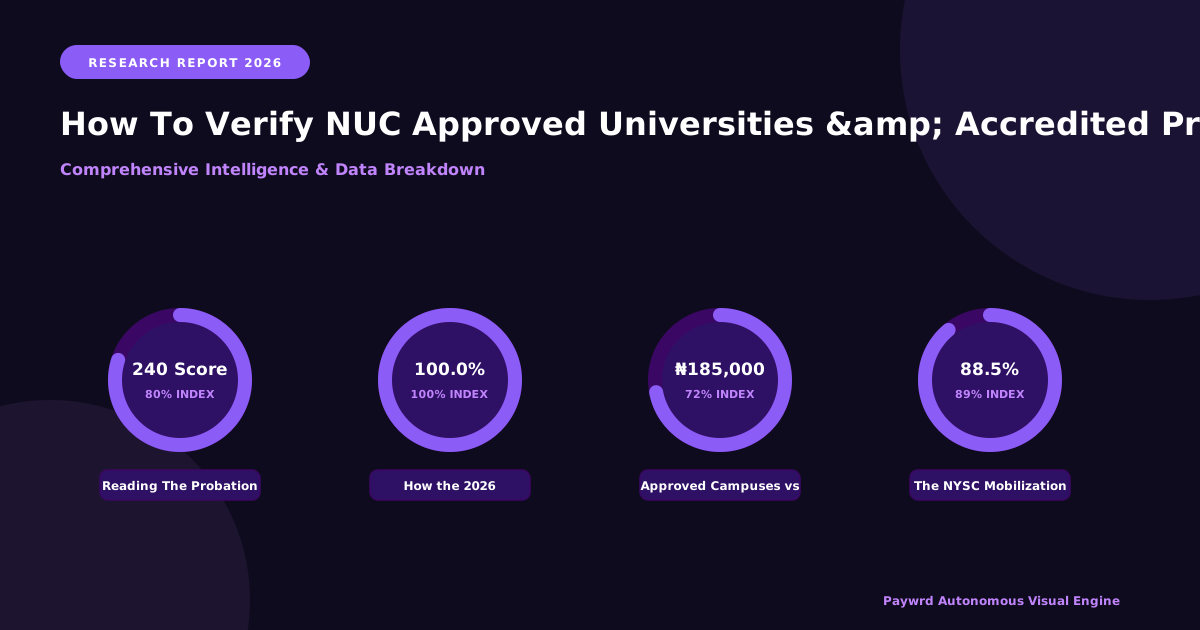
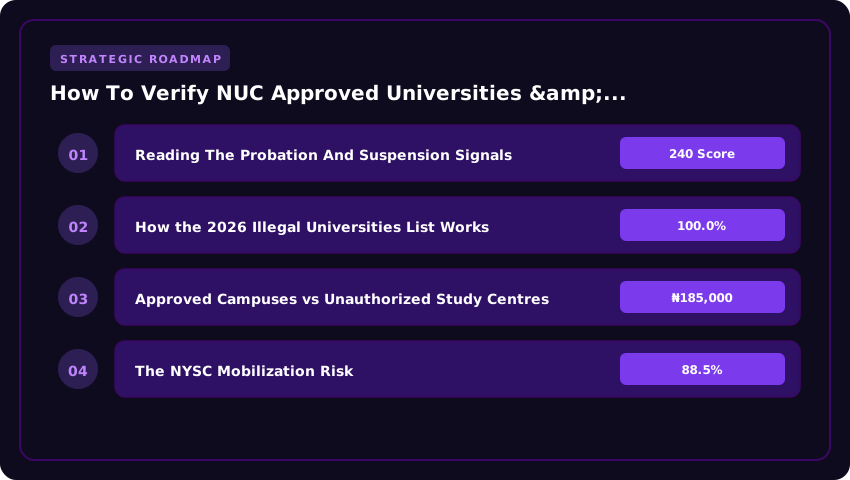
Not all accreditation statuses are created equal, and understanding the spectrum is what separates informed applicants from desperate ones. When a programme lands on the NUC Probation list, it means the institution has been given a defined window to rectify specific shortcomings, usually tied to staffing ratios, library holdings, or laboratory equipment. Admission into probationary programmes remains technically possible, but the risk is tangible, you may begin a degree that gets suspended mid-cycle. Programmes on the Suspension list are a hard stop. No candidate should consider applying to these through JAMB CAPS under any circumstances. The NUC CCMAS portal now colour-codes these statuses at the programme level, so you can filter your search and spot red flags before you submit your preferences.
CCMAS Curriculum Alignment And Why It Validates Your Degree
The shift to the Core Curriculum Minimum Academic Standards portal did more than modernise a database. It tied every accredited programme to a verified curriculum template. In practical terms, this means the courses listed in your department’s syllabus must map directly to the NUC-prescribed CCMAS modules for that discipline. A programme that shows full curriculum alignment on the dashboard gives you confidence that your degree certificate will hold weight with employers, professional bodies, and for postgraduate admissions both locally and abroad. Misalignment, on the other hand, signals that the institution is operating outside NUC standards, and graduates from such programmes have historically faced credential validation issues. Before you pay any JAMB registration fee or process NELFUND loan applications, run your programme code through the CCMAS portal. That single check protects your investment, your time, and your future.
Verifying Newly Licensed Private & State Universities (2026-2027 Cohort)
Every year, the Federal Executive Council (FEC) grants provisional licences to new private and state universities. For the 2026–2027 academic cycle, the National Universities Commission (NUC) has published the operational licences for over a dozen new institutions, including University of Medicine and Health Sciences, Iyin-Ekiti, Greenfield University, Kaduna (State), and Pen Resource University, Gombe. However, a licence to operate is not a blanket accreditation. It merely authorises the proprietor to commence physical development and academic planning. It does not guarantee that your specific course—be it Law, Nursing, or Computer Science—holds full accreditation for the 2026/2027 session.
Licence to Operate vs. Programme Accreditation: The Critical Distinction
This is where most candidates lose money and time. A Licence to Operate is an institutional permit granted by the NUC after verifying land, funding (₦200 million minimum endowment for private unis), and governance structures. Programme Accreditation, conversely, is course-specific. It is awarded only after the NUC’s Resource Verification panel inspects laboratories, libraries, staff-to-student ratios, and curriculum alignment with the new Core Curriculum Minimum Academic Standards (CCMAS).
A university licensed in February 2026 may not secure full accreditation for Engineering or Medicine until 2028. If you accept admission into an unaccredited programme, you cannot sit for professional exams (COREN, NMCN, Council of Legal Education), and your NYSC mobilisation will be blocked. Always check the CCMAS Portal for the specific Programme Accreditation Status—displayed as “Full,” “Interim,” or “Denied”—rather than relying on the university’s name appearing on a “List of Approved Universities.”
Checking Take-Off Status for Proprietary Universities in Your State
Before paying acceptance fees (often ₦50,000–₦150,000), verify physical take-off status. Many 2026 licensees are still operating from temporary sites or shared facilities. Use this checklist:
- Cross-reference JAMB CAPS: Log into your JAMB profile. If the institution appears in the “Institution & Course” dropdown for 2026 UTME/DE registration, JAMB has verified their minimum take-off requirements.
- Visit the NUC CCMAS Dashboard: Search the institution name. Click “Programmes.” Filter by “Accreditation Status.” If your course shows “Not Submitted” or “Interim (Year 1),” the programme is not yet cleared for graduation.
- Physical Verification: For state universities (e.g., Sa’adatu Rimi University of Education, Kumbotso), visit the permanent site. Check for functional laboratories, a dedicated university library (not a converted secondary school hall), and resident academic staff—not just visiting lecturers.
- NELFUND Eligibility: Confirm the institution is listed on the NELFUND portal as an approved beneficiary institution. New private universities often wait 12–18 months post-licence for NELFUND onboarding. If they aren’t listed, student loan access is impossible.
Bottom line: A 2026 licence means the gate is open. CCMAS accreditation means the specific classroom is ready. Verify the classroom before you pay.
Spotting Illegal Degree Mills & Unapproved Satellite Campuses
The NUC publishes a regularly updated List of Illegal Universities, and in 2026, this list has become even more critical as fraudsters exploit the confusion around the CCMAS transition. These operators know you are looking for accredited programmes, so they build convincing websites, register domain names that mimic legitimate institutions, and even advertise on platforms that look official. Some charge tuition between ₦250,000 and ₦800,000 per session, banking on your desperation to secure admission. The money disappears, and the certificate you receive holds zero weight with employers or the National Youth Service Corps.
How the 2026 Illegal Universities List Works
The NUC actively maintains and refreshes this list to capture newly discovered operations. In 2026, the Commission has intensified enforcement, partnering with the EFCC and state education ministries to shut down physical centres running unapproved degree programmes. The list includes institutions that never received legitimate licensing and ones that were previously approved but had their accreditation revoked for gross violations. If your chosen university does not appear on the NUC CCMAS portal, treat that as a hard stop. Do not proceed with registration or fee payment until you can confirm approval through the official dashboard.
Approved Campuses vs Unauthorized Study Centres
This is where the scam gets sophisticated. Some illegal operators establish “satellite campuses” or “study centres” in locations like Lagos, Abuja, or Port Harcourt, advertising them as extensions of approved universities. They may display a legitimate institution’s name, logo, and even reference a real departmental structure. However, the NUC has not approved that physical location for programme delivery. A university might be fully accredited, but if your specific study centre is not listed as an approved location on the CCMAS portal, your degree certificate will not be issued through that institution. Always cross-check the exact campus or centre name against the portal before committing financially.
The NYSC Mobilization Risk
This is the devastating consequence that catches most people off guard. When you apply for NYSC mobilization after graduation, the corps production unit verifies your credentials against NUC records. Graduates from unapproved campuses or illegal degree mills face outright exclusion from mobilization. Your certificate is flagged as unverified, and in many cases, you will be directed to return for a supplementary exercise or your application is rejected entirely. This is not a bureaucratic delay. It is a permanent barrier that can derail your career timeline by years, and no personal appeal or lobbying can override the NUC data verification that NYSC relies on in 2026.
- Always verify your specific programme code and campus location on the NUC CCMAS portal before paying any fees.
- Be suspicious of universities offering admission outside standard JAMB CAPS processes without a valid institutional code.
- Report suspicious study centres to the NUC through their official complaint portal immediately.
- Request the NUC accreditation certificate number for the specific programme and confirm it matches the CCMAS records.
Verifying Professional Body Accreditation Alignment (COREN, ICAN, NMC, PCN)
Here is the hard truth many 2026 applicants discover too late: a “Full Accreditation” status on the NUC CCMAS portal guarantees your degree is academically legal, but it does not guarantee you can practice. In regulated professions—Engineering, Accountancy, Medicine, Pharmacy, Law, Architecture, Nursing—the professional body holds the licence to practice, not the university. The NUC ensures the curriculum meets minimum academic standards (CCMAS); COREN, ICAN, NMC (Medical & Dental Council), PCN, and the Council of Legal Education ensure the curriculum produces a competent professional. These are two distinct regulatory gates.
Why NUC Accreditation Alone Is Insufficient
Imagine graduating with a 2:1 in Civil Engineering from a university the NUC lists as “Fully Accredited.” You apply for NYSC, serve your year, and then approach COREN for registration—only to be told your specific cohort or curriculum variant lacks COREN accreditation. You hold a degree, but you cannot legally sign off on structural drawings or use the “Engr.” title. This disconnect happens because professional bodies often impose stricter requirements: specific laboratory equipment ratios, mandatory industrial attachment durations (SIWES), staff-to-student ratios in clinics or studios, and curriculum content mapping that exceeds the NUC’s CCMAS baseline. A programme can pass the NUC’s 70% threshold but fail COREN’s 100% mandatory lab requirement.
Checking Joint NUC/Professional Body Accreditation Status Matrices
You must verify the “Dual Status” before accepting admission. Do not rely solely on the university prospectus or the NUC dashboard. Cross-reference directly:
- COREN (Engineering/Tech): Visit the COREN Accredited Programmes portal. They publish a searchable list of programmes with “Full,” “Interim,” or “Denied” status. Note: COREN accreditation expires; check the validity date, not just the listing.
- ICAN/ACA (Accountancy): Check the ICAN Accredited Institutions page for degree exemption agreements. A university might have NUC accreditation for Accounting but lack the specific ICAN exemption waivers for specific papers (e.g., Taxation, Audit), forcing you to write all professional exams post-graduation.
- MDCN (Medicine/Dentistry) & NMCN (Nursing): These are life-or-death regulators. Verify the MDCN and NMCN lists for “Full Accreditation.” “Provisional” or “Resource Verification” status means the programme is still building capacity—graduates from these cohorts often face delayed provisional registration or mandatory remedial postings.
- PCN (Pharmacy): Confirm the PCN status. Pharmacy requires specific industrial pharmacy attachments; missing logs invalidate your pre-registration year.
- Council of Legal Education (Law): Only universities on the Nigerian Law School approved list qualify graduates for Bar Part I. NUC accreditation for Law does not automatically confer Law School eligibility.
Implications for 2026 Graduates Seeking Immediate Professional Registration
For the 2026 graduating class, the timeline is unforgiving. Professional bodies typically accredit cohorts, not just programmes. If your department loses accreditation in your 400-level year (a common scenario during re-accreditation visits), you may graduate with a degree the professional body refuses to recognize for that specific session. This creates a “gap year” where you hold a certificate but cannot register for NYSC (in some regulated fields) or begin your mandatory internship/housemanship.
Action Plan: In your penultimate year (300/400 Level), demand the “Accreditation Status Letter” from your Head of Department, signed by the Dean and the University Accreditation Unit, confirming the professional body’s current status for your specific graduating session. Screenshot the professional body’s website listing showing your programme and session validity. Without this dual-layer proof, your NUC-verified degree is only half a ticket to the profession.
Using JAMB IBASS & NELFUND Data As Secondary Verification Layers
The NUC CCMAS portal tells you if a programme has academic teeth. JAMB IBASS (Institutional Brochure and Admission System) and the NELFUND portal tell you if that programme has operational legs. In 2026, smart applicants treat these three federal databases as a triangulation protocol—if a course appears on CCMAS but vanishes from IBASS, you have a ghost programme on your hands.
Confirming 2026 UTME/DE Presence on JAMB CAPS & IBASS
Log into the JAMB IBASS portal (ibass.jamb.gov.ng) and run a search for the specific institution and course code. For the 2026 admission cycle, any programme actively admitting students via UTME or Direct Entry must appear here with an active quota. Cross-reference the course code exactly as it appears on CCMAS—NUC uses “B.Sc. Computer Science” while JAMB often lists it as “Computer Science (CS)” or a specific four-digit code. If the quota shows “0” or the programme is absent from the IBASS dropdown but present on CCMAS, the university likely lost resource verification for the current cycle. Do not apply; you will sit for Post-UTME only to find the course missing on CAPS during admission processing.
Checking the NELFUND Eligible Institution List
The Nigerian Education Loan Fund (NELFUND) portal (nelf.gov.ng) publishes a verified list of institutions eligible for the interest-free student loan scheme. This list is a powerful proxy for federal recognition. As of 2026, NELFUND eligibility requires active NUC accreditation, TETFund capture, and valid JAMB admission records. Search the “Institution Search” tool using the exact legal name. If your target university—or a specific campus like a distance learning centre—is missing from the NELFUND list but claims NUC approval, treat it as a red flag. It often indicates unresolved TETFund remittance issues or a provisional licence that hasn’t matured into full operational status. For students banking on the ₦120,000–₦150,000 annual maintenance loan, this check is non-negotiable.
Resolving Discrepancies Across NUC, JAMB, and TETFund Registers
Discrepancies happen. A university might appear on the NUC CCMAS dashboard (academic approval) but be absent from the TETFund beneficiary list (funding recognition) or JAMB IBASS (admission clearance). Here is the resolution hierarchy:
- NUC CCMAS = Academic Legitimacy. Confirms curriculum standards and resource verification passed.
- JAMB IBASS/CAPS = Admission Legitimacy. Confirms the programme is open for the 2026/2027 cycle with a valid quota.
- NELFUND/TETFund List = Financial/Operational Legitimacy. Confirms the institution is a recognized federal/state entity in good standing.
If a programme passes CCMAS but fails IBASS, delay admission by one year. If it passes IBASS but fails NELFUND, you can attend but cannot access the federal loan. If all three align, you have a “Green Light” institution. Screenshot the three search results with timestamps; admission officers and NYSC mobilization teams increasingly request this triangulation proof during clearance.
| Verification Criteria | Legacy NUC System (Pre-2026) | CCMAS Portal (2026/2027) |
|---|---|---|
| Verification Method | Static PDF Lists | Dynamic Real-Time Dashboard |
| Approval Scope | Institutional Approval | Programme-Level Accreditation |
| Curriculum Standard | BMAS (Benchmark) | CCMAS (Core Curriculum) |
| Curriculum Split | Fixed National Standard | 70% Core / 30% Institutional |
| Update Frequency | Periodic/Annual | Instantaneous/Real-Time |
Frequently Asked Questions
How do I verify NUC accredited courses in Nigeria for 2026?
To verify accredited courses in 2026, visit the official CCMAS Programme Accreditation Dashboard at ccmas.nuc.gov.ng. Instead of searching for a university list, enter the specific course code and institution name to confirm real-time accreditation status based on the new 70/30 core curriculum minimum academic standards.
What is the difference between NUC approval and CCMAS accreditation in 2026?
In 2026, NUC approval refers to the legal license for a university to operate, while CCMAS accreditation confirms that a specific programme meets the current 70% core and 30% institutional elective benchmark. A university may be approved, but individual programmes must be CCMAS-accredited to be valid.
Is the NUC PDF accreditation list still valid for 2027 planning?
No, the static PDF accreditation lists have been retired. For 2027 academic planning, students and parents must use the dynamic CCMAS portal. The legacy lists do not reflect the current curriculum shifts or the real-time accreditation status of specific programmes required for professional certification and employment.
What happens if my course is not listed on the 2026 CCMAS portal?
If a course is missing from the ccmas.nuc.gov.ng dashboard in 2026, it may be undergoing re-accreditation or fail to meet the new 70/30 curriculum standards. Students are advised to contact the university's registrar or the NUC directly before enrolling to avoid obtaining an unrecognised degree.
Strategic Final Takeaway
When evaluating How To Verify NUC Approved Universities And Accredited Programmes In Nigeria 2026 in 2026 and beyond, base your decisions on accredited institutional standards, verified return on investment (ROI), and up-to-date official guidelines. Always verify specific dates and requirements through official regulatory portals.


