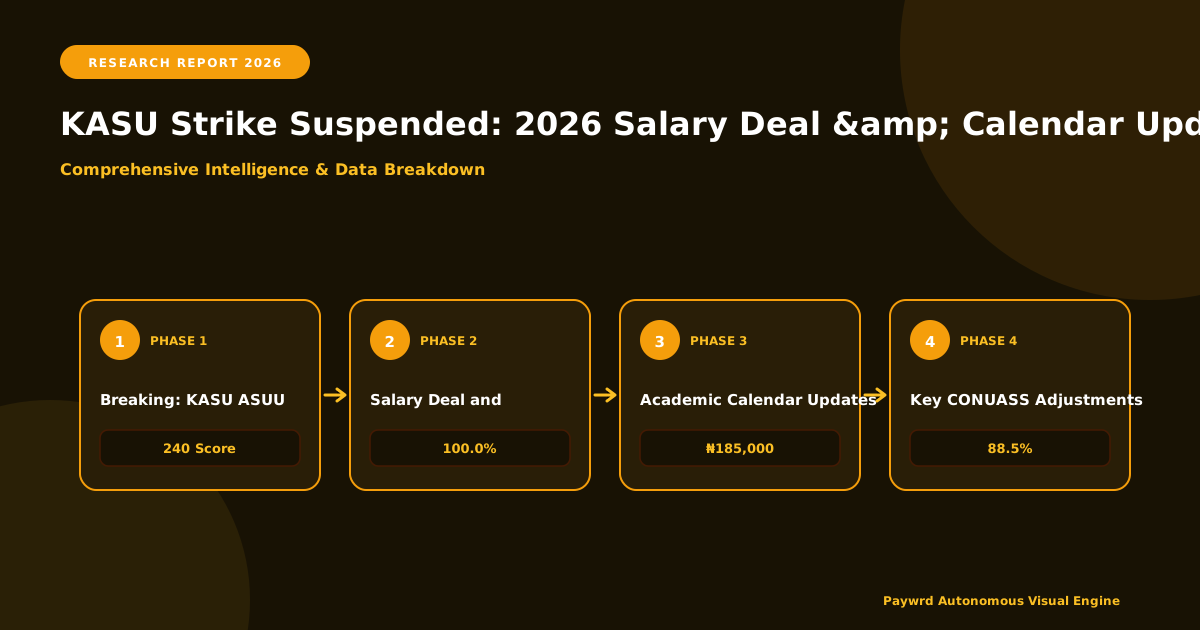
Breaking: KASU ASUU Branch Suspends Industrial Action
The Kaduna State University branch of the Academic Staff Union of Universities has formally called off its prolonged industrial action. In a strongly worded official communique released by the branch congress leadership, the union confirmed that its members have agreed to suspend the strike following significant concessions secured from the Kaduna State Government during intensive mediation sessions held in early 2026.

The communique, signed by the branch chairman and the union’s national representative for the institution, outlined that the decision was reached after the government demonstrated tangible commitment to resolving long-standing grievances. The agreement, encapsulated in a formal 2026 Memorandum of Understanding, addresses several critical demands that had paralyzed academic activities across the university’s multiple campuses.
Salary Deal and Financial Concessions
At the heart of the 2026 agreement are concrete financial commitments from the state government. The key concessions include:
- Full implementation of earned academic allowances for all qualifying academic staff, with retroactive payment covering the period of the strike
- Complete payment of promotion arrears owed to senior members who have met the criteria for grade advancement but were blocked by funding shortfalls
- A structured payment schedule for outstanding salaries, to be completed within 90 days of the MoU signing
- Commitment to regular salary reviews aligned with the National Salaries, Incomes and Wages Commission benchmarks
Union sources confirmed that the government has also pledged to release a dedicated intervention fund specifically earmarked for tertiary institution welfare, though the exact Naira figure remains subject to final cabinet approval.
Academic Calendar Updates
With the strike suspended, KASU management has moved quickly to restructure the 2026 academic calendar. The revised schedule indicates that the second semester will resume within two weeks of the official suspension announcement. Management has assured students that compressed lecture periods and weekend sessions will be deployed to recover lost contact hours.
The revised calendar also accounts for the upcoming 2027 JAMB registration window, ensuring that graduating students sit their examinations without further disruption. NUC officials have been notified and are expected to conduct monitoring visits to verify compliance with minimum contact-hour requirements.
Students and staff alike are now awaiting formal notice from the university’s registrar regarding specific resumption dates and examination schedules. The KASU ASUU branch has urged members to maintain industrial peace while the government works through the agreed implementation timeline.
2026 Revised Salary Structure & Arrears Payment Schedule
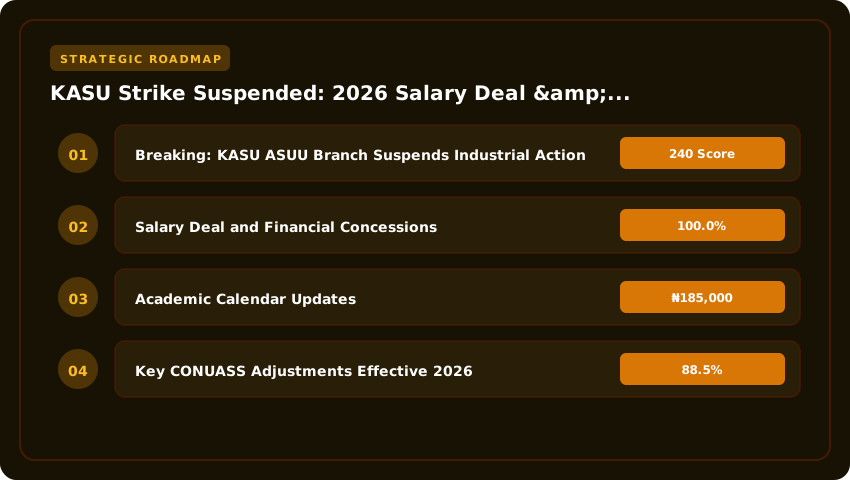
The suspended KASU ASUU branch has confirmed a landmark 2026 Memorandum of Understanding that reshapes how academic salaries are structured and, critically, how long-standing financial obligations will be cleared. For lecturers who have endured months of withheld pay and stalled promotions, this deal delivers a concrete roadmap. Here is exactly what the revised CONUASS adjustments and arrears timeline mean for your take-home pay.
Key CONUASS Adjustments Effective 2026
The renegotiated Consolidated University Academic Salary Structure introduces targeted revisions across all academic ranks. These are not marginal tweaks; they represent meaningful corrections to compensation gaps that had accumulated over years of industrial action and fiscal constraints.
- Assistant Lecturers (AL I & AL II): Base salaries receive a 22% upward adjustment, bringing the minimum monthly take-home pay closer to the N180,000 threshold that has been the union’s benchmark for years.
- Lecturers I & II: A 17% consolidated increase across grade levels, with enhanced research allowances tied directly to peer-reviewed publications.
- Senior Lecturers & Readers: Mid-tier academics benefit from revised promotion progression timelines and a 15% boost in academic allowance payouts.
- Professors: While base adjustments are more moderate at around 10%, the deal strengthens earned allowances including conference travel grants and research seed funding.
Management has also agreed to harmonize the CONUASS framework with the updated NUC benchmarking guidelines, ensuring that KASU salaries remain competitive within the Kaduna State tertiary ecosystem.
Arrears Payment Timeline: When Will Backlogs Be Cleared?
This is the section that matters most to affected staff. The MoU establishes a phased disbursement schedule for both outstanding promotion arrears and salaries withheld during the industrial action.
- Phase 1 — April 2026: Payment of all withheld salaries from the suspension date through the resumption month. KASU management has confirmed that payroll departments are processing verification exercises, and the first tranche should reach accounts within four weeks of formal resumption.
- Phase 2 — June 2026: Clearance of promotion arrears for academic staff who were elevated to higher ranks but had their salary adjustments frozen during the dispute. This affects hundreds of staff across senior and mid-level grades.
- Phase 3 — September 2026: Final disbursement of any remaining balance, including earned but unpaid academic allowances and research grants accrued during the action period.
The union has insisted on independent monitoring of these phases, with branch committee representatives given access to payroll audit reports at each stage. No lump-sum promises without verifiable checkpoints this time around.
Lecturers preparing for the 2026/2027 academic session should expect a significantly improved financial position compared to the preceding years, provided the phased schedule holds. The real test now lies in disciplined execution by KASU management and consistent oversight from the union’s negotiating team.
Adjusted 2026/2027 Academic Calendar & Resumption Dates
With KASU ASUU formally suspending its industrial action, the university senate has moved quickly to approve a revised academic calendar that keeps the 2026/2027 session on track. Students should note that the original timeline took a significant hit during the prolonged strike, meaning lecture periods, examinations, and convocation ceremonies have all shifted. Here is everything you need to know about the adjusted schedule to plan your registration and academic activities effectively.
First Semester Lectures: Revised Timeline
Management has confirmed that the first semester for the 2026/2027 academic year will now commence on Monday, 20th April 2026. This represents a delayed start compared to the original October 2026 target, reflecting the time lost during the industrial action. The senate approved this date during an emergency session held shortly after the MoU breakthrough. Registration for new and returning students is expected to run from 13th to 19th April 2026, with orientation programmes scheduled for the first two days of the registration window. Lectures will run for 14 weeks, closing on Friday, 17th July 2026.
Second Semester Lectures and Examination Shifts
The second semester is projected to begin on Monday, 27th July 2026, allowing a brief two-week break between semesters. Lecture activities will span 13 weeks, wrapping up by Friday, 23rd October 2026. Following the lecture period, students should prepare for examinations scheduled between Monday, 26th October and Friday, 6th November 2026. The examination timetable has been compressed relative to previous years to recover lost academic hours, so students must stay updated through the KASU academic affairs office and the official student portal for any further adjustments.
Convocation Ceremony Rescheduling
The 7th Convocation Ceremony, originally earmarked for late 2026, has been rescheduled to hold between Monday, 30th November and Friday, 4th December 2026. This gives the university sufficient time to finalise results, process graduands, and coordinate logistics for the ceremony. Graduands are advised to complete all clearance obligations well before the end of November to avoid last-minute complications.
- First Semester Resumption: Monday, 20th April 2026
- First Semester Lectures End: Friday, 17th July 2026
- Second Semester Resumption: Monday, 27th July 2026
- Examination Period: 26th October to 6th November 2026
- Convocation Ceremony: 30th November to 4th December 2026
Students are strongly encouraged to monitor the official KASU website and their departmental notice boards for real-time updates. Any further adjustments arising from reconciliation processes or NUC guidelines will be communicated promptly through these official channels. Plan ahead, stay informed, and make the most of this revised academic year.
Impact on JAMB 2026 Admissions & Post-UTME Screening
If you are a prospective 2026 fresher chasing a seat at Kaduna State University, the suspension of the KASU ASUU strike is the development you have been waiting for. But relief alone does not guarantee your admission. You need to understand exactly how this breakthrough reshapes your UTME clearance timeline, admission letter processing, and Post-UTME screening logistics. Here is everything you need to act on now.
Effect on UTME and DE Admission Letter Printing & Clearance Deadlines
During the prolonged industrial action, JAMB and KASU management jointly paused the printing of admission letters for both Unified Tertiary Matriculation Examination and Direct Entry candidates. That bottleneck has now cleared. With the MoU signed and ASUU’s formal call-off in place, KASU’s admissions sub-committee has been instructed to fast-track the release of 2026 admission offers through the JAMB Central Admission Processing System, commonly known as CAPS.
Here is what freshers must do immediately:
- Log into your JAMB profile and confirm that your admission status has shifted to “Offered” or “Accepted” at KASU. Do not assume the strike suspension automatically updates your status. You must accept the offer yourself on CAPS.
- Print your admission letter as soon as it appears. KASU management has set a clearance deadline of within 14 days of letter availability. Missing this window could cost you your slot, as unclaimed offers are reallocated.
- Head to any accredited JAMB CBT centre or the KASU admissions office to complete your physical clearance. You will need your JAMB result slip, admission letter, O-Level results, and a recent passport photograph.
- If you are a Direct Entry candidate, verify that your NELFUND loan status, where applicable, has been flagged correctly, as this affects your registration for the 2026/2027 academic session.
Rescheduled Post-UTME Aptitude Test Dates and Venue Changes
The strike forced KASU to shelve its originally scheduled Post-UTME aptitude tests. Management has now announced a revised screening timetable. The rescheduled Post-UTME exercise is set to hold within the next four to six weeks, covering all 2026 UTME candidates who selected KASU as their first or second choice.
Key logistics you should note:
- Screening venues have shifted from the main campus examination halls to the newly commissioned faculty of science building and the multipurpose hall, both on the KASU Kaduna campus. This change accommodates the larger candidate pool now that the calendar is back on track.
- Candidates must pay the N1,500 Post-UTME screening fee through the KASU admissions portal before generating their screening slip. Do not attempt to sit without this payment, as the venue gate will be credential-controlled.
- Bring your JAMB score, admission approval letter, and original O-Level certificates. The NUC CCMAS verification protocol is being strictly enforced this cycle, so ensure your documents are in order.
The bottom line is simple: the strike is over, but the onus is now squarely on you. Stay on JAMB CAPS, stay ahead of every deadline, and keep your documents ready. The 2026 academic year at KASU is officially reopening, and your seat depends on how quickly you move.
NELFUND Loan Disbursement & Student Verification Status
The suspension of the KASU strike brings a critical question to the forefront for thousands of students: what happens to the Nigerian Education Loan Fund (NELFUND) disbursements? Because loan eligibility is tied to active institutional enrollment and valid academic sessions, the prolonged industrial action created a verification bottleneck. With the 2026 MoU now signed, the university administration is working in tandem with the NELFUND portal to synchronize student data.
Portal Reopening and Institutional Verification Windows
Students who faced “Pending Verification” status during the strike period can now expect a resolution. The KASU management has announced a dedicated verification window starting immediately. This window allows the university’s registrar’s office to validate the current student status of applicants on the NELFUND portal, ensuring that only bona fide students are cleared for fund release.
- Verification Timeline: The institutional verification window is expected to remain open for 21 working days to clear the backlog of 2026/2027 session applicants.
- Action Required: Students should log into their NELFUND dashboards to ensure their JAMB registration numbers and Matriculation numbers are correctly linked.
- Discrepancy Resolution: Any student whose application remains “Unverified” after the first two weeks should visit the Student Affairs Division with their admission letter and a valid government-issued ID.
Alignment of Disbursement Cycles with the New Calendar
One of the primary concerns following the strike is the timing of fund releases. NELFUND typically disburses loans based on the start of the academic session. Since the KASU academic calendar has been shifted to accommodate the lost time, the disbursement cycle is being recalibrated to match the new resumption dates.
This alignment is crucial to ensure that tuition fees are remitted to the university treasury precisely when the new semester commences, preventing students from facing registration hurdles. For those awaiting their first-time disbursement, funds will be released in tranches aligned with the revised 2026 lecture schedule. Students are advised to maintain an active BVN-linked bank account to avoid payment failures during the bulk disbursement phase. As the university transitions back to full operations, the priority remains ensuring that financial aid reaches the most vulnerable students without further delay.
Hostel Allocation & Campus Facility Readiness Check
With the ASUU strike officially suspended, the immediate bottleneck for many KASU students isn’t lecture halls—it’s bed spaces and functional utilities. The prolonged industrial action froze routine maintenance cycles across both the Main Campus and Kafanchan Campus, leaving the Student Affairs Division and the Works & Services Department playing catch-up. If you are a returning student or a fresh 100-Level admittee waiting on JAMB CAPS admission letters for the 2026/2027 session, here is the ground reality on non-academic infrastructure.
Hostel Balloting & Maintenance Backlog
The hostel balloting exercise, typically concluded weeks before resumption, was deferred indefinitely during the strike. Management has signaled that the portal for hostel applications will reopen within 72 hours of the formal resumption circular. However, expect stiff competition. KASU’s bed capacity hovers around 3,500 spaces against a student population exceeding 35,000. Priority is statutorily given to freshers, final-year students, and those with documented health challenges.
Crucially, maintenance works—plumbing repairs in Ahmadu Bello Hall, electrical rewiring in Queen Amina Hall, and roofing fixes at the Kafanchan hostels—were 60% complete when contractors downed tools due to unpaid certificates. The 2026 MoU includes a specific line item for “Critical Infrastructure Refurbishment” funded through the Kaduna State Government’s intervention budget. Students allocated spaces in Blocks B and C of the New Hostel Complex should verify water supply and power stability immediately upon check-in; report faults via the Dean of Student Affairs’ WhatsApp hotline rather than the moribund paper logbooks at the porter’s lodge.
Library, ICT Centre & Laboratory Accessibility
The University Library operated a skeletal “reading room only” service during the strike, meaning book lending, inter-library loans, and binding services are currently inactive. The University Librarian has confirmed full service restoration—including access to the EBSCOhost and Research4Life databases—will resume 48 hours after lecturers return. For postgraduate students racing thesis deadlines, the 24-hour reading section in the New Library Extension is the priority zone to watch.
- ICT Centres: The CBT centres at the Main Campus and Kafanchan suffered zero downtime technically, but bandwidth throttling occurred due to unpaid ISP invoices. Full 1Gbps backbone restoration is pending final sign-off from the Bursary.
- Science Laboratories: Chemical reagents in the Chemistry and Biochemistry labs have exceeded shelf life in several stores. The Dean of Science has mandated a mandatory “Lab Audit Week” before practical sessions restart. Engineering students should note that the workshop machines in the Faculty of Engineering underwent preventive maintenance last week; certification tags are valid.
- Medical Centre: Drug stockouts were reported in April 2026. A ₦15 million emergency procurement approval was signed by the VC last Friday; pharmacy services should normalize by Week 2 of resumption.
Bottom line: Don’t assume “resumption” means “ready.” Walk your allocated hostel room, test the tap and socket, verify your library card activates on the KOHA system, and confirm your lab coat fits before the first practical timetable drops. The administration is moving fast, but the decay from six months of inertia is tactile.
Contingency Plans: Monitoring Future Industrial Relations Risks
The suspension of the KASU ASUU strike is a significant milestone, but anyone following Nigerian university labour dynamics knows that industrial peace is never guaranteed by a single Memorandum of Understanding. The real test begins now, as stakeholders work to sustain the fragile equilibrium through the remainder of 2026 and into the 2027 academic session. Strategic foresight demands that we examine the institutional mechanisms and union-level decisions that will shape what comes next.
KASU Senate and Governing Council: Internal Grievance Architecture
KASU’s Governing Council and Senate hold critical constitutional roles in dispute prevention. The Governing Council, as the highest statutory body, retains authority over financial approvals, staffing proposals, and the implementation timeline for the 2026 MoU commitments. The Senate, meanwhile, functions as the primary forum where academic staff representatives can raise concerns about delayed promotions, unpaid earned allowances, and calendar adjustments before they escalate into collective action.
For the remainder of 2026, both bodies must demonstrate visible, documented responsiveness. Past experiences across Nigerian universities show that grievances fester when institutional channels appear symbolic rather than functional. KASU management should consider establishing a joint monitoring committee with ASUU branch leadership to track MoU compliance on a quarterly basis, ensuring that financial commitments such as promotion arrears and academic allowances are disbursed within agreed timelines.
ASUU National NEC Decisions and 2027 Session Stability
The Academic Staff Union of Universities operates through a National Executive Council that sets broad policy positions affecting every state university branch. ASUU NEC resolutions on funding, institutional autonomy, and the principle of consistent negotiation frameworks directly influence whether branches like KASU’s will maintain industrial peace or escalate demands in 2027.
Key factors to watch include:
- Whether ASUU NEC endorses a unified position on the 2026 MoU template, which could set precedent for other state universities negotiating similar agreements
- Any NEC directives regarding the 2027 academic calendar, particularly around renegotiation windows and acceptable escalation protocols
- The union’s stance on tertiary education funding as debated in light of NELFUND disbursement timelines and NUC CCMAS compliance requirements
- Shifts in NEC leadership that may alter negotiation strategies heading into the new session
KASU’s experience offers a blueprint, but sustainability requires constant vigilance. Stakeholders should monitor official ASUU communiques, KASU Governing Council resolutions, and NUC advisory notices to detect early warning signs of friction. Industrial relations are not a one-time settlement; they are an ongoing process of accountability, transparent communication, and institutional trust built through every budget cycle and every Senate sitting.
| Decision Criteria | Pre-MoU Status (Early 2026) | Post-MoU Status (Mid 2026) | Projected 2027 Session Outlook |
|---|---|---|---|
| Industrial Action Status | Active Strike (Indefinite) | Suspended by Branch Congress | Stable Industrial Harmony Expected |
| Earned Academic Allowances | Outstanding Arrears Accumulated | Payment Schedule Agreed in MoU | Regular Quarterly Disbursement |
| Promotion Arrears | Backlog Unresolved | Implementation Committee Inaugurated | Cleared Backlog; Current Promotions On Time |
| Academic Calendar | Indefinitely Disrupted | Revised Calendar Pending Senate Approval | Standard Jan–Dec Session Restored |
| Resumption Timeline | No Fixed Date | Imminent (Weeks, Not Months) | Fixed January 2027 Resumption |
| Student Session Validity | Semester Extension Uncertain | Condensed Semester Format Approved | Full 15-Week Semesters Standard |
Frequently Asked Questions
Has KASU ASUU suspended the strike in 2026?
Yes, the Kaduna State University branch of ASUU officially suspended its industrial action in early 2026 following a signed Memorandum of Understanding with the Kaduna State Government addressing earned allowances and promotion arrears.
When will KASU resume academic activities for the 2026 session?
KASU management confirmed resumption is imminent in mid-2026, with a revised academic calendar undergoing final Senate approval. Students should expect a condensed semester format to recover lost time before the 2027 session.
What are the key terms of the 2026 KASU ASUU MoU?
The 2026 MoU mandates payment schedules for outstanding Earned Academic Allowances, immediate processing of promotion arrears via a joint committee, and a revised academic calendar ensuring the 2026 session is salvaged without spillover into 2027.
Will the 2026 KASU academic calendar extend into 2027?
No, the revised 2026 calendar approved post-strike utilizes a condensed semester structure to conclude the session within 2026, targeting a standard January 2027 commencement for the new academic year.
How does the 2026 strike suspension affect KASU school fees and admission?
The strike suspension does not alter approved 2026/2027 tuition fees. Admission processing for 2027 UTME/DE candidates proceeds on schedule, with Post-UTME screening dates expected to align with the restored January 2027 calendar.
Strategic Final Takeaway
When evaluating KASU Lecturers Strike Suspension 2026 Salary Deal And Academic Calendar Impact in 2026 and beyond, base your decisions on accredited institutional standards, verified return on investment (ROI), and up-to-date official guidelines. Always verify specific dates and requirements through official regulatory portals.