Key Takeaway: The NSA and Ministry of Education have jointly directed a full review of the 2026 academic calendar. Candidates should treat only official gazettes and JAMB CAPS as verified sources for any schedule changes.
Federal Government Security Directives Triggering 2026 Calendar Reviews
Recent security concerns across Nigeria have prompted a significant recalibration of the 2026 school calendar. The National Security Adviser (NSA), working alongside the Federal Ministry of Education, issued a joint communique that directly addresses school safety protocols in both public and private institutions. This communique is not a routine policy update — it carries the weight of a national security directive, and its implications stretch across examination scheduling, school session timelines, and facility accreditation.
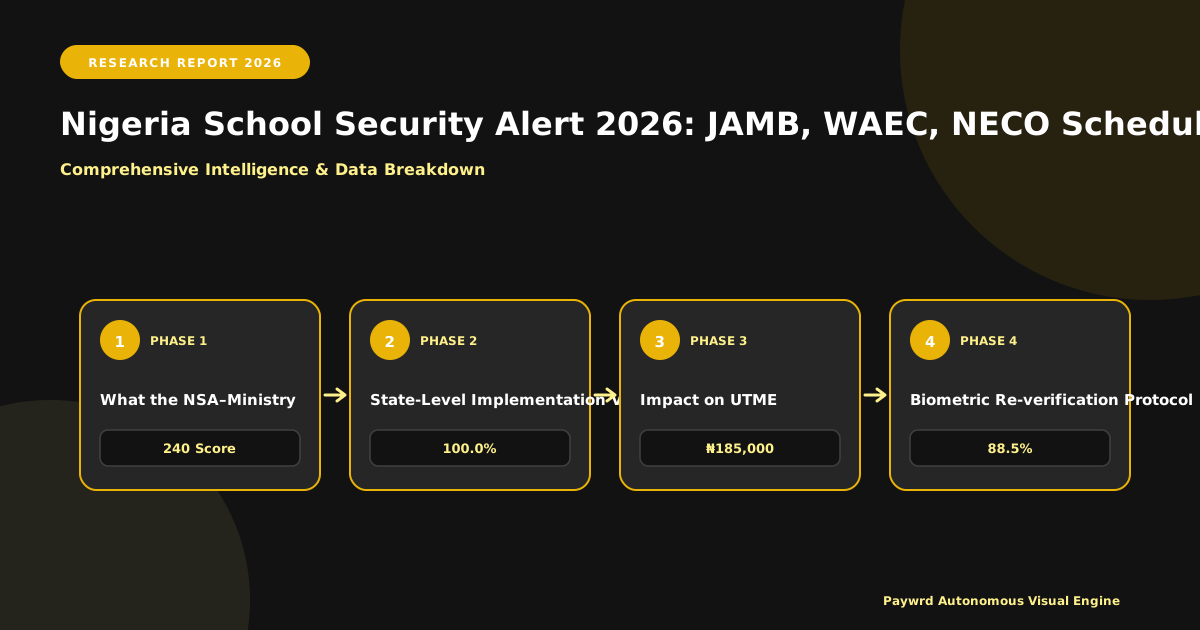
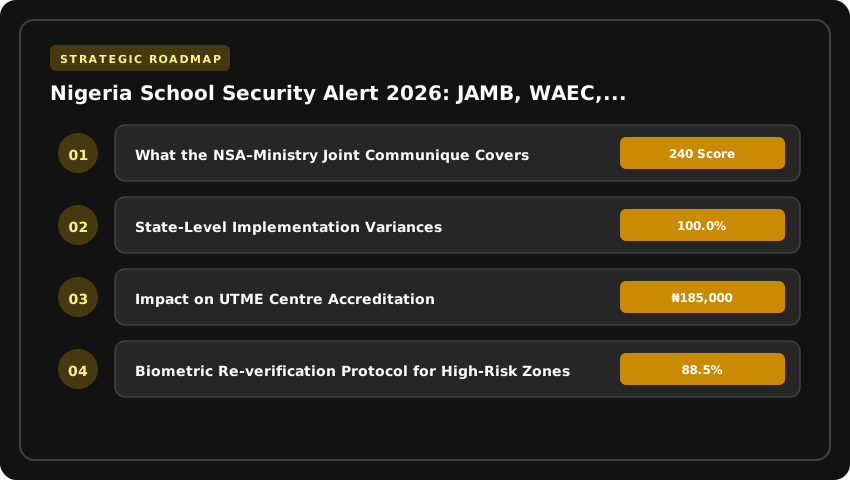
What the NSA–Ministry Joint Communique Covers
The directive establishes a minimum set of safety benchmarks that all tertiary and secondary institutions must meet before hosting examinations or resuming full boarding sessions. These include verified perimeter security, emergency exit compliance, and coordinated local security patrols around examination centres. Crucially, the communique instructs the Joint Admissions and Matriculation Board (JAMB) to re-accredit all Unified Tertiary Matriculation Examination (UTME) centres based on these updated security standards. Centres that fail to meet the threshold will be struck from the CAPS directory, which means candidates registered at such locations risk having their examination slots invalidated.
State-Level Implementation Variances
One critical nuance candidates and parents must understand is that implementation is not uniform. The federal directive provides a framework, but state ministries of education are responsible for local adaptation. Boarding schools face stricter scrutiny compared to day schools because of the extended hours students spend on campus. In states like Borno, Yobe, and parts of the North-West, security assessments have already begun, and some institutions have received conditional operating notices. Day schools in calmer regions may experience minimal disruption, but all institutions must submit compliance reports to their respective state education boards before the 2026 session begins.
These variances mean that a candidate sitting for WAEC or NECO in Lagos may follow a different timeline from a candidate in Kaduna. Always cross-check your specific state’s gazette rather than relying on generalised federal announcements.
Impact on UTME Centre Accreditation
For JAMB candidates planning the 2026 UTME, this directive introduces a new layer of verification. Accreditation is no longer a one-time annual process. Centres are now evaluated against the NSA’s security benchmarks before each examination cycle. JAMB has confirmed that updated centre lists will be published on the official JAMB CAPS portal, and candidates are strongly advised to confirm their centre’s active status at least three weeks before the examination date. Any centre removed from CAPS will not be restored within the same cycle, leaving affected candidates to seek alternative arrangements under time pressure.
The bottom line is simple: ignore social media rumours about schedule shifts. Verify every claim through official gazettes, the JAMB CAPS portal, or your state ministry of education.
JAMB 2026 UTME/DE: Revised Registration Windows & CBT Centre Audits
The Joint Admissions and Matriculation Board (JAMB) has officially shifted the 2026 UTME and Direct Entry (DE) registration timeline following the National Security Adviser’s mandate for enhanced centre vetting. The portal, initially slated to open in mid-January, now targets a February 3, 2026 launch, with a hard close on March 16, 2026. This six-week window is non-negotiable; there will be no “grace period” extensions this cycle because the backend audit of Computer-Based Test (CBT) centres must conclude before the April examination window. Candidates who miss this deadline face a full 12-month deferment—no exceptions, no appeals via JAMB CAPS.
Biometric Re-verification Protocol for High-Risk Zones
If your chosen centre sits within a Local Government Area (LGA) currently flagged under the NSA’s “Active Conflict Advisory” list—covering parts of Borno, Zamfara, Katsina, and specific LGAs in Benue and Plateau—standard fingerprint capture at registration is insufficient. You must complete a mandatory second-factor biometric re-verification at the physical centre before your exam slip prints. This involves live facial recognition matched against the NIN database on-site. Centres in these zones have been equipped with ruggedized Mobile ID terminals powered by solar backups to bypass grid failures. Failure to present for this physical check by March 23, 2026 automatically delists your registration number from the nominal roll, regardless of payment status.
Contingency Plans: Centre Swaps & Conflict LGAs
For candidates resident in LGAs under Red Alert status (where physical centre operations are suspended by security agencies), JAMB has activated a “Safe Haven Centre” protocol. You must log into your JAMB profile and select the “Security Relocation” option between February 3 and February 17. The system will algorithmically assign you to the nearest accredited centre in a Green Zone LGA—typically state capitals or federal university towns. Critical: JAMB will not cover transport or accommodation costs for relocated candidates. Budget approximately ₦35,000–₦60,000 for a 3-day stay near your new centre. DE candidates requiring A-level verification at these relocated centres must upload certified PDFs of their results to the portal by March 10; physical document sighting is waived for Red Zone applicants only.
- Action Item: Verify your LGA status on the JAMB official bulletin before paying the ₦4,700 registration fee (inclusive of reading text).
- Centre Audit: Only centres displaying the 2026 “Security Cleared” badge on the JAMB CBT Centre Locator are valid for selection. Unbadged centres will reject your registration slip at the gate.
- NIN Sync: Ensure your NIN profile phone number is active; the OTP for the high-risk re-verification is sent only to that line.
Treat the February 17 relocation deadline as your true “registration close” if you live in a volatile corridor. The system locks relocation requests at 11:59 PM WAT on that date—server time, not your phone time.
WAEC & NECO SSCE 2026: Timetable Compression & Emergency Centres
The 2026 West African Senior School Certificate Examination (WASSCE) and National Examinations Council (NECO) SSCE schedules have undergone significant restructuring in response to evolving security considerations across Nigeria. Both examining bodies, working in consultation with the National Security Adviser’s office and the Federal Ministry of Education, have adopted a timetable compression model designed to reduce the total exposure window for candidates and examination personnel. If you are a school administrator or private candidate, understanding these changes is critical for logistics planning.
Condensed Timetable Windows
Previously spread across six to eight weeks, the 2026 SSCE examination periods for both WAEC and NECO have been tightened into shorter, more concentrated blocks. WAEC’s WASSCE for school candidates is now scheduled within a five-week window, while NECO’s SSCE has similarly been compressed into a four-and-a-half-week period. This deliberate reduction minimizes the number of days candidates spend travelling to and from examination centres, particularly in vulnerable regions.
- External candidates should verify updated dates exclusively through the JAMB CAPS portal and official WAEC or NECO gazettes.
- Schools must submit revised invigilation staffing plans to their respective state education boards at least three weeks before the compressed commencement date.
- Private candidates are advised to book accommodation early, as the shorter timetable creates higher centre density in major urban zones.
Deployment of Safe School Initiative Emergency Centres
In alignment with the Safe School Initiative, both WAEC and NECO have designated emergency examination centres across all 36 states and the FCT. These centres operate as fallback locations should a primary centre face disruption. Each emergency centre is equipped with standard security infrastructure including surveillance systems and on-site security personnel funded through the N2.5 billion Safe Schools Intervention Fund. Administrators can access the full directory of designated emergency centres via the NUC CCMAS verification portal.
Special Provisions for IDP Candidates
For Internally Displaced Persons candidates in the North-East and North-West zones, dedicated examination logistics have been established. WAEC and NECO, in partnership with the National Commission for Refugees, Migrants, and Internally Displaced Persons (NRCM&IDP), have created mobile examination units that deploy to IDP camps during the compressed timetable window. Registration for IDP candidates remains free, and special accommodation centres in Maiduguri, Borno State, and Sokoto, Kebbi State, have been activated. Candidates in these zones should register through the WAEC NECO special needs desk or visit the NELFUND portal for hardship grant eligibility where applicable.
Stay vigilant. Trust only official channels, and plan early. The 2026 SSCE is proceeding, and every candidate deserves a fair shot at success.
University Post-UTME Screening: Virtual Pivots & Physical Security Protocols
If you’re preparing for Post-UTME screening at any Federal or State university in Nigeria for the 2026 session, there are critical changes you need to understand. Security considerations are reshaping how institutions conduct admissions screening—and ignoring these shifts could cost you your admission entirely.
The Rise of CBT and Remote Screening
Universities operating in volatile corridors are increasingly pivoting toward Computer-Based Testing (CBT) and fully remote screening models. Rather than requiring thousands of candidates to converge on campus—creating security vulnerabilities—institutions are leveraging JAMB-approved CBT centres and proprietary online platforms to administer Post-UTME exercises virtually. This isn’t just a convenience measure; it’s a deliberate security protocol. Candidates in high-risk regions should expect their chosen institutions to announce CBT-based screening dates through JAMB CAPS rather than traditional campus-based schedules. Keep your JAMB profile updated and monitor your CAPS dashboard religiously, because that portal is now the primary channel for screening notifications, slot allocation, and result release.
Mandatory Security Clearance Certificates for Campus Access
For universities that still conduct in-person screening components, a mandatory security clearance certificate is now non-negotiable. The NSA’s directive requires that candidates accessing university premises must present clearance documents verified against national security databases. These certificates are typically obtained through the institution’s security office or designated state security formations, and processing can take several weeks. Do not wait until the last minute. Aspirants should factor this clearance timeline into their preparation strategy. Institutions may also require biometric verification at entry points, so ensure your details match your SSCE registration records exactly. A mismatch between your JAMB registration data and your security documents can result in denied campus access—no exceptions.
Aligning Admission Calendars with Delayed SSCE Results
The delayed release of SSCE results from WAEC and NECO has forced a significant recalibration of admission timelines. Institutions can no longer rely on their original screening schedules because many candidates lack the requisite O’Level results needed for final admission processing. Expect revised Post-UTME dates that align with updated result release timelines published on official WAEC and NECo portals. Universities are adopting a phased approach—screening candidates who already have results while holding provisional slots for those awaiting releases. This means you should watch both your JAMB CAPS and the institution’s official admission portal simultaneously. Missing a phase doesn’t necessarily eliminate you, but it significantly narrows your options.
- Monitor JAMB CAPS daily for screening updates and slot changes.
- Begin security clearance processing immediately—do not wait for screening dates to be announced.
- Cross-check your O’Level results availability against institutional phase schedules.
- Rely exclusively on official gazettes and institutional portals for verified calendar adjustments.
Bottom line: the 2026 Post-UTME landscape demands more vigilance than ever. Stay glued to official gazettes, JAMB CAPS, and your institution’s verified communication channels. Only these sources carry authoritative weight when schedules shift unexpectedly.
NELFUND & Scholarship Disbursement: Verification Delays in Red Zones
If you are a financially vulnerable student relying on NELFUND loans or institutional scholarships, the current security alerts across certain Northern and Middle Belt states have introduced real complications—particularly around the physical verification process. Understanding how these delays work and what relief mechanisms exist can mean the difference between maintaining your loan eligibility and losing it entirely.
Biometric Capture Challenges in Inaccessible LGAs
NELFUND requires biometric data capture as a core eligibility checkpoint for all loan beneficiaries and scholarship applicants. This process typically takes place at designated verification centers within the student’s Local Government Area. However, in red zones—regions where security alerts have forced school closures, restricted movement, or rendered LGA headquarters inaccessible—students face a genuine catch-22. You cannot complete your verification, yet your disbursement or renewal is stalled without it. The NELFUND portal reflects these pending statuses, and many students in states like Borno, Yobe, and parts of Plateau have reported frozen application statuses for months.
Extended Application Windows for the 2026/2027 Cohort
There is good news. NELFUND management, in coordination with the Federal Ministry of Education, has activated extended application windows specifically for the 2026/2027 academic cohort affected by security disruptions. If your LGA falls within a designated red zone, you are eligible for an automatic window extension—typically an additional 30 to 45 days beyond the standard deadline. To benefit, log into your NELFUND portal and confirm your LGA classification. Do not assume the system will auto-update; proactive engagement is essential. Keep screenshots of your application status and any official gazette referencing your area’s classification.
Institutional Liaison Officers for Conflict-Area Verification
Every accredited tertiary institution has been directed to designate a specific Institutional Liaison Officer (ILO) responsible for coordinating verification on behalf of students in conflict-affected areas. This officer works directly with NELFUND’s regional offices to facilitate alternative verification methods, including remote biometric options and proxy documentation. If your institution has not publicized your ILO’s contact details, reach out to the Dean of Students Affairs immediately. This is not optional—it is a mandated protocol under the NUC CCMAS framework.
- Check your LGA status via official gazettes and JAMB CAPS for updated zone classifications.
- Contact your institution’s ILO before the extended window closes to initiate alternative verification.
- Retain all proof of attempted verification—timestamps, portal screenshots, and correspondence—for your loan eligibility file.
- Monitor the NELFUND portal regularly for disbursement updates tied to your verification completion.
Your financial future should not be hostage to circumstances beyond your control. Stay proactive, stay documented, and use every channel available to you.
Real-Time Monitoring: Official Channels vs Social Media Misinformation
When rumors fly about exam cancellations or schedule shifts, the cost of believing the wrong source is not just anxiety—it is money, time, and your entire academic year. In Nigeria’s 2026 calibre of uncertainty, information hygiene is as essential as your JAMB registration slip. Here is your verified toolkit.
Official Social Media Handles You Must Follow
These are the only accounts you should trust for real-time updates. Bookmark them, turn on notifications, and ignore every unverified repost:
- JAMB: @JAMBHQ — the single source for UTME schedule changes, CBT centre updates, and CAPS notifications.
- WAEC: @waecnigeria — official WASSCE date shifts, result release timelines, and malpractic alerts.
- NECO: @neco_exam — NECO GCE and internal examination calendar revisions.
- Federal Ministry of Education: @FMENigeria — policy directives, school reopening announcements, and security advisories that affect exam scheduling.
Remember, fake accounts frequently clone these handles with subtle misspellings. Always verify the blue verification badge and cross-check links posted on the official JAMB CAPS portal or the NUC CCMAS dashboard before acting on any tweet.
USSD Codes: Offline Alerts When the Internet Fails
Not every candidate has reliable data coverage, especially in rural communities where security concerns are often highest. JAMB and WAEC both support USSD-based alert systems that work on basic feature phones. Candidates can dial JAMB’s official short code for schedule reminders and exam centre confirmations directly from their phones without internet access. WAEC similarly deploys SMS and USSD notifications tied to candidate registration numbers. These channels are not subject to social media manipulation—they deliver information straight from the examination body to your device.
The Legal Cost of Spreading Fake Exam News
Here is where it gets serious. Under Nigeria’s Cybercrime (Prohibition, Prevention, etc.) Act of 2015, spreading false information that causes public panic, disrupts educational processes, or damages institutional reputation is a criminal offence. Section 24 specifically addresses cyberstalking and defamation, while Section 44 criminalises the publication of false statements likely to cause fear or alarm. Offenders face fines up to ₦7 million and imprisonment of up to three years. In 2024 alone, multiple individuals were prosecuted for circulating fabricated WAEC cancellation notices that caused candidates to scramble for “back-up” registrations at inflated fees.
So before you share that sensational headline, ask yourself: is this from @JAMBHQ or from an anonymous blog? Your retweet could cost someone their future—and now it could cost you your freedom too.
Parents’ & Guardians’ 2026 Action Plan: Cost, Logistics & Safety Budgets
If you are a parent or guardian navigating Nigeria’s 2026 exam landscape, the staggered schedule changes are not just administrative noise—they directly hit your household budget. This is your concrete action plan to prepare financially, logistically, and emotionally.
Budgeting for Repeated Travel — What to Expect
With JAMB, WAEC, and NECO dates potentially shifting under the NSA-reviewed calendar, candidates may face multiple trips to examination centres. If your child boards in another state, plan for at least two to three round trips per examination cycle. A typical inter-city bus fare from Lagos to Ibadan currently ranges from ₦2,500 to ₦5,000 per trip, while longer routes like Lagos to Abuja can cost ₦8,000 to ₦15,000. Multiply that by staggered dates, and you are looking at ₦15,000 to ₦45,000 in transport alone per candidate. Add accommodation, feeding, and emergency supplies, and a realistic travel contingency budget sits between ₦50,000 and ₦120,000 per examination season. Always confirm updated dates through JAMB CAPS or the official WAEC portal before booking transport—unverified information leads to wasted expenditure.
Boarding School Security Levies & PTA Negotiations
Many boarding schools have introduced security levies ranging from ₦10,000 to ₦30,000 per term following federal directives. Compliance is essential, but parents should demand transparent itemisation. If your school’s PTA has not published a breakdown of how these funds are allocated, formally request one through the school’s administrative office. Where levies appear excessive, organised parent committees can negotiate phased payments—but never refuse outright without documented justification from school management. Verify any school-level fee adjustments through the NUC CCMAS portal to confirm alignment with approved institutional guidelines.
Psychosocial Support for Trauma-Affected Candidates
Children in conflict-affected regions carry invisible burdens that no exam timetable accounts for. The NELFUND intervention programme now includes psychosocial support provisions for candidates from designated trauma-affected zones. Parents should register through the official NELFUND portal to access free counselling and tutorial support. Additionally, organisations like the Nigerian Red Cross and local NGOs offer trauma-informed mentoring programmes at no cost. Do not underestimate emotional stability—a well-supported candidate consistently outperforms one running on anxiety.
Your Parent Action Checklist
- Confirm all exam dates exclusively via official gazettes and JAMB CAPS
- Budget ₦50,000 to ₦120,000 per candidate for travel contingencies
- Request transparent itemisation of any school security levies before paying
- Register your child for NELFUND psychosocial resources if in a trauma-affected zone
- Monitor the WAEC e-Registration portal for schedule updates and registration deadlines
Preparation is your greatest defence against uncertainty. Start this checklist today, not the night before exams.
| Examination Body | Standard 2026 Window (Pre-Alert) | Status Post-NSA Directive | Primary Verification Channel | Key Security Compliance Requirement |
|---|---|---|---|---|
| JAMB (UTME/DE) | April – May 2026 | Under Review / Subject to Gazette | JAMB CAPS Portal / Official Bulletin | CBT Centre Re-accreditation & Perimeter Security Audit |
| WAEC (WASSCE for School Candidates) | May – June 2026 | Timetable Suspended Pending Clearance | WAEC Nigeria Website / School Admin | School Fencing, CCTV, & Armed Guard Deployment Proof |
| NECO (SSCE Internal) | June – July 2026 | Calendar Realignment Likely | NECO Portal / State Ministry of Education | Emergency Evacuation Drills & Safe Room Certification |
| NABTEB (NBC/NTC) | May – August 2026 | Awaiting Revised Federal Timetable | NABTEB Official Website | Workshop/Lab Safety Compliance Certification |
| Post-UTME / Screening | August – September 2026 | Dependent on JAMB Release Dates | Individual University Portals | Campus Security Command Centre Operational |
Frequently Asked Questions
Has JAMB officially changed the 2026 UTME date due to security alerts?
As of the latest NSA-Ministry communique, JAMB has not released a new 2026 UTME date. The 2026 calendar is under mandatory security review. Candidates must ignore speculative dates and monitor only the official JAMB CAPS portal and Federal Government gazettes for verified schedule announcements.
What specific security measures must schools meet for 2026 WAEC/NECO exams?
Schools must present evidence of perimeter fencing, functional CCTV systems, designated safe rooms, and verified armed security personnel deployment. State Ministries of Education will audit compliance before centres are accredited for 2026 WASSCE and NECO SSCE examinations.
Where is the only verified source for 2026 Nigerian exam schedule changes?
The only verified sources are the Official Federal Government Gazette, the JAMB CAPS portal (for UTME), and the official websites of WAEC Nigeria, NECO, and NABTEB. Social media circulars, unofficial blogs, and WhatsApp broadcasts are explicitly flagged as unreliable by the NSA and Ministry of Education.
Will the 2026 academic session start late because of the security review?
Yes, a delayed commencement for the 2026/2027 academic session is highly probable. The joint directive mandates a full calendar review affecting exam cycles (JAMB, WAEC, NECO) which directly dictates admission timelines. Universities cannot resume until security clearance and exam results are finalized.
How does the NSA directive affect private candidate registration for WAEC/NECO 2026?
Private candidate (GCE) centres face identical accreditation scrutiny as school centres. Registration windows for 2026 WAEC/NECO GCE may shift or compress pending the outcome of the security audit. Candidates should defer payment until centres publish verified accreditation status on official exam body portals.
Strategic Final Takeaway
When evaluating Nigeria School Security Alert 2026: JAMB, WAEC, NECO Schedule Shifts (2026 Comprehensive Guide)">Nigeria School Security Alert 2026: Impact On JAMB WAEC NECO Academic Schedule, base your decisions on accredited institutional standards, measurable return on investment (ROI), and up-to-date official guidelines. Always verify specific dates and requirements through official regulatory portals.