How Tennessee Promise Actually Works: Last-Dollar Scholarship Mechanics and Who Qualifies
The Tennessee Promise stands as one of the most ambitious state-funded scholarship programs in the United States, designed to eliminate the financial barrier between high school graduates and their first two years of higher education. Unlike traditional merit-based or fixed-amount scholarships, Tennessee Promise operates on a last-dollar funding model, which means the program only steps in to cover costs after every other source of gift aid has been applied to a student’s tuition bill. This structure is intentional: it allows the state to stretch its education dollars further while ensuring that federal Pell Grants, the Tennessee HOPE Scholarship, and any institutional awards are fully utilized before state dollars are spent.
To understand the mechanics, picture a typical tuition invoice at a Tennessee community college. The published average tuition for in-state students hovers around $5,000 per year at institutions like Nashville State Community College, Pellissippi State Community College, and Roane State Community College. When a financially eligible student enrolls, the federal Pell Grant—currently capped near $7,395 annually for the highest-need households—often covers the entire tuition balance on its own. Tennessee Promise contributes $0 in that scenario. However, for a middle-income student whose Expected Family Contribution disqualifies them from a meaningful Pell award but who still lacks the cash to pay tuition upfront, Tennessee Promise quietly picks up the remaining gap, which can range from a few hundred dollars to the full sticker price depending on the institution and the student’s other aid package.
Eligibility for this last-dollar safety net hinges on a strict set of criteria that students must satisfy before stepping foot on campus:
- Tennessee Residency: Applicants must be Tennessee residents for at least one year prior to the application deadline, verified through state income tax filings or other documentation approved by the Tennessee Student Assistance Corporation (TSAC).
- High School Graduation: Candidates must graduate from an eligible Tennessee high school, complete a homeschool program, or earn a GED. A valid diploma or transcript is required.
- FAFSA Submission: The Free Application for Federal Student Aid must be filed by the state priority deadline. Because Tennessee Promise is a last-dollar scholarship, the FAFSA is not optional—it is the mechanism that determines what other aid exists and what gap remains.
- Mandatory Community Service: Every recipient must complete and document 8 hours of community service prior to the first day of college classes.
- Mentor Engagement: Students are paired with a volunteer mentor and must attend at least two mentor meetings before the program begins, focusing on goal-setting and college navigation.
- Full-Time Enrollment: Recipients must register for and maintain a minimum of 12 credit hours per semester. Falling below this threshold can result in the loss of the scholarship.
- Continuous Application: The Tennessee Promise application window typically opens in the fall of the senior year and closes mid-November, with students reapplying each academic year to maintain eligibility.
The FAFSA dependency is worth emphasizing. Because Tennessee Promise is explicitly designed to function as a supplemental payer, students who skip the FAFSA automatically forfeit the scholarship, regardless of financial need. This dependency also makes the program sensitive to federal policy shifts; if the Pell Grant maximum were to decrease or if FAFSA simplification efforts alter Expected Family Contribution calculations, the dollar amount that Tennessee Promise must cover could rise, placing greater pressure on the state’s education budget.
For prospective STEM students evaluating zero-tuition pathways, the practical takeaway is straightforward: file the FAFSA as early as possible, maintain full-time status, honor the community service and mentor requirements, and recognize that Tennessee Promise is not a check written directly to you. Instead, it is a backend guarantee that your tuition balance at a participating community college will be reduced to zero once all other gift aid has been exhausted—a powerful safety net that makes the first half of a STEM bachelor’s degree genuinely tuition-free for qualifying Tennessee residents.
STEM Associate Degrees Eligible Under Tennessee Promise at Community Colleges
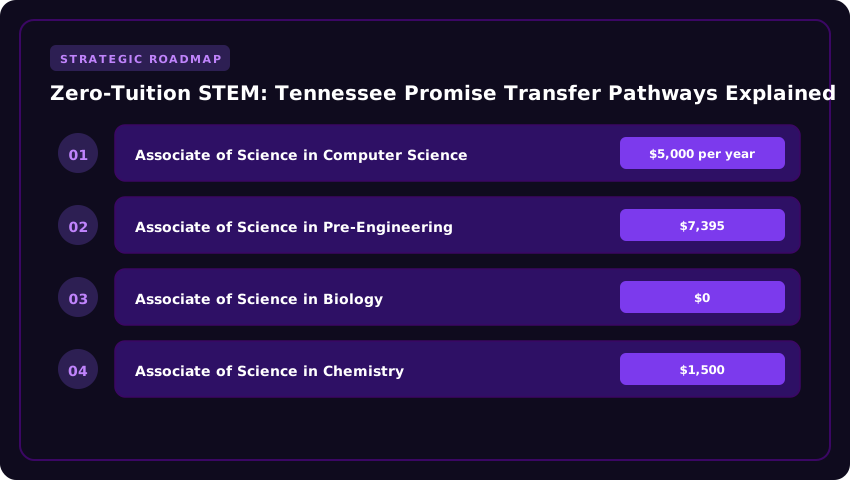
For students pursuing a debt-free education in science, technology, engineering, and mathematics, the Tennessee Promise scholarship provides a powerful gateway through the state’s community and technical college system. By covering tuition and mandatory fees not already paid by the Pell Grant, the HOPE Scholarship, or the Tennessee Student Assistance Award, Tennessee Promise effectively zeroes out the cost of an associate degree for qualifying residents. The program’s true strength, however, lies in the quality and transferability of its STEM pathways. Through articulation agreements with public universities participating in the Tennessee Transfer Pathway (TTP) initiative, students can begin specialized STEM coursework at the associate level and transition seamlessly into a baccalaureate program without losing credits or momentum.
Most STEM-eligible associate degrees require between 60 and 64 credit hours, structured across general education foundations, major-specific core courses, and elective concentrations. A typical course of study includes 41 general education credits following the General Education Core framework, with the remaining hours dedicated to the major. Below is a detailed catalog of the most sought-after STEM associate programs available across Tennessee’s community colleges.
Associate of Science in Computer Science
- Credit Load: 60-63 credit hours
- Key Coursework: Calculus I and II, Discrete Mathematics, Java or Python Programming, Data Structures, Computer Organization, and Calculus-based Physics I and II.
- Transfer Alignment: Aligns with the Computer Science TTP, guaranteeing junior standing at institutions such as the University of Memphis, Middle Tennessee State University, and Tennessee Technological University.
- Career Outlook: Computer science remains among the fastest-growing occupational fields nationally, with the U.S. Bureau of Labor Statistics projecting much faster-than-average job growth through 2033.
Associate of Science in Pre-Engineering
- Credit Load: 60-64 credit hours
- Key Coursework: Multivariable Calculus, Differential Equations, Linear Algebra, Engineering Statics, Engineering Dynamics, Thermodynamics, and Physics with Calculus I and II.
- Transfer Alignment: Designed to feed directly into ABET-accredited bachelor’s programs at the University of Tennessee, Knoxville and the University of Tennessee at Chattanooga.
- Concentrations Available: Mechanical, Electrical, Civil, and Chemical Engineering tracks, depending on the host institution.
Associate of Science in Biology
- Credit Load: 60-64 credit hours
- Key Coursework: General Biology I and II, General Chemistry I and II, Organic Chemistry I and II, Microbiology, Genetics, and Calculus or Statistics.
- Transfer Alignment: Aligns with the Biology TTP and prepares students for majors in biology, biochemistry, pre-medicine, pre-pharmacy, and environmental science at four-year institutions such as Austin Peay State University and the University of Tennessee, Martin.
Associate of Science in Chemistry
- Credit Load: 60-64 credit hours
- Key Coursework: General Chemistry I and II, Organic Chemistry I and II, Analytical Chemistry, Calculus I and II, and Physics for Scientists and Engineers.
- Transfer Alignment: Maps to the Chemistry TTP, which is accepted at every public four-year university in Tennessee, allowing graduates to enter upper-division coursework immediately.
Associate of Science in Mathematics
- Credit Load: 60-63 credit hours
- Key Coursework: Calculus I, II, and III, Differential Equations, Linear Algebra, Probability and Statistics, and Mathematical Reasoning or Proof Writing.
- Transfer Alignment: Satisfies the Mathematics TTP, supporting transfers into pure mathematics, applied mathematics, statistics, actuarial science, and data science programs statewide.
Associate of Applied Science in Information Technology
- Credit Load: 60-66 credit hours
- Key Coursework: Networking Fundamentals, Linux Administration, Cybersecurity Principles, Database Management, Systems Analysis and Design, and Cloud Computing Essentials.
- Industry Certifications Embedded: Many programs include vouchers for CompTIA A+, Network+, Security+, and Cisco Certified Network Associate (CCNA) exams, accelerating workforce entry.
Tennessee Community Colleges Leading in STEM
- Nashville State Community College: Offers a robust Computer Science and Information Technology track with direct articulation to Tennessee State University and Middle Tennessee State University.
- Pellissippi State Community College: Recognized for its Engineering Sciences concentration, featuring state-of-the-art laboratories and dual-enrollment pathways with the University of Tennessee, Knoxville.
- Chattanooga State Community College: Home to a nationally recognized Engineering Technology and Mathematics department, with strong transfer pipelines to the University of Tennessee at Chattanooga.
- Volunteer State Community College: Provides flexible STEM scheduling with emphases in Biology, Chemistry, and pre-Health professions, supporting transfers to Austin Peay and Tennessee Tech.
Across all tennessee community colleges, courses within these STEM pathways carry the Common Course Numbering prefix, ensuring that a course completed at one institution transfers as the equivalent course at any other public institution in the state. This eliminates credit loss and provides students with a predictable academic roadmap. For maximum transfer efficiency, students are strongly encouraged to complete the full Tennessee Transfer Pathway AS degree rather than a general Associate of Science or Associate of Arts, as the structured TTP curriculum guarantees junior-level admission to participating universities in Tennessee.
Actionable takeaway: before enrolling, confirm that your chosen program carries the official Tennessee Transfer Pathway designation and verify with an academic advisor that the receiving university accepts the full 60-credit block. This single step protects both your time and your financial aid eligibility under the Tennessee Promise.
Tennessee Transfer Pathways (TTP): The Guaranteed Bridge to Four-Year Universities
For thousands of Tennessee students who begin their higher education journey at a community or technical college, the Tennessee Transfer Pathways (TTP) program represents one of the most powerful transfer guarantees in the United States. Created through a partnership between the Tennessee Board of Regents (TBR) and the University of Tennessee (UT) system, TTP is built on a simple but transformative promise: if a student completes a designated TTP associate degree at a participating community college, they are guaranteed junior-level admission to a participating four-year public university, with all credits applied toward the corresponding bachelor’s degree. This is not a “may be admitted” or “credits accepted at the discretion of the university” arrangement; it is a binding, statewide articulation agreement that removes the most common obstacles community college transfer students face—lost credits, repeating coursework, and uncertain admission.
To understand why TTP matters, it helps to contrast a TTP-aligned transfer with a non-TTP enrollment. A student who enrolls in a community college program that is not part of the TTP framework may still transfer to a four-year university, but the guarantee evaporates. The receiving university evaluates each course individually, and credits that do not match its general education core or major requirements may be accepted only as electives, requiring the student to retake similar coursework at the four-year institution. This adds semesters, inflates the total cost of the degree, and delays graduation. A TTP student, by contrast, follows a pre-mapped curriculum of 60 credit hours that has been collectively designed by community college and university faculty in the same discipline. Every course in the pathway has a verified equivalent at the four-year counterpart, so the student arrives on campus with full junior standing, ready to dive directly into upper-division major coursework.
The university participation list is broad and strategically distributed across Tennessee. The University of Tennessee, Knoxville; the University of Tennessee at Chattanooga; and the University of Tennessee at Martin anchor the UT system participation. On the TBR side, flagship institutions include Middle Tennessee State University (MTSU), Tennessee Tech University in Cookeville, East Tennessee State University (ETSU), Austin Peay State University, Tennessee State University, and the University of Memphis (through its TBR-era articulation, with seamless transfer to its Loewenberg College of Nursing and Herff College of Engineering for eligible TTP graduates). Regional universities such as Cleveland State Community College’s feeder network into Lee University also operate under TTP-aligned articulation, although private institutions are not formal signatories.
For STEM students specifically, TTP has matured into one of the strongest transfer pipelines in the Southeast. The TTP-AST (Associate of Science in Teaching) STEM tracks span disciplines including Agriculture, Biology, Chemistry, Computer Science, Engineering (with concentrations in Electrical, Mechanical, Civil, and Computer Engineering), Information Systems, Mathematics, Physics, and Pre-Health Professions. A TTP-Engineering graduate from Motlow State Community College, for example, who completes the prescribed 60-hour pathway—including Calculus I–III, Differential Equations, General Chemistry, Physics with Calculus, and Engineering Statics—transfers directly into the B.S. in Mechanical Engineering program at Tennessee Tech or UT Knoxville with no lower-division course left to repeat. Likewise, a TTP-Computer Science completer from Chattanooga State Community College can articulate seamlessly into MTSU’s B.S. in Computer Science or ETSU’s equivalent, with all programming, discrete math, and data structures coursework honored in full.
For prospective transfer students, the practical actionable takeaways are clear. First, before enrolling at a community college, confirm that the intended program of study is officially designated as a TTP pathway on the Tennessee Transfer Pathways website, where each participating institution and major is listed with its four-year counterpart. Second, follow the TTP curriculum sheet exactly, including all required general education, math, and lower-division major courses; even one substitution can void the junior-standing guarantee. Third, maintain a minimum cumulative GPA of 2.0 or higher (some competitive STEM majors recommend a 2.5+ for smooth transfer into capped programs). Finally, leverage the Tennessee Transfer Pathway coordinator at your community college early and often—these advisors are specifically trained to audit your degree plan against the receiving university’s requirements, ensuring that the leap from a $0 Tennessee Promise-funded associate degree to a four-year STEM bachelor’s remains a true guaranteed bridge rather than a hopeful leap.
Strategic Course Selection: Ensuring Every Credit Transfers to Your Target STEM Program
Choosing the right courses at a Tennessee community college is the single most important decision a future transfer student will make, yet it is also the area where the most expensive mistakes occur. A student who selects an elective based on a friend’s recommendation, a convenient time slot, or an attractive course description without verifying transferability can lose an entire semester of progress, pushing back graduation by a year and adding thousands of dollars in additional living expenses. The good news is that Tennessee has built a remarkably transparent transfer infrastructure, and students who use it deliberately can protect every credit they earn.
The cornerstone tool is the Tennessee Course Equivalency system, often accessed through the TN Transfer Pathway portal maintained by the Tennessee Higher Education Commission. This database allows students to enter a specific community college course and instantly see how it maps to equivalent coursework at every public university in the state. Before registering for any class, a student should look up the course number, confirm it carries a guaranteed equivalency at their target four-year institution, and save a screenshot of that confirmation. If a course does not appear in the equivalency tables, that is a red flag worth investigating before enrollment, not after grades are posted.
Beyond the statewide system, every Tennessee community college maintains formal advising agreements, sometimes called articulation agreements or transfer pathways, with regional universities. These agreements are negotiated by academic departments and identify the exact block of courses a student must complete to enter a major as a junior. For competitive STEM fields like mechanical engineering, electrical engineering, and computer science, these agreements often dictate not only which courses to take but in which semester they must be taken. Students should request the current articulation agreement for their intended major directly from the community college advising office and treat it as a binding roadmap.
One of the most common pitfalls involves the difference between an Associate of Science (AS) degree and an Associate of Applied Science (AAS) degree. The AS degree is designed for seamless transfer to a four-year university, containing general education courses and introductory STEM coursework that mirrors the first two years of a bachelor’s program. The AAS degree, by contrast, is built for immediate workforce entry and includes highly technical, career-focused courses that often have no equivalent at a university. While a few Tennessee universities have begun accepting blocks of AAS credit in select applied fields, the vast majority of credit earned in an AAS program will not transfer toward a Bachelor of Science in Engineering or Computer Science. A student who begins an AAS program believing they will later switch to a transfer pathway often discovers, too late, that two years of coursework will not count toward their bachelor’s degree.
For students targeting competitive majors, prerequisite sequencing is equally critical. Engineering programs, for example, require a strict chain of mathematics courses: Calculus I must precede Calculus II, which must precede Differential Equations. If a student fails or withdraws from Calculus I in the fall, the entire two-year sequence collapses, and the student may not be able to catch up before the transfer application deadline. Computer science programs follow a similar structure, with courses like Data Structures and Algorithms requiring earlier coursework in discrete mathematics and introductory programming. The most successful transfer students meet with their STEM advisor before every registration period, confirm they are on track, and adjust their plan immediately if any grade falls below the expected threshold.
- Verify every course in TN Transfer Pathway before registering, and save documentation of each confirmed equivalency.
- Request the formal articulation agreement for your specific major from the community college advising office and follow it precisely.
- Choose the AS degree, not the AAS degree, unless you are certain you intend to enter the workforce immediately after community college.
- Map out prerequisite chains in mathematics and major-specific courses before your first semester to avoid delays.
- Schedule a transfer advising appointment at your target university during your freshman year to confirm you are meeting their expectations.
Students who treat course selection as a strategic planning exercise, rather than a routine administrative task, consistently arrive at their four-year institution with full junior standing, a competitive GPA, and a clear path to graduation. The Tennessee transfer system is among the most student-friendly in the United States, but it rewards only those who engage with it intentionally and early.
Beyond Tuition: The Real Cost Breakdown of a Two-Plus-Two STEM Degree in Tennessee
When families first hear about Tennessee Promise, the assumption is often that the scholarship covers everything. In reality, the program is a last-dollar tuition scholarship, which means it pays remaining tuition and mandatory fees at the community college level after Pell Grants and other gift aid are applied. It does not cover books, course-specific fees, housing, meals, transportation, or personal expenses. Understanding this gap is the difference between planning a realistic budget and discovering hidden costs mid-semester that force a student to drop out.
For most Tennessee Promise scholars pursuing a STEM pathway, the first two years are remarkably affordable. Community college fees, lab surcharges, textbooks, a laptop, and local transportation typically run between $1,500 and $3,500 per year out of pocket, depending on the program. A general Associate of Science in Pre-Engineering might sit closer to the $1,800 end once a student buys used textbooks and uses a campus shuttle, while a hands-on Associate of Applied Science in Mechanical Engineering Technology with machining labs and specialized tool kits can push toward $3,200 annually. Housing is rarely required because students live at home and commute, which is often a hidden savings of $10,000 or more per year compared to residential peers.
The financial picture shifts dramatically in years three and four at a four-year institution. Because Tennessee Promise does not transfer to the university level, students must rely on a combination of the Tennessee Education Lottery Scholarship (HOPE), institutional merit aid, Pell Grants, and parent or student loans. Annual costs vary widely across public institutions. A regional university like Austin Peay State University or Tennessee Tech might cost an in-state commuter $11,000 to $15,000 per year in tuition, fees, books, and modest living expenses, while research-intensive flagships like the University of Tennessee Knoxville or the University of Memphis can climb to $22,000 to $28,000 per year once housing, dining plans, engineering lab fees, and parking permits are factored in. Out-of-state students should expect an additional $15,000 to $25,000 on top of these figures.
Comparing the total cost of a two-plus-two STEM pathway against a traditional four-year residential experience reveals meaningful savings. A Tennessee Promise student who commutes for two years and then transfers to a mid-tier public university typically spends $45,000 to $65,000 total over four years. A peer who enrolls directly at a four-year university and lives on campus often faces a $80,000 to $120,000 total price tag before scholarships. Even when factoring in transfer scholarship gaps, the two-plus-two route frequently saves families between $20,000 and $50,000, which can be redirected toward graduate school, a first home, or student loan payoff.
- Year 1-2 Budget Items (Community College): Activity fees ($300-$600), course-specific lab fees ($200-$800), textbooks and access codes ($600-$1,200), laptop or calculator ($200-$500), transportation and gas ($1,000-$2,000).
- Year 3-4 Budget Items (University): Differentiated tuition for engineering majors (often an extra $1,500-$3,000 per year), senior design project materials ($300-$700), professional engineering student fees ($150-$400), housing and dining ($10,000-$14,000 if residential), and travel to internships or co-ops ($500-$2,000).
- Pell Grant Stacking Strategy: File the FAFSA by the January 15 priority deadline every year, even if the Expected Family Contribution is high, because some universities use FAFSA data for their own institutional aid. A dependent student from a family earning under $60,000 often qualifies for the maximum Federal Pell Grant of $7,395 for the 2024-2025 award year, which stacks on top of Tennessee Promise at the community college and on top of HOPE at the university level.
Strategic FAFSA filing is where many families leave money on the table. Use the Federal Student Aid Estimator before completing the official form to project awards, and remember that financial circumstances can change. If a parent loses employment, experiences a medical hardship, or has another qualifying event, the student can submit a Professional Judgment Appeal to the university’s financial aid office to request a re-evaluation. Many Tennessee students qualify for additional state aid through the Tennessee Student Assistance Corporation, and ABET-accredited engineering programs often layer their own department-specific scholarships worth $1,000 to $5,000 per year on top of federal and state grants.
The bottom line is straightforward: a two-plus-two STEM degree in Tennessee is one of the most affordable routes to a Bachelor of Science in the United States, but it is not free. Budget honestly for $15,000 to $35,000 in non-tuition costs over four years, file the FAFSA early and annually, and actively pursue stacking opportunities like Pell, HOPE, and institutional scholarships. Students who plan this way often graduate with under $10,000 in total debt, while their peers at residential four-year schools carry an average loan burden closer to $30,000.
Outcomes and ROI: STEM Transfer Success Rates and Career Earnings in Tennessee
The true measure of any educational pathway lies in the return on investment (ROI), and the data emerging from the Tennessee Promise pipeline tells a compelling story for STEM aspirants. According to the Tennessee Higher Education Commission (THEC), students who utilize the Promise scholarship to complete an associate degree at a community college before transferring to a four-year institution graduate with significantly lower debt loads than their peers who start directly at a university. On average, Promise transfer students in STEM fields carry roughly $10,000 to $14,000 less in federal student loan debt at bachelor’s completion compared to non-transfer students, largely because the “last-dollar” scholarship covers the first two years of tuition and mandatory fees entirely.
Completion metrics are equally encouraging. While national community college transfer-out rates hover around 30%, Tennessee Promise participants demonstrate a transfer-out rate exceeding 40% within three years, with STEM majors showing particular persistence due to the structured Tennessee Transfer Pathways (TTPs). These pathways guarantee that specific associate-level courses—calculus sequences, general chemistry, and programming fundamentals—satisfy lower-division requirements at public universities like the University of Tennessee (UT) system and Tennessee Board of Regents (TBR) institutions, eliminating the “credit leakage” that often derails STEM transfers elsewhere.
When these graduates enter the workforce, the earnings trajectory validates the strategy. Median early-career salaries for Tennessee STEM bachelor’s recipients reflect the state’s booming tech economy:
- Computer Science: $65,000 – $72,000
- Engineering (Mechanical, Civil, Electrical): $62,000 – $70,000
- Biology / Life Sciences: $42,000 – $48,000
These figures are powered by three distinct tech corridors. Nashville has evolved into a healthcare technology and data analytics hub, with employers like HCA Healthcare and Change Healthcare actively recruiting from Nashville State and Volunteer State Community College pipelines. Chattanooga leverages its municipal gigabit fiber network—the “Gig City” infrastructure—to attract logistics tech, cybersecurity firms, and advanced manufacturing, creating deep co-op partnerships with Chattanooga State. Meanwhile, Oak Ridge remains a federal research powerhouse; the Oak Ridge National Laboratory (ORNL) and Y-12 National Security Complex run formal consortium agreements with Roane State and Pellissippi State, offering paid internships that frequently convert into full-time roles requiring security clearances.
Employer partnerships are not merely ceremonial. Programs like the TCAT/Community College Mechatronics Consortium and the Northeast State Advanced Manufacturing Partnership embed industry certifications (Siemens, FANUC, AWS) directly into the associate curriculum. This means a Tennessee Promise graduate often transfers to a university not just with credits, but with verified technical competencies that command higher starting salaries and immediate productivity. For the pragmatic student, the math is clear: two years of zero tuition, guaranteed credit transfer, and direct access to high-wage regional employers creates an ROI profile that few traditional four-year entry routes can match.
Strategic Final Takeaway
Success in evaluating Zero-Tuition STEM: Tennessee Promise Transfer Pathways Explained relies on early preparation, adherence to verified accredited requirements, and cross-referencing official portals. Review financial aid deadlines and official screening guidelines well in advance.