Official Release Dates and Breaking Down the WAEC 2026 Result Statistics
The West African Examinations Council (WAEC) officially released the 2026 May/June West African Senior School Certificate Examination (WASSCE) results on Monday, August 11, 2026, ending months of anxious waiting for over two million Nigerian candidates and their families. For students in Lagos grinding through Post-UTME preparation, for those in Kano finalising NELFUND loan applications, and for school administrators across the South-East, the release date marks more than a calendar entry — it represents the gateway to JAMB UTME registration, polytechnic admission portals, and the critical decision of whether to accept an offer through the Joint Admissions and Matriculation Board (JAMB) Central Admissions Processing System (CAPS).
According to the official statement issued by WAEC’s Head of National Office, Mr. Patrick Areghan, a total of 1,952,456 candidates sat for the 2026 WASSCE across Nigeria, representing a 4.3% increase from the 1,871,205 candidates who registered in 2025. This figure includes both school candidates and private candidates, with female candidates accounting for 52.1% of the total population — a continuing reflection of the gradual gender balance shift observed since the Federal Ministry of Education’s Education for All campaign intensified in 2023.
The headline statistic that captures attention every year is the overall credit pass rate. For 2026, WAEC reported that 78.42% of candidates obtained credit-level passes (C6 and above) in a minimum of five subjects, including the mandatory Mathematics and English Language. This is a marginal improvement of 1.87 percentage points over the 2025 figure of 76.55%. However, when narrowed to candidates who scored credits in both Mathematics and English Language — the two subjects most Nigerian universities, including the University of Lagos (UNILAG), University of Ibadan, and Obafemi Awolowo University (OAU), insist upon for admission screening — the figure drops to 61.28%, meaning roughly 4 in 10 candidates still fall short of the basic eligibility threshold for competitive degree programmes.
For context on how this affects your admission journey: under the current NUC Core Curriculum and Minimum Academic Standards (CCMAS) framework, every undergraduate programme in Nigerian universities requires at least five credits, and the majority of cut-off marks published by institutions sit between 200 and 280 in UTME. A WAEC result with a credit pass in English and Mathematics is the foundational layer beneath that UTME score. Without it, no amount of Post-UTME brilliance can save your application.
The state-by-state comparative analysis reveals familiar patterns, though with some interesting 2026 shifts:
- Lagos State: Maintained its position as the highest-performing state with a credit-in-five-subjects rate of 89.74%, up from 87.91% in 2025. Lagos candidates also recorded the highest proportion of A1–B3 grades (distinctions and strong credits), at 31.6%. This performance is attributed to the sustained investment in education infrastructure under the state’s EKO Excel programme and the proliferation of well-equipped private secondary schools across Ikeja, Surulere, and Eti-Osa.
- Anambra State: Continued its strong South-East showing with 87.22% of candidates earning five credits including English and Mathematics, ranking third nationally. Anambra’s investment in digital learning tools and teacher training through the Solution Approach to Education initiative appears to be paying measurable dividends. Notably, Anambra produced the highest female performance index for the third consecutive year.
- Kano State: Posted an encouraging improvement, climbing from 54.18% in 2025 to 58.93% in 2026 — a 4.75-point jump that reflects gains from the Kano State Government’s school feeding programme and expanded girl-child education incentives. While still below the national average, the trajectory suggests that targeted intervention can shift outcomes even in regions with historically lower performance benchmarks.
- Rivers State: Recorded 82.45%, maintaining a consistent top-ten position and benefiting from strong private-sector involvement in Port Harcourt and Obio-Akpor local government areas.
- Adamawa, Yobe, and Bayelsa rounded out the bottom three, though all three showed year-on-year improvements of between 2 and 5 percentage points.
Across the broader subject landscape, English Language recorded a credit pass rate of 82.4%, while Mathematics — perpetually the most-feared subject — improved to 68.7%, up from 65.2% in 2025. Civic Education and Data Processing recorded the highest pass rates at 94.1% and 91.8% respectively, while Further Mathematics and English Literature remained among the most challenging, with pass rates of 41.2% and 53.6%.
For candidates evaluating their next move, the practical implication of these statistics is clear: securing at least a C6 in Mathematics and English is non-negotiable, and aspiring students should pair WAEC preparation with early UTME registration — typically opening in January — to avoid the ₦4,700 late registration penalty JAMB charges after the standard window closes. Additionally, candidates should verify their results promptly via the WAEC result checker portal at waecdirect.org using the smartcard number from their purchased scratch card (currently ₦1,500–₦2,000 from authorised vendors), and immediately begin aligning their subject combinations with their intended JAMB course and the admission requirements posted on their target institution’s portal.
Finally, candidates should note that WAEC has flagged 0.47% of 2026 results as being under investigation for examination malpractice, primarily involving Bluetooth-assisted cheating and impersonation. Until such results are cleared, candidates affected cannot use them for JAMB, NELFUND loan applications, or Post-UTME screening. If your result is withheld, contact your school’s examination officer immediately and follow the official clearance process — do not pay any third-party agents promising to “clean” your result, as this is a scam that has cost many Nigerian families between ₦50,000 and ₦300,000 with no actual result delivery.
Step-by-Step Process to Check Your 2026 WASSCE Result on the WAEC Portal

Congratulations on reaching the home stretch of your WASSCE journey! After weeks (or months) of anticipation, checking your 2026 result on the official WAEC result portal is the final confirmation of all your hard work. However, this is often where students across Nigeria and West Africa get stuck. From buying the wrong scratch card to battling poor network connectivity in rural areas, the verification process can be frustrating if you do not know what to expect. This guide walks you through every detail, from the exact PIN requirements to resolving common error messages, so you can access your result smoothly and confidently.
Before you begin, gather these essentials: your 9-digit WASSCE Examination Number, your 2026 Examination Year, the type of examination (May/June), and the Serial Number alongside the Personal Identification Number (PIN) printed on your WAEC scratch card. You will also need a reliable internet-enabled device such as a smartphone, tablet, or laptop, and a working browser like Google Chrome, Safari, or Firefox.
Exact Serial Number and PIN Requirements
WAEC scratch cards come with two critical codes printed under a silver coating. The Serial Number (typically 10 to 12 digits) identifies the card itself, while the PIN (usually 4 to 8 digits) is the unique key that unlocks exactly five result checks. When entering these codes on the portal, type them exactly as they appear. Avoid adding spaces, dashes, or extra characters, and never copy and paste directly from a screenshot, as hidden spaces often trigger an Invalid Card error.
Note that there are two categories of scratch cards available:
- Standard Result Checker Scratch Card: Priced at approximately ₦1,900 to ₦2,000 in 2026, this card allows you to check five (5) results. It is ideal for candidates, parents, and immediate family members who need to verify grades for personal use, admissions, or NELFUND loan applications.
- Third-Party Verification Scratch Card: Priced slightly higher, usually between ₦2,500 and ₦3,000, this card is designed for schools, employers, and immigration processing agencies that need to confirm the authenticity of a result. It accesses WAEC’s centralized verification database rather than the candidate’s personal result page.
How to Check Your Result on the WAEC Portal
Follow these detailed steps for a seamless verification experience:
- Step 1: Visit the official WAEC result checker portal at www.waecdirect.org. Always type the URL directly into your browser. Avoid clicking links shared on WhatsApp or social media, as phishing sites mimic the WAEC portal to steal PINs.
- Step 2: Select your examination type. Choose “WASSCE for School Candidates” or “WASSCE for Private Candidates,” depending on which category you registered under for the 2026 May/June diet.
- Step 3: Enter the 9-digit Examination Number printed on your candidate acknowledgement slip. Double-check every digit, as a single misplaced number will return a “No Result Found” error.
- Step 4: Select 2026 as the examination year, then choose “May/June” as the examination period.
- Step 5: Carefully input the Serial Number and PIN from your scratch card into the designated fields.
- Step 6: Click “Submit” and wait patiently for the system to load. Most results appear within 10 to 30 seconds.
- Step 7: Once your result displays, take a screenshot and save it. Do not rely solely on memory. Universities, Polytechnics, and NELFUND loan officers will request this printout during Post-UTME screening.
Resolving ‘Invalid Card’ or ‘Scratch Card Expired’ Errors
The “Invalid Card” error is the most common complaint from Nigerian students. If this happens, do not panic. Start by re-entering the Serial Number and PIN manually rather than using autofill. Make sure the silver coating was completely scratched off, as residual foil can hide digits. If the problem persists, confirm that you are using the correct card type. A third-party verification card will not work on the standard result checker portal, and vice versa.
The “Scratch Card Expired” message usually appears when candidates use leftover cards from 2025 or earlier WASSCE diets. WAEC scratch cards have a validity window, and using an outdated card will trigger this error. If you purchased a new 2026 card and still see this message, contact WAEC support immediately via support@waecnigeria.org or call their customer service line. You will need your purchase receipt and card details for a replacement.
Troubleshooting Steps for Poor Network Connectivity
Network failure is a major obstacle for students in rural areas of states like Kebbi, Zamfara, Bayelsa, and Cross River, where 3G and 4G signals are unstable. To work around this, try these proven troubleshooting tips:
- Switch from mobile data to MTN, Airtel, or Glo at different times of the day, as network congestion usually peaks between 6 PM and 10 PM.
- Use the early morning hours (5 AM to 8 AM) when server traffic is lowest and broadband is faster.
- Visit a reliable cybercafé in your local government area, which often has stronger connections and backup generators.
- Clear your browser cache and cookies before retrying, as corrupted data can block the portal from loading.
- Try an alternative browser like Opera Mini, which compresses data and works efficiently on low-bandwidth networks.
Once you successfully access your 2026 WASSCE result, the next strategic move is to align your scores with your preferred course and institution. Cross-reference your grades with the NUC CCMAS admission benchmark and aim for competitive cutoffs in your chosen school. Whether you are targeting a university, polytechnic, or college of education, a verified WAEC result is the foundation of every admission journey in Nigeria and West Africa.
Decoding Your WASSCE Grading System: What A1, B2, B3, and C6 Truly Mean for Your Future
Understanding your West African Senior School Certificate Examination (WASSCE) result begins with decoding the grading scale that West African Examinations Council (WAEC) uses to convert your raw marks into letter grades. Every subject you offer is scored on a 1-to-9 scale, where A1 represents the highest distinction (75%–100%) and F9 represents a failure (0%–39%). The intermediate grades function as follows: B2 covers 70%–74%, B3 spans 65%–69%, C4 captures 60%–64%, C5 falls between 55%–59%, and C6—the grade that determines much of your university admission fate—sits at 50%–54%. Grades D7 and E8 indicate credit passes in lower brackets, though most Nigerian tertiary institutions treat anything below C6 as a non-credit for screening purposes. Knowing exactly where your performance falls on this continuum empowers you to identify which faculties and programmes remain accessible based on your current standing.
For JAMB UTME admission screening, the grading scale transforms into something far more strategic: the aggregate score. Universities typically calculate this by dividing your JAMB score by 8 (effectively weighting it at 50%) and adding your WASSCE core subject scores in their raw percentage form (weighted at 50%). A candidate with a JAMB score of 280 and four core subjects averaging 75% would compute as follows: (280 ÷ 8) + 75 = 35 + 75 = 110 aggregate points. Most Nigerian universities set departmental cutoffs between 50 and 75 aggregate points for competitive programmes, meaning every percentage point in your O’Level result directly influences whether you cross the threshold.
- Core Subjects vs. Elective Credits: JAMB and Nigerian universities distinguish between core subjects—English Language, Mathematics, Civic Education (where applicable), and one relevant Science or Arts subject—and your elective subjects. Your core grades carry heavier screening weight because they reflect foundational competencies. Elective credits in subjects like Further Mathematics, Data Processing, or Technical Drawing can supplement your application for specialised programmes, but they cannot compensate for a failing grade in English or Mathematics.
- The C6 Mathematics Trap: Scoring exactly C6 in Mathematics (50%–54%) passes WAEC’s minimum benchmark, yet it severely restricts your options. Most engineering faculties at the University of Lagos, Obafemi Awolowo University, or the Federal University of Technology Akure require at least a B3 in Mathematics for direct entry screening. Similarly, Medicine and Surgery programmes across Nigerian universities typically demand a minimum of B2 in Mathematics alongside distinctions in Biology, Chemistry, and Physics. A C6 in Mathematics effectively disqualifies you from these competitive courses regardless of how strong your JAMB score may be.
- Faculty-Specific Cutoff Realities: While courses like Accounting, Business Administration, and Mass Communication often accept C6 in Mathematics, programmes such as Computer Science, Architecture, Quantity Surveying, and Economics (at top-tier universities) maintain stricter thresholds. Understanding these distinctions before result release allows you to plan strategically—either by upgrading weak subjects through GCE or by focusing your JAMB second choice on compatible programmes.
Actionable Takeaway: Before celebrating or panicking over your 2026 WASSCE results, cross-reference each grade against your target institution’s Post-UTME screening brochure (now updated under the NUC CCMAS curriculum framework). If Mathematics stands at C6 and your ambitions lie in Engineering or Medicine, immediately explore GCE re-sit options or consider related fields like Statistics, Actuarial Science, or Information Technology where your grade profile remains competitive. Remember that NELFUND student loan eligibility also depends on maintaining strong academic standing—so securing admission in a programme where you can genuinely excel protects both your educational investment and your long-term career trajectory.
Beyond the Joy: What To Do If Your 2026 Result Is Withheld or Missing
Checking your WAEC 2026 result should be a moment of pure celebration, but for thousands of candidates across Nigeria, the portal instead displays the dreaded “Withheld” status or a specific malpractice code like Code 07. Take a deep breath. A withheld result is not a final conviction, nor does it mean your academic journey has hit a dead end. It simply means the West African Examinations Council is investigating an anomaly, a center-wide irregularity, or an alleged examination malpractice. Here is exactly how you can protect your academic future and keep your university dreams alive.
First, it is vital to understand what these codes mean. Code 07 typically indicates that your script was flagged for irregularities. If your result is withheld, do not panic, and more importantly, do not fall victim to scammers promising to “upgrade” or clear your results for a few thousand Naira (₦). The only legitimate path to resolving this issue is through official WAEC channels and due process.
To appeal a withheld result, you must take proactive, documented steps. WAEC allows candidates to lodge complaints and provide evidence of their innocence. You will need to visit a designated WAEC zonal or branch office in person. For candidates in the South-West, the WAEC Zonal Office in Abeokuta is a primary hub for these appeals, while those in the South-East can route their complaints through the WAEC Zonal Office in Enugu. Be prepared to pay the official complaint fee—usually around ₦5,000 to ₦10,000—to initiate a thorough investigation of your script.
- Gather Your Documents: Go to the zonal office with your WAEC examination photo card, a printout of the withheld result, your JAMB UTME registration slip, and a formal written petition explaining your situation.
- Follow Up Regularly: WAEC investigation timelines can take anywhere from four to eight weeks. Keep your official reference number safe and check back consistently for updates.
- Avoid Unofficial Shortcuts: Never pay anyone outside the WAEC premises claiming they can clear your Code 07 status overnight. It is a scam.
But what happens to your admission process while you wait for the outcome? This is where strategic timing is crucial. Under the new NUC CCMAS (Core Curriculum and Minimum Academic Standards) guidelines, universities are stricter about admission prerequisites. However, you can still proceed with your Post-UTME applications. Most Nigerian universities allow you to register and sit for the Post-UTME screening using your JAMB UTME score and a pending WAEC result. You will simply indicate on the Post-UTME portal that your O-Level results are pending.
Keep in mind that you cannot be officially admitted, matriculate, or access the NELFUND student loan without a verified O-Level result. Therefore, resolving the withheld WAEC result before your institution’s final admission list is compiled is non-negotiable. Stay persistent, follow up with the zonal offices in Abeokuta or Enugu, and keep your Post-UTME dreams alive while the system works in your favor.
Securing Your Spot: Linking WAEC Results to JAMB UTME and Post-UTME Admissions
Congratulations on receiving your WAEC 2026 results — but the journey from a slip of paper to a university admission letter is not automatic. In Nigeria, the Joint Admissions and Matriculation Board (JAMB) operates the Central Admission Processing System (CAPS), a digital platform where your O’Level grades must be uploaded before any institution can consider you for admission, whether for UTME or Direct Entry (DE) candidates. Without this critical step, your five credits in English Language, Mathematics, and three relevant subjects sit idle in WAEC’s database, useless to JAMB. Let me walk you through exactly how to secure your spot.
First, understand the weighting philosophy. Most Nigerian universities do not look at your JAMB score alone. They combine your UTME score (typically 50%), your Post-UTME or screening score (typically 40%), and your O’Level grades (typically 10%). For competitive courses like Medicine, Law, or Engineering in federal universities such as the University of Lagos (UNILAG), University of Ibadan (UI), or Obafemi Awolowo University (OAU), you need a weighted aggregate of 70% and above to stand a chance. State universities like Lagos State University (LASU) or Imo State University often set cut-offs around 55–65%, while private universities such as Igbinedion University or Afe Babalola University accept lower aggregates (sometimes 50%) but charge tuition ranging from ₦800,000 to over ₦3,000,000 per session.
Here is your actionable roadmap to link WAEC results to JAMB CAPS:
- Step 1 — Confirm Your JAMB Profile: Log in to portal.jamb.gov.ng using your registration email and password. Verify that your registered email and phone number are still active, because JAMB only sends admission notifications through SMS and email. If you need to reset, visit any JAMB state office with a valid ID.
- Step 2 — Buy the WAEC Upload PIN: Navigate to the JAMB e-Facility and click on “Upload O’Level Results.” You will be prompted to pay a fee of ₦2,000 (excluding charges) using a Remita-enabled debit card or the JAMB CBT-approved payment channels. For Direct Entry candidates, ensure you also have your A’Level results ready for upload.
- Step 3 — Generate WAEC Serial Number and PIN: Scratch the back of your WAEC result card to reveal your Exam Number, Serial Number, and PIN. If you lost your card or it has faded, purchase a fresh “WAEC Result Checker” from any authorised vendor or use the free WAEC online portal to reprint your results at waecdirect.org.
- Step 4 — Upload Carefully: Enter the details exactly as they appear on your slip — any typo will trigger an “Invalid Result” error and force you to pay another ₦2,000 to re-upload. Double-check spelling of names, date of birth, and subject combinations. A common error is mixing up “Further Mathematics” with “Mathematics” in the wrong slots.
- Step 5 — Wait for Verification: JAMB forwards your details to WAEC for authentication, which typically takes 24 to 72 hours. Once verified, you will see a green “Verified” stamp beside your O’Level section in CAPS.
Now, let us talk about cut-off marks for the 2026 cycle. JAMB itself sets a general minimum of 150 for universities and 180 for competitive programmes like Nursing, Law, and Public Health. However, each institution releases its own Post-UTME cut-off, usually published between July and September 2026. Federal universities typically demand 200+ for science courses and 220+ for professional courses. State universities sit around 180–200, while private universities may admit candidates with 150 and above. Remember, these are minimum thresholds — scoring exactly 180 in JAMB for Medicine does not guarantee anything; your aggregate calculation matters more.
Here is how to calculate your weighted aggregate in three minutes:
- Convert your JAMB score out of 400 to a percentage: divide by 4. If you scored 280, that is 70%.
- Convert your Post-UTME score out of 100 (or whatever your school uses) to a percentage. A score of 70 becomes 70%.
- Assign your O’Level grades a numerical value: A1=6, B2=5, B3=4, C4=3, C5=2, C6=1. Sum your five core subjects (English, Maths, and three relevant) and divide by 30, then multiply by 100. Five B2s would be 25/30 × 100 = 83%.
- Apply the institution’s formula: (JAMB% × 0.5) + (Post-UTME% × 0.4) + (O’Level% × 0.1) = Weighted Aggregate. So a candidate with 280 JAMB, 70 Post-UTME, and 5 B2s would score: (70 × 0.5) + (70 × 0.4) + (83 × 0.1) = 35 + 28 + 8.3 = 71.3%, which is competitive for most federal universities.
Finally, a pro tip about NELFUND student loans: the Federal Government launched the Nigerian Education Loan Fund to cushion tuition for indigent students. If your chosen institution’s fees are above ₦200,000, and you earn below ₦500,000 annually, apply at nelfund.gov.ng once your admission is confirmed on JAMB CAPS. You must first accept admission on CAPS before NELFUND disburses funds directly to your school’s bursary account. And never ignore the deadline for accepting admission: usually 14 to 21 days after the offer, otherwise JAMB moves to the next candidate on the merit list. Stay vigilant, check your CAPS weekly, and secure your spot today.
Safeguarding Your Investment: NELFUND Loans and Next Steps After Confirming Your Scores
Congratulations on checking your WAEC 2026 results! Now that the numbers are live, the real journey begins: converting those grades into a tangible future. For many Nigerian and West African students, the dream of higher education often collides with the harsh reality of funding. Tuition in private universities now ranges from ₦1.2 million to over ₦8 million annually, while even federal institutions charge between ₦100,000 and ₦200,000 in acceptance fees, plus additional charges for accommodation and levies. This is where the Nigerian Education Loan Fund (NELFUND) transforms from a government promise into a lifeline.
NELFUND is specifically designed for Nigerian citizens who have gained admission into accredited tertiary institutions — including universities, polytechnics, colleges of education, and vocational schools registered under the NUC (National Universities Commission) CCMAS framework or equivalent regulatory bodies. To qualify, you must have secured admission through JAMB UTME or Direct Entry, and your chosen institution must be accredited. Importantly, the loan covers tuition, charges, and a living stipend, meaning you do not need to rely solely on family savings or community fundraising to begin your 2026/2027 academic session.
Applying for the loan is a straightforward but detail-oriented process. Once you receive your JAMB admission letter on the JAMB CAPS portal, you can begin the application at the official NELFUND portal. You will need to provide your JAMB registration number, admission details, your WAEC verification number, NIN, BVN, and bank account information. The system cross-references your data with JAMB and your institution to confirm genuine admission. Pro tip: apply within the first two weeks of receiving your admission letter because disbursement is processed in batches, and early applicants typically receive funds before resumption.
Understanding the repayment structure is essential for financial peace of mind. NELFUND loans offer a two-year grace period after graduation (or after completing your National Youth Service), during which no repayment is required. Once employment begins, you repay 10% of your monthly gross salary through a direct deduction at source. For self-employed graduates, repayment is structured at 10% of your monthly profit. If you secure high-paying roles — perhaps in engineering, medicine, or tech — your repayment window shortens. If you earn modestly, the tenure extends, but the loan is designed to never become a debt trap. There is no interest accumulation on the principal during study or the grace period, and the 9% interest only applies after employment begins.
Beyond funding, your next strategic move is academic planning. If you have not yet chosen a course, prioritize programs aligned with CCMAS-approved curricula that match your WAEC strengths. For example, students with strong scores in English, Mathematics, Economics, and Commerce are excellent candidates for Accounting, Business Administration, or Economics — all of which remain highly employable in Nigeria’s growing fintech and banking sectors. Once admitted, download your institution’s academic calendar, purchase recommended textbooks early (cheaper at the university bookshop before resumption), and join online study groups for your department to get a head start.
Finally, safeguard your results and admission documents. Print multiple certified copies of your WAEC result, JAMB admission letter, and NELFUND approval. Upload them to a secure cloud drive like Google Drive or email them to yourself. Lost documents cause unnecessary delays during registration and NYSC mobilization. By securing your loan early and planning intentionally, you protect both your academic investment and your family’s financial future.
- Verify Eligibility: Confirm your institution is NUC, NBTE, or NCCE accredited before applying for NELFUND.
- Apply Immediately: Use your JAMB admission letter to start the NELFUND application within two weeks.
- Understand Repayment: Budget for the 10% salary deduction and use the two-year grace period wisely.
- Align with CCMAS: Choose a course that matches your WAEC strengths and labor market demand.
- Secure Documents: Keep digital and physical copies of your WAEC, JAMB, and loan approval safely stored.
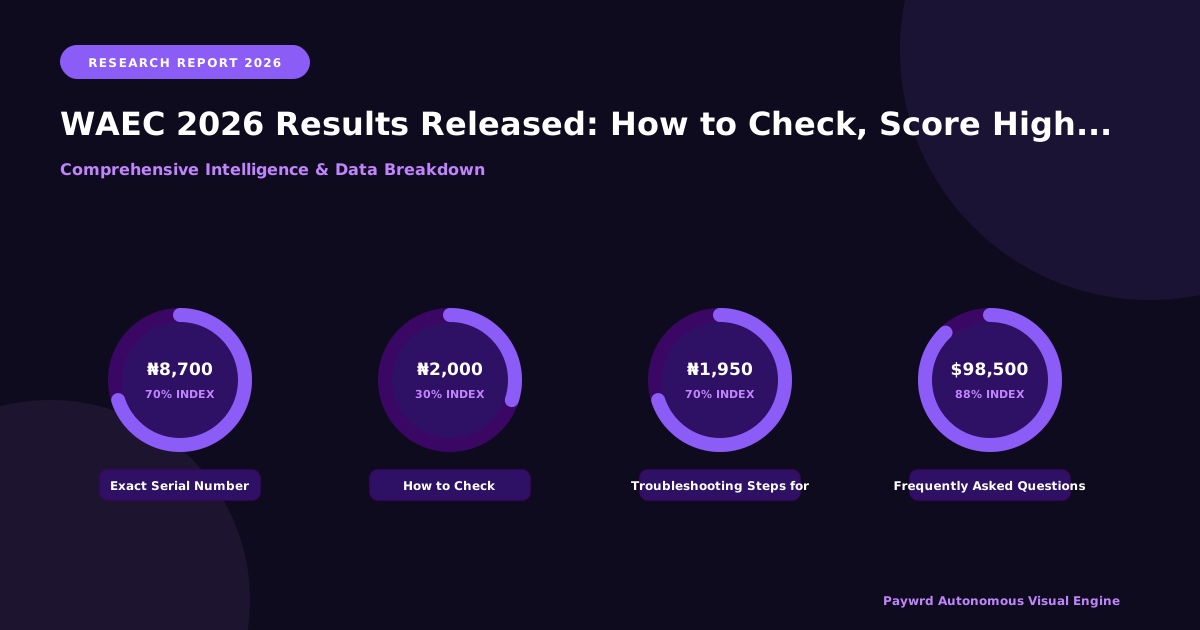
| Metric | WAEC WASSCE 2026 | JAMB UTME 2026 | Post-UTME (Top Universities) |
|---|---|---|---|
| Registration Cost (₦) | ₦27,000 | ₦8,700 | ₦2,000 – ₦5,000 |
| Result Checking Fee | ₦1,950 (scratch card/pin) | Free (portal) | Free (portal) |
| Minimum Admission Cut-off | Credit pass in 5 subjects (incl. English & Maths) | 140 (general) / 200 (competitive) | 50% aggregate (university-specific) |
| Result Release Timeline | ~45 days after final exam (Aug 11, 2026) | ~7–14 days after exam | ~2–4 weeks after screening |
| Validity Period | Lifetime | 1 year | 1 admission cycle |
| Career ROI (Avg Starting Salary) | ₦60,000 – ₦120,000/month (entry-level with O-level) | ₦80,000 – ₦150,000/month (with degree admission) | ₦150,000 – ₦350,000/month (graduates of top-tier universities) |
| Pass Rate (2026 Statistics) | ~72% with 5 credits incl. English & Maths | ~65% scored 200+ | ~30% conversion rate to admission |
| Next Steps After Result | Apply for remarking (₦5,000) or proceed to admission | Accept/Reject offer on JAMB CAPS | Accept admission & pay acceptance fee (₦25,000 – ₦50,000) |
Frequently Asked Questions
How do I check my WAEC 2026 WASSCE result online?
Visit the WAEC result portal at waecdirect.org, enter your 10-digit examination number, select your exam year (2026) and type (May/June), input the scratch card PIN and serial number, then submit. Results display immediately showing subject grades. The scratch card costs ₦1,950 and is available at accredited WAEC vendors nationwide.
What is the minimum WAEC score required for university admission in Nigeria?
Nigerian universities require a minimum of five credit passes including English Language and Mathematics in not more than two sittings. Competitive courses like Medicine, Law, and Engineering demand credits in relevant subjects (Biology, Chemistry, Physics, Literature) with grades of B3 or higher to strengthen admission chances.
When was the WAEC 2026 May/June result officially released?
The West African Examinations Council officially released the 2026 May/June WASSCE results on Monday, August 11, 2026. Over two million Nigerian candidates sat for the examination. Results are accessible via the WAEC direct portal using scratch cards, and candidates can apply for remarking within 60 days of release.
Can I use my WAEC 2026 result for admission without JAMB?
No. WAEC WASSCE results alone cannot secure direct university admission in Nigeria. Candidates must also sit for JAMB UTME, meet the minimum cut-off mark (140 general, 200 for competitive courses), and pass their chosen institution's Post-UTME screening. WAEC provides the O-level requirement; JAMB and Post-UTME complete the admission process.
Strategic Final Takeaway
Success in evaluating WAEC 2026 Results Released: How to Check, Score High & Secure Admission relies on early preparation, adherence to verified accredited requirements, and cross-referencing official portals. Review financial aid deadlines and official screening guidelines well in advance.