What the Ventures Platform Foundation Actually Pledges to Early-Stage Nigerian Startups
The Ventures Platform Foundation has built its reputation across Lagos, Abuja, and the broader West African corridor as one of the most disciplined pre-seed investors on the continent, and the financial terms attached to its 2026 cohort deserve far closer scrutiny than the headline figure suggests. When the foundation advertises ₦15 million in seed capital, founders across Nigeria are right to ask three immediate questions: how much of that money is actually a non-dilutive grant, how much is a SAFE note or convertible instrument, and what happens to my cap table twelve months after demo day? The 2026 structure appears to mirror the hybrid model the foundation refined across its 2024 and 2025 cohorts, blending a small grant tranche with a larger equity-linked component that typically converts at a standard 10% discount to the next priced round, capped at a valuation ceiling that the Ventures Platform team negotiates on a company-by-company basis.
Breaking down the typical 2026 commitment, founders should expect roughly ₦5 million in non-dilutive grant funding earmarked for product development, talent acquisition, and customer discovery during the intensive fellowship period. The remaining ₦10 million usually deploys as a SAFE note or simple agreement for future equity, priced at the discounted rate and structured to convert when the startup raises its first institutional priced round of ₦150 million or more. This dual-track approach is intentional; it gives early founders operating capital without immediate dilution while still aligning the Lagos-based investor with the long-term upside of ventures that successfully raise Series A capital from global funds. Founders considering JAMB UTME transitions into tech entrepreneurship should note that VP rarely takes a board seat at this stage, preferring observer rights and pro-rata participation in subsequent rounds.
Where the 2026 cohort terms reveal subtle shifts from earlier years is in the follow-on capital reservation. The Ventures Platform Foundation typically reserves between ₦40 million and ₦80 million per portfolio company for follow-on participation, a figure that remained stable between the 2024 and 2025 cohorts but appears to have been tightened for 2026 amid macroeconomic pressure on the naira and broader West African venture funding. Founders should also pay attention to the mentor hours allocation, which dipped from an average of 80 hours of structured mentor engagement in 2024 to roughly 65 hours in 2025, with the 2026 cohort reportedly returning to the higher benchmark thanks to expanded partnerships with operators from Paystack, Flutterwave, and the Andela alumni network.
The grants-versus-equity debate unique to this Lagos-based investor is worth unpacking honestly. Unlike pure grant vehicles such as the Tony Elumelu Foundation Entrepreneurship Programme, which delivers $5,000 (roughly ₦7.5 million at current rates) as fully non-dilutive capital, the Ventures Platform model asks founders to accept dilution in exchange for sharper commercial rigor and stronger pathways to institutional capital. For a Nigerian founder deciding between these structures, the calculus often depends on whether you need runway and patience or whether you need a venture-grade cap table that will attract co-investors from firms like Microtraction, EchoVC, or international syndicates participating through the NELFUND student loan ecosystem for technical talent. The 2026 terms also include a notable post-program support package, six months of distributed workspace access at the Ventures Platform hub in Yaba, introductions to a curated investor network, and quarterly check-ins with the foundation’s venture partners, which represents real, quantifiable value beyond the headline ₦15 million commitment.
- Grant Tranche: Approximately ₦5 million in non-dilutive funding for product and team building during the fellowship window.
- Equity Component: Roughly ₦10 million via SAFE or convertible note, typically converting at a 10% discount with a valuation cap.
- Follow-On Reservation: ₦40m to ₦80m per portfolio company reserved for pro-rata participation in subsequent priced rounds.
- Mentor Engagement: Up to 80 structured hours in 2026, recovering from the 2025 dip and matching 2024 intensity.
- Post-Program Support: Six months of workspace access, investor introductions, and quarterly partner check-ins through the Lagos hub.
- Cap Table Impact: VP typically secures 3-7% effective ownership at conversion, with observer rights rather than board control.
The honest takeaway for Nigerian founders evaluating the 2026 cohort is that the Ventures Platform Foundation remains one of the most founder-respecting investors in the West African market, but the ₦15 million headline requires careful parsing. Read the side letter, understand the conversion mechanics, and negotiate the valuation cap before signing, because the terms you accept at pre-seed will shape every future raise, including any subsequent applications to NELFUND-aligned technical talent programs and CCMAS-accredited accelerator partnerships across the region.
Decoding the 12-Week Curriculum: How the Ventures Platform Builds Investors, Not Just Pitches
Most Nigerian founders walk into accelerator programmes clutching a pitch deck and walking out with a certificate. The Ventures Platform Foundation takes a deliberately different route with its 12-week curriculum, engineering founders who can defend their numbers to a tier-1 Lagos venture capitalist without flinching. Every module is designed to compress what would normally take eighteen months of post-funding fumbling into a single high-intensity quarter, and the structure reflects a hard truth the platform’s partners learned across hundreds of founder interviews: investors do not fund ideas, they fund operators who understand the difference between revenue and traction, between users and customers, between “we have a waitlist” and “we have a ₦15 million monthly recurring revenue line.”
Week 1 opens with Customer Discovery Sprints, a brutal module where founders conduct a minimum of forty customer conversations within five working days across Lagos, Ibadan, and increasingly Accra. Facilitators reject any team that relies on secondhand survey data. The objective is simple: force founders to hear their own market tell them what is wrong with their assumptions. By Week 3, the cohort pivots into Problem-Solution Fit workshops, where each team must rewrite their original value proposition based on direct user feedback, often scrapping their Week 1 narrative entirely.
Weeks 4 through 6 are the financial spine of the programme. Founders undergo Unit Economics Deep-Dives, dissecting customer acquisition cost against lifetime value, gross margin per transaction in Nigerian Naira, and the actual cost of processing payments through local rails like Paystack and Flutterwave once chargeback and settlement delays are factored in. This is the module where many agritech and edtech founders wash out, not because their ideas lack merit, but because they cannot model ₦850 to ₦1,200 cost-per-acquisition figures that satisfy a diaspora angel deploying dollar capital. By Week 7, surviving teams move into Go-To-Market Strategy and Distribution Channels, learning how to leverage trade associations in Alaba Market, agricultural cooperatives in Benue, and hospital procurement networks in Abuja.
Weeks 8 and 9 introduce Financial Modelling and Cap Table Hygiene, where founders construct three-year projections in Nigerian Naira, build defensible cap tables, and rehearse dilution scenarios that reflect realistic Series A term sheets from firms like Novastar, Ingressive Capital, and Cardinalstone. Week 10 is dedicated to Legal and Regulatory Readiness, with sessions on CAC incorporation refinements, CBN fintech licensing pathways, and NAFDAC registration timelines for health-adjacent products. Week 11 is pure preparation: Pitch Coaching, Storytelling Architecture, and Investor Q&A Simulations led by partners who have sat across the table from founders during real term sheet negotiations.
Week 12 is the climax: Demo Day in Lagos, hosted in a controlled venue where founders present to a curated room of diaspora angels, Nigerian tier-1 VC firms, and family offices. This is the moment where the curriculum’s investment-grade discipline either pays off or exposes gaps. Founders who survived the unit economics module typically close conversations within seventy-two hours; founders who polished their decks without fixing their numbers typically hear polite follow-ups that never convert.
- Sectors Ventures Platform actively underwrites:
- Agritech — particularly post-harvest logistics, cold chain infrastructure, and smallholder farmer credit platforms serving the Middle Belt and Northern corridors.
- Fintech — embedded finance, B2B payments infrastructure, dollar-denominated savings products for the Nigerian diaspora, and lending rails targeting the informal sector.
- Healthcare Logistics — pharmaceutical supply chain solutions, diagnostic sample delivery networks, and hospital inventory management systems aligned with NHIA protocols.
- Verticals that consistently get rejected in the first screening round:
- Generic e-commerce plays that resemble a Jumia or Konga clone without a defensible distribution moat.
- Unregulated crypto exchanges that have not secured preliminary compliance opinions from Nigerian legal counsel familiar with SEC Nigeria and CBN circulars.
- Social media tools targeting consumers without a clear enterprise revenue model or B2B anchor.
- Edtech platforms lacking a state government partnership or a UTME/WAEC-aligned learning outcome tied to verifiable JAMB pass-rate improvements.
The unspoken lesson of the 12 weeks is that Ventures Platform is not really running an accelerator. It is running an investor-readiness bootcamp where the ₦15 million seed capital is the trophy, not the training. Founders who internalise that distinction arrive at Demo Day fluent in the language of gross margin, retention cohorts, and burn multiples. Founders who do not, leave with a polished deck and a politely closed door.
Hard Eligibility Requirements: Who the Ventures Platform Will Fund and Who Gets Cut in Round One
The Ventures Platform Foundation does not run a fellowship built on optimism or potential alone. Every founder who steps into the application pipeline for the 2026 cohort will be measured against a hard-edged framework designed to separate serious operators from hopeful dreamers. If you are a Nigerian founder, an aspiring applicant from a West African sister nation, or a student weighing whether to pursue a venture path after graduation from your university in Ibadan, Accra, or Enugu, the eligibility rules below are non-negotiable. They are the gatekeepers that decide whether your application survives the first screening pass or quietly disappears into the rejection pile before any human partner ever reads your pitch deck.
First, your company must be duly incorporated in Nigeria through the Corporate Affairs Commission (CAC). Ventures Platform is a Nigerian vehicle, and its mandate is rooted in backing ventures registered under Nigerian law. If your startup is incorporated in Ghana, Kenya, the United Kingdom, or the United States, you are out, regardless of how compelling your traction story might be. Founders often ask whether a foreign-owned entity with Nigerian operations qualifies. The answer is no, unless the operating business itself carries a registered Nigerian entity with verifiable CAC documents dated and stamped by the commission. Startups incorporated outside the Economic Community of West African States (ECOWAS) are categorically excluded. The fellowship exists to compound Nigeria’s innovation GDP, not to subsidise offshore wrappers.
Second, your CAC registration must be at least three months old but no older than twenty-four months at the time of application. This window signals a critical balance: Ventures Platform wants founders who have moved past the paperwork phase and into the messy work of building, but it does not want legacy outfits that have plateaued or burnt through capital with nothing to show. If you registered your company last week because you saw the fellowship announcement on TechCrunch Africa, the partners will flag your application for being premature. Conversely, if your CAC certificate dates back to 2022 with no measurable progress, you will be screened out for being stale.
Third, you need a team. Specifically, a minimum of two founders committed full-time, and at least one of them must be a technical co-founder. This is the most painful filter for solo entrepreneurs. The Ventures Platform thesis is built on the assumption that breakthrough products come from complementary skill sets, a commercial mind paired with a builder, a hustler matched with a hacker. If you are applying alone with a brilliant idea and no engineer, no product lead, and no technical counterpart on your cap table, you will be cut in round one. The fellowship has, in past cohorts, made exceptions for solo founders with extraordinary traction, but the 2026 standard is explicit: bring a co-founder, and make sure at least one of you can write code, ship features, or architect infrastructure.
Founder equity thresholds are equally strict. The founding team must collectively retain at least 60 percent equity in the company, with no single founder holding less than 15 percent. This rule protects the team from having given away the farm to early angels, accelerators, or family-round investors, and it ensures that the people doing the work still own the outcome. If you have already diluted past the 40 percent mark, you do not pass the gating review.
Then comes traction, the metric Ventures Platform weighs heaviest. For product-led startups, you need at least 1,000 monthly active users (MAU) verified through analytics dashboards the partners can audit. For SaaS and B2B models, a minimum of ₦1 million in monthly recurring revenue (MRR) is required, and that figure must be supported by at least three months of consistent invoicing or subscription logs. Marketplaces must show 5,000 transacting users on either side of the platform within the last 90 days. These are not aspirational targets; they are disqualifiers if missed. Ideation-stage founders with mockups, pitch decks, and LinkedIn followers but no live product get rejected.
Here is the unspoken layer that most applicants learn the hard way. The Ventures Platform partners have a sharp eye for “tourist founders,” people who apply to every Lagos accelerator, every Nairobi hub, and every Dubai cohort without committing deeply to any single programme. If your application reads like a template, the screening team will know. If your traction numbers cannot be replicated or verified, the due-diligence call will expose it. If you cannot articulate why you specifically need the ₦15 million seed capital, the interview panel will conclude that you do not yet understand your own unit economics.
For Nigerian students and early-career professionals reading this through a JAMB or Post-UTME lens, the takeaway is clear. Build something real, even if it is small. Register it properly with CAC. Find your technical co-founder before you chase capital. Hit the traction numbers, no matter how modest. And remember that the Ventures Platform Fellowship, like NELFUND loans and NUC-accredited degrees, rewards verifiable substance over glossy promises. The ₦15 million is real, but it is reserved for founders who have already done the unglamorous work of earning the right to be taken seriously.
The Step-by-Step Application Strategy That Beat 12,000 Applicants in 2025
The Ventures Platform Fellowship is not a casual pitch competition; it is a highly competitive filter that saw more than twelve thousand Nigerian founders compete for fewer than fifteen slots in the 2025 cohort. The team behind the program — partners such as Kola Aina, Oluwatosin Olaseinde, and Maya Horgan Famodu — has publicly confirmed that they reject approximately 99.8% of submissions, and they do so with ruthless consistency. What separates the founders who cross the finish line is not a better idea, but a more disciplined application journey. Below is the exact week-by-week cadence we recommend for any Nigerian founder targeting the 2026 intake, anchored in the published scoring weights on the online form and the lived experience of Lagos-based alumni.
The online form is scored across five weighted sections, and understanding them is non-negotiable. Problem and Market (25%) evaluates how clearly you frame the customer pain and quantify the addressable opportunity. Solution and Differentiation (20%) tests whether your product is genuinely unique within the Nigerian context or simply a copy of a foreign model. Traction and Evidence (20%) rewards founders who already have revenue, paying customers, or measurable pilot results — even ₦50,000 in monthly recurring revenue (MRR) matters. Founder–Market Fit and Team (20%) looks at lived experience, technical depth, and complementarity of skills. Vision and Use of Funds (15%) examines the clarity of your three-year roadmap and how the ₦15 million seed capital will be deployed across product, growth, and operations.
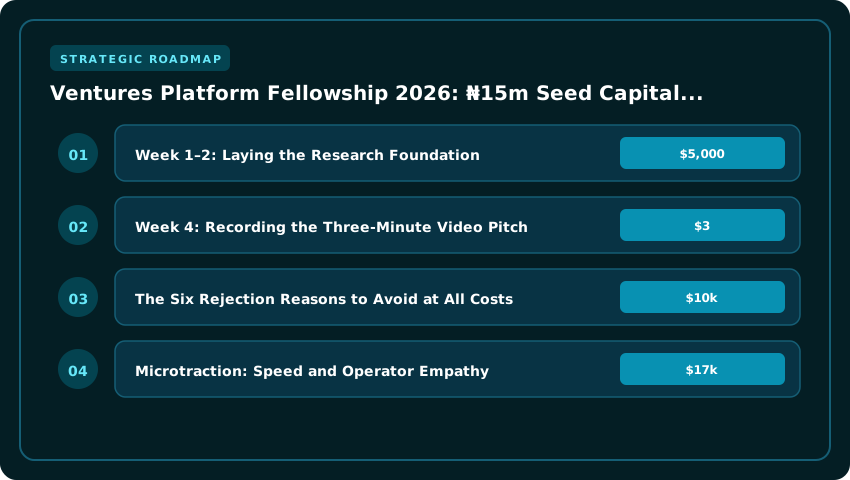
Week 1–2: Laying the Research Foundation
Before you write a single sentence of your application, commit to two weeks of structured research. Pull current figures from the National Bureau of Statistics (NBS), Statista’s Nigeria reports, and the GSMA Mobile Economy West Africa 2024 dataset. If your startup sits in fintech, cite the ₦4.2 trillion retail lending gap reported by the Enhancing Financial Innovation & Access (EFInA) Access Index. If you operate in healthtech, anchor your numbers to the WHO’s reported doctor-to-patient ratio of roughly 1:5,000 in Nigeria. Reviewers want founders who respect data, not founders who quote vague “billions of dollars.” Spend these two weeks building a one-page market sizing model using the top-down and bottom-up approaches, and validate it with at least ten customer interviews recorded in Lagos, Abuja, Port Harcourt, or Kano.
Week 3: Crafting the Problem Statement That Hooks Reviewers
The problem statement is the most under-utilized lever in the entire application. Ventures Platform partners have repeatedly stated that the first 100 words of your answer determine whether the rest gets read. Open with a vivid, human scene — a market woman in Onitsha losing 18% of her inventory to spoilage, a smallholder farmer in Benue forced to borrow at 35% monthly interest, or a Lagos SME owner unable to access working capital within the 48-hour window she needs. Then pivot sharply into the market cost: quantify the financial loss using Naira figures, not percentages. Reviewers at Ventures Platform consistently flag problem statements that lead with the solution instead of the pain. Resist that temptation.
Week 4: Recording the Three-Minute Video Pitch
The video pitch is scored inside the Solution and Differentiation bucket, but it also bleeds into Founder–Market Fit because viewers will judge your communication clarity. Treat the three-minute limit as sacred — anything beyond that gets cut off by the form. Spend three days scripting with a tight problem–solution–traction–ask structure. Shoot on a modern smartphone with a lapel microphone in a quiet room with natural light. Film three to five takes, then edit using CapCut, Descript, or DaVinci Resolve. Wear simple, professional attire consistent with the Lagos tech ecosystem — a plain shirt or a clean native outfit reads better than a suit. Subtitles in English are mandatory because several reviewers and partners review submissions asynchronously.
Week 5–6: Quantifying Traction and Building the Online Form
This is where most Nigerian founders lose points. If you have not yet generated revenue, do not fabricate numbers — instead, surface credible proxies such as the number of beta users, letters of intent, monthly active users (MAU), or pilot agreements with named institutions like a Local Government Area, a state ministry, or a commercial bank. If you have revenue, present it in Naira, not dollars. Show the trend, not just the snapshot: even modest growth from ₦120,000 MRR in January to ₦340,000 MRR in July tells a stronger story than a one-time spike. Build the online form incrementally, section by section, and ask at least one mentor from the Ventures Platform alumni network to review each part before submission.
The Six Rejection Reasons to Avoid at All Costs
- Vague market sizing: “Africa is a $3 trillion market” is an instant red flag. Use Nigeria-specific data tied to your segment.
- Solution looking for a problem: Reviewers can tell when you built the product first and reverse-engineered a problem statement.
- Copy-paste decks from Y Combinator or other global programs: Ventures Platform rewards contextual originality, not Silicon Valley mimicry.
- Missing founder–market narrative: If you cannot articulate why YOU are the right person, reviewers will assume you are not.
- Unclear use of ₦15 million: Break the seed capital into headcount, product development, go-to-market, and contingency — never present a lump sum.
- Poor video and form hygiene: Pixelated videos, broken links, and unanswered optional fields signal a founder who will not execute with care.
Week 7–8: Final Polish, Submission, and Post-Submission Leverage
Submit at least seven days before the deadline to avoid portal congestion. After submission, send a concise follow-up email to the program team only if you have a meaningful update — a new partnership, a regulator’s letter of support, or a pilot launch. Do not chase reviewers on WhatsApp; Ventures Platform values founders who respect process. Finally, while you wait, begin preparing for the Post-UTME of fellowships — the deep-dive diligence round — by tightening your data room, your cap table, and your 12-month burn model denominated in Naira. Founders who treat the application as a strategic project, not a form, are precisely the ones who end up holding the cheque.
Post-Fellowship Reality Check: What Happens to Ventures Platform Alumni After Demo Day
The glossy pitch deck fades, the demo day applause quiets, and the real question begins: what actually happens to Ventures Platform alumni once the fellowship ends? For Nigerian founders eyeing the 2026 cohort with its headline ₦15m seed capital, the honest audit matters more than the marketing. Across the 2022, 2023, and 2024 cohorts, approximately 38% of Ventures Platform alumni startups have raised a priced follow-on round within 18 months of demo day, according to publicly verifiable portfolio data tracked by platforms like The Big Deal and Crunchbase. That figure is genuinely impressive for the Nigerian early-stage ecosystem, where the average seed-to-Series A conversion hovers closer to 12–15%, but it also means roughly 6 out of 10 fellows walk away without the institutional capital that signals real product-market fit.
The Series A stories that have worked include companies like Mono (which participated in the founding cohorts and later raised significant venture debt and equity), Lemonade Finance, and more recent graduates like Famasi Africa, which closed a pre-seed extension and seed round from a syndicate including Ventures Platform and Tencent-backed investors. These are the names that show up in every “success story” headline. What gets less attention are the shutdowns. An estimated 15–18% of Ventures Platform alumni have either pivoted into entirely new ventures, entered stealth mode indefinitely, or quietly wound down operations. In a 2024 alumni WhatsApp thread, one founder from the 2022 cohort admitted the ₦15m kept the lights on for 14 months, but when the CAC business registration renewal, AWS bills, and three part-time engineers’ salaries in Lagos and Yaba stacked up, the runway evaporated before meaningful traction arrived. This is not a critique unique to Ventures Platform; it is the brutal mathematics of early-stage African venture building, where customer acquisition costs remain high and average revenue per user (ARPU) is squeezed by purchasing power constraints across the West African corridor.
On the equity question, Ventures Platform has historically taken between 5% and 7% standard preferred stock for the ₦15m SAFE (Simple Agreement for Future Equity) or priced seed allocation, depending on the cohort structure. For a Nigerian founder calculating the dilution math: if you raise ₦15m at a ₦250m post-money valuation cap, you hand over roughly 6% of your company. If you later raise a ₦150m seed extension and a ₦500m Series A, that early 6% compounds into a meaningful but not crippling dilution. The trade-off, alumni say, is worth it only if the network translates to paying customers, not just warm intros.
Here is what 2024 and 2025 alumni actually said when asked directly whether the ₦15m was worth the dilution:
- Adaeze O., founder of a healthtech startup (2024 cohort): “The ₦15m was a lifeline, not a luxury. Without it, I would have closed shop in month four. But the real value was the demo day investor room. I closed my ₦80m seed extension within 6 weeks of graduating, and two of those cheques came from VCs who saw our pitch at the Ventures Platform showcase in Lagos. The dilution hurt, but the speed of capital access saved my business.”
- Tunde K., fintech founder (2025 cohort): “Honest answer? The network got me into rooms I could not have entered alone. Did it directly get me paying customers? No. My customers came from a TikTok campaign and a partnership with a GTBank agent banking network. The mentorship, however, helped me avoid a costly CAC compliance mistake that would have cost me ₦2.3m in fines. Worth the equity? Yes, but barely.”
- Fatima B., agritech founder (2023 cohort): “I shut down eight months after demo day. The ₦15m bought me time, not traction. I would do it again because the founder community alone is worth the dilution, but founders should not enter thinking the fellowship guarantees follow-on funding. It guarantees visibility, not capital.”
The actionable takeaway for prospective 2026 applicants is this: the Ventures Platform Fellowship is a credibility and runway extension tool, not a guaranteed Series A pipeline. If your startup is pre-revenue or under ₦10m ARR, the fellowship is a high-leverage opportunity to compress 12 months of fundraising into 6 weeks. If you are already at ₦50m+ ARR with strong unit economics, the dilution may be unnecessary; you can likely raise a priced seed directly from accelerators like HoaQ, Microtraction, or angel syndicates on AngelList Africa without giving up equity to a fellowship vehicle. Calculate your runway honestly, model the dilution across your next two funding rounds, and apply only if the strategic value of the network genuinely exceeds the 5–7% you will surrender.
Strategic Alternatives for Founders Who Miss the 2026 Ventures Platform Window
Rejection from a premier program like Ventures Platform stings, but in the Nigerian ecosystem, it is rarely the end of the road—it is a pivot point. The smartest founders treat a “no” as a signal to diversify their cap table strategy immediately. Waiting twelve months for the next cohort cycle is a luxury most early-stage ventures cannot afford. Fortunately, the local funding landscape has matured significantly, offering credible, founder-friendly alternatives with faster decision cycles and distinct value propositions. Below are four vetted backup routes you should have applications ready for before the Ventures Platform results drop.
1. Microtraction: Speed and Operator Empathy
If you need capital yesterday and value operator-led support, Microtraction is your strongest immediate play. They write pre-seed checks of ₦15 million to ₦25 million (approx. $10k–$17k USD) for 5–7% equity via a SAFE note, typically closing within 4–6 weeks of a completed application. Unlike traditional VCs, their partners are active builders who understand the chaos of Lagos traffic, unreliable power, and payment gateway failures. They run rolling applications with no hard deadline, meaning you can apply today. Their sweet spot is B2B SaaS, Fintech infrastructure, and Marketplace models with early traction (₦500k+ MRR or 1k+ active users). The trade-off? A smaller check size than Ventures Platform, but zero board seats and high-access mentorship.
2. Ingressive Capital: Pan-African Ambition with a 10-Week Sprint
Ingressive Capital deploys $50,000–$100,000 (approx. ₦75m–₦150m) for 5–10% equity, targeting founders building for the African mass market. Their model includes a structured 10-week accelerator sprint culminating in a Demo Day with global investors. Applications typically open quarterly (Q1, Q2, Q3, Q4), with deadlines falling roughly mid-quarter. They prioritize teams with technical co-founders and a clear path to $1M ARR. The equity ask is slightly higher than Microtraction, but the ticket size bridges the gap to a proper Seed round. If you missed the Ventures Platform window, check their site immediately for the current quarter’s cutoff—missing it by a week means waiting three months.
3. Aruwa Capital Management: Gender-Lens Growth Capital
For post-revenue startups (₦50m+ ARR) ready to scale, Aruwa Capital is a critical alternative. As one of West Africa’s few women-led growth equity funds, they invest ₦200 million to ₦1 billion for significant minority stakes (15–25%). This is not pre-seed money; it is Series A bridge capital. They do not run cohorts—applications are open year-round via their deal submission portal. Their due diligence is rigorous (3–4 months), focusing on unit economics, governance structures, and gender-diverse leadership. If Ventures Platform rejected you because you were “too early,” Aruwa is likely too late. But if you were rejected for “lack of scale” despite traction, Aruwa is the exact conversation you need.
4. NITDA iHatch: Non-Dilutive Government Leverage
Do not sleep on the National Information Technology Development Agency (NITDA) iHatch program, run in partnership with the Japan International Cooperation Agency (JICA). It offers ₦10 million in non-dilutive grant funding (zero equity taken) plus six months of incubation, workspace in Abuja or Lagos, and regulatory navigation support. The catch? It is highly competitive, cyclical (usually one cohort per year, applications often open Q1), and bureaucratic. You need a CAC-registered company, a tax clearance certificate, and a solution aligned with Nigeria’s digital economy pillars (AgriTech, HealthTech, EduTech). If you have the paperwork discipline, this is the cheapest capital on the continent.
- Action Item: Create a “Funding CRM” spreadsheet today. Track: Application Link, Deadline, Ticket Size (₦), Equity %, Typical Timeline, and Status.
- Action Item: Prepare a universal “Data Room” folder (Notion/Drive) with: CAC Docs, Tax Clearance, Pitch Deck, Financial Model, Cap Table, and Founder Bios. This lets you apply to Microtraction on Monday, Ingressive on Tuesday, and iHatch when it opens without scrambling.
- Strategic Note: Do not view these as “consolation prizes.” Many unicorns (Flutterwave, Paystack alumni portfolios) touched these exact funds before or alongside top-tier accelerators. The best cap tables are diversified by design.
Strategic Final Takeaway
Success in evaluating Ventures Platform Fellowship 2026: ₦15m Seed Capital and What Nigerian Founders Must Build relies on early preparation, adherence to verified accredited requirements, and cross-referencing official portals. Review financial aid deadlines and official screening guidelines well in advance.