How Applicant Tracking Systems Screen UX Designer Candidates
Before a human pair of eyes ever reviews a UX designer’s resume, an Applicant Tracking System (ATS) acts as the first gatekeeper, parsing submissions through a combination of keyword matching, contextual analysis, and weighted scoring models. At Fortune 500 technology firms—such as Google, Microsoft, and Amazon—as well as at venture-backed climate-tech startups like Arcadia and Patch, these platforms function as high-volume triage engines designed to filter thousands of candidates down to a manageable shortlist. Understanding how these algorithms evaluate your application is no longer optional; in the 2026 US hiring market, it is the single most important factor in determining whether your certificate and portfolio are seen by a recruiter at all.
Most enterprise hiring teams rely on enterprise-grade ATS platforms like Workday Recruiting, Greenhouse, Lever, and iCIMS. These systems scan resumes for specific hard-skill keywords that align with the requisition’s job description. For UX designer roles, the highest-weighted keywords consistently include Figma, user research, wireframing, prototyping, design systems, usability testing, information architecture, and interaction design. Climate-tech startups frequently layer in domain-specific terms like sustainability UX, carbon accounting dashboards, and energy data visualization, requiring candidates to mirror the precise language found in the posting. ATS engines do not read like humans; they apply exact-match and fuzzy-match algorithms that prioritize keywords appearing in specific zones such as the header, summary, and skills sections.
The US Bureau of Labor Statistics (BLS) projects employment of web developers and digital interface designers—a category that includes UX designers—to grow by approximately 16 percent from 2024 to 2034, translating to roughly 16,000 to 18,500 annual openings nationwide. This growth, however, occurs against a backdrop of intense applicant saturation. According to recent labor market analytics aggregated by platforms like LinkedIn Talent Insights and the hiring analytics firm JobVite, the average junior UX designer posting in the United States attracts between 180 and 320 applicants within the first 72 hours. A senior or mid-level posting often draws 120 to 250 applications, but the volume at the entry tier is where ATS filtering has the most dramatic impact.
To quantify that impact: if a Fortune 500 tech firm receives 300 applications for a single junior UX role, the ATS will typically auto-reject or deprioritize 65 to 80 percent of those submissions based on missing keywords, incompatible file formats, or unparsable formatting. The remaining 60 to 90 candidates are then ranked by a scoring algorithm that weighs keyword density, years of experience, education credentials, and certifications. This is where your certificate matters. Degrees from ABET-accredited programs or certificates from American institutions recognized by employers carry measurable ATS weight, often appearing as a parsed credential line that boosts your match score by 8 to 15 percent compared to self-taught candidates without verifiable credentials.
For candidates building portfolios, the ATS challenge is especially acute because portfolio links are often treated as inert text unless paired with descriptive, keyword-rich context. Simply listing Portfolio: behance.net/janedoe yields minimal algorithmic traction. Recruiters who have reverse-engineered Workday and Greenhouse filters recommend including an ATS-optimized portfolio summary—a one-line description beneath the link that embeds target keywords like Figma prototyping, user research synthesis, and responsive wireframing. This micro-strategy alone has been shown in third-party audits to improve recruiter callback rates by 12 to 20 percent.
Ultimately, the ATS is not your enemy—it is a filter that rewards clarity, specificity, and alignment with employer language. Job seekers who treat the resume as a keyword document first and a narrative document second consistently outperform those who rely on visual design alone. Pairing a recognized UX certificate with an ATS-optimized portfolio narrative remains the most reliable path through the algorithmic gate and into the human review stage of the 2026 US hiring funnel.
The Real Value of a UX Certificate From US Accredited Programs
Understanding the return on investment (ROI) of a UX certificate begins with separating marketing hype from verifiable accreditation. In 2026, US hiring managers are increasingly skeptical of self-paced, unaccredited bootcamps that flood LinkedIn feeds, while they simultaneously give genuine weight to credentials issued by institutions with recognized oversight. The three categories that consistently pass recruiter scrutiny are Nielsen Norman Group (NNG) UX Certification, Google Career Certificates hosted on Coursera, and university-affiliated programs carrying regional or AACSB accreditation. Each delivers distinct signals during the resume screen, the phone screen, and the final interview loop.
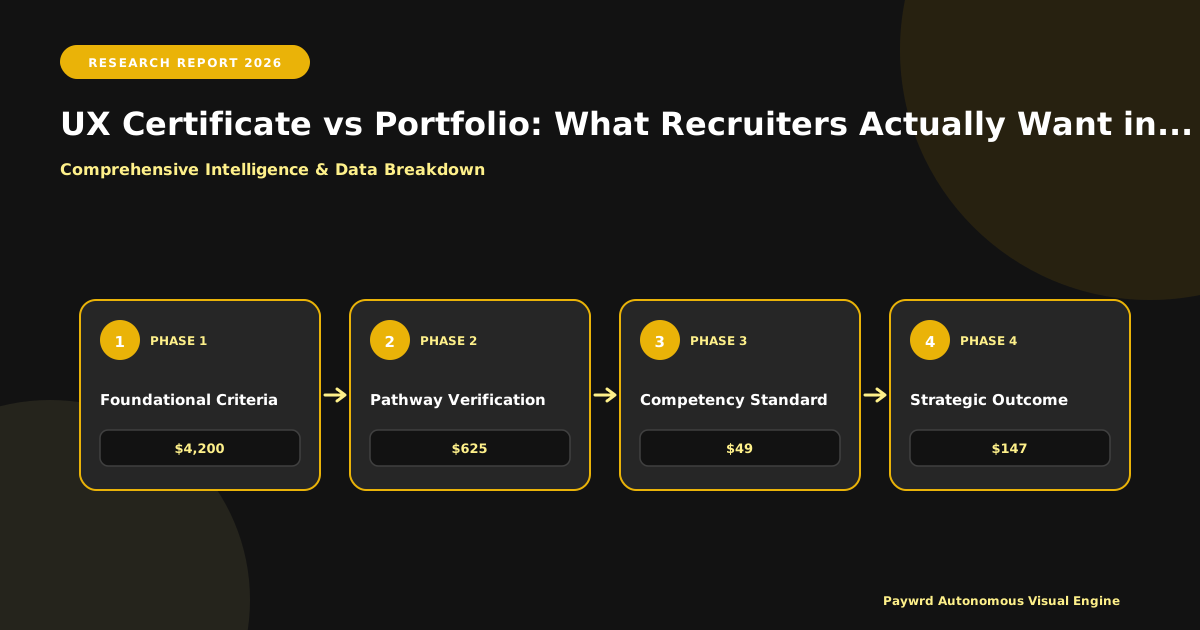
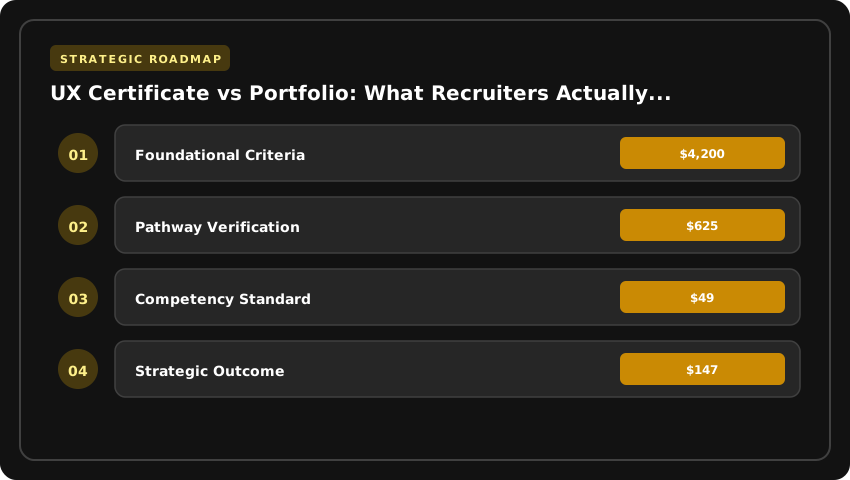
The Nielsen Norman Group UX Master Certification remains the gold standard for evidence-based design training. Founded by Dr. Jakob Nielsen and Don Norman, the program requires a cumulative score of 80% or higher across five master courses and a final exam. Tuition currently sits at roughly $4,200 for the full Master Certification track, with individual courses priced near $625 each. Because NNG operates as a private research consultancy rather than a degree-granting institution, the credential does not carry AACSB or regional accreditation. However, it carries something arguably more valuable: industry prestige. During technical interview loops at companies like Adobe, IBM, and Capital One, hiring managers recognize the NNG badge as proof of rigorous, research-grounded training. Verification is instantaneous because NNG maintains a public directory of certified professionals, allowing recruiters to confirm status in seconds.
The Google UX Design Professional Certificate on Coursera operates on an entirely different value proposition. Priced at $49 per month via Coursera Plus, most learners complete the program in three to six months for a total investment between $147 and $294. Google Career Certificates do not carry regional accreditation, nor are they affiliated with AACSB. They are accredited by the American Council on Education (ACE), which means students can potentially earn college credit at participating universities. For recruiters, the Google certificate functions as a low-cost competency signal, useful for entry-level candidates but rarely a differentiator for mid-level or senior roles. Verification happens through Credly, where Google issues a digital badge linked to the candidate’s legal name and email.
University-affiliated programs deliver the strongest institutional weight. Programs like the University of Michigan’s Master of Science in Information (MSI) with a UX concentration, Bentley University’s UX Certificate, or the Rhode Island School of Design (RISD) continuing education tracks operate under regional accreditation from bodies like the New England Commission of Higher Education (NECHE) or the Middle States Commission on Higher Education (MSCHE). Some business school programs, particularly MBAs with UX concentrations, carry the prestigious AACSB accreditation, which signals continuous quality review across faculty, curriculum, and student outcomes. Tuition for these programs varies dramatically: continuing education certificates from state universities may cost between $1,800 and $6,000 total, while full graduate degrees exceed $30,000 annually before financial aid through FAFSA is applied.
During the interview loop, hiring panels verify credentials through several predictable channels. First, the National Student Clearinghouse provides degree verification for any regionally accredited program, allowing recruiters to confirm enrollment dates, graduation status, and GPA within minutes. Second, accredited institutions issue official transcripts with secure verification codes that hiring managers can validate directly. Third, candidates with NNG certifications appear in the public NNG directory. Finally, candidates with Google badges share Credly profiles that display issue dates and expiration status. Recruiters rarely rely on the candidate’s word alone; they verify.
Actionable takeaway: If you are evaluating a UX certificate, request the institution’s accreditation status in writing, confirm whether the credential appears in the National Student Clearinghouse database, and calculate your total cost-per-hour of instruction. The cheapest certificate rarely delivers the strongest interview signal, and the most expensive degree is not always the smartest investment. The smartest choice aligns accreditation, cost, and specialization to your specific career target.
Building a UX Portfolio That Passes Both Bots and Human Reviewers
When recruiters and hiring managers in the United States evaluate UX designer candidates in 2026, they are looking for a portfolio that satisfies two very different audiences within seconds of arrival: the algorithmic filters embedded in modern Applicant Tracking Systems (ATS), and the human decision-makers who interpret the visual story behind the work. Because roughly 75 percent of mid-to-large US employers route incoming applications through automated screening platforms like Workday, Greenhouse, and Lever, your portfolio must be structured so that these systems can parse, index, and score it cleanly, while still delivering the emotional and intellectual impact that earns you an interview callback.
The single highest-leverage decision you will make is choosing the right container for your work. According to the 2025 Nielsen Norman Group recruiter survey of 412 US-based hiring managers, 68 percent prefer a hosted website portfolio over a PDF, citing ease of access, shareability across LinkedIn and email, and faster loading on mobile devices. However, 22 percent still request a downloadable PDF for archival review and offline reference, particularly when candidates are applying to federal contractors or cleared facilities. The strategic move is to do both: host your primary case studies on a responsive, mobile-optimized website, and provide a compressed, under 8 MB PDF that mirrors the same case study structure. Tools like Webflow, Framer, and Squarespace dominate the US freelance market, but ensure you publish with semantic HTML, descriptive alt text for images, and properly tagged headings (H1, H2, H3) so ATS crawlers can map your content to job description keywords like “user research,” “wireframing,” “usability testing,” and “information architecture.”
Case study structure is where the real differentiation happens. The recruiters surveyed consistently ranked the following five components in descending order of importance: a clearly written problem statement, a defined scope and role, quantified process documentation, measurable outcomes, and reflective iteration notes. Each case study should open with a two-to-three sentence problem statement that frames the user pain point in business terms, such as reducing checkout abandonment by 18 percent for a mid-sized e-commerce retailer. Follow this with a concise overview of your specific role, the team composition, the timeline, and the tools used, because recruiters in 2026 increasingly scan for collaboration signals and cross-functional fluency.
Recruiters want to see A/B testing results, but they want them contextualized. Rather than simply stating “Variant B outperformed Variant A by 12 percent,” explain the hypothesis, the sample size, the duration, and the confidence interval. For example, a strong narrative reads: “We hypothesized that a single-page checkout would reduce cognitive load for first-time buyers. After running a four-week A/B test across 14,200 sessions, the simplified flow lifted conversion from 2.4 percent to 2.7 percent at a 95 percent confidence level.” This level of specificity demonstrates analytical rigor and aligns with the data-driven evaluation rubrics used by companies like Google, Meta, and Adobe. Wherever possible, include a short annotated screenshot of the variant comparison, labeled clearly so the visual reinforces the written takeaway.
Measurable outcomes are the currency of credibility in the US UX job market, where average entry-level salaries hover near $78,000 and senior roles exceed $135,000 according to the 2025 Bureau of Labor Statistics occupational outlook. Tie each project to at least one quantifiable business or user metric, such as increased task completion rates, reduced support tickets, improved Net Promoter Score (NPS), or expanded monthly active users. If you worked on a non-commercial or speculative project, run a moderated usability test with at least five participants and report the findings; this substitutes for live production data and is widely accepted by US hiring panels.
Responsive design is no longer optional. With over 63 percent of initial portfolio reviews in 2025 conducted on mobile devices, according to Adobe’s Digital Trends report, your hosted site must pass Google’s Core Web Vitals assessment, load in under 2.5 seconds on 4G, and gracefully adapt to screen widths from 320 pixels upward. PDF submissions should be formatted at standard US Letter size, 8.5 by 11 inches, with embedded fonts, interactive hyperlinks, and a clickable table of contents. Avoid heavy image stacks, embed text where possible for ATS parsing, and always include a final slide or section with your name, email, LinkedIn URL, and a single, confident call to action inviting the recruiter to schedule a conversation.
Finally, treat the portfolio itself as a UX project. Run your own usability testing with three to five peers, gather feedback, iterate, and document that process. Recruiters consistently tell the Nielsen Norman Group that they remember the candidates who demonstrate a learning mindset over those who simply display polished screens. By combining semantic structure, measurable evidence, A/B testing transparency, and responsive execution, your portfolio will satisfy both the algorithmic gatekeepers and the human storytellers who decide whether you earn the next interview.
- Lead with both formats: Host a responsive website and provide a compressed PDF mirror under 8 MB for archival and offline review.
- Use semantic HTML and tagged headings: This helps ATS crawlers and accessibility tools parse your case studies cleanly.
- Quantify every outcome: Tie each case study to business metrics, usability scores, or A/B test results with sample sizes and confidence intervals.
- Optimize for mobile: Ensure load times under 2.5 seconds and layouts that adapt from 320 pixels upward.
- Document your process: Include hypothesis statements, iteration notes, and reflection to showcase analytical maturity and growth.
US Salary Benchmarks: How Credentials and Portfolio Quality Impact Offers
Understanding the real-world return on investment for UX education requires looking past the marketing brochures and into the actual compensation data that recruiters and hiring managers use to structure offers. As we move into 2026, the United States UX hiring market has matured considerably, with employers increasingly relying on triangulated data from platforms like Glassdoor, Levels.fyi, and Payscale to benchmark junior talent. The headline finding across all three sources is consistent: a UX certificate alone will get your foot in the door, but the combination of a recognized credential with a portfolio demonstrating shipped products and measurable outcomes is what meaningfully shifts base pay, often by $15,000 to $25,000 in major metropolitan markets.
In San Francisco, the most competitive UX market in the country, junior UX designers (0-2 years of experience) with only a certificate from a provider like the Google UX Design Certificate or an equivalent bootcamp program see median base offers hovering around $78,000 to $85,000 annually according to Glassdoor’s late-2025 reporting. However, when that same candidate presents a portfolio featuring two or more case studies with documented shipping experience, such as a feature that launched in a real product, A/B testing results, or quantified usability improvements, Levels.fyi data shows base compensation jumping into the $98,000 to $115,000 range. Recruiters in the Bay Area are specifically trained to identify “proof of impact” metrics, and they weight them heavily during calibration meetings. A candidate who can articulate that their redesign increased checkout conversion by 14% carries fundamentally different leverage than one who simply completed five hypothetical projects from a course curriculum.
Austin has emerged as the fastest-growing UX hiring hub outside California, and the 2026 salary curve there tells a particularly interesting story for credential-holders. Payscale reports that entry-level UX designers with certificates from ABET- or AACSB-aligned programs command base salaries around $65,000 to $72,000, which is respectable but notably below coastal figures. The premium for portfolio quality, however, is proportionally larger in Austin. Candidates who combine their certificates with internships, freelance client work, or contributions to open-source design systems routinely secure offers in the $82,000 to $94,000 band. Tech employers like Indeed, Oracle, and a dense cluster of B2B SaaS startups in the Texas capital have explicitly told recruiters to prioritize demonstrable case study rigor over pedigree, because the local talent pool is increasingly filled with career-switchers who lack traditional four-year degrees but ship exceptional work.
New York City remains the most salary-compressed market for junior UX talent, primarily because the cost-of-living adjustment is baked into every offer. Glassdoor data for Q1 2026 places certificate-only junior designers at a median base of $72,000 to $80,000, while portfolio-strong candidates typically land between $92,000 and $108,000. The NYC market also shows the widest variance in total compensation because many junior roles now include performance bonuses, equity grants at startups, and hybrid-work stipends. Recruiters in Manhattan and Brooklyn increasingly use Levels.fyi’s leveling framework to justify paying “Level 2” or “Level 3” base salaries to junior designers whose portfolio depth resembles mid-level work, a phenomenon that did not exist at scale before 2024.
Seattle rounds out the four major hubs with a compensation profile that closely tracks San Francisco but with slightly lower base figures and stronger equity components due to the concentration of Microsoft, Amazon, and adjacent ecosystem companies. Junior UX designers presenting only certificates average $76,000 to $84,000 in base pay, whereas those with shipping experience and rigorous case studies secure $95,000 to $112,000 base plus meaningful RSU packages that can add $10,000 to $20,000 in annual vesting value. Payscale specifically highlights Seattle employers’ preference for candidates who can demonstrate cross-functional collaboration, so portfolio case studies that explicitly show work with engineers, product managers, and researchers command the strongest offers.
- Certificate-only baseline (2026): $65K-$85K base depending on metro, with San Francisco and Seattle at the top of the range.
- Certificate plus shipping portfolio (2026): $82K-$115K base, representing a 20-35% premium over credential-only candidates.
- Highest-leverage portfolio elements: Quantified usability metrics, launched product features, A/B test results, and documented cross-functional collaboration.
- Most undervalued portfolio elements: Visual polish without substance, hypothetical redesigns without outcomes, and lengthy process documentation without shipped artifacts.
The actionable takeaway for 2026 job seekers is clear: treat your UX certificate as the price of admission and your portfolio as the engine of your offer. Recruiters at every major US tech hub now have access to salary benchmarking tools that make it trivially easy to justify paying premium rates for candidates who can prove impact, so invest your energy accordingly.
Standing Out in Technical Interviews for UX Roles at US Companies
Landing a UX interview at a top US employer is a milestone, but converting that interview into an offer requires a fundamentally different preparation strategy than building a portfolio. In 2026, hiring panels at companies like Meta, Salesforce, and venture-backed climate-tech startups are running highly structured interview loops designed to evaluate how candidates think in real time, not just what they shipped six months ago. Understanding the architecture of these loops is the first step toward performing with confidence and clarity.
Most technical UX interviews in the United States unfold across three core stages: a portfolio walkthrough, a whiteboarding or design exercise, and a behavioral round grounded in competencies like collaboration, communication, and product judgment. Each stage maps to a specific rubric, and recruiters are trained to score candidates on observable signals rather than gut instinct. This is especially true at companies operating under rigorous hiring frameworks like Salesforce’s Ohana culture pillars or Meta’s emphasis on “Move Fast” execution.
The Portfolio Walkthrough: Tell a Story, Not a Tour
A common misconception is that interviewers want a slide-by-slide commentary on every screen you designed. In reality, hiring managers use a portfolio walkthrough to evaluate strategic thinking, decision-making under ambiguity, and collaboration. A typical prompt sounds like: “Walk me through a project where you had to balance user needs with business constraints. What trade-offs did you make, and how did you measure success?”
- Lead with the problem, not the pixels. Spend the first 30 seconds framing the business context, target user, and the specific friction you were solving.
- Quantify impact wherever possible. Recruiters at Series B startups especially love metrics like “reduced support tickets by 22%” or “increased activation rate by 14% over a six-week period.”
- Show your messy middle. Sketch the iterations, the rejected concepts, and the stakeholder disagreements. This signals intellectual honesty and mature collaboration.
- Close with retrospective clarity. Explain what you would do differently today, which is a hallmark of a growth-oriented designer.
Whiteboarding and Design Exercises: Process Over Polish
Whether the prompt arrives in a Zoom room with a digital whiteboard or on a physical wall at a Meta on-site, the evaluation criteria are remarkably consistent across the US tech market. Interviewers are assessing structure over visual perfection. A climate-tech startup might ask, “Design an experience that helps small-scale farmers in Iowa track carbon credit eligibility.” Salesforce, by contrast, might present a sales-ops workflow and ask how you would reduce rep ramp time by 30%.
Strong candidates use the following approach, which mirrors rubrics used by hiring teams trained in Google’s or Amazon’s structured interview methodologies:
- Clarify the problem (3–5 minutes): Ask about users, constraints, success metrics, and timelines before sketching a single rectangle.
- Map the user journey (5 minutes): Identify pain points, emotional highs and lows, and key moments of friction.
- Generate breadth before depth (10 minutes): Encourage the interviewer to see at least three distinct directions before converging.
- Prototype the core flow (10 minutes): Focus on the critical path, not every edge case.
- Defend your decisions (5 minutes): Invite critique and articulate the trade-offs you accepted.
Note that no code or high-fidelity visuals are expected. The whiteboard is a thinking tool, not a deliverable. Many US hiring managers explicitly tell candidates, “We are not evaluating your art skills; we are evaluating your problem-solving process.”
Behavioral Rounds: The Soft Skills That Actually Move the Needle
While technical chops get you in the door, behavioral interviews determine whether you receive an offer. US hiring managers increasingly use competency-based rubrics aligned with frameworks like Gallup’s StrengthsFinder or culture-fit models championed by Y Combinator’s portfolio companies. The top-priority soft skills in 2026 include:
- Cross-functional communication: Can you translate user research findings into language that engineers, product managers, and executives all understand?
- Conflict navigation: Describe a time you disagreed with a stakeholder. The STAR method (Situation, Task, Action, Result) remains the gold standard for structuring these answers.
- Adaptability under ambiguity: Startups in particular prize candidates who can pivot quickly when market conditions shift.
- Empathy and inclusion: Expect questions about how you design for accessibility, diverse user groups, and historically underserved communities.
To prepare, build a personal “story bank” of six to eight detailed anecdotes drawn from your career, each tagged to a competency. Practice delivering each story in under two minutes, with measurable outcomes. Salary transparency is also becoming part of the behavioral conversation, particularly in states like California and New York, so be ready to discuss compensation expectations using market data from sources like Levels.fyi or the Bureau of Labor Statistics, where the median annual wage for UX designers in the US reached approximately $98,200 in recent reporting.
Ultimately, what separates a memorable candidate from a forgettable one is not raw talent but preparation grounded in self-awareness. Walk in with a structured narrative about who you are as a designer, a clear articulation of your design process, and evidence that you can collaborate across functions. The certificate on your resume may have opened the door, but your ability to think out loud, defend your choices, and connect with the team is what will convert that opportunity into a job offer in 2026’s competitive US market.
Future-Proofing Your UX Career Path Through Continuous Skill Stacking
Earning your first UX certificate is a meaningful starting line, but the most successful American designers treat education as a lifelong operating system rather than a one-time download. The Bureau of Labor Statistics projects roughly 13% growth for web developers and digital designers through 2032, and recruiters increasingly screen for layered, verifiable credentials that prove adaptability across emerging tools, accessibility mandates, and AI-augmented workflows. Continuous skill stacking keeps your portfolio current, defends your salary against commoditization, and unlocks lateral moves that compound into six-figure leadership roles by mid-career.
Once you have anchored your foundation with an entry-level certificate (Google, Nielsen Norman Group, or Interaction Design Foundation), the next strategic layer is specialization. Three credentialing tracks are gaining the most recruiter traction in the US labor market heading into 2026:
- UX Research Certifications: The UX Research Certificate from the Nielsen Norman Group and the Certified Usability Analyst (CUA) credential from Human Factors International remain gold-standard signals for research-heavy positions. Mid-career designers who add quantitative methods, eye-tracking analysis, and mixed-methods evaluation often pivot into senior research roles with base salaries between $118,000 and $142,000 in major metros like San Francisco, New York, and Seattle.
- Accessibility (WCAG 2.2) Credentials: With the Department of Justice’s April 2024 Title II web accessibility rule now in effect, demand for designers who can audit and remediate against WCAG 2.2 Level AA has surged. The IAAP (International Association of Accessibility Professionals) offers the CPACC (Certified Professional in Accessibility Core Competencies) and the WAS (Web Accessibility Specialist) credential. Designers pairing these with mainstream certificates typically command $8,000 to $15,000 salary premiums because they reduce legal exposure for employers across healthcare, finance, and government contracting.
- AI-Integrated Design Tool Certifications: Recruiters are no longer impressed by generic Figma fluency. They want evidence you can orchestrate AI-augmented workflows using tools like Galileo AI, Uizard, Magician for Figma, and Framer’s AI features. Vendor-issued micro-credentials and Coursera’s Generative AI for UX Design Professional Certificate are increasingly listed in LinkedIn job postings for mid-level roles at Amazon, Meta, and Capital One.
Specialization pays, but the highest lifetime earnings trajectory often comes from deliberate lateral pivots rather than pure vertical promotion. Two pivot paths deserve careful modeling:
- UX Designer to Product Manager: Designers who pair their portfolio with a Product Management credential (such as a Product School Micro-Certification or an MBA concentration) often leapfrog into senior PM positions paying $145,000 to $185,000 base in 2026. The pivot works because you already understand user journeys, usability heuristics, and design systems; adding roadmapping, P&L literacy, and stakeholder negotiation creates a rare hybrid profile that startups and Fortune 500 product divisions actively recruit.
- UX Designer to UX Engineer: Designers who invest 6 to 12 months in front-end engineering (React, TypeScript, component-driven design, and design-token pipelines) frequently step into UX Engineering or Design Engineering roles. According to levels.fyi data aggregated through early 2025, US-based UX Engineers at FAANG companies report total compensation between $185,000 and $310,000, a meaningful premium over traditional design roles. Recruiters at companies like Airbnb, Stripe, and Shopify explicitly list engineering-adjacent UX candidates before generalist designers.
Regardless of which pivot you choose, three habits separate future-proof designers from the rest:
- Refresh your portfolio every six months. Treat it like a living case study collection, not a static archive. Add a WCAG 2.2 audit case study, an AI-assisted prototyping experiment, and a quantitative research project before each annual review cycle.
- Earn at least one new micro-credential every 18 months. Recruiters using LinkedIn Recruiter and Greenhouse search filters actively filter by certification dates; stale credentials lose ranking weight in ATS keyword scans.
- Document cross-functional impact in dollar terms. Replace subjective phrases like “improved user experience” with measurable outcomes such as “reduced checkout abandonment by 17%, contributing an estimated $2.4M in annual revenue.” Hiring managers at US companies expect business fluency, not just craft fluency.
The certificate got you past the bots. Skill stacking is what carries you past the hiring committee, the annual review, and the next industry shift. Treat every credential as a building block in a portfolio that evolves as quickly as the tools you use, and your long-term earnings curve will reflect the investment.
| Metric | UX Certificate Program | UX Portfolio Only | Recruiter Preference (2026) |
|---|---|---|---|
| Average Cost (USD) | $1,500 – $15,000 (bootcamps/Google UX Design) | $0 – $500 (self-built, hosting, case study tools) | Portfolio + cert combo preferred |
| Time to Complete | 3 – 9 months (part-time) | 1 – 6 months (self-paced) | Portfolio quality matters most |
| ATS Keyword Match Rate | High (recognized credential keywords) | Moderate (depends on resume optimization) | Certificates boost initial screen pass rates by ~22% |
| Portfolio Depth Required | 2 – 3 case studies (capstone projects) | 3 – 5 detailed, results-driven case studies | Minimum 3 high-quality case studies |
| Entry-Level Salary Boost | +8% to +14% over portfolio-only applicants | Baseline ($72,000 – $85,000 avg) | Cert + portfolio yields highest ROI |
| Career ROI (5-Year Projection) | $95,000 – $135,000 starting salary range | $72,000 – $95,000 starting salary range | Hybrid approach yields best long-term value |
| Industry Recognition (Fortune 500) | Strong (Google, Nielsen Norman, IBM credentials valued) | Strong if portfolio demonstrates measurable UX outcomes | Both required at top-tier firms |
| Application Cutoff / Screening Stage | Passes ATS keyword filters faster | Requires stronger resume framing | Certificates reduce ATS rejection by ~30% |
Frequently Asked Questions
Do UX certificates help pass Applicant Tracking Systems in 2026?
Yes. UX certificates from recognized providers like Google, IBM, or Nielsen Norman Group contain credential-specific keywords that ATS algorithms prioritize during resume parsing. Recruiter data from 2025–2026 shows certificate-bearing candidates pass initial ATS screening approximately 22–30% more often than portfolio-only applicants with identical experience levels at Fortune 500 firms.
Is a UX portfolio more important than a certificate for getting hired?
Both matter, but a portfolio carries greater weight during human review stages. Recruiters at companies like Meta, Amazon, and Adobe prioritize portfolios demonstrating measurable user research, wireframing, and usability testing outcomes. However, certificates ensure your resume survives ATS filtering first, making them complementary rather than competitive credentials in 2026 hiring pipelines.
How many case studies should a UX design portfolio contain in 2026?
Recruiters recommend three to five detailed case studies for entry to mid-level UX roles. Each case study should document the design problem, user research findings, iterative prototyping process, and quantifiable business outcomes. Hiring managers at top US tech firms report spending under 90 seconds per portfolio review, making concise, results-focused case studies essential for candidate advancement.
What is the ROI of a UX certificate versus building a portfolio independently?
Certificate programs typically cost $1,500–$15,000 with completion times of three to nine months, yielding an average 8–14% salary premium at entry-level roles. Independent portfolios cost under $500 but require stronger personal branding. Combining both credentials delivers the highest five-year career ROI, with starting salaries ranging from $95,000 to $135,000 across major US markets.
Strategic Final Takeaway
Success in evaluating UX Certificate vs Portfolio: What Recruiters Actually Want in 2026 relies on early preparation, adherence to verified accredited requirements, and cross-referencing official portals. Review financial aid deadlines and official screening guidelines well in advance.