Why ‘Accepted’ Credits Differ From ‘Applicable’ Credits in Online Programs
For most adult learners returning to finish a bachelor’s or master’s degree online, the single most confusing moment in the entire enrollment process happens when they receive their official transfer credit evaluation. A student might open a portal and see 60 credits “accepted,” breathe a sigh of relief, and then discover that their degree audit still requires 48 courses to graduate. That painful gap is the difference between accepted credits and applicable credits, and understanding that distinction before you apply can save you thousands of dollars, multiple semesters, and a great deal of frustration.
An accepted credit is a course that a university’s Office of the Registrar has officially posted to your transcript. The registrar, working through the institutional Office of Transfer Credit, verifies the sending institution’s regional accreditation status, confirms the credit hours on the official transcript, and determines that the grade meets the institution’s minimum threshold (commonly a C- or higher for undergraduate programs, though many online programs set the floor at C or B- for quantitative coursework). Once accepted, the credit lives permanently on your academic history and counts toward your overall cumulative credit total.
An applicable credit is something quite different. It is a credit that has been successfully mapped, or “articulated,” into a specific slot within your declared degree program. Think of it this way: acceptance happens at the transcript level, but applicability happens at the degree-audit level. A general elective “Introduction to Psychology” might sail through acceptance, but if your degree is a Bachelor of Science in Accounting, that psychology credit will likely land in an open elective bucket rather than fulfilling a required major course like ACC 311 Intermediate Accounting I.
This is where accreditation enters the picture, and where many prospective online students underestimate the rigidity of the rules. Programmatic accreditors such as ABET (engineering and computing), AACSB (business), NCATE and its successor CAEP (education), CCNE (nursing), and APTA (physical therapy) impose hard caps on how much specialized, upper-division technical coursework can be transferred from a non-regionally accredited or non-equivalent institution. AACSB-accredited online MBA programs, for example, typically refuse to accept more than two or three core business courses from outside institutions, regardless of how many general electives a student brings in. ABET programs often require that no more than 25 percent of technical credits be transferred for credit toward a BS in Computer Science or Electrical Engineering, because the accreditor wants to ensure the graduate has completed a substantial body of work at the degree-conferring school.
Closely tied to these programmatic caps is the residency requirement. The vast majority of US regionally accredited universities require that between 30 and 36 credit hours of a bachelor’s degree be earned in residence at the institution that will confer the credential. For a standard 120-credit bachelor’s, that translates to roughly one academic year of full-time study, or the equivalent of one full-time year at the conferring school. Online programs generally apply the same residency rule, although some institutions allow short virtual residencies, proctored exam weeks, or capstone experiences to count toward those hours. Residency exists for several reasons: it guarantees that the degree reflects the receiving institution’s curriculum, satisfies accreditation expectations, and produces graduates who can legitimately claim membership in that school’s alumni community.
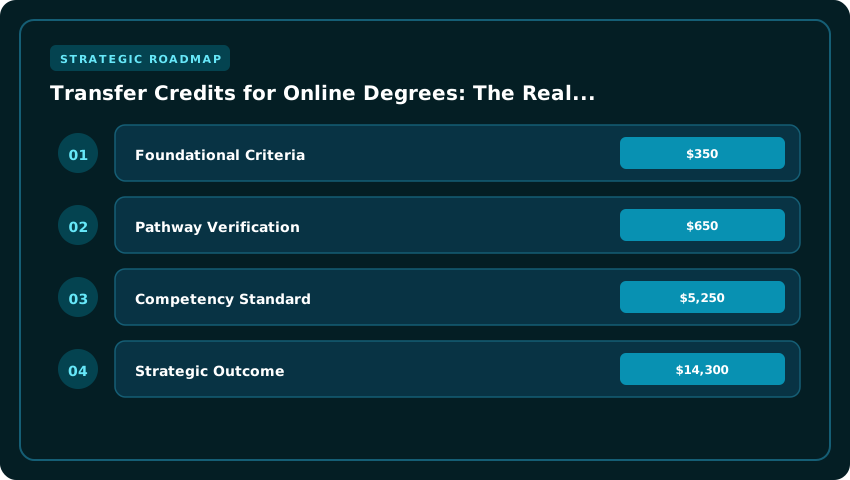
Now, here is the number that should anchor your planning: industry analyses consistently show that students who receive an initial “60 credits accepted” evaluation typically discover, after the formal degree audit, that only 38 to 45 of those credits are actually applicable toward their chosen major. The uncovered shortfall averages between 15 and 22 credits, which represents roughly one extra semester of full-time tuition at current online program rates of $350 to $650 per credit hour. At those rates, that hidden gap translates to an unplanned $5,250 to $14,300 in additional tuition before a student can graduate.
To protect yourself, take three concrete steps before enrolling. First, ask the admissions counselor for a preliminary degree audit, not just a transfer credit evaluation, and review it line by line. Second, ask specifically how many of your accepted credits will count toward your major core, your major electives, your general education block, and your free electives. Third, confirm the residency minimum and the programmatic accreditation status of your specific major, because the answer to “how many credits will transfer” is really three different questions depending on which of those categories you are asking about.
When you separate acceptance from applicability, the transfer credit process stops feeling like a bait-and-switch and starts feeling like a navigable set of rules. The credits you bring in are real and permanent, but the degree you earn belongs to the school that grants it, and that school gets the final say on how its curriculum is assembled.
How Regional Accreditation Status Determines Whether Your Credits Will Move
Before any registrar ever evaluates a syllabus, a course description, or a grade, they look at a single foundational data point: the institutional accreditation status of the college or university where you originally earned the credit. In the United States, this distinction is not a technicality. It is the gatekeeper that decides whether your transcript will be reviewed at all, or quietly filed away in a rejection folder. Understanding this hierarchy is the single most important step any prospective transfer student can take before enrolling in a single course.
The Department of Education recognizes seven regional accrediting agencies, each covering a specific geographic zone, and these bodies are universally treated as the gold standard of academic quality. The Higher Learning Commission (HLC) governs institutions across the Midwest and several southern states. The Middle States Commission on Higher Education (MSCHE) covers Delaware, Maryland, New Jersey, New York, Pennsylvania, Puerto Rico, and the U.S. Virgin Islands. The Southern Association of Colleges and Schools Commission on Colleges (SACSCOC) serves Alabama, Florida, Georgia, Kentucky, Louisiana, Mississippi, North Carolina, South Carolina, Tennessee, Texas, and Virginia. The New England Commission of Higher Education (NECHE) accredits the six New England states. The Northwest Commission on Colleges and Universities (NWCCU) oversees Alaska, Idaho, Montana, Nevada, Oregon, Utah, and Washington. The WASC Senior College and University Commission (WSCUC) and the Accrediting Commission for Community and Junior Colleges (ACCJC) split coverage of California, Hawaii, and American Samoa.
- Credits earned at a regionally accredited institution are overwhelmingly accepted in transfer by other regionally accredited institutions across state lines.
- Articulation agreements, which are formal partnerships between specific colleges and universities, almost exclusively require both parties to hold regional accreditation.
- NC-SARA, the State Authorization Reciprocity Agreement, only applies to institutions that are already regionally accredited, making it an extension of the same trust framework.
Contrast this with national accreditors, such as the Distance Education Accrediting Commission (DEAC) or the Accrediting Council for Independent Colleges and Schools (ACICS, now defunct but historically relevant). National accreditation focuses on faith-based, vocational, career, or technical schools. While legitimate, credits from nationally accredited schools are frequently rejected by regionally accredited universities evaluating transfer applicants. Even more restrictive are programmatic accreditors like ABET for engineering, AACSB for business, or CCNE for nursing. These bodies accredit individual programs rather than whole institutions, and their credits rarely satisfy general education or elective requirements outside their specialty.
Students holding degrees from foreign universities or unregulated diploma mills face the steepest barrier. Without recognition by a regional accreditor, transcripts are often deemed invalid on arrival, forcing students to repeat coursework at a cost ranging from $1,200 to $4,500 per course at their new institution. This is one of the most expensive mistakes in higher education, and it is entirely preventable.
Actionable takeaway: before you pay for a single transfer-credit evaluation, verify your source institution’s accreditation in the Department of Education’s Database of Accredited Postsecondary Institutions and Programs (DAPIP). If the school is not regionally accredited, your odds of a successful credit transfer drop dramatically, and the financial risk shifts entirely to your wallet.
Community College-to-Online Bachelor’s Pipeline: Maximizing Your Associate Degree
For ambitious learners who begin their higher education journey at a two-year institution, the community college-to-online bachelor’s pipeline represents one of the most financially strategic pathways in American higher education today. An Associate of Arts (AA) or Associate of Science (AS) degree is far more than a standalone credential; it functions as a pre-packaged block of roughly 60 lower-division semester credits that, when properly aligned with statewide articulation frameworks, can satisfy the entire general education core of a four-year degree. Understanding how this pipeline actually works—and how to verify that your credits will move with you—is essential for protecting both your prior academic investment and your future tuition budget.
At the heart of this system are statewide articulation agreements—formal guarantees that ensure coursework completed at one regionally accredited institution will be recognized by another. These frameworks vary by state but share a common purpose: eliminating redundant coursework and creating predictable transfer pathways for students who relocate or complete their degree online. Without these guarantees, a student could theoretically lose dozens of credits simply by crossing a state line or switching delivery formats, which is why every prospective transfer student should map their state’s specific agreement before enrolling in a single community college course.
- Ohio – Transfer Assurance Guides (TAGs): The Ohio Department of Higher Education oversees TAGs, which guarantee that specific courses in English composition, mathematics, natural sciences, social sciences, humanities, and the arts will transfer among all public Ohio institutions. When all TAG courses are completed, students are awarded the Ohio Transfer Module, satisfying lower-division general education requirements at any of Ohio’s public four-year universities.
- Michigan – Michigan Transfer Agreement (MTA): Satisfying the MTA satisfies at least 30 credits of lower-division general education at participating Michigan four-year institutions. Students must complete courses from approved distributions in English composition, English literature, humanities, mathematics, natural sciences, social sciences, and a second humanities or social science course.
- Florida – Statewide Articulation Agreement and STARS: Florida’s articulation system is among the most mature in the country. The Statewide Articulation Agreement guarantees that an Associate of Arts degree from a Florida College System institution transfers to a state university or Florida College System institution offering a baccalaureate degree. The State Transfer Articulation Reporting System (STARS) provides customized, course-by-course articulation guides for every public institution pair in the state.
- California – IGETC: The Intersegmental General Education Transfer Curriculum is the gold-standard transfer framework. IGETC certification—a single seal on a student’s transcript—satisfies all lower-division general education requirements at any University of California (UC) or California State University (CSU) campus. Students who complete IGETC before transferring are virtually guaranteed junior standing in terms of general education.
Why do major online universities publish dedicated transfer pathway landing pages rather than simply listing transfer policies in a buried catalog footnote? The answer is competitive economics. Institutions like Arizona State University (ASU) Online, Southern New Hampshire University (SNHU), and Western Governors University (WGU) have built enrollment funnels around adult learners who already hold significant college credit. A dedicated “transfer pathways” page—complete with free credit-evaluation tools, articulation agreements with community college systems, and 2+2 program listings—acts as both a recruitment asset and a retention tool. It signals to prospects that the institution values prior learning, has invested in evaluating thousands of transcripts, and can deliver a faster, cheaper degree. For a working adult weighing whether to start (or restart) a bachelor’s program, that transparency is often the deciding factor.
The financial impact of this pipeline is substantial and measurable. A typical online bachelor’s degree at a non-profit institution ranges from $38,000 to $62,000 in total tuition, depending on program, residency, and whether the school charges per-credit or flat-rate tuition. Students who transfer in a fully articulated associate degree frequently see tuition reductions of $9,000 to $22,000, because they enter as juniors and avoid paying for 30 to 60 credits of lower-division coursework. At SNHU, for example, transferring in 60 prior credits at the standard per-credit tuition rate effectively eliminates nearly two full semesters of cost. At WGU’s competency-based model, students accelerate further by demonstrating mastery, often finishing bachelor’s degrees in 18 to 24 months rather than four years. At ASU Online, accepted transfer credits directly reduce the billable credit load, often shaving a full year off both the timeline and the total cost.
- Actionable Takeaway #1: Before enrolling in any community college course, request your state’s official articulation guide (TAG, MTA, STARS, or IGETC) and choose courses that satisfy the full transfer module in one pass.
- Actionable Takeaway #2: Request a free unofficial transfer credit evaluation from at least two target online universities before committing to your associate degree, so you can confirm which credits will actually apply toward your major.
- Actionable Takeaway #3: Confirm regional accreditation through agencies recognized by the Council for Higher Education Accreditation (CHEA), since credits from unaccredited institutions rarely—even with articulation agreements—transfer cleanly.
- Actionable Takeaway #4: Aim for the full 60-credit associate degree rather than stopping after 30 credits, because the complete credential triggers the most generous block-transfer guarantees and maximizes tuition savings.
When executed strategically, the associate-to-bachelor’s pathway compresses a four-year, $50,000 degree into a two-and-a-half-year commitment at roughly half the cost—while preserving the rigor of a regionally accredited four-year credential at the end of the journey.
Course Equivalency vs. Course Substitution: Decoding the Evaluator’s Playbook
Behind every transfer credit decision is a human being (or increasingly, a smart workflow assisted by artificial intelligence) reading your transcript through a very specific lens. A transfer evaluator at a regionally accredited online university is not simply checking whether you earned a C- or better; they are conducting a side-by-side comparison of three crucial variables: course description, documented learning outcomes, and contact or credit hours. When those three elements line up closely enough with a course already in the institution’s catalog, you receive direct equivalency. When only one or two elements match, the evaluator often reclassifies the course as a general elective or applies a formal course substitution. Understanding this playbook is the single most powerful advantage an adult learner can have when maximizing transfer value toward an online Bachelor of Business Administration, RN-to-BSN, or general studies degree.
Start with the course description. Evaluators compare the catalog narrative from your previous institution against the receiving program’s published course description, looking for at least 60 to 70 percent topical overlap. Next, they examine learning outcomes, which are increasingly standardized through ACE-recommended credit frameworks. The American Council on Education reviews and validates courses from non-traditional providers, including massive open online course platforms, competency-based programs, and workplace training. If your ACE transcript documents that you completed, for example, “Introduction to Macroeconomics” with a recommended three semester hours in the lower-division baccalaureate category, evaluators can usually apply that credit with minimal friction, provided the receiving school accepts ACE in principle. A Prior Learning Assessment (PLA) portfolio, by contrast, is student-generated evidence (résumés, certifications, essays, supervisor letters) evaluated by faculty subject-matter specialists against demonstrated learning outcomes rather than formal course descriptions, which can create a longer review window and more variability in the final credit award.
- Direct equivalency: Course description, learning outcomes, and credit hours match the receiving institution’s catalog course closely enough to count toward a specific degree requirement.
- Course substitution: The content area is similar, but the level or focus differs. The evaluator formally substitutes your course for a required one, often with a memo or notation on your degree audit.
- General elective only: The credit is real, residency-friendly, and counts toward graduation totals, but it does not satisfy a major or general education requirement.
- ACE-recommended credit: Pre-reviewed by the American Council on Education; usually the smoothest non-institutional pathway, but acceptance still depends on the receiving school’s transfer policy.
- PLA portfolio credit: Evaluated individually by faculty; offers flexibility but requires strong documentation of college-level learning.
Consider a practical example. If you completed “Introduction to Psychology” at a community college accredited by a Higher Learning Commission regional body, the course description reads something like, “A survey of the major concepts, theories, and research methods in psychology, including biological bases of behavior, sensation, perception, learning, memory, cognition, and social interaction.” That language maps almost perfectly onto the receiving online university’s “General Psychology” course. Credit hours typically align at three semester hours, and learning outcomes on a verified ACE transcript or community college syllabus are nearly indistinguishable. This is why introductory Psychology transfers cleanly across more than 90 percent of accredited online programs.
Now contrast that with a 200-level Statistics course you completed while pursuing an associate degree in nursing or an early BBA concentration. The content may cover descriptive statistics, probability, and hypothesis testing, but many online RN-to-BSN programs only require a basic undergraduate statistics course at the introductory level, and they often prefer their own program-specific version to ensure continuity with their evidence-based practice curriculum. The evaluator sees the 200-level Statistics credit, agrees it is rigorous and legitimate, but codes it as a general elective rather than the required statistics core. In an online BBA program, the same course might transfer cleanly if the AACSB-accredited business core requires calculus-based statistics at the 200-level; the outcome depends entirely on the receiving curriculum, not the intrinsic rigor of your prior course.
Actionable takeaway: before you commit to a transfer credit evaluation fee, request a pre-evaluation or unofficial transcript review from the receiving university, and have your previous school’s course descriptions and learning outcomes ready in PDF format. If a course does not transfer as direct equivalency, ask the admissions counselor whether a formal substitution petition is possible. Many schools allow a one-page faculty memo that aligns specific learning outcomes, turning an elective-coded course back into a major requirement and saving you thousands of dollars in tuition.
Grade Inflation, Time Limits, and the Seven-Year Rule Most Students Overlook
Most prospective online degree candidates spend weeks comparing tuition prices, accreditation seals, and program flexibility, yet almost no one reads the fine print buried in the transfer credit policy until a course is rejected on their degree audit. That small-print clause usually contains three devastating variables working together: an age-of-coursework cap, a minimum grade threshold, and a replacement rule for repeated courses. Together these levers quietly determine whether the 60 community college credits you earned in your twenties will still count when you enroll at 42, or whether the introductory statistics course you passed during the chaotic spring 2020 semester will be treated as a transferable grade at all.
Across the United States, the most common age-of-coursework ceiling sits between seven and ten years, with seven being the dominant standard for STEM and nursing programs and ten years more typical for general education and business coursework. The rationale is rooted in accreditation, not pedagogy. ABET-accredited engineering and computer science programs must demonstrate that transfer students meet current curriculum standards, so a C++ course from 2014 may no longer satisfy a modern software engineering concentration. Similarly, CCNE and ACEN nursing accreditors require recent anatomy, pharmacology, and pathophysiology coursework to ensure clinical competence, which is why nursing schools almost universally enforce a strict seven-year rule. AACSB-accredited business schools sit in the middle, generally accepting up to ten years for quantitative courses like accounting and economics but tightening the window to seven for analytics, data science, or finance concentrations that have evolved rapidly since 2020.
The second gatekeeper is the 2.0 minimum GPA floor. While 2.0 sounds generous, the calculation is rarely a simple cumulative average. Most institutions evaluate the GPA of the transferring coursework alone, meaning a 3.8 overall GPA earned at a four-year school cannot rescue a 1.9 GPA in a specific discipline. Schools frequently require a C- or higher for individual courses, disqualifying any C-, D, or F earned in a foundational subject even if the cumulative GPA remains above the floor.
The third variable is the one that catches returning students during COVID terms. During 2020, thousands of institutions defaulted to pass/fail or credit/no-credit grading, and transcripts from that period now trigger transfer evaluations inconsistently. Some receiving schools will convert pass/credit grades to a neutral C equivalent for transfer, while others refuse them outright unless accompanied by a documented pandemic-policy addendum. Students who selected pass/fail thinking it would protect their GPA often discover years later that an “acceptable” grade on their transcript is not an “equivalent” grade for transfer purposes.
Course repetition policies add a final layer of complexity. If you retook College Algebra three times to replace an old F, most online universities will only count the highest grade earned once, but some will count only the most recent attempt, and a minority will average all attempts into the transfer GPA. The differences are not academic trivia; they can swing your eligibility by a full grade point and determine whether you qualify as a sophomore or junior standing upon enrollment.
Industry data consistently shows the human cost of these policies. Roughly 23% of transfer applicants lose credits solely due to age-of-coursework rules, not because the content failed to meet learning outcomes but simply because the calendar ran out. For a 60-credit transfer block, that means the average student loses around 14 credits, adding an entire semester of tuition cost and roughly 4 to 7 additional months of time-to-degree. Multiply that across a workforce returning to finish degrees and the economic impact runs into billions of dollars in redundant tuition, lost wages, and delayed promotions.
The good news is that nearly every accredited online institution offers a formal appeal or petition process, typically initiated through the office of the registrar or the academic dean. A successful petition generally includes three elements: a current course syllabus demonstrating content alignment with the receiving institution’s course, a professional résumé showing continuous application of the skill since the original coursework, and a written rationale explaining why the age-of-coursework cap should be waived. STEM and nursing petitions are more rigorous, often requiring demonstrated competency through CLEP, DSST, or ACE credit-by-examination, but they remain the most reliable path forward.
Actionable takeaways before you enroll:
- Request a preliminary transfer evaluation in writing before paying your enrollment deposit, and ask specifically how pass/fail 2020 grades will be evaluated.
- Ask whether the school uses the highest, most recent, or averaged grade for repeated coursework, and get the answer in writing.
- Confirm whether the 2.0 GPA floor applies to the cumulative transcript or to the transferring coursework alone, and whether C- grades are accepted for major-specific courses.
- If your coursework is older than seven years, budget for the cost of one or two competency exams, which typically run between $100 and $150 each and can rescue hundreds of tuition dollars in blocked credits.
- Keep digital copies of every syllabus, credential, and certification earned since your original coursework, as these become the foundation of any future academic dean appeal.
Understanding these three levers, age, grade, and repetition, is the difference between finishing your degree in two years and watching half your hard-earned credits quietly expire on an administrative spreadsheet. Treat the transfer credit policy as seriously as the tuition price, because in most cases it determines the true cost of your degree far more than the advertised tuition rate.
Step-by-Step Strategy to Negotiate a Higher Transfer Credit Award Before Enrolling
Walking into an enrollment decision with only a verbal credit estimate is the single most expensive mistake an adult learner can make. The number a recruiter quotes on a Tuesday afternoon call can evaporate by the time your official transcript review is completed, sometimes dropping by ten, fifteen, or even twenty credits with no explanation beyond “department policy.” To prevent that, you need a deliberate, multi-step negotiation strategy that runs parallel to your admissions process, not after it. The playbook below sequences the exact moves to make, the documents to demand, and the leverage points to press before you ever click “accept” on an enrollment agreement or pay a non-refundable deposit.
Step 1: Request a Formal Pre-Evaluation Using Official Syllabi
- Email the Office of the Registrar (not the admissions counselor) and ask for a “preliminary transfer credit evaluation” or “pre-evaluation based on official syllabi.” Use this exact phrasing because it triggers the formal workflow rather than the informal estimate counselors give during recruitment calls.
- Attach course descriptions, learning outcomes, and the full syllabus for every college-level course you want evaluated. Include the textbook ISBN, contact hours per week, and assessment methods (exams, papers, labs) so the evaluator can match content, not just course titles.
- Set a seven-day expectation in writing. If the institution is regionally accredited by bodies like the Higher Learning Commission (HLC) or the Southern Association of Colleges and Schools (SACSCOC), they are accustomed to processing these requests and will typically respond with a per-course decision sheet.
Step 2: Cross-Reference the Award Using Transferology and the College Scorecard
- Upload every course you have already completed to Transferology, the free tool hosted by the American Association of Collegiate Registrars and Admissions Officers (AACRAO). It tells you, in seconds, which member institutions have published equivalent course matches. When a competitor school has already approved a course, you have empirical evidence to bring back to your target school.
- Open the U.S. Department of Education’s College Scorecard and review the “Average Transfer-In” data. If the median transfer-in for your program is 36 credits but your evaluator is offering only 24, you have a documented benchmark to question the discrepancy. Scorecard data also exposes graduation rates and post-enrollment salaries, which help you calculate return on investment before committing.
- Ask the registrar: “Course X has been accepted as direct equivalent at [Peer Institution], which is also regionally accredited. Can you tell me why your department declined the match?” That question forces a content-based justification rather than a blanket policy citation.
Step 3: Inquire About Department-Level Challenge Exams and Alternative Credit
- Ask specifically whether the program accepts CLEP, DSST, Sophia Learning, StraighterLine, or Modern States credits. Some programs accept up to 30 credits of these competency-based alternatives, which can be completed in a single semester for under $500 total.
- Request the school’s “Credit by Examination” policy in writing. If your target program is accredited by ABET, AACSB, or CAEP, it is required to publish these thresholds.
- Ask whether the program offers internal challenge exams. Many online programs in business, nursing, and information technology allow you to test out of up to nine credits by demonstrating mastery through a proctored assessment.
Step 4: Time Your Enrollment Around Tuition Reset Dates
- Online programs frequently raise tuition by $50 to $150 per credit hour every twelve to eighteen months. Each “raise” only applies to courses you have not yet started, which means every additional accepted transfer credit protects you from the next price hike.
- If a tuition reset is scheduled for the fall term, lock in your current rate by enrolling in summer courses while continuing to negotiate the transfer evaluation. Some schools will honor the prior rate for one term if you have an active enrollment but no current coursework.
- Ask the bursar’s office for the “tuition guarantee window.” Many institutions guarantee the rate for sixty, ninety, or even 120 days after acceptance, giving you time to finish the transfer negotiation without financial penalty.
Step 5: Calculate the True Cost-Per-Credit of the Remaining Degree
- Take the total program cost, subtract the dollar value of your accepted transfer credits (credits × cost per credit), then divide by the remaining credits. This reveals the “real” cost per credit you will actually pay, which is often 20% to 40% higher than the advertised headline rate.
- If the remaining cost-per-credit climbs above the regional median ($420 for undergraduate, $625 for graduate, according to the most recent IPEDS data), push back. Ask whether the program can be completed at a lower tuition tier, whether alternative credits can replace remaining electives, or whether employer tuition assistance can be stacked against the balance.
- Get every negotiated credit in writing, signed by the registrar, before you submit your enrollment deposit. Verbal commitments from admissions counselors are not binding; a formal transfer credit award letter is.
By executing these five steps in sequence, you transform the transfer credit conversation from a passive acceptance of an institutional offer into an evidence-based negotiation. You protect yourself financially, accelerate your time-to-degree, and enter the program with a clear-eyed view of the investment you are actually making. The schools that welcome these questions are the schools worth attending; the ones that resist transparency rarely improve once you have enrolled.
Strategic Final Takeaway
Success in evaluating Transfer Credits for Online Degrees: The Real Acceptance Rules relies on early preparation, adherence to verified accredited requirements, and cross-referencing official portals. Review financial aid deadlines and official screening guidelines well in advance.