2026 First-Year Law Admission Rates at Top ABA-Approved Schools
For the 2025–2026 admissions cycle feeding into the Class of 2029, the American Bar Association (ABA)–approved landscape reveals one of the most competitive graduate admission environments in the United States. According to data published through the Law School Admission Council (LSAC) and each institution’s ABA 509 Disclosure, fewer than one in every seven applicants to the nation’s most selective law schools received an offer of admission. At the apex—Harvard Law School, Yale Law School, and Stanford Law School—published acceptance percentages ranged from roughly 3.2 percent to 6.8 percent, translating into applicant pools that often exceeded 9,000 candidates for fewer than 600 first-year seats.
Yield rates tell an equally compelling story. Top-tier institutions routinely post enrollment yields between 60 percent and 85 percent, meaning that for every ten admitted students, roughly seven ultimately matriculate. Columbia Law School, for example, admitted approximately 1,100 applicants for a Class of 2029 estimated near 420 JD candidates, while yielding close to 72 percent of its admits. NYU Law School reported a similar pattern, with acceptance near 16 percent but an applicant-to-seat ratio exceeding 15:1. The University of Virginia School of Law and the University of Michigan Law School—both strong public flagship institutions—maintained acceptance rates near 11 to 14 percent, with yield rates around 50 percent, reflecting the powerful draw of their in-state tuition tiers (approximately $37,000 per year for Virginia residents) and Big Law placement pipelines that compete with private peers on outcomes rather than prestige.
- Ultra-selective tier (under 7 percent): Harvard Law, Yale Law, Stanford Law, and the University of Chicago Law School. Early Decision admittees at Yale often exceed 70 percent of the binding cohort, dramatically improving an applicant’s chance compared to Regular Decision pools.
- Highly selective tier (10–18 percent): Columbia Law, NYU Law, University of Pennsylvania Carey Law, University of Virginia, University of Michigan, Northwestern Pritzker Law, and Duke Law School. These programs balance high yield with substantial scholarship offers, frequently extending half-tuition awards to candidates with LSAT scores at or above the 75th percentile.
- Strong selective tier (20–35 percent): UCLA Law, Georgetown Law, Cornell Law, UC Berkeley Law, and the University of Texas at Austin School of Law. Berkeley Law’s in-state tuition advantage (about $52,000 annually for residents) combined with elite bar passage rates above 92 percent continues to attract a deep national applicant pool, especially through binding programs like Berkeley Law’s Law Scholars Program.
Rolling admissions meaningfully reshape candidate strategy. Whereas peer programs in business or medicine rely on committee-based round cycles, law schools review files as they arrive between late September and early March. Submitting a complete application—verified LSAT score, Credential Assembly Service (CAS) report, personal statement, and optional diversity statement—before Thanksgiving often correlates with admission rates two to four percentage points higher than identical files submitted in February. Schools such as NYU Law and Northwestern Pritzker explicitly publish admissions committee commentary noting that early-cycle applicants benefit from scholarship maximization, while late-cycle candidates frequently face a thinner discretionary budget. For prospective students targeting the Class of 2029, the strategic implication is clear: treat the LSAT as a fall priority, finalize the CAS report by October, and align letters of recommendation with binding Early Decision deadlines, which typically fall on November 1 or December 1.
Ultimately, navigating the 2026 cycle demands more than a strong LSAT and GPA; it requires precise timing, alignment with ABA-approved credentials, and a clear-eyed view of yield behavior. The applicant-to-seat ratios at the most selective law schools in the United States now exceed 25:1 at Yale, underscoring the value of authentic narrative essays, strategic school selection, and early submission. Students should monitor each ABA-accredited institution’s official admissions dashboard, subscribe to LSAC’s Candidate Referral Service updates, and engage pre-law advisors before the November binding deadlines to optimize their probability of matriculation at their target program.
Median LSAT and GPA Benchmarks: What Class of 2029 Selectors Revealed

When navigating the highly competitive landscape of American legal education, understanding the hard data behind admissions is non-negotiable. For the 2025–2026 admissions cycle feeding into the Class of 2029, official ABA 509 disclosures reveal a fascinating narrative about what top-tier law schools actually value. The benchmark metrics remain remarkably consistent: median LSAT scores for Top 14 (T14) institutions hover between 170 and 174, while undergraduate GPAs (UGPAs) typically range from 3.85 to 3.95. However, raw numbers only tell part of the story, and relying on them without context can lead to costly missteps—especially when you are planning your FAFSA submissions and calculating the return on a $200,000+ legal education.
Before admissions committees even see an application, the Law School Admission Council’s (LSAC) Credential Assembly Service (CAS) goes to work. CAS normalizes transcripts by accounting for institutional grading cultures, course rigor, and grade inflation trends. This means a 3.7 from a grade-defiant public university might carry more weight than a 3.9 from a notoriously lenient program. CAS converts your academic history into a standardized, normalized GPA that selectors trust, ensuring a
Tuition, Fees, and Total Cost of Attendance for the 2026 Academic Year
Understanding the financial commitment of a Juris Doctor (JD) program is just as critical as navigating the highly competitive admissions process. According to the College Board Trends in College Pricing 2025 data, the cost of graduate and professional education continues to outpace general inflation, making proactive financial planning absolutely essential. For the 2026 academic year, matriculants entering the Class of 2029 at top-tier, American Bar Association (ABA)-approved law schools will face a significant financial landscape. Sticker-price tuition at the ten flagship programs typically ranges from $63,000 to $78,000 per academic year. When combined with estimated living expenses—which generally fall between $22,000 and $28,000 depending on the geographic cost of living in cities like New York, Chicago, or Palo Alto—the total cost of attendance (COA) can easily exceed $100,000 annually.
However, the published sticker price rarely tells the whole story for prospective legal professionals. You must carefully analyze the net price, which is the total cost of attendance minus any need-based or merit-based institutional grants. Top law schools are increasingly offering robust need-based aid to ensure accessibility and attract diverse talent. For instance, at highly endowed flagship programs, students from families earning under $100,000 annually may see their tuition effectively reduced by 50% to 80%. Mapping your individual net price requires utilizing each institution’s Net Price Calculator and submitting the Free Application for Federal Student Aid (FAFSA) early in the admissions cycle to maximize your institutional aid eligibility.
When institutional aid falls short of covering the total cost of attendance, federal financing becomes the backbone of legal education funding. Graduate and professional students are not eligible for Direct Subsidized Loans; instead, they rely on the federal Direct Unsubsidized Loan, which has a strict annual cap of $20,500 for graduate students. Because the total cost of attendance for these flagship programs vastly exceeds this cap, Class of 2029 matriculants will almost universally need to rely on Grad PLUS loans to bridge the gap. Grad PLUS eligibility allows students to borrow up to the full cost of attendance minus any other financial aid received, though it requires a modest credit check. Understanding these borrowing limits is crucial for building a sustainable financial model for your three years of study.
To effectively manage this substantial investment and protect your future financial health, students should adopt a strategic, proactive approach to financing their legal education:
- Maximize Institutional Aid: Apply for need-based aid by submitting the FAFSA and any required institutional financial aid applications as early as October of your admissions cycle. Do not assume you will not qualify for assistance.
- Evaluate Total Cost of Living: Factor in regional living expenses. A program offering a $10,000 tuition discount might still be more expensive if located in a city with a $28,000 annual living cost compared to a region with a $22,000 living cost.
- Understand Loan Repayment: Before borrowing via Grad PLUS, investigate whether your target school offers a Loan Repayment Assistance Program (LRAP), which helps graduates pursuing public interest law manage their substantial debt loads.
- Budget Conservatively: Use the lower end of your estimated living expense range when calculating your borrowing needs to minimize long-term interest accrual on your federal graduate loans.
How ABA Accreditation Status Shapes Bar Passage and Employment Outcomes
The American Bar Association’s Council of the Section of Legal Education and Admissions to the Bar is the single most consequential gatekeeper in American legal education. Every accredited JD program must satisfy ABA Standards 301 through 503, a dense body of rules governing faculty, curriculum, library resources, admissions selectivity, and student services. These standards are enforced through a rigorous seven-year review cycle, during which schools submit comprehensive self-studies, host multi-day on-site inspections led by trained Site Inspection Teams, and respond to detailed accreditation reports. A school that loses accreditation cannot sit for a bar exam in most US jurisdictions, which means the ABA stamp is functionally a license to operate as a lawyer in 49 of 50 states.
At the heart of the accreditation framework sits Standard 301, which requires that each school demonstrate a bar passage rate at least 75% of the ultimate bar passage threshold. This is not a one-year snapshot; the ABA averages first-time pass rates across several administrations and tracks “ultimate” passage (within two years of graduation). Failure to meet the 75% benchmark for two consecutive years triggers a compliance warning, and persistent underperformance can lead to probation, suspension, or revocation of accreditation. The result is a powerful market signal: employers, state bar examiners, and transfer admissions committees all read accreditation status as a proxy for graduate readiness.
For the Class of 2026, first-time bar passage rates at T14 institutions ranged from 81% to a near-perfect 98%, reflecting how thoroughly elite schools calibrate doctrinal teaching, bar prep integration, and academic support. Yale Law School reported a 98% first-time passage rate on the February 2024 Uniform Bar Exam, while the University of Chicago and Stanford followed closely. Even the lowest T14 performers sat comfortably above the 75% floor, underscoring how ABA Standards 301–503 effectively create a quality band that filters out chronic underperformance while allowing competitive differentiation within the elite tier.
Employment outcomes are equally stratified. According to the ABA’s 2024 Employment Summary Report, JD Advantage employment at graduation reached 78.4% at T14 schools, compared with a national average near 67%. JD Advantage roles include contract management, compliance, and policy advocacy, all of which require legal training but not bar admission. The full-time, long-term, bar-required employment rate at top schools routinely exceeded 92%, with the balance split between federal judicial clerkships, large-firm associate positions, public-interest fellowships, and government honors programs.
Salary medians illustrate the financial dividend of accreditation. The median first-year salary for a Big Law associate at a Vault 100 firm stood at approximately $225,000 in 2024, before bonuses and special compensation. Federal judicial clerkships paid a median of roughly $215,000 across district and circuit court positions, with COA clerks at the top of the scale. Smaller firms and public-sector employers offered median offers in the $70,000–$85,000 band, but T14 graduates were statistically more likely to land the high-paying clerkship and Big Law tracks because ABA Standards 501–503 require career services infrastructure capable of supporting these placements.
For prospective students evaluating offers, the practical takeaways are clear:
- Verify active accreditation through the ABA’s official Standard 509 Reports, which publish admission rates, tuition, financial aid, and bar passage data annually.
- Read the most recent accreditation letter for any school on probation or under heightened scrutiny, as this can affect bar exam eligibility and employment reputation.
- Compare ultimate bar passage, not just first-time rates, because ultimate passage reflects total graduate success and is the figure the ABA uses for compliance.
- Evaluate JD Advantage employment percentage alongside bar-required employment to capture the full career picture.
- Weight salary medians by employer type, recognizing that federal clerkships, Big Law, and public service each have distinct compensation curves and loan repayment pathways.
Ultimately, ABA accreditation is the unseen architecture connecting classroom learning to courtroom eligibility. Standards 301 through 503 do not just regulate law schools; they shape the economics of legal practice, the mobility of JD graduates across state lines, and the long-term ROI of a legal education investment measured in dollars and career trajectory.
FAFSA, Need-Based Aid, and Merit Scholarships for Law Applicants
Financing a legal education at a top American law school is rarely a single-source equation. Most candidates blend federal aid, institutional grants, outside scholarships, and modest loans to bridge a tuition gap that frequently exceeds $70,000 per year before living expenses. Understanding the three financial-aid pillars — the FAFSA, the institutional CSS Profile, and named merit awards — is therefore just as important as crafting a strong admissions file. Below is a step-by-step walk-through anchored to the 2025–2026 award year.
- Step 1: Confirm your dependency status. The U.S. Department of Education treats most professional and graduate students as independent for FAFSA purposes. Law students almost always fall into this category, meaning parents’ assets and income are excluded from the federal formula. Only the applicant’s (and spouse’s, if married) income and assets are reported on the FAFSA.
- Step 2: Gather 2023 tax data. The 2025–2026 FAFSA uses the prior-prior year (PPY) income model, so applicants submit 2023 IRS tax transcripts via the IRS Data Retrieval Tool. Have FSA IDs ready for both student and spouse, and confirm Social Security numbers match federal records to avoid verification flags.
- Step 3: Submit the FAFSA at studentaid.gov. Law schools typically have priority deadlines between March 1 and April 15, but the federal deadline extends well into the summer. Filing early maximizes eligibility for campus-based aid like Federal Work-Study and Perkins-style supplements.
Beginning with the 2024–2025 cycle, the longstanding Expected Family Contribution (EFC) was retired in favor of the Student Aid Index (SAI). The SAI can be negative — down to –$1,500 — which better signals severe need to institutions that package grants rather than loans. A negative SAI does not mean automatic full funding, but it does unlock access to the largest merit-and-need pools at schools such as Harvard, Yale, Stanford, and Columbia, all of which commit to meeting 100% of demonstrated need for at least three years of J.D. study.
- CSS Profile schools. Approximately 30 ABA-approved law programs require the College Board’s CSS Profile in addition to the FAFSA. These include Harvard Law, Stanford Law, Yale Law, NYU, Columbia, the University of Pennsylvania Carey Law, Georgetown, and the University of Michigan. The CSS captures home equity, medical expenses, and household size, producing a more granular institutional need analysis.
- Non-CSS schools. Public flagship programs such as the University of Virginia, UC Berkeley, the University of Texas at Austin, and the University of Michigan rely primarily on the FAFSA and an institutional application, simplifying the reapplication process for continuing students.
Merit-based awards remain a critical funding layer, particularly for splitters and high LSAT performers who may not qualify for need-based grants. Several named awards have become benchmarks of prestige:
- Yale Law School – The Anastasi Award. A full-tuition scholarship awarded competitively to roughly a dozen incoming J.D. students each fall. Selection emphasizes intellectual range, public-service orientation, and leadership evidence; recipients are recognized at the annual Anastasi Lecture.
- University of Virginia School of Law – Law Fellows Program. A merit-plus-public-service package that provides full tuition plus a $10,000 annual stipend in exchange for two summers of qualifying public-interest work. The award is binding for three years and carries a GPA floor of 3.0.
- University of Michigan Law School – Distinguished Merit Scholarship. Awards average $25,000 per year, renewable for all three years provided the scholar remains in good academic standing. A subset of Distinguisted Merit Scholars also receive the John P. Cook Scholarship, valued at full tuition plus a $5,000 research stipend.
- Stanford Law School – Knight-Hennessy Scholars Program. Although cross-disciplinary, Knight-Hennessy admits a small cohort of future J.D. candidates annually, covering full tuition, stipend, and travel funding for up to three years of graduate study.
- Northwestern Pritzker School of Law – Grossman Scholars. Full tuition plus a $10,000 stipend for entering students with demonstrated entrepreneurial impact; renewable annually.
Actionable takeaway: Build a parallel financial-aid calendar that mirrors your admissions timeline. File the FAFSA by March 1, complete the CSS Profile two weeks before each school’s priority date, and submit merit-scholarship essays — most institutional awards require separate, short personal statements — well before the April scholarship deadlines. Document every form’s confirmation number; verification requests can delay disbursement by 30 to 60 days, and a missing tax transcript in late July can turn a generous grant package into a loan-dependent plan.
Strategic Application Timing: Early Decision versus Regular Decision Cycles
For ambitious applicants targeting elite JD programs like NYU Law and Georgetown Law, the calendar you choose can be just as decisive as the credentials you present. Binding Early Decision (ED) agreements at most ABA-approved schools typically convert applications at a rate 1.8 to 2.4 times higher than Regular Decision (RD) pools, a structural advantage that has become more pronounced as the Class of 2029 applicant volume surged past 12,000 applications at several top-tier institutions. Understanding the architecture of these cycles is the first step in crafting a strategic submission plan.
NYU School of Law does not offer a binding Early Decision program, but it does provide a non-binding Early Action (EA) option that allows candidates to submit by November 15 and receive decisions by late December. Georgetown University Law Center, conversely, operates a binding Early Decision plan with a November 1 deadline, an option that has historically produced admit rates near 28–32% for ED candidates compared to roughly 14–18% for the broader Regular Decision universe. For students absolutely certain that Georgetown is their top choice, the binding commitment can be a powerful differentiator, signaling both institutional loyalty and decisiveness to the admissions committee.
Early Action at NYU preserves strategic optionality while still offering meaningful advantages. EA applicants are reviewed in a smaller, more analytically intimate pool, often before the January LSAT administration, which means a candidate who improves their score in December can sometimes defer their application into the Regular Decision cycle for reconsideration. Georgetown’s ED applicants, by contrast, must withdraw all other law school applications upon acceptance and pay an enrollment deposit that historically runs $700–$1,000, forfeiting the ability to compare financial aid offers from competing institutions. This trade-off between admit-rate advantage and financial flexibility is the central calculation every applicant must make.
Deferral requests, including those for the emerging Class of 2030, are evaluated with increasing rigor at top programs. NYU Law typically approves deferral requests for candidates pursuing fellowships, military service, or documented health circumstances, with deferral periods of one year being most common. Georgetown Law reviews deferral petitions on a case-by-case basis, requiring a formal written request, a statement of purpose for the deferral period, and occasionally an updated resume or letter of affirmation. Approved deferrals generally preserve any merit scholarship awards, though need-based grants are typically re-evaluated against the new enrollment year’s financial profile.
Transfer pathways from LLM programs represent an underutilized strategic lane for applicants who may not be competitive for direct JD admission. Several top law schools, including NYU, allow exceptional LLM students to apply for transfer into the JD program after their first semester, particularly if the LLM was completed at the same institution. Georgetown has historically been more restrictive, evaluating LLM-to-JD transfers only when seats remain available and academic performance places the candidate in the top decile of their LLM cohort. This pathway can effectively reset an applicant’s trajectory, transforming a marginal LSAT profile into a competitive admission through demonstrated graduate-level legal scholarship.
- Binding Early Decision admit-rate boost: 1.8x–2.4x advantage over Regular Decision at most ABA-approved schools with ED programs.
- NYU Law Early Action deadline: November 15, with decisions released by late December, non-binding and preserving RD optionality.
- Georgetown Law Early Decision deadline: November 1, binding commitment with a $700–$1,000 deposit, financial aid forfeited at competing schools.
- Deferral evaluation criteria for Class of 2030: Fellowships, military service, health documentation, and structured purpose statements; merit aid typically preserved.
- LLM-to-JD transfer pathway: Available at NYU for internal LLM top performers; Georgetown restricts transfers to top decile candidates with available seats.
- Strategic timing recommendation: Apply EA or ED only after final LSAT attempt unless your target school explicitly allows score updates during deferral review.
| Law School | 2026 Acceptance Rate | Median LSAT (75th %ile) | Median GPA | Annual Tuition (USD) | Application Deadline | Career ROI (Median Starting Salary) |
|---|---|---|---|---|---|---|
| Yale Law School | 3.1% | 177 | 3.94 | $71,250 | Feb 15, 2026 | $225,000+ |
| Stanford Law School | 3.4% | 176 | 3.93 | $72,450 | Feb 1, 2026 | $215,000+ |
| Harvard Law School | 3.6% | 176 | 3.92 | $71,400 | Feb 1, 2026 | $210,000+ |
| Columbia Law School | 4.2% | 175 | 3.90 | $75,500 | Feb 15, 2026 | $202,500 |
| University of Chicago Law | 4.5% | 175 | 3.91 | $73,560 | Mar 1, 2026 | $205,000 |
| NYU School of Law | 5.9% | 174 | 3.88 | $74,980 | Feb 15, 2026 | $200,000 |
| University of Pennsylvania (Carey) | 6.2% | 173 | 3.87 | $72,150 | Mar 1, 2026 | $190,000 |
| University of Virginia School of Law | 8.7% | 172 | 3.85 | $68,200 | Mar 3, 2026 | $180,000 |
| Northwestern Pritzker School of Law | 10.1% | 171 | 3.82 | $70,890 | Mar 15, 2026 | $175,000 |
| Georgetown University Law Center | 11.8% | 171 | 3.80 | $69,250 | Mar 1, 2026 | $190,000 |
| UC Berkeley School of Law | 12.5% | 170 | 3.79 | $62,475 (in-state) / $78,930 (out-of-state) | Feb 1, 2026 | $185,000 |
| University of Michigan Law School | 13.4% | 170 | 3.81 | $67,300 (in-state) / $75,200 (out-of-state) | Feb 15, 2026 | $180,000 |
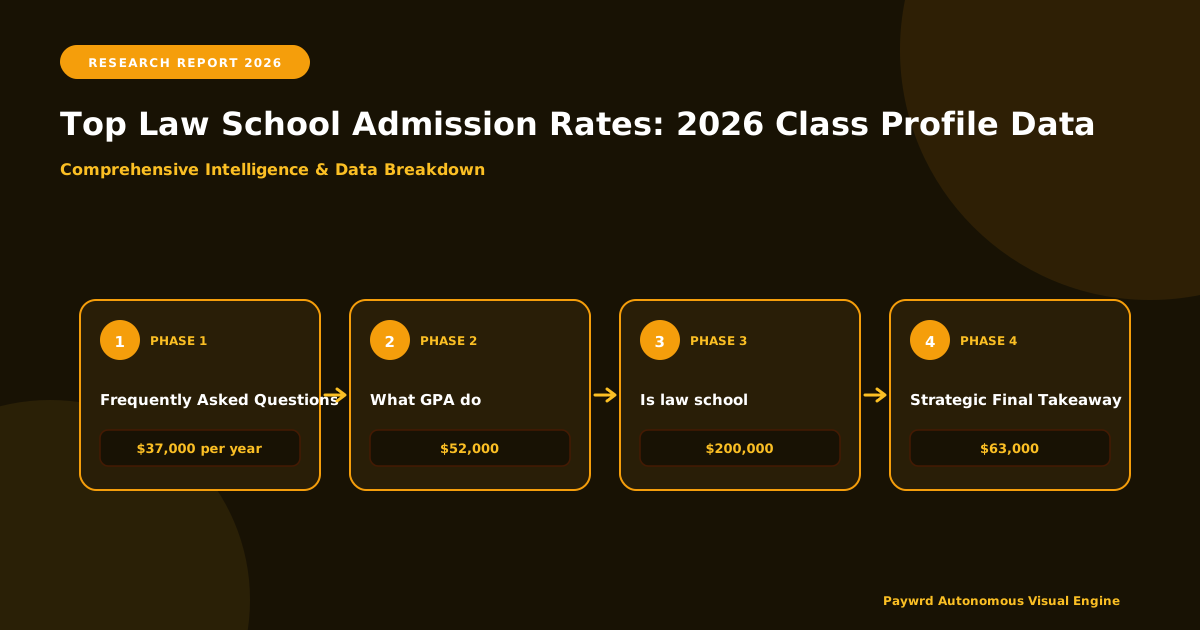
Frequently Asked Questions
What LSAT score do you need for top law schools in 2026?
For the 2025–2026 admissions cycle, the top 14 ABA-approved law schools require a median LSAT score between 170 and 177. Yale, Stanford, and Harvard admit median scorers of 176–177. A score of 170+ places you competitively, while 173+ is generally necessary for the T-14. Scores below 165 typically eliminate candidates at these elite institutions.
What GPA do you need to get into a top law school?
Top law schools for the 2026 entering class report median undergraduate GPAs ranging from 3.79 (UC Berkeley) to 3.94 (Yale). The T-14 typically requires a 3.85+ median GPA. Most successful applicants hold GPAs above 3.7, though LSAT performance can offset slightly lower grades at less selective programs within the top tier.
How much does law school cost at the top ABA-approved schools?
Annual tuition at top ABA-approved law schools for 2026 ranges from $62,475 (UC Berkeley in-state) to $78,930 (out-of-state) and $72,000–$75,500 at private institutions like Columbia, NYU, and Stanford. Total three-year tuition costs typically exceed $200,000, excluding living expenses, books, and fees averaging $25,000+ annually.
Is law school worth the cost in 2026?
Top law school graduates in 2026 command median starting salaries of $175,000–$225,000, with Big Law firms paying $225,000 nationally. The investment typically pays off within 5–7 years for T-14 graduates, though loan debt averaging $165,000 makes career planning essential. Lower-ranked schools yield significantly diminished returns.
Strategic Final Takeaway
Success in evaluating Top Law School Admission Rates: 2026 Class Profile Data relies on early preparation, adherence to verified accredited requirements, and cross-referencing official portals. Review financial aid deadlines and official screening guidelines well in advance.