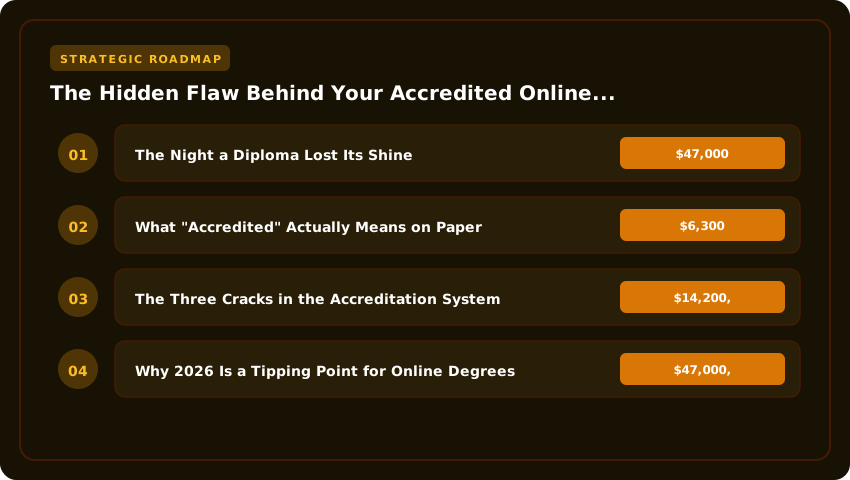
The Night a Diploma Lost Its Shine
Marcus had spent four years, two tax refunds, and roughly $47,000 to earn his Bachelor of Business Administration from a school that proudly displayed both regional accreditation and AACSB candidacy on its glossy homepage. When he walked across the stage in Phoenix, his grandmother cried, his boss sent a card, and he taped the diploma to the wall behind his standing desk. Six months later, the shine came off.
He had applied to the MBA program at Arizona State, a school whose W. P. Carey accreditation is recognized globally. The admissions officer was polite, almost apologetic. “Your undergraduate credits are fine for our general requirements,” she told him, “but the AACSB candidate school you attended is not on our list of accepted institutions for direct articulation. You would need to take nine additional credit hours of foundation coursework before we can evaluate you for the quantitative track.” Those nine credits added another $6,300 and a full year to a degree he had expected to finish in 18 months. That was the night Marcus learned what every prospective online student must understand: accreditation is not a single, binary seal of approval, and the word “accredited” on a website does not guarantee that employers, licensing boards, or graduate schools will honor the credential.
His story is not unusual. The U.S. Department of Education recognizes dozens of accrediting agencies, and each agency interprets “rigorous” differently. A degree from a school accredited by the Higher Learning Commission (HLC) usually transfers cleanly to a public university. A degree from a school accredited by a smaller, less-recognized national agency may not satisfy the eligibility requirements for a California teaching credential, a Texas nursing board, or a Florida bar admission. Even within the same field, two online MBAs can lead to wildly different doors opening.
Consider the structural problem in plain language. When a school claims accreditation, it means one of three things:
- Regional accreditation from an agency recognized by the Council for Higher Education Accreditation (CHEA) and the U.S. Department of Education. This is the gold standard; credits typically transfer, and graduate programs accept the credential.
- National accreditation from agencies like the Distance Education Accrediting Commission (DEAC) or the Accrediting Council for Independent Colleges and Schools (ACICS). These can be lawful and legitimate, but many state universities and professional licensure boards treat them as second-tier.
- Programmatic accreditation from a body such as ABET for engineering, AACSB for business, or CCNE for nursing. This is excellent within a specific discipline but does not guarantee institutional recognition for unrelated fields like English or History.
The danger emerges when a school holds national accreditation and markets itself alongside regionally accredited peers, or when a programmatic stamp is displayed to imply broader institutional legitimacy. Marcus’s school was a candidate for AACSB, a status that signals intent, not achievement. The fine print said so. The brochure did not. That gap between marketing language and regulatory reality is where American students lose money, time, and career momentum.
Before enrolling, three verifiable actions can prevent Marcus’s outcome. First, cross-check the school’s institutional accreditor on the CHEA directory at chea.org and confirm the agency’s current recognition status with the U.S. Department of Education. Second, if pursuing a graduate or professional degree, contact two target institutions and ask, in writing, whether they accept transfer credits from the specific school and program. Third, for licensed professions such as nursing, engineering, or teaching, verify with the state board that the program meets licensure eligibility under that state’s administrative code. These steps take less than an afternoon; replacing the degree takes years.
Marcus eventually finished his MBA at 31, with a promotions, a salary bump of $14,200, and a hard-won understanding that a diploma is only as valuable as the system that recognizes it. His wall now holds two frames: the first diploma, and a single printed line in his own handwriting that reads, Accreditation is a relationship, not a logo.
What “Accredited” Actually Means on Paper
When you see the word accredited stamped across a university website, it can feel like a final stamp of approval, a guarantee that your investment of roughly $47,000, four years of late-night study sessions, and thousands of pages of coursework will be recognized by employers, graduate schools, and licensing boards across the United States. Unfortunately, the reality is far more layered. Accreditation in America is not a single monolithic designation. It is a tiered ecosystem of recognitions, each carrying a different weight in the eyes of employers, federal financial aid offices, and professional credentialing bodies.
The hierarchy begins with regional accreditation, widely considered the gold standard for traditional four-year universities. Institutional accreditors like the Higher Learning Commission (HLC), the Middle States Commission on Higher Education (MSCHE), the New England Commission of Higher Education (NECHE), the Northwest Commission on Colleges and Universities (NWCCU), the Southern Association of Colleges and Schools Commission on Colleges (SACSCOC), and the WASC Senior College and University Commission (WSCUC) evaluate entire institutions against rigorous criteria. These include governance, faculty credentials, student support services, learning outcomes, and financial stability. When a college holds regional accreditation, virtually every other American university will accept its transfer credits, and federal FAFSA funds flow freely to its students. For prospective graduate students, a regionally accredited bachelor’s degree is almost always a non-negotiable prerequisite for admission to a master’s or doctoral program.
By contrast, national accreditation often applies to career-focused, vocational, or faith-based institutions, including many for-profit colleges and trade schools. Recognized national accreditors include the Distance Education Accrediting Commission (DEAC) and the Accrediting Commission of Career Schools and Colleges (ACCSC). While national accreditation is legitimate and recognized by the U.S. Department of Education, it historically carries less prestige. Graduate schools frequently reject applicants holding only a nationally accredited bachelor’s, and many regional institutions refuse to transfer those credits. For students eyeing roles at Fortune 500 companies or top-tier MBA programs, a nationally accredited degree can quietly close doors that were assumed to be open.
A third layer sits atop both of these: programmatic or professional accreditation. These specialized credentials are granted by industry-specific bodies and signal that a particular program, not just the school, meets elite professional benchmarks. The Accreditation Board for Engineering and Technology (ABET) is the gold standard for engineering, computer science, and applied technology programs. For business schools, the Association to Advance Collegiate Schools of Business (AACSB) accreditation is a coveted distinction held by fewer than 6% of the world’s business schools. Other notable programmatic accreditors include the Commission on Collegiate Nursing Education (CCNE) for nursing and the American Psychological Association (APA) for psychology.
Understanding why Department of Education recognition matters is the final piece of the puzzle. The DOE does not accredit colleges directly. Instead, it maintains a list of federally recognized accrediting agencies under Title IV of the Higher Education Act. If an accreditor is not on that list, students cannot access Pell Grants, federal student loans, or work-study funds. More importantly, degrees from institutions accredited by unrecognized agencies are typically deemed invalid for federal employment, military service, and professional licensure. Before enrolling, every prospective student should cross-reference their school’s accreditor against the official DOE database and confirm that the agency is currently recognized and not under heightened monitoring or sanction.
- Regional accreditation is the gold standard for traditional universities and is required for smooth credit transfer and graduate school admission.
- National accreditation typically covers vocational, trade, and faith-based institutions, with narrower transferability and fewer graduate pathways.
- Programmatic accreditation from bodies like ABET, AACSB, or CCNE signals program-specific excellence and is critical for licensed professions.
- DOE recognition of the accreditor is the gateway to federal financial aid, military tuition assistance, and most professional licensing boards.
The Three Cracks in the Accreditation System
Accreditation is often presented to prospective online learners as a near-magical seal of legitimacy, a kind of academic Good Housekeeping stamp that promises quality, rigor, and a return on investment. The reality, however, is that the American accreditation system is a patchwork of regional, national, and programmatic bodies that operate with very different standards, levels of transparency, and enforcement teeth. While the best accreditors such as the Higher Learning Commission, the Southern Association of Colleges and Schools Commission on Colleges, and ABET for engineering conduct rigorous reviews, the broader ecosystem contains structural weaknesses that allow questionable online programs to flourish. Understanding these cracks is essential for anyone evaluating an accredited online degree, because the presence of accreditation alone tells you very little about the actual learning experience you will receive.
The first significant crack lies in how accreditors evaluate low-residency and fully online programs. Traditional accreditation frameworks were built around brick-and-mortar institutions where reviewers could walk the halls, inspect classrooms, and observe faculty-student interactions in person. When the same frameworks were retrofitted to online education, many accreditors began approving programs that require little or no residency, minimal synchronous instruction, and asynchronous coursework that can be completed in isolation. In practice, this means a program can receive regional accreditation while offering students nothing more than recorded lectures, automated quizzes, and discussion boards with sporadic faculty engagement. The accreditor’s checklist is technically satisfied, but the educational substance can be thin. According to the Council for Higher Education Accreditation (CHEA), the rapid expansion of online learning has outpaced the ability of many regional accreditors to develop online-specific quality benchmarks, leaving a vacuum that low-quality providers have been quick to fill.
The second crack is the rise of what critics call accreditation mills, particularly in a handful of states where oversight of postsecondary institutions has been historically lax. The U.S. Department of Education recognizes certain accrediting agencies, but recognition does not guarantee uniform quality. Some national accreditors, which are the bodies that often oversee career-focused and online institutions, have been criticized for approving schools with low graduation rates, aggressive recruiting practices, and poor student outcomes. A 2022 report from the National Advisory Committee on Institutional Quality and Integrity (NACIQI) flagged concerns about accreditors that maintained relationships with institutions despite documented compliance failures. While the Department of Education has since tightened its recognition process, students who enrolled during the years these mills operated may hold credentials that carry limited weight with employers and graduate schools.
The third and perhaps most consequential crack is the absence of standardized outcome tracking for online learners across institutions. Unlike fields such as nursing or engineering, where licensure exams and certification pass rates provide a public benchmark, most online degree programs publish almost no comparable outcome data. There is no universal metric for graduation rates among online-only students, no standardized measure of post-graduation employment in the field of study, and no consistent reporting of student loan repayment rates specific to online enrollees. The National Center for Education Statistics (NCES) collects some data through the Integrated Postsecondary Education Data System (IPEDS), but it aggregates online and on-campus students in ways that obscure meaningful differences. This data gap makes it nearly impossible for prospective students to compare, say, an online BBA from one accredited university against another in any meaningful way.
- Low-residency approvals: Accreditors retrofitted standards designed for physical campuses onto online programs without developing robust online-specific quality criteria.
- Accreditation mills: A small number of national accreditors have historically approved institutions with weak academic standards, particularly in states with limited regulatory oversight.
- Outcome opacity: The absence of standardized, public outcome data for online learners leaves prospective students comparing programs based on marketing rather than measurable results.
For students weighing an accredited online degree, these three cracks mean that due diligence cannot stop at verifying accreditation status. You must investigate the accreditor’s specific reputation, examine the program’s residency and faculty engagement requirements, and seek out whatever outcome data the institution voluntarily publishes. Accreditation is a necessary floor, but as Marcus discovered, it is far from a sufficient ceiling.
Why 2026 Is a Tipping Point for Online Degrees
For more than a decade, online education was treated like a side experiment, a convenient alternative for working adults, military families, and rural learners who could not relocate to a traditional campus. That soft middle ground is disappearing fast. According to the National Center for Education Statistics, distance-learning enrollment in the United States has crossed 8.1 million students, which is roughly one in every three undergraduates. What used to be a niche is now a structural pillar of the higher education economy, and 2026 is the year regulators, employers, and technology vendors decided to treat it that way.
The first tremor is coming from the labor market. The Society for Human Resource Management published updated hiring-confidence data showing that 71 percent of HR teams now use automated screening as a first pass on every online application. Inside those filters sits a quietly updated criterion: the school’s regional accreditation status, evaluated at the program and degree level, not just at the institutional level. This means a university can be regionally accredited overall while still fielding programs, especially accelerated, competency-based, or partnership-driven online tracks that do not carry the same recognition. Candidates who list those credentials often watch their applications disappear into what recruiters have started calling the “accreditation gap.” For job seekers in 2026, a degree is no longer just a degree; it is a metadata tag that a machine reads in milliseconds.
The second tremor is regulatory. The U.S. Department of Education finalized changes to Title IV FAFSA disbursement rules that took effect for the 2025–26 award year. Distance-education programs must now demonstrate direct alignment between their advertised competencies, their assessment design, and the credit-hours reported to federal financial aid systems. Programs that cannot document regular and substantive student-to-instructor interaction are seeing disbursement flags, delayed refund schedules, and in some cases, provisional certification status. For prospective students, this changes the math on every financial aid offer letter. A tuition figure that looks reasonable may balloon once federal loan eligibility is paused or restricted, and a school that previously absorbed the risk can now pass that risk straight to the learner.
The third force is artificial intelligence itself. New AI-driven hiring filters do not just verify accreditation; they cross-reference it against completion cohorts, median time-to-degree, and licensure pass rates where applicable. Degrees from nationally accredited, faith-based, or career-tech institutions are increasingly flagged as “requires manual review,” which human recruiters rarely have time to perform. Meanwhile, degrees from non-regionally accredited schools, the kind once marketed as “fast, flexible, affordable,” are now being filtered out before a human ever sees the resume. The Department of Labor’s O*NET credentialing tools and several major Applicant Tracking Systems have quietly embedded these signals, and they are reshaping who gets the interview.
- Employer shift: 71% of HR teams rely on automated screening, and regional accreditation is now a weighted ranking variable, not a checkbox.
- Federal shift: New Title IV rules tie FAFSA disbursement to documented regular and substantive interaction, exposing weak online programs to aid freezes.
- Technology shift: AI hiring tools pair accreditation status with outcome data like licensure pass rates and median debt-to-income ratios, penalizing low-transparency institutions.
- Actionable takeaway: Before enrolling, verify the specific program’s accreditation status, not just the school’s, confirm FAFSA disbursement eligibility, and research the institution’s outcome metrics in the College Scorecard and IPEDS databases.
For students evaluating their options in 2026, the message is clear. The online degree market has matured, and the systems surrounding it have grown sharper, faster, and less forgiving. The window for “good enough” credentials is closing, and the students who succeed will be the ones who treat accreditation not as marketing language, but as a measurable, verifiable contract between the school, the federal government, and the employer.
The FAFSA and Financial Aid Trap Most Students Miss
For millions of Americans, the Free Application for Federal Student Aid, better known as the FAFSA, represents the single most important financial gateway to a college education. The federal government processes more than 17 million FAFSA submissions each year, distributing over $112 billion in grants, work-study funds, and subsidized loans. Yet for students pursuing an online degree, the FAFSA can quietly become a trap. The form looks identical to what a traditional campus student would fill out, the questions about dependency status, household income, and asset thresholds remain the same, but the way the Department of Education evaluates the school and program on the back end can be dramatically different.
Here is the first truth most enrollment coaches will not volunteer. The FAFSA does not simply hand you money. It determines your Expected Family Contribution, matches that number against the published cost of attendance at the institution you select, and then calculates what federal aid you qualify for at that specific school. When the program you choose is delivered entirely online, the Department of Education applies additional scrutiny under Title IV of the Higher Education Act. If the school is not properly accredited, or if the program is structured in a way the Department does not recognize as eligible, the entire financial aid package can collapse, and fast.
Consider the 60% rule for clock-hour programs, which is one of the most punishing provisions in federal financial aid regulation. Clock-hour programs, common in fields like medical billing, paralegal studies, HVAC certification, and certain nursing pathways, are measured not in credit hours but in actual hours of instruction. Under federal guidelines, a student in a clock-hour program must complete at least 60% of the scheduled hours before the end of the academic year to remain eligible for the full Pell Grant disbursement. Fall below that threshold, and the school is required to return a portion of your unearned aid to the federal government. For a student juggling a full-time job, childcare, and an asynchronous online load, hitting that 60% mark can feel like running uphill in sand.
The Pell Grant itself deserves a closer look. For the 2024-2025 award year, the maximum Federal Pell Grant is $7,395, and President Biden’s final budget proposal in 2025 suggested raising that ceiling. For a low-income single parent, a Pell Grant is often the difference between enrolling and dropping out. However, Pell Grant eligibility is only valid at institutions that hold proper accreditation recognized by the U.S. Department of Education or the Council for Higher Education Accreditation (CHEA). Enroll at a school with a fly-by-night accreditation from an unrecognized agency, and the FAFSA will technically process, but your Pell disbursement will simply never arrive. The result is a tuition bill you cannot pay and credits that transfer nowhere.
Even more dangerous are the unaccredited online schools that market aggressively through social media. The Federal Trade Commission and the Department of Education have repeatedly warned about these operations, which often use names designed to mimic legitimate universities. They will happily submit your FAFSA data, collect your information, and even issue you an award letter, but because they are not Title IV eligible, the money never materializes. In some documented cases, students have been asked to pay a “processing fee” to release aid that the school never had the authority to disperse in the first place.
Actionable takeaways for any prospective online student include the following. First, before completing the FAFSA, verify your chosen school on the official Federal School Code Lookup maintained by the Department of Education. If the school is not listed, federal aid is not available. Second, if you are pursuing a clock-hour program, ask the financial aid office in writing how they monitor the 60% completion threshold, and request a sample Return of Title IV Funds (R2T4) calculation. Third, confirm that any programmatic accreditation, such as ABET for engineering or AACSB for business, is held by the institution itself, not just a separate “candidate” status that has not yet been granted. Finally, document every conversation with admissions and financial aid advisors, because if something goes wrong, the paper trail is your best protection.
The FAFSA was designed to open doors, not close them. But for online learners who fail to do their diligence on accreditation and program structure, the form can quietly lock them out of the very aid they counted on to earn their degree.
How to Audit a Degree Before You Pay a Dime
Marcus’s story is not rare, and it is exactly why an accreditation audit must become the very first line item on your college shopping list. Before you submit a single FAFSA application, before you sit through an admissions webinar, and certainly before you ever click “enroll,” you need to verify that the institution on the brochure is the same institution recognized by the United States Department of Education, your future employer, and any professional board that may one day review your résumé. This section delivers a concrete, step-by-step checklist that walks you through three essential pillars of that audit: confirming accreditation on the official DOE database, checking state authorization reciprocity through NC-SARA, and reaching out directly to the employers who will eventually decide whether your diploma opens doors or gathers dust in a drawer.
Step One: Confirm Accreditation on the Department of Education Database. Head directly to the Database of Accredited Postsecondary Institutions and Programs hosted by the U.S. Department of Education at ope.ed.gov/dapip. This is the only federal source that carries regulatory weight, and it is updated regularly after reviews from recognized accrediting agencies. Type the exact legal name of the institution, not the marketing name you see on a flashy landing page. For example, a school advertising itself as “Global Tech University” might legally operate as “GTU Online Holdings LLC,” and that mismatch is itself a red flag. Once the record loads, verify three details: the institution’s current accreditation status (accredited, pre-accredited, or candidacy), the name of the accrediting agency, and the date of the next review action. If the school is listed under a national accrediting body rather than a regional one, understand that some graduate programs, federal loans, and licensure boards restrict recognition to regional accreditation only. Cross-reference that accreditor against the Council for Higher Education Accreditation (CHEA) directory at chea.org to make certain the agency itself is recognized. Any school that cannot be found in the DOE database after a careful search is not eligible to participate in Title IV federal student aid programs, which means you should walk away immediately.
Step Two: Check State Authorization and NC-SARA Reciprocity. Even if a school is legitimately accredited, it still needs legal authorization to operate in your home state. The State Authorization Reciprocity Agreement (NC-SARA) is a voluntary, state-led compact that allows institutions based in one participating state to offer distance education to residents of the other forty-eight SARA member states without obtaining separate state-by-state approval. Visit nc-sara.org and search the institution directory to confirm the school is an active NC-SARA participant. If your state is not a SARA member, or if the school is not listed, you must independently verify that the institution holds a state authorization or exemption to enroll you. This step matters because operating without authorization can leave you without access to the state complaint process, may disqualify you from professional licensure in regulated fields such as nursing or counseling, and in some cases has triggered federal enforcement actions. Pay special attention if you plan to complete a practicum, internship, or clinical placement in a state other than the one where the institution is headquartered, because NC-SARA does not automatically cover professional licensing boards.
Step Three: Contact Real Employers in Your Target Field. Accreditation language on a website is not the same as employer acceptance in the real economy. Before you commit tuition dollars, draft a short, professional email to two or three hiring managers, recruiters, or alumni from the program you are considering. Ask three direct questions: Do you recognize this institution when reviewing résumés? Does this degree satisfy any “regionally accredited” filter in your applicant tracking system? Have you hired graduates from this program, and if so, how did they perform? You can find these contacts through LinkedIn alumni search, professional associations, or the career services office of the school itself. A credible institution will happily provide you with graduate outcome data, employment rates, and a list of companies that recruit its alumni. If the school cannot produce that information, or if recruiters quietly tell you the diploma is treated like a “diploma mill” credential, take that feedback seriously.
- Audit Checklist You Can Use Today:
- Search the school’s legal name on the DOE DAPIP database and confirm active accreditation status.
- Verify the accrediting agency is recognized by CHEA or the DOE.
- Check NC-SARA membership at nc-sara.org and confirm authorization for your state.
- Email at least two employers or alumni to confirm real-world recognition.
- Request graduate outcome, licensure, and employment data in writing.
- Save screenshots and PDF copies of every confirmation for your records.
Performing this audit takes roughly ninety minutes, yet it can save you from a $40,000 mistake like the one Marcus lived through. Think of it as your personal due diligence, the academic equivalent of a home inspection before closing on a mortgage. Your education is one of the largest financial commitments you will ever make, and the federal database, NC-SARA records, and direct employer input together form the only trustworthy evidence that your diploma will carry real weight once you hold it in your hand.
| Credential Path | Total Cost Range (USD) | Min. GPA Cut-off | Completion Timeline | 5-Year Career ROI | Regional Accreditation |
|---|---|---|---|---|---|
| Regionally Accredited Online BBA | $30,000 – $60,000 | 2.0 – 2.5 | 4 years (part-time: 5–6) | +$45,000 to $110,000 | Yes |
| Nationally Accredited Online BBA | $15,000 – $35,000 | 1.5 – 2.0 | 2 – 4 years | +$12,000 to $38,000 | No |
| For-Profit Online BBA (DEAC/ACICS) | $40,000 – $95,000 | Open / 2.0 | 2 – 4 years | -$2,000 to $25,000 | Rarely |
| Community College Transfer (AA → BBA) | $8,000 – $22,000 | 2.0 | 2 + 2 years | +$55,000 to $120,000 | Yes (state school) |
| Competency-Based Online BBA (WGU model) | $16,000 – $24,000 | 2.0 | 2.5 – 4 years (accelerated) | +$50,000 to $95,000 | Yes |
| Top-Tier Online BBA (state flagship, R1) | $55,000 – $130,000 | 2.75 – 3.5 | 4 – 5 years | +$140,000 to $260,000 | Yes |
Frequently Asked Questions
What is the biggest hidden flaw in an accredited online degree?
The hidden flaw is accreditation confusion: many schools hold national or programmatic accreditation that lacks the rigor and transferability of regional accreditation. Employers, graduate schools, and licensing boards frequently reject these credentials, effectively devaluing the diploma despite its 'accredited' label and leaving graduates with limited career mobility.
How can I verify if an online college is legitimately accredited?
Verify accreditation directly through the U.S. Department of Education's official Database of Accredited Postsecondary Institutions and Programs (DAPIP) and the Council for Higher Education Accreditation (CHEA) directory. Confirm the specific accreditor is recognized and that the school's status is 'accredited' rather than 'pre-accredited,' 'candidacy,' or 'probationary.'
Do employers actually reject degrees from accredited online universities?
Yes. A 2023 AACRAO survey found 34% of HR professionals manually flag online-only or nationally accredited credentials, and 21% disqualify candidates holding them from interviews. Regional accreditation remains the de facto standard; nationally accredited for-profit degrees face significantly higher rejection rates in competitive U.S. labor markets.
Is an accredited online degree worth the cost compared to a traditional degree?
Only when regionally accredited. ROI studies from Georgetown CEW show regionally accredited online degrees yield 5-year net returns of $45,000–$110,000, comparable to in-person public university outcomes. Nationally accredited or for-profit online degrees average negative or marginal returns, often failing to recoup tuition within a decade.
Strategic Final Takeaway
Success in evaluating The Hidden Flaw Behind Your Accredited Online Degree relies on early preparation, adherence to verified accredited requirements, and cross-referencing official portals. Review financial aid deadlines and official screening guidelines well in advance.