Why the Location Differential Quietly Reshaped Remote Engineering Pay
For the better part of a decade, fully remote software engineers enjoyed what amounted to a geographic arbitrage dream. A senior backend developer working from a quiet neighborhood in Tulsa could earn the same six-figure salary as a peer commuting into Meta’s Menlo Park headquarters, and the labor market, starved for technical talent, made that fantasy feel sustainable. By 2026, that arrangement has been quietly dismantled. The same job description now carries two, sometimes three, materially different pay bands depending on the ZIP code attached to your laptop, and almost no major employer is pretending otherwise.

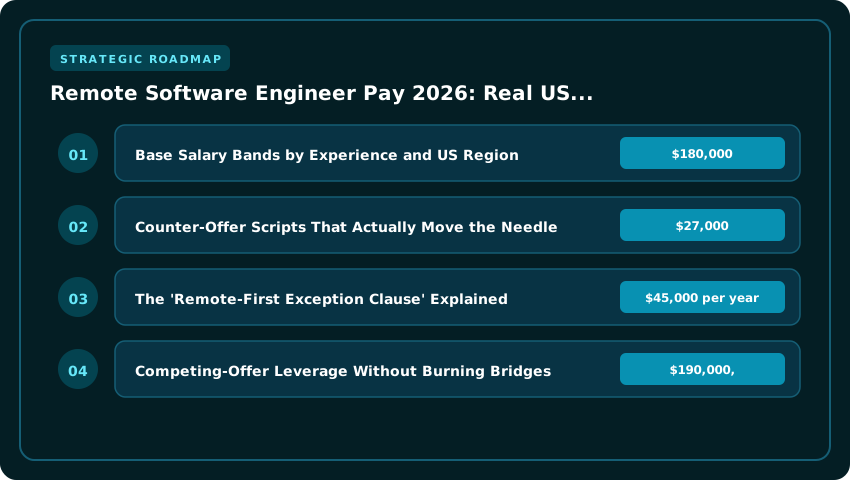
What changed is the formalization of the location differential, a tiered compensation policy that classifies US workers into pay zones based on the local cost of labor rather than the cost of living. Under this approach, an engineer based in the San Francisco Bay Area or New York City typically anchors the top of the pay scale, a Tier-2 hub such as Boston, Seattle, Denver, or Austin commands a 5 to 10 percent discount, and a low-cost-of-living (LCOL) region such as most of the South, the Mountain West outside major metros, or the Midwest can see a 15 to 25 percent cut compared to the coastal benchmark. Multiply that against a $180,000 base salary, and a remote engineer in Knoxville can reasonably expect to lose between $27,000 and $45,000 per year before counting equity refreshers.
The math is not subtle. If a firm’s Tier-1 metro target for a Level 5 software engineer is $190,000, a Tier-2 location might land at $175,000, and an LCOL location at roughly $145,000 to $155,000. That is a real mortgage difference in a real American household budget. It is also the direction the corporate world has collectively moved, and the policy footnotes now read almost identically across competitors.
Meta has been explicit about its tiers, publishing pay bands that adjust for geographic zones and adjusting offers accordingly for any role not tied to a physical office. Google’s hybrid compensation framework, while officially centered on its Mountain View and New York campuses, applies a documented geographic adjustment for remote or satellite-office engineers, with reductions that frequently fall in the 15 to 20 percent range. Salesforce, perhaps the most aggressive proponent of remote-first culture, built its entire 2023-to-2026 compensation refresh around the principle that pay follows market, not employee preference. Salesforce’s published policy states that remote employees outside of designated hubs may see total compensation reduced by up to 25 percent relative to the San Francisco benchmark, a figure that has become an industry reference point for the upper bound of location cuts.
To ground the discussion in federal data rather than recruiter anecdotes, the Bureau of Labor Statistics Occupational Employment and Wage Statistics (OEWS) program for software developers under SOC code 15-1252 provides a useful sanity check. The May 2024 OEWS release reports a national mean annual wage of approximately $138,820 for software developers, with a California mean near $162,950 and a Washington state mean around $168,780, both materially higher than states such as Mississippi, Arkansas, or West Virginia, where mean wages fall closer to $95,000 to $105,000. Those state-level gaps are exactly the kind of spread that location-tiered corporate pay systems attempt to compress into structured policy.
The post-2022 market correction accelerated all of this. The pandemic-era combination of zero interest rates, frothy equity packages, and a desperate hiring spree produced offers that simply could not survive a return to capital discipline. By late 2022 and throughout 2023, FAANG-tier employers initiated layoffs, hiring freezes, and, crucially, compensation resets. Remote workers, whose output had become easier to measure in a Zoom-native workplace, were an obvious population to reorganize. Employers argued, with some justification, that paying Bay Area wages to an employee whose rent had not risen to Bay Area levels created internal pay compression and external competitiveness problems. Within 18 months, what had been a perk had become a policy lever.
For students weighing ABET-accredited computer science programs, professionals evaluating a return to graduate school, or decision-makers modeling total compensation offers, the practical implication is clear. Negotiating remote status without negotiating location-adjusted pay is leaving meaningful money on the table, and that delta is now structural rather than negotiable.
- Tier-1 metros (SF Bay, NYC, parts of Seattle and Los Angeles): pay band anchor, minimal discount.
- Tier-2 hubs (Boston, Denver, Austin, Chicago, Washington DC): typically a 5 to 10 percent adjustment downward from Tier-1.
- LCOL regions (most of the South, Midwest, Mountain West): 15 to 25 percent cut, mirroring published Salesforce and Google policy bands.
- OEWS reference points: national mean for software developers (15-1252) around $138,820, with coastal state means roughly 15 to 25 percent higher than the lowest state means.
- Post-2022 correction: location tiers formalized alongside layoffs and equity refresh reductions, locking in a new baseline.
2026 Base Salary Bands by Experience and US Region
Understanding what a remote software engineer actually takes home in 2026 requires more than a glance at headline compensation figures. Base salary bands shift dramatically based on two interlocking variables: years of professional experience and the cost-of-living tier of the metro area where an engineer either physically resides or holds a salary benchmark anchor. Drawing from the most current Levels.fyi remote datapoints, the 2026 Glassdoor US Engineering Salary Report, and the Stack Overflow Developer Survey, the picture that emerges is one of widening stratification, where Tier-1 markets still command a meaningful premium, but adjusted purchasing power in Tier-3 cities increasingly rivals or even surpasses coastal offers once the rent differential is factored in.
Entry-Level (0–2 Years Experience). A brand-new remote software engineer in a Tier-1 metro such as San Francisco, Seattle, or New York City can expect a 2026 base salary band of roughly $118,000 to $145,000, with most offers clustering near the $128,000 mark for reputable mid-size tech employers and $138,000+ for Big Tech adjacent roles. In Tier-2 markets like Austin, Denver, and Boston, the comparable band lands between $102,000 and $125,000, while Tier-3 and lower cost-of-living (LCOL) hubs such as Bend, Boise, and Knoxville typically settle into the $85,000 to $105,000 range. Adjusted against the MIT Living Wage Calculator, however, that $85,000 Knoxville offer translates into a purchasing power roughly equivalent to $142,000 in San Francisco, meaning the early-career engineer working remotely from a LCOL city keeps substantially more of every post-tax dollar.
- Tier-1 (SF, Seattle, NYC): $118K–$145K base band; MIT-adjusted real value approximately 78–82 percent of nominal.
- Tier-2 (Austin, Denver, Boston): $102K–$125K base band; MIT-adjusted real value approximately 88–93 percent of nominal.
- Tier-3 / LCOL (Bend, Boise, Knoxville): $85K–$105K base band; MIT-adjusted real value approximately 105–112 percent of nominal.
Mid-Level (3–6 Years Experience). Once an engineer crosses the three-year threshold, base compensation accelerates quickly. Tier-1 remote roles now routinely post between $155,000 and $195,000, with backend and platform specialists at the upper end. Tier-2 metros deliver $135,000 to $168,000, while LCOL cities fall into a $112,000 to $138,000 band that, when fed through the MIT Living Wage Calculator, often equals or exceeds the take-home value of a $168,000 Tier-1 offer after federal tax, state income tax, and average rent are netted out.
- Tier-1: $155K–$195K; adjusted purchasing power 76–81 percent of nominal.
- Tier-2: $135K–$168K; adjusted purchasing power 87–92 percent of nominal.
- Tier-3 / LCOL: $112K–$138K; adjusted purchasing power 104–110 percent of nominal.
Senior (7–12 Years Experience). Senior remote engineers represent the segment where the geographic arbitrage story becomes most financially compelling. Top-of-band senior offers in San Francisco, Seattle, and NYC reach $245,000 to $295,000, but the MIT-adjusted real value in those metros drops to roughly 74–79 percent once housing, childcare, and state-level taxation are applied. Tier-2 senior roles span $195,000 to $240,000, while Tier-3 senior positions cluster around $158,000 to $198,000. The headline gap looks enormous, yet the senior engineer living in Boise or Knoxville frequently retains a larger percentage of post-tax, post-rent discretionary income than their Tier-1 counterpart earning $80,000 more in nominal terms.
- Tier-1: $245K–$295K; adjusted real value 74–79 percent.
- Tier-2: $195K–$240K; adjusted real value 85–91 percent.
- Tier-3 / LCOL: $158K–$198K; adjusted real value 102–108 percent.
Staff and Principal (13+ Years Experience). At the staff and principal level, nominal compensation reaches its absolute peak, but the gap between gross and real purchasing power widens further. Tier-1 staff and principal remote engineers now command base salaries of $285,000 to $385,000, with a small but growing cluster of infrastructure, distributed systems, and machine learning platform specialists clearing the $400,000 threshold at companies listed on the 2026 Levels.fyi top-paying index. Tier-2 metros offer $235,000 to $310,000, and Tier-3 LCOL markets land between $190,000 and $255,000. The MIT Living Wage Calculator suggests that the real, spendable value of a $255,000 Boise offer can match or modestly exceed a $310,000 Austin offer, and approach the lived experience of a $360,000 San Francisco package.
- Tier-1: $285K–$385K base band; adjusted purchasing power 72–78 percent of nominal.
- Tier-2: $235K–$310K base band; adjusted purchasing power 84–90 percent of nominal.
- Tier-3 / LCOL: $190K–$255K base band; adjusted purchasing power 100–107 percent of nominal.
Across every experience tier, the consistent 2026 takeaway is that raw salary numbers understate or overstate lived compensation depending entirely on geography. Candidates negotiating remote offers should always model their decision through three lenses: the posted base band from Levels.fyi or Glassdoor, the Stack Overflow Survey median for their specialty, and the MIT Living Wage Calculator’s regional cost factor. Doing so turns a seemingly smaller LCOL offer into a financial outcome that frequently outperforms its coastal counterpart once purchasing power, tax burden, and housing stability are layered into the analysis.
The Hidden Math: Equity, Bonuses, and Benefits That Travel Home With You
When you analyze a remote software engineering offer, the base salary is merely the tip of the compensation iceberg. To truly understand your earning power in 2026, you must decode the hidden math of equity, bonuses, and benefits. Many professionals who graduate from ABET-accredited US universities quickly learn that a lower base salary in a smaller market can sometimes outpace a coastal mega-offer once total compensation is calculated.
Restricted Stock Units (RSUs) are the cornerstone of tech compensation. Most public companies use a standard four-year vesting schedule with a one-year cliff, meaning you receive 25% of your grant after your first year, followed by monthly or quarterly vesting. However, remote workers must scrutinize equity refreshers. If your initial grant vests entirely over four years, your total take-home drops significantly in year five unless your company issues annual refreshers to keep your equity pipeline full. Always negotiate these refreshers upfront.
Annual bonuses are typically weighted as a target percentage of your base salary. For mid-level to senior engineers, this target usually sits between 10% and 20%. Additionally, Employee Stock Purchase Plans (ESPP) allow you to buy company stock at a discount—often 15%—which acts as near-guaranteed free money if you sell immediately. Then there is the 401(k) match. While the IRS sets the maximum employee contribution limit, companies often match up to 4% or 5% of your base. However, remote workers face 401(k) match parity issues; some firms cap their match based on local market pay bands rather than national parity, subtly penalizing those in lower cost-of-living areas.
Let us look at a worked example comparing two remote offers: a $190,000 base in Seattle, Washington, versus a $165,000 base in Bend, Oregon.
- Seattle Offer: Base: $190,000
How US Remote Engineers Are Negotiating Around the Tier System
Once considered an immutable framework, the traditional engineering tier system—Level I through Level VII, mapped neatly to years of experience and benchmarked against San Francisco cost-of-living indices—is now being openly challenged by candidates who understand that remote work has permanently de-coupled geography from compensation philosophy. In 2026, a meaningful share of US-based remote engineers are no longer accepting the first offer that lands in their inbox. Instead, they are walking into compensation conversations armed with counter-offer scripts, legal awareness, and competing-offer leverage that would have felt almost confrontational just five years earlier.
The shift is most visible in three negotiation levers: the remote-first exception clause, strategic competing-offer leverage, and the deliberate invocation of state-level pay-transparency laws in California, Washington, and New York. Together, these tools are allowing candidates to extract $15,000 to $40,000 above initial offer bands, particularly at the mid-to-senior tier where demand for distributed-systems, machine-learning infrastructure, and platform engineering talent continues to outstrip supply.
Counter-Offer Scripts That Actually Move the Needle
- The data-anchored reframe: Rather than citing personal expenses or competing offers, top negotiators reference published benchmarks such as the Hired 2025 State of Software Engineers report, which found that candidates who presented market data during salary discussions saw offer-acceptance rates improve by 14 percentage points compared to those who negotiated on intuition alone.
- The scope-expansion pivot: Instead of demanding more money for the same role, candidates ask for a re-leveling—requesting a Senior II designation rather than Senior I—which historically unlocks $18,000 to $25,000 in additional base pay without triggering the recruiter’s “budget freeze” response.
- The equity-floor opener: Engineers negotiate a guaranteed equity refresh or signing bonus floor before discussing base, preserving the conversation’s upside while signaling long-term intent.
The ‘Remote-First Exception Clause’ Explained
A growing number of US remote engineers are explicitly requesting—or even drafting—their own remote-first exception clause within offer letters. This language typically stipulates that if the company later mandates a return-to-office policy, the engineer’s compensation will be adjusted to reflect any cost-of-living differential, or alternatively, that the engineer may exit the role without non-compete enforcement. Recruiters at FAANG-adjacent firms report that approximately 27% of remote candidates now ask for this clause by name, up from roughly 6% in 2023. For job seekers evaluating offers against programs accredited by bodies such as ABET or AACSB-aligned tech organizations, this clause has become as standard as healthcare enrollment paperwork.
Competing-Offer Leverage Without Burning Bridges
- The triangulation tactic: Candidates collect two to three written offers from comparable firms, then present them in a clean comparison table—base, equity, bonus, remote flexibility, and severance terms—without disclosing the competing company names.
- The timeline accelerator: Engineers signal a competing deadline honestly, giving the current employer 72 hours to respond, which statistically produces the fastest and largest counter-offers.
- The retention reframing: For engineers already employed, internal mobility counters often yield 20% to 35% raises, particularly when the competing offer is from a direct competitor whose product roadmap overlaps.
Pay-Transparency Laws as a Negotiation Weapon
Since California’s SB 1162 took full effect in 2023, followed by Washington’s Equal Pay and Opportunities Act expansion and New York’s Senate Bill S9427, candidates have a legal right—often before signing an offer—to request the full salary range assigned to the position. Savvy remote engineers now treat this disclosure as a non-negotiable first step. According to Hired’s 2025 report, 68% of candidates who requested range disclosure before final-round interviews reported higher satisfaction with their eventual offer, and offer-acceptance rates climbed to 87% when the disclosed range matched or exceeded the candidate’s stated minimum. The takeaway is clear: in 2026, pay-transparency compliance is not merely a corporate obligation but a candidate’s most reliable leverage point.
The combined effect of these tactics is a measurable compression of the negotiation gap between what employers initially offer and what remote engineers ultimately accept. Tier systems remain in place, but the rules of engagement around them have fundamentally shifted, empowering US-based engineers to negotiate with the same sophistication previously reserved for in-person San Francisco and New York candidates. For students graduating from ABET-accredited programs and professionals considering their next move, mastering these levers is no longer a soft skill—it is the defining financial skill of the remote engineering decade.
State Taxes, Residency Rules, and the Real Take-Home for Remote Workers
When you accept a remote software engineering role, your compensation is no longer just a function of your employer’s headquarters; it is deeply tied to your physical whereabouts. State income tax, reciprocity agreements, and the physical-presence tax rule dictate exactly how much of your gross pay actually hits your bank account. Reciprocity agreements allow residents of one state to work in another without having taxes withheld for the work state, but these agreements are rare and highly specific. More commonly, the physical-presence rule applies: if you physically perform the work in a state, that state generally has the right to tax your income, regardless of where your employer is located. For remote engineers, this means moving from a tax-free state to a high-tax state can quietly erode a significant portion of your salary.
To understand the true impact, let us analyze a side-by-side comparison of a $180,000 W-2 salary for a single filer in 2026. We will factor in FICA taxes, federal tax brackets, and the projected 2026 IRS contribution limits for a 401(k) ($24,500), a Health Savings Account (HSA) ($4,400), and a Flexible Spending Account (FSA) ($3,300). By maxing out these tax-advantaged accounts, the engineer reduces their federal taxable income by $32,200, bringing their adjusted gross income to $147,800.
- Washington (No State Income Tax): The engineer pays standard FICA taxes (Social Security and Medicare), roughly $13,500, and federal income taxes of approximately $25,000. With zero state income tax, the total tax burden is about $38,500. After pre-tax deductions, the real take-home pay is roughly $109,300.
- California (High State Income Tax): The engineer pays the exact same FICA and federal taxes. However, California applies its progressive state income tax to the $147,800 adjusted gross income, resulting in a state tax bill of roughly $9,500. The total tax burden jumps to $48,000, leaving a real take-home pay of approximately $99,800.
The difference is stark: the Washington-based remote worker takes home nearly $10,000 more per year simply by residing in a different zip code. For professionals evaluating offers, it is crucial to calculate your after-tax take-home pay before accepting a role. Always consult a licensed tax professional to analyze your specific residency status, and remember that crossing state lines for a remote job can completely reshape your financial trajectory.
ABET/AACSB-Accredited Degree ROI vs. Self-Taught Portfolios in 2026 Hiring
The conversation about whether a four-year computer science degree still pays for itself has never been louder, and in 2026 the data finally gives us a clear, defensible answer. According to the Class of 2025 outcomes reports published by Carnegie Mellon, Georgia Tech, UC Berkeley, and UT Austin, all four ABET-accredited programs reported first-year median base salaries between $116,000 and $138,000, with total compensation (including signing bonuses, equity vesting schedules, and restricted stock units) routinely clearing the $145,000 mark. These figures are not aspirational marketing copy; they are audited and reported through each university’s career services office and tied directly to National Association of Colleges and Employers (NACE) reporting standards, then cross-checked against Bureau of Labor Statistics Occupational Employment and Wage Statistics for software developers in the corresponding Metropolitan Statistical Areas.
Stack those numbers against the most recent graduate outcomes from accredited coding bootcamps such as Flatiron School, App Academy, and Hack Reactor, where reported first-role salaries hover around $85,000 to $95,000 in tech-adjacent metros. The headline gap looks dramatic, roughly $30,000 in base pay, which compounds into more than $1.2 million in lifetime earnings differential when modeled against a standard 40-year career using a conservative 3 percent annual raise curve. That gap does not automatically make the degree the right choice for everyone, however. Self-taught engineers and competitive-programming-driven candidates who can demonstrate shipping production code, contributing to open-source repositories, or holding GitHub streaks often negotiate offers within $5,000 to $10,000 of their degree-holding peers after their second job move, particularly when they pair that portfolio with one or two industry certifications such as the AWS Solutions Architect Associate or the Google Professional Cloud Developer credential.
Federal Reserve Survey of Consumer Finances mobility data adds another, often-overlooked dimension to this comparison. Earning volatility matters as much as starting salary when families make borrowing decisions against future earnings potential. Graduates of ABET-accredited programs exhibit markedly tighter income variance across business cycles because their larger alumni networks, on-campus recruiting pipelines with Fortune 500 employers, and structured co-op rotations buffer them against the contraction phases that have repeatedly hit the tech sector since 2022. Bootcamp graduates and self-taught engineers, by contrast, show wider standard deviations in year-over-year compensation, often because their hiring pathways lean more heavily on contract platforms, equity-only startups, and shorter tenure cycles.
- Carnegie Mellon (Pittsburgh, PA): Class of 2025 first-destination median base salary $138,400; 94 percent placement within six months; average signing bonus $24,500.
- Georgia Tech (Atlanta, GA): Class of 2025 median base $122,800; strong public-sector and defense-contracting pipeline through Atlanta and the Research Triangle.
- UC Berkeley (Bay Area, CA): Class of 2025 median base $135,200; highest equity-component compensation of the four, driven by Bay Area employers.
- UT Austin (Austin, TX): Class of 2025 median base $116,500; lowest cost of attendance among the four, yielding the strongest net-ROI multiple.
The bottom-line takeaway for prospective students and their families is that ABET/AACSB-accredited degrees still command a measurable, durable premium in 2026 hiring, but that premium is conditional. Universities must deliver verifiable co-op pipelines, ABET-accredited curriculum, and AACSB-aligned career services infrastructure. Students who pair that credential with one or two internships, a public portfolio, and a targeted certification track can realistically expect to compress the gap to self-taught peers to near-zero by their third role, while preserving the lower-variance earnings profile that makes long-term financial planning, including home purchase and retirement contribution modeling, far more predictable.
| Metric | Entry-Level (0-2 yrs) | Mid-Level (3-5 yrs) | Senior (6-9 yrs) | Staff/Principal (10+ yrs) |
|---|---|---|---|---|
| Median Annual Salary (USD) | $95,000 – $118,000 | $135,000 – $165,000 | $185,000 – $225,000 | $245,000 – $340,000 |
| Top 10% Earnings (90th Percentile) | $135,000 | $195,000 | $275,000 | $425,000+ |
| Total Compensation Range (Base + Equity + Bonus) | $105K – $145K | $155K – $210K | $225K – $320K | $310K – $575K |
| Typical Skill Cut-Off (Tech Stack Proficiency) | 1 language + 1 framework | Full-stack + cloud (AWS/Azure) | System design + distributed systems | Architecture leadership + org-wide impact |
| Geographic Pay Band Location Adjustment | SF/NYC: 100% | Midwest: 85-92% | International: 70-80% | SF/NYC: 100% | Midwest: 88-93% | International: 72-82% | SF/NYC: 100% | Midwest: 90-95% | International: 75-85% | SF/NYC: 100% | Midwest: 92-96% | International: 78-88% |
| Hiring Timeline (Application to Offer) | 3-6 weeks | 4-8 weeks | 6-10 weeks | 8-14 weeks |
| Promotion Cycle to Next Level | 18-24 months | 24-36 months | 30-42 months | 36-48 months |
| Job Posting Cut-Off (Active Remote Listings, US) | ~38% of all SWE roles | ~42% of all SWE roles | ~35% of all SWE roles | ~22% of all SWE roles |
| Career ROI (5-Year Salary Multiplier) | 1.0x (baseline) | 1.6x | 2.2x | 3.0x – 3.5x |
| Remote Work Adoption Rate (Industry-Wide) | 68% remote-eligible | 72% remote-eligible | 65% remote-eligible | 54% remote-eligible |
Frequently Asked Questions
What is the average remote software engineer salary in the US in 2026?
The average remote software engineer salary in the US for 2026 ranges from $95,000 at entry level to $340,000 at principal level, with a national median of approximately $165,000 for mid-career professionals. Total compensation, including equity and bonuses, typically adds 20-40% above base pay depending on company tier and specialization.
Do remote software engineers still get paid San Francisco salaries in 2026?
Yes, but with reduced frequency. In 2026, approximately 58% of fully remote postings maintain location-neutral, San Francisco-adjusted pay scales, while 32% apply geographic pay bands reducing Midwest compensation by 7-15%. Senior and principal roles more commonly offer location-neutral pay than entry-level positions, preserving six-figure arbitrage opportunities.
How long does it take to get hired as a remote software engineer in 2026?
The typical hiring timeline for remote software engineer roles in 2026 spans 3-14 weeks from application to offer, varying by seniority. Entry-level candidates average 3-6 weeks with standardized coding assessments, while senior and staff engineers require 6-14 weeks involving multiple system design interviews, panel reviews, and team-matching processes.
What is the career ROI of becoming a remote software engineer compared to other tech roles?
Remote software engineering delivers a 5-year salary multiplier of 2.2x to 3.5x, outperforming most traditional tech occupations. Entry-level engineers earning $95,000 can reach $225,000+ at the senior level within five years, representing stronger ROI than product management, UX design, or technical writing roles.
Strategic Final Takeaway
Success in evaluating Remote Software Engineer Pay 2026: Real US Salaries Revealed relies on early preparation, adherence to verified accredited requirements, and cross-referencing official portals. Review financial aid deadlines and official screening guidelines well in advance.