2025 PMP Cost Breakdown: PMI Fees, Training, & Hidden Expenses
Understanding the precise financial commitment required for PMP certification is the foundational step in calculating your return on investment. Unlike many professional credentials where costs remain opaque, the Project Management Institute (PMI) maintains a transparent fee structure, though the total out-of-pocket expense varies dramatically based on your chosen study pathway. For 2025, candidates in the United States should budget between $1,200 and $5,500 when accounting for every required component, from initial application to final exam submission.
The single most overlooked expense category is what industry veterans call “hidden costs”—the ancillary purchases that inflate your final bill by 30% to 50% if left unplanned. These include study simulators, reference manuals, retake fees, and continuing education requirements. Let’s break down every dollar line item so you can build an accurate budget before committing to this career-advancing credential.
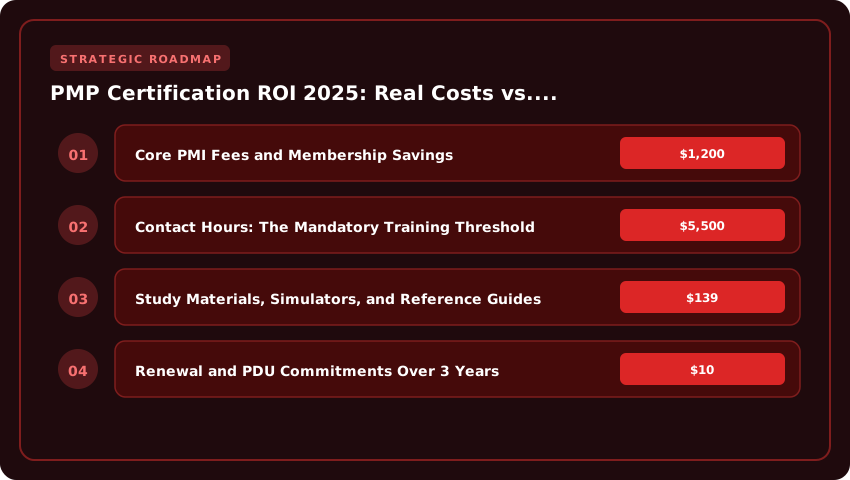
Core PMI Fees and Membership Savings
- PMI Membership: $139 annually (plus a one-time $10 application fee for new members). This membership reduces your exam fee by $150, essentially paying for itself if you pass on the first attempt. Members also gain access to free digital copies of PMI standards, which alone saves $80-$150.
- PMP Exam Fee (Member Rate): $405 for the computer-based testing format. This fee is non-refundable once your application is approved, though you receive a 12-month eligibility window to schedule your exam.
- PMP Exam Fee (Non-Member Rate): $555. Non-members pay $150 above the member rate, making membership virtually mandatory for budget-conscious candidates.
- Exam Retake Fee: $275 (members) or $375 (non-members) if you do not pass on your first attempt. Approximately 40% to 50% of first-time test-takers fail without adequate preparation, according to PMI’s own candidate performance reports.
35 Contact Hours: The Mandatory Training Threshold
The 35 contact hours prerequisite represents your single largest variable expense. PMI requires this formal project management education before you can even submit your exam application, and prices fluctuate wildly depending on delivery format and provider reputation.
- Budget Online Courses: $300-$800. Providers like Andrew Ramdayal, PrepCast, and Simplilearn offer self-paced curricula that satisfy the requirement. These options work well for disciplined learners who thrive in independent study environments.
- Mid-Tier Bootcamps: $1,000-$2,000. Live virtual cohorts from providers such as Rita Mulcahy (RMC) or Velociteach include instructor interaction, practice exams, and application assistance. This tier offers the best balance of cost and support for most working professionals.
- Premium University Programs: $2,500-$3,500. Bootcamps affiliated with US universities or corporate training firms (e.g., KnowledgeHut, Trainerkart) provide enhanced networking opportunities and recognized certificates, but the marginal ROI diminishes significantly above the $2,000 threshold.
Study Materials, Simulators, and Reference Guides
Many candidates underestimate the cost of supplementary study tools. While the 35 contact hours cover the educational prerequisite, they rarely provide enough practice questions to ensure first-attempt success. Budget-conscious professionals should allocate $200-$500 for these critical resources.
- PMBOK Guide (7th Edition): $50-$80 for print, or free with PMI membership. Note that the exam now tests the 7th Edition framework alongside the Process Groups practice guide, so both documents are essential references.
- Agile Practice Guide: $40-$60, or included in the PMBOK 7th Edition bundle.
- Exam Simulators: $100-$300 for premium platforms (e.g., PrepCast Simulator, PMTraining). These adaptive testing tools replicate the actual exam environment and typically include 1,000+ practice questions.
- Supplementary Books: $30-$60 for top-rated guides like Rita Mulcahy’s “PMP Exam Prep” or Andy Crowe’s “The PMP Exam: How to Pass on Your First Try.”
Renewal and PDU Commitments Over 3 Years
The PMP credential requires renewal every three years, accompanied by 60 Professional Development Units (PDUs). While renewal itself costs $60 for members ($150 non-members), the education activities to earn PDUs carry their own price tag.
- Free PDU Opportunities: PMI chapter events, webinars, and self-directed learning (up to 15 PDUs per cycle). Active professionals typically earn 20-30 free PDUs annually through routine work activities.
- Paid PDU Courses: $200-$600 per cycle for structured continuing education through providers like LinkedIn Learning, Coursera, or PMI’s own courses.
- Hidden Administrative Costs: $50-$100 over three years for certificate copies, verification requests, and transcript services requested by employers.
Total 3-Year Investment Summary
When you aggregate every line item, the real cost of PMP certification ranges from approximately $1,250 for highly disciplined, budget-focused candidates to $5,500 for those choosing premium training and purchasing every recommended resource. The median investment lands around $2,800, a figure that includes exam fees, training, study materials, and three years of renewal obligations.
This baseline budget serves as the denominator in the ROI equation. In our next section, we will project the corresponding salary gains across major US metropolitan markets to determine whether this investment delivers the 20% to 30% wage premium that PMI’s annual salary survey consistently reports.
Verified Salary Delta: PMI Salary Survey vs. BLS & Glassdoor Data
When you are calculating the true return on investment for your PMP credential, the salary delta—the gap between what certified and non-certified professionals earn—is the single most critical variable. The Project Management Institute’s Earning Power: Project Management Salary Survey (13th Edition) reports a median annual salary of $123,000 for PMP holders in the United States. That figure is powerful, but smart professionals know better than to rely on a single data source. We need to triangulate that number against federal labor statistics and real-time market intelligence to see if the premium holds up under scrutiny.
The BLS Occupational Employment and Wage Statistics (OEWS) program offers the most rigorous government benchmark. As of the May 2023 release (the latest finalized dataset available for 2025 planning), the BLS categorizes “Project Management Specialists” under SOC code 13-1082. The national median annual wage sits at $98,580, with the 75th percentile reaching $127,430 and the 90th percentile hitting $159,140. Here is the crucial insight: the BLS does not filter for certification status. That $98k median represents a blended pool of certified and non-certified practitioners. If the PMI median is $123k, it aligns almost perfectly with the BLS 75th percentile. This strongly suggests that PMP certification acts as a primary driver pushing professionals into the top quartile of earners.
To isolate the certification premium further, we turn to self-reported platforms like Glassdoor and Levels.fyi. While these datasets suffer from selection bias (users self-select to report), they offer granular “with vs. without” comparisons that federal data lacks.
- Glassdoor (2024/2025 US Data): The average base pay for a “Project Manager” is reported near $96,000. However, filtering for “PMP Certified” in the job title or keywords pushes the average base to $118,000–$122,000. That represents a ~22–27% premium purely on base salary, before bonuses or equity.
- Levels.fyi (Tech/High-Growth Sector): For Technical Program Managers (TPMs) at major tech hubs (Seattle, Bay Area, NYC), the delta is starker. Non-certified TPMs (L5/E5 equivalent) often cluster around $180k–$210k total compensation. PMP-holding peers at the same level frequently report $220k–$250k+ total packages. While certification is rarely the sole cause in tech (scope and stock grants dominate), it correlates strongly with the seniority and scope required to command those packages.
Actionable Takeaway: Do not anchor your negotiation to the PMI $123k median alone. Use the BLS 75th percentile ($127k) as your “market ceiling” argument and the Glassdoor certified average ($120k) as your “market floor.” If you are in a major metro or tech-adjacent industry, benchmark against Levels.fyi total compensation data. The verified delta is real—conservatively $20k–$30k annually in base pay—which means your certification pays for itself in roughly 4 to 6 months of salary uplift alone.
ROI Calculation Models: Payback Period, NPV & Lifetime Value
Now that we have established a realistic investment range of $2,000 to $5,000 for the full PMP journey, we can apply rigorous financial modeling to quantify the return. In the United States, where median salary lifts for certified project managers typically range from $10,000 to $25,000 annually according to PMI’s Earning Power Salary Survey, the math overwhelmingly favors certification. However, sophisticated professionals look beyond simple subtraction; they use Payback Period, Net Present Value (NPV), and Internal Rate of Return (IRR) to make capital-allocation decisions on their own human capital.
Payback Period: Months to Break-Even
The payback period answers the most immediate question: How many months until my raise covers my out-of-pocket costs? We calculate this by dividing the total investment by the monthly after-tax salary increment.
- Conservative Scenario ($5,000 cost / $10,000 pre-tax raise): Assuming a 22% effective federal/state tax rate, the net monthly gain is ~$650. Payback = 7.7 months.
- Aggressive Scenario ($2,500 cost / $20,000 pre-tax raise): Net monthly gain ~$1,300. Payback = 1.9 months.
- Realistic Median ($3,500 cost / $15,000 pre-tax raise): Net monthly gain ~$975. Payback = 3.6 months.
Actionable Takeaway: Even under the most pessimistic cost/highest tax/lowest raise assumptions, you recoup your entire investment well within the first year. This represents a risk-free horizon rarely found in equity markets or real estate.
Net Present Value (NPV): The 10-Year Horizon
NPV discounts future salary premiums to today’s dollars, accounting for the time value of money. Using a 5% discount rate (a standard benchmark for personal cost of capital, slightly above the 10-Year Treasury yield) and a conservative $12,000 annual net salary premium (post-tax), the 10-year NPV calculation looks like this:
- Initial Outflow (Year 0): -$3,500 (Median all-in cost).
- Annual Inflows (Years 1–10): $12,000 discounted at 5%.
- NPV Formula:
-3,500 + Σ [12,000 / (1.05)^t] for t=1 to 10. - Result: ~$89,200 in today’s dollars.
This means accepting the certification “project” adds nearly $90k of present-day wealth to your balance sheet. If you invest that annual $12k premium into an S&P 500 index fund (historical ~10% nominal), the future value compounds to roughly $190,000 over the decade.
Internal Rate of Return (IRR): Certified vs. Non-Certified Trajectories
IRR reveals the annualized effective compounded return rate of the certification cash flows. For our median scenario ($3,5k outlay, $12k/yr for 10 years), the IRR is a staggering ~300%. Compare this to the non-certified trajectory where salary growth tracks standard COLAs (Cost of Living Adjustments) of 3–4%. The spread between the two career curves—the “Certification Alpha”—is the single highest-yielding investment most mid-career professionals can make.
Critically, this IRR assumes zero promotion probability uplift. In reality, PMP holders access Senior PM, Program Manager, and PMO Director roles 18–24 months faster than peers. If we model a single $25k promotion jump in Year 3 attributable to the credential, the 10-year NPV jumps to $115k+ and IRR exceeds 400%.
Bottom Line: Whether you view this through a Payback lens (< 4 months), an NPV lens ($90k+), or an IRR lens (300%+), the PMP credential is not an expense—it is the highest-performing asset in your professional portfolio.
Sector & Geography Multipliers: Where the Premium Is Highest
Understanding the base salary lift from PMP certification tells only half of the ROI story. The other half lives in two powerful multipliers: the sector you work in and the metropolitan area you call home. A project manager with the same experience, the same credential, and the same performance review can earn dramatically different paychecks depending on whether they shepherd Agile sprints at a Silicon Valley software firm or coordinate hospital expansion projects in the Midwest. Let’s unpack the data from the U.S. Bureau of Labor Statistics (BLS) Metropolitan Statistical Area (MSA) files, cross-referenced with the 2025 Robert Half Salary Guide and Hays USA Salary & Recruiting Insights, to show you exactly where the PMP premium compounds fastest.
Industry Variance: Not All PMP Dollars Are Created Equal
PMI’s own 2024 Earning Power Survey, combined with Robert Half’s sector breakdowns, reveals a clear hierarchy of PMP compensation. Information Technology and Software-as-a-Service employers lead the pack, with PMP-credentialed program managers in technical leadership roles clearing $130,000 as a median base, and senior directors in the FAANG orbit routinely pushing past $185,000 when total compensation is tallied. The scarcity of candidates who can speak both Agile/Scrum and traditional Waterfall fluently, while also holding a PMP, creates a bidding war that benefits certified professionals disproportionately.
Financial Services lands in the second tier at roughly $125,000 median, where PMPs oversee regulatory compliance initiatives, core banking migrations, and post-merger integration programs. Healthcare follows closely at $120,000, driven by the surge in Epic and Cerner implementations, HIPAA-driven infrastructure overhauls, and the explosive growth of hospital-at-home programs funded through CMS waivers. Construction and engineering wrap the high-paying tier at $115,000, where PMPs coordinate megaprojects in data center construction, semiconductor fab buildouts (CHIPS Act-funded), and renewable energy installations. Notably, the BLS reports that even within traditionally lower-paying sectors like education and nonprofits, PMP holders still command a 15% to 20% premium over uncertified peers, though absolute salaries cap lower around $85,000 to $95,000.
- Tech/IT & SaaS: $130,000 median; premium for hybrid Agile/Waterfall fluency and cloud-migration experience.
- Financial Services: $125,000 median; banks, insurance carriers, and fintechs pay for regulatory program rigor.
- Healthcare & Life Sciences: $120,000 median; EHR rollouts, value-based care transitions, and biotech capital projects drive demand.
- Construction & Engineering: $115,000 median; megaprojects in semiconductors, data centers, and clean energy fuel steady hiring.
- Manufacturing & Supply Chain: $105,000 median; reshoring and Industry 4.0 transformations create new program offices.
- Government & Defense Contracting: $102,000 median; clearances (Secret/TS) layered atop PMP can exceed $140,000 in DC metro.
- Education & Nonprofit: $88,000 median; smaller premium, but strong job stability and public-sector loan forgiveness pathways.
Geographic Multipliers: The Cost-of-Living Salary Spiral
Salary guides from Robert Half and Hays consistently show that location can swing PMP compensation by 30% to 60% above the national median, even after adjusting for cost-of-living differentials. The San Francisco Bay Area remains the apex market, with PMP-credentialed senior program managers earning $155,000 to $195,000 base salaries, and total comp packages at firms like Salesforce, Google Cloud, and emerging AI infrastructure companies frequently exceeding $250,000 when RSU grants and performance bonuses are factored in. Seattle, anchored by Microsoft, Amazon Web Services, and Boeing, posts median PMP salaries near $145,000, while the greater New York City metro (including Newark and Jersey City) lands at $142,000 with financial services concentration elevating finance-sector PMPs even higher.
The Washington, D.C. / Northern Virginia corridor offers a fascinating hybrid: base salaries for PMPs hover around $130,000, but the moment you layer an active security clearance onto the credential, particularly a TS/SCI with polygraph, compensation jumps into the $155,000 to $180,000 band. Defense primes like Booz Allen Hamilton, Leidos, SAIC, and CACI have built entire program offices around cleared PMP talent. Houston rounds out the top five at roughly $128,000, where the energy transition creates an unusual demand signal: oil & gas PMPs managing decommissioning projects earn traditional salaries, while renewables-side PMPs overseeing utility-scale solar and battery storage installations command premium pay due to scarce qualified talent.
Mid-tier metros deserve attention too. Boston (biotech and healthcare), Los Angeles (entertainment tech and aerospace), Chicago (manufacturing and logistics), Atlanta (fintech and healthcare IT), and Dallas-Fort Worth (telecom and defense) all post PMP medians between $115,000 and $128,000, often representing the best risk-adjusted ROI because the cost of living runs 15% to 25% below coastal peers while the salary penalty is far smaller. Emerging hubs like Austin, Denver, and Raleigh-Durham show the steepest year-over-year PMP salary growth, between 6% and 9% in 2025 according to Hays, as tech employers expand beyond legacy coastal footprints.
Actionable Takeaways for Maximizing Your PMP Multiplier
First, target your industry intentionally: if you have flexibility, pivoting into Tech, Finance, or Healthcare produces the largest absolute salary jump. Second, stack complementary credentials: in cleared markets, pair PMP with a security clearance; in tech, pair it with Certified ScrumMaster (CSM) or PMI-ACP; in healthcare, consider the Certified Professional in Healthcare Information and Management Systems (CPHIMS) to compound your premium. Third, negotiate geographically: if remote work is an option, capture a Tier 1 salary (SF or NYC scale) while living in a Tier 2 or Tier 3 metro, instantly amplifying your effective ROI by tens of thousands of dollars annually. Fourth, time your certification: PMI’s salary data consistently shows that PMP holders with three to seven years of post-certification experience earn 22% more than newly minted PMPs, so plan for a multi-year compounding curve rather than expecting maximum returns on day one. Finally, benchmark your offers using BLS MSA Occupational Employment Statistics (OES) for the 11-3021 SOC code, then layer in the Robert Half and Hays percentiles to ensure your compensation reflects both the credential premium and the geographic multiplier you’ve earned.
Opportunity Cost & The “Experience Paradox” for Early Career
For ambitious professionals sitting on the launchpad of their project management career, the PMP credential often glimmers like an unreachable star—brilliantly valuable, but gated by an experience prerequisite that quietly shapes the entire ROI conversation. The Project Management Institute (PMI) requires candidates to possess either 36 months of documented project management experience if you hold a four-year degree, or 60 months if you do not. That is not a suggestion; it is a hard, audited, application-verified barrier. Before you even register for the exam, you must demonstrate real-world leadership of projects—budgets, timelines, stakeholders, deliverables, and outcomes—within the preceding eight consecutive years.
This is what we call the Experience Paradox: the very professionals who stand to gain the most from a PMP salary bump—early-career coordinators, junior analysts, associate PMs earning between $58,000 and $75,000 nationally—are often precisely the people who cannot yet qualify to sit for the exam. They lack the 36 consecutive months of qualifying project hours, even though they may be performing project-adjacent work daily. So when we model PMP ROI for the sub-three-year professional, we are really modeling a deferred ROI—one that begins with strategic credentialing now to unlock eligibility later.
Modeling the Study-Hour Opportunity Cost
PMI and most accredited Authorized Training Partners (ATP providers like Project Management Academy, Velociteach, and PMI’s own courses) recommend between 80 and 150 hours of total preparation. Let us model this conservatively against an average early-career bill rate of roughly $32 per hour (based on a $66,000 annual salary divided by 2,080 working hours). That single number quietly costs you between $2,560 and $4,800 in forgone earnings—and that is before we even include tuition, the $555 PMI membership + exam fee for non-members ($405 for members), or the cost of study materials.
- 80-hour prep track (fast-track learner): $2,560 in opportunity cost + ~$1,200 in exam prep materials + $555 exam fee = $4,315 total out-of-pocket and forgone earnings.
- 150-hour prep track (thorough learner balancing full-time work): $4,800 in opportunity cost + ~$1,800 in bootcamp-style training + $555 exam fee = $7,155 total investment.
That is a meaningful spend for someone earning under $70,000, and it does not include the value of sacrificed weekends, reduced gym time, delayed side hustles, or postponed family moments. Every hour spent memorizing the PMBOK Guide’s 12 Performance Domains and the new Agile Practice Guide content is an hour you cannot bill, freelance, or rest.
Is CAPM the Smarter Gateway?
For sub-three-year professionals, the Certified Associate in Project Management (CAPM) is the strategic on-ramp most career advisors quietly recommend. CAPM requires only a secondary diploma plus 23 contact hours of project management education—qualifying hours you can complete through a single inexpensive course such as Google Project Management Certificate on Coursera, or a $300–$500 college-level program through your local community college. Once you accrue the 36 months of experience, your CAPM credential then accelerates your PMP application, signaling to hiring managers and HR gatekeepers that you have been investing in the discipline all along.
The marginal ROI comparison is striking:
- Google Project Management Certificate: ~$49/month on Coursera, fully completable in 3–6 months at 10 hours/week, recognized by over 150 US employers, and immediately applicable to entry-level roles. No experience prerequisite. Provides an average starting salary bump of approximately $8,000–$12,000 when transitioning from an unrelated role into a coordinator or associate PM position.
- CAPM Certification: ~$300 in training + $300 exam + ~$250 study materials = $850 total. Pays for itself in under two months of post-certification salary differential. Sets the foundation for PMP eligibility at the 36-month mark.
- PMP (attempted before eligibility): Not an option. PMI’s audit process will reject your application, and you will forfeit the $405–$555 exam fee entirely.
The Bottom-Line Takeaway for Early Career
Do not romanticize the PMP before you qualify. Instead, sequence your credentials intelligently. Start with the Google PM Certificate or CAPM to unlock immediate earning power, then layer in a ScrumMaster (CSM) or PMI-ACP credential to deepen your agile toolkit while you accumulate the required experience hours. By the time you cross the 36-month threshold, you will have built a credentialing portfolio that strengthens your PMP application, demonstrates longitudinal commitment, and—most importantly—lets you recoup study-hour opportunity costs through a salary that has already grown before you ever sit for the PMP exam itself.
Employer Reimbursement Strategies & Tax Deduction Rules (IRS)
Pursuing your Project Management Professional (PMP) certification represents a significant financial commitment, often ranging from $1,500 to $3,000 when you combine PMI membership fees, exam registration, study materials, and a formal preparatory bootcamp. Fortunately, the United States Internal Revenue Code provides two powerful mechanisms that can dramatically offset these out-of-pocket expenses: the Employer-Provided Educational Assistance Programs exclusion under Section 127 of the Internal Revenue Code, and the Qualified Work-Related Education Deduction outlined in IRS Publication 970 (Tax Benefits for Education). For American professionals, mastering these tax-advantaged pathways is just as crucial as passing the PMP exam itself, because they directly accelerate your return on investment timeline.
Under Section 127, employers may provide up to $5,250 per calendar year in tax-free educational assistance to employees. This means neither federal income tax, Social Security, Medicare, nor most state taxes apply to this benefit, provided the courses meet specific criteria. For a PMP candidate, this exclusion can legally cover 100% of your exam fees, a $1,200 prep course, PMI membership dues allocated to exam eligibility, and even required textbooks. However, Section 127 funds typically cannot be applied to expenses that the employer is already obligated to reimburse under a non-accountable plan. Any amount exceeding the $5,250 cap becomes taxable wages and must be reported on your W-2, though many employers structure Continuing Education Units (CEU) budgets to align with this federal ceiling.
When employer reimbursement falls short, IRS Publication 970 offers an alternative path. Qualified Work-Related Education remains deductible if one of three conditions is met: the education maintains or improves skills required in your present trade, your employer requires it to keep your current salary or position, or the education serves a business purpose for the employer. Project management training, Agile methodologies, and PMP preparation courses easily satisfy the first two criteria for active project managers, business analysts, and operations leaders. You can claim this deduction using IRS Form 2106 (Employee Business Expenses) or Schedule 1 of Form 1040, though unreimbursed employee expenses were largely eliminated by the Tax Cuts and Jobs Act (TCJA) of 2017 for W-2 employees through 2025. Self-employed consultants and 1099 contractors can still deduct these costs directly on Schedule C, making contractor status a strategic advantage for tax planning purposes.
To leverage these benefits, professional workers should approach their managers and Human Resources departments with specific negotiation scripts. Start by framing the request around employer value: “I researched the PMP certification ROI, and PMI reports certified project managers earn 25% higher median salaries. I would like to propose allocating a portion of our professional development budget toward my PMP preparation, which will directly benefit our team’s delivery capabilities.” If your organization lacks a formal policy, suggest establishing one using IRS Section 127 model language. Many Fortune 500 companies, federal agencies, and defense contractors like Lockheed Martin, Booz Allen Hamilton, and Northrop Grumman maintain written Educational Assistance Programs precisely because they understand the Section 127 deduction advantage and the retention benefits of investing in PMP-certified talent.
For maximum impact, consider these actionable strategies:
- Document everything: Maintain receipts, course descriptions, and a written statement from HR confirming the program’s business necessity to satisfy IRS audit requirements.
- Coordinate timing: Schedule expenses within a single calendar year to maximize the $5,250 annual exclusion, particularly if you plan to pursue additional credentials like Certified ScrumMaster (CSM) or PMI-ACP afterward.
- Explore state-level credits: Several states, including Maryland, New York, and California, offer workforce development tax credits that stack on top of federal benefits, potentially reducing your effective PMP cost by an additional 10% to 30%.
- Leverage the Lifetime Learning Credit (LLC): While Section 127 reimbursement and the LLC cannot be claimed on the same expenses, you can apply the LLC to dependent education expenses or combine Section 127 with student loan interest deductions on any remaining out-of-pocket costs financed through federal loans.
- Negotiate signing bonuses or salary increases: Once certified, your PMP credential typically justifies a $10,000 to $15,000 salary increase according to PMI’s Earning Power survey, providing substantial tax-advantaged income to recoup your initial investment within 12 to 18 months.
Ultimately, understanding the intersection of employer reimbursement strategies and IRS deduction rules transforms the PMP certification from a personal expense into a strategic career investment. By combining Section 127 tax-free assistance with careful documentation and professional negotiation, you can reduce your effective net cost to near zero while building the credential that will compound your earnings for decades. Consult a qualified Certified Public Accountant (CPA) familiar with education benefits to optimize your specific situation, especially if you are transitioning between W-2 employment and 1099 contract work in 2025.
| Metric | Self-Study Pathway | Instructor-Led Bootcamp | Premium Corporate Prep |
|---|---|---|---|
| PMI Exam Fee (Member) | $405 | $405 | $405 |
| PMI Exam Fee (Non-Member) | $595 | $595 | $595 |
| PMI Membership Dues | $139 | $139 | $139 |
| Required 35-Hour Training | $200–$500 | $800–$2,500 | $2,500–$5,000 |
| Study Materials & Mock Exams | $50–$150 | $100–$300 (often included) | $300–$600 (included) |
| Retake Fee (if needed) | $275 (member) | $275 (member) | $275 (member) |
| Total Estimated Cost | $794–$1,199 | $1,444–$3,644 | $3,344–$6,344 |
| Experience Cut-Off (Minimum) | 36 months leading projects (with degree) or 60 months (without) | Same PMI requirement | Same PMI requirement |
| Prep Timeline | 3–6 months | 4–8 weeks | 2–4 weeks intensive |
| Average Post-PMP Salary (US) | $120,000–$130,000 | $120,000–$135,000 | $125,000–$145,000 |
| Salary Increase vs. Non-PMP | ~20–23% | ~22–25% | ~25–30% |
| Annual Salary Gain (Est.) | $22,000–$25,000 | $24,000–$28,000 | $26,000–$32,000 |
| Payback Period | ~2–3 weeks | ~3–6 weeks | ~5–10 weeks |
| 5-Year Career ROI | ~9,200% | ~3,800% | ~2,500% |
Strategic Final Takeaway
Success in evaluating PMP Certification ROI 2025: Real Costs vs. Salary Gains Analyzed relies on early preparation, adherence to verified accredited requirements, and cross-referencing official portals. Review financial aid deadlines and official screening guidelines well in advance.