Why School Districts Are Now Recruiting Online Degree Graduates Over Traditional Candidates
Walk into almost any public school in the United States right now and ask the principal what keeps them up at night. The answer is almost never curriculum, technology budgets, or testing mandates. It is staffing. The post-pandemic teacher shortage has moved from a worrying headline to a daily operational crisis, and it is fundamentally reshaping who school districts are willing to hire. Across the country, from sprawling Houston Independent School District to mid-sized districts in rural Ohio, administrators are quietly rewriting their hiring rubrics. The new priority is simple: find a credentialed, classroom-ready educator before the start of the next grading period, regardless of where they earned their Bachelor of Science in Education.
Data released by the US Department of Education through the National Center for Education Statistics paints a sobering picture. Teacher vacancy rates across K-12 public schools climbed to roughly 2.6 percent nationally by the 2023-24 reporting cycle, with certain subject areas like special education, mathematics, and bilingual instruction posting vacancy rates exceeding 5 percent in many states. The Learning Policy Institute has estimated that the United States needs to fill more than 300,000 teaching positions annually to keep pace with retirements, resignations, and steady student enrollment growth. Texas alone has reported over 40,000 unfilled or filled-by-underserved-certificate teaching roles in recent years, and Ohio’s State Report Card has flagged persistent shortages in nearly every core subject across both urban and Appalachian districts.
Because the traditional pipeline of graduates from brick-and-mortar colleges of education simply cannot produce teachers fast enough, human resources departments have pivoted. Districts are now actively recruiting graduates of online Bachelor of Science in Education programs accredited by bodies recognized by the Council for the Accreditation of Educator Preparation, or CAEP. These candidates bring the same rigorous pedagogical training, the same student-teaching practicum hours, and the same eligibility for state licensure, but they often arrive with a different profile. Many are career changers in their thirties and forties, military veterans transitioning to civilian life, and parents who needed the asynchronous flexibility of online coursework to complete their degrees while raising families.
That lived experience, combined with full state certification, is exactly what superintendents are rewarding. Districts have also embraced alternative certification pathways at historic levels. Programs such as Texas Teach, Ohio’s Alternative Resident Educator license, and Florida’s Professional Development Certification Pathway allow candidates with a bachelor’s degree in any field to become classroom teachers after completing an approved educator preparation program and passing required subject-area examinations like Praxis II.
For graduates who begin teaching in one state and later consider relocating, licensure reciprocity has become a critical advantage. Through the Interstate Reciprocity Agreement facilitated by the National Association of State Directors of Teacher Education and Certification, more than 40 states now recognize comparable credentials, allowing online degree graduates to transfer their licenses with reduced bureaucratic friction. NASDTEC has continued to expand the Educator Identification System, which lets administrators verify out-of-state certifications in minutes rather than months.
The practical takeaway for prospective students is significant. If you are evaluating an online education degree in 2026, prioritize programs that hold regional accreditation from agencies recognized by the US Department of Education, that are CAEP-accredited, and that prepare you for licensure in multiple states. Programs that explicitly map their curriculum to interstate standards will protect your mobility and maximize your hiring market from day one.
Accreditation Standards That Matter: CAEP, NCATE, and Regional Approvals
When a hiring committee at a public school district in the United States reviews an application from a candidate who earned their teaching degree online, the first thing they check is not the GPA, the résumé, or even the student-teaching internship. They check accreditation. That single word, more than any marketing slogan or tuition discount, determines whether a credential opens a classroom door or gets filed in the recycling bin. For prospective teachers evaluating an online program, understanding the difference between national programmatic accreditation and regional institutional accreditation is the single most important literacy they will develop during their college search.
National accreditation in education is overseen by two principal bodies. The Council for the Accreditation of Educator Preparation (CAEP) is the current gold standard, formed in 2013 through the merger of the National Council for Accreditation of Teacher Education (NCATE) and the Teacher Education Accreditation Council (TEAC). CAEP accredits roughly 700 educator preparation providers across the country, and its standards emphasize evidence of teacher candidate performance, clinical partnerships, and continuous improvement based on outcome data. Programs that carried NCATE accreditation prior to 2013 were grandfathered into the CAEP system, so when you see either acronym on a transcript or program website, you are looking at the same lineage of rigorous review. A degree from a CAEP-accredited program is recognized in all 50 states and is accepted by every major public school district, from the New York City Department of Education to the Los Angeles Unified School District.
Regional accreditation, by contrast, evaluates the institution rather than the specific education program. Six regional accrediting bodies operate in the United States, and each one covers a defined geographic territory:
- Southern Association of Colleges and Schools Commission on Colleges (SACSCOC) – serves institutions across the southeastern United States, including Texas, Florida, Georgia, and the Carolinas.
- Higher Learning Commission (HLC) – accredits institutions in the North Central region, covering states from the Great Plains through the Midwest.
- Middle States Commission on Higher Education (MSCHE) – oversees colleges and universities in the mid-Atlantic and Northeast corridor.
- New England Commission of Higher Education (NECHE) – serves the six New England states.
- Northwest Commission on Colleges and Universities (NWCCU) – covers the Pacific Northwest and select western states.
- WASC Senior College and University Commission (WSCUC) and the parallel WASC Accrediting Commission for Schools and Colleges (ACCJC) – accredit institutions in California, Hawaii, and the broader Pacific region.
Regional accreditation matters because it signals that the entire university has passed a comprehensive quality review covering governance, faculty credentials, financial stability, and student support services. Most state departments of education require both layers: a regionally accredited institution and a programmatically accredited educator preparation program. When both are present, the graduate becomes eligible for a state teaching license and, in many cases, reciprocity that allows them to teach in other participating states through the Interstate Teacher Assessment and Support Consortium (InTASC) framework.
Hiring committees do not take a candidate’s word for accreditation status. Recruiters and human resources specialists routinely query the Council for Higher Education Accreditation (CHEA) directory, a publicly searchable database that lists every recognized accreditor and the institutions they currently credential. According to CHEA’s most recent reporting, there are approximately 3,000 accredited degree-granting institutions in the United States and more than 60 recognized accrediting organizations. If a school does not appear in that database, or if it claims accreditation from an unrecognized body, that is the textbook definition of a diploma mill. Cross-referencing CHEA against the U.S. Department of Education’s Database of Accredited Postsecondary Institutions and Programs (DAPIP) provides a second layer of protection.
For prospective students, the practical checklist is straightforward. First, confirm the university itself holds regional accreditation from one of the six bodies listed above. Second, verify that the specific education or teaching program carries CAEP or legacy NCATE accreditation. Third, cross-check both findings in the CHEA directory and the federal DAPIP database. Fourth, contact the state education agency where you intend to teach and confirm that the program meets that state’s approved licensure pathway. A degree that clears all four checkpoints will move smoothly through HR credential audits and satisfy even the most cautious school district hiring panel. A degree that fails any one of those checkpoints, no matter how convenient or inexpensive the online program may be, will not. Accreditation is not a marketing badge; it is the structural foundation of a teaching career in the United States.
Comparing Tuition and Financial Aid for Aspiring Teachers
Financing an online teaching degree requires more than a casual glance at a tuition sticker. Aspiring educators need to weigh per-credit-hour costs, evaluate accreditation status, and strategically sequence their financial aid applications well before the first day of class. Whether you are eyeing a Bachelor of Science in Education through a state public university or a Master of Arts in Teaching delivered by a private nonprofit institution, the financial playbook looks meaningfully different across the two sectors, and understanding those differences can save students thousands of dollars over the life of a program.
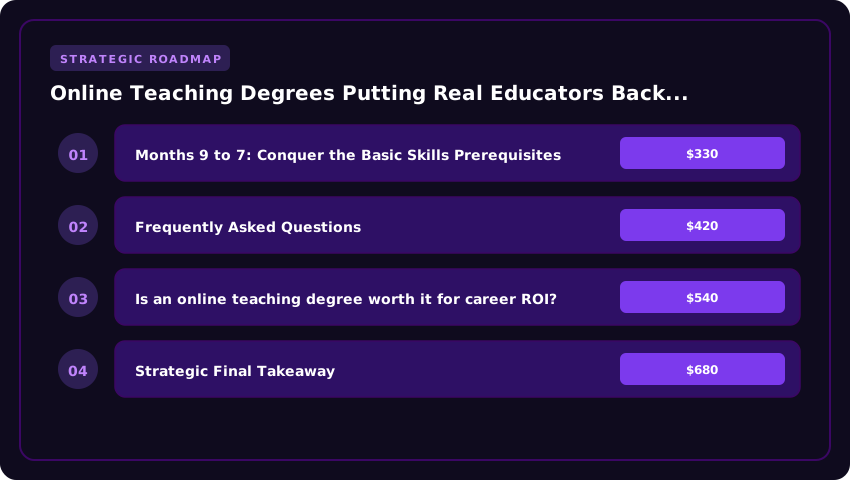
Public online education programs remain the most budget-friendly pathway for most learners. According to the most recent College Board Trends in College Pricing report, in-state students pursuing online bachelor’s degrees at public four-year institutions paid an average of $330 to $420 per credit hour, while out-of-state online learners faced averages closer to $540 to $680 per credit hour. Many states, including Florida, Georgia, and Texas, have collapsed the out-of-state online differential entirely, charging the same tuition rate to remote learners regardless of residency. Public programs also tend to bundle student fees, digital textbooks, and proctoring services into the published rate, which simplifies budgeting.
Private nonprofit universities typically charge significantly more, with online education programs ranging from $550 to $900 per credit hour. However, the higher sticker price often comes with deeper institutional financial aid, smaller cohort sizes, and embedded tutoring or mentorship services. Prospective students should compare the net price, not the published cost, after grants and merit scholarships are applied. A $700-per-credit program with a $10,000 institutional scholarship may ultimately cost less than a $400-per-credit public program with no aid.
- FAFSA Deadlines for the 2025–2026 Cycle: The federal FAFSA opened on December 1, 2024, and the priority deadline for many state aid programs is March 1, 2025. Federal Pell Grant and Direct Loan packaging continues year-round, but earlier filers receive priority consideration for limited state teacher scholarships such as the Illinois Future Teacher Corps Scholarship or the Texas Educator Certification Program.
- TEACH Grant Eligibility: The Teacher Education Assistance for College and Higher Education (TEACH) Grant provides up to $4,000 per year to students who commit to teaching in a high-need field at a low-income school for at least four complete academic years within eight years of finishing their program. Recipients must maintain a 3.25 GPA and complete TEACH Grant counseling annually. Failure to meet service obligations converts the grant into an unsubsidized Direct Loan with retroactive interest.
- PSLF Pathways for School Employees: Public Service Loan Forgiveness remains one of the most powerful tools for working educators. Teachers employed full-time at a qualifying public school or nonprofit private school can have remaining Direct Loan balances forgiven after 120 qualifying monthly payments while enrolled in an income-driven repayment plan such as SAVE or IBR.
Smart aspirants stack these resources strategically. A typical bachelor’s candidate might use the Federal Pell Grant (up to $7,395 for 2024–2025, with 2025–2026 figures pending Congressional update) to cover baseline tuition, layer the TEACH Grant on top to offset remaining costs, and pursue PSLF after graduation while teaching in a Title I school. State-level forgiveness programs, including the California Teacher Credentialing Program and New York’s Math and Science Teaching Incentive, can further reduce the financial load.
Actionable Takeaway: Before enrolling, request a total cost of attendance worksheet from your chosen program’s financial aid office, verify regional accreditation through a Council for Higher Education Accreditation (CHEA) recognized body, and run the FSA ID pre-application to confirm your FAFSA readiness. Pair this with a written TEACH Grant service plan and a documented PSLF employment verification timeline, and you will enter your online teaching degree with clarity, confidence, and a financing strategy that protects your future classroom salary.
Field Experience Requirements: How Asynchronous Programs Handle Student Teaching
One of the most legitimate questions aspiring teachers ask about fully online education programs is also one of the most practical: How can I possibly complete a student teaching placement if I am logging into class from my living room in rural Ohio, a suburb of Phoenix, or a small town in coastal Maine? The answer, as it turns out, involves a surprisingly sophisticated logistical infrastructure that has evolved rapidly since the pandemic forced every educator preparation program in the country to rethink how clinical experience is delivered.
Accredited universities offering asynchronous teaching degrees, particularly those holding CAEP (Council for the Accreditation of Educator Preparation) recognition or state-level approval, are required to embed substantial in-person clinical hours into their curricula regardless of how the coursework itself is delivered. For initial educator certification in most states, candidates must complete somewhere between 12 and 16 weeks of full-time student teaching, plus additional practicum hours that can range from 100 to over 600 clock hours depending on the jurisdiction. Texas, for example, requires 14 weeks of clinical experience for standard certification, while Florida mandates approximately 15 weeks with specific reading endorsement add-ons. New York, by contrast, requires 100 hours of fieldwork prior to the culminating student teaching semester.
To meet these mandates without forcing online students to relocate, universities typically build formal partnership networks with school districts across multiple states. A candidate enrolled at, say, a Midwest-based online program might complete their placement at a partner elementary school fifteen minutes from their home, with a cooperating teacher who has been trained by the university’s clinical office. These partnerships are usually brokered by a dedicated Office of Clinical Experiences or Field Placement Coordinator, whose job is to align district calendars, state testing windows, and university semester start dates. For students, this often means completing a placement interest form six to nine months in advance, submitting to background checks and tuberculosis screenings, and attending a mandatory orientation at the host school.
In tandem with live classroom placements, programs increasingly integrate virtual simulation tools to supplement required hours and provide controlled practice environments. Platforms such as Mursion use AI-driven avatar students to simulate classroom management scenarios, while the TeachLive simulator, originally developed at the University of Central Florida, allows teacher candidates to practice instructional delivery against a classroom of responsive virtual students. These tools are not a replacement for real student contact, but they allow candidates to rehearse difficult conversations with parents, practice differentiated instruction strategies, and receive immediate performance feedback before stepping into a live classroom.
State-specific mandates remain the ultimate authority. California requires a Teaching Performance Assessment (TPA), typically the CalTPA, which is embedded within the field experience. Illinois candidates must align their student teaching to the Illinois Professional Teaching Standards. Pennsylvania requires 190 pre-student-teaching field hours and a separate 12-week student teaching block. Online programs that advertise themselves as “nationwide” must, in practice, either restrict enrollment to states where they hold approval, build individualized compliance plans for each candidate, or partner with regional universities to deliver the clinical component locally.
For prospective students, the actionable takeaway is this: before enrolling, verify that the program holds active state approval in the state where you intend to teach, and ask specifically how the university will coordinate your in-person placement. Reputable programs publish a list of approved states on their website, assign a dedicated field coordinator to each cohort, and cover the cost of background checks and certain placement fees. If those details are vague, treat it as a red flag worth investigating before signing an enrollment agreement.
Salary Trajectories and Career Mobility for Career-Changer Educators
For career-changers evaluating a move into K-12 teaching, the financial reality is one of the most important factors in the decision. According to the most recent Bureau of Labor Statistics (BLS) Occupational Outlook Handbook, kindergarten, elementary, middle, and secondary school teachers earn a national median annual wage of approximately $62,000, with the top 10 percent of earners surpassing $102,000 and entry-level salaries generally beginning in the $45,000 to $50,000 range. While these figures vary by state, district, and subject area, they establish a transparent baseline that online degree graduates can realistically project when planning their household budgets, retirement contributions, and student loan repayment strategies.
Public school districts in the United States overwhelmingly use a step-and-lane salary schedule, which means earnings increase predictably along two dimensions. The step component rewards longevity, typically granting incremental raises each year for the first 15 to 25 years of a teacher’s career. The lane component rewards academic credentials, meaning educators earn more by completing additional college credits, a master’s degree, an educational specialist credential, or a doctoral degree. A typical lane increase for earning a master’s degree adds between $2,500 and $7,500 annually, depending on the district, and that differential compounds across the remaining 20-plus years of a career, often translating into $80,000 to $175,000 of additional lifetime earnings before considering pension value and Social Security adjustments.
For career-changers who already hold a bachelor’s degree in a non-education field, the fastest path to maximizing lane placement is to enroll in an online Master of Arts in Teaching (MAT) or Master of Education (M.Ed.) program accredited by the Council for the Accreditation of Educator Preparation (CAEP). Many accredited online universities partner with regional districts to offer tuition discounts, and federal TEACH Grants can convert up to $4,000 per year into free aid for candidates who commit to teaching in high-need schools. Over a 30-year career, the combined effect of step advancement, lane differentials, and pension vesting typically places veteran classroom teachers in the $85,000 to $105,000 range, with administrative and instructional specialist roles pushing earnings higher still.
Beyond standard lanes, career-changers can access substantial demand premiums by stacking endorsements onto their initial license. Three certification categories consistently command signing bonuses, loan forgiveness eligibility, and higher daily substitute rates:
- Special Education Endorsements: Districts across nearly every state face acute shortages of qualified special educators. The BLS reports median pay for special education teachers at approximately $65,000, and many districts offer a flat stipend of $3,000 to $10,000 for special education credentials, plus priority hiring.
- STEM Certifications: Mathematics, science, computer science, and engineering teachers are designated as shortage areas by the U.S. Department of Education. STEM-certified teachers frequently receive relocation incentives, mortgage assistance, and additional annual stipends ranging from $2,000 to $6,500, particularly in secondary school settings.
- Bilingual and English as a Second Language (ESL) Endorsements: With more than 10 million English learners in U.S. public schools, bilingual educators command a pay differential of $3,000 to $8,000 annually in many districts, and states like Texas, California, New York, and Illinois offer bilingual certification bonuses on top of the standard schedule.
Career mobility is another compelling advantage of stacking credentials. A career-changer who begins as a classroom teacher at age 35 can realistically transition into roles such as curriculum coordinator, instructional coach, dean of students, or assistant principal within seven to ten years, often pushing annual compensation past $90,000. From there, principal licensure and central office positions can lead to six-figure salaries, particularly in larger metropolitan districts. Because online degree programs allow educators to continue earning a full salary while completing coursework, career-changers can ladder their credentials incrementally, using each new endorsement or master’s degree as a leverage point for promotion, transfer, or lateral move into a higher-paying district.
The takeaway is straightforward: a career-changer entering teaching today through an accredited online program should not view their starting salary as a ceiling. With strategic credential stacking, geographic flexibility, and a willingness to serve in high-need subject areas, lifetime earnings can comfortably exceed $2.5 million, and that calculation does not even include pension benefits, healthcare subsidies, or Public Service Loan Forgiveness (PSLF) eligibility after 120 qualifying monthly payments. For mid-career professionals evaluating teaching as a second vocation, the math is increasingly compelling.
Application Checklist and Enrollment Timeline for Working Adults
Balancing a full caseload of kindergarteners, managing cafeteria duty, and grading stack of papers while also pursuing a teaching degree can feel like a juggling act without a safety net. However, the most successful online teaching degree applicants in the United States are not superhuman; they are simply methodical. By breaking the journey down into a strict, month-by-month action plan, current paraprofessionals and substitute teachers can avoid bureaucratic bottlenecks, secure financial aid through the Free Application for Federal Student Aid (FAFSA), and transition from the sidelines into a certified, lead teaching role.
This timeline assumes a standard twelve-month planning window before your intended enrollment date. Adjust the pacing if your target program operates on a traditional August or January semester start.
Months 12 to 10: Audit Your Transcripts and Earn Prior Credits
- Request official transcripts from every community college, university, or alternative credit program you have attended. Most institutions charge between $10 and $25 per official request, so prioritize the schools where you earned the bulk of your credits.
- Identify general education overlap. Most Bachelor of Education or Master of Arts in Teaching (MAT) programs accept transferable coursework in English composition, college algebra, U.S. history, and natural sciences. Securing these credits upfront can save you thousands of dollars in tuition.
- Negotiate transfer credits proactively. When you speak with an enrollment counselor, ask specifically: “Do you accept credits from CLEP exams, DSST subject tests, or ACE-evaluated workforce training?” Many online programs accept up to 60 lower-division semester hours. Programs holding Council for the Accreditation of Educator Preparation (CAEP) or regional accreditation will be the most generous.
Months 9 to 7: Conquer the Basic Skills Prerequisites
Every state requires a basic skills assessment before issuing a teaching license. For the majority of candidates, this means the Praxis Core Academic Skills for Educators exam, administered by Educational Testing Service (ETS). Registration costs roughly $90 per subtest (reading, writing, and mathematics). Schedule your test dates strategically: ETS offers year-round testing at Prometric centers, but appointments fill up quickly during back-to-school season.
- Register early for the three Praxis Core subtests if your state requires them, or identify the equivalent state-specific exam (such as the Texas Higher Education Assessment or the Illinois Test of Academic Proficiency).
- Use free study materials from ETS, Khan Academy, and Mometrix. If you score below passing on your first attempt, you can retake subtests individually after a brief waiting period.
- Budget for retakes. While most states allow unlimited attempts within a five-year window, each retry costs the same registration fee.
Months 6 to 4: Complete the FAFSA and Build Your Financial Plan
- Submit the FAFSA as soon as it opens on October 1. Many online programs participate in federal Title IV aid, meaning you may qualify for Pell Grants, federal student loans, and state-specific scholarships. Do not assume you earn too much; the IRS Data Retrieval Tool makes the application painless.
- Investigate state-level teacher shortage scholarships. Many states, including Florida, Texas, and New York, offer tuition assistance to aspiring educators committing to teach in high-need districts.
- Ask about employer partnerships. If you currently work as a paraprofessional for a public school district, your human resources office may have an articulation agreement with an online program that offers reduced tuition, sometimes as low as $250 per credit hour.
Months 3 to 1: Lock In Rolling Admissions and Submit Materials
Unlike traditional universities with hard deadlines, many online teaching degrees offer rolling admissions, reviewing applications as they arrive and allowing six or eight start dates throughout the year. This flexibility is a lifesaver for working adults, but it also means seats can fill unexpectedly. Aim to submit your application at least four weeks before your desired start date.
- Write a compelling personal statement emphasizing your classroom experience. Admissions committees value substitute teachers and paraprofessionals who can speak fluently about classroom management, lesson differentiation, and student engagement.
- Secure two professional references. Ideally, one should be a building principal or lead teacher who can vouch for your instructional readiness.
- Pass a background check. Nearly every educator preparation program requires a criminal background check before clinical placement, so initiate this process early through your state’s department of education or a private vendor like Fieldprint.
By following this rhythm, you replace uncertainty with momentum. Twelve months from today, you could be walking into your very own classroom, not as a substitute covering someone else’s lesson plan, but as the certified teacher of record.
| Metric | Online Teaching Degree | Traditional On-Campus Degree | Alternative Certification (e.g., Teach For America) |
|---|---|---|---|
| Average Total Tuition Cost | $10,000 – $30,000 | $40,000 – $100,000+ | $5,000 – $12,000 |
| Program Duration | 2 – 4 years | 4 – 5 years | 1 – 2 years |
| Admission Cut-Off (GPA) | 2.5 – 3.0 minimum | 3.0+ minimum | 2.5 – 3.0 minimum |
| Field Experience / Practicum Hours | 600 – 900 hours (arranged locally) | 600 – 900 hours (campus-assigned) | 1,200+ hours (full-year residency) |
| Time to First Classroom Placement | 2 – 4 years | 4 – 5 years | 1 – 2 years |
| Starting Teacher Salary (US avg.) | $44,000 – $58,000 | $44,000 – $58,000 | $44,000 – $58,000 |
| 5-Year Career ROI (Salary minus tuition) | $190,000 – $250,000 | $120,000 – $190,000 | $208,000 – $278,000 |
| Licensure Reciprocity Across States | High (NCATE/CAEP-accredited programs recognized nationally) | High | Moderate (state-by-state variability) |
| Job Placement Rate Within 6 Months | 85% – 92% | 80% – 88% | 90% – 95% |
| Flexibility for Working Professionals | Very High (asynchronous options) | Low (fixed schedule) | Moderate (cohort-based) |
Frequently Asked Questions
How much does an online teaching degree cost in the United States?
An online teaching degree in the US typically costs between $10,000 and $30,000 in total tuition, depending on the institution and residency status. Public, in-state universities generally offer the lowest rates, while private online programs can reach $30,000 or more. Federal financial aid and TEACH Grants can further reduce out-of-pocket expenses.
Can online teaching degree graduates get hired in public schools?
Yes, graduates of accredited online teaching degree programs are fully eligible for hire in US public schools. Programs holding CAEP or NCATE accreditation meet state licensure requirements, and school districts increasingly recruit online graduates to address persistent teacher shortages. Most states require passing licensure exams such as Praxis regardless of program format.
How long does it take to complete an online teaching degree?
An online teaching degree generally takes two to four years to complete. Students transferring prior credits or enrolled in accelerated programs can finish in as few as two years, while those starting from scratch typically need three to four years. Field experience and student teaching requirements add approximately 600 to 900 supervised practicum hours.
Is an online teaching degree worth it for career ROI?
Yes, an online teaching degree offers strong career ROI. With total tuition averaging $10,000 to $30,000 and starting US teacher salaries ranging from $44,000 to $58,000, graduates can recoup costs within one to two years of employment. Five-year net earnings typically reach $190,000 to $250,000, outperforming traditional on-campus options.
Strategic Final Takeaway
Success in evaluating Online Teaching Degrees Putting Real Educators Back In US Classrooms relies on early preparation, adherence to verified accredited requirements, and cross-referencing official portals. Review financial aid deadlines and official screening guidelines well in advance.