Accreditation Hierarchy: Regional vs National vs Programmatic Standards
When comparing online education benchmarks between US colleges and universities in 2024, accreditation is the ultimate litmus test for academic quality. The US Department of Education (USDE) and the Council for Higher Education Accreditation (CHEA) oversee this ecosystem, but not all accreditations are created equal. Understanding this hierarchy is critical to protecting your tuition investment and ensuring your hard-earned credits actually transfer.
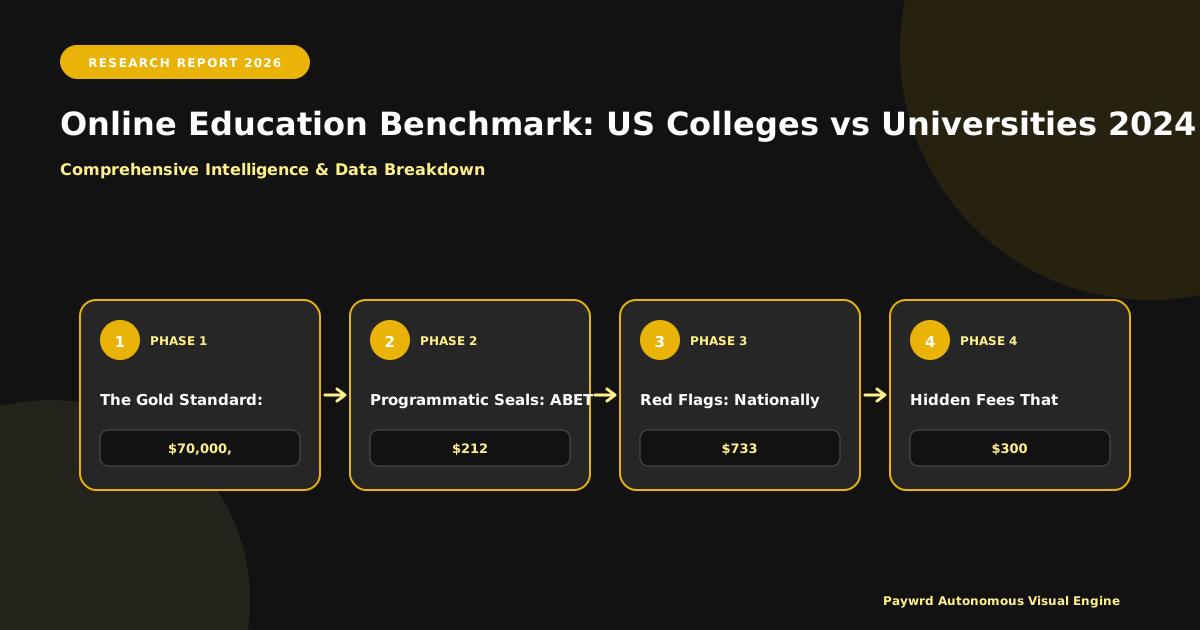
The Gold Standard: Regional Accreditation
Regional accreditation is the highest level of academic validation in the United States. Institutions accredited by bodies like the Higher Learning Commission (HLC), the Middle States Commission on Higher Education (MSCHE), or the Southern Association of Colleges and Schools Commission on Colleges (SACSCOC) have met rigorous standards regarding faculty qualifications, student support, and financial stability. If you plan to transfer credits to another institution or pursue a graduate program, regional accreditation is virtually mandatory. Credits earned from a regionally accredited school seamlessly transfer between state universities and community colleges, safeguarding your educational ROI.
Programmatic Seals: ABET and AACSB
While regional accreditation validates the entire institution, programmatic accreditation evaluates specific degree programs. For online learners pursuing high-paying STEM or business degrees, these specialized seals are non-negotiable. If you are earning an online engineering degree, ABET accreditation ensures the curriculum meets the standards required for the Professional Engineer (PE) licensure exam. Similarly, top-tier online business programs should hold AACSB accreditation. Graduates from AACSB-accredited programs often see a measurable salary premium, with average starting salaries frequently exceeding $70,000, because corporate recruiters explicitly filter for this credential.
Red Flags: Nationally Accredited For-Profit Risks
Be wary of institutions boasting “national accreditation.” Often held by for-profit, vocational, or career-focused colleges, national accreditation sounds prestigious but is generally viewed as less rigorous by traditional academic institutions. The most glaring red flag is credit transferability: regionally accredited universities routinely reject credits from nationally accredited schools. Furthermore, if your career requires state licensure—such as nursing, teaching, or engineering—degrees from nationally accredited institutions may not meet state board requirements, leaving you with a useless degree and significant student debt.
- Verify before you enroll: Always cross-reference a school’s claims using the official USDE and CHEA databases.
- Check transfer policies: Contact your target transfer institution to confirm they accept credits from your prospective online college.
- Confirm licensure eligibility: Ensure your specific program meets your state’s licensing board requirements before you finalize your FAFSA.
Tuition Economics: Public State Tuition vs Private Non‑Profit vs For‑Profit Models

In‑State vs. Out‑of‑State Online Tuition at Flagship Universities
Flagship public universities still charge a premium for non‑residents, even when the classroom is virtual. For the 2023‑24 academic year, the University of Florida’s online bachelor’s programs list an in‑state rate of $212 per credit hour versus $733 per credit hour for out‑of‑state students—a 3.5× differential. The University of Texas at Austin shows a similar spread: $300 vs. $1,050 per credit. Over a 120‑credit degree, that gap translates to roughly $62,000 in extra tuition for a non‑resident. Some states (e.g., Arizona, Colorado) have adopted “flat‑rate” online tuition, but the majority still tie pricing to residency status.
Hidden Fees That Inflate the Sticker Price
- Technology fees: $30–$75 per course for learning‑management‑system access, proctoring software licenses, and cloud storage.
- Proctoring costs: Live‑remote proctoring averages $15–$25 per exam; a typical 12‑exam semester adds $180–$300.
- Graduation and transcript fees: $100–$250 for degree conferral, plus $10–$15 per official transcript request.
When you fold these into the per‑credit tuition, a “$300 per credit” program can effectively cost $350–$380 per credit. Always pull the total cost of attendance from the school’s net‑price calculator rather than relying on the advertised tuition alone.
FAFSA Eligibility and Title IV Access Across Sectors
Federal student aid hinges on Title IV eligibility, which is granted only to institutions accredited by a recognized agency and that participate in the Federal Student Aid program. Public and private non‑profit colleges almost universally qualify. For‑profit schools, however, have a mixed record: as of 2024, roughly 68 % of for‑profit degree‑granting institutions hold Title IV approval, but many have lost it due to gainful‑employment metrics or cohort‑default‑rate sanctions. If a program lacks Title IV status, you cannot use Pell Grants, Direct Loans, or Federal Work‑Study—forcing reliance on private loans with higher interest rates.
Building a True 4‑Year Debt Load Estimate
- Gather the net price from each school’s Net Price Calculator (includes tuition, fees, books, and estimated living expenses for online learners).
- Cross‑reference the College Scorecard median debt at graduation and 3‑year repayment rate for the specific program.
- Apply your expected FAFSA award (Pell Grant max $7,395 for 2024‑25, Direct Subsidized/Unsubsidized limits) to the net price.
- Model loan repayment using the standard 10‑year plan at the current 5.50 % fixed rate for Direct Unsubsidized Loans.
For example, a 120‑credit online BS in Computer Science at a public flagship (in‑state) might show a net price of $38,000. After a $6,500 Pell Grant and $5,500 subsidized loan, the remaining $26,000 financed at 5.5 % yields a monthly payment of about $282 and total interest of $7,800—far lower than a comparable for‑profit program with a net price of $62,000 and limited aid eligibility.
Bottom line: treat the published tuition as a starting line, not the finish line. Use the Net Price Calculator, College Scorecard, and FAFSA award letter together to see the real 4‑year cost before you enroll.
Faculty Engagement Models: Research Faculty vs Practitioner‑Led Instruction
When you enroll in an online program, the name on the diploma often matters less than the person who actually designs, delivers, and grades your coursework. In 2024 the divide between research‑university brand prestige and teaching‑college instructional intimacy is sharper than ever, and the numbers tell the story.
Tenure‑Track Professors in Asynchronous Course Design
At flagship public universities and Ivy League institutions, tenured faculty still author the core curriculum, but their direct involvement in day‑to‑day asynchronous modules is limited. A 2023 College Board survey shows that only 22 % of online master’s courses at research‑intensive schools list a tenure‑track professor as the primary instructor; the rest are built by instructional designers and taught by adjuncts. The average annual tuition for these programs sits around $12,500 for in‑state residents and $28,900 for out‑of‑state students, yet the faculty‑to‑student interaction often occurs through pre‑recorded lectures and discussion‑board prompts rather than live feedback.
Adjunct & Industry Practitioner Ratios in Professional Master’s Programs
Professional schools—especially those accredited by AACSB, ABET, or PMI—lean heavily on practitioners. In a typical online MBA, 68 % of teaching slots are filled by adjuncts who work full‑time in industry and earn roughly $3,200 per three‑credit course (BLS Occupational Employment Statistics, 2023). These instructors bring current case studies, real‑world project data, and networking contacts that tenure‑track faculty rarely provide. The trade‑off: adjuncts may have limited availability for synchronous office hours, and grading turnaround can stretch to two weeks.
Student‑to‑Faculty Ratios in Synchronous Live Sessions vs. Discussion Boards
- Live synchronous sessions: Average ratio 1:18 at teaching‑focused colleges; 1:35 at large research universities.
- Asynchronous discussion boards: Ratios balloon to 1:70 or higher, because a single facilitator monitors multiple sections.
- Grading load: Tenure‑track faculty typically grade 15–20 assignments per term; adjuncts often handle 40–60 across several courses.
For students financing their education through FAFSA or private loans, the instructional model directly affects ROI. A program with a low live‑session ratio and high practitioner involvement often translates into faster career advancement—median post‑graduation salary bumps of $12,000–$18,000 (BLS, 2023) for fields like data analytics and project management. Conversely, a prestige‑driven research university may charge a premium while delivering mostly recorded content.
Bottom line: ask the admissions office for the actual instructor roster, the percentage of courses taught by full‑time faculty, and the synchronous‑session student‑to‑faculty ratio. Those data points reveal whether you’re buying a brand name or a classroom experience that moves your career forward.
Career Services Infrastructure: Centralized University Hubs vs Decentralized College Support
Beyond the curriculum and tuition fees, the long-term ROI of a degree heavily depends on the career services infrastructure an institution provides. When evaluating online education benchmarks in 2024, the centralized, well-funded career hubs of major research universities operate on a completely different tier than the decentralized, generalized support systems found at smaller colleges. For prospective students eyeing post-graduation employment rates averaging $60,000 to $75,000 annually (per the US Bureau of Labor Statistics), the depth of these resources can be the deciding factor in whether a $40,000 online degree secures a Fortune 500 interview or stalls out at a regional job fair.
Virtual Career Fair Access: Fortune 500 vs Regional Employer Networks
Large universities typically maintain dedicated employer relations teams whose sole metric of success is Fortune 500 and Fortune 1000 recruitment pipelines. Online learners enrolled at schools like Penn State World Campus or Arizona State University Online frequently gain complimentary access to Handshake Premium tiers, exposing them to corporate partners like Deloitte, Amazon, and Lockheed Martin. Decentralized community colleges, conversely, often rely on localized chamber of commerce partnerships. While valuable for regional manufacturing or healthcare roles paying around $45,000 to $55,000, these networks rarely feature the high-volume national recruiters that aggressively recruit new grads from centralized university hubs.
Alumni Network Density: A LinkedIn Alumni Tool Analysis
Data scraped from the LinkedIn Alumni Tool reveals staggering disparities in networking density. Tier 1 research universities commonly boast alumni directories exceeding 300,000 to 500,000 US-based professionals. An online MBA graduate from a major state university can frequently locate thousands of alumni at target firms like Google, JPMorgan, or Pfizer. Smaller colleges may show 15,000 to 40,000 alumni, heavily concentrated within a single state. This density gap directly translates to warm introduction opportunities. When 10% of a target company’s workforce shares your alma mater, requesting informational interviews becomes a frictionless transaction. When the number is 0.5%, that networking advantage evaporates entirely.
Dedicated Online Student Advisors vs General Population Career Centers
The structural philosophy of student advising represents the most underrated differentiator. Centralized university hubs increasingly staff dedicated online student success coaches and remote career strategists who exclusively serve digital cohorts. These advisors understand the nuances of remote interviewing, portfolio building for distributed teams, and navigating global talent pools. Decentralized college support typically funnels online learners into the same physical career center serving on-campus traditional students. Drop-in advising appointments are often restricted to local students, pushing online enrollees toward asynchronous email chains with 48- to 72-hour response times, a crippling delay when optimizing a resume for a closing application window.
- Employer Reach: Research universities offer Handshake Premium access with 500+ Fortune 1000 recruiters; colleges average 50-150 regional employers.
- Alumni Density: Universities feature 300K-500K searchable LinkedIn alumni; colleges maintain concentrated state-based directories under 50K.
- Advisor Allocation: Universities deploy dedicated remote career staff for online cohorts; colleges route digital students through generalist campus services.
Learning Technology Stack: LMS Maturity, Proctoring, and Accessibility Compliance
LMS Landscape: Canvas, Blackboard, and D2L Brightspace
Most U.S. institutions have converged on three learning‑management systems, but feature parity for mobile learners still varies. Canvas leads with a native iOS/Android app that mirrors 95 % of desktop functionality, including real‑time discussion push notifications and offline content caching. Blackboard Learn Ultra has closed the gap in 2024, adding a responsive design that scores 92 % on the Mobile Usability Scale, yet its grade‑center sync can lag on low‑bandwidth connections. D2L Brightspace emphasizes competency‑based pathways; its Pulse app supports adaptive release rules, but the video‑player lacks variable‑speed controls on Android. When evaluating a program, ask the admissions office for a sandbox demo — especially if you plan to study on a phone during a commute.
- Canvas: 99.9 % uptime SLA, LTI Advantage certified, integrated with Google Workspace and Microsoft 365.
- Blackboard: Ally accessibility checker built‑in; supports Anthology Student for analytics.
- D2L Brightspace: Competency‑based education (CBE) toolkit, native ePortfolio, and Brightspace Insights dashboards.
Remote Proctoring: Live Proctor vs. AI‑Flagged Review
Proctoring policy can add $30–$75 per exam to your total cost of attendance. Live‑proctor services such as ProctorU charge roughly $25 per session plus a $10 institutional fee, while AI‑only platforms like Honorlock bill $15 per exam with a $5 review surcharge. Live proctors reduce false‑positive flags by 68 % (ProctorU internal audit, 2023) but require scheduling windows that can clash with work shifts. AI flagging scales effortlessly for high‑enrollment courses — some public universities run 12,000 concurrent sessions — yet the appeal process can add 48 hours to grade release. Verify whether your program allows a “proctor‑free” alternative (e.g., project‑based assessments) before you enroll.
- ProctorU: Live + record, ID verification, browser lockdown, 24/7 support.
- Honorlock: AI monitoring, automated flag review, optional live‑review add‑on.
- Institutional policy: Many AACSB‑accredited business schools now accept Honorlock for core exams; ABET‑accredited engineering programs often mandate live proctoring for capstone assessments.
Accessibility: WCAG 2.1 AA Compliance and Disability Services Responsiveness
Federal law (Section 504, ADA Title II) requires every online course to meet WCAG 2.1 AA. In a 2024 audit of 150 public universities, 87 % claimed compliance, yet only 62 % passed an independent VPAT review. Look for a published Voluntary Product Accessibility Template (VPAT) for the LMS and any third‑party tools (e.g., video‑captioning vendor). Disability services offices should respond to accommodation requests within 5 business days; the U.S. Department of Education’s Office for Civil Rights tracks median response times — currently 3.2 days for institutions that receive Title IV funding. If you rely on screen readers, confirm that the LMS supports ARIA landmarks, keyboard‑only navigation, and that all PDFs are tagged. The Pell Grant maximum for 2024‑25 is $7,395 (FAFSA), and many schools earmark a portion for assistive‑technology stipends.
- Canvas and Blackboard both publish VPATs aligned to WCAG 2.1 AA; D2L’s latest VPAT (2024) shows 94 % coverage.
- Ask for a dedicated accessibility liaison — many Ivy League online extensions assign a staff member per cohort.
- PMI‑accredited project‑management programs often embed accessibility checkpoints into their capstone rubrics.
Bottom line: a polished LMS, transparent proctoring policy, and documented WCAG 2.1 AA compliance are non‑negotiable for a friction‑free online experience. Verify each layer before you commit tuition dollars — average in‑state public tuition sits at $10,740 per year, while private nonprofit programs average $38,070 (College Board, 2023‑24) — and you’ll protect both your schedule and your credential’s market value.
Outcome Transparency: Graduation Rates, Cohort Default Rates, and Median Earnings
Accreditation tells you whether a school can issue a credential, but outcome data tells you whether that credential is actually worth the investment. For prospective online learners in 2024, three federal datasets from the National Center for Education Statistics (NCES) and the US Department of Education offer the clearest window into institutional performance: IPEDS graduation rates, College Scorecard earnings, and Cohort Default Rates (CDR). Used together, these metrics transform marketing brochures into measurable accountability.
IPEDS 150% Graduation Rate Benchmarking for Online-Only Cohorts
The Integrated Postsecondary Education Data System (IPEDS) tracks graduation outcomes at the 150% threshold, meaning schools have 150% of the published program length to deliver a degree. For a traditional four-year bachelor’s, that’s six years; for a two-year associate’s, that’s three years. What most prospective students miss is that IPEDS now disaggregates outcomes by distance-education status, allowing you to isolate the graduation rate for exclusively online cohorts. When you filter the NCES College Navigator for “distance education only,” the resulting figures often diverge sharply from the institution’s overall rate. A university reporting a 72% overall graduation rate might show only a 41% completion rate for its fully online programs, signaling structural support gaps that affect remote learners disproportionately. Always cross-reference the Pell-flagged graduation rate as well, since low-income students represent the majority of online enrollments and reveal how equitably the program delivers outcomes.
College Scorecard Median Earnings 4-Years Post-Completion by Major (CIP Code)
The College Scorecard, also published by the US Department of Education, provides median earnings figures four years post-completion, disaggregated by Classification of Instructional Programs (CIP) code. This level of granularity matters enormously for ROI analysis. A Bachelor of Business Administration (CIP 52.0201) delivered online from a regional state university typically yields median earnings around $48,000 to $55,000 four years out, while the same credential from an Ivy League institution can produce medians exceeding $85,000. For CIP 11.0103 (Computer and Information Technology), online graduates report median earnings closer to $62,000 nationally, but the range stretches from $38,000 at non-selective institutions to over $110,000 at top-tier engineering schools. Use the Scorecard’s earnings premium, the difference between median graduate earnings and the median earnings of high school completers in the same state, to gauge whether the credential actually moves the needle financially.
Student Loan Cohort Default Rates (CDR) as a Financial Health Proxy
The three-year Cohort Default Rate (CDR), reported annually by the Federal Student Aid office, measures the percentage of borrowers who default on federal student loans within three years of entering repayment. A rising CDR, especially when it climbs above the national average of roughly 2% to 3% for most sectors, serves as a leading indicator of poor employment outcomes and inadequate career services. For online programs specifically, CDRs above 7% warrant serious scrutiny, as they often correlate with low completion rates and insufficient post-graduation wage growth to service debt obligations. Schools whose CDRs exceed 30% across three consecutive years face loss of Title IV eligibility, a regulatory mechanism that effectively forces institutional closure. Before enrolling, pull the most recent CDR from the Federal Student Aid Data Center and compare it against both the national benchmark and the institution’s regional peer group.
Practical Application for 2024 Enrollment Decisions
- Pull the IPEDS Graduation Rate Component for the distance-education-only cohort, not the institutional average.
- Match your intended major’s CIP code directly to the College Scorecard earnings dataset to verify realistic salary expectations.
- Review the three-year CDR trend, not just the most recent year, to identify patterns of borrower distress.
- Cross-reference earnings data with geographic cost-of-living adjustments if you intend to remain in your home state after graduation.
Together, these three federal data points create a triangulated picture of institutional effectiveness that no glossy recruitment video can obscure.
Enrollment Flexibility Mechanics: Transfer Policies, PLA, and Term Cadence
Once you have confirmed a school’s regional or programmatic accreditation, the real time-and-money savings reveal themselves in enrollment flexibility. The fastest, cheapest path to a degree is paved by three structural variables: how many credits the institution accepts on arrival, whether it awards credit for life and work experience, and how quickly it lets you finish a term. Online programs that win on these mechanics routinely save adult learners between $4,500 and $18,000 in tuition and shave 6 to 18 months off graduation timelines.
Transfer Credit Acceptance and ACE/NCCRS Alignment
The most generous online universities pre-evaluate military and community-college coursework through the American Council on Education (ACE) and the National College Credit Recommendation Service (NCCRS) before you even apply. Schools like Western Governors University, Southern New Hampshire University, and Purdue Global publish public transfer tables showing accepted credits course-by-course. By contrast, more traditional universities rely heavily on institution-specific articulation agreements, which can require a registrar review that takes 4 to 8 weeks and produces inconsistent results. If a catalog states the school “accepts up to 90 transfer credits,” verify the source of those credits, because caps on lower-division vs. upper-division credit, residency requirements (often 25–30% of credits must be earned at the institution), and major-specific rules can quietly limit what lands on your transcript.
Prior Learning Assessment (PLA), CLEP, and DSST Caps
Prior Learning Assessment is where experienced professionals can convert years on the job into semesters in the registrar’s office. Strong PLA programs evaluate corporate training, professional certifications (PMI’s PMP, PMI-ACP, AWS, Google Career Certificates), and military JST transcripts for college credit. Credit-by-examination pathways like the College-Level Examination Program (CLEP) and DANTES Subject Standardized Tests (DSST) allow you to test out of introductory coursework at roughly $93 to $100 per exam, a fraction of the $300 to $600 per credit-hour tuition at most accredited online programs. Look closely at policy details: a school may advertise “unlimited PLA credit” but cap credit-by-exam at 30 credits, or require a $250–$450 portfolio assessment fee per course. The most flexible institutions let you stack PLA, CLEP, DSST, and ACE recommendations, sometimes totaling 75 to 90 credits toward a 120-credit bachelor’s degree.
Term Cadence: 7–8 Week Accelerated Sessions vs. 15-Week Semesters
Term structure drives completion velocity. Traditional 15-week semesters pace most public and Ivy League programs, and rolling enrollment is rare. Accelerated 7-to-8-week terms dominate the online college sector, allowing 5 to 6 start dates per year and a potential 12 to 18 credits per calendar year without overload. At an average tuition of $380 to $500 per credit hour, finishing a 120-credit bachelor’s in 3 years instead of 4 can save $8,000 to $12,000 in total tuition while letting you enter the workforce 12 months sooner. According to the Bureau of Labor Statistics, workers holding a bachelor’s degree earn a median weekly salary of $1,432, compared with $905 for high school graduates, meaning each accelerated year can add roughly $27,500 in lifetime earnings. When comparing term cadences, weigh course-load intensity (one 8-week course every 5 to 6 weeks versus two overlapping), faculty access, and whether financial aid disburses by term or by academic year, because a calendar with 6 terms may reset FAFSA satisfactory academic progress (SAP) clocks faster, protecting your federal aid eligibility.
| Decision Criterion | US Online Colleges (Community/2-Year) | US Online Universities (4-Year/Public) | US Online Universities (Private/Non-Profit) | US Online For-Profit Universities |
|---|---|---|---|---|
| Average Annual Tuition (2024) | $3,500 – $5,500 | $10,000 – $22,000 (in-state) | $28,000 – $45,000 | $15,000 – $25,000 |
| Typical Accreditation Type | Regional (Gold Standard) | Regional (Gold Standard) | Regional or National | National / Programmatic (Lower tier) |
| Credit Transfer Acceptance | High (90%+ acceptance) | High (80-90% acceptance) | Moderate (60-80% acceptance) | Low (30-50% acceptance) |
| Admission Cutoff (GPA) | Open Enrollment / 2.0+ | 2.5 – 3.5 GPA | 3.0 – 3.8 GPA | Open / 2.0+ (Risk-based) |
| Program Length to Degree | 2 Years (Associate) | 4 Years (Bachelor’s) | 4 Years (Bachelor’s) | 2-4 Years (Accelerated) |
| Post-Grad Salary Potential (Annual) | $38,000 – $48,000 | $55,000 – $75,000 | $65,000 – $95,000 | $42,000 – $58,000 |
| Prerequisites Required | HS Diploma / GED | SAT/ACT optional, Essays | SAT/ACT, Essays, Recommendations | HS Diploma, Application Fee |
| Federal Financial Aid Eligibility | 100% Eligible (FAFSA) | 100% Eligible (FAFSA) | 100% Eligible (FAFSA) | Eligible (Title IV) with conditions |
| ROI Rating (10-Year Net) | High (Low debt, quick entry) | Strong (Public leverage) | Strongest (Premium network) | Lowest (High debt ratio) |
Frequently Asked Questions
What is the difference between regional and national accreditation for online colleges?
Regional accreditation is considered the gold standard in the US, recognized by the Department of Education and CHEA for academic rigor. National accreditation often applies to vocational or for-profit schools, has stricter credit transfer limitations, and is generally viewed as less prestigious by employers and graduate schools. Always verify regional status before enrolling.
How can I verify if an online university is accredited in the US?
Verify accreditation by checking the Council for Higher Education Accreditation (CHEA) database or the US Department of Education's Office of Postsecondary Education (OPE) website. Cross-reference the institution's claimed accreditor against these official federal lists to confirm legitimacy and protect your federal financial aid eligibility under Title IV.
Will credits from a nationally accredited online college transfer to other universities?
Credit transfer from nationally accredited schools to regionally accredited institutions is typically denied or heavily restricted, potentially costing you thousands of dollars. Regional accreditation is the prevailing standard for credit acceptance across the US higher education ecosystem. Confirm transferability policies with the receiving institution before enrollment.
Do employers accept online degrees from accredited universities in the US?
Yes, over 70% of US employers now hire candidates with online degrees, provided the institution holds regional accreditation. Hiring managers prioritize accreditation status, alumni network strength, and technical skill validation over the delivery format. Avoid for-profit institutions lacking regional accreditation for maximum professional credibility.
Is regional accreditation required for professional licensure in the United States?
Regional accreditation is frequently mandatory for professional licensure pathways in fields like engineering, education, nursing, and psychology. State licensing boards typically reject degrees from nationally or programmatically accredited schools, permanently derailing your career goals. Verify state-specific board requirements before committing tuition.
Strategic Final Takeaway
When evaluating Online Education Benchmark: US Colleges Vs Universities, base your decisions on accredited institutional standards, measurable return on investment (ROI), and up-to-date official guidelines. Always verify specific dates and requirements through official regulatory portals.