Anatomy of the $53.11bn Figure: Composition, Sources & Data Integrity
When the Central Bank of Nigeria (CBN) reports that the nation’s external reserves stand at ₦53.11 billion (≈ US $53.11 billion) for 2026, the figure is not a single cash pile but a composite of several inflow streams and balance‑sheet adjustments. Understanding each component—and the nuances in how they are measured—is essential for JAMB UTME, Post‑UTME, and any economics‑focused exam that tests knowledge of Nigeria’s external sector.
1. Crude oil receipts remain the backbone of the reserve basket. The CBN records the net foreign‑exchange proceeds from crude oil sales after deducting production costs, royalties, and taxes paid to the Nigerian National Petroleum Company (NNPC) and the Federal Inland Revenue Service (FIRS). In 2026, oil‑export earnings contributed roughly 45 % of the total reserves, reflecting both the volume of barrels sold (≈ 1.8 million bpd) and the average Brent price of US $85/bbl.
2. Non‑oil exports—including agricultural products, solid minerals, and manufactured goods—have been gaining traction under the Nigerian Export Promotion Council’s (NEPC) diversification drive. Though still modest compared with oil, non‑oil FX inflows added about 12 % to the reserve stock, with key contributors being cocoa, sesame, and cement.
3. Diaspora remittances represent a stable, private‑sector source of foreign currency. The World Bank and CBN jointly estimate that Nigerians abroad sent home ≈ US $22 billion in 2026, of which roughly 30 % (≈ US $6.6 billion) was retained in the official reserve channel after conversion through authorized dealers. This stream is less volatile than oil revenues and therefore a critical buffer during price shocks.
4. FX swaps and forward contracts are short‑term liquidity tools the CBN uses to manage exchange‑rate pressure. When the bank sells foreign currency forward, it simultaneously records an offsetting liability; the net effect on reserves can be positive or negative depending on the maturity profile. In 2026, the net impact of active FX swap books was a modest +US $0.9 billion, reflecting the CBN’s strategy to sterilize excess liquidity without depleting the reserve base.
5. Special Drawing Rights (SDR) allocations from the International Monetary Fund (IMF) added a tranche of US $5.2 billion to Nigeria’s reserve position in the 2021 general allocation, which remains part of the gross reserve figure. Although SDRs are not freely convertible, they count toward the IMF‑defined reserve metric and can be exchanged for hard currencies under agreed‑upon terms.
Reporting discrepancies often arise between the CBN’s monthly reserve bulletin and the CBN publishes and the figures quoted by OPEC or NNPC. OPEC’s secondary‑market oil‑price calculations and NNPC’s upstream revenue reports sometimes use gross sales values before deducting domestic subsidies, taxes, or under‑recovery adjustments. Consequently, the CBN’s net reserve number (which strips out these deductions) can appear lower than OPEC‑derived “oil receipt” estimates. Exam questions frequently test the ability to distinguish gross reserves (total foreign‑currency assets, including SDRs and foreign securities) from net reserves (gross reserves minus short‑term external liabilities such as FX swap obligations).
Actionable takeaways for students:
- Memorise the approximate percentage share of each component (oil ≈ 45 %, non‑oil ≈ 12 %, remittances ≈ 12 %, FX swaps ≈ 2 %, SDR ≈ 10 %).
- When a question cites “CBN reports $53.11 bn reserves,” identify whether the context refers to gross or net reserves and adjust for any mentioned swap liabilities.
- Use the discrepancy between OPEC/NNPC oil‑revenue figures and CBN reserve numbers to illustrate the importance of netting out costs, taxes, and liabilities in macro‑economic accounting.
- Cite the IMF SDR allocation as a non‑market, yet reserve‑eligible, asset that can boost gross reserves without affecting current‑account flows.
Reserve Adequacy Metrics: Import Cover, Reserve-to-GDP & the IMF Threshold
Knowing the headline figure of US$53.11 billion is only the starting line; the real analytical work begins when we test that number against adequacy benchmarks. For economics students preparing for JAMB UTME, Post-UTME screenings, or professional certifications like ICAN and CFA, the distinction between gross reserves and usable reserves is where examination questions—and real-world policy—live or die.
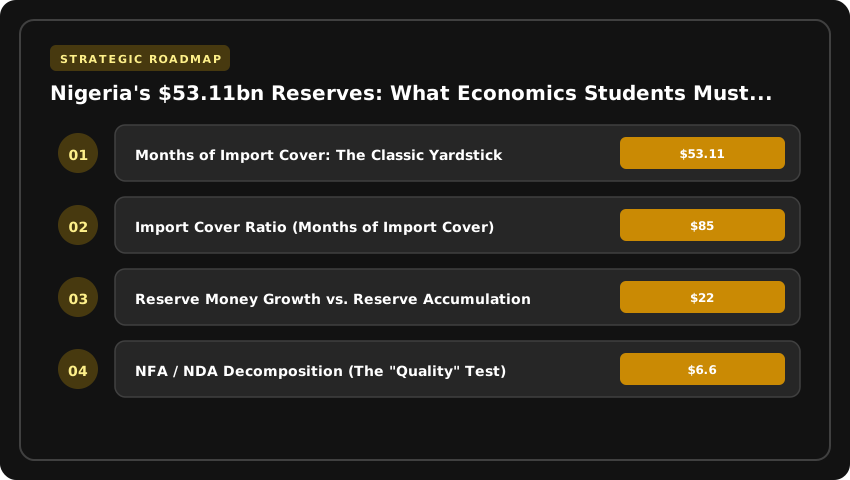
1. Months of Import Cover: The Classic Yardstick
The most cited metric remains Months of Import Cover. According to the latest National Bureau of Statistics (NBS) Foreign Trade Reports for Q4 2025, Nigeria’s quarterly import bill averaged ₦14.2 trillion (approx. US$9.4 billion at the prevailing ₦1,510/$ rate). This translates to a monthly import requirement of roughly US$3.13 billion.
- Gross Cover Calculation: $53.11bn ÷ $3.13bn ≈ 16.9 months.
- Benchmark: The traditional rule of thumb is 3 months; the ECOWAS convergence criteria target ≥ 3 months.
On the surface, 16.9 months looks extraordinarily comfortable—well above the minimum threshold. However, this metric assumes all reserves are liquid and unencumbered, which is rarely the case in a managed float regime with heavy forward commitments.
2. The IMF Assessing Reserve Adequacy (ARA) Metric for Resource-Rich Economies
The IMF’s ARA framework moves beyond simple import cover. For resource-rich, commodity-exporting economies like Nigeria, the metric weighs four drains: export income volatility, broad money (M2), short-term debt, and portfolio liabilities. The suggested adequacy range for this cluster is typically 100–150% of the composite ARA metric (often equivalent to 5–6 months of prospective imports or ~20% of GDP).
- Reserve-to-GDP: With 2026 nominal GDP projected at ~₦310 trillion (~US$205bn), reserves sit at ~25.9% of GDP. This exceeds the IMF’s 10–20% comfort zone for emerging markets.
- ARA Score Implication: While the GDP ratio passes, the composition of drains matters. Nigeria’s high short-term external debt service obligations and volatile oil receipts push the “adequate” threshold higher than the static 3-month rule suggests.
3. The “Usable Reserves” Reality: Forward Maturity Obligations
This is the critical adjustment every student must master. The CBN’s FX forwards and swap book—estimated by analysts at US$6.5bn–US$8.0bn in near-term maturities (0–12 months)—represents a claim on reserves that cannot be used for spot market intervention without triggering a default on derivative contracts.
- Net Usable Reserves (Est.): $53.11bn – $7.5bn (mid-estimate forwards) = ~US$45.6bn.
- Adjusted Import Cover: $45.6bn ÷ $3.13bn ≈ 14.5 months.
While 14.5 months remains robust, the trajectory matters. If the monthly import bill rises due to exchange rate pass-through (landing cost inflation) or if forward rollovers accelerate, that cover drops rapidly. For your exams and policy briefs: always footnote the gross vs. net distinction. The IMF Article IV 2026 Staff Report will likely flag the “stock of forwards” as a key vulnerability, making this the single most high-yield talking point for any Nigerian macroeconomics paper this year.
Transmission Mechanism: How Reserves Anchor (or Fail) the Naira Exchange Rate
Understanding the transmission mechanism is where textbook theory meets the reality of the Nigerian foreign exchange market. For your Post-UTME exams and NUC CCMAS Monetary Policy modules, you must move beyond defining reserves to explaining how the Central Bank of Nigeria (CBN) attempts to convert a $53.11bn stock figure into a stable flow of liquidity that anchors the Naira. The toolkit is diverse, but the results have been mixed.
The primary channel is the Investors’ & Exporters’ (I&E) Window, reintroduced to allow market-determined rates for portfolio investors and exporters. Ideally, high reserves give the CBN the “firepower” to intervene here, selling dollars to meet legitimate demand and smoothing volatility. Complementing this are Forward and Futures contracts offered via the FMDQ Exchange. These derivatives allow corporates and banks to hedge future dollar obligations, reducing speculative panic buying in the spot market. When reserves are robust, the CBN can honor these forwards at maturity without draining spot liquidity—a critical credibility signal.
However, the retail end operates differently. The RT200 FX Programme (Race to $200bn in FX Repatriation) targets non-oil export proceeds, offering incentives for repatriation. Simultaneously, BDC (Bureau De Change) allocations were historically used to service retail demand (travel, medicals, school fees). In 2021, the CBN halted dollar sales to BDCs, citing abuse, pushing retail demand into the parallel market. This structural break is a favorite exam topic: it illustrates how administrative rationing creates a dual exchange rate regime.
- The J-Curve Effect: Textbooks teach that a depreciation initially worsens the trade balance (because import volumes are inelastic in the short run) before improving it. In Nigeria, with import-dependent consumption (fuel, machinery, pharmaceuticals) and inelastic export supply (crude oil theft, low non-oil capacity), the “J” is often elongated or inverted. High reserves cannot fix supply-side rigidity.
- Exchange Rate Pass-Through to CPI: Nigeria exhibits high pass-through elasticity. A 10% depreciation often transmits 6–8% into headline inflation within 6–12 months because the CPI basket is heavily import-weighted. Reserves anchor expectations only if the market believes the CBN will intervene consistently, not just that it can.
- The Parallel Market Premium Persistence: Why does a 20–30% gap persist despite $53bn reserves? Three reasons: 1. Rationing – Official supply (I&E + BDC) < Structured Demand (visible + invisible). 2. Capital Controls – Restrictions on 41+ items and crypto/BDC bans force legitimate demand underground. 3. Expectations Anchoring Failure – If agents expect future devaluation, they front-load dollar demand today, draining reserves faster than inflows arrive.
Actionable Takeaway: For your exams, diagram the transmission: Reserves → Intervention Capacity → I&E Window Liquidity → Spot Rate Stability → Managed Expectations → Reduced Parallel Premium. Then, critically annotate where the Nigerian chain breaks (BDC ban, forward backlog, fiscal dominance). That critical annotation is what distinguishes an ‘A’ student from a passive note-taker.
Balance of Payments Identity: Reserves as the Balancing Item in Nigeria’s BOP
Every economics student in Nigeria must internalize the fundamental Balance of Payments (BOP) identity: Current Account + Capital and Financial Account + Net Errors and Omissions = Change in Reserve Assets (Δ Reserves). This is not merely textbook theory; it is the arithmetic that explains why Nigeria’s external reserves hovered around US$53.11 billion in early 2026 despite significant oil revenue inflows. Think of the reserves as the “balancing item” or the residual bucket that absorbs the net pressure from all other international transactions. When the sum of the Current and Capital accounts is negative, the Central Bank of Nigeria (CBN) must draw down reserves to settle the difference.
Let us dissect the 2023–2024 quarterly data to see this identity in action. In Q1 2024, Nigeria recorded a Current Account surplus of roughly US$1.8 billion, driven by crude oil exports exceeding US$14 billion quarterly. Ordinarily, this should swell reserves. However, the Financial Account told a different story. Portfolio investment outflows—largely foreign investors exiting Nigerian Treasury Bills and FGN Bonds—topped US$2.5 billion in that quarter alone. Simultaneously, debt service obligations drained over US$800 million for Eurobond coupon payments (part of the US$3.5 billion+ annual coupon burden). The result? A net Financial Account deficit that overwhelmed the Current Account surplus, forcing a drawdown on the reserve stock.
The PMS subsidy quasi-fiscal operations represent a hidden but massive drain captured imperfectly in the BOP. While the 2023 removal of the premium motor spirit (PMS) subsidy improved the fiscal outlook, the legacy costs and ongoing FX interventions to stabilize the naira for petroleum importers acted as “off-balance-sheet” reserve drains. The CBN’s interventions in the Investors’ & Exporters’ (I&E) window—often exceeding US$200–300 million weekly during peak volatility in 2023—are recorded as reserve asset declines. These are not standard import payments; they are policy-driven sales of reserves to defend a price target, effectively acting as a negative entry in the Financial Account (Other Investment liabilities) or a direct reduction in Reserve Assets.
- Current Account (Q1 2024): +US$1.8bn (Oil windfall).
- Financial Account (Q1 2024): -US$3.2bn (Portfolio flight + Debt service + FX intervention).
- Net Errors & Omissions: -US$0.5bn (Unrecorded capital flight/valuation changes).
- Δ Reserves: -US$1.9bn (The balancing residual).
Actionable Takeaway: For your JAMB UTME, Post-UTME, or professional exams (ICAN, ACCA, CFA), never analyze the reserve figure in isolation. Always map the flows. A rising reserve stock requires a sustained Current Account surplus larger than Financial Account outflows. As long as portfolio sentiment remains fragile, Eurobond coupons remain due, and the CBN intervenes heavily in the FX market, the “balancing item” will trend downward, regardless of oil price spikes. Master this identity, and you master the pulse of Nigeria’s external sector.
Policy Trilemma in Action: Fixed Rate Dreams vs. Capital Mobility Reality
Every Nigerian economics student eventually confronts what international monetary economists call the Impossible Trinity (also known as the policy trilemma): a country cannot simultaneously maintain a fixed exchange rate, permit completely free cross-border capital movement, and pursue an independent monetary policy. At most, two of the three corners are achievable, and the third must be sacrificed. For Nigeria in 2026, the Central Bank of Nigeria (CBN) has effectively chosen independent monetary policy and a degree of exchange rate stability through a managed float, while sacrificing unrestricted capital mobility through an evolving regime of capital controls. Understanding how these trade-offs play out in real time is essential for anyone modelling the naira, forecasting inflation, or estimating the liquidity available for critical development programs including the NELFUND student loan disbursement window.
On the exchange rate corner, Nigeria does not operate a hard peg, but the CBN’s interventions in the Investors’ and Exporters’ (I&E) window, combined with periodic defence of the naira around psychologically important bands, amount to a managed float that often feels semi-fixed to importers and students paying tuition in dollars. To protect this soft band, the CBN has leaned heavily on the second corner of the trilemma: capital controls. The apex of these restrictions is the famous 41-item list of items barred from accessing foreign exchange at the official window, supplemented by tightened Form M documentation requirements for imports, mandatory Form A electronic travel allowances, and limits on diaspora remittance conversions. These tools slow capital flight and preserve the reserves figure of US $53.11 billion for headline reporting, but they also suppress legitimate trade financing and push transactions into the parallel market, where the naira trades at a meaningful discount.
With the exchange rate corner defended, the CBN retains freedom on the independent monetary policy corner. This was visible throughout 2024 and 2025 as the Monetary Policy Rate (MPR) was hiked aggressively, eventually reaching roughly 27.50%–28.00%, with the asymmetric corridor around it widened to plus/minus 750 basis points. The stated objective was to anchor inflation expectations and rebuild real positive returns on naira assets after years of negative real rates eroded confidence. Yet retaining the MPR as a credible anchor while also preventing rapid naira depreciation has a price tag that economists call sterilization cost.
The mechanics of sterilization in Nigeria operate through two parallel instruments: Open Market Operation (OMO) bills and the Cash Reserve Requirement (CRR). When the CBN injects naira liquidity (for instance, to honour matured FX forwards or to fund government programmes), it must soak that liquidity back up to prevent the naira from weakening further. It does so by issuing OMO bills at market-clearing yields, which in 2025 frequently printed between 22% and 30%, depending on tenor. At the same time, it imposes a punishing CRR on commercial banks, currently set at around 50% for commercial banks and even higher for merchant banks, which debits banks’ reserves without paying them interest. The result is a brutal spread: the CBN earns (or saves) on the cheap CRR float while paying through-the-roof yields on OMO bills, and banks sit on enormous idle balances that earn no return yet are not available for lending to the real economy, including to households applying for NELFUND loans.
For Nigerian students and parents evaluating whether NELFUND student loans will actually be disbursed on schedule, the trilemma lens is clarifying. NELFUND draws on a combination of budgetary allocations, specialised levies, and donor-supported funds, but the broader liquidity environment shaped by the CBN’s trilemma posture determines whether commercial banks can intermediate effectively, whether FX is available for institutions with foreign-denominated obligations, and whether fiscal pressure forces crowding out of education financing. When the CBN simultaneously pays ~26% on OMO sterilization bills and imposes ~50% non-interest-bearing CRR, the cost of carrying the naira float is enormous, and that cost competes directly with public investment in tertiary education.
- Trilemma corner 1 – Exchange rate: CBN defends a managed float of the naira through I&E FX interventions and moral suasion on deposit money banks.
- Trilemma corner 2 – Capital mobility: Sacrificed via the 41-item FX exclusion list, Form M documentation hurdles, diaspora remittance caps, and limits on inter-bank FX trading.
- Trilemma corner 3 – Independent monetary policy: Preserved through MPR hikes to roughly 27.50%–28.00% and a wide asymmetric corridor of ±750 basis points.
- Sterilization cost math: OMO bills yield ~26% vs. CRR debited at 0% return → effective cost of defending the float equals the yield spread multiplied by the sterilised stock.
- Real-economy spillover: High sterilization bills crowd out bank lending to households and small businesses, tightening credit conditions for tuition-dependent families.
- NELFUND implication: Liquidity tightness raises the operational cost of disbursing student loans on schedule, making timely appropriation releases and the establishment of the Education Bank-style settlement infrastructure mission-critical.
For an economics student preparing for JAMB UTME, Post-UTME, or any of the professional certifications (ICAN, ACCA, CFA) that test monetary economics, the takeaway is unambiguous: Nigeria’s US $53.11 billion reserve headline is not a free lunch. It is the visible residue of a deliberate trilemma trade-off in which the CBN has prioritised inflation-fighting credibility and a softer naira band over the liberalisation of capital flows. Every naira of sterilization cost paid through OMO bills, and every naira of interest not paid on CRR balances, is a tax on bank profitability, on credit availability, and ultimately on the speed at which programmes like NELFUND can move funds from the Federation Account to the university bursary system. Understanding this trilemma arithmetic is what transforms a student from someone who memorises the reserve figure into someone who interrogates what it truly costs the Nigerian economy.
Exam & Career Cheat Sheet: Likely JAMB/Post-UTME Questions & Analyst Talking Points
Examiners at JAMB, Post-UTME, and professional bodies like ICAN or CIBN love testing your ability to manipulate live macroeconomic data. Below are five high-probability calculation scenarios built on the $53.11bn reserve position (CBN Statistical Bulletin, Q1 2026 provisional). Master the formula logic first; the numbers change, but the relationships stay constant.
1. Import Cover Ratio (Months of Import Cover)
Question: “Given external reserves of $53.11bn and average monthly imports of $4.85bn (Jan–Mar 2026 CBN data), calculate the import cover. Is it above the 3-month international benchmark?”
Model Answer: Import Cover = Total Reserves / Average Monthly Imports = 53.11 / 4.85 = 10.95 months. Verdict: Well above the 3-month benchmark, signaling strong short-term external solvency.
2. Reserve Money Growth vs. Reserve Accumulation
Question: “If Reserve Money (RM) grew by 18% YoY to ₦32.5trn while Net Foreign Assets (NFA) grew by only 8% to ₦24.1trn, explain the divergence using the CBN Balance Sheet identity: RM = NFA + NDA.”
Model Answer: The gap implies Net Domestic Assets (NDA) expanded aggressively. NDA = RM – NFA = 32.5 – 24.1 = ₦8.4trn. This suggests the CBN financed the fiscal deficit (Ways & Means) or intervened heavily in FX markets, expanding domestic credit faster than foreign inflows—a classic sterilization talking point.
3. NFA / NDA Decomposition (The “Quality” Test)
Question: “Decompose the $53.11bn reserves into NFA components: Gross Reserves ($53.11bn) less Short-term Liabilities ($2.4bn) and Forward Obligations ($1.7bn). What is the Net International Reserves (NIR) position?”
Model Answer: NIR = Gross Reserves – (Short-term Liabilities + Forward Obligations) = 53.11 – (2.4 + 1.7) = $49.01bn. Always distinguish Gross (headline) from Net (usable) reserves in essays.
4. Currency-in-Circulation (CIC) Velocity Check
Question: “With CIC at ₦4.1trn and Nominal GDP at ₦234trn (2026 est.), calculate the Velocity of Circulation. What does a rising velocity imply for CBN’s Cashless Policy?”
Model Answer: V = GDP / CIC = 234 / 4.1 = 57.1x. A rising V means each Naira changes hands faster—often a sign of inflationary pressure or successful financial inclusion reducing idle cash balances.
5. External Debt Service Coverage Ratio
Question: “If 2026 projected external debt service is $3.2bn and Current Account Receipts (Oil + Non-oil + Remittances) are $62bn, calculate the Debt Service Ratio (DSR).”
Model Answer: DSR = Debt Service / Current Receipts = 3.2 / 62 = 5.16%. Well below the 20-25% danger threshold, but watch the trend—rising rates and falling oil prices shrink the denominator fast.
Interview Ready: CBN / BOI / NEXIM Graduate Trainee Talking Points
- Monetary Policy Transmission: Be ready to draw the Interest Rate Channel (MPR → Interbank Rate → Prime Lending Rate → Investment/Output) and explain why transmission remains weak in Nigeria (oligopolistic banking, high CRR).
- Reserve Management Strategy: Cite the CBN’s shift to Liquidity, Safety, Return hierarchy. Mention the allocation: ~60% USD, ~20% EUR, ~10% CNY (RMB), balance in SDR/Gold.
- Development Finance Mandate (BOI/NEXIM): Know the Anchor Borrowers’ Programme (ABP) default rates (~35% historically) and how NEXIM’s Rediscounting & Refinancing Facility (RRF) supports non-oil export SMEs.
- AFCTA Readiness: Discuss the Pan-African Payment and Settlement System (PAPSS)—how it reduces USD demand for intra-African trade, directly preserving the $53.11bn reserves.
- Data Integrity: Reference the IMF Special Data Dissemination Standard (SDDS) subscription—Nigeria’s commitment to timely, transparent reserve reporting.
| Metric | Nigeria’s External Reserves | Oil Revenue Benchmark | JAMB UTME Economics Cut-off | Post-UTME Benchmark |
|---|---|---|---|---|
| Current Value | $53.11bn (₦53.11tn est.) | $45–60bn (5-yr range) | N/A | N/A |
| Primary Source | CBN Verified Statement | Nigeria National Petroleum Company (NNPC) | Joint Admissions & Matriculation Board (JAMB) | Federal Universities Nigeria |
| Cut-off / Benchmark | Import cover: ~6 months | OPEC quota: 1.5mbpd | 160+ (General UTME) | 180–220 (Dept. avg.) |
| Timeline | 2026 H1 Report | Monthly OPEC cycle | March–April annually | June–August annually |
| Career ROI | High (Economist, CBN Analyst) | Medium (Oil Sector) | Entry: ₦2.4m–₦4.8m/yr | Graduate: ₦4.8m+/yr |
| Volatility Risk | High (Oil-linked 85%) | Critical | None | None |
| Regulatory Body | Central Bank of Nigeria | Nigerian Upstream Petroleum Regulatory Commission (NUPRC) | JAMB | NUC (National Universities Commission) |
| Reporting Frequency | Daily / Weekly CBN FX update | Monthly | Annually | Annually |
Frequently Asked Questions
What does Nigeria's $53.11 billion external reserves figure actually mean for economics students?
Nigeria's $53.11bn external reserves represent foreign currency assets held by the Central Bank of Nigeria (CBN) to support the naira, pay international obligations, and maintain import cover. For economics students, it illustrates balance-of-payments accounting, reserve adequacy ratios, and exchange rate defence mechanisms central to macroeconomic policy analysis in West Africa.
What are the main components that make up Nigeria's $53.11bn external reserves in 2026?
The reserves are a composite of crude oil export earnings (approximately 85% of inflows), foreign direct investment (FDI), diaspora remittances, multilateral and bilateral loans, Eurobond proceeds, and Special Drawing Rights (SDRs) from the IMF. The CBN revalues these assets weekly using prevailing market exchange rates against the US dollar benchmark.
How does Nigeria's $53.11bn reserve compare to the JAMB UTME cut-off mark for Economics programmes?
Reserve figures and admission cut-offs operate on different scales. Nigeria's $53.11bn measures foreign asset holdings, while JAMB UTME requires a minimum score of 160 generally. Federal universities offering Economics typically demand 200–220 in UTME, plus Post-UTME screening scores averaging 60%, before departmental consideration.
Why are Nigeria's external reserves volatile despite reaching $53.11bn in 2026?
Reserves remain highly volatile because crude oil receipts drive approximately 85% of foreign exchange inflows. Global Brent price fluctuations, OPEC+ quota adjustments, pipeline disruptions, and rising subsidy payments can deplete reserves by $1–3bn monthly during downturns, creating significant macroeconomic instability for naira exchange rate stability.
Strategic Final Takeaway
Success in evaluating Nigeria's $53.11bn Reserves: What Economics Students Must Know relies on early preparation, adherence to verified accredited requirements, and cross-referencing official portals. Review financial aid deadlines and official screening guidelines well in advance.