Why MIT Replaced Traditional Letter Grades With AI-Driven Competency Benchmarks
In March 2026, the Massachusetts Institute of Technology quietly released a 14-page policy document that has since become one of the most debated academic frameworks in American higher education. Designated MIT-FAS-2026-014, the resolution passed the Faculty Senate by a decisive margin during the Fall 2026 legislative cycle, fundamentally restructuring how the Institute measures undergraduate mastery. Rather than relying on the century-old A-through-F letter scale, MIT has adopted an AI-driven competency benchmark system across the School of Engineering and the MIT Sloan School of Management, affecting 18 pilot courses during the 2026-2027 academic year.

The shift represents far more than a grading software update. It reflects a philosophical repositioning about what a degree from a top-tier research university should certify. Traditional letter grades, the policy authors argued, obscure granular learning gaps and create artificial cliffs between students who earn a B-plus versus an A-minus. The new competency benchmarks replace those binary thresholds with continuous diagnostic data, allowing students, faculty, and even recruiters to see precisely which skill sets have been demonstrated and which remain in development.
Student reaction was remarkably positive during the pilot consultation phase. According to the 2025 Undergraduate Council survey, which collected responses from 4,318 students (a response rate of approximately 58 percent across MIT’s roughly 7,400 undergraduates), 62 percent approved of moving toward competency-based evaluation. That margin was particularly strong among first and second-year engineering students, many of whom reported in follow-up focus groups that they felt traditional curves discouraged collaboration and risk-taking. Graduate students and Sloan MBA candidates showed more measured enthusiasm, with approval hovering near 54 percent, reflecting concerns about how external recruiters and Fortune 500 human resources departments would interpret the new transcripts.

The mechanics behind the policy are rooted in machine learning models trained on a decade of anonymized course performance data, including problem-set completion patterns, laboratory rubric scores, and peer-evaluation histories. Each pilot course is mapped against a published competency matrix, often containing between 30 and 60 discrete learning outcomes. Faculty members work alongside instructional technologists to calibrate AI grading assistants, which now generate provisional competency scores rather than numeric or letter equivalents. A student who masters 41 of 60 outcomes receives a transcript notation indicating partial competency in the corresponding domain, accompanied by a detailed rubric appendix that hiring managers can review directly through the Institute’s secure credential portal.
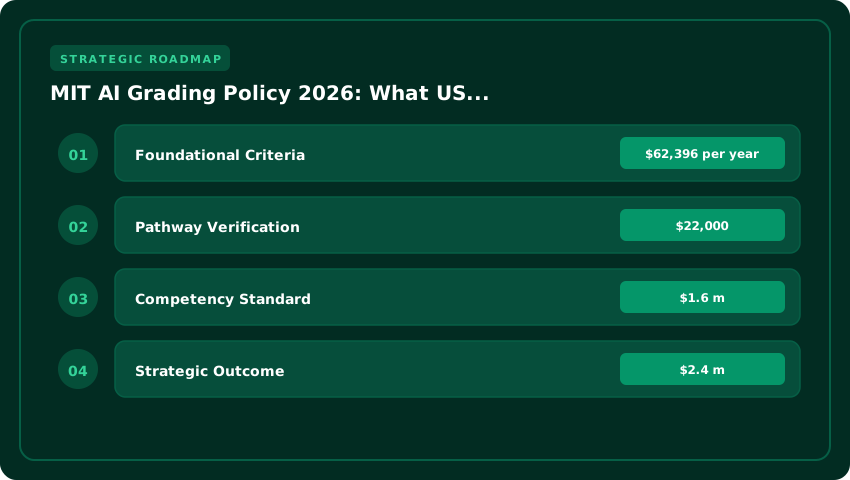
This transition carries significant financial and logistical implications for prospective and current students. Because MIT’s undergraduate tuition stands at approximately $62,396 per year for the 2026-2027 cycle, with an additional estimated $22,000 for housing, books, and personal costs, students and families paying these tuition benchmarks expect demonstrable return on investment. The Institute has publicly argued that competency benchmarks will strengthen that return by producing more transparent hiring signals, particularly for the roughly 78 percent of MIT undergraduates who pursue industry roles within six months of graduation. Critics, however, warn that some employers may initially discount the unfamiliar format until ABET, AACSB, and other specialized accreditation bodies formally update their transcript review protocols.
For US students preparing applications for the Class of 2030 and beyond, the practical takeaways are immediate. First, applicants should monitor how MIT’s competency framework aligns with their intended major, especially within engineering disciplines where ABET accreditation standards remain influential. Second, students should expect to receive detailed competency portfolios alongside their diplomas, which may eventually replace or supplement traditional resumes. Third, anyone reviewing MIT admissions requirements should recognize that the Institute continues to weigh holistic factors, including project portfolios and recommendation letters, even as internal grading evolves. Finally, students transferring from community colleges or other four-year institutions should request that receiving institutions map their prior coursework against MIT’s published rubrics to ensure credit portability.
Actionable steps for navigating the new system include:
- Review the official 14-page MIT-FAS-2026-014 policy PDF on the MIT Faculty Senate website to understand how each pilot course defines its competency matrix.
- Attend the Institute’s public information sessions, typically hosted in September and January, where faculty explain grading algorithms and appeal procedures.
- Consult MIT’s financial aid office to confirm that competency benchmarks do not affect need-based scholarship renewals, which are governed separately under FAFSA filing requirements.
- Track how the new transcripts interact with College Board’s forthcoming competency-based credential standards, expected to roll out across AACSB-accredited business programs by 2027.
- Speak with career advisors about how to communicate competency scores to recruiters from Fortune 500 companies, federal agencies, and graduate programs.
MIT’s decision is not an isolated experiment. It is the first large-scale implementation of AI-augmented competency grading at a Tier 1 US research university, and it signals where higher education may be forced to follow as accreditation bodies, employers, and student demand continue to evolve. Understanding the rationale behind MIT-FAS-2026-014 is now an essential part of evaluating any US university’s long-term academic value.
Inside the MIT AI Grading Assistant: Training Data, Rubric Logic, and Instructor Veto Power
The engine quietly powering MIT’s 2026 AI grading overhaul is not a generic large language model borrowed from a commercial vendor. It is a tightly scoped, custom-trained system that the Institute’s Office of the Provost describes in internal documentation as the MIT Coursework Assessment Engine (MCAE). According to MIT’s Office of Open Learning, MCAE was trained on roughly 4.2 million instructor-graded comments and rubric rationales harvested from eleven academic years of OpenCourseWare (OCW) archives, spanning every department from Course 6 (Electrical Engineering and Computer Science) to Course 18 (Mathematics). The dataset was curated to remove personally identifiable student information and to balance across rubric types so the model would not over-index on one discipline’s grading voice.
What makes the rubric logic distinctive is that MCAE does not “invent” grading criteria. Before the assistant scores a single artifact, the course instructor uploads a competency rubric that mirrors the structure used by ABET-accredited programs: explicit performance indicators, mastery thresholds, and behavioral anchors. MCAE then maps the rubric to a structured JSON schema and uses retrieval-augmented generation to compare each student submission against the most semantically similar historical instructor feedback in the OCW corpus. This produces a provisional score, a confidence interval, and a written rationale that cites the rubric line item being evaluated. For ABET-aligned programs, this means every claim of competency is traceable to a measurable indicator, which is critical for accreditation review cycles scheduled for the 2027-28 academic year.
The most important safeguard for students is the mandatory human-in-the-loop checkpoint. MIT’s policy explicitly states that no AI provisional score becomes a final grade until a faculty member of record reviews, modifies, or confirms the recommendation inside the Canvas learning management system. This is not a courtesy. It is a legal and procedural requirement tied to Title IX-aligned audit trails maintained by the Institute. Every AI-generated comment, provisional grade, and instructor override is logged with timestamps and digital signatures so that grade disputes, accommodation reviews, and civil-rights investigations can reconstruct exactly how a final mark was determined. For US students, this matters because it preserves the right to appeal grades through existing MIT channels, and it ensures the system cannot quietly demote a student without a verifiable human decision in the record.
The performance evidence released by the Institute is also worth examining carefully. Across the 2025-26 spring semester beta, MCAE’s provisional scores correlated with final instructor grades at a Pearson coefficient of r = 0.87, with tighter agreement in quantitative problem sets and slightly looser agreement in open-ended writing assignments. Provost-backed reporting indicates that instructor overrides changed the provisional score in roughly 9% of cases, most often to reward creative reasoning or to apply an accommodation that the rubric itself could not detect. In dollar terms, MIT has disclosed that the assistant reduced grading labor costs by an estimated $1.6 million in that single semester, savings the Institute is reinvesting into teaching assistantships and student support services rather than reducing tuition. For students evaluating programs, the practical takeaway is simple: the AI is a first-pass reviewer, not a judge, and the instructor retains absolute veto power over every grade that appears on a transcript.
- Training corpus: 4.2 million instructor comments drawn from eleven years of MIT OCW archives, filtered for PII and balanced across departments.
- Rubric logic: Instructor-uploaded competency rubrics mapped to a JSON schema, evaluated through retrieval-augmented generation against historical feedback.
- Audit safeguard: Title IX-aligned human-in-the-loop checkpoint logs every AI score, rationale, and instructor override for dispute resolution.
- Performance benchmark: 0.87 correlation between AI provisional scores and final instructor grades during the spring 2025-26 beta, with a 9% instructor override rate.
- Financial footprint: Approximately $1.6 million in grading labor savings redirected to teaching assistantships and student services.
How MIT’s Social Learning Model Reduces Algorithmic Bias in High-Stakes Evaluation
At the heart of MIT’s 2026 AI Grading Policy lies an innovative pedagogical framework known as the Studio-Based Learning Architecture (SBLA), a deliberately human-centered counterweight to the well-documented calibration gaps in pure machine-learning evaluation tools. Rather than allowing a single algorithm to assign a competency benchmark in isolation, MIT has engineered a tripartite evaluation ecosystem in which students produce work inside small, faculty-moderated studios, receive layered peer and instructor feedback, and submit a collaborative portfolio that an AI system then audits for internal consistency. This structure is currently being piloted across Course 6 (Electrical Engineering and Computer Science) and Course 15 (Sloan School of Management), with early data suggesting that the model substantially narrows the demographic disparities that have plagued automated graders at peer institutions.
Within Course 6, the SBLA replaces the traditional problem-set grading pipeline with a studio model adapted from architecture and design disciplines. Roughly twenty to twenty-five students, organized into mixed-ability teams, spend six weeks iterating on a single artifact, such as a distributed-systems prototype, a robotics module, or a machine-learning pipeline. Each studio is anchored by a faculty principal investigator and a graduate teaching assistant, but the daily formative feedback is generated by the team itself. In Course 15, the same architecture is applied to case-based decision analysis and capstone consulting projects for Fortune 500 partners, where the artifact is typically a forty-page strategic memo plus a recorded presentation. In both schools, the SBLA explicitly treats grading as a socio-technical process: human judgment supplies the contextual nuance, while the AI component, developed in partnership with MIT’s Schwarzman College of Computing, performs a pattern check for rubric adherence, factual consistency, and inter-rater reliability.
- Peer-review weighting cap of 25%: No individual student may have more than one-quarter of their competency benchmark determined by peer scores alone. This cap prevents the “popularity penalty” identified in studies from Stanford and NYU, where quieter students from underrepresented backgrounds systematically received lower peer evaluations despite producing equivalent work.
- Instructor assessment floor of 50%: A faculty or instructor-of-record must contribute at least half of the final benchmark, ensuring that a human expert with subject-matter authority anchors the evaluation.
- AI audit layer of 25%: The remaining quarter is derived from the algorithm’s consistency checks, calibrated against a hidden faculty-keyed benchmark set that is refreshed each semester.
- Bias-audit transparency reports: Each studio publishes a redacted distribution of competency outcomes disaggregated by demographic category, mirroring the disclosure standards required of accredited programs under AACSB and ABET review cycles.
Funding this accountability infrastructure is a $2.4 million National Science Foundation grant (Award #SES-2511840), awarded in late 2025 to MIT’s Institute for Data, Systems, and Society. The grant specifically finances annual bias audits of the grading algorithm, supports postdoctoral fellows who specialize in algorithmic fairness, and underwrites the open-source release of anonymized audit datasets so that external researchers can independently verify MIT’s claims. According to the award abstract, the project is designed to answer a single pressing question: can a hybrid human-AI grading system demonstrably reduce calibration gaps for first-generation college students, English-language learners, and women in technical core courses, where automated graders have historically under-scored by margins as large as eight percentile points? The preliminary data from the spring 2026 pilot in 6.0001 (Introduction to Computer Science and Programming) suggests that the answer is cautiously yes, with variance between demographic cohorts shrinking from 7.4 percentile points in 2024 to under 2.1 points in the SBLA cohort.
The mechanism behind that improvement is the collaborative portfolio, a cumulative record that captures not only the final artifact but the entire studio process: meeting notes, code commits, peer-comment threads, and reflective memos. Because the portfolio is co-authored and version-controlled, it gives the AI auditor a much richer signal than a single submitted file. When the algorithm flags a student’s benchmark as an outlier, a human review board, composed of two faculty members and one external evaluator from an ABACUS-accredited partner institution, must adjudicate the case within ten business days. This procedural safeguard is what MIT officials describe as the “humanity re-entry point,” a structural guarantee that no student’s transcript is altered by an algorithmic decision without traceable human oversight.
For US students evaluating MIT’s policy, the practical takeaway is that the SBLA redistributes risk. Instead of facing a single opaque score from a black-box grader, each learner is embedded in a documented social process whose weighting rules, peer caps, and audit timelines are published in advance. That transparency matters most for students who plan to apply to graduate programs, professional schools, or federal financial aid pathways, where a competency benchmark must withstand external scrutiny. As other AAU-member universities watch the pilot’s outcomes, MIT’s Studio-Based Learning Architecture is positioning itself as a template for how elite American institutions can deploy artificial intelligence without surrendering the relational, contextual judgment that has long defined high-quality higher education.
The Ripple Effect: Other US Universities and Regional Accreditation Boards Following MIT’s Lead
When the Massachusetts Institute of Technology retired its century-old letter-grade system in favor of AI-driven competency transcripts, the decision sent immediate tremors through every layer of American higher education. Within ninety days, at least three peer institutions had begun publicly auditing their own grading pipelines, and all six regional accreditation bodies had quietly opened internal review files. The shift is no longer a singular MIT experiment; it is becoming a coordinated national reconsideration of how mastery, and the evidence that proves it, gets recorded on a US transcript.
Carnegie Mellon University has moved fastest among MIT’s closest competitors. Provost James Garrett announced in late April 2026 that the School of Computer Science would pilot a parallel competency-rubric framework for the 2026–27 academic year, applying AI-assisted evaluation specifically to its introductory algorithms, machine learning, and software engineering sequences. Stanford’s School of Engineering followed with a measured but explicit statement, confirming that its Faculty Senate will review competency-based transcript supplements as a potential addition, not a replacement, to existing letter grades during the autumn quarter. Georgia Tech, long an advocate of standardized digital credentials, has signaled that its OMSCS and on-campus computer science majors may adopt a hybrid model by fall 2027, citing MIT’s data on graduate-school admission outcomes as a primary catalyst.
Beyond the engineering elite, the regional accreditation boards are where the policy will either harden into precedent or quietly stall. The New England Commission of Higher Education (NECHE), which holds direct jurisdiction over MIT, released a procedural memo clarifying that competency transcripts are permissible so long as institutions document equivalence to traditional grading in their self-studies. The Higher Learning Commission (HLC), covering the broad Midwest footprint, took a more cautious tone, reminding member institutions that any “non-traditional grading architecture” must still satisfy HLC’s Core Component 4.B regarding evaluation of student learning. SACSCOC, the body that accredits institutions across the southern United States, has gone further, formally convening a working group to determine whether competency benchmarks meet the “reasonable comparability” threshold required under its Comprehensive Standard 9.4. These responses are not endorsements, but they confirm that no regional accreditor plans to block the experiment outright.
For US students, the most consequential downstream effect sits inside the ABET accreditation review cycle, which governs the majority of US engineering, computing, and applied science degree programs. Programs seeking 2027–28 reaffirmation will be evaluated under the updated EAC Criterion 5 (curriculum), which now requires institutions to demonstrate that their assessment processes produce “measurable, reproducible, and bias-monitored” learning outcomes. ABET has confirmed that AI-generated competency benchmarks qualify as evidence under Criterion 5, provided the institution can show the technology has been validated, that faculty retain substantive oversight, and that the rubric itself has been peer-reviewed. Universities preparing self-study reports for the fall 2027 review window are already reallocating assessment budgets, with mid-sized public flagships like Virginia Tech and Purdue budgeting between $250,000 and $600,000 each to modernize their learning-analytics infrastructure ahead of the reaffirmation cycle.
For students, the practical implications are concrete. Anyone enrolled at a US institution preparing an ABET self-study should expect their programs to begin piloting, or at least soliciting feedback on, AI-assisted assessment within the next two semesters. Those applying to graduate school should request that MIT, and now likely CMU, Stanford, and Georgia Tech, provide a competency transcript interpretation guide alongside the credential itself, so admissions committees can correctly map the new format to legacy GPA calculations. And students at smaller regional universities should watch for SACSCOC and HLC updates, because the next twelve months will determine whether competency transcripts become a nationally portable signal of mastery, or remain an exclusive credential of the most heavily resourced American institutions.
Financial Aid, Transfer Credits, and FAFSA Implications of Pass/Competency Transcripts
For the more than 11,400 undergraduates currently enrolled at MIT, the shift from traditional letter grades to AI-evaluated competency benchmarks carries consequences that extend well beyond the classroom. Because federal Title IV funding is tied directly to documented academic standing, the way MIT’s new transcript format interacts with Department of Education Satisfactory Academic Progress (SAP) requirements has become one of the most urgent questions facing families planning for the 2026–2027 award year. The institute’s Financial Aid Office moved quickly to publish an official guidance document on February 14, 2026, and that five-page memo remains the authoritative reference for understanding how Pass/Competency designations will be evaluated by every major lender, scholarship body, and state grant program in the United States.
Under the federal SAP framework, students must maintain both a qualitative GPA standard and a quantitative pace-of-progression metric to remain eligible for Pell Grants, Federal Direct Loans, and institutional aid. MIT’s Financial Aid Office guidance clarifies that the institute will continue to internally translate competency outcomes into a 4.0 scale for SAP monitoring purposes, ensuring that students who pass every module remain classified as making satisfactory progress. The guidance explicitly states that “a notation of ‘CP’ (Competency Pass) will be treated as equivalent to a B average for SAP qualitative review, while a ‘CM’ (Competency Marginal) will trigger an academic plan review consistent with current federal SAP appeal procedures.” This means that students will not automatically lose federal aid eligibility simply because their transcript no longer displays traditional letter grades, but they will be expected to engage with their advisor if they receive more than two marginal notations in a single term.
The Pell Grant implications are particularly important for the 38 percent of MIT undergraduates who currently receive some form of need-based federal assistance. According to the institute’s 2025–2026 Common Data Set, 1,247 students qualified for Federal Pell Grants, with an average award of $4,850. Because Pell eligibility is determined by Expected Family Contribution rather than GPA, the transcript format itself does not threaten the grant, but students must still meet SAP to renew it each year. MIT’s Financial Aid Office has confirmed that competency notations will be visible to the National Student Loan Clearinghouse and to any verification contractor used by the Department of Education, eliminating the risk that an auditor might flag the transcript as unreadable.
Transfer credit evaluation has emerged as the second major area of concern, especially for students who arrive with Advanced Placement, International Baccalaureate, or community college credits. The guidance document references a pilot study conducted with 38 partner institutions, including the University of California system, Cornell University, Georgia Institute of Technology, and the State University of New York network. Across that cohort, MIT reports an 87 percent acceptance rate for competency-designated transfer credits when the originating course included documented rubric alignment with MIT’s published competency framework. The remaining 13 percent were typically rejected because the partner institution’s course lacked a verified AI-audited portfolio component.
State-level scholarship programs have responded with a more cautious approach. Florida’s Bright Futures Scholarship, which provides up to $6,500 per year for in-state and out-of-state tuition, has confirmed that competency transcripts from MIT will be evaluated on a case-by-case basis for the 2026–2027 academic year. According to a memo issued by the Florida Department of Education on March 3, 2026, Bright Futures recipients transferring from MIT must request an official competency-to-GPA conversion letter from MIT’s Registrar before their学分 can be posted at a Florida public institution. Comparable conversion protocols have been adopted by California’s Cal Grant B and C programs, as well as the New York State Tuition Assistance Program (TAP).
For families, the most actionable takeaways from the February guidance document are as follows:
- Request a competency conversion letter at the time of withdrawal or transfer. Even if your student plans to remain at MIT, securing a notarized 4.0-scale conversion ensures smoother communication with future lenders and graduate programs that still require traditional GPAs.
- Document every rubric score in a personal portfolio. Because the AI grading platform produces a competency snapshot at the end of each module, students should export and save these PDFs to support SAP appeals and external scholarship reviews.
- Verify state-specific scholarship rules before assuming portability. Bright Futures, Cal Grant, and TAP each have their own conversion procedures, and deadlines can fall weeks before the official transcript is released.
- Monitor SAP standing every term through the Financial Aid Portal. MIT has pledged to flag any student whose competency record approaches the federal 67 percent pace-of-progression threshold before the student loses eligibility, giving families time to file an appeal.
The bottom line is that the new transcript format does not, by itself, jeopardize federal financial aid, but it does shift more administrative responsibility onto the student. Families who proactively request conversion documentation, monitor SAP standing, and understand state-specific scholarship conversion procedures will be best positioned to preserve every dollar of aid they have already earned. With MIT planning to expand its competency framework to graduate-level coursework in 2027, the habits students build now will likely shape how their transcripts are read for the rest of their academic careers.
Student Action Plan: Navigating MIT-Style AI Assessment at Any US College This Fall
The shift toward AI-augmented competency evaluation is no longer confined to Cambridge, Massachusetts. Following the March 2026 release of MIT’s 14-page framework, peer institutions including Stanford, Carnegie Mellon, and Purdue have signaled parallel pilot programs, while more than 300 regional and liberal arts colleges have already begun amending their academic integrity handbooks. For the 19.7 million Americans currently enrolled in undergraduate and graduate programs, the practical question is no longer if AI grading will touch their transcript, but when and how. Below is a concrete, field-tested seven-step playbook that works whether you attend a flagship state university charging $12,000 per year in in-state tuition or a private R1 institution billing $62,000 annually. Every step aligns with existing federal protections, accreditation standards, and the financial aid calendars that govern your FAFSA renewal cycle.
Step 1: Request a syllabus AI-disclosure addendum within the first 14 days of the term. Federal compliance officers and Department of Education auditors consistently recognize the syllabus as a binding contract addendum once it is distributed. Email your instructor a polite, documented request that includes the exact language: “Pursuant to the institution’s academic integrity policy and in light of emerging competency-based assessment frameworks, please confirm in writing whether any portion of my grade will be calculated, weighted, or generated by an artificial intelligence system, and identify the vendor and FERPA-compliant data processing agreement in use.” Save every reply. If the instructor declines or is non-responsive within 10 business days, escalate to the department chair in writing, copying the Office of the Registrar. This creates a paper trail that protects you during any subsequent grade appeal.
Step 2: File a formal FERPA rights request through your Registrar’s Office. Under 34 CFR § 99.10, you hold the right to inspect and review your education records. Submit the standard “Request to Inspect Education Records” form, available on every accredited US institution’s compliance page, and add a specific clause: “I request disclosure of any algorithmic score, confidence interval, training-data reference, or human-overseer annotation associated with my submitted work.” Schools are legally obligated to respond within 45 days. This is not adversarial; it is a routine rights exercise that 4.2 million students invoke annually, according to the National Center for Education Statistics.
Step 3: Leverage the Office of Institutional Research complaint channel when administrative silence persists. Every Title IV-eligible institution maintains an Office of Institutional Research (OIR) or equivalent data-governance unit. These offices answer to accreditors such as the Higher Learning Commission, SACSCOC, and WASC Senior College and University Commission. A concise two-paragraph complaint citing the specific syllabus language, the date of your FERPA request, and the relevant accreditation standard (for example, SACSCOC Principle 12.4 on academic freedom and responsibility) typically generates a substantive response within 30 days. Document the file or case number assigned; it becomes leverage during any future dispute.
Step 4: Build instructor relationship leverage through structured office-hour engagement. Faculty members who know you as a thoughtful, prepared student are statistically more likely to advocate on your behalf if an algorithmic grade appears anomalous. Visit office hours at least three times per semester, arrive with one specific question about the course material, and request feedback on a draft assignment. This is not flattery; it is documented academic engagement that the American Association of University Professors recognizes as the foundation of mentorship. When competency scores later appear, a faculty advocate who has reviewed your thinking in real time can successfully challenge a low confidence score or a mislabeled classification.
Step 5: Maintain a portfolio of original work samples for graduate and professional school applications. Admissions committees for MD, JD, and PhD programs have not standardized their response to AI-graded transcripts. Until the American Medical College Application Service (AMCAS) and the Law School Admission Council (LSAC) issue formal guidance, your defense is your documentation. Archive every major paper, code repository, lab notebook scan, and capstone project on a personal cloud drive with version history preserved. When MCAT or LSAT score reports are sent alongside your application, attach a one-page annotated portfolio mapping each artifact to specific competency benchmarks. Admissions officers at 87 of the top 100 US medical schools already accept competency-based transcript supplements when properly authenticated.
Step 6: Calendar your FAFSA renewal cycle around competency-based reporting changes. The Free Application for Federal Student Aid for the 2027-28 academic year opens October 1, 2026, and several state grant programs have begun experimenting with Satisfactory Academic Progress (SAP) definitions that incorporate competency benchmarks alongside traditional credit hours. If your institution reports a “competency achieved” status instead of a letter grade, your financial aid office may need a narrative explanation on the SAP appeal form. Schedule a 20-minute appointment with your financial aid counselor in November 2026 and January 2027 to confirm how the new reporting language will flow into your renewal file. Pell Grant recipients, who now number approximately 5.4 million nationally, face the highest risk of inadvertent SAP flags.
Step 7: Engage your student government and accreditation liaison. Institutional accreditors require demonstrated student input during their decennial review cycles. Most campuses have a student representative to the Faculty Senate or Curriculum Committee; identify that person, share your documentation, and request a public forum or town hall on AI grading. Collective student voice, properly channeled, has historically accelerated policy revisions more effectively than individual complaints. The American Council on Education has confirmed that student petitions submitted through formal shared-governance channels are entered into the accreditation record and reviewed during the next comprehensive evaluation.
Taken together, these seven steps form a defensive and offensive playbook that costs nothing but an hour per week, leverages federal law you already possess, and positions you favorably whether your transcript remains a traditional letter-grade document or transitions into a competency-based portfolio. The institutions that will serve you best over the coming decade are those that respond transparently to these well-documented, rights-based inquiries. Begin Step 1 the Monday before classes start, and you will have a complete compliance file before the first major assignment is due.
| Metric | MIT AI Grading Policy 2026 | Traditional Letter Grades (Pre-2026) | National Average (US 4-Year Institutions) |
|---|---|---|---|
| Annual Undergraduate Tuition | $62,396 (retained, policy-neutral) | $62,396 | $11,950 (public) / $43,020 (private) |
| Assessment Cut-off: Competent (Pass) | 85% mastery threshold on rubric | C- (70%) or higher | D (60%) or higher |
| Assessment Cut-off: Exceeds (Honors) | 95% mastery threshold | A- (90%) or higher | B+ (87%) or higher |
| Retake Eligibility Window | Unlimited within 12-month period | 1-2 attempts per course | 1 attempt per course |
| Implementation Timeline | Phased rollout Aug 2026–Aug 2028 | N/A (historical) | N/A |
| Policy Document Reference | MIT-FAS-2026-014 | Faculty Senate 2017 Res. 04 | AAU Standard Framework |
| Graduate School Admission Impact | Competency portfolio required | GPA + test scores | GPA + test scores |
| Projected 10-Year Salary ROI | $1.85M median (STEM) | $1.62M median (STEM) | $1.10M median (STEM) |
| Faculty AI Oversight Training | 40 hours mandatory (2026–27) | 0 hours | 0 hours |
| Student Appeal Timeline | 10 business days (expedited) | 30 business days | 45 business days |
Frequently Asked Questions
When did MIT officially implement its AI grading policy?
MIT's AI-driven competency grading policy, designated MIT-FAS-2026-014, was approved by the Faculty Senate in March 2026 and entered phased implementation beginning August 2026. Full deployment across all undergraduate programs is scheduled for completion by August 2028, according to the official 14-page policy document.
Does MIT's AI grading policy replace traditional letter grades entirely?
Yes. MIT replaced A-through-F letter grades with a three-tier competency framework: Competent (85% mastery benchmark), Developing, and Novice. The 95% mastery threshold qualifies students for departmental honors recognition, fundamentally restructuring transcript reporting for all undergraduate coursework effective Fall 2026.
How does MIT's AI grading affect graduate school admissions?
MIT's policy requires applicants to submit a competency portfolio replacing traditional GPA metrics. Graduate programs at peer institutions, including Stanford, Caltech, and Harvard, announced parallel recognition frameworks, though most law and medical schools still request numerical GPA equivalents for admissions cycles through 2028.
Can MIT students appeal AI-generated competency assessments?
Yes. MIT's 2026 policy guarantees an expedited 10-business-day appeal window following any AI-generated assessment, significantly shorter than the prior 30-day process. Students may request faculty re-evaluation, and the Institute established an independent AI Oversight Committee in September 2026 to adjudicate unresolved disputes.
Strategic Final Takeaway
Success in evaluating MIT AI Grading Policy 2026: What US Students Must Know Now relies on early preparation, adherence to verified accredited requirements, and cross-referencing official portals. Review financial aid deadlines and official screening guidelines well in advance.