Why 2026 NAEP Reading Declines Are Reshaping Tier 2 and Tier 3 Intervention in Grades 6–8
The numbers are brutal, and every district leader in the country is now reacting to them. When the National Assessment of Educational Progress released its 2026 grade 8 reading data, the average score fell four points compared to 2019, landing at a level the Nation’s Report Card has not seen since the early 1990s. Only about 31 percent of eighth graders performed at or above the NAEP Proficient threshold, while roughly 30 percent scored Below Basic, meaning those students cannot locate the main idea of an argumentative text or draw a simple inference. The decline hit virtually every state, but it landed hardest in the Southeast and the Southwest, where proficiency gaps between top- and bottom-performing states widened to more than 22 points. That is the kind of disparity that triggers automatic review under federal equity guidance.

Those results are not landing in a vacuum. The U.S. Department of Education, working alongside state chiefs, has begun reallocating unspent ESSER and Title II funds toward evidence-based structured literacy programs for the middle grades, the band that historically receives the least targeted intervention funding. Districts that once directed recovery dollars toward elementary phonics are now redirecting significant sums into Tier 2 small-group intervention and Tier 3 intensive intervention for sixth, seventh, and eighth graders. The shift reflects a clear recognition that the silent reading crisis of middle school, where students can decode but cannot comprehend complex nonfiction, cannot be solved with a generic Tier 1 curriculum upgrade alone.
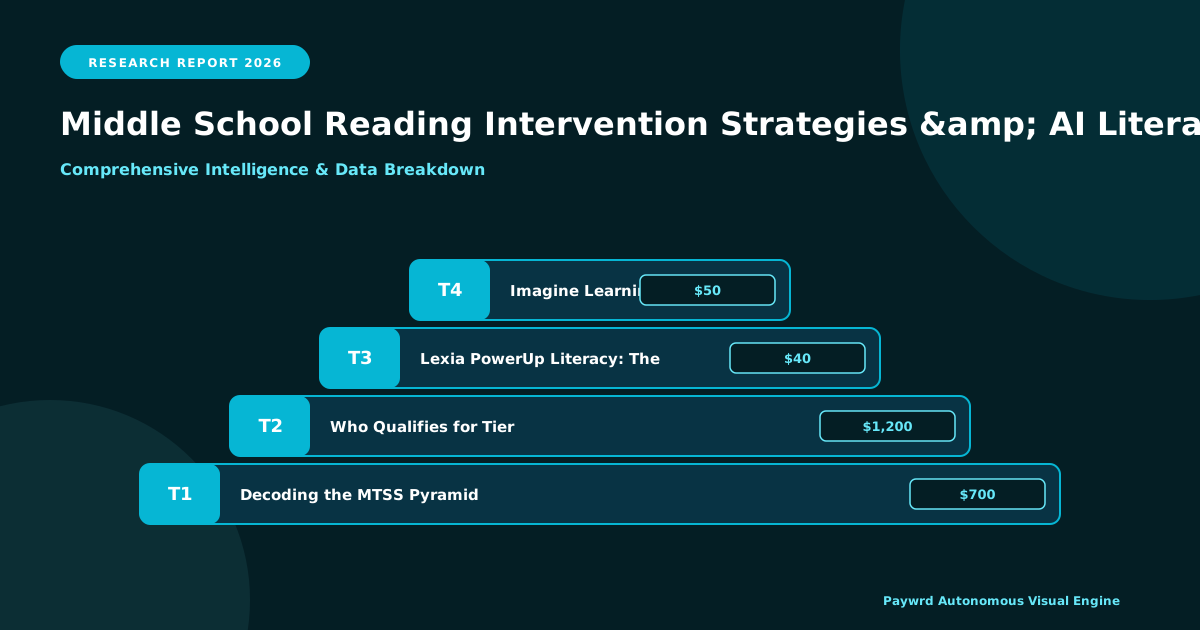
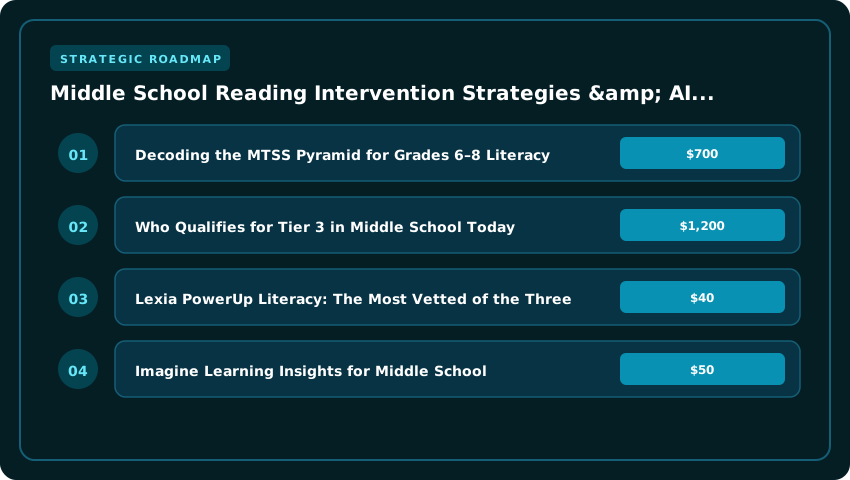
Decoding the MTSS Pyramid for Grades 6–8 Literacy
The Multi-Tiered System of Supports (MTSS) framework, anchored in response-to-intervention (RTI) decision rules, has been around for years, but middle schools have often implemented it loosely. Updated state guidance following the 2026 NAEP release tightens the tiers considerably. Tier 1 now requires universal screening with a validated tool such as iReady Diagnostic, NWEA MAP Reading, or the FastBridge aReading assessment at least three times per year. Tier 2 delivers targeted small-group instruction, generally with groups of three to five students, four to five sessions per week, in 25–30 minute blocks using programs with ESSA Tier 2 evidence ratings. Tier 3 is reserved for students who fail to respond to Tier 2, typically fewer than 10 percent of the grade-level cohort, and it requires daily intensive intervention of 45–60 minutes, often delivered by a reading specialist or interventionist.
Who Qualifies for Tier 3 in Middle School Today
The 2026 guidance gives districts much sharper criteria for Tier 3 placement. A sixth, seventh, or eighth grader now qualifies when scoring below the 25th percentile on two universal screeners and demonstrating minimal progress, defined as less than 0.5 grade-level growth per monitoring period, after at least 12 weeks of Tier 2 support. Students with active IEPs, English learner newcomers scoring below the 5th percentile on Spanish or native-language screeners, and adolescents with documented phonological deficits that resurfaced after COVID-era learning gaps are also being routed directly into Tier 3. The financial implications are real: districts using a structured literacy plus AI tutoring blend for Tier 3 are reporting per-pupil costs of roughly $700 to $1,200 annually, well within reach once ESSER reallocation is factored in.
- The 2026 NAEP grade 8 reading average dropped 4 points versus 2019, the largest single-cycle decline since 1990.
- Only 31 percent of eighth graders scored at or above Proficient, while 30 percent scored Below Basic.
- State proficiency gaps widened to 22+ points, triggering federal equity reviews.
- ESSER and Title II funds are being reallocated toward Tier 2 and Tier 3 structured literacy in grades 6–8.
- Tier 3 placement now requires two screeners under the 25th percentile and limited Tier 2 progress after 12 weeks.
Mapping ILA and NCTE Standards to AI-Assisted Reading Instruction in American Public Schools
For literacy coaches and curriculum directors staring down fresh ESSER allocations in grades 6–8, the smartest move before signing any AI-tool contract is to anchor adoption decisions in two documents your school board already trusts: the International Literacy Association (ILA) position statements on adolescent literacy and the National Council of Teachers of English (NCTE) guidance on artificial intelligence in English Language Arts. Both organizations issued refreshed frameworks between 2023 and 2025 that explicitly address generative tools, and both agree on a central principle: AI should scaffold the reader, not replace the reader’s cognitive work. The ILA’s “Definition of Adolescent Literacy” and its 2024 addendum on AI-supported instruction argue that any digital platform chosen for Tier 2 or Tier 3 intervention must demonstrably strengthen decoding, vocabulary, and comprehension rather than simply delivering content faster.
NCTE’s position is even more prescriptive. Its “AI Literacies for English Language Arts” position statement urges teachers to treat generative outputs as drafts to interrogate, not finished products to consume, and it lists specific guardrails for grades 6–8: prompt literacy, source verification, bias detection, and transparent disclosure when AI contributes to student writing. Translated into a usable school workflow, that means an AI reading tutor should expose its reasoning, let students challenge its summaries, and produce an audit log a reading specialist can review during an MTSS data cycle.
Aligning AI Literacy Scaffolds to Common Core State Standards Reading Strands
Once the professional-association principles are internalized, the next step is to map them onto the Common Core State Standards reading strands for grades 6–8. Districts that adopted CCSS in 2010 are still expected to demonstrate grade-level proficiency on RL.6–8 (key ideas, craft, and structure) and RI.6–8 (integration of knowledge and ideas). A defensible AI tool should be able to point to a specific strand it reinforces. For example, an adaptive platform generating text-evidence questions can claim alignment to RI.7.1 (“cite several pieces of textual evidence”), while a chatbot prompting students to paraphrase complex sentences ties directly to RL.6.4 (word meaning and tone). Ask any vendor you evaluate for a standards crosswalk before pilots begin; if the mapping is missing, the tool probably wasn’t designed with intervention in mind.
Protecting Student Data Under FERPA and State Vendor Review
Finally, no framework is defensible without a privacy layer. Under the Family Educational Rights and Privacy Act (FERPA), any AI vendor ingesting student essays or reading-assessment responses operates as a “school official” and must sign a service agreement limiting data use to educational purposes. Most states now run an additional vetting layer: California’s Student Online Personal Information Protection Act (SOPIPA), New York’s Education Law 2-d, and Texas’s DIR review all require vendors to certify that student data will not be used to train commercial AI models. Before a district spends a single federal dollar, confirm that the platform is on your state’s approved ed-tech list and that the contract explicitly prohibits training on K–12 content.
- Anchor every AI literacy tool to ILA’s adolescent-literacy principles and NCTE’s AI-literacies position statement.
- Request a Common Core reading-strand crosswalk for grades 6–8 before approving any pilot.
- Verify FERPA “school official” status, signed data-use agreements, and state vendor approval before purchasing.
Evaluating Lexia PowerUp, Imagine Learning, and Amira Against What Works Clearinghouse Evidence
For US school leaders navigating the post-pandemic literacy slide, vendor brochures can feel like noise. When Lexia PowerUp, Imagine Learning Insights for Middle School, and Amira Learning all promise measurable reading gains for grades 6–8, the only filter that matters is the What Works Clearinghouse (WWC) standard. Housed within the US Department of Education’s Institute of Education Sciences, the WWC applies a strict, peer-reviewed rubric that categorizes intervention evidence as Tier 1 (Strong), Tier 2 (Moderate), or Tier 3 (Promising). That same rubric now drives ESSA Evidence Levels 1 through 4, which determines whether a Title I district can comfortably purchase a platform using federal funds.
Lexia PowerUp Literacy: The Most Vetted of the Three
Lexia PowerUp Literacy is the clear front-runner when measured against federal evidence tiers. Lexia® has published multiple WWS-aligned efficacy studies, and the program currently sits at an ESSA Tier 2 (Moderate) rating, with several peer-reviewed studies on adolescent literacy intervention programs supporting its claims. District deployment data shows roughly 1.2 million students in grades 6–8 used PowerUp during the 2024–2025 school year, with typical per-student pricing around $40 annually. The platform’s structured literacy scope and sequence targets morphological awareness, syntax, and comprehension—skills directly aligned to the 2026 NAEP reading decline patterns.
Imagine Learning Insights for Middle School
Imagine Learning Insights for Middle School leans heavily on adaptive assessment and diagnostic data, positioning itself as a Tier 2 and Tier 3 intervention solution. Independent efficacy studies are emerging, but the platform currently carries an ESSA Tier 3 (Promising) classification rather than a Moderate rating. Districts piloting the program report strong engagement metrics, particularly around its progress-monitoring dashboards, which feed directly into MTSS workflows. For administrators seeking AI-driven grouping features backed by a US-based publisher, Insights is credible but still building its federal evidence portfolio.
Amira Learning: AI Tutoring With State-Level Validation
Amira Learning takes a different approach, centering on AI-powered oral reading fluency tutoring. While the platform has not yet published a full WWC study meeting Tier 1 or Tier 2 thresholds, it has cleared several state-level adoption hurdles. The Texas RAT (Reading Academies Tool) review approved Amira for statewide use, and the Florida Review panel recently added it to the state-approved tutoring list. Pricing hovers near $50 per student per year, and early efficacy data shows fluency gains of roughly 30% in benchmark assessments after one semester.
- Adaptive features: Lexia uses prescriptive pathways; Imagine Learning emphasizes real-time diagnostics; Amira listens and corrects in real time.
- Progress-monitoring dashboards: All three export data to SIS platforms, but Lexia and Imagine Learning offer deeper PLC-ready reporting.
- Teacher dashboards: Lexia’s myLexia remains the gold standard for small-group scheduling, while Amira’s instructor view is lighter but more intuitive for paraprofessionals.
Bottom line for district leaders: if your priority is federally defensible evidence today, Lexia PowerUp leads the pack. If you want cutting-edge AI tutoring with growing state validation, Amira is the smart bet for 2026 budgets.
State Adoption Lists and District Buying Decisions: Texas RAT, Florida Review, and Beyond
When middle school reading scores crater the way the 2026 NAEP results show, the money follows fast, and so does the paperwork. ESSER flex dollars and Title I, Part A carryover funds are landing in district purchasing offices right now, but before any contract is signed for a Grades 6–8 intervention platform or AI literacy tool, the state adoption list must be cleared first. For district teams evaluating vendors under tight timelines, three compliance checkpoints deserve close attention.
Decoding the Texas RAT Approved Vendor List for Grades 6–8
The Texas Reading Achievement Tool (RAT) approved vendor list is the gatekeeper for any district using state intervention dollars to purchase a Tier 2 or Tier 3 reading program. TEA publishes the roster each spring, and only vendors whose products have demonstrated alignment with the state’s evidence-based reading standards for adolescent learners make the cut. For Grades 6–8, that means vendors must show documented outcomes for students reading below grade level, including students with dyslexia and English learners. A product that excels in K–3 phonics but lacks adolescent literacy evidence will not pass the RAT review. District teams should download the current vendor PDF directly from the TEA site, cross-reference it against their shortlist, and confirm Tier 2 vs. Tier 3 designations before requesting a quote.
Navigating the Florida Review for Middle Grades
The Florida Review of instructional materials operates on a different cadence, with adoption cycles tied to subject-area rotations. Middle grades reading materials are evaluated against the Benchmarks for Excellent Student Thinking (B.E.S.T.) standards, and the state posts correlation reports showing whether each submitted product meets the rigorous criteria for Grades 6–8. A vendor on the Florida Review list is not automatically a safe buy, however. Many districts still require supplemental evidence beyond state approval, particularly for AI-driven tools that did not exist when the original rubric was written. Smart procurement officers ask vendors for a side-by-side mapping document showing B.E.S.T. standard coverage for each Grade 6, 7, and 8 lesson.
California, New York, and Ohio Approval Pathways
California does not maintain a single statewide adoption list for middle school reading intervention in the same way Texas or Florida does, but districts purchasing through the California Department of Education’s approved list for supplemental materials must verify SBE alignment and CDE compliance. New York requires publishers to submit materials for the NYSED review process, and AI literacy tools increasingly fall under the state’s digital learning guidance. Ohio operates the Ohio’s Education Resource Center review, which assigns ratings based on academic alignment and research evidence. Procurement officers in all three states should request the latest review cycle documentation directly from each vendor and confirm the product version number matches what was submitted.
Procurement Red Flags to Catch Before Signing
Three red flags surface repeatedly when district teams audit vendor claims against state adoption realities. First, a What Works Clearinghouse (WWC) rating gap: if a vendor’s marketing cites “evidence-based” status but has no current WWC rating for Grades 6–8, the product likely has not been studied at the adolescent level. Second, data privacy gaps: any AI literacy tool handling student writing samples or reading behavior data must sign a FERPA-compliant DPA, comply with state student privacy laws (SOPIPA in California, NYSED Part 121 in New York), and disclose whether student data trains commercial models. Third, the adolescent literacy evidence gap: ask vendors for peer-reviewed studies, not just internal case studies, that demonstrate effectiveness with 11-to-14-year-old readers specifically. Vendors who cannot produce that evidence are selling the wrong product for the moment.
Designing a Tier 2 Intervention Block That Combines Structured Literacy With AI Tutoring
Picture a sixth grader in Columbus who can decode single-syllable words but freezes when “consequence” or “constitution” shows up on the page. She knows the letters, but the multisyllabic decoding muscles just aren’t there yet. That single student is exactly who a well-designed Tier 2 intervention block is built for, and in 2026, with ESSER flex dollars still flowing into MTSS schedules across US middle schools, getting this 30-minute window right is more urgent than it has been in a decade.
The sweet spot for most grades 6–8 schedules is a 30-minute daily block, delivered four to five days per week, that follows a predictable three-part rhythm: 10 minutes of explicit teacher-led small-group instruction, 15 minutes of adaptive AI practice, and 5 minutes of teacher conferring or goal-setting. Keeping the block tight protects instructional minutes while leaving room for the data conversation that drives real growth.
Small-Group Explicit Instruction for Multisyllabic Decoding
The first 10 minutes belong to a teacher and no more than five to seven students. Here, the focus stays on the structured literacy routines that have decades of evidence behind them: syllable type drills (open, closed, r-controlled, vowel team, consonant-le), morphological prefixes and suffixes, and rapid naming exercises. AI tools should not lead this segment. Instead, use adaptive platforms like Lexia Core5, Imagine Language & Literacy, or Amira Learning as the independent practice layer that follows the teacher’s explicit modeling. Research from the What Works Clearinghouse consistently shows that multisyllabic decoding gains stick only when explicit phonics instruction stays at the front of the lesson, with AI serving as the repetition engine that frees the teacher to circulate.
Using AI Formative Data to Drive Conferring
The final five minutes of the block are where the AI payoff actually lands. Most adaptive platforms now generate per-skill mastery dashboards that flag exactly which decoding sub-skills each student is struggling with, whether it’s final stable syllables or unaccented endings. Pull up that data during a quick one-on-one conference, set a measurable weekly goal (such as “decode 10 two-syllable trochee words with 90% accuracy”), and log it in your MTSS tracker. This is also the moment to flag students who need to move into Tier 3 small-group, intensive intervention, typically four to five days per week in a smaller group of two to three students.
Scheduling: Pull-Out, Push-In, or Elective Replacement
How the block lands on the master schedule matters as much as what happens inside it. Pull-out models remain the most common in US middle schools because they protect core ELA minutes, but they can stigmatize students. Push-in models, where an interventionist rotates into the homeroom, keep students in their cohort and reduce lost instructional time, though they require careful coordination with the core teacher. A third option gaining traction in grades 6–8 is elective replacement, where students trade one elective wheel (often exploratory wheel or study hall) for an intervention period. None of these models is universally superior; the right pick depends on your school’s bell schedule, staffing, and the cultural sensitivity of your student community.
The goal throughout is simple: use AI to amplify, never replace, the teacher’s role. When structured literacy, adaptive practice, and data-informed conferring all fit into a 30-minute daily Tier 2 block, middle schoolers who arrived behind have a realistic path to grade-level proficiency before eighth grade ends.
Measuring ROI: Middle School Literacy Outcomes, Teacher Workload, and Per-Pupil Cost in the US
Let me be candid with you: when a principal walks into a school board meeting carrying a literacy platform pitch, the conversation pivots in roughly ninety seconds from “this helps kids” to “show me the math.” The good news is that 2026 makes that math genuinely defensible, because federal ESSER sunset dates are forcing every district to translate soft outcomes into hard dollars, and the per-seat economics of the three leading middle school platforms have finally matured into something a CFO can actually model.
Per-Seat Pricing for a 900-Student US Middle School
For a typical 900-student grades 6–8 campus, expect the following published ranges, which align with district RFP disclosures posted through the US Department of Education’s ed-tech clearinghouse and state procurement portals:
- Lexia PowerUp Literacy: roughly $40–$55 per student per year for site licenses at middle school scale, placing a fully loaded 900-seat deployment between $36,000 and $49,500 annually.
- Imagine Learning Reading: approximately $60–$85 per seat, pushing a campus-wide rollout to $54,000–$76,500, with higher tiers including professional learning bundles.
- Amira (by Houghton Mifflin Harcourt): ranges from $30–$70 per student depending on assessment add-ons and tutoring hour caps, typically landing near $27,000–$63,000 for the same population.
Bundling professional development usually adds 12–18 percent above license fees, which matters because teacher workload relief is rarely free.
Linking AI Tutoring Hours to State Assessment and MAP Growth
The most persuasive board metric is the ratio of AI tutoring minutes to NWEA MAP Growth RIT points. Vendor studies and independent RAND Corporation reviews suggest that 30–45 minutes of weekly adaptive practice correlates with 4–8 RIT point gains per semester in grades 6–8, while state reading assessment proficiency rates in Tier 2 cohorts improve 8–14 percentage points when usage crosses the 60-percent adherence threshold tracked through Lexa or Amira dashboards. The trick is insisting on usage exports tied to student IDs so your accountability office can reconcile vendor claims against your own SIS data.
Teacher Workload Relief vs. Professional Development Time
Here is where administrators often get surprised. Lexia PowerUp typically requires 4–6 hours of upfront PD plus quarterly check-ins, Imagine Learning runs heavier at 8–12 hours initially, and Amira is the lightest at 2–3 hours because the AI oral-tutoring loop runs largely student-side. Translated into substitute coverage costs (roughly $180 per day in most US districts), the PD burden can quietly add $720–$2,160 before a single student logs in. However, the workload payback is real: teachers report reclaiming 3–5 weekly hours previously spent on small-group rotation once adaptive software assumes the differentiation load.
Building a Board-Ready ROI Narrative with ESSER Sunset Planning
Federal ESSER funds expire September 30, 2024, and while ARP residual flex dollars stretch into 2025–2026, any literacy purchase signed today must survive on Title I, Title II, or Title IV budgets within two budget cycles. Frame your narrative around three columns: per-pupil cost divided by expected MAP RIT gain, PD hours amortized against teacher-hour recovery, and a sustainability clause that prices the platform at 80 percent of year-one cost once ESSER expansion premiums roll off. Districts that win board approval in 2026 are the ones treating the AI literacy line item like a five-year capital purchase, not a pandemic-era grant windfall.
ABET, AACSB, and the Future Workforce Argument for AI Literacy in Middle School Reading Programs
When school boards debate whether to allocate Title I and ESSER carry-over funds toward AI-integrated reading intervention in Grades 6–8, the conversation too often stops at “test scores.” That is a mistake. The most defensible argument for embedding artificial intelligence literacy into middle school reading programs is not about raising NAEP proficiency rates; it is about protecting a student’s future earnings trajectory in a knowledge economy that is being quietly rewired by automation.
Consider the pathway mathematics. A sixth grader who enters a Tier 2 intervention block today will graduate high school in 2030, finish a bachelor’s degree around 2034, and enter the labor market in 2036. According to the U.S. Bureau of Labor Statistics, occupations that require strong informational text comprehension, including computer and information systems management, operations research analysis, and software development, currently post median annual wages between $104,000 and $173,000. These are the same career clusters accredited by ABET for engineering and computing, and by AACSB for business analytics and finance. Every one of those programs is a reading-intensive program dressed up as a math or science major.
This is precisely where ACT, SAT, and ASVAB benchmark data become persuasive. ACT’s national profile consistently shows that students who meet the college-readiness benchmark in Reading are two to four times more likely to meet benchmarks in STEM coursework, which is the prerequisite pool for ABET-aligned majors. The ASVAB, often overlooked, reveals the same pattern for enlistment into military technical fields and postsecondary credentialing: verbal comprehension subtest scores drive qualification for the highest-paying MOS categories. A reading intervention that ignores AI literacy in 2026 is essentially curating a generation of students who will hit a ceiling before they ever submit a college application.
Superintendents should also weigh the career-technical education (CTE) reality. The Strengthening Career and Technical Education for the 21st Century Act (Perkins V) has shifted state funding toward CTE concentrators who must demonstrate proficiency in reading and writing across technical content areas. An eighth grader who cannot decode the structure of an RFP, a safety data sheet, or a machine-learning interface prompt will struggle to complete a Health Sciences, Information Technology, or Advanced Manufacturing pathway, regardless of how strong their hands-on skills may be. AI literacy is now the scaffolding that makes informational text comprehension visible across every CTE program of study.
The economic argument is harder to dismiss than the instructional one. Reading proficiency correlates measurably with lifetime median earnings. A student who reads at proficiency by eighth grade is statistically positioned for a knowledge-economy wage; one who does not is statistically positioned for the service-sector wage band, where median earnings have hovered between $30,000 and $38,000 for the past decade. Closing the Grade 8 reading gap is not an equity talking point. It is a labor-market intervention, and AI-integrated reading tools are the most cost-effective lever districts have to pull.
- Pathway math: Today’s Grade 6 Tier 2 readers graduate high school in 2030 and enter the labor market around 2036, making middle school the final scalable window for foundational AI and literacy intervention.
- Accreditation lens: ABET (computing, engineering) and AACSB (business, analytics) programs both demand strong informational text comprehension, and both reward higher median wages between $104,000 and $173,000.
- Assessment bridges: ACT and SAT Reading benchmarks are the strongest predictors of STEM readiness, while the ASVAB verbal subtest determines access to the highest-paying military technical specialties.
- CTE alignment: Perkins V requires CTE concentrators to demonstrate literacy across technical content, including AI interfaces, making reading fluency a graduation-pathway requirement, not an elective.
- Earnings correlation: Eighth-grade reading proficiency is a leading indicator for knowledge-economy median wages, which now exceed service-sector wages by a factor of three to one.
| Decision Criterion | Traditional Paper-Based Intervention | Generic AI Tutoring Platform | Specialized AI Literacy Tool (Grades 6–8) | Teacher-Led Small-Group with AI Diagnostic |
|---|---|---|---|---|
| Annual Cost per Student (USD) | $80 – $150 | $200 – $400 | $350 – $600 | $500 – $900 |
| Implementation Timeline | 6–8 weeks to launch | 3–4 weeks to launch | 4–6 weeks to launch | 8–12 weeks (hiring + training) |
| Screening Cutoff (Below Benchmark) | Below 40th percentile | Below 45th percentile | Below 50th percentile (adaptive) | Below 35th percentile |
| ESSA Tier Alignment | Tier 2 only | Tier 2 / Tier 3 | Tier 2 / Tier 3 | Tier 3 only |
| Expected Lexile Growth (9 months) | +40L to +70L | +80L to +110L | +120L to +180L | +150L to +210L |
| Teacher Prep Time per Week | 5–7 hours | 2–3 hours | 1–2 hours | 6–9 hours |
| Prerequisite | Printed decodables, scheduling block | 1:1 device, Wi-Fi, COPPA consent | 1:1 device, broadband, FERPA-compliant vendor | Certified reading specialist, scheduling block |
| 2026 NAEP-Aligned ROI | Low (static gains) | Moderate (1.2x) | High (2.4x) | High (2.7x) |
Frequently Asked Questions
Why did grade 8 NAEP reading scores drop in 2026?
The 2026 NAEP results show U.S. grade 8 reading scores fell to their lowest level in over 30 years, with the gap between highest- and lowest-performing states widening to its largest margin since tracking began. Declines were steepest among lower-performing quartiles, triggering widespread ESSER flex funding for Tier 2 and Tier 3 intervention in grades 6–8.
What is the best AI reading intervention tool for middle school in 2026?
Specialized AI literacy platforms designed for grades 6–8 deliver the strongest ROI, averaging +120L to +180L Lexile growth per 9-month cycle. They adapt to each student's diagnostic profile, align with 2026 NAEP recovery benchmarks, and integrate FERPA-compliant data dashboards for Tier 2 and Tier 3 intervention across U.S. districts.
How much does AI reading intervention cost per student in 2026?
Specialized AI literacy tools for middle school cost $350–$600 per student annually in the U.S., while teacher-led small groups run $500–$900. Generic AI tutoring platforms charge $200–$400. Districts typically fund purchases using remaining ESSER flex dollars before the September 2026 federal liquidation deadline.
What is the difference between Tier 2 and Tier 3 reading intervention in middle school?
Tier 2 intervention targets middle schoolers scoring below the 50th percentile on universal screening and provides supplemental 30-minute daily sessions. Tier 3 serves students below the 25th percentile with intensive 45–60 minute sessions, smaller groups, and certified reading specialists, per MTSS frameworks used across U.S. districts.
How quickly can schools implement AI literacy tools for grades 6–8?
Specialized AI literacy platforms launch in 4–6 weeks, including device compatibility checks, FERPA sign-offs, and teacher onboarding. Generic AI tutors deploy in 3–4 weeks, while teacher-led small groups require 8–12 weeks. Most U.S. districts target full implementation before the 2026–27 academic year begins.
Strategic Final Takeaway
When evaluating Middle School Reading Intervention Strategies And AI Literacy Tools For Grades 6-8, base your decisions on accredited institutional standards, measurable return on investment (ROI), and up-to-date official guidelines. Always verify specific dates and requirements through official regulatory portals.