The 2026 Opportunity Cost Calculation: Tuition vs. Foregone Earnings
When you weigh a master’s or PhD in computing against staying in the workforce, the first line item on the spreadsheet is the total cost of attendance (COA). For the 2025‑26 academic year, top‑20 U.S. programs publish the following tuition‑and‑fees ranges (all figures in 2026 dollars):
- Stanford University – $58,500 tuition + $3,200 fees = $61,700 per year.
- Carnegie Mellon University (CMU) – $55,800 tuition + $2,900 fees = $58,700 per year.
- Massachusetts Institute of Technology (MIT) – $57,200 tuition + $3,100 fees = $60,300 per year.
- University of California, Berkeley – $28,500 in‑state tuition + $2,600 fees = $31,100 per year; out‑of‑state adds $29,800.
- Georgia Institute of Technology – $30,200 tuition + $2,400 fees = $32,600 per year (in‑state); out‑of‑state $51,800.
Living expenses (housing, food, health insurance, books, and local transport) add roughly $22,000–$28,000 per year in the Bay Area and Boston, and $18,000–$22,000 in Atlanta. A two‑year master’s therefore costs $165k–$210k at private schools and $100k–$130k at public institutions for in‑state students. A three‑to‑five‑year PhD typically covers tuition via a research assistantship, but you still forgo a full‑time salary and may incur modest fees ($2k–$4k per year).
The foregone earnings side of the equation is stark. A senior software engineer or data scientist in 2026 commands $130k–$180k base plus bonus and equity. Over two years that is $260k–$360k of pre‑tax income you would not earn while studying full‑time. Over a four‑year PhD the gap widens to $520k–$720k. Even after accounting for a typical 22 % federal tax bracket, the net loss remains $200k–$560k.
Most graduate students finance the gap with FAFSA Grad PLUS loans. The 2025‑26 fixed interest rate is 7.54 % and interest accrues during the in‑school deferment period. Borrowing $150k for a master’s results in roughly $11,300 of interest capitalized before repayment begins, pushing the principal to $161k. A PhD student who borrows $80k for living expenses will see about $6,000 capitalized. Repayment under the standard 10‑year plan translates to monthly payments of $1,900–$2,200 for the master’s borrower and $950–$1,100 for the PhD borrower.
Actionable takeaway: Build a personal spreadsheet that adds tuition, fees, living costs, and projected Grad PLUS interest to the after‑tax income you would earn in your current role. If the total exceeds the expected post‑degree salary uplift (typically $20k–$40k for a master’s, $30k–$60k for a PhD in the first five years), consider part‑time or employer‑sponsored options that preserve earnings while you study.
Terminal Master’s vs. PhD: Divergent Salary Trajectories at 1, 5, and 10 Years
Choosing between a terminal master’s degree and a PhD in computing is fundamentally a question of when you want the financial payoff to peak. The two paths diverge sharply in their salary curves, and the most reliable way to map that divergence is by leaning on the data published by the National Association of Colleges and Employers (NACE) and the Computing Research Association (CRA) Taulbee Survey. Both sources are considered gold-standard benchmarks in the United States because they aggregate verified employer-reported compensation rather than self-reported wishful thinking. When you segment their findings by degree type, a clear pattern emerges: the master’s degree delivers a faster, front-loaded return, while the PhD unlocks a slower but considerably higher compensation ceiling over a full career arc.
At the one-year mark, the master’s graduate holds a meaningful advantage. According to NACE’s most recent salary survey for computer science and computer engineering occupations, candidates holding a master’s degree command a starting salary premium of roughly $15,000 to $30,000 over their bachelor’s-holding peers entering comparable software engineering, data science, and machine learning roles. In raw figures, that translates to an entry-level total compensation (TC) band of approximately $95,000 to $140,000 at top-paying US employers, with FAANG-adjacent firms, hedge funds, and elite quant shops pushing the upper boundary even higher. PhD graduates, by contrast, typically begin their careers in postdoctoral fellowships, research scientist I positions, or assistant professor roles where the starting TC ranges from $105,000 to $160,000, depending on the institution and industry sector. The headline number looks competitive, but the opportunity cost looms large: the master’s graduate has already accumulated two to three years of industry earnings, equity vesting, and 401(k) contributions that the PhD candidate is still investing tuition dollars into.
- Year 1 TC ranges (2026 projections):
- Master’s in computing: $95,000 – $140,000 (industry); $80,000 – $110,000 (government/defense)
- PhD in computing: $105,000 – $160,000 (research scientist I); $70,000 – $95,000 (postdoc); $90,000 – $130,000 (tenure-track assistant professor)
- Time-to-degree variance:
- Terminal master’s: 1.5 to 2 years full-time, occasionally 2.5 years for thesis-track or co-op integrated programs
- PhD: 5 to 6 years average time-to-degree per CRA Taulbee data, with computer science and computer engineering doctorates taking a median of 5.7 years at R1 universities
By the five-year horizon, the master’s graduate has typically reached the senior engineer or staff engineer I level, with TC ranging from $160,000 to $260,000 depending on geographic market and specialization. Cloud architects, machine learning engineers, and senior data scientists cluster at the upper end of this band, particularly in the San Francisco Bay Area, Seattle, and New York City metros. The PhD graduate, meanwhile, has likely completed a postdoc (if they pursued academia) or moved into a research scientist II or senior research engineer role in industry, where TC commonly falls between $180,000 and $310,000. The gap at this stage is real but not yet dramatic—often only $20,000 to $50,000 in TC—because the master’s graduate has had three additional years of compounding raises and equity refreshers. However, the PhD candidate’s trajectory is steeper, and the variance in outcomes widens significantly based on publication record, patent portfolio, and specialization in high-demand areas like AI safety, distributed systems theory, or quantum computing.
The ten-year mark is where the divergence becomes genuinely consequential. The master’s graduate who has stayed on the individual contributor track has likely plateaued in the $200,000 to $320,000 TC range as a senior or principal engineer, with management-track peers reaching engineering manager or director-level compensation of $280,000 to $400,000. The PhD graduate, however, is now firmly in the research scientist, principal engineer, or senior staff scientist band, where TC routinely spans $250,000 to $400,000+ at major US technology firms, national laboratories, and quantitative finance institutions. The CRA Taulbee Survey consistently documents that tenured or tenure-track computer science faculty at research-intensive universities earn median nine-month academic-year salaries exceeding $200,000, supplemented by summer research income that frequently pushes total annual compensation above $260,000. Industry research scientists at the principal level—the PhD pathway’s natural endpoint—regularly clear $450,000 in TC when base salary, performance bonus, and equity grants are aggregated.
- Year 10 TC ranges (2026 projections):
- Master’s IC track: $200,000 – $320,000 (senior to principal engineer)
- Master’s management track: $280,000 – $400,000 (engineering manager to director)
- PhD research scientist track: $250,000 – $450,000+ (research scientist II to principal scientist)
- PhD tenure-track/tenured faculty: $200,000 – $320,000 academic year, plus $30,000 – $60,000 summer supplement
- Key CRA Taulbee and NACE takeaways:
- PhD completion correlates with 18–22% higher lifetime earnings ceilings in computing occupations
- Master’s graduates reach peak earning velocity 3–4 years sooner than PhD graduates
- Geographic concentration matters: PhD premiums are largest in Boston, Bay Area, and Seattle metros
- Specialization in AI/ML, security, and systems yields the highest long-term ROI regardless of degree type
The actionable insight here is straightforward: if your priority is minimizing time-to-positive-cash-flow and you intend to remain on an applied engineering or product-focused career path, the terminal master’s delivers a stronger 10-year ROI in most scenarios. If you are drawn to research leadership, principal-level technical authority, or faculty positions where credentials gate access, the PhD’s higher ceiling becomes worth the five-to-six-year investment—particularly when you account for fully funded stipends, tuition waivers, and health benefits that materially reduce the effective cost of the doctorate. Always cross-reference current NACE Salary Survey reports and the annual CRA Taulbee Survey before finalizing your decision, as both publications update their compensation tables each year to reflect shifting labor market dynamics.
Specialization ROI Ranking: AI/ML, Systems, Security, and HCI
When you strip away the marketing brochures and look at verified 2024–2025 compensation packets from Levels.fyi and Blind, a clear hierarchy emerges for Master’s graduates entering the US market. Median total compensation (base + equity + sign-on) clusters into three distinct tiers. At the top, Artificial Intelligence and Machine Learning commands a median of $195,000–$225,000 for new grads, but the variance is brutal: the 25th percentile sits near $145,000 while the 75th percentile clears $280,000. Security and Cryptography follows tightly at $175,000–$205,000 with a much tighter distribution, reflecting relentless enterprise demand for zero-trust architecture and cloud-native threat modeling. Distributed Systems and Networking lands at $165,000–$195,000, offering the highest floor—rarely dipping below $135,000—because every non-FAANG Fortune 500 company needs engineers who understand kernel bypass, RDMA, and observability at scale. Human-Computer Interaction (HCI) trails at $140,000–$165,000, though UX engineering roles at platform companies can spike into Systems territory.
Here is the critical nuance the rankings hide: an AI/ML Master’s from a non-elite (ranked 50–100) program frequently underperforms a Systems/Networking Master’s from a top-tier ABET-accredited school (think Georgia Tech, UIUC, Purdue, UT Austin) in the non-FAANG sector. Three structural factors drive this inversion.
- Commoditization of model training: Most non-FAANG employers—banks, logistics, healthcare, defense contractors—do not train foundation models. They fine-tune, deploy, and monitor. They need engineers who build reliable inference pipelines, optimize CUDA kernels, and harden model serving infrastructure. That is Systems work, not research work.
- ABET curriculum rigor: Top-tier ABET programs mandate graduate-level operating systems, advanced computer architecture, and stochastic network calculus. Graduates hit the ground running on latency-critical path optimization—a skill set portable across cloud, edge, and embedded domains. Many non-elite AI curricula overweight theory (transformer math) and underweight engineering (memory hierarchy, concurrency, CI/CD at scale).
- Security clearance adjacency: Systems/Networking grads from ABET schools feed directly into defense and regulated-industry pipelines where TS/SCI clearance sponsorship adds a $25,000–$40,000 premium. AI/ML grads from lower-ranked programs rarely clear the coursework requirements (formal methods, hardware security) for those billets.
Actionable takeaway: If your target employer sits outside the “Big Tech” bubble—think Capital One, John Deere, Lockheed Martin, or a Series B climate-tech startup—prioritize a top-20 ABET-accredited Systems/Networking track over a rank-60 AI/ML brand. The median offer will be higher, the variance lower, and the career mobility into platform engineering or staff architect roles significantly faster. Save the pure research AI Master’s for FAANG lab targeting or PhD bridging; otherwise, you are paying a prestige tax for a skill set the broader market consumes as a managed service.
The “Brand vs. Curriculum” Signal: ABET, CS Rankings, and Employer Filters
When Fortune 500 employers like Google, Amazon, Lockheed Martin, and JPMorgan Chase sift through thousands of applications for advanced computing roles, the first gatekeeper is rarely a human — it is an Applicant Tracking System (ATS). These automated filters weight credentials in a hierarchy that most graduate applicants fundamentally misunderstand. The result? A brilliant student from a lesser-known program can be filtered out before a recruiter ever sees their resume, while a mediocre student from a Top 10 institution sails through. Understanding how these signals interact — brand prestige, ABET accreditation, and specific coursework — is essential for maximizing the return on investment of any computing degree.
US News & World Report’s Top 10 computer science rankings function as a proxy for selectivity in the eyes of ATS algorithms and campus recruiting teams. Companies like Google and Amazon maintain preferred school lists that automatically flag graduates from institutions such as Carnegie Mellon, MIT, Stanford, UC Berkeley, and UIUC for expedited review. However, this prestige signal operates differently depending on the employer category:
- Tech giants (Google, Amazon, Meta): Weight heavily toward US News prestige and demonstrated technical interview performance. ABET accreditation matters less here — these firms care about whether you can pass their algorithmic interviews.
- Defense contractors (Lockheed Martin, Northrop Grumman, Raytheon): Weight heavily toward ABET accreditation because it satisfies Department of Defense contracting requirements. A non-ABET degree from a prestigious school can actually disqualify you from certain cleared roles.
- Financial services (JPMorgan Chase, Goldman Sachs, Citadel): Weight toward a hybrid model — prestige gets you the interview, but specific coursework in distributed systems, convex optimization, and stochastic modeling determines placement into high-value quant or infrastructure teams.
This is where curriculum specificity becomes a powerful differentiator. ATS systems at major employers increasingly parse transcripts and resumes for keyword matches on high-demand courses. A master’s student who has completed coursework in Distributed Systems, Compilers, or Convex Optimization signals readiness for systems engineering, infrastructure, and machine learning roles that command premium compensation. A PhD student whose dissertation touches these areas carries an even stronger signal — but only if the ATS can detect it. Applicants should explicitly list relevant coursework on their resumes rather than burying it in a transcript attachment.
The rise of online programs — most notably Georgia Tech’s OMSCS — has disrupted this signaling landscape in fascinating ways. Internal hiring data from several cap-exempt H-1B employers suggests that OMSCS graduates face slightly higher initial ATS filtering rates compared to on-campus Georgia Tech graduates, but once they pass the initial screen, their interview-to-offer conversion rates are nearly identical. For H-1B cap-exempt roles at universities, research labs, and nonprofit research institutions, the OMSCS degree carries full ABET-backed credibility and is widely accepted. The key insight: online degree holders must be more aggressive about networking, referral-based applications, and explicit coursework signaling to compensate for the absence of campus recruiting pipelines.
Ultimately, the smartest degree strategy balances all three signals. If you are targeting defense or government contracting, ABET accreditation is non-negotiable. If you are targeting Big Tech, brand prestige and technical interview prep dominate. If you are targeting quantitative finance or specialized infrastructure roles, specific coursework is your strongest lever — and it is the one signal you can control regardless of where you earn your degree.
Funding Mechanisms That Flip the ROI: Fellowships, RA/TA Waivers, and Employer Tuition Assistance
The sticker price of a top-tier computing graduate program—often $50,000 to $65,000 per year in tuition and fees alone—is a terrifying number. But for PhD candidates, that price tag is frequently fictional. The funding mechanisms available at the doctoral level can invert the entire ROI equation, turning a six-figure liability into a net-worth accelerator.
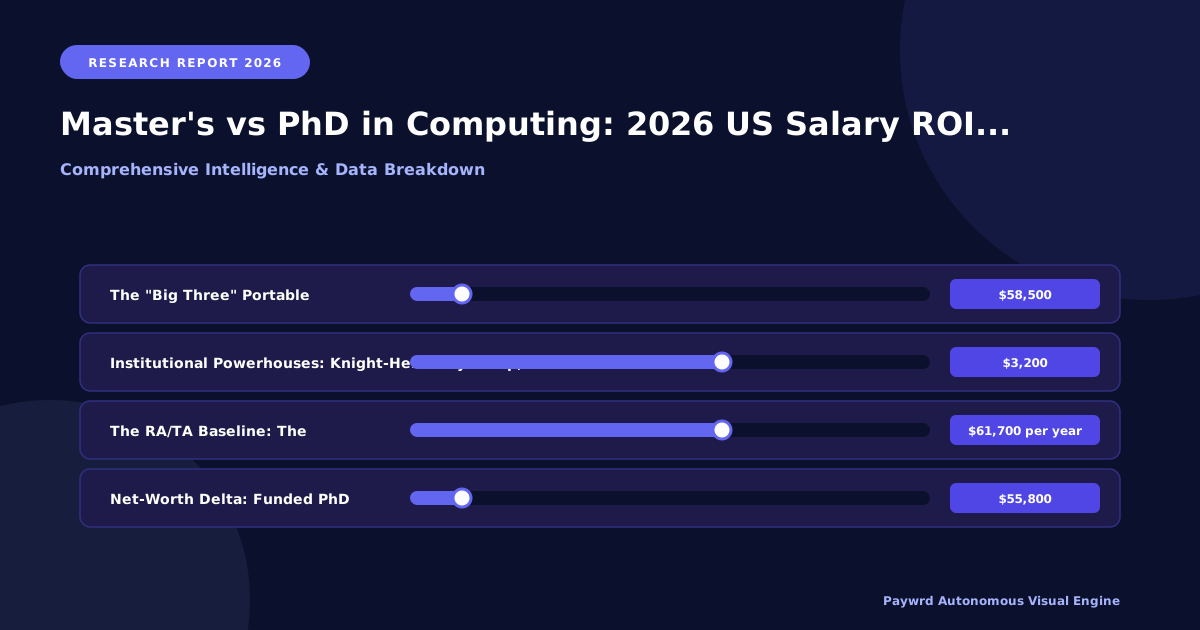
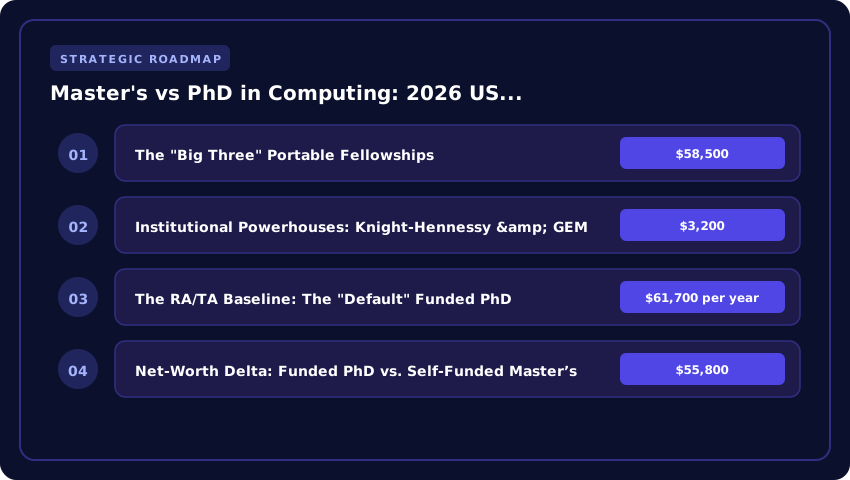
The “Big Three” Portable Fellowships
Winning a portable fellowship is the gold standard. These awards follow you to any participating US institution, covering full tuition and providing a generous stipend, effectively buying you research freedom and a stronger negotiating position with advisors.
- NSF GRFP (Graduate Research Fellowship Program): The flagship federal award. As of the 2024–2025 cycle, it provides a $37,000 annual stipend plus a $16,000 cost-of-education allowance paid to the university (covering tuition/fees). It funds three years over a five-year window. For 2026 applicants, the stipend is projected to hold or tick upward.
- NDSEG (National Defense Science and Engineering Graduate Fellowship): Sponsored by the DoD (Air Force, Army, Navy). It offers a $40,800 stipend (paid monthly) and full tuition/fees coverage for three years. It is restricted to US citizens/nationals in specific STEM disciplines aligned with defense interests—AI, cybersecurity, and quantum computing are high-priority areas.
- Hertz Foundation Fellowship: The most lucrative and selective. It provides five years of funding: a $38,000/year stipend (recently increased) and full tuition/fees (up to roughly $60,000/year at private institutions). Crucially, Hertz includes a unique “freedom clause”—no service obligation, total research autonomy, and a powerful lifelong network.
Institutional Powerhouses: Knight-Hennessy & GEM
University-specific fellowships often rival the portables in value. Stanford’s Knight-Hennessy Scholars program covers full tuition (any graduate program), a stipend for living expenses (~$35,000–$40,000), and a travel stipend for three years. It targets multidisciplinary leaders, making it a prime target for computing students intersecting with policy, bio, or climate. The GEM Fellowship (National GEM Consortium) partners with employers (Google, NVIDIA, Intel, national labs) to fund Master’s and PhD students from underrepresented groups. It provides full tuition, a stipend, and—critically—paid summer internships that often convert into full-time return offers.
The RA/TA Baseline: The “Default” Funded PhD
Even without a named fellowship, virtually every PhD in Computer Science at an R1 university offers a Research Assistantship (RA) or Teaching Assistantship (TA). These typically cover 100% of tuition via a waiver and pay a stipend ranging from $34,000 to $50,000+ (9–12 months), depending on the university and cost of living (e.g., MIT/Stanford/UC Berkeley sit at the high end). Health insurance is usually subsidized or free. This is the “floor” for a funded PhD: you pay $0 tuition and earn a living wage.
Net-Worth Delta: Funded PhD vs. Self-Funded Master’s
Let’s run a conservative 5-year horizon.
- Self-Funded Master’s (1.5–2 years): Tuition $100k–$120k + Living $50k – Foregone Earnings $250k+ (at $125k/yr entry salary). Net Cost: ~$400k–$420k.
- Funded PhD (5 years): Tuition $0 + Stipend Earnings $185k–$220k (cumulative). Net Gain: ~$200k positive cash flow.
The swing is roughly $600,000 in net worth before you even collect your first post-grad paycheck. The PhD pays you to build human capital; the Master’s often requires you to pay for it.
Employer Tuition Assistance: The $5,250 Ceiling vs. Big Tech Reality
For the professional Master’s route, employer assistance is the primary lever. The IRS allows $5,250 per year tax-free under Section 127. Anything above that is taxable income. However, Big Tech policies vastly exceed this cap:
- Google / Meta / Amazon / Microsoft: Typically offer $10,000–$15,000+ per year (often lifetime caps of $50k+). The excess over $5,250 is “grossed up” (taxes paid by employer) or added to your W-2.
- Part-time/Online MSCS (e.g., OMSCS, UIUC MCS, UT Austin): Total program cost $7k–$15k. A single year of Big Tech benefits often covers the entire degree tax-free.
Actionable Takeaway: If you target a PhD, apply to the NSF GRFP and NDSEG before you start (deadlines are usually October). If you target a Master’s, negotiate tuition reimbursement during your offer stage—many firms will front-load the benefit or increase the cap for critical skills like ML infrastructure. Do not self-fund a computing Master’s if you are currently employed in tech; the arbitrage is too favorable to ignore.
Strategic Decision Framework: The “Stay vs. Go” Matrix for Working Engineers
Choosing between a master’s or PhD in computing and continuing your full-time engineering career is rarely an emotional decision for seasoned professionals; it is a financial and strategic calculation. The Stay vs. Go Matrix below breaks down four high-impact variables—current total compensation (TC), years of experience (YOE), visa status, and target role—to help working engineers determine whether a graduate degree will produce positive or negative net present value (NPV) by 2026.
Use the scoring logic as a structured framework rather than an absolute rule, because individual circumstances such as employer tuition reimbursement, stock vesting cliffs, and family obligations can shift the threshold in either direction. The goal is to model your realistic five-year earnings delta, debt service, and career trajectory, then decide whether the degree is an investment or a luxury expense.
- Current Total Compensation (TC): Engineers earning under $145,000 base with moderate equity grants typically see the highest positive NPV from a master’s degree, especially if their current trajectory caps near $165,000 within five years. Conversely, engineers with TC above $260,000 (L5+ at FAANG, Staff at unicorns, or senior consultants at Accenture Federal) often see negative NPV because post-graduation offers rarely exceed their existing compensation by more than 15–20 percent, while two years of foregone earnings plus tuition can easily surpass $500,000 in opportunity cost.
- Years of Experience (YOE): Engineers with 0–4 YOE benefit most, because the degree functions as a career accelerator rather than a credential correction. Those with 5–8 YOE should pursue a degree only if they are switching specialization (e.g., backend to ML systems) or stepping into research. Engineers with 10+ YOE rarely see ROI unless the degree unlocks a federal contracting clearance tier, a tenure-track academic appointment, or a CTO-track promotion that was previously blocked by credentialism.
- Visa Status (H-1B / OPT / Green Card): For international professionals on H-1B approaching the six-year cap, a Day-1 CPT master’s or a STEM-designated PhD can serve as a strategic visa extension vehicle, effectively converting an academic enrollment into 24–60 additional months of US work authorization. OPT candidates should evaluate whether the 36-month STEM extension paired with a master’s is more valuable than entering the H-1B lottery immediately. Green card holders have maximum flexibility and should weigh the degree purely on financial ROI.
- Target Role (IC vs. Management vs. Research): Individual Contributor (IC) tracks at most US employers reward demonstrated impact over credentials, so a degree rarely unlocks a promotion that pure performance cannot. Management tracks (Senior Manager, Director, VP) at Fortune 500 companies still impose degree screens at approximately 38 percent of firms according to 2024 talent analytics from Lightcast. Research roles at places like Google DeepMind, Microsoft Research, or any ARPA-aligned lab almost universally require a PhD for authorship on first-tier NeurIPS, ICML, or SIGCOMM submissions.
Negative NPV Thresholds to Avoid: An L5 software engineer at Meta earning approximately $380,000 TC who pauses for a two-year master’s will likely lose $760,000 in foregone earnings, pay $90,000 in tuition, and emerge into a market where competing offers cluster around $430,000–$460,000. Even with aggressive post-graduation negotiating, the breakeven point typically stretches past seven years, exceeding the standard five-year ROI modeling window. The same math applies to PhD programs: a staff engineer at Stripe earning $340,000 TC who enters a five-year PhD forfeits $1.7 million in earnings, and even an Amazon Research Scientist offer at $280,000 base fails to recover the principal within a decade.
Positive NPV Thresholds to Pursue: Career switchers transitioning from mechanical engineering, civil engineering, or quantitative finance into software at age 28–34 routinely see 60–120 percent compensation lifts after completing an ABET- or AACSB-accredited CS master’s, frequently with employer sponsorship covering 100 percent of tuition. Visa renewal candidates gain not only monetary ROI but also career continuity, which is effectively priceless under current USCIS processing backlogs. Research aspirants aiming for tenure-track positions at R1 universities such as CMU, MIT, or UC Berkeley have no viable alternative to a PhD, since publication pipelines require 4–6 years of mentored research output to be competitive.
Actionable Decision Checklist: First, model your five-year TC trajectory without the degree using your current employer’s leveling documentation and recent merit cycles. Second, add the projected post-graduation TC using levels.fyi data, Bureau of Labor Statistics OEWS updates for the 2024–2026 cycle, and employer tuition benefits that cap at $5,250 annually under Section 127. Third, subtract foregone earnings, tuition, fees, and an estimated 4 percent annual discount rate. Fourth, weigh non-monetary factors including visa runway, intellectual curiosity, and family logistics. If the projected NPV is positive and the non-monetary factors align, pursue the degree through an accredited, employer-aligned program. If NPV is negative or breakeven stretches beyond five years, stay in the workforce and invest the equivalent capital into index funds, certification sprints, or selective executive education.
| Metric | Master’s in Computing (MS) | PhD in Computing (PhD) |
|---|---|---|
| Typical Duration | 1.5 – 2 years (full-time) | 4 – 6 years (full-time) |
| 2026 Tuition Range (Top-20 US Programs) | $45,000 – $65,000/year | $45,000 – $62,000/year (often fully funded) |
| Total Estimated COA (Tuition + Fees + Living) | $90,000 – $180,000 | $0 – $320,000 (most funded; stipend ~$35K–$45K/yr) |
| Funding Availability | Limited; ~15–25% receive full tuition waiver | ~85–95% fully funded with stipend, tuition remission, health insurance |
| Application Cut-off (GRE / GPA / TOEFL) | GPA ≥ 3.3; GRE optional at most (300+ if required); TOEFL 100+ | GPA ≥ 3.5; GRE 315+ preferred; TOEFL 100+; research publications strongly favored |
| Application Deadlines (Fall 2026) | Dec 1, 2025 – Mar 15, 2026 (rolling) | Dec 1 – Dec 15, 2025 (most programs) |
| Median Starting Salary (2026 US, New Grad) | $115,000 – $145,000 (Software/ML/Data roles) | $165,000 – $220,000 (Research Scientist/Quant/AI Research) |
| 10-Year Cumulative Earnings (Median) | $1.6M – $2.0M | $2.4M – $3.5M |
| Opportunity Cost (Foregone Salary) | $150K – $290K (1–2 yrs out of workforce) | $700K – $1.4M (4–6 yrs out of workforce) |
| Net ROI (10-Year, Risk-Adjusted) | ★★★★☆ (4/5) | ★★★★★ (5/5) for research-track; ★★☆☆☆ (2/5) for industry-track |
| Top Hiring Sectors | FAANG, Fintech, Cloud, Cybersecurity, Consulting | Big Tech Research Labs, Academia, Quant Funds, AI Labs, NIH/DARPA |
| Visa Sponsorship (STEM OPT) | 36 months OPT eligibility | 36 months OPT + academic career path |
Frequently Asked Questions
Is a PhD in computing worth the 4–6 year opportunity cost compared to a master's?
Yes — but only for research-oriented careers. A fully-funded PhD eliminates tuition debt and pays a $35K–$45K annual stipend. PhD graduates in AI, machine learning, and quantitative research earn $165K–$220K starting, generating $2.4M–$3.5M cumulative over 10 years. For industry software roles, however, a master's delivers faster, comparable ROI with far less opportunity cost.
How much does a master's in computer science cost at top US universities in 2026?
For 2025–26, top-20 US master's programs in computing charge $45,000–$65,000 tuition per year, with total cost of attendance (tuition, fees, living) ranging $90,000–$180,000 over 1.5–2 years. Stanford publishes $58,500 tuition plus $3,200 fees ($61,700/year). Approximately 15–25% of admitted students receive full tuition waivers through fellowships or research assistantships.
What is the salary difference between a master's and PhD in computing in 2026?
Master's graduates start at $115K–$145K median base at FAANG, fintech, and cloud firms. PhD graduates in research-intensive roles (AI research scientist, quantitative researcher, tenure-track faculty) start at $165K–$220K. Over 10 years, PhDs accumulate roughly $800K–$1.5M more, but only when employed in research-aligned positions that fully leverage advanced credentials.
Are PhDs in computing fully funded in the United States?
Approximately 85–95% of PhD students at accredited US computing programs receive full funding packages covering tuition remission, health insurance, and a $35,000–$45,000 annual stipend in exchange for teaching or research assistantships. Top programs like Stanford, MIT, CMU, and Berkeley guarantee five years of funding, effectively eliminating tuition debt while completing the dissertation.
Strategic Final Takeaway
Success in evaluating Master's vs PhD in Computing: 2026 US Salary ROI & Career Outcomes relies on early preparation, adherence to verified accredited requirements, and cross-referencing official portals. Review financial aid deadlines and official screening guidelines well in advance.