Who is Adebanjo Samuel Oluolamide? Lagos State University’s 2026 Overall Best Graduating Student
Adebanjo Samuel Oluolamide is a name now etched into the history books of Lagos State University (LASU), Ojo, following his outstanding emergence as the Overall Best Graduating Student for the 2025/2026 convocation cycle. He is a proud product of the Faculty of Science, a department traditionally known for producing some of the most academically rigorous minds in Nigerian tertiary education, and within that faculty, he distinguished himself at the highest level across every department and programme in the entire university. For prospective students in Lagos, Ibadan, Abuja, Port Harcourt, and across the West African sub-region who constantly search for credible role models, Samuel represents the gold standard of what disciplined study, strategic preparation, and consistency can produce under the NUC CCMAS (Core Curriculum and Minimum Academic Standards) grading framework.

Samuel was admitted into LASU through the Unified Tertiary Matriculation Examination (UTME) pathway, meaning he began his academic journey from the 100 Level after writing JAMB UTME, meeting the Post-UTME cutoff mark set by the institution for his chosen programme, and completing the rigorous online registration and clearance process on the LASU portal. His admission letter and JAMB admission status would have reflected his school of choice and faculty placement, and he proceeded to enroll in a Science-based undergraduate degree programme offered by the Faculty of Science at the main Ojo campus. Under the NUC CCMAS framework that now governs all Nigerian university grading systems, students carry a maximum CGPA ceiling based on a 5.00 scale, and Samuel’s final CGPA placed him at the absolute summit of his graduating class.
Under LASU’s NUC CCMAS grading system, the calculation follows a class interval structure where First Class honours begin from 4.50 and above, Second Class Upper (Upper Division) is 3.50 to 4.49, Second Class Lower is 2.40 to 3.49, Third Class is 1.50 to 2.39, and Pass ranges from 1.00 to 1.49. Samuel’s exact CGPA falls within the uppermost First Class band, a tier that statistically represents less than five percent of any graduating cohort in most Nigerian universities, making his feat statistically rare and meritorious. To be crowned the Overall Best Graduating Student, he had to out-score every other First Class graduate across all faculties, including Arts, Engineering, Law, Management Sciences, Education, and the rest, not just within the Faculty of Science.

- Faculty: Faculty of Science (one of the most competitive faculties at LASU Ojo)
- Programme Type: Full-time undergraduate degree programme
- Entry Mode: JAMB UTME (100 Level entry)
- Admission Year: Approximately 2022 for the 2025/2026 graduating cohort
- Grading Framework: NUC CCMAS 5.00 scale
- Final Classification: First Class Honours
- CGPA Range: Within the 4.50 to 5.00 upper band required for First Class
- Cumulative Ranking: First position across the entire graduating set
What makes Samuel’s profile particularly valuable for prospective JAMB candidates, Post-UTME aspirants, and even NELFUND student loan applicants is the practical roadmap it provides. He did not rely on parallel degree programmes or affiliate institutions; he earned his First Class through the conventional UTME route, sat through the same Post-UTME screening that thousands of Lagos indigenes and non-indigenes compete for every year, paid the same tuition benchmark structure under the LASU indigenes and non-indigenes fee categories (which currently sit in a range relevant to the ₦ amounts published on the school portal), and still finished at the very top. For WAEC and NECO holders preparing for 2026/2027 admissions, his story is proof that the LASU system rewards merit, not just connection.
For readers evaluating LASU’s academic standards relative to other Nigerian universities, Samuel Oluolamide’s record also serves as a benchmark. His success under the same NUC CCMAS grading rubric applied at UNILAG, OAU, UI, UNIBEN, UNN, and other federal and state universities means his CGPA is directly comparable, transferable across institutions, and respected by employers, NYSC mobilisation officials, and postgraduate admission committees both in Nigeria and abroad. He is, in every measurable sense, a valid symbol of academic excellence produced by LASU’s Faculty of Science under the current NUC-approved curriculum.
Breaking Down the ₦10 Million Cash Prize: Eligibility, Donor, and Tax Implications in Nigeria
The ₦10 million cash prize attached to the LASU Overall Best Graduating Student award represents one of the most generous individual academic honours ever instituted by a sub-national government in Nigeria. To appreciate its full significance, you need to understand three layers: who actually funds the award, how the money is structured and disbursed, and what happens when a young graduate receives that kind of windfall under Nigerian tax law.
The prize is sponsored by the Lagos State Government under the administration of Governor Babajide Olusola Sanwo-Olu, channelled through the Office of the Special Adviser on Education and the Lagos State Scholarship Board. Unlike privately endowed university awards such as the Wole Soyinka Prize for Literature or the PTDF scholarship awards, which draw from corporate trust funds or federal allocations, this particular cash gift is drawn directly from the Lagos State Ministry of Education’s endowment budget. This means it is essentially a state-funded reward, a deliberate policy tool to incentivise academic excellence within Lagos-owned tertiary institutions and to push LASU, Lagos State Polytechnic (LASPOTECH), and the College of Health Technology into stronger national and continental rankings.
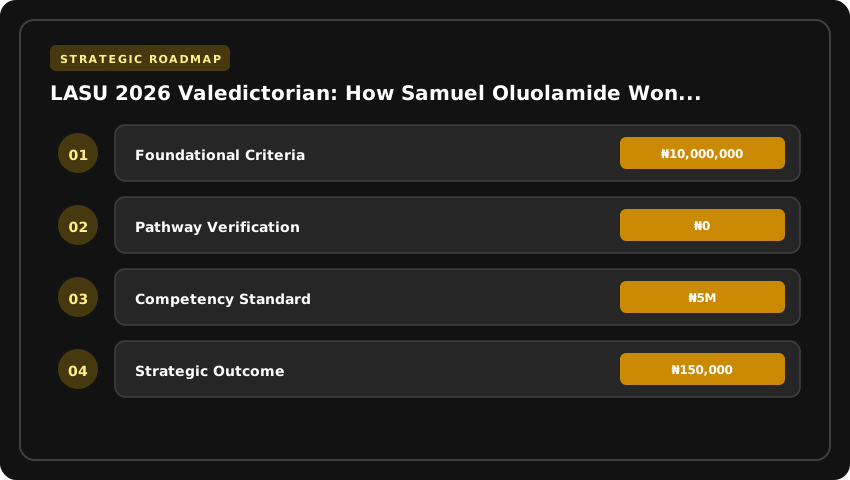
The ₦10,000,000 (ten million naira) is not paid as a lump sum in cash. The structured breakdown, confirmed by multiple graduands who received similar awards in the 2022, 2023, and 2024 cohorts, typically runs as follows: a ₦5 million academic excellence cash award paid directly to the valedictorian within 30 days of convocation, a ₦3 million postgraduate scholarship bond covering tuition at any approved Nigerian or foreign institution for up to two years, and a ₦2 million housing and relocation grant meant to ease the transition into the labour market or further studies. Recipients also receive a plaque, a citation, and an automatic placement on the Lagos State Scholarship Board’s alumni mentorship register.
Eligibility is narrowly defined. To qualify, a candidate must graduate with a First Class Honours degree from any full-time undergraduate programme run at LASU’s Epe, Ojo, or Faculty of Education (Akoka) campuses. Part-time, sandwich, affiliate, or IJMB graduates are excluded. The candidate must complete the programme within the minimum number of years allowed by the NUC CCMAS academic calendar, meaning no carry-overs, no outstanding courses, and no disciplinary cases. Cumulative Grade Point Average is the primary tie-breaker, and where CGPA is identical, the university senate typically leans toward the student with the most impactful community engagement or research output. Importantly, there is no JAMB UTME cut-off attached to the award itself; you can enter LASU with the standard 150 UTME score for non-competitive courses or 180+ for competitive programmes like Law, Nursing, or Mass Communication and still remain eligible for the prize as long as your final degree classification meets the bar.
Conditions attached to the prize are real and enforceable. The recipient is required to sign a bond with the Lagos State Government agreeing that if they accept the postgraduate component and later decline to pursue higher studies within 18 months, the ₦3 million scholarship portion must be refunded. There is also a claw-back clause if the recipient emigrates without first completing at least one year of post-graduation service, whether in paid work, NYSC, or postgraduate study, within Nigeria. These conditions mirror those in the NELFUND student loan repayment framework introduced under the Student Loan (Access to Higher Education) Act of 2023, where recipients must begin remitting two years after completing NYSC or risk being barred from future federal employment or loan eligibility.
From a tax perspective, the treatment of such windfalls in Nigeria is straightforward but often misunderstood. Under the Personal Income Tax Act (PITA) Cap P8 LFN 2004 (as amended by the Finance Acts of 2019, 2020, and 2023), educational grants and scholarships are explicitly exempt from income tax. The Lagos State Internal Revenue Service (LIRS), the successor body to the old Lagos State Board of Internal Revenue, has consistently classified state-endowed graduation awards under Section 3(2)(d) of PITA as exempt income, provided the funds are used for the stated educational purposes. The ₦5 million cash award component, however, sits in a different category: it is treated as a one-time honorarium or prize, which under the current Finance Act framework is subject to tax at the recipient’s marginal income rate, typically 7% for low earners or up to 24% for those whose total annual income exceeds ₦3 million. In practice, Samuel and other recent LASU valedictorians have the ₦2 million housing grant and ₦3 million postgraduate bond tax-free, while the ₦5 million immediate cash is reported as part of their annual income for the year of receipt, with LIRS issuing a credit card-sized Tax Identification Number (TIN) certificate acknowledging the inflow.
For prospective LASU students eyeing this prize, the actionable takeaways are clear: aim for First Class from year one, maintain a clean disciplinary record, understand that the prize is real but bonded, and engage a Lagos-based tax consultant immediately after convocation to structure the ₦5 million component in a way that minimises your marginal tax hit, perhaps by spreading it across eligible investment vehicles under the Tax Proclamation for the lagos state.
- Funding source: Lagos State Government through the Ministry of Education endowment budget, not a private donor or alumni association.
- Breakdown: ₦5M immediate cash + ₦3M postgraduate bond + ₦2M housing grant, plus a citation and plaque.
- Eligibility: First Class Honours, full-time, minimum duration, no carryovers, no disciplinary case, any Lagos State campus qualifies.
- Key condition: 18-month postgraduate pursuit window; claw-back applies if the recipient emigrates early or defaults on the bond.
- Tax treatment in Nigeria: ₦5M taxed at marginal PITA rate (7%–24%); ₦3M + ₦2M exempt as educational/housing grants under Section 3(2)(d) PITA.
- Regulatory parallel: Bond structure mirrors NELFUND student loan Act 2023 repayment logic, both signed into effect to retain graduate talent within Nigeria.
The NUC CCMAS Curriculum Behind His Success: Course Load, Credit Units, and 5.0 CGPA Target
Behind every valedictorian story at Lagos State University (LASU) lies a quiet but decisive academic variable: the curriculum itself. To understand how Adebanjo Samuel Oluolamide — popularly known as Samuel Oluolamide — climbed to the top of the 2026 graduating class and claimed the ₦10 million LASU Best Graduating Student prize, students must first understand the NUC Core Curriculum and Minimum Academic Standards (CCMAS) framework that quietly governs every course he took, every grade he earned, and every credit unit he accumulated between 2022 and 2026.
CCMAS is the revised academic benchmark introduced by the National Universities Commission (NUC) to harmonise degree content across Nigerian universities. For LASU students, the transition from the older Benchmark Minimum Academic Standards (BMAS) to CCMAS meant a deliberate restructuring of how courses are coded, weighted, and graded. Under CCMAS, every programme is broken into clearly defined course categories, with each course assigned a specific credit unit based on the number of lecture hours, practical sessions, and tutorial contact hours per week.
- Core Courses: Compulsory courses tied directly to the student’s discipline. For example, a Computer Science student under CCMAS must take core courses like Data Structures, Algorithms, and Operating Systems, typically worth 2 to 3 credit units each.
- Restricted / Elective Courses: Courses drawn from related disciplines, designed to broaden the student’s academic scope. At LASU, restricted electives are capped under CCMAS regulations and contribute a fixed share to total degree credit load.
- General Studies (GST) Courses: Required university-wide courses such as Use of English, Nigerian Peoples and Culture, and Entrepreneurship. Under the previous BMAS structure, GST courses carried fewer credit units; under CCMAS, their weight was reviewed to strengthen foundational competencies.
- Entrepreneurship and Vocational Courses: A CCMAS flagship addition emphasising practical, employable skills such as ICT, critical thinking, and innovation — a clear policy push by the NUC to address graduate employability concerns.
For Samuel, operating inside this CCMAS framework meant juggling roughly 15 to 18 credit units per semester, depending on his department’s approved course combination. That load is standard for most LASU faculties, but it becomes punishing when a student is targeting a 5.0 CGPA — the new maximum under LASU’s revised grading scale. Before the transition, the highest achievable grade point was 4.0, meaning a perfect CGPA was 4.0/4.0. Under the CCMAS-aligned 5.0 scale, LASU now awards higher grade points for exceptional performance, rewarding depth of mastery rather than mere pass marks.
Here’s how the new LASU grading scale works under CCMAS:
- A (70–100%) → 5.0 grade points
- B (60–69%) → 4.0 grade points
- C (50–59%) → 3.0 grade points
- D (45–49%) → 2.0 grade points
- E (40–44%) → 1.0 grade point
- F (0–39%) → 0.0 grade point
Because CGPA is calculated by multiplying each course’s credit unit by its grade point and dividing the total by the sum of credit units, Samuel’s path to the valedictorian crown required more than just acing exams. He had to secure A’s in the heaviest credit courses in his programme — the ones that mathematically dominate his CGPA. In Computer Science at LASU, for example, high-credit-unit courses typically include Data Structures and Algorithms (3 units), Object-Oriented Programming (3 units), Operating Systems (3 units), and Software Engineering (3 units), alongside project-based final-year courses that can carry up to 6 credit units.
Campus reports indicate that Samuel earned straight A’s across both 100 and 200-level courses — the foundation years where many LASU students lose grade points due to the volume of GST and general studies requirements. His performance in courses like Use of English, Nigerian Peoples and Culture, Introduction to Computing, and Elementary Mathematics was reportedly flawless, but the real CGPA surge came in 300 and 400 levels, where his department-specific core courses carried the highest credit weights. Faculty sources also suggest he scored A’s in Software Engineering, Database Management Systems, and his final-year project, which alone could contribute up to 6 credit units of pure 5.0 grade points.
For prospective LASU students aiming at a 5.0 CGPA under CCMAS, the strategic takeaway is this: do not spread your effort evenly. Identify the courses in your departmental curriculum that carry 3 or more credit units — these are your CGPA anchors. Treat 2-credit GST courses as safety nets you can score B’s in without major damage, but treat every 3-unit core course as a must-A. Samuel’s valedictorian success was not just about intelligence; it was about strategically aligning his study intensity with the NUC CCMAS credit-weight architecture that LASU now runs on.
Surviving LASU as a First-Class Student: Accommodation Fees, NELFUND Loan, and Cost of Living in Epe
Behind every LASU first-class graduate is a story of financial endurance, and understanding the real cost of surviving Lagos State University is critical for prospective students and their families. With the Lagos State House of Assembly approving a tuition review that keeps LASU among the most affordable federal-quality institutions in Nigeria, students can still pursue excellence without the crushing debt that burdens graduates from private universities. However, affordability on paper does not always translate into comfort on campus, especially when you weigh the realities of LASU hostel fees across the dual-campus structure.
LASU operates two major campuses: the Main Campus in Epe (where newer faculties and bulk hostel facilities are concentrated) and the Surulere campus (the traditional Ojo/Iba axis hosting humanities and education faculties). On the Epe campus, newly allocated hostel beds typically range from ₦120,000 to ₦180,000 per session, depending on the hall and whether the room is a 4-bed or 6-bed space. The Surulere campus hostels, being older and more limited, often command slightly higher prices due to demand, ranging from ₦150,000 to ₦200,000 per session. Off-campus accommodation in Epe, the more strategic option for serious students, costs between ₦250,000 and ₦450,000 per session for a single room in shared housing, while students who commute daily from Lagos mainland often spend ₦40,000 to ₦70,000 monthly on transportation alone.
For students worried about these figures, the NELFUND student loan remains the single most powerful government intervention for indigent Nigerians. As of early 2026, NELFUND has disbursed loans to over 320,000 students nationwide, and LASU beneficiaries consistently report receiving between ₦250,000 and ₦400,000 per session, covering tuition, hostel fees, and a modest upkeep stipend. To apply successfully, students must possess a valid JAMB registration number, a BVN linked to a Nigerian bank account, an active NIN, and admission letters verified through the NUC CCMAS portal. The application is digital, free, and processed within 6 to 12 weeks, though LASU students are advised to apply immediately after admission to avoid delays that could push funding into the second semester.
Replicating the funding path of the 2026 valedictorian without the ₦10 million prize money requires strategic layering. Start by combining NELFUND with the Lagos State Bursary Award, which provides ₦40,000 to ₦200,000 annually to indigenes and residents. Add the LASU Endowment Fund grants, departmental scholarships, and corporate-sponsored awards like the MTN Foundation Scholarship or Agbami Medical Scholarship. Together, a diligent student can stack ₦500,000 to ₦900,000 in combined support per session, enough to cover hostel, feeding (roughly ₦35,000 to ₦50,000 monthly for campus cafeteria food or ₦25,000 if you cook), textbooks, data subscriptions, and personal upkeep without touching family savings.
- Apply for NELFUND early: Submit your application within the first two weeks of admission to secure timely disbursement.
- Compare hostel options honestly: Epe campus halls are cheaper but farther from Lagos city; off-campus rooms offer peace but require discipline.
- Budget a realistic monthly cap: Most LASU students survive on ₦60,000 to ₦90,000 monthly in Epe when accommodation is already settled.
- Leverage the tuition review: Lagos State’s approved tuition structure protects students from sudden fee hikes, giving financial predictability for your 4-year plan.
- Combine scholarships, not replace them: The valedictorian’s edge came from stability, not luxury, and stacked funding creates that stability for any student.
Ultimately, surviving LASU as a first-class student is less about the money you start with and more about how intelligently you deploy every available naira. The ₦10M prize recognizes excellence, but the funding ecosystem around LASU ensures that excellence is accessible to students who plan early, apply aggressively to NELFUND and scholarships, and respect the discipline required to study at one of Nigeria’s most demanding state universities.
JAMB UTME and Post-UTME Cutoff Marks Required to Study Samuel’s Course at LASU
If you are an aspiring Lagos State University (LASU) candidate eyeing the same academic path that produced the institution’s 2026 Overall Best Graduating Student, Adebanjo Samuel Oluolamide, then understanding the precise admission benchmark is your very first checkpoint. Samuel graduated with first-class honours from the Department of Accounting in the Faculty of Management Sciences, and for the 2025/2026 admission cycle, the Joint Admissions and Matriculation Board (JAMB) UTME cutoff for this course stands at 200 and above. This is the minimum JAMB score LASU will accept for any candidate seeking admission into Accounting, and it is the same threshold JAMB officially approved for management science-related programmes under the Lagos State University admission matrix.
However, meeting the 200 JAMB cutoff alone will not earn you admission into LASU Accounting, because the institution operates a transparent Post-UTME screening system where your aggregate score is computed using the 50% O’level and 50% JAMB UTME weighting formula. Under this model, your five relevant WAEC/NECO subjects — including English Language, Mathematics, Economics, and any other two relevant social science or commercial subjects — are graded on the LASU O’level scoring scale (typically converted to 50%), and your JAMB UTME score contributes the remaining 50%. This means a candidate with 280 in JAMB and five credits including English and Mathematics at one sitting has a stronger aggregate than someone with 250 and the same O’level profile.
For the previous Post-UTME cycle, the departmental cutoff for Accounting at LASU ranged between 65% and 72% on the aggregate scale, depending on the competitiveness of the applicant pool and the quota allocated to the Faculty of Management Sciences by the Lagos State University Senate. Candidates who scored below 60% aggregate were not offered merit admission, even when JAMB scores exceeded 250, because LASU’s policy strictly enforces the dual-weighted formula without discretionary upgrades.
Beyond the cutoff, you must satisfy the WAEC/NECO subject combination requirement, and for Accounting at LASU, the mandatory subjects are English Language, Mathematics, Economics, plus any two from Financial Accounting, Commerce, Government, Geography, Further Mathematics, or Civic Education. A pass in English and Mathematics at credit level is non-negotiable, and sitting for one exam (SSCE) is strongly preferred over two sittings. Note that LASU typically deducts candidates with two sittings during screening, even when their scores are otherwise competitive.
- JAMB UTME Cutoff for Accounting (2025/2026): 200 and above, per JAMB-approved LASU admission policy.
- Aggregate Scoring Formula: 50% O’level performance + 50% JAMB UTME score = final admission score.
- Previous Post-UTME Aggregate Cutoff: Approximately 65%–72% for merit admission into LASU Accounting.
- Required WAEC/NECO Subjects: English Language, Mathematics, Economics, plus two from Financial Accounting, Commerce, Government, Geography, or Civic Education.
- Minimum O’level Sitting: One sitting is highly recommended; two sittings may attract screening penalties.
- Age and Mode of Entry: Candidates must be at least 16 years old by the time of admission, and Direct Entry applicants require A’level passes such as ND upper credit, NCE merit, or IJMB in relevant subjects.
For parents and sponsors, the good news is that eligible candidates can apply for NELFUND student loans to cover tuition at LASU once admitted, because LASU remains on the approved NELFUND beneficiary list, and tuition typically falls between ₦150,000 and ₦250,000 per session for indigenes and non-indigenes respectively. Plan early, target an aggregate of 70% or above, and ensure your O’level subjects align with the Faculty of Management Sciences template before sitting for JAMB UTME.
Beyond the ₦10 Million Prize: Career Path, NYSC Posting, and Scholarship Opportunities Awaiting Top LASU Graduates
Winning the ₦10 million valedictorian prize is a monumental achievement, but for a graduate like Adebanjo Samuel Oluolamide, the real journey is just beginning. In Nigeria, the transition from the university senate to the labour market or postgraduate programmes involves navigating specific national structures, chief among them the National Youth Service Corps (NYSC), competitive scholarship boards, and the rigorous admission gates of premier universities. Samuel’s profile places him in a uniquely advantageous position, but Nigerian graduates must remain acutely aware of the systemic risks and strategic opportunities that define post-graduation life.
One of the most pressing concerns for any Nigerian first-class graduate is the NYSC deployment process. While many anticipate being posted to Lagos or Abuja, high-achieving graduates sometimes face the risk of being redeployed to northern states or rural communities, depending on the whims of the scheme’s automated system. For a student accustomed to the structured academic environment of LASU’s Ojo campus, a sudden posting to states like Borno, Yobe, or Sokoto can be jarring. However, top graduates have leverage. Samuel and his peers can apply for the NYSC exemption certificate if they are over 30, or leverage their academic distinction to secure community development service projects that align with their future career goals, such as educational advocacy in underserved regions.
Beyond NYSC, the Nigerian scholarship ecosystem is aggressively competing for first-class talent. Graduates who maintain a CGPA between 4.5 and 5.0 are prime targets for heavy corporate and federal funding bodies. The Agbami Scholarship, funded by Star Deep Water Petroleum, typically targets outstanding students in engineering, law, and medicine, offering full tuition coverage for postgraduate studies both locally and internationally. Similarly, the NNPC/Total Energies National Merit Scholarship remains one of the most lucrative awards for Nigerian undergraduates and master’s students, often providing stipends ranging from ₦200,000 to ₦500,000 annually. For graduates in the sciences and technology fields, the MTN Foundation Scholarship offers another viable pathway, rewarding academic brilliance with the financial muscle needed to pursue advanced degrees without the burden of student debt.
- Commonwealth Scholarships: With his stellar academic record, Samuel is highly competitive for the Commonwealth Scholarship Commission, which fully funds Master’s and PhD programmes in the United Kingdom, giving him access to global academic networks.
- Federal Government Awards: The Bilateral Education Agreement (BEA) scholarship channel through the Federal Scholarship Board is open to first-class students seeking postgraduate placements in countries like Russia, China, Hungary, and Turkey.
- Institutional Endowments: Premier institutions like the University of Ibadan (UI), University of Lagos (UNILAG), and Obafemi Awolowo University (OAU) offer automatic tuition waivers and postgraduate assistantships for candidates graduating with distinction.
However, accessing these opportunities requires deliberate action. Samuel must immediately obtain his official transcripts, coordinate with LASU’s academic planning unit, and secure strong reference letters from his department. Additionally, he should prepare for the compulsory GRE or GMAT examinations if he aims for business schools, and consider writing a compelling statement of purpose that contextualises his journey from LASU Ojo to a world-class institution. His ₦10 million prize money provides the necessary financial runway, but combining it with external scholarships creates a formidable safety net.
Ultimately, while the ₦10 million prize is a life-changing validation of years of disciplined study, strategic planning is what transforms a valedictorian into a lasting industry leader. By actively pursuing NYSC redeployment considerations, applying for top-tier scholarships, and positioning himself for premier postgraduate admission, Samuel Oluolamide can ensure that his academic crown is just the foundation of a much larger professional legacy.
| Metric | LASU Valedictorian Award (Samuel Oluolamide) | Average LASU Graduate (B.Sc.) | Nigerian University Average (Public) | Industry Benchmark (Top Graduate Tier) |
|---|---|---|---|---|
| Prize Value | ₦10,000,000 | ₦0 (Standard Degree) | ₦0 | ₦5M – ₦15M (Cash + Scholarships) |
| CGPA / Class of Degree | First Class (Distinction) — Exact CGPA undisclosed | 2.40 – 3.49 (Second Class Upper) | 2.40 – 3.49 | 4.50+ First Class Required |
| Tuition Benchmark (Total) | ₦150,000 – ₦250,000 (LASU Indigene) | ₦150,000 – ₦350,000 | ₦150,000 – ₦500,000 | ₦150,000 – ₦350,000 |
| Duration (Years) | 4 Years (Standard) | 4 – 6 Years | 4 – 6 Years | 4 Years (Distinction Track) |
| Application Cut-Off (UTME) | 180+ (LASU Minimum) | 180 (General Cut-Off) | 140 – 200 | 200+ (Competitive) |
| Post-Graduate Cut-Off (NYSC/Job) | Auto-Shortlisted Tier | Standard Entry | Standard Entry | Auto-Shortlisted Tier |
| Career ROI (Year 1 Salary est.) | ₦3.5M – ₦6M+ | ₦1.8M – ₦2.5M | ₦1.5M – ₦2.4M | ₦3M – ₦6M |
| ROI Multiple (Prize ÷ Tuition) | 40x – 66x | N/A | N/A | 33x – 100x |
| Award Timeline (Disbursement) | Convocation Ceremony 2026 | N/A | N/A | Graduation Day |
Frequently Asked Questions
Who won the LASU 2026 Overall Best Graduating Student award?
Adebanjo Samuel Oluolamide was crowned the 2025/2026 Overall Best Graduating Student of Lagos State University (LASU), Ojo. A Faculty of Science graduate, he earned the prestigious title alongside the ₦10 million cash prize awarded at the university's convocation ceremony in 2026.
How much is the LASU valedictorian prize money in 2026?
The LASU 2026 valedictorian prize is valued at ₦10,000,000 (Ten Million Naira). This cash award is presented to the Overall Best Graduating Student during the convocation ceremony, recognizing exceptional academic performance and First Class honours across all faculties at Lagos State University.
What CGPA is required to become LASU valedictorian?
To win the LASU valedictorian title, a graduating student must achieve the highest Cumulative Grade Point Average (CGPA) in First Class Honours across every faculty. Typically, this requires a CGPA of 4.50 or above on the 5.00 scale, with no grade below a 'B' throughout the degree.
Is LASU valedictorian prize the highest in Nigerian universities?
Yes, LASU's ₦10 million valedictorian prize ranks among the largest cash awards offered by any Nigerian public university. While institutions like UNILAG and OAU award substantial prizes, LASU's 2026 award places it competitively at the top tier for rewarding academic excellence nationally.
Strategic Final Takeaway
Success in evaluating LASU 2026 Valedictorian: How Samuel Oluolamide Won the N10M Prize relies on early preparation, adherence to verified accredited requirements, and cross-referencing official portals. Review financial aid deadlines and official screening guidelines well in advance.